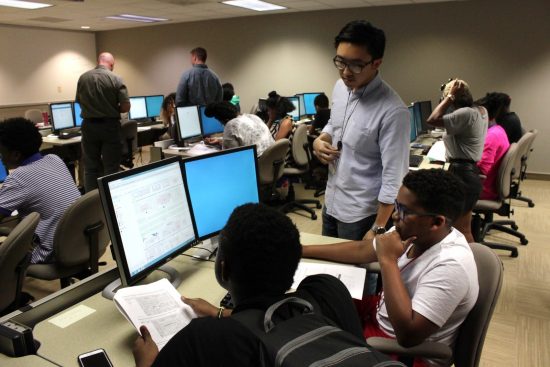
For the second summer in a row, the United States Department of Agriculture (USDA) and the Governance Lab (GovLab) put on camps for middle and high school students to teach them how to harness the power of open data and crowdsourcing to make important decisions in agriculture and food. The students came to USDA headquarters in Washington, D.C. for two weeks this summer to learn more about food safety and urban agriculture, as well as to learn more and get excited about data science.
ESRI Staff assists the students with map layers and the Story Maps application at their headquarters in Virginia.
The camps kicked off with curriculum from GovLab on data science, helping the students learn what types of issues can be explored through data, the techniques used to gather data, the problems of missing data, and more. Beyond the classroom, the students got to map urban gardens around the National Mall, enjoy hands-on lessons about nutrition and food safety, and take a tour of the capital’s largest green rooftop.
The Urban Agriculture Team notes the types of produce grown in a community-run garden.
Why is this camp so important?
“As more government data becomes available for re-use and redistribution, we need citizens to be able to use for government oversight, to advocate for policies, or to create new businesses. The Open Data Summer Camp is an opportunity to test a curriculum that can get youth excited about data,” said Beth Noveck, The GovLab’s director.
Megan Smith, the Chief Technology Officer of the Office of Science and Technology Policy at the White House, attended student presentations and imparted insights into the importance of data in today’s world.
The USDA has said that it hopes to encourage future data scientists, data analysts and maybe even some future farmers with the program. Cisco is proud to be a part of helping to inspire these students!
Earlier this summer, more than 40 Cisco partners converged in downtown Chicago for the second annual Partner Adoption Workshop—otherwise known as “Adopt Shop.” The two-day event was highlighted by dynamic speakers such as Nick Metah, CEO of Gainsight; Steve Robb, President, Solution Group, LaSalle Solutions; and Steve Reasner, President and COO of LIFTinnovate. Cisco’s top experts in customer experience and customer success also took center stage.
https://www.youtube.com/watch?v=r2DEEs-rD8A
The goal? To inspire and support partners in building their own customer adoption practices.
We recently talked to Cisco’s Kelli Kirwin, Senior Manager, Global Virtual Sales & Customer Success, to find out more about the event and why having an adoption practice matters for today’s partners.
Q: What is Adopt Shop and how did it come about?
Kelli: The idea came about last year as we launched the Global Customer Success organization. One of the most important ideas we embraced from the beginning is that successful adoption of software and services are essential for transforming the customer experience. Because partners are core to our strategy at Cisco, we know that it is essential for partners to understand and implement adoption practices of their own.
The inspiration behind Adopt Shop was to knowledge transfer what we’ve learned so far about the value of adoption, and to give partners the opportunity to engage with industry leaders in the customer success field. The breakout sessions focused on the people, processes and tools that drive successful adoption including: Service Transformation Strategies, and How to Build a Winning Customer Success Team and Practice. We also shared information on using tools like Cisco Impact and programs such as Lifecycle Advantage that can accelerate renewals & adoption with data-driven automation.
Q: Why is building an adoption practice so important?
Kelli: There is a lot of pressure in IT departments today—pressure to cut budgets while also increasing profits. Every technology investment must bring value or it will be replaced or forgotten, and that’s why adoption is critical. Adoption accelerates the value realization that customers receive from Cisco solutions when they utilize the full capabilities and feature set of our products and services. By engaging in a repeatable, scalable globally consistent process, Cisco and our partners will ensure that customers receive maximum lifetime value in the solutions they purchase which leads to an improved customer experience and stronger customer retention.
Q: Beyond the Adopt Shop workshops, how is Cisco helping partners achieve stronger adoption practices?
Kelli: Many of our partners are eager to learn more and they want to embed best practices into their business workflows to ensure customer value is realized. To support and empower partners, our team has created a resource library that includes adoption playbooks, customer success webinars, customer health scoring tools, white papers and more. We’re also offering one-on-one expertise to help partners tailor their approaches so that they can gain a competitive advantage and differentiate themselves to win a greater share of wallet with their customers.
The Customer Success Talk Series plays a critical role in our ability to scale. There have been no less than 200 partners attending these events hosted every 2 weeks and are a great way to reinforce the message we deliver in our workshops and partner-facing one-on-one’s. We also participate in customer advisory boards to ensure the message resonates across the channel & industry. Lastly, because digital engagement is critical for scaling adoption practices, we’re inviting partners to take advantage of our data, analytics and automation tools to move customers smoothly through all phases of the relationship lifecycle.
Q: What kind of results are partners seeing through a stronger focus on adoption?
Kelli: It’s still early but our analysis has shown that partners with an end-to-end lifecycle practice are significantly outperforming those who don’t. For example, we’ve seen renewal rates rise by five points when a best-in class lifecycle approach is implemented. The key differentiator for these partners is the Customer Success Manager function.
The feedback we received at the event and through ongoing communication with partners has been very positive. They’re telling us how they’re winning, differentiating and growing because of the unprecedented value the customer is realizing through the partners adoption strategies. This energizes us to continue to build upon what we’ve helped them achieve so far.
Q: What can we expect from your team as far as future adoption events?
Kelli: With only a select group of partners participating these past two years, we aim to expand the program to more partners and our broader subscription portfolio. We’re only just getting started—stay tuned!
Did you miss Tech Field Day Extra at Cisco Live US? No worries! We can give you full access to what was discussed.
For those of you who haven’t seen Tech Field Day, here is the breakdown: the top influencers (podcasters, bloggers, and speakers) came to #CLUS to listen to a few Cisco experts that shared information and opinions in a presentation and discussion format. These session were livestreamed and they are now shared on YouTube.
This year our experts presented to ten influencers on the latest and greatest at Cisco. Our sessions included discussions on:
Branch Threat Defense innovations with a Cisco Umbrella Branch demo
Validation of Experience
APIC-EM Controller discussion and EasyQoS demo
Digital Business Transformation and Solutions
Throughout our presentations the influencers asked questions to the presenters. You can listen to the questions asked in the videotaped sessions below from the first session at #TFDx CLUS:
In this session Product Manager Elisa Caredio presents on the latest additions to the Branch Threat Defense Portfolio. She covers both the Cisco Umbrella branch and Stealthwatch Learning Network License. Elisa discusses the threat protection at the DNS layer and the ability to filter domains of an enterprise branch, focusing on guest-wifi use cases. She also dives into innovate ways to turn the branch router into a sensor.
The Challenge
As deployment footprints continue to grow on AWS, multiple VPCs are required to manage and segment computing resources. When dealing with 2 VPCs, VPC peering can be used to connect one VPC to the other, but as soon as you add a third VPC, peering just one VPC to the new VPC will not allow all VPCs to communicate due to the non-transitive nature of VPC peering. That is, the only way to interconnect all VPCs in a deployment is to peer each VPC to each other which becomes unsupportable when scale.
Solution – Saving Time
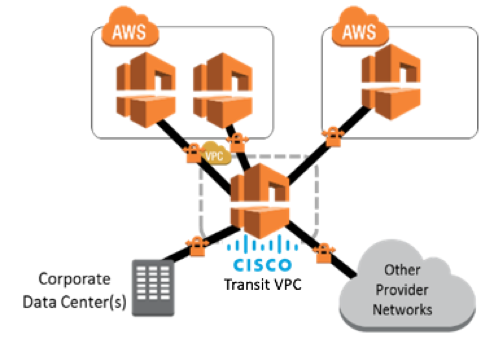
A solution to this is building a transit VPC that will serve as a global network transit center based on the Cisco CSR 1000v virtual router. This transit VPC can be used to interconnect VPCs in the same region as well as across geographic regions. This design saves setup time as AWS has partnered with Cisco to build and test cloud foundation scripts that will automate the creation of a Transit VPC on AWS with the CSR 1000v. This means time is not required to build mesh peering networks between all your VPCs or to setup the high availability pair of CSRs and route tables required for the transit VPC solution. It is a huge time savings in labor costs.
Solution – Saving Money
The next area where the transit VPC solution with the CSR 1000v saves you money is the absence of physical transit point. Since the solution is hosted on AWS in a virtual data center the expense of establishing a presence in a colocation transit hub is not needed. Also the truck-roll and equipment costs of deploying physical networking devices is removed from the TCO equation.
Pay-as-You-Grow
And last but not least, the final area where the solution generates savings is the ability to tailor throughput to your requirements. This means you do not need to buy a higher throughput networking device than currently necessary. Instead you can upgrade to higher throughput licenses in the future without an upfront commitment now. See the AWS blog about this same topic here: AWS Solution – Transit VPC.
It’s often said that “apple doesn’t fall far from the tree” – and my “apple” has fallen very close to me. This summer, my 18-year-old daughter earned the opportunity to work as an intern at Cisco. As a 20-year Cisco veteran, my daughter’s internship inspired me to reflect on my career experiences in the Internet era. While my daughter begins her professional journey, I can’t help but think about the many advancements and innovations that have reshaped the workplace I joined two decades ago.
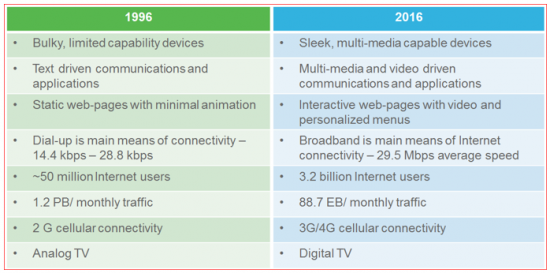
When I started at Cisco, in December 1996, I was issued a Toshiba laptop with 166 MHz processor chip, 8 MB of RAM and possibly 1 GB of hard disk. I also had the privilege of receiving a company-paid dial-in modem and a pager – so that I could be available for any urgent communications related to my business responsibilities. To connect to the VPN remotely, I had a separate piece of visiting-card sized hardware that generated a token. I had an early-generation cell phone that could only make voice calls – more than 3 cm in thickness.
In terms of popular Internet applications, they were basically nonexistent. Almost every app I relied on was PC centric – the mystery of world wide web was still in very early years of being woven. There was no streaming media over the Internet– most of the apps were text driven and any rudimentary webpage animation represented an awe-striking contrast to the volumes of static content. Online gaming was limited to games downloaded to your PC. Voice was the main application over cell phones.
Television was delivered over analogue signal and rabbit ears. The number of global television households had just crossed the 1 billion mark in early 1996.
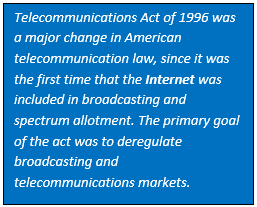
Netscape was the popular Internet browser. Internet service providers (ISPs) were moving from charging by the hour for Internet connectivity to flat monthly fees. Amazon.com had been launched as an online bookstore but e-books had still not appeared on the scene. Google had begun as a research project but the popular online video platform, You Tube, was almost a decade away. Apple was having to justify its very existence with a limited mac user base consisting primarily of academia.
We have come a long way since then in terms of technology evolution and our degree of connectivity. I begin with comparing “then” (1996) to the “now” (2016) of the generation entering the workforce. The devices are much sleeker – my daughter’s smartphone is less than a quarter in thickness of my first cell phone, with much higher computing and multi-media capability. The Mac laptop she was given on her first day of work has over 2 GHz quad-core processor with 256 GB hard drive. She often complains about the slowness of our home broadband connection (45 Mbps), while at work she enjoys the lickety-split speeds of more than 100 Mbps.
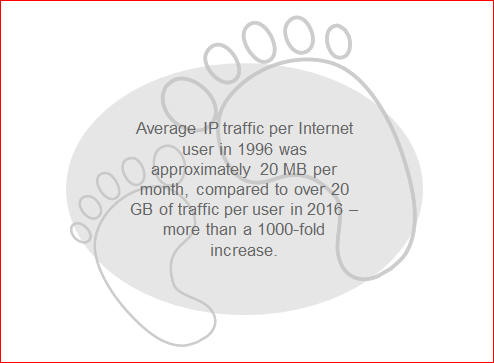
In summary, while her shoe size might be smaller, her digital footprint as measured in IP traffic is much bigger than what was mine at the start of my career at Cisco.
“It was an amazing day. It is so inspiring that the guidance of mentors helped me choose my career. It is unbelievable how 11 minutes helped me so much.”
Can a few hours really change your life? Can an 11-minute conversation with a stranger inspire you to change your career aspirations?
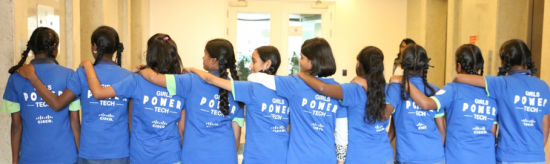
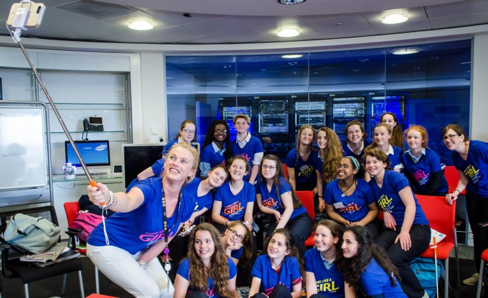
At Girls Power Tech (GPT), 5,498 young women from all around the globe gathered at 104 Cisco sites that offered the event this year. The teenage girls received mentorship, learned about the Internet of Things (IoT), listened to panels and guest lectures (including our very own CEO Chuck Robbins, CFO Kelly Kramer and EVP Chris Dedicoat), and competed in hands-on challenges.
Inspiration and excitement filled the air as the girls experienced an afternoon like no other. The day flew by as they shared their passions, dreams, and took selfies with robots. The magic was enhanced by the smooth transitions and the hours of behind-the-scenes planning and logistics. Without 238 site leads and 1,600 generous volunteers, GPT would not have been possible.
Months before the event, a group of passionate Cisco employees from around the globe began planning and hammering out the details of the event. From seeking sponsorships and donations to organizing t-shirt deliveries and finalizing speakers and events, these volunteers went above and beyond their daily Cisco duties to plan a truly life-changing day.
Whether you are passionate about supporting diversity and promoting inclusion, or you simply want more women to hold STEM careers, volunteering with Girls Power Tech is for you. The joy on the girls’ faces when they figure out the solution to the IoT challenge and the thrill of seeing the event grow from year-to-year makes every moment spent planning worth it.
You’ll see the passion spark in young women. You’ll see their excitement when they realize that STEM careers are achievable and cool. And after the event, the feedback from the students makes it that much more rewarding:
“Yes, I am a woman. Yes, I can make it. I love Cisco, networking, and engineering. I have never been so sure of what I want to do in my future until today.”
“I didn’t think I would like [STEM] at all and didn’t even consider doing anything in technology but [GPT] has changed my mind.”
This is why we do it. We do it to make a difference. No matter your personal beliefs or political views, we can all agree that these girls are the future. They are the future of Cisco, IT and the world. Whether your involvement in GPT impacts one girl or 500, it matters. You can make a difference.
So, if you are on the fence about getting involved or have never considered getting involved before, just do it. It’s right at your fingertips, so what are you waiting for?
Cisco employees can take action by clicking here. Guests of this blog site who would like to learn more about Girls Power Tech, click here
In today’s highly-developed and ultra-competitive telecommunications markets, there is a widespread expectation among consumers that they should be able to access Wi-Fi for free wherever they are – from cafes and bars to airports, shopping centres, sports venues and public transport. In this era of ‘free’ Wi-Fi, how can service providers finance Wi-Fi deployments? Here are my thoughts:
Offer Wi-Fi with a difference
Traditionally, you’ve been able to profit by charging venue owners, stadiums and hotel chains for the Wi-Fi that is deployed in their premises. Still today, if you’re the first to cover a specific area with Wi-Fi then you ‘own the land’ for the foreseeable future. But now with current Wi-Fi solutions available, you can also offer additional services that will provide such customers with a great deal of added value.
Let your customers harness usage data
Data is a precious commodity, and this is as true for Service Provider Wi-Fi (aka Carrier Wi-Fi) as for anything else. You can differentiate your offering by enabling the Wi-Fi buyer to access presence and location data and use data analytics to learn how consumers are using the network. This can come in the form of regular, fully ‘anonymized’ reports that give the customer a better understanding of what is going on in their premises.
Facilitate more informed decisions
Insights from data analytics can show how users flow through an environment, where they spend their time, and where they come from and go to. Retailers and venue owners can use this invaluable information to determine their marketing campaigns and digital signage, for instance pricing high traffic areas over low traffic.
Another way to differentiate your Wi-Fi offering is to help your customers put their mark on the service they provide to users in their premises. Now they can broadcast their own branded SSID to users, so they can immediately create a greater connection between their own brand and their customers. And they can also tie that SSID to their own branded mobile app that delivers loyalty incentives, rewards, offers, content and information to their customers’ smartphones.
A particular successful example is with stadium partnerships developed to enhance the fan experience. Cisco’s StadiumVision Mobile, which delivers up to four channels of live unique video content, also offers opportunities for targeted advertising, sponsorship activations, promotions, branding and more.
Take to new locations
There are places that people just don’t expect to get Wi-Fi – so with a creative approach, you can engage them in new and effective ways. For example Maxima Telecom partnered with Moscow Metro to deliver Wi-Fi throughout the entire network – including tunnels. This technical innovation, combined with a login portal that upsells additional content services, drives a highly effective customer acquisition strategy.
Events create similar opportunities on a smaller scale. For example Telstra in Australia achieved a significant profile boost when they installed Wi-Fi in Sydney Harbour for the arrival of the Extreme Sailing Series.
Just provide a better Wi-Fi service
As well as data and personalisation-based innovations, there is a lot to be said for just offering Wi-Fi Connecting is getting easier and becoming more and more transparent for users. There is more space granularity and a better service with more throughput, less sensitivity to environmental turbulence and the possibility to closely align the service levels with your 3G/LTE offering. That too will differentiate your service from competitors.
In Malta, Melita decided to upgrade to a ‘Connected Island’ – fast Wi-Fi wherever you are. It’s fully integrated with their mobile network to deliver overall better connectivity that sets them apart.
If your offering includes voice services, you also need a Wi-Fi network that you can trust to deliver an experience that meets expectations. And if you’re a cable operator, Wi-Fi may be your only way to stay in touch with customers while they are on the go. In that case, the argument for providing a high-performance, easy-to-use Wi-Fi service couldn’t be stronger.
Watch Video interview from Cisco Expert in Wi-Fi here:
Get more details about what Cisco can do for mobile network operators here.
Inspired by the annual issue of Fortune magazine that lists the world’s 500 largest companies, I wrote a blog little more than a year ago entitled “Why the Fortune 500 is Fast Becoming the Digital 500. “ At that time, Fortune editors asked CEOs of companies on the 2015 list, “What is your company’s greatest challenge?” Their number one answer then was, “The rapid pace of technological change.” So, what has changed in twelve months?
Surveyed again this year, CEOs’ first answer in the 2016 Fortune 500 published just more than one month ago was the same – but with greater urgency and focus on faster digital transformation. Adding further insights to their opinions, 75% of the CEOs said that “ … a trio of technologies – cloud computing, mobile computing and the Internet of Things—will be either ‘very important’ or ‘extremely important’ to their businesses in the future.” More than 50% added artificial intelligence and machine learning to the list.
How Do You Define “CTO?”
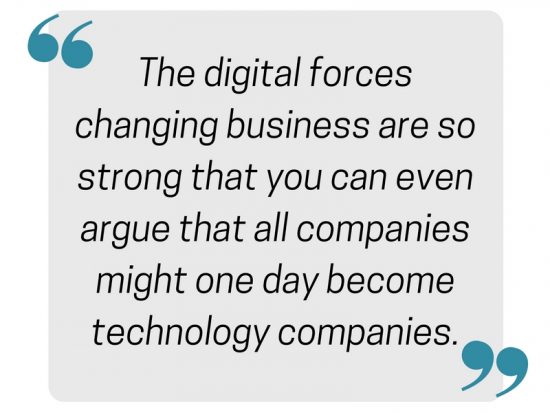
As digital adoption grows, perhaps it’s not surprising that the Harvard Business Review has freshly translated the title of corporate Chief Technology Officer (CTO) into the Chief Transformation Officer. The IT organization is also changing along with this description. Its perception as a cost center is evolving to become one of a business enabler. Technology is shaping companies’ business strategy. The digital forces changing business are so strong that you can even argue that all companies might one day become technology companies.
From the Factory to the Farm, Digital Technology is Reinventing Work.
Working with line of business managers, forward-looking IT departments have become the orchestrators of digital change. Examples abound: Remote sensors on off shore oil rigs monitor drilling activity in real time to both optimize the use of drilling equipment and ensure that the same equipment is proactively maintained to prevent accidents. Machine learning embedded in manufacturing tools ensures consistent product quality through digitally generated feedback so that real-time equipment adjustments can be made for greater factory productivity. A modern farm tractor moving through a cornfield has become a computing system on wheels that can determine via sensor data and related analytics when crops require irrigation or fertilizer to maximize agricultural yields.
The list of innovative new uses of digital technology is endless. Common to these and similar Internet of Things (IoT) use cases is that hyper-distributed data at the edge of a network demands instant analysis. Businesses can’t wait days or weeks to act upon the information generated; the data’s value is measured in seconds. Actions often need to happen in minutes.
So Much Data. So Little Understanding.
The consulting firm, McKinsey and Company, reports in their study, The Internet of Things: Mapping the Value Beyond the Hype, that “Most IoT data is not used currently … The data that are used today are mostly for anomaly detection and control, not optimization and prediction, which provide the greatest value.”
As I mentioned in my earlier blog on the Digital 500, “ … at the heart of digital business transformation is the ability to connect the unconnected. However, it is not just about connecting people to people, people to things, and things to things—it is about what you can do once they are connected.” Enterprises need to move fast to cope with digital change—but they also need to move with a purpose.
Sharpening Business Purpose: Edge Analytics to the Fore.
Having the right analytic tools helps give tangible meaning to ideas, transforming thinking into new realities. Taming the large and complex world of IoT also requires tools that are highly approachable, to speed development of applications and their adoption.
Cisco Edge Analytics Fabric (EAF) software is a great way for companies to accelerate their digital transformation. Truly successful IoT solutions require an entirely new infrastructure. The requirements for large-scale systems can range from millions of data-generating devices to the frequency of data generated, and from a diversity of locations to a diversity of industries. These and other requirements are all formidable barriers to adoption. EAF lowers them. Put simply, EAF is an open architecture software platform that enables immediate processing and analysis of distributed data from the fog to the edge of the network.
Analytics Designed From the Outside In.
Historically, enterprises have captured data from any source and moved it into a central data warehouse for analysis. But the process is slow. And all the data is often inaccessible to users (see my last blog on the virtues of data virtualization and removing this obstacle). As a result, analysis is sporadic or non-existent. Many times, it’s simply a case of data for the sake of having data.
Cisco’s approach to analytics is different. It works from the outside in – from the network’s edge all the way to the cloud. Data gathered at the edge is analyzed in context and in real-time – or stored for later analysis if desired. This approach helps edge analytics determine the immediate value within huge amounts of complex data in hyper-distributed environments.
Think Small: Micro Services Add Speed and Flexibility.
One important way Cisco Edge Analytics Fabric accomplishes its tasks is through the use of micro services. Rapidly implementing an analytics solution with a scalable architecture is non-trivial. If an IoT system is to be widely adopted, the time required to implement it must be reduced from years to weeks. Micro services show the path forward.
Micro services can be created and deployed in several major ways, including data acquisition, retention, transport, processing, manipulation, and control. The beauty of this modular approach is the ability for applications to work independently or in coordination with different subsystems. Third party software can even be added. Thanks to a uniform architecture, EAF software assures interoperability between micro services, common data encoding across all micro services, and different modes of communicating between them.
This open system approach supports both proprietary and standard interfaces. In short, it gives businesses the power, flexibility and speed they need to move at market velocity. It’s the fabric on which enterprises can build a digital future.
How is your company transitioning its business direction in the new digital world? How is analytics playing a role? Do you see your company becoming part of the new Digital 500? Tell me. I’d love to hear more.
I was playing Pokémon GO the other day, and I realized how new technologies and applications are being launched every day, rapidly reshaping how we connect, play, and live. Technologies that were only dreams a few years ago, are now made into reality one after one in incredibly short amount of time, and becoming incredibly viral. I mean, look at Pokémon GO: I bet they had no idea that it would surpass Twitter in daily active users, and it hasn’t even gone global yet! Unfortunately, I went crazy in the first few weeks of playing Pokémon GO due to many server issues and outages.
One major question the makers of Pokemon GO and any tech company should ask is: “Is my network infrastructure in place to make the user experience as seamless as possible for massive amount of users?” And that ultimately comes down to bandwidth and latency, critical ingredients for success.
In the midst of massive technological transformation, the network is ultimately the backbone of all these technologies. Companies need to ensure that their network is ready to deal with the ever-increasing volume of devices, traffic patterns, and data.
To address the need for a flexible network that can handle ever-changing business needs, Cisco introduced the Cisco Nexus 3100V switches – new Top of Rack (ToR) switches that are improved versions of the 3100 series at the SAME COST.
Just a little bit of background:
Since the Cisco Nexus 3000 series started shipping 4.5 years ago, our customers have purchased over 10 million Nexus 3000 ports. What makes the Nexus 3000 series the industry’s leading merchant silicon switching product line is its best in class support model, open operating system with advanced programmability, and flexibility for changing business needs (“3 Reasons 10 Million Is A Big Number”, Huitema)
You may ask “so what makes Nexus 3100-V unique?” Here is a summary of the most important highlights:
Support of 100G uplinks
Bigger buffer (16MB)
Double System memory (16GB)
Quadruple Ingress ACL: increased from 4,000 to 16,000
VxLAN routing
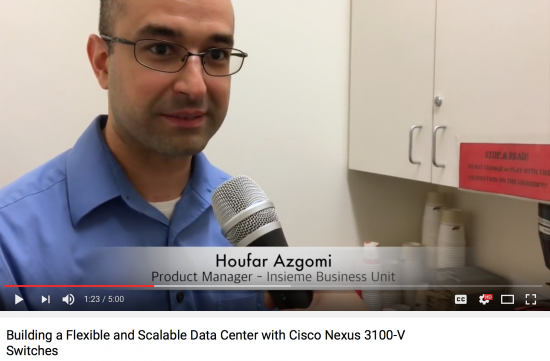
Watch this video if you’d like to get a brief tour on Cisco campus and watch Houfar Azgomi present the Nexus 3100V.
The new 3100V switches come in 3 flavors:
Cisco Nexus 3132Q-V: A 32-port 40G switch that can also convert into a 104-port 10G switch with breakout cables
Cisco Nexus 31108PC-V: A 48-port SFP switch with 6 uplink ports that can run at 100G, 40G or 4x10G
Cisco nexus 31108TC-V: A 48-port RJ45 switch with 6 uplink ports that can run at 100G, 40G or 4x10G.
Benefits:
100G uplinks: Cisco predicts that global data center IP traffic will grow 31% every year in the next 5 years. For this, it is obvious that 100G is the new norm for higher bandwidth, big data, and IP storage workloads.
16 MB enhanced buffers: Compared to 12MB buffer from previous generation, the Nexus 3100V models offer 16 MB enhanced buffers to absorb bursts of traffic and applications. You won’t have to worry when you need to expand your network in the future, because these deep buffers are designed for highly oversubscribed environments.
16 GB Increased system memory: In the previous model – Cisco Nexus 3100XL – Cisco already increased the system memory from 4GB to 8GB in order to introduce network programmability features developed in NXOS 7.x. But as networks are becoming more complex, competitive businesses need more memory to store more objects. Hence, Cisco has doubled the capacity again in the Nexus 3100V models from 8GB to 16GB to improve capacity for object-model programming.
Quadrupled ingress ACL table size to 16,000: for more greater security,traffic control, enhanced security, and policy management flexibility
Support full VxLAN routing (layer 3 VxLAN): With this, workloads in different segment IDs can directly communicate, whereas with VxLAN bridging (layer 2 VxLAN), workloads need to be in the same segment ID to interact.
Once again, Cisco continues to bring you true flexibility and scalability through rich architectural options for any size of data center to address increasing business requirements. You can never go wrong with more connectivity options and a diverse set of form factors to meet ever-changing data center needs.
Last but not least, if you want to catch Pokémons and get good food, go to San Mateo downtown, I go there quite often, so you may find me meandering around. And yes, I am Team Valor. Follow me @EmmelineWong if you’re also Team Valor!











 Netscape was the popular Internet browser. Internet service providers (ISPs) were moving from charging by the hour for Internet connectivity to flat monthly fees. Amazon.com had been launched as an online bookstore but e-books had still not appeared on the scene. Google had begun as a research project but the popular online video platform, You Tube, was almost a decade away. Apple was having to justify its very existence with a limited mac user base consisting primarily of academia.