Avatar

Last week, Cisco’s Research Triangle Park (RTP), NC and San Jose, CA campuses hosted 60 students for the CyberCamp Summer Camp 2016 – a special cybersecurity camp sponsored by CyberPatriot, the Air Force Association’s national youth cyber education program. In its second year, CyberCamp aims to inspire local students towards education and careers in cybersecurity and other science, technology, engineering, and math (STEM) disciplines.
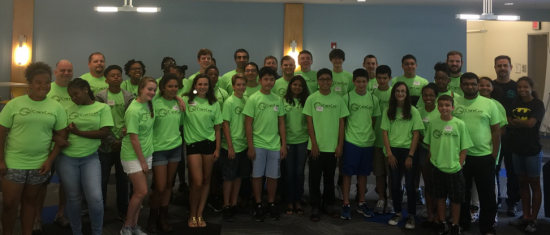
Cisco RTP hosted over 30 local students on campus during last week’s CyberCamp

This year’s CyberCamp provided young men and women from local middle and high schools – who had little to no experience with computers or cybersecurity – the opportunity to further explore the field in an exciting and engaging way.

Over a five-day period, students completed 20 hours of curriculum and participated in practical, hands-on activities that gave them exposure to machines that ran on Windows and Linux platforms, as well as the ability to analyze risk assessments and vulnerabilities on these machines. The camp ended with mock competition similar to the competitions that other students across the country are able to compete in leading up to the CyberPatriot National Finals held each year in Washington, D.C.

Throughout the week, students were introduced to many concepts found in this tech field, including an overview of cybersecurity and why it is important, what is a virus and malware, how to safely use social media and the Internet, and how to assess risks on computer operating systems.

During the afternoon sessions, students were able to take a tours of the Cisco Tactical Operations Networking Emergency Response Vehicle (NERV truck) and Technical Assistance Center (TAC labs), interact with robots, use Raspberry Pi computer programming, hear from the Talos team and learn about Cisco’s role in WiFi security for the Rio Olympics.
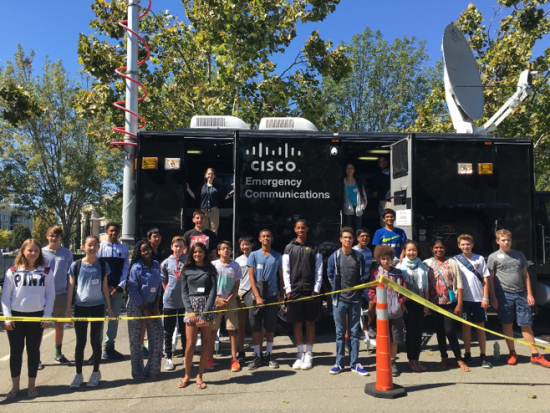
Students in San Jose took tours of the NERV truck to learn first-hand how Cisco’s TacOps teams respond in time of crisis during last week’s CyberCamp.

John Luber, Manager of Cisco’s Firewall TAC team and CyberCamp RTP Site Host, was pleased to see the students getting excited about technology, and more specifically, cybersecurity.

“An opportunity like CyberCamp is an outstanding way to get young people in the community excited not only about tech and what they can do in their careers, but also learn some sound fundamentals on what to and what not to do to keep themselves and family secure while on the internet,” he said. “Day 1 teaches about social media, what to post/not to post, how the post can be perceived negatively and affect them later on in life, and how cyber predators can use this information as well. These are good life skills to have in general.”
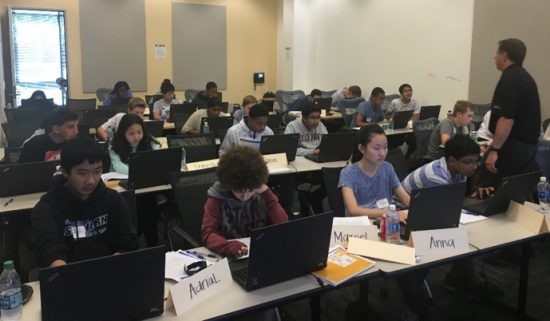
Students in San Jose participated in practical, hands-on activities, inspiring the young men and women to pursue careers in the cybersecurity field.

Rob Couture, a Cisco TAC engineer and CyberCamp RTP volunteer believes the CyberCamp is a great learning experience for the students.

“Not only are the students exposed to Cisco and our technology, but they also got the opportunity learn the fundamentals of securing Windows and Linux operation systems and the ability to look into other technologies that they may not have known much about before this camp,” Couture said. “The students also got the chance to work closely with Cisco employee volunteers, who provided first-hand experience and insight to what it’s like to work at a major technology company.”

Cisco has made building a pipeline of diverse students prepared to enter the STEM field a top priority for nearly two-decades. Cisco is at the forefront of providing opportunities to those who would not otherwise be exposed to the STEM industry. Through mentoring, IT training, and support for schools and nonprofits, Cisco has a proud history of investing in programs to prepare a diverse generation of young people for careers in STEM.

As part of Cisco’s US2020 efforts, Cisco has committed to having 20% of our US employees provide STEM mentoring to students by the year 2020. Over 25 Cisco employees and TAC engineers volunteered at both Cisco locations last week to work hands-on with students and teach them the CyberPatriot curriculum throughout the week. Cisco employee volunteers and instructors benefited from being able to interact with the students and share their knowledge in tech with them.

“The program is probably one of the unique opportunities that Cisco employees have to pass on their passion for technology and create a generation of students who will come and take their places in the future. We are stimulating their minds to get them learning,” says Mike Hammon,  CyberPartriot Cisco Lead. “This is an opportunity to teach students through mentoring and keeping the CyberPatriots program alive while using our skill sets. Students come out from the program with Cisco certifications, they get accepted into colleges of their choice, and ultimately have a leg up into finding a job.
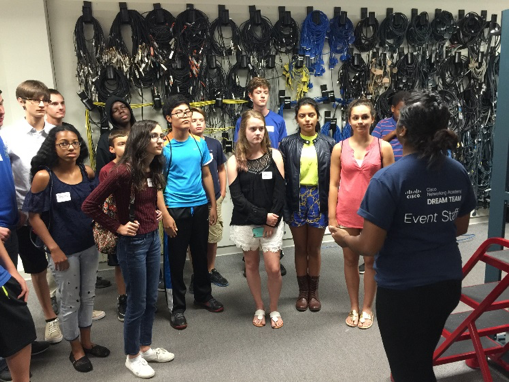
Cisco TAC engineers took students on TAC lab tours during CyberCamp, inspiring the young men and women to pursue careers in the cybersecurity field.

Cisco has a longstanding partnership with CyberPatriot and works year-round with the organization to inspire hundreds of young people from across the country to learn about the opportunities that the technology sector holds for their future through hands-on exposure to the latest technology and engagement with Cisco employee volunteers. Since its creation in 2009, CyberPatriot has grown by more than 20 percent each year, with 2,175 teams registering for the competition this year.

For more information about Air Force Association’s CyberPatriot Program click here.

Authors

Megan DePorter Zeishner

Community Relations Program Manager

Avatar


“No-Ops” for Developers and “No-Dev” for IT Ops


Analysts agree that IT is in the midst of a major transformation. Based on the results of latest Gartner enterprise IT buying behavior survey, the majority of spending is going towards modernizing, functionally expanding or substituting long-standing business and office applications with cloud-based software-as-a-service. According to the June 2016 forecast from Gartner, worldwide spending on enterprise application software will reach $154 billion in 2016, increasing to more than $216 billion in 2020. To make things even more interesting, by 2020, 75% of application purchases supporting digital business will be “build,” not “buy” involving “a combination of application components.”  As a result, these applications will not be deployed and managed from one place – e.g. all cloud native SaaS or all on-prem traditional out-of-the-box.

Apprenda ACI BLOG TITLE Feature Image OPTION 2

What would you do if you had the opportunity to redesign your IT department? What if your IT organization could simultaneously provide stability of legacy and agility of innovation? And what if you could do this without worrying about silos between IT operations and software development teams and without doubling the size of your teams?

Now you can achieve these goals!

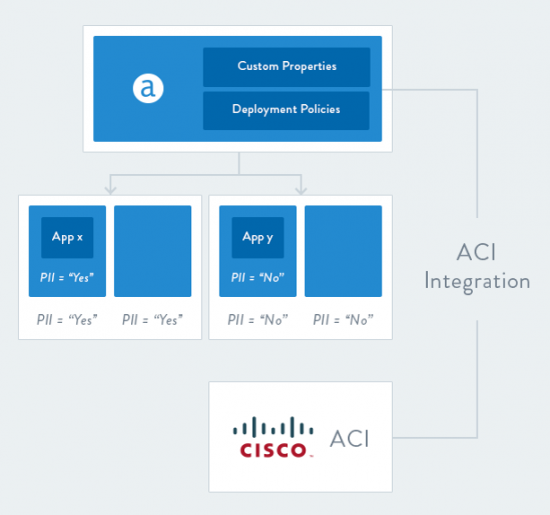
I am ecstatic to announce the production grade integration of Apprenda PaaS platform and Cisco ACI. The integration allows developers to run their existing N-tier applications and new cloud native applications in a self-service fashion without requiring networking or infrastructure management expertise. In addition, it allows enterprise users to inherently cloud enable legacy Java or .NET application enabling them across data center or multi-cloud and hybrid clouds environments.

Apprenda ACI Block Diagram for Blog image OPTION 2

Apprenda’s container based PaaS platform integrates with Cisco ACI’s open policy interfaces to free developers and IT operations teams from the manual constraints of network configuration and achieve very high isolation of application tiers, data and network without any dedicated infrastructure. Cisco ACI segments the network based on policy information collected from the application and developer, and Apprenda optimizes placement of workloads based on the same policy information. The mapping of these two policy frameworks constitutes the integration between Apprenda and Cisco ACI.


Here is how typical application deployment workflow now looks like:

  • Network engineers create blueprint versions of EPGs and contracts
  • Developer passes application artifacts, including policy metadata, to the Apprenda platform
  • Apprenda platform sends network policy metadata to Cisco ACI
  • Cisco ACI controller maps policy to the right EPGs and contracts
  • Cisco ACI provisions the network

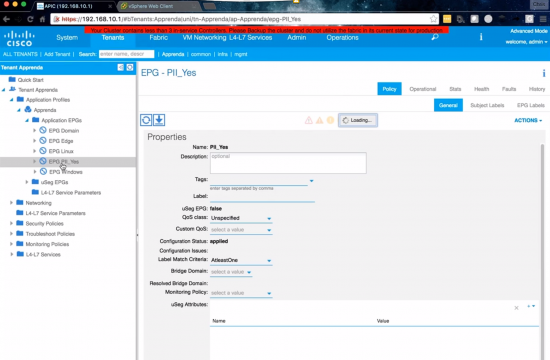
If you want to see how this all comes together, please check out this video

Apprenda ACI Demo Video Screen Capture Aug 19 2016

Together, the integrated solution brings the best possible means for application centric enterprises to achieve governance, security, rapid development, reliability with greatly reduced operating and capital expenses. The following are unique benefits for application development and IT operations teams:

  • Single way to manage diverse workloads, traditional and cloud native
  • Enable developers while ensuring consistent operations
  • Simple application governance despite diverse infrastructure
  • Manage a secure private cloud while leveraging public/hybrid clouds
  • Execute all of the above without being locked into a single underlying infrastructure

And last but not least, achieve “zero friction” IT through “No-Ops” experience for developers, and “No-Dev” experience for IT operations.

To learn more, please visit:

Solution Brief: Cisco ACI and Apprenda – Build a Secure Application-centric Platform as a Service (PaaS)

Solution Overview: Cisco ACI and Apprenda – Today’s Most Secure and Advanced Enterprise Hybrid Platform-as-a-Service

Video – Technical Demo Video: Cisco ACI and Apprenda Integration – How it works?

Video – Apprenda in Cisco DevNet : How APIs make Cisco solutions programmable?

Cisco ACI

Cisco ACI Eco-system

Cisco ACI micro-site at Apprenda

Authors

Adam Ozkan

Hybrid Cloud Infrastructure

Avatar

This is Part IV in a four part series of blogs. This blog has been co-written with Vincent Esposito (@vesposit)

This is the last of a series of blogs dedicated to explaining some of the use cases that can leverage ACI Micro Segmentation capabilities. In the first blog we described how to use ACI micro segmentation to implement a 2-tier web application on a single flat subnet. In the second blog we illustrated how to leverage the APIC API to dynamically create a sandboxed environment for Development and Testing for that application, and how to use VM-attribute based micro segmentation to easily promote workloads from Dev to Test to Production environments, including automation of L4-7 services. On the third blog, we looked at operating the environment from previous blogs, and covered how the ACI integrated overlay approach and various operational capabilities of the APIC facilitate Day-2 operations in a micro segmentation environment.

In this post, we look at how we can use the ACI Policy Model and the micro segmentation features in order to enhance the security posture of the physical server infrastructure by minimizing the attack surface.

This blog has been written with my friend and colleague Vincent Esposito (@vesposit). Vincent also did the demos for this blog. So let’s look at how Acme will enhance security for its infrastructure.

Continue reading “Micro Segmentation and Cisco ACI – From Theory to Practice Part IV”

Authors

Juan Lage

Principal Engineer

INSBU

Avatar

The term ‘Internet of Things’ means many things to many people. To some it’s the future: an ideal for the shape of things to come. To others it’s just a buzzword, an idea that’s a long way from coming true. But thanks to new technologies, the future’s a lot closer than you think. And it’s all about the way we connect things, and what we’re able to connect.

https://youtu.be/IlH1PYs5sDc

Connecting the unconnected

In the past, what’s stood in the IoT’s way is largely a matter of economics and business viability. It started by connecting people, then connecting things – and this was driven by business consideration.

While existing cellular technologies are used to connect things, some of these ‘things’ have very specific requirements which make them redundant. These requirements include very low power consumption so they can run for months untouched, very low data transfer rates, and connectivity from remote locations – sometimes underground or at sea. You need to achieve all this simply and economically to make the business case for investing in IoT. And that’s discouraged many organisations in the past.

A long-range solution

A new range of technologies, aka as LPWA (Low Power Wire Area) technologies, are making IoT investment a much more viable business proposition. In particular, LoRa (Long Range technology) has been designed to address the challenges of connecting things with constrained, long-range, low-power or low-bandwidth environments. And it’s achieved in a low-cost way. So this all combines to make the Internet of Things a much more viable proposition: a reality that businesses can make happen, and not just an idea.

Open, affordable and available

Technologies like LoRa aren’t just in the pipeline – they’re being deployed right now by leading SPs such as Orange in France. Which means organisations don’t have to play the waiting game anymore: they can start making the IoT a reality for themselves – before their competitors get there first. And the way LoRa addresses the issues of connecting things isn’t something that can be done today with existing mobile networks, but instead it’s a solid, complimentary technology that can be used with what service providers already have. It’s a powerful new tool to add to their arsenal, fitting neatly into the existing bigger picture of existing methods of connectivity including wired connections, cellular and Wi-Fi.

Enabling LoRa deployment

At the February 2016 GSMA Mobile World Congress in Barcelona, Actility announced that it was collaborating with Cisco to provide real IoT solutions. Actility is the industry leader in Low Power Wide Area (LPWA), and the Actility ThingPark Wireless™ Platform combined with Cisco’s IoT solutions in a form that’s ready for customers to deploy.

And Cisco is also part of the new LoRa™ Alliance that is bringing together SPs and IoT solution providers to agree standards and enable worldwide mobility for IoT.

It’s happening. Not in the future, but now. And that means there’s no excuse not to make the most of it.

Watch Video interview from Cisco Expert in Mobility and IoT: here.

Learn more about what Cisco can do for mobile network operators here.

Authors

Eric Hamel

Senior Systems Architect

Service Provider IoT solutions

Avatar

South West Institute of TAFE is the largest provider of technical and vocational education in the southwest part of the State Victoria, Australia. Spread over four campuses and a large geographical area, SW TAFE was determined to provide staff and students with the capacity to learn virtually as well as in a face to face setting.

To do this, SW TAFE recognized the need to make their classrooms “smart” by equipping them with the technology tools that would support collaboration and learning from multiple locations.

SW TAFE recognized that while the visible technology tools were important, they would not provide the requisite functionality unless they were underpinned by robust and scalable core infrastructure. To this end, SW TAFE implemented Cisco Meraki Wireless technology to provide fast connectivity to students and faculty, the capacity to generate and exploit data and analytics provided in the infrastructure, and reduced operational complexity in the backend. SW TAFE also implemented TelePresence units in selected classrooms, underpinned by Cisco Call Manager and Cisco WebEx.

FrontPage
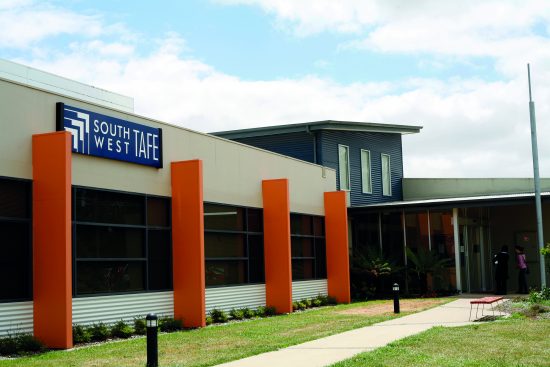
One of SW TAFE’s four campuses.

According to Director of Business Renewal at SW TAFE, Brad Henderson, “The smart classroom for us is all about our students. We want them to be highly engaged in their training at SW and able to collaborate – not just interact – using technology.”

Prior to implementing the Cisco collaboration technology, the institute had identified shifts in the way students were learning. According to Brad, students were gathering in groups, whether on campus or off, and interacting with the course material on their devices. Because of students’ desire to learn in an accessible, simple and collaborative way, SW TAFE wanted to give students the opportunity to learn anywhere, on any device, at any time through virtual lectures and classes.

For the students that physically need to be on campus, the new technology allows them to engage with the course material like never before. For example, students who are studying to be automotive mechanics can now observe an engine being fixed through use of video in the smart classroom, and can watch a recording of the lecture at a later time if they need to refresh their learning.

“Smart campus isn’t so much about the physical reality of the technology, but what it enables our students to do,” said Brad.

Through the implementation of smart classroom technology, SW TAFE is bridging communication challenges that existed between their four campuses and reach and educate more students than ever before.

DSC_5849
SW TAFE’s Portland campus.

“The smart classroom is a big step forward, a big change, but will set the standard in terms of learning in the years to come,” said Brad.

While the institution has had a positive response to the adoption of this technology, they’ve had to tackle many challenges around change and expectation management and learn as they went. This includes collaboration between technology and teaching and learning functions within the institute to ensure that the initial designs and blueprints are adaptive to the feedback provided by the ultimate users of the technology (the teachers).

The institute will continue to bring innovative technologies and learning methods to their students, enabling them to provide cutting edge trainings and skill development to the current and future TAFE students in Australia.

Authors

Reg Johnson

General Manager, Education

Cisco Australia and New Zealand

Avatar

Voice over Wi-Fi (VoWi-Fi) is growing as a service that mobile operators offer to customers. That’s because it helps you solve issues with poor coverage and takes some strain off your cellular network, customer support and technical services. But in order to achieve a first-class VoWi-Fi service that will really help your business and satisfy your customers, you need to know two things: how it works, and how to make it work well.

Always use the best available network

When a user is indoors in a home environment, VoWi-Fi handles their calling needs if their mobile reception is sufficiently poor to warrant it. But if they move outdoors and into an area of better coverage, the cellular network kicks in again. The aim is to always select the best available network to connect the smartphone user, and that’s the smart part of VoWi-Fi: always knowing which to use.

And that’s where you come in. As the service provider, you decide when the voice service needs to switch from 3G or 4G (LTE) to Wi-Fi. Only you know where the user is located and which services they have subscribed to, as well as what kind of experience they expect, so you choose the triggers that make the switch from cellular to Wi-Fi or vice versa. It’s not only a case of tailoring the service for your customers, but also to meet your own needs and resources.

Deploying VoWi-Fi in the right way

There are a few things mobile operators need to sort out before Wi-Fi calling can really work well. Eventually, your objective is to have the solution working on any kind of Wi-Fi. But initially it should be a phased approach, starting with what you know best: your own existing network. And when setting up VoWi-Fi, it’s crucial to define exactly the right triggers to switch users between your mobile network and your Wi-Fi.

As well as consumers, there’s also a demand from enterprise. These organisations mostly don’t have Wi-Fi networks suitable for voice calls at present, but the opportunity here is in extending hi-grade wireless into enterprises via small cells, fully integrated with the cellular network.

Here’s where we come in. Cisco and our partners have extensive experience in Voice over Wi-Fi. We have all the expertise needed to help you design and build the right VoWi-Fi solution to match you and your customers’ needs, as well as the specifications of your existing network. And those things are key if VoWi-Fi is really going to make your customers happy and reduce your operating expenses.

Watch Video interview from Cisco Expert in VoWi-Fi here:

https://youtu.be/7AKO96-ZWoU

Learn more about what Cisco can do for mobile network operators here.

Authors

Bernard Lamy

Senior Business Development Manager

GSP Mobility EMEAR

Avatar

The IT team at the University of León was battling a huge issue with their wireless network. With increasing numbers of mobile users and devices, the campus wireless network was being pushed beyond its original capabilities. Inevitably, users’ experiences began to suffer. There had to be a better way.

After testing products from three separate vendors, University of León landed on Cisco access points. With Cisco Wireless, the university can now support 5,000 concurrent users with 100 percent coverage across the campus, yielding a 70% rise in wireless traffic.

Additionally, the wired and wireless networks are managed together with ease through Cisco Prime™ Infrastructure. With one single view and point of control, the IT team can locate and fix issues much faster than before. And they can proactively monitor and control the network usage and allocation.

University of Leon

With improved Wi-Fi, students and teachers have limitless possibilities for learning and teaching. Teachers now create and provide online resources for students, and students can access online learning resources on demand.

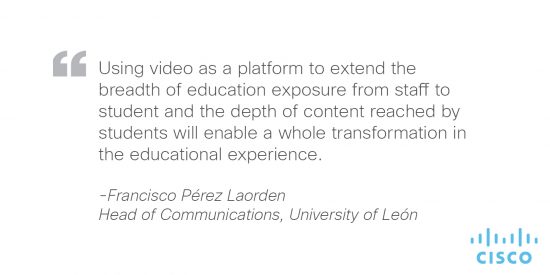
According to Francisco Perez Laorden, the Head of Communications at the University of León, “The new Cisco Wi-Fi infrastructure will change forever the learning lives of our students and teaching staff.”

To read more about the University of León’s implementation of Cisco technology, read the full case study here.

Authors

Alexia Crossman

Senior Cross-Portfolio Messaging Manager

Cisco Marketing

Avatar

Digital business transformation is driving renewed interest in desktop and app virtualization as a mean to provide secure application and desktop delivery to a mobile, distributed and fluctuating workforce. Keeping the desktops and apps securely centralized in the data center provides many benefits. It eases the headache associated with managing thousands of desktops, keeps your intellectual property protected and provides the deployment flexibility needed to keep up with the ever faster pace of business.

Desktop and app virtualization has evolved a lot in recent years. If you’ve tried it in the past and had a bad experience – slow, cumbersome, poor user adoption – you should give it another look. A lot has changed in the underlying infrastructure, allowing an on pare, if not better, experience as with physical desktops. Storage has evolved tremendously and Flash arrays have been a game changer. Similarly, the advent of virtual GPU support by Citrix and VMware, the leading desktop and app virtualization platforms, has improved user experience enormously. It even opened up new use cases such as 3D graphic workstations replacement, helping industries like automotive, manufacturing, architecture and design benefit from desktop and app virtualization.

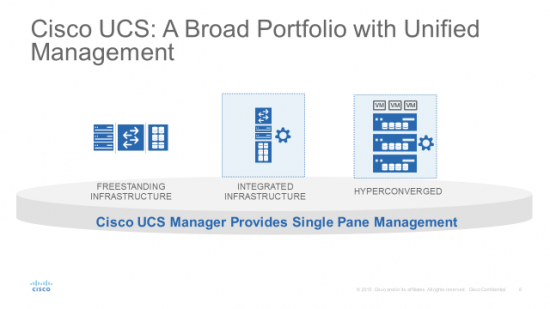
At the core of a great desktop and app virtualization solution you need a solid foundation that is easy to manage and allows for growth. This is where Cisco Unified Computing Systems (UCS) shines. What is unique about UCS is that it was designed from the ground up for virtualization. It integrates compute, storage, networking, virtualization, and management into a single platform through a fabric Interconnect which delivers consistent networking across physical, virtual and cloud environments. It offers several form factors delivered as one system.
UCS portfolio

First, we have our core blade and rack servers which are the foundation of our solutions. They can be combined with Cisco networking and third party storage to provide custom built solutions on which you can deployed your virtualized workloads.

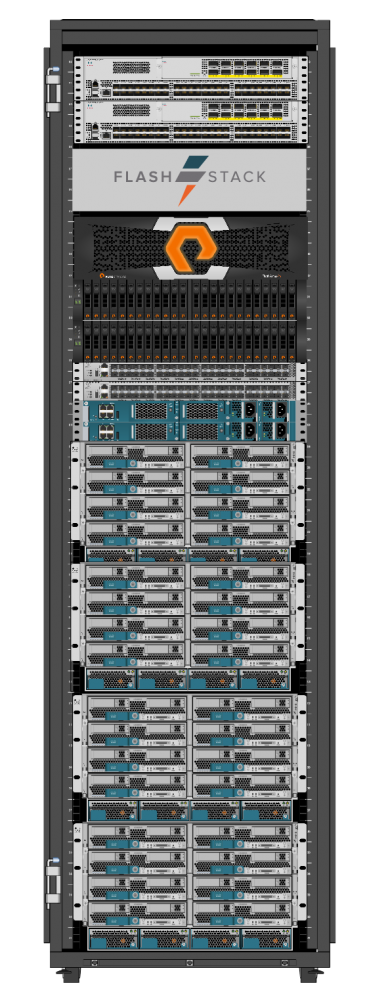
Then we have our integrated infrastructure where we’ve combined our UCS blade and rack servers with Nexus switches and third party storage such as Pure Storage with FlashStack.

Then moving down to even more integration and convergence, we have our recently released hyperconverged solution, Cisco HyperFlex systems. HyperFlex is also built on UCS but we integrated the compute, network storage and hypervisor nodes delivered as clusters in an appliance that can be stood up and one hour. The real benefit of hyperconvergence is you don’t need a SAN network or separate storage; the storage is part of the appliance.

Each architecture delivers specific benefits and customers will lean towards one architecture or the other based on storage vendor preference, deployment size and internal IT skills.

FlashStackOne recent entry in our portfolio of integrated infrastructure is FlashStack, based on Pure Storage all flash arrays and Cisco UCS blade servers.

Cisco’s technical team tested and documented the deployment of a 5000-seat mixed workload on FlashStack with VMware Horizon 6.2. With over 2,000 work hours in average in design and testing, Cisco Validated Designs (CVD) provide trusted, scalable and predictable guidelines for configuring and deploying your virtual desktop infrastructure. This CVD documents a mix of RDS server-based sessions and Linked Clone Windows 7 virtual desktops on vSphere 6. Read the CVD here.

This enterprise-grade solution delivers a highly adaptable architecture with non-disruptive scalability. The combination of Cisco UCS and Pure Storage FlashArray//m provides a high performance, easy to manage platform for a successful large-scale VDI deployment. Read the Pure Storage blog detailing the CVD process.

We will be showcasing our recent work with FlashStack and VMware Horizon at VMworld, Sun Aug 28- Wed Aug31. Come by Cisco booth #1739 to catch a theater presentation, or stop by our demo pod to talk to one of our VDI expert.

On a personal note, let me know if you have intel on where the good Pokémon hide in Vegas! pokemon-1530315_1920
@FrancoiseBRees

Authors

Francoise Rees

Marketing Manager

Customer Solution Marketing, Cisco Intersight