Today – World Humanitarian Day – is dedicated to recognizing the work and sacrifices of humanitarian personnel. It is also a day to create awareness for the people and organizations that save lives, reduce suffering, and respect human dignity – to recognize those who are working to solve some of our most pressing global challenges.
Since 1945, CARE (Cooperative for Assistance and Relief Everywhere) has been doing just that. The organization delivers emergency relief that helps people withstand and overcome disasters such as the 30-year drought in Ethiopia and last year’s earthquakes in Nepal, or the plight of refugees. It also seeks long-term improvements in the world’s poorest communities by advancing educational opportunities for girls, improving health for mothers and their babies, and economically empowering women through CARE Village Savings and Loan Associations (VSLA). This U.S.-based, non-profit organization is one of the largest and oldest humanitarian aid organizations focused on fighting global poverty. Last year, CARE worked in 95 countries and reached more than 65 million people.
We wanted to take this day to consider, how can technology help accelerate this work? How can it help better even more lives?
NOTE: The conversation below on how to ignite innovation first appeared on the web site of TeskaLabs, a Europe-based security startup selected to join the IDEALondon program, powered by Cisco, DJ Thomson and University College of London. A big thanks to Cindy Dam, TeskaLab’s marketing and community manager, for permission to re-post her Q&A blog.
An interview with Alex Goryachev, Senior Director – Innovation Strategy & Programs Corporate Strategic Innovation Group, Cisco, is a part of a series of interviews on enterprise innovation with corporate intrapreneurs, technology enthusiasts and visionaries within some of the world’s largest companies.
We spoke to Alex Goryachev about the recent Innovate Everywhere Challenge, an initiative from Cisco to “empower employees to think and act like passionate entrepreneurs with greater agility, speed, and risk-taking.”
Cindy Dam: Hi Alex, could you please tell us more about yourself and how you got involved with Cisco’s innovation programs and this particular Innovate Everywhere Challenge?
Today, thousands of Cisco customers are using the Identity Services Engine for guest and BYOD access. Naturally they want their users to have a great experience with great looking portals that’s consistent with their company brand.
Custom portal creation typically requires technical and design expertise that’s scarcer than you would think. That can put IT in a bit of a bind when they’re trying to provide a quality service to their users. That’s why we created the cloud-based ISE Portal Builder which allows ISE customers to easily create guest and BYOD portals for free instead of paying someone to do it. To date, more than 3,000 ISE customers have used the ISE Portal Builder to create over 7,000 custom portals without special technical or design skills.
When we first designed this tool, we envisioned that it would be mostly used by smaller companies, but we’re seeing it used by Fortune 50 companies as they seem to have just as hard a time finding the talent and expertise to develop their portals.
How did this save over $17 million? Portal creation can be costly and vary from $500 to $50,000. Instead of paying an average of $2,500 for each portal, ISE customers are saving a lot in design costs in addition to having customized portals without a bunch of operational bugs.
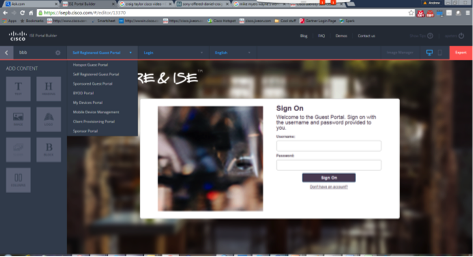
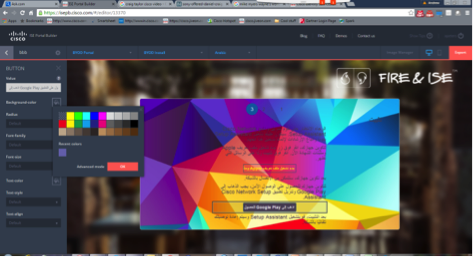
Customers tell me they like the ISE Portal Builder because it’s fast and easy to create brand-customized portals that look like they were done by a professional. In case you didn’t know, the ISE Portal Builder is a drag and drop WYSIWYG (what you see is what you get) design tool built for people with limited or no design or technical skills. You can create all of your guest and BYOD portal pages using templates or from scratch, translate them into 17 languages, and further customize by language or page and share them with others to comment on or change.
When a design is finished, you can upload it to ISE. The whole process is relatively easy, but if you have problems we provide excellent support.
Here are a few samples, but if you are a Cisco customer please go and take a look at the tool.
Create Guest Sign-on Pages in English
Modify BYOD Success Page in Arabic (and 16 other languages)
Large companies are often associated with complexity, lack of speed, and even obsolescence. Creating a start-up like ecosystem deep within the bowels of a large company calls for disruptive people practices and non-linear improvements. It also requires a trade-off between current business priorities and future opportunities that may align better to our customer’s priorities and the technology strategy we wish to drive. This also helps us in creating avenues for co-development and innovation with our customers.
So, how do we make it happen? Falling back on my engineering roots helps me create an equation that explains it as:
Cisco f (x) = ex.
f(x) essentially represents building top talent, breaking silos, aligning behind speed and outcome, and driving joint innovation with customers focused on solving their biggest innovation problems. Linear investment in these can generate exponential results simply because all this happens in the context of a powerful, facilitating environment we call Cisco.
Cisco ‘alpha projects’ are a great example of valuing and generating innovation from within. Over the last two years, there are many alpha success stories. My team’s project focused on innovating and building products for hyper-scale infrastructure. This meant combining deep customer listening, cross-company collaboration, busting silos and bottlenecks with a team that represented the best networking talent, all at a tire burning and gravity-defying speed. Thus, our internal code name for this project was xSpeed.
The xSpeed alpha project disrupts our own product portfolio and processes in a significant way. This, in turn, forces us down a path of further innovation and new frontiers; frontiers that are broader than the current technology spectrum and promise exciting times for us engineers.
The classic Innovator’s Dilemma myth needs some busting. Large companies have the resources and the wherewithal to launch ambitious and innovative projects. Whether in the form of alphas, or acquisitions, within engineering we have been able to nourish and grow disruptive ideas with start-up-like agility while operationalizing them like a mature company.
The incumbent in every industry faces the highest level of pressure. And, in embracing disruption and often times disrupting ourselves, we ensure our relevance and leadership in an evolving ecosystem of contributors and competitors. With this approach, we create growth opportunities for our talent. This, in turn, gives us several breakthrough ideas to pursue across the spectrum of our business interests. So, really, who says innovation is only for smaller companies and start-ups?
Voice over Wi-Fi (VoWi-Fi) is a relatively new technology that’s already had a good reception from mobile network operators. And that’s because it fixes one of the top issues of your customers: poor mobile reception indoors. Here’s a quick overview:
Many consumers have been long plagued by a bad radio signal when they want to use their mobile phones at home. VoWi-Fi solves this by allowing them to use a Wi-Fi connection instead to make calls.
Of course, this is great for customer satisfaction. It reduces customer churn because the service users are less likely to jump ship in favour of another provider who might give them better coverage. A happy customer is a loyal customer and a longer-lasting one.
Cutting workloads for providers
When you’re receiving fewer complaints and technical support requests to your contact centres, this reduces the strain on customer services, too. What’s more, it can also result in you spending less of your resources on engineer call-outs to check your installations, fix technical problems and so on.
Making services go further
VoWi-Fi isn’t just a good thing in terms of keeping customers happy. It means that first-class Wi-Fi networks can share some of the load when it comes to voice traffic, taking the pressure off other services.
Well received by the industry
VoWi-Fi service has already been rolled out by network operators including EE in Europe and T-Mobile in the USA. And mobile device manufacturers are increasingly making the solution native in their products: Samsung launched it in 2012, followed by Apple in 2015.
That’s sure to accelerate deployments worldwide, as consumers become more aware of VoWi-Fi functionality and increasingly demand the service from their providers. And, as always, it’s better to be ahead of the curve than behind it.
The Cisco approach
Cisco leads the way in delivering solutions for service providers. Back in November 2014 we launched the Cisco® Universal Wi-Fi solution – the industry’s first end-to-end solution featuring HDVX (High-Definition Voice Experience) technology that enables millions of Wi-Fi devices to operate as phones. A carrier grade solution, it delivers secure onboarding, ubiquitous coverage, performance and scale.
Watch Video interview from Cisco Expert in VoWi-Fi here.
Discoverwhat Cisco can do for mobile network operators here.
Now more than ever, cybersecurity is a top-of-mind issue for business, students, and even United States presidential candidates. With billions of bytes of data connecting to the Internet every day, our information needs more protection and security than ever before.
For more than 47 percent of businesses surveyed by Global Knowledge, IT security is a hiring priority; by 2019, there will be a global shortage of two million cybersecurity professionals. And for students looking to break into the industry, IT security represents a tremendous opportunity; the same survey found that cybersecurity careers are the third-highest paying jobs in all of IT.
Omar Shaban, Director, Global Operations Cisco Networking Academy, recognizes the growing need for talent all around the world. “At a macro level, any country you go to, developed or developing, talk to the minister of labor or the president, and there are three top-of-mind areas,” he said. “One is security, physical and cyber, two is around the creation of jobs, and three is around education.”
That’s why in June, Cisco announced a new $10 million Global Cybersecurity Scholarship. The goal of the program, which officially launched in August, is to create 10,000 new cybersecurity jobs. More than that, it’s goal is to prepare students, professionals, and those looking to re-skill with the necessary certifications and knowledge to thrive in today’s digital economy.
https://youtu.be/L2iCDFfKce0
Shaban believes the program is essential in the face of digitization. “It is changing industries,” he said. “Every engineer in healthcare and every electrician will need to know something about networking. It will create new jobs and change existing jobs.”
As part of the program, Cisco will invest $10 million in updating curriculum, providing new, cybersecurity-specific courses, and delivering the coursework to students around the globe. Students commit to a three-month training program, which includes:
Access to 2 online, instructor-led courses with assessments
“The scholarship is a great opportunity to take all of the wonderful things we’re doing in the Cisco Networking Academy and the Cisco Learning Network and expand on them,” Shaban said. “We’re providing new students and students who have finished an even more advanced-level of training advanced opportunities for in-demand careers.”
If you are at least 18 years old, proficient in English, and planning a career in IT cybersecurity, apply for the scholarship today!
As a freshman in college, I was young and clueless. I was busy partying, and staying up late. I always got A’s in high school, and severely underestimated the work-load of Boston University Engineering.
I found myself without a passion.
Then sophomore year hit me like a ton of bricks. And, to make matters worse, one of my best friends since middle school, Patrick, passed away. I was devastated. As a result, I did terrible in school and failed a couple of courses.
Then, I decided to take a year off from college, and I set out to change.
I broke down personal barriers, tried new things, and found myself working towards a new purpose — fully engaged in a lifestyle that kept me learning, happy and motivated.
I went to San Francisco, California and attended Make School as an iOS developer. I travelled around the Bay Area, learned countless computer science techniques, cyber security, industry experience, startups, networking, presenting, and how to code.
I fell in love with coding, it enabled me to make anything I wanted, any game, and any business endeavor – coding offered endless possibilities. It was fun and I was good at it.
Suddenly, everything clicked. It was then that I knew I could apply my technological passion to shape my career in engineering.
After that year, I came back to BU and combined my newly acquired CS knowledge with my computer engineering/entrepreneurial skill set.
I achieved my highest semester GPA ever, won two hackathons, and started a company from my senior design project. I also won the Top Hacker Award in BU and was invited to Cisco Live! in San Diego where I attended the DevNet Hackathon.
My experience at the DevNet Hackathon was extraordinary. Not only did I connect with intelligent people, I also had direct access to Cisco technologies that made creating a full-stack IoT application in 24 hours look easy.
Our project leveraged CMS, IAAS, Cisco Zeus and IOx to build a mobile and web platform for users to view the cleanest restaurants nearby. Non-compliance to hand washing is a major issue that leads to the spread of infections and Sanitize was created to solve this problem. This app uses a combination of BLE beacons, Arduino vibration sensors, and CMX location tracking to increase hand washing compliance rates among employees.
Then we won grand prize at hackathon for $10k!
After that week at Princeton, I was formally offered a job at Cisco.
I knew Cisco would be the one place where I could finally unlock my full potential. It’s is weird because before I went to California, I thought that I didn’t want to work at a large company. I thought it would be boring, and that there would be too many restrictions. Stuck in an office surrounded by four walls. My creativity would be suppressed.
However, this was not the case with Cisco, and no matter where I was, I felt that the employees shared similar visions and passions to myself.
Everyone I met, they were intelligent and driven individuals who loved their job, because it gave them that freedom to thrive.
Cisco’s culture encourages its employees to break down those four office walls and get out there to build real solutions that help people and make a footprint on the world.
Ultimately, I want to pioneer my vision, bring my ideas to life, and create value for others on a global scale. Combining this drive to succeed with my passion for technology and digitizing the world — What better place to get it done than at Cisco?
Are you looking to find your passion or maybe even on your way to a career at Cisco? Here’s some advice I’d offer:
Ask yourself: What drives you? What is your end goal in life, and how are you going to work at it to get there? What is going to be your contribution to society and the world?
You don’t have to work 24/7. You just have to be productive with the time you have. Cisco encourages a work/life balance for their employees because they know with rest comes even more innovation.
Manage your time and set a habit tracker. I coded every day for a year; constantly trying to push my streak.
Set deadlines so that you feel like you have something to lose if you don’t do it in time. Set goals on Trello!!!!! Trello is love. Trello is life.
Start building problems that you actually encounter; chances are that others have the same problem as you. Solve real problems. Get things done.
Do what makes you happy, even if you have to grind to get yourself there. Be healthy, get plenty of sleep, eat right, and workout.
Travel places and always be open to try something new. Aspire to create value for others and more importantly, invest in yourself.
Just go out and try to teach yourself how to build your ideas. Start googling everything you don’t know how to do, you’ll find a way. That’s the beauty of software/hardware — usually if you can dream it, you can build it.
Learn how to code. This will help you to see your dreams become a reality.
Have you ever wondered about Cisco Hyperlocation? Want to know how it works? Well, then you should check out the write up from the No Strings Attached Show. We invited the hosts of the show, Blake Krone and Samuel Clements to our Over the Air Test Facility for a deep dive into Cisco Hyperlocation Technology.
Cisco Hyperlocation is our award winning Wi-Fi location technology, providing 1-3 meters of location accuracy, which is a tremendous accuracy improvement over traditional wi-fi RSSI based location.
Figure 1 The prototype progression of Cisco Hyperlocation hardware
Here’s a link to the write up, make sure you download the PDF or iBook, because that’s where you’ll find the interesting details!
It was a fantastic experience. We covered just about every facet of Hyperlocation. Everything from the nitty-gritty of how the solution works, interviews with the RF gurus behind the technology, prototypes of the product at different stages of development, and of course we put Hyperlocation through its paces. Testing its capabilities in several scenarios. We even tracked a smartphone on a model train.
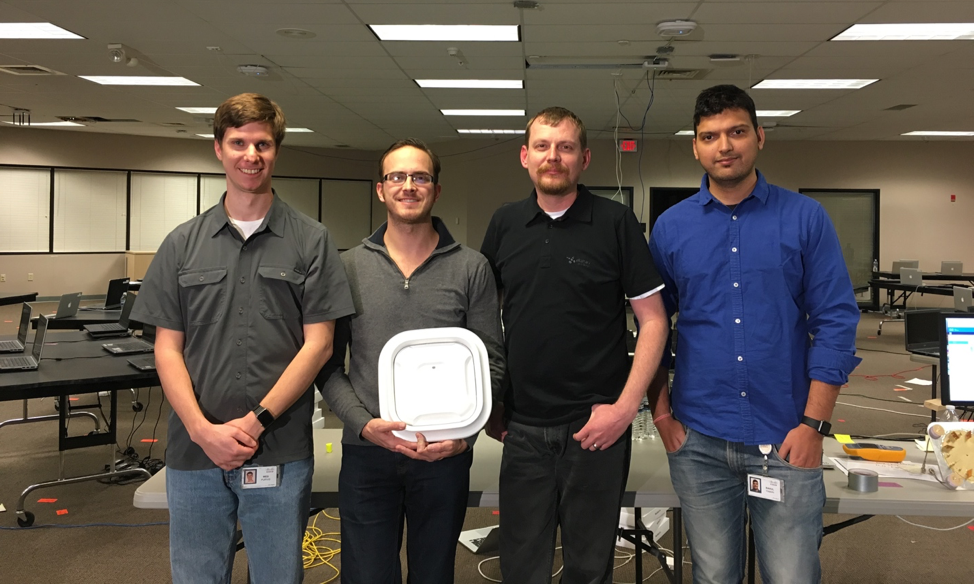
Figure 2 The crew testing Hyperlocation at the Cisco Over the Air Test Facility. L-R Wes Purvis, Blake Krone, Samuel Clements, Rahul Tiwari
Will the Internet continue to grow at historical rates, or has growth peaked? This was the question was posed by Sanjay Patel of CableLabs to the panelists on the Bandwidth Consumption Trends panel during the August 2016 CableLabs Summer conference. I was pleased to have been invited to participate in the panel, alongside Rob Kenny of Communications Chambers and Damian Poltz of Shaw Communications.
The panel presented a surprising diversity of perspectives on the future of Internet growth. One audience member commented to me that listening to the panel made him feel the future of the Internet is still very much unknown. I had the same impression, and it makes me happy to think the Internet still has surprises in store for us.
While I believe all the panelists have differing perspectives on long-term growth, there were no flat-out contradictions. In fact, over the course of numerous discussion we concluded that our numbers can all be reconciled with each other because they all are measuring different aspect of the near-term future of the Internet, even if our perspectives on long-term growth may differ.
I’d like to summarize here the answer each panelist has offered to Sanjay’s question.
Sanjay Patel, Principal Strategist at CableLabs. In additional to framing the question for the panelists, Sanjay also presented recent numbers from CableLabs’ edge network traffic measurements, where traffic growth does appear to have leveled off in the past year. Sanjay’s answer to the question was that growth may be flattening in the near-term.
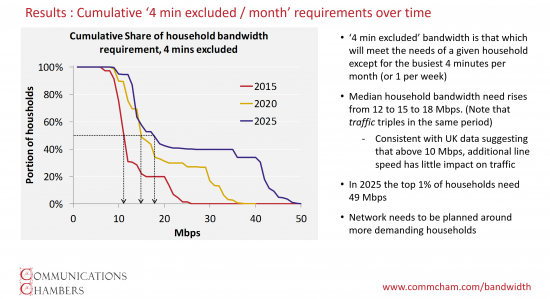
Rob Kenny, Founder at Communication Chambers.Rob’s answer to the question was that traffic may continue to grow at historical rates, but the need for broadband speeds will not. Rob has done extensive mathematical modeling to determine that it’s fairly uncommon for multiple high-bandwidth applications such as HD video to be in use simultaneously within a household. And apart from console game and movie downloads, there aren’t too many applications that require high speeds. As such, he projects that for all applications expected to be on the network with the next few years, the need for high bandwidth is not as high as many expect. For the UK his numbers show a median bandwidth demand of 15 Mbps in 2020 and 18 Mbps in 2025, up from 12 Mbps today. The top 1% of households will require 49 Mbps in 2025. Admirably, Rob has made his report and entire model available to the public.
Arielle Sumits, Senior Analyst at Cisco.My own answer to the question was that traffic growth will likely taper slightly, but the Internet is not saturated and growth will hold steady in the long-run. At the end of my presentation, I mentioned that in the 12 minutes I had been speaking, 15 million gigabytes had crossed the network, but 4 billion gigabytes of data had been created. Less than 1% of data created today is transmitted onto the Internet, partly because we do not currently have the analytical capabilities to process this much data. AI is entering a period of exponential progress, and as it does, it will make sense to move more data onto the network where it can be accessible for analysis. We are nowhere near a saturation point. That’s the long-term view, but in the short-term we are also seeing persistent growth. There is a slight tapering in year-over-year growth rates, but much lower than we’d expect given the high volumes of traffic the network carries today. Even without substantial data from machines, there are substantial broadcast viewing hours and offline gaming hours that will make their way onto the Internet in the next five years. Regional and country level details are available on the Cisco VNI site.
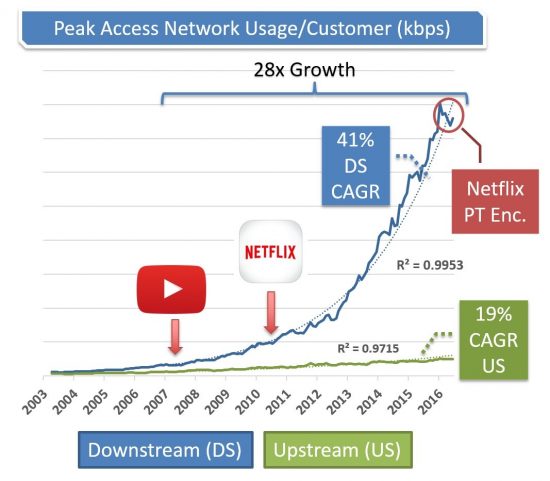
Damian Poltz, Director of Technology Strategy at Shaw Communications.Damian’s answer to the question was an enthusiastic affirmation that peak traffic growth will hold at historical rates. He pointed out that historical forecasts of Internet growth have almost always turned out to be low, and if one had simply projected constant growth over the past 15 years, their forecast would have been right on target. “Don’t bet against the Internet” was Damian’s theme and rightly so. Damian added that predicting constant growth is the more conservative option for service providers, because it’s a lot easier to dial down infrastructure investment than it is to dial it up. As a side note, Damian mentioned that his recent numbers show a dip in traffic due to Netflix’s re-encoding of their video assets.
Each panelist measured different aspects of the network – Damian’s focus was on peak traffic, mine was on average traffic, Rob’s was on broadband speeds. When we compared numbers, we felt each of our forecasts could be made compatible with those of our fellow panelists. But in the end, I think we have differences of opinion regarding the long-term prospects for traffic growth. And the differences lie in the impact of applications that are only a blip on the traffic radar right now, such as virtual reality, cloud gaming, and IoT. I can’t wait to see what a “bandwidth consumption trends” panel looks like in 2025.






 of interviews on enterprise innovation with corporate intrapreneurs, technology enthusiasts and visionaries within some of the world’s largest companies.

 Cisco ‘alpha projects’ are a great example of valuing and generating innovation from within. Over the last two years, there are many alpha success stories. My team’s project focused on innovating and building products for hyper-scale infrastructure. This meant combining deep customer listening, cross-company collaboration, busting silos and bottlenecks with a team that represented the best networking talent, all at a tire burning and gravity-defying speed. Thus, our internal code name for this project was xSpeed.


 As a freshman in college, I was young and clueless. I was busy partying, and staying up late. I always got A’s in high school, and severely underestimated the work-load of Boston University Engineering.


 Arielle Sumits, Senior Analyst at Cisco. My own answer to the question was that traffic growth will likely taper slightly, but the Internet is not saturated and growth will hold steady in the long-run. At the end of my presentation, I mentioned that in the 12 minutes I had been speaking, 15 million gigabytes had crossed the network, but 4 billion gigabytes of data had been created. Less than 1% of data created today is transmitted onto the Internet, partly because we do not currently have the analytical capabilities to process this much data. AI is entering a period of exponential progress, and as it does, it will make sense to move more data onto the network where it can be accessible for analysis. We are nowhere near a saturation point. That’s the long-term view, but in the short-term we are also seeing persistent growth. There is a slight tapering in year-over-year growth rates, but much lower than we’d expect given the high volumes of traffic the network carries today. Even without substantial data from machines, there are substantial broadcast viewing hours and offline gaming hours that will make their way onto the Internet in the next five years. Regional and country level details are available on the
  Damian Poltz, Director of Technology Strategy at Shaw Communications. Damian’s answer to the question was an enthusiastic affirmation that peak traffic growth will hold at historical rates. He pointed out that historical forecasts of Internet growth have almost always turned out to be low, and if one had simply projected constant growth over the past 15 years, their forecast would have been right on target. “Don’t bet against the Internet” was Damian’s theme and rightly so. Damian added that predicting constant growth is the more conservative option for service providers, because it’s a lot easier to dial down infrastructure investment than it is to dial it up. As a side note, Damian mentioned that his recent numbers show a dip in traffic due to Netflix’s re-encoding of their video assets.