Modern security and IT infrastructures are complicated. Efficiently managing these environments is hard. Gaining value from the massive volumes of data generated by these infrastructures is even harder. That’s why Cisco and Splunk have joined forces to deliver integrated solutions for IT Operations and Security Analytics that deliver end-to-end, real-time visibility across every infrastructure element.
In this digital world, data and analytics-driven insights provide customers with a strategic advantage. Union Hospital of Cecil County uses Splunk Enterprise on Cisco UCS to protect hospital systems from cyberattacks, and to keep patients’ medical information private, and in compliance with federal requirements.
Integra uses Splunk on UCS to monitor, analyze and visualize data from nearly all critical IT systems with use cases ranging from application delivery, capacity planning, and monitoring and troubleshooting mission critical business applications.
Splunk .conf2016 provides the perfect opportunity to learn more about how Cisco and Splunk are enabling our joint customers to accelerate troubleshooting, reduce security risks and drive business transformation.
Cisco Data Center and Security experts will be in Orlando to connect with Splunk data professionals and discuss solutions for IT Operations Analytics and Security Analytics. Make sure to add these sessions to your .conf2016 agenda:
“Finding your faults before mom” – Deploying Splunk for IT Troubleshooting and Capacity Planning on Large Scale Integrated Data Center Infrastructure, with Karthik Karupasamy and Wissam Ali-Ahmad, Wednesday, September 28th, 12:05 PM-12:50 PM, Dolphin Southern 4/5
Infrastructure Analytics: Driving Outcomes through Practical Use Cases and Applied Data Science with Splunk and Cisco, with Robert Novak, Matt Birkner, and Ian Hasund, Wednesday, September 28th, 2:15 PM-3:00 PM, Dolphin A2
Securing the Enterprise using Event-Driven SDN with Threat Intelligence, with Steven Carter, Thursday, September 29th, 10:30 AM- 10:15 AM, Community Theater
Also, make plans to drop by the Cisco booth to learn about how Cisco UCS delivers exceptional performance, best-in-class TCO and seamless scalability for Splunk Enterprise. The Cisco Security team will also be on hand to showcase the Splunk integrations across Cisco’s security portfolio to deliver a complete, continuous view of your organization’s security posture. Of course, we’ll also have cool giveaways and raffle prizes.
5 Ways Cisco ACI® Integration with ServiceNow® will Elevate Your IT Operations Management
According to a recent report by Gartner, more than $1 trillion in IT spending will be directly or indirectly affected by the cloud shift during the next five years. Traditional IT spending is shifting over to cloud services, and the market for cloud services has grown to a very remarkable percentage of total IT spending. The collective amount of cloud shift in 2016 alone is estimated to reach $111 billion, increasing to $216 billion in 2020.
Cloud shift is not just about cloud. As organizations pursue a new IT architecture and operating philosophy, they become prepared for new opportunities in digital business, including next-generation IT solutions such as the Internet of Things, furthermore, organizations embracing dynamic, cloud-based operating models position themselves better for cost optimization and increased competitiveness.
This is why organizations in all industry-specific market segments are turning to cloud solutions to accelerate innovation, expand market reach, and reduce IT costs. However, embracing the cloud presents challenges especially for IT operations teams struggling to deliver and maintain the business services needed to help ensure end-users remain productive and ensure the uptime of critical business services.
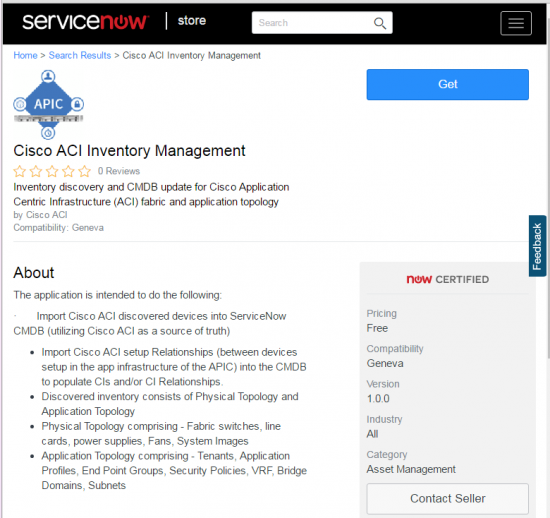
As we continue to evolve Cisco ACI eco-system to enable IT organizations to deliver and maintain the critical business services, I am very excited to announce that we have received certification of Cisco ACI Inventory Management with ServiceNow and the application is available in the ServiceNow Store.
Some of you might be surprised that we are integrating an ITSM/ITOM platform with DC/Cloud infrastructure fabric, however, our customers have been telling us that ITSM/ITOM paradigm is trickling down to various layers of DC/Cloud infrastructure for quite some time. As a matter of fact, these customers have been using ServiceNow to pull business critical information from the network and in some cases they have been actually provisioning and managing the underlying infrastructure.
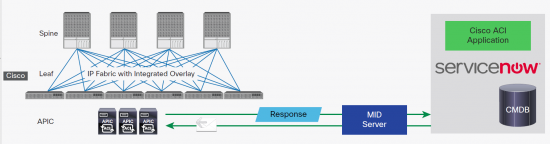
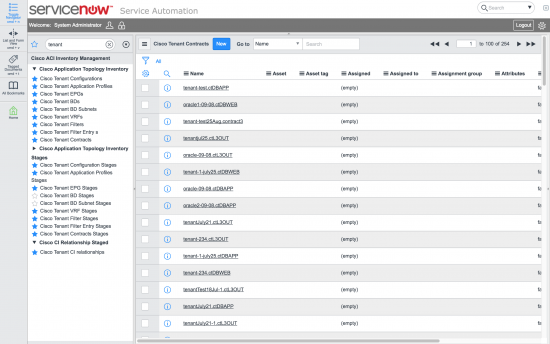
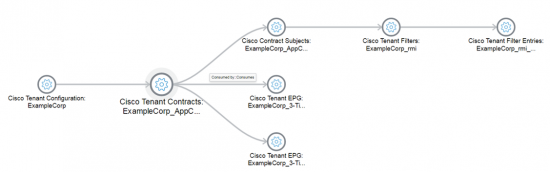
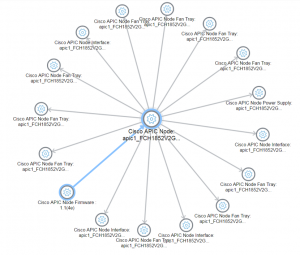
The Cisco ACI integration provides ServiceNow customers with a simple view of IT infrastructure and the way it relates to business services, with complete isolation of application tiers and data within shared infrastructure. With this integration, IT organizations can use the Cisco ACI application in their ServiceNow instance to run discovery processes through the Cisco ACI management, instrumentation, and discovery (MID) server and automatically update the ServiceNow configuration management database (CMDB) with discovered inventory data consisting of both physical configuration data (switches, APIC controller, node links, chassis information, etc.) and logical configuration data (tenants, endpoint groups [EPGs], L4-7 configurations, contracts, policies, etc.)
In addition, as Cisco ACI connects various tenants, VMs and services across scale out infrastructure, ACI End Point Tracking feature provides ServiceNow CMDB admins with most comprehensive end-point dynamic metadata including end-point initial discovery, lifecycle, location, downtime, making sure that CMDB is in sync with changes happening in logical & physical configurations.
The Cisco ACI solution integrated with ServiceNow provides IT organizations with the following 5 benefits for achieving a scalable service-aware IT operations management environment.
1) Accurate dynamic service mapping – By correlating infrastructure with existing services, ServiceNow and Cisco ACI discovers and models components that are part of a business service. This unique approach eliminates irrelevant data points and creates accurate service maps in minutes
2) Real time infrastructure visibility – When service and infrastructure changes occur, including actions related to change requests, infrastructure events, and service outages, IT teams can quickly identify the root cause and determine the best way to remediate the issue, leading to drastically reduced mean time to recovery (MTTR).
3) Cost savings through automation – IT organizations can dramatically reduce the time required to map new services and detect changes for existing ones through automated service mapping process. Through automation provided by Cisco ACI enabled infrastructure, IT organizations can also reclaim or retire applications, servers, and storage and networking resources, when they are no longer needed, resulting in additional operational agility and resource efficiencies.
4) Operational efficiency – IT operations teams respond more quickly and become more proactive with Cisco ACI keeping an up-to-date view of service-aware infrastructure and informing ServiceNow about the services that are available and the ways that they are connected.
5) Realistic and guaranteed SLAs – Improved automation, visibility, and compliance, coupled with dynamic and accurate service mapping, enable IT organizations to create realistic SLAs that can be met and to easily share them with stakeholders across the organization.
The Cisco ACI integration is available as free download at the ServiceNow Store. So, go ahead and download the free app, create connection with your ServiceNow instance, run your asset discovery process and start mapping your business services with most accurate CMDB.
If you happen to be in the LA area, please register for Cisco sponsored Los Angeles ServiceNow User Group (SNUG) on September 8, 2016 where we have a great line up of technical presentations highlighting ServiceNow and Cisco integrations and also hands-on demo session showcasing how these integrations work in real life pragmatic use cases. Please stay tuned as we are planning more Cisco sponsored SNUG meetups in other regions as well.
We’re consistently hearing from manufacturers that security risks and protecting data are their top careabouts. In light of this we are hosting a #CiscoChat to learn how manufacturers are protecting their value chains on Wednesday, September 14th at 10AM PDT/1PM EDT.
What data do you think is most critical to protect?
Where do you think manufacturers should be making their biggest investments in security?
How important is it to you that your vendor participates in standards organizations like ISA to help develop security standards?
A lot of factories still have industrial PCs that require security patches, and system updates – what kind of risk does that pose?
As you connect your suppliers, how are you making sure your vendors are securing your equipment?
How does a machine builder best integrate their equipment into a digital manufacturing environment?
Make sure you’re logged into your Twitter account
Go to Twitter and search for the #CiscoChat hashtag using the search bar on the upper right side of the page
Click on the “Live” tab in the middle of the page. and be sure to refresh this page to follow the conversation
Open a second window to the Twitter homepage to create your responses to the chat
The Chat moderator @CiscoMfg will begin welcoming guests at 10AM PDT/1PM EDT and will start questions after intros are done. Introduce yourself to us and the other attendees! Funny memes and photos from the event are encouraged
Be sure to use the #CiscoChat hashtag at the end of each tweet, so that others can find your contributions to the discussion. Refresh the page over the course of the chat to see all the responses
Preface each tweet with “1A, 2A,” etc. in order to make it easier for others to follow along with the conversation
For @ replies to specific participants in the discussion, please use a “.@” at the beginning of the tweet, so that your question or comment will appear in your public twitter feed
Prepare any links or images you want to share during the discussion in advance of the chat
Feel free to bring your own questions to the discussion as well. See you there!
Today is the 17 year anniversary of my first video download. In September 1999, I was so excited to use the new robust 802.11a for an incredible 11 mbps download.
Do you remember wireless networking 1999? Back then, if you had challenges at 11 mbps to download a video what did you do? You went to look for the wire. You plugged your laptop into the Ethernet port. That’s what everyone did and it’s why we had Cat5 Ethernet ports being installed in virtually every cubicle across the world. For most of us, this approach of “going to the wire” continued through 802.11n until just recently. Up until a year ago, my kids were still plugging in their PS4s to Ethernet ports for a better gaming experience. But 802.11ac Wave 2 changes the things completely.
With 802.11ac Wave 2, wireless has now exceeded the capacity of the wired infrastructure. It did this by breaking the Cat5e barrier of 1 gigabit. So now, it’s the wire that becomes the bottleneck in a growing network.
A greater challenge is the bottleneck of expectations we are seeing in mobile data traffic. Deployed wireless speeds have already started eclipsing that of their wired counterparts. The idea of finding a cabled Ethernet port to get the best data rate has gone out with the 90s, because the data flow between iPhones and Access Points has improved with each new WiFi standard. The bottleneck is now forming behind that AP which is now demanding at as much as 3 to 4 Gbps. The issue is not with the Access switch, it’s with the cable in the wall.
Today, there are over 70 billion meters of Cat5e and Cat6 deployed in the world. That’s 10 meters for every man women and child on Earth. So what are the options to ensure that the wired infrastructure does not completely bottle-neck the wireless network? One option is re-deploying the wire, but sometimes it may not be possible. Assuming it is even possible, cost estimates have scaled to over $300k per building.
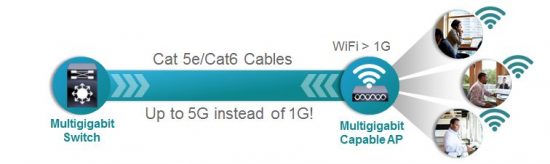
A more viable option is to upgrade your Cat5e cable without ever touching a wall. This is the approach that Cisco and the NBASE-T Alliance have taken to give us an immediate and cost effective solution. Thanks to their work, there is now a solution where you can get 2.5 and even 5 Gbps across existing Cat5e cable.
Cisco Catalyst Multigigabit Technology is a game-changing innovation to enable data rates through existing Cat5e and Cat 6 cables beyond 1Gbps to 2.5 and even 5 Gbps up to 100 meters. By using a Cisco Multigigabit capable switch like the Catalyst 3850 and the Cisco Aironet 3800 Access Point, you can sustain up to 5X data speeds without replacing cabling infrastructure. Cisco Catalyst Multigigabit Technology is compliant with 1000BASE-T and 10GBASE-T IEEE standards and supports Power-over-Ethernet (PoE) standards up to 60 watts.
We’d love to hear from you! To earn points and badges for participating in the conversation, join Cisco Social Rewards. Your comment(s) will appear instantly on the live site. Spam, promotional and derogatory comments will be removed.
In an effort to keep conversations fresh, Cisco Blogs closes comments after 60 days. Please visit the Cisco Blogs hub page for the latest content.
YRC Freight, based in Kansas, is a leading transporter of industrial, commercial, and retail goods, specializing in solutions for businesses across North America. In fact, so large is their network and operations that anything we buy at any store is possibly shipped by YRC.
In 2013, their IT department began a new initiative to modernize their entire infrastructure and application development and delivery process. Instead of scaling vertically with 2 or 3 large production servers, YRC wanted to move to a distributed, horizontal scale-out model with 100s of servers. They wanted to expand or contract capacity using policies and orchestrate and dictate the actual work to be done. From a network infrastructure perspective, YRC wanted to move away from a traditional siloed model towards SDN. With the emergence of IOT and high speed mobile networks, they were able to collect more data from their drivers and truck mounted devices. This means, there will be a substantial set of new applications and new services that they did not have before. YRC felt that the implementation piece should be a lot easier and a lot less expensive from both a CAPEX and OPEX perspective once they have this automated, orchestrated infrastructure in place. YRC freight challenges can be summarized in simple terms as below.
Challenges & Opportunities
Move from a legacy mainframe architecture to a modern enterprise infrastructure using software defined networking (SDN)
Streamline infrastructure provisioning and implement more efficient management practices
Solution had to scale horizontally across smaller servers, be simple to manage, and be able to utilize any hypervisor
So, their IT department decided to implement software-defined networking (SDN) to manage the workloads and cloud-aware applications. Moving to this modern architecture would allow YRC Freight to scale horizontally across hundreds of very small servers for maximum flexibility and agility.
YRC Freight turned to its long trusted partners Citrix and Cisco for help. YRC Freight was already successfully using Citrix XenApp to deliver applications to over 400 terminal locations nationwide.
“Citrix enables a lot of our key business operations. It gives us the ability to implement new business initiatives more quickly than we’ve ever done so in the past. This should allow us to compete with other logistics and transportation companies who haven’t yet adopted these new models of delivering new services to their customers.” Austin Lang, Infrastructure architect, YRC Freight
Watch Austin Lang extoll the benefits of ACI and NetScaler joint solution:
https://youtu.be/04fHgExym1Q
They were also running a number of their WAN and data center networks using Cisco solutions. YRC Freight chose Cisco ACI for data center networking and its integrated Citrix NetScaler Application Delivery Controller (ADC) Layer 4-7 (L4-7) services.
Why Citrix and Cisco
Great existing relationship with both Citrix and Cisco
Citrix and Cisco have a very close working relationship especially when it came to integration and problem solving trusted advisors who provided extensive design, engineering, and implementation support
“We saw alignment in what Citrix and Cisco were doing,” said Austin Lang, infrastructure architect with YRC Freight, “we wanted to have options, like the ability to use any hypervisor. [Citrix and Cisco] were coming to market with a product that was already integrated and fairly turnkey. We had a strong commitment from both companies to achieve our vision.”
YRC Freight is currently in the early stages of implementation, but they anticipate Cisco ACI with Citrix NetScaler will support all of their business applications, and significantly decrease capital and operating costs. SDN gives them the ability to deliver applications faster and they have already implemented Agile methodology within their development teams. With NetScaler integration, YRC Freight anticipates that they can deliver consistent configurations across multiple environments, resulting in a much more secure network. Finally, network automation and orchestration capabilities deliver faster provisioning and streamlined management of the new infrastructure helping YRC Freight say yes to better agility through data center automation.
All these infrastructure modernization efforts translated into competitive advantages for YRC Freight in terms of delivering new services to their customers.
Results*
Able to implement Agile IT methods to take full advantage of new infrastructure features
Anticipate being able to streamline management of the new infrastructure
Faster provisioning and infrastructure control with policy-based automation
Plan to implement faster go-to-market strategies for new applications to use Internet of Things (IoT) to get ahead of competition
Predict huge savings both in CapEx and OpEx
Moving to a Cisco ACI-Citrix NetScaler SDN architecture has brought unprecedented simplicity to infrastructure manageability to YRC Freight. YRC can now manage a vast and diverse network from a single, centralized plane and programmatically control the network. YRC’s Application development folks can easily tie in now to their infrastructure and, be able to deliver new solutions fast. From a business perspective YRC is experiencing an accelerated time to market in reaching their customers with their new products and services.
How many of us know someone in the armed forces? Probably a few, but not many (I know I hadn’t before meeting my husband back in 2000).
How many know someone musical, perhaps in a band? I expect this may get a few more head nods than my first question, but still not many.
My first post introduced you to Operation Encore, a group of active-duty and retired U.S. service members who share their experiences through music. These talented artists span the military branches and are now completing their second album. To help the members — many of whom are stationed overseas — connect and collaborate, I introduced them to Cisco Spark.
When I suggested the idea of streamlining communications, the group’s founders called it a “no brainer.” Replacing all the email strings and Facebook messages with a more centralized and dynamic tool was exactly what they needed. Now, using Spark, the group can house and share all their files in dedicated Spark “rooms,” which helps with version control and accessibility. With group messaging, feedback from all team members can be captured in one place. Plus Cisco Spark meetings offer on-demand video conferencing capabilities for live, face-to-face interaction.
A lot of planning is in the works as the November CD launch approaches. In addition to producing the actual CD, Operation Encore needs to complete set lists, work on song arrangements, find sponsors, and organize the event itself. They are even getting a head start on a few new songs for their third album. One of those is Waiting, an original song written by Jerry Maniscalco.
Waiting is a great example of how the group has benefited from Cisco Spark. A Navy helicopter pilot deployed in the Middle East, Jerry’s ability to connect with the Operation Encore team is tough, to say the least. With co-founders Erik Brine based in Washington, D.C., and Rob “Trip” Raymond stationed in Germany, connecting with Jerry in any sort of meaningful way would be almost impossible. But Cisco Spark helps them stay in touch, despite the distance, and get more done.
In the Spark app, they have created a secure, virtual “room” just for Waiting where they discuss vocal arrangements and guitar tones, and agree on final details for the studio back in the States. To lock down the guitar tones, they post audio files and share comments. They can even meet face-to-face over video with a single click. You certainly can’t do all that with email.
“In the past, we’d be lucky to speak with adeployed artist once or twice over the phone, and then wait for email responses the rest of the time. Collaborating in real-time is a game changer. We are much further along than we ever thought we would be, thanks to the Cisco Spark app.”– Trip Raymond
Recently, Trip and Jerry connected over a Spark Meeting so they could both see the mixing software on Trip’s screen. They experimented with various tones and sound treatments – and in a 30-minute video call accomplished what would have previously taken weeks over email. By the next day, the studio had what it needed to complete the final song mix. And Trip and Jerry were able to shift their focus to their next tasks – musical or otherwise.
Even with the advances we’ve seen in technology over recent years, and new apps entering our lives almost daily, Operation Encore is a great example of how Cisco Spark brings people together in a more effective and satisfying way.
To close out this post, I’d like to share more about Operation Encore artist Jerry Maniscalco.
Jerry always wanted to fly, so he joined the United States Naval Academy. After graduating in 2007, he completed three deployments as an SH-60B Seahawk pilot. During his time in the military, he has found that music offers an escape from his high-stress lifestyle. He was even a member of the United States Naval Academy Men’s Glee Club. Now, through his collaboration with Operation Encore, he can share his experience with a broader audience.
Last week I was pleased to be part of a Cisco celebration of home-grown innovation. Our first-ever Party on the Patio showcased strategic innovations, underscoring that there’s no vacation for innovation this year at Cisco. The event included food, music, games, giveaways, and hands-on demos of some of the many ways Cisco is fostering innovation—from our nine global Innovation Centers, to hackathons, to working with drones and virtual reality. Here are some highlights:
Drones have the ability to change the world—but where is Cisco’s place? For the past year we’ve been incubating the idea of using fog computing to not only enable drones to communicate and coordinate with one another but also to act as a connector between the drone fleet operators, applications providers and customers. At the Party on the Patio we showed how a drone can send live video via TelePresence or WebEx to remote experts anywhere in the world.
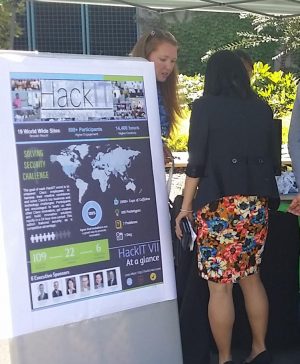
HackIT is Cisco’s bi-annual global hackathon, which has produced creative solutions to a wide range of problems posed by Cisco leaders. The HackIT team showcased solutions from their latest security hackathon that are being developed in the IT incubator. Visitors got an early look at an Internet of Things solution that helps safeguard privacy in a world saturated with video surveillance cameras by blurring a person’s face to preserve privacy in the video stream.
Virtual and augmented reality for the enterprise was one of the winning entries in our internal Innovate Everywhere Challenge. The winning team gave visitors a first-hand look at some of the collaboration and training experiences made possible by building VR and AR applications on the Cisco Spark platform.
An interactive map showcased the work of our nine Innovation Centers around the world, where Cisco fosters co-innovation efforts with customers, startups, and academic institutions.
All in all, Party on the Patio was a fun way to highlight non-stop innovation at Cisco. We are continuing to find and fund innovative external startups through our 2016 Innovation Grand Challenge (now underway), and we’re about to kick off a new internal Innovate Everywhere challenge in a few weeks. These are just some of the ways we continue to seek out and highlight great ideas at Cisco.
Today everything is becoming digital, and we don’t mean just connecting to a network. We are talking about machines communicating with other machines, employees retrieving the information they need allowing their work to be done anywhere and everywhere, customers interacting with their favorite brands and suppliers and the network becoming a source of insights when it comes to user interaction and threat awareness. These important, integral connections are why Cisco introduced the Cisco Digital Network Architecture (Cisco DNA).
The epicenter of the digital revolution is the network edge—regardless if it’s the wireless LAN, LAN or even the WAN edge at the branch. The edge is the catalyst to success more than ever before.
To be successful at the edge Cisco knows not just any solution will do. You need to have top security to protect the business and key assets, you need higher intelligence to make sure devices and apps deliver the optimal experience, you need to adapt faster and you need more granular data to identify problems when they’re still small—before they become big problems. This all adds up to you making better decisions, faster.
Cisco has invested a lot in the digital network edge to make sure our customers are prepared for not only the challenges of today, but tomorrow’s demands too. Our strategy isn’t about just meeting the latest standard. Cisco meets and surpasses them because we know the digital world moves fast, and those standards can be outdated in an instant. It’s no coincidence that as soon as a new standard is ratified, we start hearing about the NEXT standard.
In addition to the speed and ease in which you can get to the edge, harvesting and utilizing useful data is a breeze. With both cloud and on-premises deployments supporting Connected Mobile Experience (CMX), your network transforms from being a simple connection to the outside world to one that can granularly inform you about what’s happening in your own organization.
For our on-premises deployments, CMX works hand-in-hand with Hyperlocation, a feature that utilizes industry-leading location accuracy technology to provide even more data and security for your network. This is simply another way of interacting with your customers and your employees, making sure that these connections made on the edge will work for you.
The voyage to the network edge is where your next level of connections will take place, allow Cisco to take you there quickly and securely.
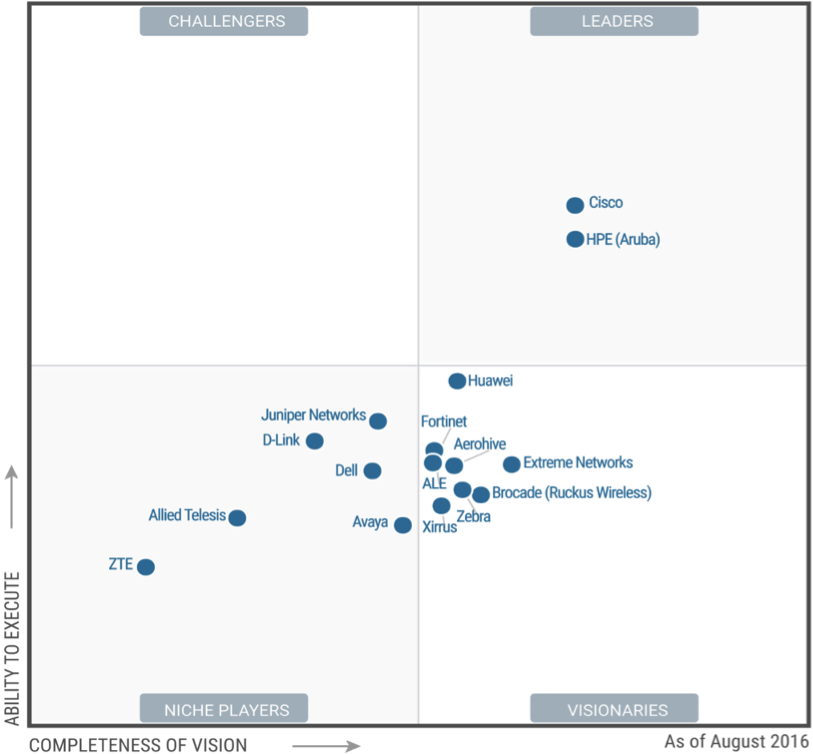
This graphic was published by Gartner, Inc. as part of a larger research document and should be evaluated in the context of the entire document. The Gartner document is available upon request from Cisco. Gartner does not endorse any vendor, product, or service depicted in its research publications, and does not advise technology users to select only those vendors with the highest ratings or other designation. Gartner research publications consist of the opinions of Gartner’s research organization and should not be construed as statements of fact. Gartner disclaims all warrantees, express or implied, with respect to this research, including any warrantees of merchantability or fitness for a particular purpose.



 volumes of data generated by these infrastructures is even harder. That’s why Cisco and Splunk have joined forces to deliver integrated solutions for IT Operations and Security Analytics that deliver end-to-end, real-time visibility across every infrastructure element.

 3) Cost savings through automation – IT organizations can dramatically reduce the time required to map new services and detect changes for existing ones through automated service mapping process. Through automation provided by Cisco ACI enabled infrastructure, IT organizations can also reclaim or retire applications, servers, and storage and networking resources, when they are no longer needed, resulting in additional operational agility and resource efficiencies.






 The event included food, music, games, giveaways, and hands-on demos of some of the many ways Cisco is fostering innovation—from our nine global Innovation Centers, to hackathons, to working with drones and virtual reality. Here are some highlights:
 HackIT is Cisco’s bi-annual global hackathon, which has produced creative solutions to a wide range of problems posed by Cisco leaders. The HackIT team showcased solutions from their latest security hackathon that are being developed in the IT incubator. Visitors got an early look at an Internet of Things solution that helps safeguard privacy in a world saturated with video surveillance cameras by blurring a person’s face to preserve privacy in the video stream.
 Virtual and augmented reality for the enterprise was one of the winning entries in our internal Innovate Everywhere Challenge. The winning team gave visitors a first-hand look at some of the collaboration and training experiences made possible by building VR and AR applications on the Cisco Spark platform.
 All in all, Party on the Patio was a fun way to highlight non-stop innovation at Cisco. We are continuing to find and fund innovative external startups through

 Get the Podcast