Avatar

We’re busy here in Cisco Collaboration – so busy that sometimes I feel like we’re moving at warp speed. We’re driving amazing traction with Cisco Spark, leading everywhere we can with it. “Call, Message, and Meet” is central to our strategy. And it’s on fire! We have announced partnerships and acquisitions to innovate and extend the offering.

But when you’re at warp speed, sometimes you don’t take the time to reflect on where you’ve been or what you’ve done. With today’s acquisition of Worklife, it made me pause to think about the last few months…

What have we done?

  • Partnered with IBM to bring artificial intelligence to Spark with Watson to improve collaboration
  • Delivered what we promised with Apple to make Spark better for the mobile workforce
  • Struck an alliance with Salesforce to natively embed Spark for Salesforce users and make it easy to collaborate
  • Created a $150M Innovation Fund to enable more partners than ever before to integrate and extend Spark
  • Acquired Tropo to extend offers, customizations, and integrations in Spark
  • Acquired Synata to enhance search capabilities in Message
  • …and today, added Worklife to our portfolio, which will make meetings even better!

The acquisition of Worklife underlines how important productive meetings are in today’s world. If that sounds like a natural fit for WebEx and Cisco Spark, it is. Worklife expands beyond the now – the in-meeting experience – to pre- and post-meeting capabilities like agendas, templates, notes, co-editing, tasks, and meeting previews. It’s about helping users stay engaged before, during, and after meetings. I’m excited to integrate these tools into Spark.

I’m glad I took a moment to reflect on our effort. We’ve done a lot. I’m so proud of our teams, and looking forward to seeing what comes next. We’re not standing still nor backing down on our goal to get Spark in everyone’s hands!

Please let me know what you think via Twitter at @jensmeggers.

Authors

Jens Meggers

No Longer with Cisco

Avatar

As groups around the world continue the conversation around cybersecurity – we’re at the midway point of National Cyber Security Awareness Month (#NCSAM) in the U.S. and European Cyber Security Month (#CyberSecMonth) – and speed toward the holidays, we at Cisco Talos want to touch on how to stay safe online during this busy time of year. We are seeing a lot of talk about ransomware lately, but let’s think bigger.

Before ransomware can be a problem, an attacker needs to gain entry to your system. Once an attacker has a strong foothold, they can do what they want within the limits of their capability – keyloggers, shells, the oft-mentioned ransomware, and much more. With that in mind, let’s focus on a broader set of security tactics you can employ that protect against the boogeyman du jour, as well as a host of other nastiness you could encounter.

I asked a few of my Talos team members to give us their best advice about how to stay safe online and to avoid these threats in the first place. I got many interesting responses that I would like to share here. Thank you Earl Carter, Tazz Worley, and Warren Mercer for sharing your expertise. For more in-depth coverage, check out Martin Lee’s Threat Briefing webinar on October 18.

BACKUP. PLEASE. JUST DO IT NOW.

Commonly available services like iCloud, Google Drive, OneDrive, Box, etc. make back-up easier than ever. However, most people still aren’t doing it regularly. According to Techiestate, 18 percent of users NEVER backup and 39 percent only back up “when they remember”. You just remembered. Go ahead and run a back-up now. I’ll be here when you’re finished. I’m serious…

Warren Mercer: A valid method of survival against most malware is to ensure you have sufficient backups in place. Simple things such as photos, music, schoolwork, and family videos are some items that you should consider backing up to a cloud service or to a removable storage device.

Earl Carter: Yes, backing up is crucial to protect against ransomware and other malware. One problem with backing up is that more advanced malware can attempt to encrypt or corrupt backup information if it is accessible [on the same system/network]. Since USB drives are relatively cheap, a simple solution can be to alternate between a couple of different drives. This also provides a backup for hardware failure in the process.

Running out-of-date Software

Here’s a scary fact. When a software company releases a patch, it’s possible to have an exploit for the out-of-date versions before the workday is complete. Have you been ignoring those software updates because you are in the middle of some other task? It’s hazardous to your online health, similar to how people and pets need to stay up-to-date on immunizations to avoid disease.

Earl: Attackers take advantage of vulnerabilities in software. Patching software as proactively as possible makes it more difficult for attackers to target your system. You need to actively patch all of the software that you use to help minimize your attack surface.

Risky Clicks

Even those of us who are “security minded” can fall victim to one of the oldest and simplest tricks in the book – the bad link click. Phishing attacks (and their more insidious cousin spear-phishing attacks) are a very common and effective attack vector. These attacks have grown in sophistication and effectiveness over time, but they still rely on one action – you clicking the bad link.

Earl: Be cautious when opening any email attachments. The same applies to clicking on links provided in email messages. Blindly opening attachments and clicking on links is incredibly dangerous.

Warren: You can protect your personal information by taking some care as to what you open, click on or accept from people or individuals you do not know. The aim of a lot of phishing-based attacks is to try and entice the end user to click ‘something’ – generally that something can be a malicious or compromised host which is used to deliver malware to the end user. Sadly it is not always evident as to what is a phishing email and what is not to a general member of the public. This is why people should ensure they are only opening information they are expecting, even if it appears to come from a friend.

But what if it is a very crafty email that looks like it came from a friend or you happened to get caught at the perfect moment of inattention? Is there a safety net? (Hint: Check out The Rising Tide of Spam Webinar on October 26.)

Earl: Using software that blocks malware on your system is important in providing extra protection against malware attacks in general. For home users, if you are running a version of Windows, you can install a Talos favorite, Immunet (http://www.immunet.com/) on your system. Blocking access to known bad domains is a quick step towards stronger security. Over 90 percent of malware uses DNS to access its command & control infrastructure. Installing OpenDNS is a simple way to gain extra protection against these threats. There is a free option for home users (https://www.opendns.com/home-internet-security/).

What about so-called “drive-by downloads” that don’t require a user to click?

Tazz: Use adblockers and don’t disable them when a site asks you to. Personally, I don’t visit sites that require you to allow them a free pass around your adblocker. For those who are super security conscious, I would say encrypt your hard drive and files with a strong and unique password. Also, don’t store or save what you don’t need and print critical docs and keep them offline for archive.

Defense Wins Championships

A little bit of daily defense helps give peace of mind against the headline-grabbing threats. It also can protect against the garden variety threats that are commonly used to get that first foothold in a system to exploit it further. We can use the tips above to mitigate attacks and recover more quickly if we are compromised. For individuals and businesses, it is not a matter of IF we will be attacked, but a matter WHEN and how ready we will be when it happens.
For more information on the latest threat research from Talos, please check out the latest blog at www.talosintelligence.com.


Join the National Cyber Security Month conversation on Twitter @CiscoSecurity #CyberAware.

Authors

Avatar

We’ve all experienced it. A flash, a resounding boom, a flicker, then darkness. Then comes the scramble for the flashlights and candles. How long will the lights be out? It’s hard to say, but hopefully after a few anxious moments, there’s a flicker again and power is restored. Usually it’s a brief outage, but what if it’s more than that? What if that flash and boom is a hurricane instead?

osuedu

Source: Osu.edu

This is what the residents of the southeast experienced following Hurricane Matthew. In North and South Carolina alone, more than 1.2 million customers found themselves without power. What happens next?

With digital smart grid systems, your wait will likely be much less than it was in the past.

Prior to smart grid implementation, storm response relied heavily on customer reports. This is problematic at best because when power lines are down, many times the communications lines are out too. Power companies required vast fleets of repair trucks – often recruited from far away utilities – to roam devastated roads to find line disruptions. This hit-and-miss strategy resulted in extended outage times and lost productivity.

Utilities can accelerate service restoration and more importantly, limit the number of affected customers in the first place using smart grid technologies. Fewer trucks are required to manage the disruptions, and crews are used more efficiently.

Utilities around the world are investing big money in upgrading to the digital grid.

Duke Energy in 2011 announced that they were spending $1 billion on the effort. As the investment dollars indicate, it’s not a small endeavor.

And it’s paying off for customers. Following Hurricane Hermine this year, the new Smart Grid technology prevented 25,000 Duke Energy Florida customers from outages – saving over 3 million customer minutes of power interruptions during the storm. Duke Energy is investing more and plans to have Smart Grid devices installed on lines serving 35 percent of customers by mid-2017. Today, only 20 percent of all Duke Energy Florida customers benefit.

10-6-16+Hurricane+Matthew+photo+for+Florida_mid

Source: Duke Energy

Upgrading to a digital grid involves transitioning antiquated systems to an Internet Protocol (IP) base, including open standards communication networks that allow for higher levels of automation and real-time data exchange.

With this technology:

  • Utilities can sense a failure as it’s happening. Self-healing grid systems can immediately reroute power to healthy parts of the grid to keep the number of customer outages to a minimum. Many customers will only see a momentary loss as the grid is re-routed.
  • Network systems with “last” or “dying gasp” support can allow utilities to determine where failures occur with more accuracy, allowing for quicker response times and fewer repair crews in the field.
  • Real-time data exchange allows customers to view outage information online, down to their own geographic location and estimated time-to-repair.

We have been at the forefront of the digital grid revolution, helping many of the world’s largest utilities transition their networks to state-of-the-art, upgradable technology. This level of integration also includes highly secure communications and NERC CIP compliance, allowing utilities to respond reliably and quickly to any incident – from a minor traffic accident disruption to devastation from natural disasters.

Using Cisco’s Connected Grid GridBlock Architecture, utilities can integrate their electrical grid with the digital communications network. This provides an end-to-end system control from Trans-Regional and Interchange Networks, through Substation and Distribution Networks, all the way to the Customer and End User Networks and Systems.

See what we can do for your digital grid strategy:

page-cta-2

Authors

Jon Judson

Marketing Manager

Industry Marketing

Avatar

I’m pleased to announce the acquisition of Heroik Labs, Inc. doing business as Worklife. Worklife is a privately-held company based in San Francisco, CA that provides software to improve meeting productivity.

Worklife’s mission is to help teams be prepared and informed so they can run highly effective meetings. Their application enables people to be more productive at work, by giving them more options to stay engaged before, during, and after meetings, from sharing agendas before the meeting, to taking notes during the meeting, and sharing those notes, as well as action items, after each meeting.

We are excited to welcome a team with a vision that is so complementary to Cisco’s own collaboration strategy, namely, to provide the best collaboration experience across every touch point, every space, and for every employee. With the Worklife team onboard, we see an opportunity to build on the virtual meeting experience that the Cisco Spark platform currently provides, and enhance meeting productivity across the board. For example, we can start offering additional tools, tightly integrated into Cisco Spark, to help users track calendars, create agenda templates, and collaborate on note-taking in real-time during a meeting. Together, we can drive a better meeting experience for all of our users.

Collaboration continues to be a top priority for Cisco. Worklife’s technology and talent builds on the success of Cisco’s previous collaboration software acquisitions such as Collaborate.com, Assemblage, Tropo, Acano and Synata.

The Worklife team will report into the Cloud Collaboration Technology Business Unit under Senior Vice President and General Manager Jens Meggers. The current plan is that Worklife’s existing online meeting software will continue to be offered free to customers.

Authors

Rob Salvagno

Vice President

Corporate Development and Cisco Investments

Avatar

A few weeks ago Cisco had the opportunity to present at Cloud Field Day to a panel of 14 influencers and to a larger audience via live stream. For those of you who haven’t seen or heard of Cloud Field Day, an extension of Tech Field Day, here is the breakdown: the top influencers (bloggers, podcasters, speakers, and freelance writers) come to Cisco to listen to a few experts talk about exciting topics in a presentation and discussion format. The influencers may ask questions throughout the presentation which makes the sessions more interesting and interactive.

Senior director of engineering and Cofounder at Cisco CloudCenter Gaurav Manglik presented at #CFD1 and gave a technical overview and shared details of how the product works and also showed a demo.

He further explains how Cisco CloudCenter, a hybrid cloud management platform, allows enterprises to easily create application models and shows how it is an efficient, flexible, and secure way to manage an evolving mix of Hybrid IT services.

You can watch the video below:

Noteworthy questions from the influencers (with time stamp included):

(10:50) What kind of integration do you have with ServiceNow? As a service catalog integration?

 (16:30) Is this [CloudCenter] being positioned as a competitor to vRA and RightScale? Listen in for key differences!

(17:45) Would you position this as the service catalog for an organization?

(22:00) What happens if you try to do something that cannot be implemented by policy? Micro-segmentation NSX, I can’t do that somewhere else, do you warn me about that when I deploy or does it just not happen?

(26:30) From the orchestrator perspective what’s the parody between yours and vRO?

Gaurav then transitions into the CloudCenter demo.

You can find the video below:

Noteworthy questions from the influencers during the demo (with time stamp included):

(10:00) You were contrasting various ways of deploying things saying scripting is bad because we have to change is all the time [can you further explain]?

(19:10) When you hit that provision button and set all the parameters can you do that through an API?

Is there anything I cannot do via API?

(19:50) What integrations do you have with configuration management systems, Chef, Puppet, Ansible?

Cloud Field Day in all had three different sessions from Cisco. Check out the recap of our first session where we discussed everything Cisco Metapod.

Feel free to comment below and watch out for the next upcoming Tech Field Days.

Authors

Breana Jordan

Product Marketing Specialist

Products and Solutions Marketing

Avatar

The excitement around the Grace Hopper Celebration of Women in Computing (#GHC16) conference is growing and growing! That’s because only a few days from now, some really awesome women in tech will descend upon Houston, TX and begin three days of networking, learning, interviewing and having fun!

With #GHC16 just around the corner, the @Cisco_Wise (Women in Science and Engineering) Twitter handle and the ‘WeAreCisco’ Snapchat channel partnered on the very first ever #CiscoChat / Snapchat crossover!

WeAreCisco Snapcode
Snap the code and follow along!

Not only was there great conversation happening on the Twitter chat, where Christine Bastian, VP of HR was answering questions about the great advantages, challenges and advice for being a successful woman in technology. In addition to answering the questions in 140 characters during the #CiscoChat, she also gave a little more detail on the topic with help from one of the WeAreCisco Snapchat super employee ambassadors, Rehana Rehman, Business Operations Manager.

Why a Snapchat crossover? That’s because next week at #GHC16, the WeAreCisco Snapchat channel will be Snapping away with attendees and encouraging them to share about this same topic – what makes them a strong woman in tech – where they can win an opportunity to get a networking opportunity with one of Cisco’s great women in technology leaders, Liz Centoni, SVP/GM of Cisco’s Computing Systems Product Group. If you want participate, or to follow along with WeAreCisco at #GHC16 on Snapchat, be sure to scan our Snapcode, or search for username WeAreCisco.

Below you’ll find a recap of the Snapchat story, in case you missed it, and the link to the Storify, where you can see the conversation from the #CiscoChat.

https://youtu.be/mZMHC5k9iNU

Will you be in Houston at #GHC16 next week? Be sure to stop by and say hi, or comment below to make connections before you go.

Want to join us and be a strong CISCO woman in tech? Visit our Careers site.

Authors

Carmen Shirkey Collins

Social Media Manager

Talent Brand and Enablement Team, HR

Avatar

AT30103

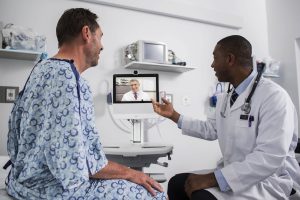
We’ve all been there: we just had a test performed at a doctor’s office, now we’re at home waiting on pins and needles for the results. Whether the results are good or bad, hearing them on the telephone can be a bit impersonal. Some times the doctor isn’t the one making the phone call. If you have questions and an expert isn’t around to take them, the time it takes for he or she to get back to you can be grueling.

Minnesota’s vRad, a leading national teleradiology service and telemedicine company, wants to take the impersonality out of test results. To do so, they tasked Cisco with creating a new wired and wireless network where video traffic is prioritized and carried with great accuracy. This way when a patient is given test results—even if the doctor is remote—he or she is able to communicate directly with the expert who made the diagnosis.

According to a vRad spokesperson, the face-to-face diagnose over video makes a world of difference. Even if the two don’t share the same physical space, a sense of trust is developed between patient and caregiver. That goes a long way in subsequent patient-caregiver interactions.

The network infrastructure was created using Cisco Aironet 3700 Access Points, Cisco Catalyst 3750X and 6500 Series Switches and Cisco 2500 Series Wireless Controllers. To make sure that the network was secure, Cisco Identity Services Engine (ISE) was used to safeguard the solution.

While the wireless network is great for colleagues who are able to instantly transfer high-resolution patient imaging files such as mammograms. The speed and clarity in which experts receive the images allows experts to make much more informed diagnoses.

To view this case study, please go here.

Authors

Byron Magrane

Product Manager, Marketing

Avatar

There’s never been a better time to reimagine the future, and at Gartner’s annual Symposium/ITxpo, we’ll be doing just that.

The ITxpo, which will take place from October 16th-20th in Orlando, is a gathering of more than 8,500 senior IT leaders and 3,000 CIOs. The goal of the symposium is to prepare these executives to deliver long-term business benefits through disruptive industry trends, and this year’s theme focuses on driving digital to the core.

As a proud leader of digital transformation, Cisco will be an executive sponsor of the event. We will communicate our innovative vision through speaking sessions, analyst activities and booth presence. You won’t want to miss Chuck Robbins’ mastermind keynote and Kevin Bandy’s inspirational session on Tuesday the 18th, or the other sessions featuring Cisco leaders throughout the week. For the full speaking schedule, please visit Gartner’s site.

Screen Shot 2016-10-14 at 9.53.26 AM

While you’re visiting the exhibitor floor, be sure to stop by booth # 331 for a demonstration of some of our key digital technologies. We will be demonstrating a variety of offers to help you evolve the workplace, prepare your digital-ready network, protect your organization from cyber threats and use data-driven insights to make changes intelligently. Ask our expert staffers how we can help your health facility, campus, community, city or country today.

What do we hope that you to take away from the event? Cisco and its trusted ecosystem of partners are in a unique position to enable your digital transformation vision. We want to help you securely connect everything to make anything possible.

Won’t be able to attend Gartner’s ITxpo? Follow @Cisco, @CiscoEDU and @CiscoGovt along with Cisco Health on Facebook for updates from the show!

Authors

Cecile Willems

Director, Global Public Sector

Global Sales Organization

Avatar

Rapidly changing business conditions, global competition, and digital transformation projects have resulted in an increased reliance on IT to deliver positive business outcomes. Yet, many businesses continue to struggle with delivering the applications and services at the rate and speed required to meet the needs. The culprit? Inflexible IT that cannot support the scale and rate of change their businesses demand. Legacy IT infrastructure remains complex, expensive to deploy and maintain, and risky to upgrade or change.

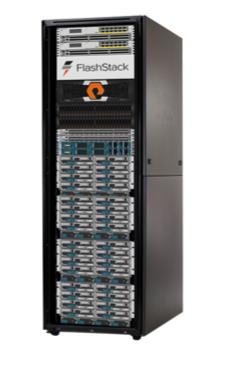
Modern businesses need modern IT. The FlashStack converged infrastructure solution consists of Cisco UCS servers, Nexus switches, and Pure Storage FlashArray storage. UntitledFlashStack is a high performance, always-on solution that is simple to deploy, operate, and upgrade.

The early results are positive. FlashStack has experienced some really strong traction with thousands of deployments spread across more than 30 countries. A recent customer example is FlightStats, part of FlightGlobal, which provides real-time and historical flight information to both companies and individuals. As their business grew, FlightStats’ IT Infrastructure struggled to keep pace. They deployed FlashStack using just four cables to connect UCS to the Pure Storage array. They run 239 virtual machines on just 5 UCS blades and process millions of messages per hour.

Continue reading “IT Infrastructure at the Speed of FlashStack”

Authors

Todd Brannon

Product Management Senior Director, Cisco Compute