NOW is the time to align your marketing and sales efforts.
More than ever you as partners, regardless of your function, have to remain vigilant of customers’ needs in today’s digital world. Everything moves faster. Everyone is connected. Your customers have transformed. Digital natives will dominate. As a result, your competition will disrupt you.
By aligning your marketing and sales you will be more in tune with your customers, and you will improve outcomes that you may not have even realized existed.
Face it. Digital is the new universal language. That means everyone in your practice holds responsibilities for both marketing and sales in supporting customers.
Engage in the Evolution
How are we helping you with alignment and your skills in the new digital first world? Enter the Engage Marketing Suite. It helps you step up, stand out, and get through to your customers. It’s a suite of digital marketing services. One side educates, connecting you to training, experts and best practices. The other side enables you to put those skills to action. Closing the divide between marketing and sales to increase impact.
Is it working? In the short time since we’ve introduced it we have seen the positive impact it’s had – partners that have fully immersed in Engage have reaped nearly 20% growth! By maximizing the benefits of Engage, our partners are experiencing success in what was a challenging environment. Let me be clear this isn’t a tool, platform, program or gimmick, this the value exchange we give to you, our partners. We want you to be successful. In doing so it helps you enhance your marketing efforts and impact your sales and brings those functions closer together. If you’re already blending your marketing and sales capabilities, you’re already a step ahead. Now you need to transform to a digital first model.
Get digitally savvy through Engage. Get access to always on marketing best practices, training and knowledge transfer from experts through Marketing Velocity to learn the digital language. Ready to get started with the ‘action’? Partner Marketing Central brings it all together through campaigns, funding dashboards and dedicated marketing expertise. The beauty of Engage is that you just need to start, where you begin is up to you. The outcome takes your marketing and sales to a new level, and the result will expand your outcomes, revenues and success.
Walk the Walk AND Talk the Talk
We at Cisco have experienced the benefits of closer marketing and sales alignment. To demonstrate this, Karen Walker, CMO will share the success of when these two worlds merge during Partner Summit in San Francisco (Nov. 1-4). She will offer proof points, partner insights and how our collective approach will change the way you do business in today’s digital world – through marketing AND sales.
Don’t fret if you can’t attend the event live. We will also make this discussion available through Virtual Partner Summit, and I invite you to register so you don’t miss it. You will also get fantastic insights for upcoming programs and marketing tutelage from guest speakers like branding expert, Martin Lindstrom.
Now is your time to change the way you do business. Your customers have made the transition to digital. Now is your time to get ahead of them — by aligning your efforts and transitioning to digital, you will succeed.
In our recently published E-Book, A Roadmap for Transport Network Modernization, we use a step-by-step checklist to evaluate what should be considered before embarking on a network modernization project. Our checklist seeks to address a core set of modernization requirements all service providers share. If you haven’t already developed a list of your own or are in the process of developing an RFP, our checklist is an excellent starting point for assessing the fit and function of different transport modernization solutions.
Transitioning from TDM to IP
Before you begin you should consider how will you transition from an aging TDM infrastructure to a next generation carrier class solution. Many telecom providers still generate significant revenues from TDM-based services, as a significant percentage of their customer traffic flows through TDM interfaces. However, the goal of most network modernization projects is to transition to an all-packet network. So how do you find a balance? How can you continue to meet the needs of your TDM customers, while efficiently scaling to meet the growing volume of IP traffic? A prudent approach would be a hybrid network supporting TDM, Ethernet, and IP. Transitioning with this type of solution would support your business needs now and provide a solid foundation for your next-generation transport network when you are ready to go to a full IP network.
The Requirements Checklist
At a high level, our checklist addresses the effects of a new solution on an organization’s business model, future growth opportunities, OpEx and CapEx targets, and integration into existing operational models, which includes staffing, skill sets, and OSSs and business support systems (BSSs). This checklist is not comprehensive. There are other factors unique to each business that should be considered, they include: assessing the current state of your legacy technology infrastructure, the size of your business, your geographic location, customer demographics, and the competition in your market.
The list that follows is designed to help you examine both generic and unique requirements that you should consider as you evaluate transport network modernization solutions.
Minimize effects on legacy infrastructureservices. You depend on your current TDM revenue stream and a new modernization solution should not disrupt it. Therefore, you’ll want to clearly understand how the new solution would affect your legacy infrastructure services. Questions to ask:
Can you still maintain existing service SLAs on a port-by-port basis?
Can you continue to use existing customer premises equipment (CPE) rather than replace it?
Launch new service offerings. One of the key benefits of modernizing your network is the ability to launch new service offerings, but it may not be a simple task. You’ll be replacing a significant amount of aging equipment with the latest technology. Questions to ask:
How easily will the solution enable you to launch new IP and Carrier Ethernet services over a single converged packet optical transport network?
Does it incorporate simplified workflows and operations-based tasks that align with existing user roles? Does it require new hires or employee skill sets are?
Reduce OpEx requirements. A new transport modernization solution should save you money as today’s hardware is more compact, powerful, and energy efficient. You should also see a reduction in the cost per bit to deliver traffic through the integration of next-generation technology. Questions to ask:
Does the solution replace gear that is expensive to maintain, like the aging DCS and ADM hardware?
Can it reduce the cost to deliver a bit through the use of scalable and efficient technology such as DWDM and MPLS?
Support Existing SLAs. To support your existing SLAs your new transport modernization solution needs meet industry standards and scale as more IP traffic is added to the mix. Questions to ask:
Can the solution meet the industry standard 99.998 percent SLAs for uptime, and 50ms timing for voice?
Does the solution use scalable technology such as DWDM to support an anticipated 50 percent annual bandwidth growth rate?
Reduce CapEx while maintaining support for critical network management. A network modernization solution needs a management tool that is standards-based and seamlessly integrates into your existing OSS/BSS systems. You’ll also need comprehensive TDM and IP service lifecycle management, including fault detection, configuration, performance, and provisioning. Lastly, it needs to be easy to use. Questions to ask:
Does it support business-critical operational features (for example, bit error rate testing (BERT) and loopback testing)?
Does it integrate with existing OSS/BSS systems?
Can it do comprehensive TDM and IP service lifecycle management, including fault, configuration, performance monitoring, and provisioning?
Is it easy to use? Does it align with existing user roles so that no new hires or skill sets are required?
Supports a simple, robust implementation. Your new transport network modernization solution needs to be easy to deploy, automated and the migration process needs to have minimal effects on end customers, existing services, and maintenance windows. Questions to ask:
Can I replace aging hardware as needed or do a more comprehensive changeover?
Can the solution be deployed and integrated with no effect on end customers or existing services?
Alison is a marketing manager with the Service Provider Cloud, Infrastructure & Business Solutions team. Her area of expertise is network management software, where she has more than 16 years of experience working and consulting for companies including InfoVista, Qovia, Ipswitch, CITTIO and RiverMuse. Prior to joining Cisco, Alison had her own product/digital marketing agency, where she consulted with a broad range of B2B and B2C clients. Although the core of her professional experience is in product/digital marketing, she’s also worked in product management, technical training and instructional systems design.
It’s about that time of year again! This week the Grace Hopper Celebration of Women in Computing (#GHC16) will be gearing up in Houston, Texas – and the women in tech here at Cisco are excited!
What’s GHC all about? Well, for starters, it’s the largest technical conference for women in computing. 15,000 attendees will be celebrating women in tech over three days, and gaining a lot of career knowledge too!
Our Cisco WISE employee resource organization (Women in Science and Engineering) helped to kick off the celebration recently by taking to our WeAreCisco Snapchat account and shared why they chose Cisco, career advice of their own, and why we’re so crazy about GHC!
https://youtu.be/AElv51fIqnM
Are you headed to Grace Hopper? Be sure to follow WeAreCisco on Snapchat and Instagram where you can snap/gram with us for a chance to win an exec meet & greet Liz Centoni, SVP/GM of Cisco’s Computing Systems Product Group. Don’t forget to stop by the Cisco booth and say, “Hello!”
Are you ready to embrace your power and be legendary? Join us! Apply Now!
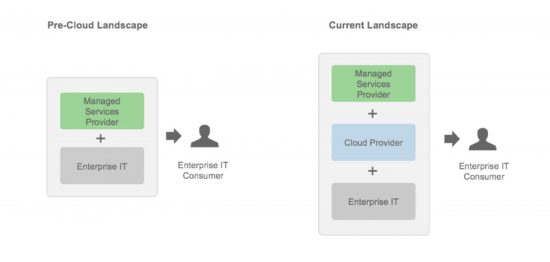
Managed Services is traditionally understood to be the practice of having a third party Service Provider – also known as a Managed Services Provider (MSP), take over the IT operations management (ITOM) responsibilities and functions from an enterprise’s internal IT. The third-party aspect is highlighted in the use of the prefix “out” as a part of words like “out-sourcing” or “out-tasking” that are used to describe this practice. Companies typically look at leveraging MSPs to help achieve their strategic business goals of improving operational efficiencies, managing complexity and driving new technology adoption.
On the other hand, Cloud Computing enables organizations to consume compute resources as a utility, rather than having to build and maintain computing infrastructures in-house. Three key benefits of Cloud Computing to businesses are that the computing resources are abstracted, managed and made consumable such that they are:
Self-provisionable and available on-demand
Elastic i.e. can be scaled up or down based on demand
Pay-For-Use i.e. resources usage can be metered granularly and users can be charged for exact usage
It is also well understood by now that Cloud Computing can be classified as Private or Public – the difference being whether the entity managing and providing the Cloud Computing resources is internal or external to the company.
The evolving role of Managed Service Providers with Cloud
In both Managed Services and Cloud Computing – regardless of whether it is Private or Public, there is a third-party entity that is providing a service to the consuming business entity. The fact that the services being provided in both cases are generally in the realm of computing and IT operations management, in my opinion causes some people to draw false equivalency. This then leads to thoughts where organizations ponder if Managed Services is even relevant in the context of Cloud Computing.
How Managed Services will evolve in a Cloud Computing world
Thoughts about whether Managed Services will be relevant to Cloud Computing were more rampant during the earlier days of Cloud. These days, the real question is not whether Managed Services is relevant in the context of Cloud Computing, but rather, how Managed Services will evolve to meet the demands of customers in a Cloud Computing centric landscape. After all, Managed Services is a business that has continually evolved over the years in response to dynamic market demands – from the early days of break-fix for PCs, through the era of networking and the Internet, to current service management models predicated on proactive and predictive management methods.
Here are a few points worth remembering about the applicability and relevance of Managed Services to Cloud Computing.
Managed Services is no longer about just keeping the lights on
Traditionally, Managed Services has been about keeping the lights on. This is why Managed Services started out with addressing IT break-fix, and ultimately evolved to the proactive IT operations management it offers today. With Cloud Computing, the responsibility of keeping the lights on is now the job of the Cloud Services Provider. Instead, Managed Services will now become about helping organizations understand how to effectively and optimally use the various capabilities made possible by Cloud Computing. The focus also shifts broadly to the application, and away from infrastructure management. This changes the way IT departments have to organize themselves, and MSPs can be the key to helping lead the change.
Complexity drives demand for Managed Services and Cloud Computing ain’t that simple
One of the key attributes of Cloud Computing as an operational model is that it makes self service possible. People sometimes make the mistake of extrapolating the simplicity of self service to management. This leads to a sentiment that Cloud makes management simpler and that organizations should now be able to handle management themselves. This is of course not true. In fact, with the proliferation of technology options in a Cloud Computing world, complexity is at an all-time high. Just ask the average IT staffer to navigate and make sense of the AWS or Google Cloud console. It is not that simple. It is no wonder that Amazon themselves have a growing list of Managed Services partners listed on their web site.
Hybrid, Multi-Vendor IT is here to stay. There is even more stuff to manage now!
The vast majority of enterprises will likely adopt and implement a Hybrid IT approach for the foreseeable approach that includes some combination of private and public clouds with traditional on-premises IT that is, invariably, multi-vendor. Consequently, the demand for Managed Services that cover all the elements of Hybrid, Multi-Vendor IT will continue to be in demand. MSPs can be invaluable in helping internal IT teams manage legacy IT, bridge their current gaps of knowledge wrt Cloud and then help transform to a Cloud operational model.
The need for Specialized Domain Expertise and Seasonality become a part of the equation
With everything moving to, or being organized in, a Cloud operating model (e.g. databases, applications, and analytics), there is a need for specialized management expertise in each of those areas. Let us take big data for example. It requires specialized expertise not only in terms of infrastructure implementation and operations but also to process and draw analytical value out of all of the data. For many organizations, this specialized and varied expertise is not readily sourced or economically justifiable – especially since seasonality could affect demand for this expertise over the year.
Compliance and Security concerns are now compounded
Cloud Computing is only compounding the compliance and security concerns that CIOs traditionally rate as one of their top concerns. This is evidenced in virtually every industry and analyst poll taken on the subject. Staying on top of evolving requirements in the areas of compliance and security in a Cloud world can be a challenge for IT departments that are already stretched thin. MSPs can really help organizations stay on top of their compliance and security policies as the IT landscape evolves to include the Cloud, thus enabling their IT departments to focus precious resources and energies on more strategic initiatives for the company.
Managed Services for IaaS, PaaS and even SaaS
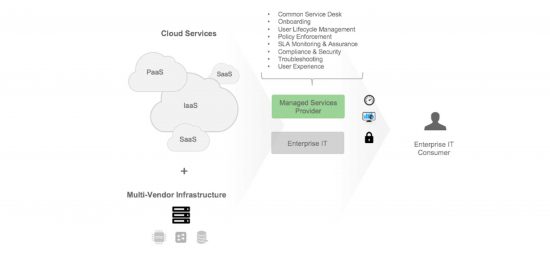
Now that we have established the relevance and the need for Managed Services in the Cloud Computing context, let us look at how Managed Services could be applied broadly to the three models of Cloud Computing, i.e. Infrastructure-as-a-Service (IaaS), Platform-as-a-Service (PaaS) and Software-as-a-Service (SaaS).
How MSPs can add value across Cloud Hybrid Cloud
IaaS
Private or Public IaaS Cloud providers such as Amazon Web Services enable the provisioning and consumption of one or more virtual server instances along with requisite storage. The lifecycle management of these instances (e.g. configure, start, stop, scale etc.) is done via a web console or through application programming interfaces (APIs).
Public IaaS cloud providers often provide a rich set of features and capabilities that vary by provider, and that can be overwhelming to the uninitiated. Understanding the proper way to interface with these capabilities, and effectively manage and orchestrate workloads in the context of a Hybrid, Multi-Vendor IT environment can be challenging. Virtual Machine proliferation is also an issue. The costs of running forgotten VMs can add up. Monitoring and managing the lifecycle of the VMs is a full time challenge. MSPs can help immensely by bringing their deep operational expertise across the various technologies, in addition to helping enforce policies around accounting, compliance and security.
PaaS
In the PaaS model, Cloud providers are responsible for hosting development tools and environments that developers can consume over the Internet using APIs, Web portals and gateways. PaaS can be delivered on-premises as part of a Private Cloud solution, or directly across the Internet by a Public Cloud provider.
In the case of a Private Cloud, the operational management of the underlying infrastructure to prevent latency and ensure availability, performance, policy compliance and security present plenty of opportunities for Managed Services. Even in the case of an organization consuming a public PaaS, Managed Services can help provide organizations with valuable expertise to enforce policies around accounting, compliance and security, wrapped around the other Hybrid IT services that are also likely in use by the organization.
SaaS
SaaS refers to the cloud model that delivers software applications that are consumed over the web via a browser or a mobile device. For example, Microsoft Office 365 is a SaaS offering for productivity software and email services.
It may be believed that given the simplicity of SaaS, management is a non-issue. However, with the growing popularity of SaaS it is likely that most organizations are consuming more than one SaaS offer across their entities. In the most likely case, where these multiple SaaS offers come from different providers, organizations end up having to deal with multiple activation and on-boarding processes. User provisioning & lifecycle management, orchestration, SLA management, policy enforcement, compliance and security across the different SaaS offers is non-trivial. Here again MSPs can be provide value by helping IT to create, provide and enforce a common user experience and operating model across all the SaaS offers.
How Cisco Cloud & Managed Services can help
It should be clear by now that Managed Services is evolving and will be even more relevant with the growing management complexity resulting from the adoption and proliferation of Hybrid Cloud Computing and multi-vendor IT environments. The ability of an organization’s IT function to handle this increased demand for services will continue to be a challenge, especially amid the backdrop of growing complexity and limited resources, budgets and expertise.
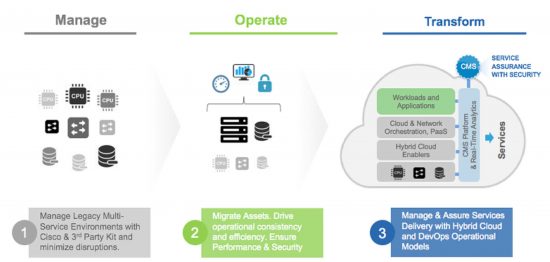
Cisco Cloud and Managed Services enables and manages your Enterprise’s transformation to Hybrid Cloud
The Cisco Hybrid Cloud Product Portfolio is comprehensive and provides all the building blocks for putting together a cutting edge Hybrid Cloud infrastructure comprising Infrastructure (e.g UCS, Nexus, Hyperflex), Orchestration & Management (e.g. UCS-Director, ACI, Cisco Cloud Center/CliQr) and PaaS (Cisco Cloud Native Development Platform).
Cisco Cloud and Managed Services (CMS) wraps managed services around the Cisco portfolio as well as around third party solutions. In combination with Cisco’s product expertise, CMS is uniquely positioned to help organizations looking for a MSP who can not only manage their existing heterogeneous, multi-vendor IT infrastructure, but also be a partner and trusted advisor in helping them transform their IT into a Hybrid Cloud operating model. CMS can truly be your bridge to the Hybrid Cloud.
On or Off the Clock, Staying Cyber Secure is a New Fact of Life
Cybersecurity has always been a major concern for workplace networks. But, increasingly, it is top of mind for home networks as well. Take a quick guess at how many mobile devices are automatically connecting with your home Wi-Fi once in range? If you guessed two or three, guess again. If your household consist of two or more persons, that number could easily reach a dozen. Add children and, well, your calculations can quickly explode exponentially. Portable devices such as smartphones, tablets, laptops and more stationary end points like smart TVs, security systems and even appliances are the reality promised by the Internet of Things. And as you extend your home’s network fabric beyond the traditional laptop it is critical that you consider implementing a threat-centric approach at home as well as in the workplace.
While anyone can fall victim to the vast array of malware, phishing emails and other sordid schemes, you should, given commonsense precautions, feel perfectly safe and secure using the Internet. The huge gains the internet has provided to interconnect the world far outweigh the crime that has come with it. As National Cyber Security Awareness Month (October) approaches, this is the perfect time to reflect on our own personal cybersecurity. While managing cyber incident response teams for both public and private sector organizations, I have personally witnessed countless individuals having their entire digital life torn apart and pillaged. Because of this real-world experience, I consider (and suggest you do as well) that every connected device in your personal life is a potential target in the eyes of an attacker.
Hacking has become a big business and the currency it trades in is accounts and systems. Think of an old bank account you may have but no longer use. You might think it isn’t at risk or a target since there is no money it. But to hackers, it is a valuable resource, one well established and accessible. Attackers can gain control of the account and use it to transfer illegal funds – leaving you to answer a lot of unwelcome questions from authorities. In 2016 it is more important than ever for all of us to realize we must take precautionary steps to keep our online accounts, systems and presence secure. Unfortunately social media, online applications and operating systems are not going to do it for you. So let’s take a few minutes to go over some simple steps you can take to protect your family and assets from cyberattack:
Secure your main email account(s): You may not have thought about it, but your email account is the key link to a variety of things in your life. For example, if someone hacks your email account they can force a password change for online retailers linked to that email (Like Amazon or iTunes). Similarly, your bank and many other systems may use your email as a way to allow for password resets. As a result, the security of your email account plays a central role in your overall internet safety. It is very important you set a strong password and enable two-factor authentication. All of the major players have ways to set this up. For example, with Gmail you can:
Click on “Get Started” then “Start Setup.” Enter your phone number and verify it by entering the numeric code that Google sends by either text message or voice call to that number.
You could instead choose to use the smart phone app “Google Authenticator”, which you would register through the same wizard shown above. Either option works and will help prevent attackers from taking over your personal email (and of course your online identity!).
Secure your bank account(s): Similarly to email, your bank accounts are high-value targets. This is especially true with online services like EBay and PayPal, the latter of which links directly to your bank account. EBay accounts are often hijacked to fraudulently sell high-dollar items (like iPhones), leaving the account owner responsible. If you use either, it is critical that you setup two factor authentication. Also do the same with your bank accounts. This will help ensure that a simple password crack, guess or reuse will not lead to account compromise.
Run the most current software: Even though your personal systems and accounts are targets, it is very unlikely an attacker will spend significant resources, using an unknown or 0-day attack, to break in if your software is up to date. Why? Because the number of unpatched, older operating systems and applications is so huge that the hackers have found it much more efficient to create automated tools capable of finding and exploiting holes in them. So you can be 100% more secure than almost everyone else on the Internet by merely updating to the latest operating systems & applications. But make sure to enable automated patching and force updates if you run any software that doesn’t offer automated updates.
Lastly, use a password manager and set unique passwords for each site you visit. All it takes is for one site to be compromised and then hackers will use that same email/password combination in an attempt to log onto other sites. Attackers have automated that part of the hacking process, so any successful email/password combination will quickly be run on potentially thousands of random sites. I realize trying to remember multiple complex passwords is both difficult and time consuming. So I suggest checking out the latest password tools to help: 1Password and Roboform. Both can offer you and your family a high quality, automated method to securely store and track your passwords.
So remember, as the Internet of Things expands the WiFi fabric within your home, it is critical that you also consider implementing a threat-centric approach to stay cyber secure. I encourage you to take some time during October’s National Cyber Security Awareness Month to take the first steps in doing so by researching and implementing your own personal cybersecurity solutions.
Thanks to DigiCert for their contributions co-authoring this post.
Interoperability for technology solutions is a top priority—standards used in these solutions become irrelevant when products operate in a silo. Thus, shifting to a new protocol in any solution takes careful consideration and collaboration by multiple parties in order to achieve a seamless operation.
One such protocol is Enrollment over Secure Transport (EST). EST provides secure digital certificate provisioning. Some of our products already support EST for digital certificates (e.g., Cisco IOS and IOS-XE), but EST endpoints don’t just operate by themselves. EST involves a certificate consumer and a certificate provider, usually called a Certificate Authority (CA). We needed to ensure that our EST solutions are compatible with third parties such as CAs, authentication servers, and endpoints.
To achieve that, Cisco collaborated with DigiCert to make sure Cisco’s EST implementations are interoperable with their CA. Today we want to share with you some lessons we learned from our testing.
Why EST?
EST is a standard (RFC7030) designed to improve the provisioning and management of digital certificates. At Cisco, we believe EST will be the chosen protocol for certificate management in industries that need more flexible and secure certificate registration. We have blogged about this before and have written about how EST compares with SCEP and other certificate management protocols, and why the industry has started to shift to EST.
About the Testing
The Cisco and DigiCert collaboration started in 2015. DigiCert provides the CA functionality (issuance and certificate lifecycle management) while our solutions are direct certificate consumers, clients themselves, or enable other clients to provision certificates from the CA.
Our goal for testing was to get the Cisco EST functionality that is embedded in our products to interoperate with the DigiCert EST server.
In the process we discovered some bugs that prevented our code from completing the supported EST transactions securely, but we fixed the issues. The following are some things we learned along the way:
Clear language in standards specifications is imperative. Implementers commonly interpret RFC text incorrectly, which can lead to interop issues.
Workflows defined by different use cases can lead to slightly different implementations. For example, the EST protocol defines certificate and basic HTTP client authentication. Depending on the use case, both authentication mechanisms might not be necessary. Thus, two different implementations could support different client authentication which leads to interop issues.
EST clients and servers do not always have the same requirements. For example, it’s important for the certificate providers to have the functionality to distinguish between certificate profiles of the client requesting the certificate, which is not a requirement at the client side. We found that path segments were needed at the CA EST server to map clients to different certificate profiles which also needs to be supported by the client.
Library dependencies could introduce issues. For example, we found that manually parsing HTTP headers on one side and using common HTTP libraries on the other revealed improper header processing in the manual parsing code which prevented the EST exchanges from completion.
Interoperability Success
The EST operations we tested initially were /cacerts, /simpleenroll and /simplereenroll. After concluding our first phase of testing, we have confirmed that:
Cisco IOS and IOS-XE products require feature enhancements to successfully interop with the Digicert CA. Cisco products that offer Registration Authority (RA) functionality can successfully allow Cisco IOS an IOS-XE products to communicate with Digicert CA using EST.
Cisco products leveraging the Cisco EST libraries (similar to libEST) can successfully communicate with Digicert CA using EST.
Authentication and certificate management are needed to establish device identity, which is increasingly important in a connected world. Interoperability between the DigiCert CA and Cisco products is needed to establish this identity through EST. We look forward to further collaboration with DigiCert and the rest of the industry to achieve a more secure and flexible PKI for the future.
Note: We would especially like to thank Rick Roos for the fruitful collaboration and other members of the DigiCert team for discussions that led to the improvement of our code and the protocol implementation.
Today’s world is all about moving fast, getting things done on the go – or at Cisco, going Full Speed – and mobility is critical to this way of life. Think about how mobility has changed industries – in healthcare, nurses can take patient information at the bedside using an iPad. In retail, sales people can checkout using their iPhone anywhere in the store. However, when the experience is frustrating – slow apps, hanging transactions – it’s easy to take a different course. All of us want to have the same connectivity that we have at work and at home no matter where we are.
This is why, over the last year, our engineering teams have been working with Apple engineers to develop the very best app and voice experience for iPhone and iPad on the best corporate networks. We know that it only takes one bad experience to lose a customer. Second chances are a luxury.
We think it is not just about experience. It is also about digital transformation, as a means to drive faster innovation, reduce cost and complexity, and keep your competitive edge.
Through our partnership with Apple and with the release of iOS 10 and availability of solutions on the latest Cisco networking software and hardware, you can now:
Roam freely – be more productive while on the go with efficient roaming, reduced network load and lower battery usage
Let your business come first – easily prioritize the most critical apps on your wireless network
Make it easy and automated – your network will configure itself automatically to optimize roaming and prioritize mobile app traffic
Enjoy improved mobile collaboration – deep iPhone integrations combines Cisco Spark’s high-quality voice and video calling with Apple’s legendary hardware and ease of use.
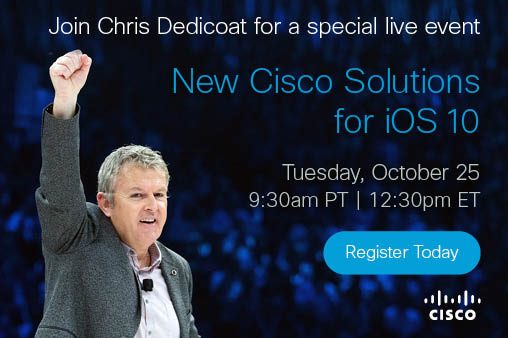
Please join Rowan Trollope, Joe Cozzolino, Jeff Reed, a special Apple guest speaker, and myself on October 25th for a livestream event to discuss our latest solutions that will help fast track your mobile enterprise.
Watch this space for the replay, coming week of November 7.
Topics during the one-hour session include:
Transforming your business with mobile solutions
Calling, messaging and meetings on iPhone and iPad
Optimizing Wi-Fi connectivity and prioritizing business apps
Centralized support across your Cisco and iOS devices
Live Q&A
You can read more about what we’ve done to optimize Wi-Fi connectivity and prioritize apps here and more on the collaboration updates here.
Think back to the healthcare and retail examples I shared earlier. Think about how enhancing mobility can transform your business. It starts with user experience and there’s never been a better time. Looking forward to you joining us to learn how to get started.
National Cybersecurity Awareness Month is a good time to look back and to note candidly where more effort is needed to improve cyber risk management. While it is a strong champion for this cause, the U.S. federal government has itself faced significant challenges in securing information technology systems in the wake of the 2015 Office of Personnel Management breach. To date, the funding mechanisms used by the government have complicated efforts to shift resources away from maintenance of legacy systems in favor of investments in newer, more secure technologies. Now, there are new and hopeful signs that both Republicans and Democrats can work together on a plan to help modernize the federal government’s IT infrastructure.
Chairman Will Hurd (R-TX), Congressmen Steny Hoyer (D-MD) and Jerry Connolly (D-VA) successfully combined two innovative mechanisms to improve federal technology procurement into a single bill—the Modernizing Government Technology Act of 2016—that recently passed the House of Representatives. If passed by the Senate and signed by the President, the legislation would:
Establish a centralized IT Modernization Fund based on the White House’s Cybersecurity National Action Plan. Agencies would compete for access to the funds based on demonstrated future savings and security enhancements. Upon repayment, other agencies would then be able to pursue similar opportunities.
Enable agencies to act on their own to reprogram money designated for operation and maintenance of expensive, insecure legacy systems. This idea preserves the autonomy of the agency leadership to redirect funds towards projects that make more sense in the long-term.
Both ideas will accelerate a pivot away from outmoded legacy systems to modernized solutions, which should cut costs, improve security and boost operational efficiency. In combination, they will move the federal government beyond from the status quo where nearly 80% of IT spending is used to maintain aging, insecure, and expensive legacy federal IT systems.
The US government will benefit significantly from this new bipartisan proposal. Federal systems currently in use are increasingly at risk of cyber-attacks and theft of sensitive personal data. They can and should be replaced with technology built on cloud-based, shared service models. The modernization of IT systems across the federal government enabled by this legislation will deliver cost savings, security enhancements, and improvements in the quality of citizen services. We appreciate the leadership of Mr. Hurd, Hoyer and Connolly, and will work with them to advance these important ideas.
I invite you to also check the Security Blog regularly throughout Cyber Security Awareness Month as we cover weekly topics that will provide insights about security, safety, and privacy. You can learn more about National Cyber Security Awareness Month in the US, and European CyberSecMonth across the European Union, as well as other corresponding cybersecurity advocacy campaigns around the world. Join the National Cyber Security Month conversation on Twitter @CiscoSecurity #CyberAware
In Scott Brown’s recent blog post, “The Digital Shift: Partner Evolution and Future of IT”, he talks about the transformation of product and service delivery models in our industry and evolution of sales practices to keep pace with customer expectations. As digitization and the anything-as-a-service model have taken hold, buyers want to pay as they go and try things out before they commit. By the time a prospect speaks with you, odds are they’ve already done their research and are pretty confident they are going to give you a try. Landing a new customer is no longer the ultimate goal. In fact, today, the initial sale is when the customer journey begins. And it’s post-sale where partners have the opportunity to differentiate and get ahead of the competition.
So, What’s the Key to Success? Take a Lifecycle Management Approach
Driving loyalty and delivering value after the initial point of sale is what sets companies apart, which means that now more than ever, the post-sale customer experience trumps all things.
Growing customer satisfaction along the entire relationship lifecycle is something we have to work at every day. It’s not easy. That’s why we’ve been analyzing the anatomy of the customer journey here at Cisco. We know that customer success is not driven by sales, or delivery or support alone: it’s the combination of all of these moving parts – at all the different touch points along the relationship lifecycle that creates an optimal customer experience.
Customer Success Starts with Adoption
As we drill down further into what drives customer success and loyalty, it’s clear that effective software adoption is critical. Building an adoption practice requires a focus on the health of the customer throughout the relationship lifecycle, looking both forward and backward. Ask yourself:
How effectively have your customers used your solutions?
Who has not logged in to the product in over 30 days?
Are there features they don’t know exist which would really help them?
Are they achieving outcomes they had hoped to with their technology investment?
Definition of Effective Adoption: Help customers realize the full value of their current Cisco investment so that they achieve the highest-potential ROI.
If we can answer these and other questions and empower customers to use all of the features and get maximum ROI from the things they buy from us, we evolve from being just another technology provider to a trusted advisor. In a nutshell, that’s exactly what we’re doing at Cisco with our lifecycle management and adoption strategy. We’re providing partners with the resources and enablement tools they need to assess customer health and drive value realization.
The partners who have participated in the early stages of our program have learned that adoption is a two-way street. It’s about creating value for customers, and in turn, this opens up new revenue opportunity for your business.
We’re on a Shared Journey
Customer needs are changing… and the pace of change is multiplying. And in today’s digital age and dynamic business environment, where trust and loyalty aren’t what they used to be, maintaining customer health can be challenging to say the least! At Cisco, we’re embracing the transformation and driving innovation to help our partners stay ahead of a changing economy and stand out from the competition. That’s why we’re organizing adoption and lifecycle management workshops to help partners exceed customer expectations for the Cisco technology investments they’ve made. In addition, we created the SuccessHub resource center, which offers innovative partner-focused content, playbooks and processes built around adoption, value exchange and customer success. With change comes uncertainty but also great opportunity. We’re embracing change and invite you to join us on this journey.
Learn more about developing a Lifecycle Management practice:
Watch this on-demand Customer Success Talk webinar:




 Alison is a marketing manager with the Service Provider Cloud, Infrastructure & Business Solutions team. Her area of expertise is network management software, where she has more than 16 years of experience working and consulting for companies including InfoVista, Qovia, Ipswitch, CITTIO and RiverMuse. Prior to joining Cisco, Alison had her own product/digital marketing agency, where she consulted with a broad range of B2B and B2C clients. Although the core of her professional experience is in product/digital marketing, she’s also worked in product management, technical training and instructional systems design.