Avatar

Are you investing in new IT equipment – or for that matter, any IT services including SaaS/Cloud services?  If so, I wonder how much you have invested in your operations management people, processes, and tools? Or are your operations team left to catch up on their own when you introduce new equipment, technologies and IT services delivered by third parties via the cloud.

If you are not investing in your operations management and IT services management processes at the same time as you invest in new IT equipment, you are potentially missing some of the biggest opportunities for return on your investments.  Have a quick review of the video below and I’ll explain.


Continue reading “Buying New Gear? Have You Invested in Operations Management to Assure Your RoI?”

Authors

Stephen Speirs

No Longer at Cisco

Avatar

As digitization is being embraced by companies, communities, cities, organizations large and small, it is critical to assess and address the challenges that exist. Challenges that can become show-stoppers for the internet of things (IoT), challenges that could diminish the promise of big data, challenges that may push promising innovations in domains of artificial intelligence, virtual reality or bio tech even further into the future. Challenges that can become huge business opportunities when addressed in an organized and proper way. The list of challenges to digitization below is by no means complete, but it does address the most important ones and how Cisco seeks to address some of them.

The Art of Connecting Everything

With the exponential growth of IoT and of digitization, connecting everything, securely and seamlessly, has become a true art. What is required, is for the industry to enable architectures that allow for convergence of a growing array of access technologies, end devices, sensors, software layers, analytics and solutions to come together. Cisco leads the world in this space. Having said that, such architectures require collaboration and agreement among partners in a booming ecosystem to become reality.

Standards

The development of IoT has suffered from a lack of standards in the market. Proprietary protocols and fragmented markets proved the rule rather than the exception. Without standards, IoT cannot mature. 2015 and 2016 have proved to be years of change and an inflection point as such. While on the consumer market side the emergence of standards is still in its early stages, on the industrial side, in areas such street digitization or in new technologies such as LoRa, standards emerge and certain protocols become de facto standards. With that said, a lot of work remains to be done and efforts in the market to “self-standardize” are delivering a huge boost to the overall development of IoT.

Big Data

Big data has often been called “the new oil”. Harvesting and leveraging big data is becoming mainstream yet plenty of issues remain, especially in the public domain, with issues concerning ownership, privacy and cyber security hovering in the background. Who guards the data and guards the guardian? Neither the private sector nor the government can be solely trusted to provide the full orchestration of the governance of privacy sensitive data. Adequately addressing this challenge is one of the most important organizational issues of our day and of our age.

Security

Cyber security is on everybody’s mind when addressing digitization. The world currently deals with 2.5 million cyber security threats per second. Understandably, 60 % of business leaders are reluctant to innovate due to cyber risks. Cyber security is an enormous challenge and yet also a great opportunity. Cisco certainly views it that way and has become one of the world leaders in cyber security. No other organization knows better where each packet of data is sitting, where it’s coming from and going to –and whether it is supposed to be there in the first place. Cisco delivers security in the network rather than adding a solution on top of it. Cisco Talos monitors 600 billion emails every day. On average the detection of a common breach takes the affected organization 100 to 200 days to discover. Cisco does it on average in 17.5 hours.

Skills & Jobs

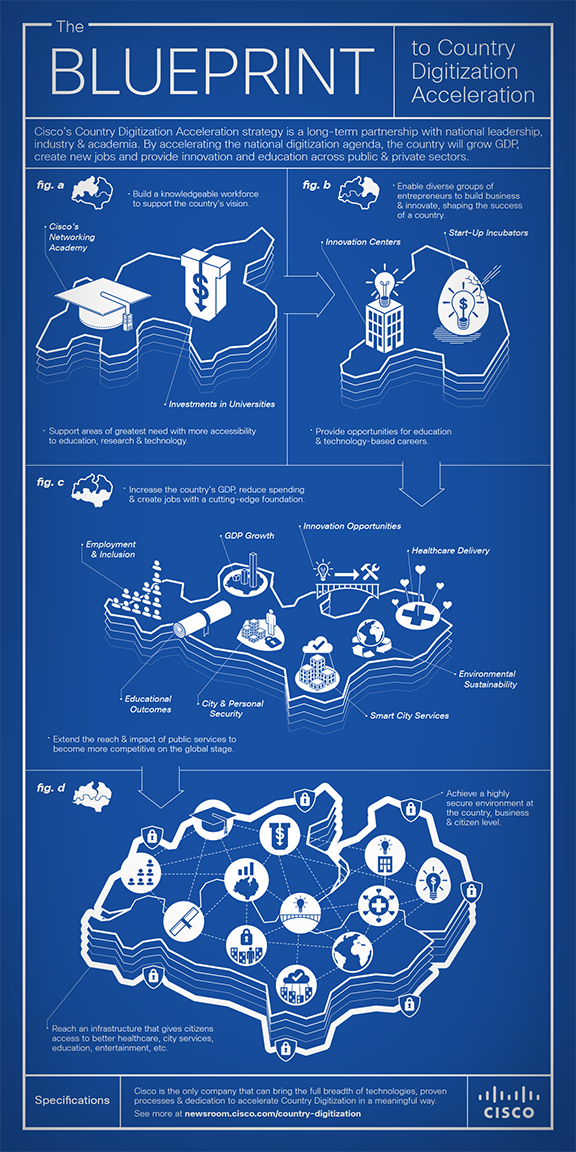
Digitization and the demand it is creating for the right professionals – engineers, network and solution architects, big data analysts etc. – is growing faster than educational institutes provide training. In Europe alone, it is expected that 1.2 million IT related job vacancies will exist by the year 2020. It is a challenge, however yet again this also creates an opportunity – for universities, technical schools, governments and the tech industry. Cisco’s Network Academy continually enrolls hundreds of thousands of professionals worldwide. The network academy has also become an important aspect of the Country Digitization Acceleration initiatives Cisco has launched in partnership with the governments of countries such as France, Germany, Italy, Mexico and India.

Proof of Value

All digitization efforts have technology at its core. What drives the adoption of these efforts however, is not so much proof of concept, but Proof of Value. Many IoT solutions find themselves at a stage where value is being proved – in monetary, social and environmental terms. Building the appropriate business architectures isn’t just a challenge, it is an opportunity for many in the market – and it is happening at a fast pace.

Understanding & Anticipating Impact

Digitization is triggering an economic revolution. In the words of Jeremy Rifkin, acclaimed thought-leader in this area: “The Internet of Things is the first general purpose technology platform in history that can potentially take large parts of the economy to near zero marginal costs.”

Take the transport sector in the US as an example. Automated vehicles will cause a major impact on one of the biggest professions in the US within a decade: the job of a driver. In the words of Robin Chase, founder of ZipCar: “There are 3.5 million freight and delivery truck drivers in the United States. There are 665,000 bus drivers. In New York City alone, there are 90,000 registered taxi drivers — not counting Uber and Lyft drivers. There are 5.5 million people manufacturing and designing cars and 1.65 million people working at dealerships. All of these jobs are at high risk.” Government and enterprise will have to collaborate in order to anticipate and respond to the exponential change digitization produces.

The challenges that come with digitization are large, but the opportunity is even larger. We are collectively at an inflection point, where the Internet of Things is becoming mature. There has never been a better time.

Click here to see Cisco’s Blueprint for Country Digitization Acceleration.


Authors

Bas Boorsma

Director

Internet of Everything & City Digitization - North Europe

Avatar

My grandfather used to say, “Better safety than sorry.”

His message was as strong as his English was broken. Case in point – cybersecurity and the banks of today.

Earlier this year, hackers broke through the security firewall of the Central Bank of Bangladesh to make off with over $80 million. Between the years of 2013 and 2015, there has been a 183% increase in financial services data protection breaches worldwide. On top of maintaining a round-the-clock caution against such attacks, banks also carry the imperative to adhere to ever-evolving compliance standards.

In such a world of meticulous regulatory reform, banks are indeed highly sensitive to breaches and attacks of any kind. Why? Huge fines and legal battles aside, the reputational risk that such breaches pose to the core business of banking may leave them reeling from an undoable damage. And that is notwithstanding the fact that these breaches may indeed be mere lapses rather than outcomes of organizational or employee misconduct. So is there a way that these banks could detect (and thwart) any deviation – even a lapse ? Is there a way to look at each flow of data and weed out anomalous flows – in real time? Absolutely.

https://www.youtube.com/watch?v=cPNi3y8Vi9U

Cisco Tetration Analytics has this very ability to filter data flows inside a bank’s data center, identify anomalous flows and pin-point rogue flows in real-time. Tetration works on a zero-trust policy framework, thereby monitoring every single flow through a data center.. and there could be hundreds of billions of them! Based on unsupervised machine learning and behavior based algorithms, Tetration gives the richest insight into all the applications interacting within a data center. One of its kind and first in the industry.

For more information on Cisco Tetration Analytics and how it can help your banking business, click here.


Authors

Premchand Akella

APJ Marketing Lead

Financial Services Industry Group

Avatar

As a Cisco customer, your voice is important to us. We want to hear about your experience with our company, the good and the bad, and use your feedback to design and prioritize improvements.

We listen to you in a variety of ways and surveys are an important tool. But, when response rates go down, and your comments reflect “too many requests for input” versus constructive remarks about your interaction with Cisco, we know there’s a problem.

Over the past year, we’ve made improvements to our listening channels and responded to input that you find our surveys too long and time consuming. We significantly shortened our CSAT survey, keeping only the questions that help us understand how you feel about Cisco and where we can still improve.

We’re now addressing channels specific to our customers who have experienced Cisco Services solutions and support. I’ve asked Kurtis Yang, who heads up Customer Experience and Listening for Services at Cisco to share details about our new approach, benefits to you, and how this change will help us listen more and respond better.


Guest Author: Kurtis Yang, Director, Customer Experience and Listening, Cisco Services

kyang cropCustomer experience is more than just a transaction. It’s about establishing trust and building relationships. It’s also about listening and responding in order to meet your expectations and consistently deliver. We recently evolved our listening approach and took these and other customer experience principles to heart.

In the past, customers may have received multiple surveys depending on which Cisco services and solutions they are using. This led to redundancy and overlap with other touchpoints and requests you receive from Cisco.

We’ve simplified things by creating one survey for our Services customers. Your time is valuable, so we’ve also made it shorter – reducing the number of questions and the time it takes to complete by 50%. The format is flexible so you can respond to most questions by selecting a multiple choice answer or adding comments and detail in an optional open text field.

Questions are designed to help us uncover and understand your source of frustration so we can prioritize customer experience improvements and create lasting results. For example:

• Has Cisco made it easy for you to obtain the support and solutions you need for your business?
• Did Cisco meet your expectations?
• Has your experience with Cisco improved or declined over the last year?
• If you were considering alternatives to Cisco, who would be your top choice?
• How likely are you to recommend Cisco to others, and why?

To make us easy to recognize, we’ve created a new email: cisco_services_listening@cisco.com. In late October, we’ll send the survey to current Cisco Services customers from this address, so watch for it in your inbox.

Evolving the way we listen is just the first step. We’re committed to acting on your feedback faster and also communicating what we change as a result. Thank you for participating in our survey and for sharing your thoughts that will help us enhance your experience with Cisco.

Have a comment now? Share below or email ciscolistens@cisco.com.

Authors

Curt Hill

Senior Vice President

Customer Assurance

Avatar

In the summer of 2012, I was asked to pick up a high profile project with time restrictions for Bank of America/Merrill Lynch (BAML). The brief was to implement a mobile phone recording solution for UK traders to comply with UK’s FSA rules on mobile call recording for financial institutions.

Part of the problem with this was that the technology wasn’t very mature when it was first introduced. There were a lot of pilot programs and discussions at all the banks, with lots of suppliers jostling for position and airtime.

Before dCloud

Cisco SecurityMy first instinct was to start contacting suppliers and initiate the RFI/RFP/RFQ/Pilot process to find a solution that was a good fit for BAML.  So the fun began and I spent the best part of a month defining requirements and talking to suppliers.

During this time, the front runners became clear. We created a shortlist and suppliers had even started to ship me mobile phones for onsite testing.

We had narrowed the decision down to SIM-based or agent-based solutions, but then Cisco contacted me to say that they were close to offering a solution that would integrate into the Bank’s existing VOIP setup. BAML was already a Cisco shop, so it made sense to get the sales team in and understand their offering.

This was my first time talking to Cisco face to face, and surprisingly it was death by PowerPoint. Where the other suppliers had been able to live-demo their products, Cisco couldn’t demo anything for months! They had a 30 page slide deck with pretty pictures and diagrams, explaining how it would work when released… We were disappointed.

Strategically we all knew that the Cisco solution was the best thing for the Bank. But short term we couldn’t wait for a Cisco Proof of Concept to be set up to convince us. We pulled the trigger and went with a SIM-based solution, and replaced 2,000 SIM cards across the UK in a matter of weeks.

After dCloud

Cisco ChatSince that time, Cisco has plugged this gap of not being able to provide demos at short notice. The dCloud platform has taken the concept of on-site demos and labs to a whole different level, which enables the Sales Engineers to run at #FULLSPEED.

In 2016, dCloud is a well established sales tool, poised to be part of the Cisco Sales future with over 200 different types of demo/lab content. It is available 24/7 in four globally-located data centers with 24/7 support, and has a dedicated team of developers constantly working on refreshing content and adding new offerings. It allows our Sales Engineers to fully demonstrate Cisco products and solutions that fix our customers’ problems – with no more PowerPoints!

Win with dCloudAs you’ve probably figured out… I’m now on the other side of the fence, working for Cisco.

I manage a fantastic team of developers, creating Data Center Content for the dCloud platform.  I also manage the UI/UX team of developers who are responsible for the dCloud experience and the upcoming mobile app.

I get great satisfaction out of the fact that I now work at Cisco dCloud in a team that really makes things happen. We enable Sales Engineers and customers to learn about our products and get their hands dirty at a moments notice, and really try before they buy.

Brian NarcumWhat’s your “Digital Selling” story?

Are you part of ours?

Tell us how dCloud is helping your Digital Transformation.

dCloud.cisco.com


Avatar

MichelleRagusaBFF

In early July, I read a blog about two Cisco Interns, best friends starting their career together at Cisco – and I smiled.  My mind immediately flashed back to a summer 12 years ago where two young girls stood nervously in line.  800 men and women joined us as we waited to interview in a “speed dating-esque” round table. DING DING- SWITCH! We sheepishly grinned at each other and started talking as we waited for our turn.

“Where are you from?” I asked?

She smiled and said, “North Carolina.” in a very clear European accent.

“Really?” I asked.

“OK Kyrgyzstan” she said with a grin, “but North Carolina is my home now.”

“Awesome, I am from New York,” I informed her, “but I’d love to call it home too if I get the job!”

Although perfect strangers from opposite sides of the world, that fateful day we formed a friendship not knowing what would happen next would completely change the course of both of our lives forever.

That young lady was Lesia Greene, and fate was on our side – we both got the job, and began our careers at Cisco in the Global Academy.  Our cubicles positioned side by side we studied together, learned together, lunched together, and laughed together.  We became best friends, and proud graduates of the Cisco ASR Program, CCSE and CCDA certified and were ready to begin our lives at Cisco.

Our celebration commencement was at Cisco Live in San Francisco. We excitedly watched then CEO John Chambers – our corporate hero – with hope and enthusiasm. We were now officially a part of the team and vision in changing the way the world lived, worked, played and learned. We soaked in the moment, taking it all in.

As we walked down the stage we caught another glimpse of John and our pace slowed, not sure if we should make eye contact or not. He smiled at us and said, “You must be our ASR’s!” We laughed – which signaled that the answer was, “Yes!” and he invited us to come over and talk.  We were truly taken with the moment in how our then CEO was actively curious about what new graduates thought of the company, and what we could do to improve.

Through the years that followed, Lesia moved to Seattle and I stayed in North Carolina – both in sales roles. We spoke often and never lost touch.  We even celebrated my 25th Birthday together in the Bahamas! We reunited when she became homesick as she missed the NC culture and moved back to a new role in Operations.

Throughout our careers, as it so often happens, life evolved – and so did we.   We celebrated joys and heartbreaks. We lost loved ones and comforted each other.  I broke both of my arms, and she fed me ice cream and nursed me back to health. We even celebrated our mom’s birthdays together every year as they share the same March 4 Birthday!  I also bought the world’s biggest, fluffiest bunny before I excitedly drove to the hospital as she welcomed her first daughter Maya (and was there for every chicken nugget craving leading up to that moment when her husband Bobby was away.)

The boy I was seeing, became my fiancé, and eventually my husband, Jay.  Lesia was a beautiful bridesmaid in my wedding who stood by my side and wiped my tears.  Jay and I then went on to have not one, but two daughters, Brooklyn and Cali, and Lesia had twins – Ava and Max!

We have spent the past 11 ½ years pursuing a career we love, building fulfilling lives – professionally and personally. And with every moment, we had our best friend by our side. Could it be any better?  To the young girls starting your careers – enjoy every moment of this amazing company and your friendship.


I wanted to share with you some valuable lessons I have learned along the way:

  • If you happen to dress alike from time to time, #Twinning is #Winning when it’s with your bestie! Do everything in life with conviction and a smile.
  • Having a friend who is a colleague is mutually beneficial for best practice sharing, team building, and constructive feedback on how to improve from someone who can and will be honest with you no matter what.
  • If you find yourself living far away from one another (I now live in NY) – you will be happy there are technology companies like Cisco that make amazing communication tools to stay connected with everyone in the world – no matter where you are!
  • You never know where life will take you, and in a blink of an eye you will look back and smile at the growth of your careers, your families, and of course, your friendship.

Want to find your best self – and maybe a best friend – at a great company? See open roles at Cisco here.

What do others say about working at Cisco? See our Glassdoor reviews!

Authors

Michelle Ragusa-McBain

Lead, Provider Elevate Team

Global Partner Organization

Avatar

Web


Locky has continued to evolve since its inception in February 2016. This has made it difficult to track at times due to changes in the way in which it’s distributed as well as various characteristics of the malware itself. The actors responsible for Locky have continuously attempted to improve operational security (OpSec) in regards to the tracking of affiliates making use of the ransomware.. This post will discuss a new Locky configuration extractor that Talos is releasing, which we are naming ‘LockyDump’. This is the first open source tool which can dump the configuration parameters used by all currently known variants of Locky ie; .locky, .zepto & .odin based ransomware.

Using LockyDump you can run a known Locky sample within a virtualized environment and it will extract and provide all of the configuration information for the sample, including the AffilID associated with the sample. The latest variant of Locky made this extraction process increasingly difficult. Once this config extraction changed Talos looked to reverse further Locky samples in an attempt to gain the all important AffilID information. Obtaining the affiliate information for individual samples allows the historical tracking of Locky affiliates to identify trends and other characteristics on an individual affiliate basis such as their primary distribution method of choice ie; through the use of Exploit Kits (EKs) or spam/phishing email.

Read More >>

Authors

Talos Group

Talos Security Intelligence & Research Group

Avatar

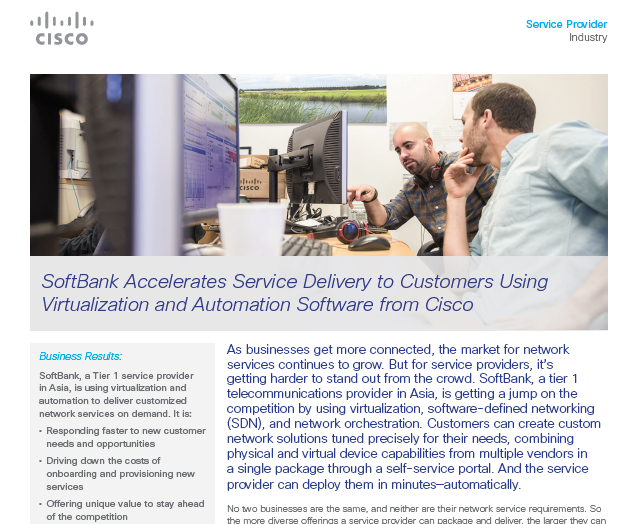
In the competitive market for network services, it’s getting harder for operators to stand out from the crowd. SoftBank, a Tier-1 service provider in Asia, is changing the game with automation, virtualization, and orchestration.

Today, enterprise customers can select and tailor network service offerings for precisely what they need from SoftBank’s SmartVPN Web portal. With end-to-end automation and orchestration powered by Cisco, new services can be up and running in minutes, on demand. Customers get more speed and flexibility. And Softbank is accelerating time-to-revenue and slashing operating costs.

Automating Services

Softbank has long given customers a broad menu of options for customized network services, with the ability to combine network equipment from multiple vendors to create exactly the solution they required. But the tradeoff for that flexibility was time.

Chaining together multiple network functions into a single service offering required teams of skilled engineers to manually configure and wire together hardware—often including devices from several vendors. The time from receiving a new service order to deploying the service was often days, and sometimes weeks. All of that manual effort translated to high operating costs for SoftBank, as well as missed revenues while waiting for the service to go live—both for the service provider and, potentially, its customers.

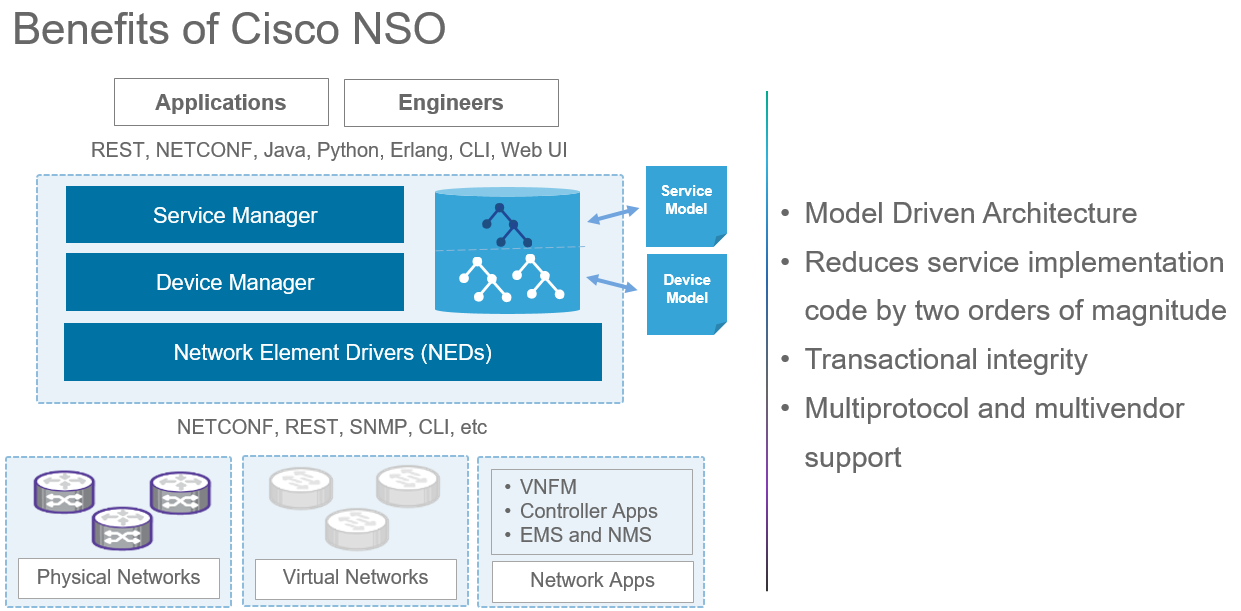
Now, SoftBank is virtualizing and automating network service provisioning. The operator virtualized key network resources and is using Cisco Virtual Topology System to create a more flexible, elastically scalable pool of network resources. And, instead of manually wiring and configuring each element of the service, they’re orchestrating the provisioning of multivendor network elements end-to-end with Cisco Network Services Orchestrator (NSO) enabled by Tail-f.

SB1

“With the Cisco solutions, it now takes just 10 minutes to provision equipment when a new service is deployed,” says Sadahiro Sato, senior vice president of ICT Innovation, Softbank. “That’s 86 percent less time than it used to take. And we expect to reduce operational expenses by 40 percent.”

SB2

Sadahiro Sato, SVP, ICT Innovation, Softbank

Supporting Hybrid Environments

While SoftBank is capitalizing on virtualization, they still use physical network devices for some services and will continue to do so for some time. Cisco NSO gives them the flexibility to automate provisioning and service chaining with physical equipment just as easily as virtualized resources.

“The required network environments are different for each customer, and from a performance and cost perspective, physical appliances still make sense in some areas,” says Sato. “With our hybrid environment, our customers have broader options to choose the best solution for their specific needs.”

Whether delivered via physical or virtualized network elements, SoftBank customers get exactly what they need, much faster, with a lot less effort.

“For our customers, the solution means that lead times are shorter and introducing new services is easier,” says Sato. “They are able to develop new services faster and reduce their TCO.”

Looking Ahead

SoftBank plans to continue expanding its use of virtualized network functions and SDN to make network services more scalable, simpler to manage, and easier for customers to consume. Company leaders believe that Cisco is an ideal partner to support them through this evolution.

“In the long term, we are moving towards a model of a highly reliable and autonomous network system with fully automated service deployment and healing,” says Sato. “We expect Cisco to continue developing cutting-edge NFV and SDN innovations to help us achieve our objectives.”

View SoftBank’s Virtualization and Network Automation Success Story

Want to know more about how SoftBank is capitalizing on virtualization and network automation? View their case study here.

SB blog4

Find Out More

And to find out what Cisco Network Services Orchestrator can do for your business, visit www.cisco.com/go/nso

Authors

John Malzahn

Senior Marketing Manager

Service Provider Cloud Solutions

Avatar

In my previous blog, I discussed the most common question I receive, “How do I begin the digitization journey for my company?” The next question is often, “How do we change our corporate culture?”

Corporate culture is key to the success or failure of digital business transformation. From my conversations with hundreds of companies, I believe executives hold two misconceptions around culture and digitization: 1) digitization will disrupt the culture they’ve taken so long to build, and 2) their culture isn’t ready to enable and embrace digitization.

Both of these positions reflect a widespread reluctance to act and a preference for the status quo. However, in today’s digital world, just the opposite—action—is required. Stagnation is an invitation to be disrupted.

Given this dynamic environment, agility must become your new corporate culture. Because change is the only constant today, the ability to quickly and effectively pivot cannot be approached with fear or in an incremental way. Instead, developing an agile culture must be embraced as an opportunity for growth, and potentially even survival, by seizing control of your organization’s digital destiny.

So, how do you create an agile culture? Regardless of where your company’s culture is today, “digital business agility,” a concept we highlight in Digital Vortex, is a great place to begin.

Create an agile culture with informed decision-making, fast execution, and pervasive security.

In April, I highlighted the three capabilities of digital business agility—hyperawareness, informed decision-making, and fast execution. Today, I want to focus on how informed decision-making and fast execution, along with pervasive security are especially powerful in creating an agile culture. This is because companies need to maximize the value of their most important and costly resource—their people—who need to collaborate across functions and distances.

In fact, work is no longer a place and organization charts can’t tell you who needs to take part in decisions. Expertise must be found and utilized wherever it is located. That’s why Cisco has brought more flexible and intuitive collaboration solutions to market like Spark and Jabber, as well as embedding analytics across the network that enable an agile culture.

Don’t lose sight of the fact that every employee is ultimately a decision-maker who can benefit from seamless collaboration and analytics. Not every “informed” employee needs to be a data scientist, but everyone can take advantage of analytics in their work. This is especially true when organizations shield analytical complexity from front-line users and embed intelligence in their workflows.

After employees are informed with accurate, timely, and relevant information, they need to act on it. In the context of digital business agility, fast execution is the ability of companies to implement plans quickly and effectively. This gives organizations a competitive edge by enabling them to acquire, manage, and rapidly shift talent and technology as needed. Fast execution also enables companies to more quickly create new capabilities, seize opportunities, and neutralize threats.

The last main component to create an agile culture is pervasive security. When companies know their employees, intellectual property, and customers are protected, they are more comfortable investing to build a digital business. Cisco’s own research showed 64 percent of respondents recognize that security is a vital foundation for digital growth strategies. To become truly agile, you need to treat pervasive security as an innovation competency.

In summary, be truthful about what may need to be addressed in your culture, and do not wait.  Seizing the initiative is the only way to survive in today’s digital world.  Learn more about how to digitize your business by staying tuned to my upcoming blogs.

Keywords: culture, collaboration, Spark, WebEx, Jabber, analytics, digitization, digital, transformation, agility, Digital Vortex, analytics, security, decision making, fast execution, digital business agility


Authors

Kevin Bandy

No Longer with Cisco