Avatar

Today Cisco announced support for the Intel® Xeon® processor E5-2600 v4 family on the Cisco Unified Computing System™ (Cisco UCS®).

On the same day as the Intel announcement, Cisco captured Nine world records on industry benchmarks on Cisco UCS to highlight the way in which Cisco UCS can accelerate performance across the data center. As we know, there is no better way to compare performance than by using industry-standard benchmarks, and with Nine new world record benchmark performance results Cisco has demonstrated Cisco Unified Computing System’s outstanding performance and IT productivity across key data center workloads. Check out the Performance Brief for additional information on the nine new Cisco UCS world record benchmarks. The detailed benchmark disclosure reports are available here. The performance leadership across a wide range of workloads provided by Cisco UCS is validated by the nine World records announced today summarized below:

  1. SPECfp®_rate_base2006 – Best 2-socket x86-architecture result
  2. SPECint®_rate_base – Best 2-socket x86-architecture result
  3. SPECint_base2006 – Best 2-socket x86-architecture result
  4. SPECjbb®2015-MultiJVMBest 2-socket x86-architecture result for critical jOPS
  5. SPECfp®_base2006 – Best 2-socket x86-architecture result
  6. TPC Express Benchmark HS (TPCx-HS)- Best performance and price/performance at the 1-TB scale factor
  7. TPC Express Benchmark HS (TPCx-HS)- Best performance and price/performance at the 10-TB scale factor
  8. SAP Sales and Distribution (SD)- Best 2-processor, 44-core, 2-tier result
  9. SPEC®OMPG2012 – Best 2-socket x86-architecture result

 Cisco’s world-record-setting benchmark results also demonstrate dramatic performance improvements over the prior- generation Intel® Xeon® processor E5 family. Cisco’s results demonstrate the degree to which Cisco UCS servers with large memory configurations deliver the power of the new Intel Xeon processor E5 v4 family. Compared to Cisco’s previous-generation servers powered by the Intel Xeon processor E5 v3 family, Cisco’s new servers demonstrate dramatic improvements in raw CPU power as well as business and parallelized application performance.

Cisco UCS with the Intel® Xeon® processor E5-2600 v4 family delivered up to 127 percent better performance over the prior generation Intel® Xeon® processor E5 family as shown in the graph below:

LE-56601-PB-Broadwell-Results (3)
Performance Improvement Compared to Previous Generation Cisco UCS Servers (Percent)

It is interesting to note that although all vendors have access to same Intel processors, Cisco UCS unleashes their potential to deliver high performance to applications through the power of unification and performance optimization. Cisco UCS integrates industry-standard x86-architecture blade and rack servers with networking and storage access into a unified system. Automated server and network configuration let you quickly and easily deploy new applications, repurpose existing servers, and scale applications with configurations that are compliant with your IT standards.

Cisco’s continued performance leadership with Cisco UCS comes in part due to the power of the Intel Xeon processors that power Cisco UCS servers. Intel Xeon processor E5-2600 v4 family CPUs provide the best balance of performance, power efficiency, and features to meet the diverse needs of your data center applications and workloads. Built on 14-nanometer (nm) processor technology, these innovative processors offer up to 22 cores, large high-speed memory configurations, and accelerated I/O throughput, delivering significant performance improvements compared to previous-generation processors. The processors also offer increased memory bandwidth monitoring and cache allocation capabilities, optimum data center orchestration and virtualization features, and hardware-assisted security advancements, which work in conjunction with Cisco UCS servers to further enhance the value of IT infrastructure in your enterprise.

The architectural advantages of a single cohesive system optimized for virtualized environments coupled with the industry leading benchmark performance results makes the Cisco Unified Computing System an “infrastructure platform of choice” to provide industry-leading performance in your data center. For additional information on Cisco UCS and Cisco UCS solutions please visit Cisco Unified Computing & Servers web page.

 Disclosures

  1. The floating-point throughput performance improvement of 19.3 percent compared the SPECfp_rate_base2006 score of the Cisco UCS C220 M4 Rack Server with the previous-generation Cisco UCS C220 M4 Rack Server, a result that was available on September 8, 2014.
  2. The integer throughput performance improvement of 27.5 percent compared the SPECint_rate_base score of the Cisco UCS C220 M4 Rack Server with the previous-generation Cisco UCS C220 M4 Rack Server, a result that was available on March 5, 2015.
  3. The integer processing performance improvement of 14 percent compared the SPECint_base2006 score of the Cisco UCS C220 M4 Rack Server with the previous-generation Cisco UCS C220 M4 Rack Server, a result that was available on March 5, 2015.
  4. The Java application performance improvement of 127.3 percent compared the SPECjbb2015- MultiJVM critical-jOPS score of the Cisco UCS C220 M4 Rack Server with the previous-generation Cisco UCS C220 M4 Rack Server, a result that was available on September 30, 2015.
  5. The floating-point performance improvement of 16.8 percent compared the SPECfp_base2006 score of the Cisco UCS C220 M4 Rack Server with the previous-generation Cisco UCS C240 M4 Rack Server, a result that was available in December, 2014.
  6. The big data system performance improvement of 11.1 percent and the price/performance improvement of 29.6 percent at a scale factor of 1 TB compared the TPCx-HS results of Cisco Integrated Infrastructure for Big Data and Analytics using Cisco UCS C240 M4 Rack Servers with Huawei FusionInsight for Big Data, a result that was available on September 15, 2015.
  7. The big data system performance improvement of 3.9 percent and price/performance improvement of 13.3 percent at a scale factor of 10 TB compared the TCPx-HS results of the Cisco UCS Integrated Infrastructure for Big Data and Analytics using the Cisco UCS C240 M4 Rack Server with the previous generation of Cisco’s solution, a result that was available March 22, 2016.
  8. The SAP SD benchmark certification number was not available at press time and when certified can be found on the following web page: http://global.sap.com/campaigns/benchmark/index.epx.
  9. The parallel-processing performance improvement of 28.2 percent compared the SPECompG_peak2012 score of the Cisco UCS C220 M4 Rack Server with the previous-generation Cisco UCS C220 M4 Rack Server, a result that was available on September 8, 2014.
  10. The Transaction Processing Performance Council (TPC) is a nonprofit corporation founded to define transaction processing and database benchmarks and to disseminate objective and verifiable performance data to the industry. TPC membership includes major hardware and software companies. The performance results described in this document are derived from detailed benchmark results available as of March 31,2016, at http:// www.tpc.org/tpcx-hs/results/tpcxhs_perf_results. asp.
  11. SPEC, SPECfp, SPECint, SPECjbb, and SPEComp are registered trademarks of Standard Performance Evaluation Corporation. The benchmark results used to establish world-record status are based on those available at http://www.spec.org as of September 8, 2014.


Authors

Girish Kulkarni

Senior Marketing Manager

Data Center & Virtualization Marketing

Avatar

In my role as Global Manager, Energy Market, I have seen changes due to threats like the shortage of expertise and falling oil prices. The current price for crude oil is at the lowest level in two decades (U.S. Energy Information Administration). Does this mean that there are no changes and opportunities? Definitely not, when one door closes a few others open. Let’s explore some of those opening doors.

energy-blog-1

The landscape of the Oil & Gas market is traditionally categorized in three areas:

  • Upstream – exploration, development, and production of O&G
  • Midstream – the storage and transportation of O&G
  • Downstream – processing and selling the final products

It is clear that with the current low oil price, only those oilfields where the oil can be extracted for less cost per barrel than the current selling price are still financially attractive to explore.

energy-blog-2

Upstream is a difficult place to be at this moment. Nobody wants to be the first to stop producing because others will take over your market share. Oilfields will keep producing and store the oil or take the loss for a relative short time. This leads to the current overproduction of crude oil.

With the current oil price, upstream companies would be wise to not sell more crude oil (unless it serves a strategic goal) since this can cause a further price drop.

Upstream O&G companies should focus on cost reduction in the current economic climate.

energy-blog-3

If you can sell the same amount of product while making lower costs, your margins will improve. For upstream O&G, Cisco is focusing on solutions to cut costs by becoming more efficient and effective. In the next blog, I will highlight some of the solutions which can be deployed to achieve this.

These solutions will enable better and faster decisions, prevent and shorten unplanned downtime, and provide better security and safety. All these solutions will add to the bottom line – either by increasing revenues, reducing costs, mitigating risks, and increasing customer loyalty.

Whereas upstream is challenging, midstream and downstream companies are benefiting from low oil prices as there has never been so much crude oil to store, transport, and process. Terminal companies see their storage tanks filled to the brim and pipeline companies have a lot of oil to transport. Since the price of oil is a ‘cost of goods’ for a refinery, low oil prices mean that the margins of refineries are healthier and more investments are being made in refinery land.

In the next blog we’ll explore how we’re helping profits flow for O&G companies using digital technologies.

To take a deeper dive into these macro-economic developments, read our latest whitepaper “A New Reality for Oil & Gas” and visit www.cisco.com/go/oilandgas for the latest updates.

Authors

Rene Pluis

Senior Manager, Global Industry Energy

Avatar

Great leaders inspire us. They create exciting new visions. They push us to do things we might not have tried before. During times of crisis, they think and act creatively to solve problems. Leaders aren’t just needed in business but in all areas of life: family, friends, neighborhood, social circles etc.  Sometimes a leader is inherited and comes along with a situation. Sometimes a new leader steps up to manage a situation. But sometimes WE have to step-up and be the leader. Are YOU ready?

Selling requires leadership. As sales people, we have to inspire our customers to imagine the solution we are recommending. We have to be able to paint a vision of the changes that will occur should they acquire that solution. And in the event of problems, we must quickly solve the issue and calm the situation. We cannot sell without being a leader throughout the process.

So exactly how good are YOUR leadership skills?  Do you have what it takes to not only close the deal but to step-up in other areas of your life? Mindtools.com has a quick quiz you can take to get a handle on your leadership skills. The free quiz will assess your emotional intelligence, your transformational leadership skills, your positive outlook and much more.

Regardless of your score on the quiz, you DO have what it takes to be the leader – you just have to commit to being one. Being a leader requires consistency around four (4) characteristics:

  1. Set a positive example: Leaders roll their sleeves up, along with everyone else to get the job done. They don’t sit back and bark orders for others to get the hard work completed. Instead, they chip-in, work alongside the team towards mutual goals and garner respect for being a team player. As a sales professional, make sure you are knee deep in the details. Your customers will appreciate the effort and your level of credibility will be improved markedly. You have to know your stuff.
  2. Admit when you make mistakes: Let’s face it. We are all human and mistakes are just part of that experience. Leaders must be willing to admit when they’ve had an error in judgement or made a wrong move. Admitting mistakes takes courage but also gives others permission to admit they made mistakes. This creates space for people to take more risks which are necessary to innovate and improve. And most importantly, mistakes are almost always uncovered eventually so best to get in front of it instead of covering for yourself later on.
  3. Make the tough decisions: Leaders have to be willing to make the tough calls even when they are unpopular because they are necessary for the long-term health of the team. In sales, there are times when you have to say “no” or deliver that bad news to the customer and team. Putting it off or avoiding only prolong the pain. So face the fear and be open about difficult decisions. As long as you are honest and have the best interests of the customer in mind, the situation is salvageable.
  4. Live with integrity: Great leaders have a strong sense of integrity. They know what they believe and are willing to stand-up for what is right regardless of the consequences. This is not always easy. But at the end of the day, we have to look in the mirror and like who we see. A leader who flip flops or is weak in this area will never garner the level of respect they desire. Such is true in sales and everywhere in our lives. Always do the right thing and keep your self-respect intact..

Leading isn’t always easy but it is necessary to step-up and lead when we are called upon to do so. Keep these four tips in mind and you will hone your leadership skills in all areas of your life. No matter how good your leadership skills are now, there is always room for growth. What are the biggest lessons you’ve learned around leadership? Please share…

Authors

Karin Surber

Sr. Global Business Development Manager

Global Partner Strategy and Planning

Avatar

Talos is disclosing the discovery of vulnerability TALOS-2016-0095 / CVE-2016-2347 in the Lhasa LZH/LHA decompression tool and library. This vulnerability is due to an integer underflow condition. The software verifies that header values are not too large, but does not check for a too small header length. Decompressing a LHA or LZH file containing an under-value header size leads to the decompression software allocating a pointer to point to released memory on the heap. An attacker controlling the length and content of such a file can use the vulnerability to overwrite the heap with arbitrary code.

Read More>>


Authors

Talos Group

Talos Security Intelligence & Research Group

Avatar

The world’s video content leaders head to Las Vegas in a few weeks for the annual National Association of Broadcasters (NAB) convention, where a sustaining theme is how to get to “cloud scale” – meaning a media optimization weaving all through the content ecosystem, from the camera to the end screen (and whether that screen is hanging on the wall, or tucked into a back pocket.)

What is “cloud scale,” you ask? Excellent question. To me, “scale” means launching new stuff that can grow quickly – without being greedy about physical space, taking too much time, costing too much, etc. That’s usually what people mean, when they say “yes, but does it scale?” So in that sense, “cloud scale” is all of that, as it applies to virtualization and securely moving content production, distribution, and consumer experience elements into these cloud scale environments.

What is “media optimization”? It is making the infrastructure aware of the media applications and workloads (treating them as VIP tenants), and maintaining Quality of Service (QoS) and reliability without packet loss. All while ensuring that media applications behave in these new cloud/IP environments.

On the media/content side, what used to be a fairly straightforward ecosystem – acquisition, production, distribution and user experience – is careening toward IP distribution, programmable data centers, virtualized applications and personalized experiences. It’s all an effort to optimize the lifecycle of entertainment video.

NAB is a natural proving ground for cloud scale and media optimization, because it’s such a uniquely rich blend of entertainment stuff, and technology stuff, which is pretty much where we live!

Cisco will be there with details and demos about what it takes to build and operate a media-optimized infrastructure, so as to securely scale branded experiences. That means elastic data center and networking to support demanding video production and distribution requirements, combined with automated and simplified operations, to meet (endlessly!) evolving needs in a fraction of the time it currently takes!

It also means immersive experiences delivered directly to consumers, accelerating engagement and monetization – like streamlined publishing of video content to all devices, and flexible content management, monetization and protection across all platforms.

Here’s a sampling of some of the capabilities we’ve been implementing with customers, which you can come see in our booth (Upper South Hall, #8502):

  • New solutions to help broadcast media production transition from SDI to IP.
  • A new, virtualized data center framework for running media applications and workloads from Cisco and third parties.
  • The virtualization of primary distribution letting you rapidly extend control from uplink to downlink.
  • Our Virtualized Video Processing platform orchestrating media applications and workflows across hybrid cloud environments.
  • Our Infinite Video solution providing a cloud-based OTT platform for multiscreen live, linear and video-on-demand services.
  • Security solutions for media and broadcast, extending from data center and networking environments through video content and service protection.

Off the show floor, we have a long list of speakers who will share their insight on the drivers of change in the media industry and how to be prepared. Our own Dave Ward, CTO of Engineering and Chief Architect at Cisco, will keynote an NAB Super Session titled, “Cisco Presents: Media In a World of Exponential Technology Changes,” on Tuesday, April 19, from 12:30-1:30 p.m. in the South Hall, Room S222.

We have two execs participating in the Imagine Communications Imagine Live! Power Sessions on Tuesday, April 19: Bryan Bedford, Global Business Development, Partner Organization, Sports, Media & Entertainment Ecosystems at Cisco, will serve on a panel to highlight “Open Standards That Drive Innovation – The AIMS Alliance,” Tuesday April 19, 10:00 – 10:30 a.m., and Dave Ward will keynote a discussion on “Video’s Five-Year View and What to Do About it Now,” from 2:00 – 2:30 p.m. in Booth #N2502.

We have several speakers presenting at the ‘Connected Media / IP Theater’ sessions Monday, April 18 – Wednesday, April 20 including:

  • “Architecting the IP Replacement for SDI,” Pradeep Kathail, Chief Software Architect, Cisco; Subha Dhesikan, Principal Engineer, Cisco.
  • “A Stateless Virtualized Broadcasting Facility,” Tom Ohanian, Senior Business Development and Media Segment Strategist, Cisco; Matt Caulfield, Principal Engineer, Cloud & Virtualization Group, Cisco.
  • “Secure Multi-Sensory Digital Media Coverage Through Drones,” Biren Gandhi, Distinguished Engineer and Strategist, Cisco.
  • “Live Video Production and Next Generation Broadcast Video with IP,” featuring joint speakers from Cisco and EVS.

Also of note is our Michael Koons, VP of Global Systems Engineering, will participate in a ‘Leadership Summit Panel’, on Sunday, April 17, from 1:00-1:30 p.m.

In the Twitter-sphere you won’t want to miss our #CiscoChat on Monday, April 18, beginning at 9:00 a.m. PT where Cisco’s Rajeev Raman, Director, Infinite Video, and Technology, Tom Ohanian and industry tech journalist and analyst Leslie Ellis will discuss “using the cloud as the next video platform.” Join us and be part of the conversation by following @CiscoSP360!

In closing: We’ve invested heavily in cloud infrastructure and delivery – north of $2 billion, as well as security, and video – and currently support a growing list of more than 70 as-a-service-based Infinite Video customers, which went from “ok let’s do it” to “up and running” in days/weeks, not months/years.

We’re wired for agile methodologies, and everything that goes with the cultural and workplace shift toward continuous integration and continuous development. We’re ready for cloud scale and media optimization. Are you? Come by, let’s talk. Hope to see you there!

Authors

George Tupy

Market Manager

Service Provider, Video Solutions

Avatar

EngineeringSmiles

How incredibly amazing are the Cisco #LoveWhereYouWork pictures on social? I have learned so much about our fellow Cisconians globally by the stream of pictures that came in last month – it was hard not to get hooked!

Our Engineering/Engineering HR team took the Life At Cisco #LoveWhereyouWork Challenge to heart and strove to knock this picture out of the park while illustrating our playful side. Our team is diverse and filled with some extraordinary women (and man) but I think what might set us apart from the rest is the unconditional support that we lend each other. Most of all, we ALL truly Love Where We Work!

When our uber creative team began brainstorming ideas on how to tackle the #LoveWhereYouWork challenge, we toyed with the idea of doing something around teamwork perhaps around the SuperBowl. But then ‘The Dreamer’ on our team (read more on this below) came up with the brilliant idea to spoof the Vanity Fair Hollywood 2016 Cover. With Women’s History Month and Diversity being such a hot topic we knew that our #LoveWhereYouWork picture would have be amusing and entertaining.

Take a look, did we hit the mark? Personally, I think we slayed!

EngineeringVanityFair

All great teams consist of people whose strengths define who they are and it’s how they bring those strengths to collaborate on a team is what makes all the difference! This is especially true for us, so without any further ado I would love to introduce our fabulous Engineering/Engineering HR team. Check out why they #LoveWhereYouWork!


The Fighter: Linda Clark

Linda

I love being part of an awesome team who keep the Chief Development Office for Engineering running successfully.  There are lots of things, which get done behind the scenes, and this is the team responsible.  We are rarely in the limelight, so this is a special opportunity for us.


The Dreamer: Liz Centoni

LizCentoni

#LoveWhereYouWork – because everyday I work with fierce women who are creative, strong, funny, inspirational and unstoppable as they set out to change the world for the benefit of everyone


The Mentor: Christine Bastian

Christine

I love where I work because of the people, driving change and being a part of Cisco’s incredible innovation engine.

The Stabilizer:

Stabilizer

I #LoveWhereYouWork because I have the most amazing women surrounding me daily with their brains, brawn and beauty.


The Connector: Alayne Lima

Alayne

I love where I work because I have the freedom to be myself and work with a team who inspires and challenges me to think outside the box.


The Enabler: Jan Foo

Jan

I love working at Cisco because Cisco truly changes the way we live, learn and play, and the learning possibilities are endless here.


The Builder: Adithya Mopuri

Adithya

There are lots of opportunities around here. Great place to network and the innovative culture brings out the best in employees, making Cisco an ideal place to work.


The Magician: Cheer Cao

Cheer

Cisco allows me to embrace all: Life, learning, fulfillment, friendship and growth…and of course much more pending to be explored…”


The Designer: Jeanne Chang

Jeanne

The people at Cisco are a pleasure to work with and make it enjoyable to come to work!


The Explorer: May Le

May

I #LoveWhereIWork because I’m surrounded by intelligent, fearless and compassionate women who are my true role models for success. #goals


The Advocate: Ana Lim

 Ana

I love where I work because I can bring my authentic self to work and thrive. I interact with inspiring colleagues on a day-to-day basis who challenge me to learn and grow.


The Storyteller: Rehana Rehman

RehanaR

#LoveWhereYouWork comes easy to this team and WE are the Real Inspiration of 2016 because we all look out for each other, we support each other’s ideas and work together to foster an environment that drives innovation 24/7.


Honorable Mention: The Collaborator: Tobi Martin (not pictured in the group pic)

Tobi

Cisco brings out the very best in me by challenging the status quo and encouraging innovation at every level in the organization.


Want to work for a company that’s filled with inspiring teams?  Join us!


Authors

Rehana Rehman

No Longer with Cisco

Avatar

Author: AJ Ramsey, Global Public Sector Marketing

iwceThe International Wireless Communications Expo (IWCE) was held in Las Vegas the week of March 21st with over 7000 attendees at this year’s event. IWCE is one of the premier events of the year for communication professionals and Cisco along with a number of our partners demonstrated a variety next-generation public safety solutions based on open standards, secure networks, and Internet of Things technologies. Cisco also provided several presentations and participated on multiple panel discussions discussing our next generation instant communications solutions using private and public networks that are available to government and enterprise customers.
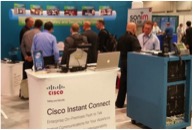
IWCEboothIWCE was a great showcase for Cisco’s newest release of our Instant Connect software solution, which includes an integrated phone dialer and live video streaming client now available to customers. Cisco Instant Connect supports public safety, utilities, and industrial customer needs with multivendor, interoperable-broadband technologies and provide the ability to connect different systems that unify P25, LTE and public safety broadband technologies.

Continue reading “Cisco Demonstrates How to Communicate Instantly Without Limitation with the Cisco Instant Connect Solution at IWCE 2016”

Authors

Kacey Carpenter

Senior Manager

Global Government and Public Sector Marketing

Avatar

Industry analyst firm, Gartner, expects the market for hyperconverged infrastructure to reach $5 billion by 2019. We’ve pulled together insights from a variety of analyst firms to explain why many customers are interested in this technology.

Customer Benefits Create Demand

Hyperconverged infrastructure (HCI) and software defined infrastructure in general address a wide range of customer demands. These technologies have been evolving for several years. They have reached a level of maturity that provide customers compelling reasons to transition from traditional infrastructure and the supporting operational processes. HCI fits into a broader product portfolio providing some distinct advantages. According to a recent blog from analyst firm Forrester Research:

Hyperconverged platforms architect compute, storage and network together as a complete system (whether physical or virtual). Blending ease of use, scalability, and integration into easily consumable webscale building blocks which allows infrastructure and operations (I&O) leaders to spend less time engineering and tuning fundamental infrastructure and more time putting capabilities in the hands of their firms’ customers. (“2016 – Hyperconvergence Solutions with Containers to Become the ‘Norm’”, Forrester blog, 12/29/15)

Many IT organizations consider HCI to be a good alternative as they evaluate options for updating their current server and storage systems. According to reasearch from The Aberdeen Group, 42% of SMBs reported aging infrastructure as their top IT challenge. Hyperconverged infrastructure provides an efficient way of achieving additional savings and efficiencies while upgrading existing infrastructure.

Importance of a Complete Product Portfolio

The hyperconverged infrastructure market has been led by start-ups for the past four years, but they have focused on one product out of necessity. IDC conducted a recent end-user converged systems survey that included questions regarding HCI. The participants were asked the question, “When considering (HCI) vendors, please rate the importance of the vendors ability to offer a complete product portfolio outside of HCI?” More than 70% of the people surveyed indicated the vendor’s ability of offer a complete product portfolio was “very important, we value a vendor’s ability to deliver full breadth of products and services” or “important, we prefer to keep as much with trusted partners” (see Figure 1). This was true in smaller companies of less than 1,000 employees as well as larger ones of more than 5,000 employees (source: IDC Converged Systems: End User Survey Report 2015).

Figure 1: Response to IDC Survey Question Based on Size of Company

>70% of end users think HCI vendors should offer a broad product portfolio

Flexible Scaling

Most of the first generation hyperconverged products adopted an appliance approach, so systems were implemented on a single server type that scaled by stacking the systems in a linear fashion. IDC also conducted a survey regarding the adoption of hyperconverged infrastructure with IT executives; the executive interviews were a small sample of in-depth interviews. In response to the question, “What do you see as the major challenges of hyperconverged?” the top response was “must scale compute and storage together” (Source IDC Integrated Systems: Executive Interviews 2015).

We spoke with over 100 customers, as we were developing our requirements for a hyperconverged solution, so we understood customers wanted greater flexibility to scale HCI. Cisco HyperFlex Systems™ allow you to scale compute and storage resources independently.

Keep the Management Simple

Customers emphasized the need to reduce complexity. They wanted to avoid establishing another island of technology in their data center to manage. HCI needed to be an addition to the product portfolio that fit seamlessly into a broader management architecture.  This requirement was affirmed by Zeus Kerravala, the founder and principal analyst of ZK Research,  in his recent article,

Cisco’s unique differentiator is that it can move hyperconverged from being a standalone technology to being part of a larger converged architecture where converged and hyperconverged systems can be managed through a single, policy driven console offered via Cisco Enterprise Cloud Suite. (“Cisco flexes some data center muscle at Partner Summit 2016”, Zeus Kerravala, Networkworld, 03/01/16)

Cisco HyperFlex Systems are next generation hyperconverged infrastructure. They leverage all the benefits of the Cisco UCS management platform, including the broader partner ecosystem Cisco has developed over the past six years. HyperFlex also includes storage efficiency functionality, such as deduplication and compression, through the HX Data Platform.

What Do the Customers Think?

The industry analysts can offer insights, but customers and partners are the people who determine if a product is successful in the market. Less than one month after announcing Cisco HyperFlex, we’re off to a great start. CRN spoke with our channel partners, and they published an article entitled, “Cisco HyperFlex Already ‘Sizzling’ in Hyper-Converged Market“. The article describes the strong customer demand partners are experiencing for HyperFlex.

As I mentioned in my previous blog, hyperconverged infrastructure is Crossing the Chasm. Cisco has delivered a “whole product” to the market and demand is accelerating. In the CRN article, channel sales reps noted that “…Cisco is differentiating itself in the market with the ability to offer HyperFlex’s combined compute and software-defined storage technologies, along with Cisco’s networking expertise.”

If you’d like to get additional insights regarding hyperconverged infrastructure from an independent analyst firm, download the 451 Research report, “Considerations for the Next Phase of Hyperconverged Infrastructure”.

Ken

For more information: www.cisco.com/go/hyperflex

Authors

Ken Spear

Sr. Marketing Manager, Automation

UCS Solution Marketing

Avatar

Every day, there are millions in need in our communities and around the world– a mother who is not able to feed her children before putting them to bed; a child who is not able to attend school because of open wounds on his or her body; a family without housing because of war and conflict in their country – and many other similar stories we’ve heard where dependable access to basic human necessities is a struggle.

And every day, we have the opportunity to bridge this gap by connecting to these communities and using those connections to change our world for the better.

Here at Cisco, we take that opportunity to heart and find ways to multiply the impact we can make, because these are the moments that matter. We are committed to doing what we can, not only as a company, but on an individual basis by using our time, talent, and treasure to make the world, and its local communities, a better place.

Be the Bridge InfoGraphic-legal

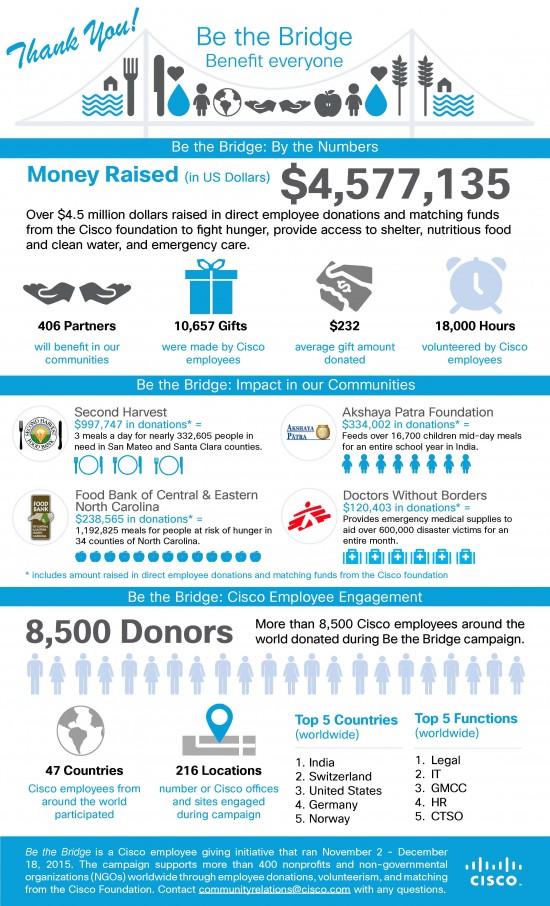
During the first year of our Be the Bridge campaign, we opened up our giving pool to more than 400 different organizations around the globe between November and December. We empowered employees to “Be the Bridge” for those in need by supporting social issues that are important to them or their communities. While hunger relief remained a top priority, other important organizations — which provide shelter, housing, nutritious food and clean water — became eligible for employee giving as well.

The results:  more than 8,500 employees participated, generating $4.5 million dollars in direct employee donations and matching funds from the Cisco foundation for 406 community partners.  It was evident that our employees understood their communities best. For us, we found our employees saw this giving campaign as an extremely positive part of our culture.  Most of them wanted to help, and were only looking for an opportunity to do so.

Continue reading “Cisco’s Inaugural Be the Bridge Campaign Raises Millions to Change the World”

Authors

Rebecca Jacoby

No Longer with Cisco