Avatar

Guest blogger: Suresh Sangiah, Sr. Director, Enterprise Networking Group 

Suresh leads the effort to reinvent the software stack that powers Cisco’s enterprise network portfolio. He spends his (long) days pushing the envelope on the infrastructure and networking technology needed to influence and lead the transformation of enterprises of the future.

Customers worldwide have been using Cisco’s Enterprise Networking portfolio of routers, switches, access points and management systems to solve their networking needs for over three decades. And for the most part this has been an excellent win-win partnership that has proven the test of time.

As a member one of the engineering groups that develop these products I am proud that we have consistently led the networking industry by delivering breakthrough products and technologies that combine innovation with a healthy dose of reliability. We have been able to stay ahead by embracing the mantra that the only constant in this ever-accelerating technology landscape is change.

And so, now, we march towards the next big change in networking – a software-driven network. Perhaps, the biggest change in a decade. And part of this change includes an evolution of the Cisco IOS.

AR04209

The software for the Enterprise Networking portfolio has its roots in Cisco’s IOS software stack, which was modernized in 2008 with IOS XE that first shipped on the ASR1000 series of routers.  Our enterprise networking engineering team has now been working for over two years to lead the charge in evolving IOS XE to the next level to meet the needs of today’s enterprise networks encompassing routing, switching, wireless and also IoT.   This evolved IOS XE will accelerate IT’s ability to embrace the Cisco Digital Network Architecture and prepare the network for the agility, simplicity and security demanded by the new digital era. It will make the enterprise network ready for a controller-driven, open and extensible future that will ease and simplify network operations by allowing programmability and automation.  This is achieved in the evolved IOS XE with a technology leap in the software stack while building on the excellent foundational capabilities already present in IOS and IOS XE.

There are three main benefits that these IOS XE enhancements offer:

  1. Consistency: By delivering a common software base across the entire enterprise networking portfolio, customers can experience the benefits of consistency of capabilities, validations and operations network-wide. Evolved IOS XE delivers on that demand even as it enables significant new operational and serviceability capabilities to reduce the time to deploy while driving down the costs of running the network.
  2. Open and extensible. By offering open, north-bound interfaces at device and controller layers, IOS XE enhancements allow for easier and more sustainable programmability and automation. This allows much better and deeper integration with the Cisco APIC-EM controller, and development of better, more impactful controller-based applications.
  3. Resiliency, scale and performance. The high availability and resiliency capabilities across the entire portfolio will be advanced in a consistent manner along with improvements in scale and performance made possible by the technological evolution of the existing software for future needs.

In an upcoming series of blog posts, senior engineers working on the evolved IOS XE software stack will go under the hood on how Cisco is bringing enterprise networking into a new age and enabling the outcomes our customers are looking for with their mission-critical enterprise networks.

In the meantime you can learn more about evolved IOS XE here. I look forward to hearing what you think about these developments.

Authors

Anand Oswal

No Longer with Cisco

Avatar

Speed, simplicity and security – these are 3 of the recurring themes that come up in conversations with customers when discussing ACI. Why? Because ACI addresses 3 fundamental problems that seem to be consistent with people running data centers – across vertical markets, geographies and organization sizes:

  • Problem 1: It takes too long to respond to business requirements, so apps don’t get rolled out fast enough.
  • Problem 2: The data center has gotten too complex, resulting in additional cost and time to deploy/operate/troubleshoot.
  • Problem 3: Managing security is too laborious, complicated and error prone, resulting in security holes.

With ACI, customers are seeing dramatic increases in their ability to get apps and associated infrastructure rapidly deployed. This is due in large part to the simplicity that comes from ACI’s policy based automation. Additionally, security is built in to the system, by virtue of ACI’s whitelist policy model, as well as deep integration with ecosystem partners. Read on to see if these claims are just hand waving from the marketing guy, or if there is substance to back this up.

First, I want to point out that an ever growing base of customers are leveraging ACI. In February, we announced that there were over 6,000 Nexus 9000 customers and 1,400 ACI customers, along with 50 ecosystem partners. Many of these customers joined us, not too long ago, at Cisco Live Berlin. Here is a 2 ½ minute summary of what some of them had to say:

ACI addresses Problem 1 with Speed

Sainsbury’s, the second largest supermarket chain in the UK, is a ~150 year old company with a vast array of legacy systems. They wanted to change how they interact with customers, wherever and whenever, and try new things, extending their business model. To do this, IT needed to move at the speed of business. Jon spoke of how, before ACI, speed of deployment had been a real challenge, in that it used to take day’s to get servers rolled out. Now this happens in hours.

Halkbank is a large Turkish bank. Cenk contrasted the speed of doing network upgrades with ACI versus the way things went in the past. He was clearly pleased with his experience of doing an entire data center upgrade in 10 minutes: 6 minutes to upgrade spine switches, 4 minutes for the leafs,  0 minutes downtime.

ACI addresses Problem 2 with Simplicity

Andreas from Dresden University of Technology described how ACI’s policy model simplifies initial deployment and ongoing growth. As his data center grows, he basically just adds switches, plugs them in and they are automatically configured by the fabric.  His overall summary:

  • “It just works.  That’s pretty cool!” 

Halkbank, with 100’s of branches and 1000’s of ATMs, continues to grow year over year, in part through acquisitions. This adds to the complexity of the IT environment, though at the same time, they’re trying to simplify things for customers. The business wants a lot and wants it fast, and ACI helps them simplify.

ACI addresses Problem 3 with Security

NBCUniversal is a huge force in the entertainment industry with a range of businesses including news, theme parks, movies, etc.   Steve spoke of their need for speed, and highlighted the need of delivering this in a highly secure fashion.   He discussed the requirement to provide an environment for their businesses that is isolated, but can share common services in a way that gives them more security.

Others, like Andreas, also highlighted how ACI allows them to scale a multitenant environment with security.

More Details

Speed and Simplicity are addressed in this thorough analysis from InfoWorld.   Comments include:

  • “Assuming the cabling is complete, the entire process of standing up an ACI fabric might take only a few minutes from start to finish.”
  • “Implementing ACI is surprisingly simple, even in the case of large-scale buildouts.”

Regarding Security, the results of this customer survey from ESG reflected the challenges associated with traditional security. Summary comments include:

  • “Implementing network security controls is tedious and time-consuming.”
  • “Network security operational issues leads to human error and configuration problems.”
  • “It’s difficult to make changes to security controls once they are implemented.”

These obviously reflect issues associated with manually managing ACL’s that are 100’s or 1000’s of lines long, not wanting to trim the list for fear of creating some catastrophic leak, etc. ACI is able to effectively address these and many other issues because of the security that is an inherent part of its design. You can read more about topics such as ACI’s secure multitenancy, white list policies, and built in stateless L4 firewalling in this paper on ACI’s overall security architecture. Here is some background on ACI’s microsegmentation capabilities.

Summary

A summary of each of the customer’s who were profiled at Cisco Live Berlin is here. Also, you can check out the entire Cisco Live customer session (note it requires you to register). In any case, if you don’t have time to dig into the details above, the key takeaway here is that ACI delivers Speed, Simplicity and Security for these, and many other customers.

Authors

Craig Huitema

No Longer with Cisco

Avatar

It’s the first day of April, and spring is finally here. Everywhere, a sense of renewal and optimism is spreading. So, today I’d like to focus on a few cutting-edge technologies that are transforming our world.

Quantum computing? Artificial intelligence? Augmented reality? All pale in comparison to these innovations, which truly have the potential to change the way we live, work, and play.

  • The first is a radical new technology called paper. Apparently made from trees in a secret process, paper is flat, lighter than an iPad and used in conjunction with a dedicated writing instrument that is held in the hand (and fits in the pocket!). With paper, one can keep track of thoughts, ideas, dreams, and plans. It never crashes, is immune to cybercriminals, and — as demonstrated before my own amazed eyes at the executive briefing center of an innovative startup — can be folded in such a way to make it fly.
  •  Another idea with huge potential is the non-mobile phone or landline. In some ways smarter than a smartphone, the non-mobile phone never has a bad signal or suffers from dropouts or interference. I tried one recently, and didn’t once utter the words, “Could you repeat that please, I couldn’t hear you.” Also, it’s unlikely that your landline phone will ever go through the washing machine (or worse). Truly revolutionary.

  •  Analog Athletics is one of the most promising concepts. Unlike online gaming or eSports, it requires muscles beyond those in the thumb. This takes some getting used to, as does the actual ball, which is filled with air and bounces on a hard surface. However, the analog version of basketball, which I tried recently, is truly transformative. Your teammates must be in the same place as you play, but I feel this is a small sacrifice for a unique experience.


OK, so it’s April Fools’ Day and we’re having a bit of fun. However, it’s good to remember that some of these technologies, such as paper and the landline, were radical in their day — and drove their own disruptions. For centuries, the elites of the world tried to keep paper, reading, and writing from the masses. Another disruptive innovation, the printing press, changed all that. To get an idea of the anxiety and future shock caused by the landline phone, the toaster, or the motorcar, just catch a replay of Downton Abbey.

Downton Abbey

(Photo Credit) 

Today, we are going through another time of great change. The digital age—with its accelerating pace of disruption—can be daunting indeed. But connecting in new ways and adapting to change is what we humans have always been great at.
Today, disruptive technologies are changing our personal and work lives. Sure, digital business transformation is challenging, but the opportunities for those who do it right are enormous. Would you really want to live in a time when things are just staying the same?

In the meantime, it’s spring. Put down that tablet, and get out and play some (analog) sports.

Authors

Michael Riegel

Vice President

Industries, Platforms, and Services Marketing

Avatar

Adding to all the accolades our Digital Network Architecture (DNA) announcement has received, the automation engine within DNA (the APIC-EM Controller) won TechTarget’s Network Innovation Award. And I am indeed very proud that our approach to automating the Enterprise Network is receiving such positive recognition.

But I will also be honest, and as befits a winner in an awards show, humble. You see, over the last few years, as we were tracking towards our new vision for the Enterprise Network, and introducing the different point products we would build on to deliver on the vision, I got used to criticism: “Cisco’s SDN strategy is confusing!” was one I heard quite often. As we receive the TechTarget award, I have spent some time thinking why the momentum has shifted from some criticism to accolades – even though honestly we’re only 50% there on our way to fulfill our entire vision.

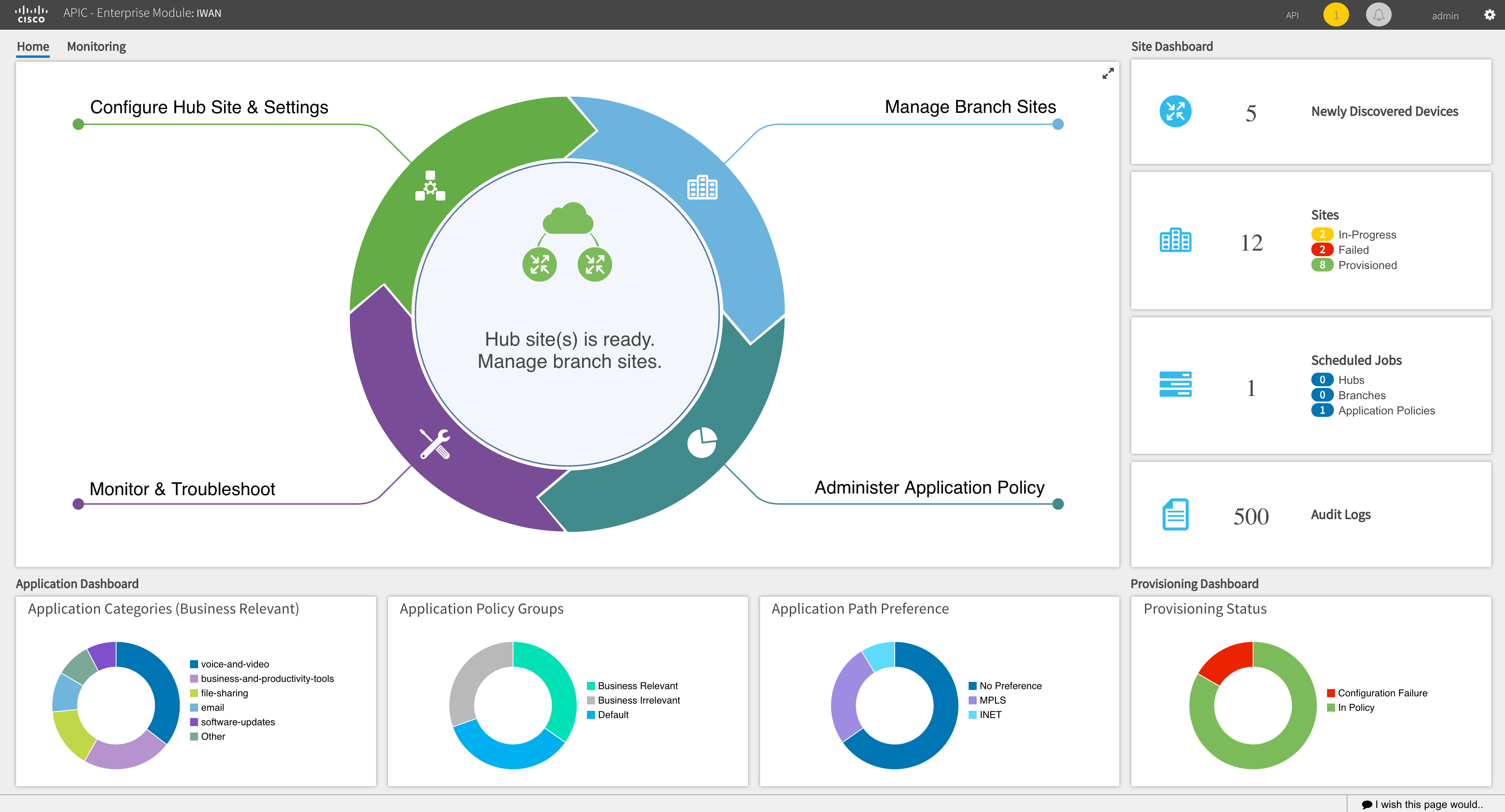
APIC-EM Visual

The answers? I think it’s because the pieces have come together with DNA. I urge you to read TechTarget’s Jessica Scarpati’s interview with Ronnie Ray. Several powerful statements there about the power of network abstraction, thanks to policies written in business language. Hard to pick a favorite, but if you forced me to, it would be this: “..We’re trying to bring down opex and shrink time to deployment. This can be done by a few clicks. Before, it took thousands of lines of programming to input the configuration. Today, it’s reduced to maybe 10 clicks per branch or 10 clicks per groups of branches if you apply the same template to them.  ..”. That sums up the essence of what we’re trying to do. Bring SDN benefits to our customers by having them deploy shrink-wrapped applications that come standard with APIC-EM, often for free (many other blogs address the details, just believe me – this is really simply to deploy). And, that’s why we seeing fast adoption, with over 100 customer deploying up to 4000 devices!

I want to keep this blog short so you can go read the TechTarget interview. But I’d like to wrap up by noting that I think that what we are seeing, as “SDN” and network automation go mainstream, is that many enterprise customers –not surprisingly- are adopting straight-forward solutions that simply free up their time away from repetitive manual tasks, and in turn allow them to look into additional solutions that elevate the business relevance of the network.

Please read the TechTarget interview here.

Also, if you are interested in this topic, please join our Cisco Chat on Monday April 4.


Authors

Paul Liesenberg

Digital Network Architecture Philosopher

DNA Product Solutions

Avatar

The CoSN 2016 Annual Conference is almost here! CoSN – the Consortium for School Networking – is the premier professional association for district technology leaders, and their annual conference provides an opportunity for experts from across the country to engage in comprehensive discussions about K-12 education technology.

The 2016 annual conference, taking place from Monday, April 4 to Thursday, April 7 in Washington, DC, will focus on ways that school systems can change their organizational culture to embrace digital options and accelerate success. Cisco will have numerous representatives at CoSN 2016 to join the conversation and share what we’re doing to accelerate K-12 student success using education technology.


the Jefferson Memorial during the Cherry Blossom Festival. Washington, DC

Here’s where we’ll be:

If you’re going to be at CoSN 2016, make sure you join us at any of these panels or workshops. We’ll also be at the @InnovationCentral expo at pod #2, so stop by and say hello. And if you couldn’t make it to Washington, DC this year, make sure you follow along at @Cisco_K12Edu and the hashtag #CoSN16 for insights from the panels and from the show floor.

Authors

Mary Schlegelmilch

Business Development Manager

Education

Avatar

Peter Drucker“Culture eats strategy for breakfast,” were the final words echoed last week during a thought-provoking Innovation Catalyst training session at Cisco’s campus in Richardson, Texas. Building on earlier sessions in San Jose last November, I joined other super-charged Cisco leaders to learn more about winning formulas and attributes that can cultivate 10x innovation across our teams and culture.


In prior sessions, I wrote about catalysts and execution strategies that bring brilliant ideas to life around 10x innovation. Last week, we laser-focused on key individual and cultural attributes that foster an environment of 10x innovation, especially within a large and established company like Cisco. Following the wisdom of management guru, Peter Drucker, everyone understood that Innovation as a Skillset and Innovation as a Discipline are two different things. Continue reading “Catalysts for 10x Innovation – Innovator Attributes”

Authors

Biren Gandhi

Head of Drone Business & Distinguished Strategist

Corporate Strategy Office

Avatar

Looking at the marketplace today, now more than ever the oil and gas industry needs to take action.

Crude oil prices are at incredible lows—just over $30 last week. While I’d never assert my ability to predict future oil prices, I did ring the bell last April for digital as the modern-day anecdote for doing more with less when crude was in the mid-$40s!

According to a recent Reuter’s story, one-third of publicly traded oil companies are at high risk of going bankrupt this year. One-third. Talk about the power of creative destruction gripping the market!

Deloitte based their findings on the examination of 500 oil and natural gas exploration and production companies worldwide. To be fair, the 175 or so companies that are most at risk have a mountain of debt—more than $150 billion in total. Sometimes being highly leveraged can be deadly.

If there was doubt before, there can be no doubt now. Oil and gas firms must rely on technology to become operationally efficient.

According to Mark Hill of Oilprice.com, “Oil field, drilling, and information technology have combined to create a perfect storm of capability and agility that will allow … oil markets to respond with a speed typically only seen in the digital realm … In many ways, Moore’s Law has finally arrived in the oil patch.”

While there’ve been many downturns in the past, this one is different. It’s coming at a time when two forces are colliding: the need to keep pace in uncertain markets; and the digital era refusing to slow down or stop.

It’s not enough to sit on the sidelines until oil prices rise. Some firms will be out of business by then. Even those who may survive with becoming digital may not be able to effectively compete.

Becoming operationally efficient must be a permanent transition. It’s kind of like going from a VW Bug to a Ferrari—there’s no turning back after that.

The good news is that for those who create a digital strategy now, there are rewards down the road.

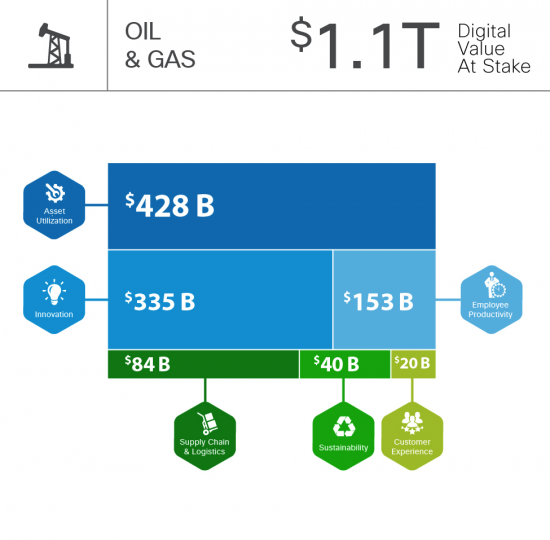
In fact, from 2015 to 2024, according to Cisco research, the oil and gas industry will generate $1.1 trillion in Digital Value at Stake.

The immediate focus for getting a share of this value is for oil and gas companies to integrate digital technologies and processes with their existing operational technology.

Oil & Gas Digital Value at Stake
Figure 1. Six value drivers have the potential to generate a total of $1.1 trillion for oil and gas companies worldwide (2015-2024).

The top areas of opportunity are:

  • Recover efficiency ($278 billion): Enhanced oil-recovery techniques
  • Lifting-process automation ($194 billion): Automation and remote management of production processes
  • Remote monitoring ($191 billion): Early detection/reaction to leakages, theft, rig downtime, etc.
  • Drilling optimization ($93 billion): Using data management and Big Data analytics to drive efficiencies
  • Project planning ($20 billion): Using Big Data analytics to improve project outlay estimates

It’s not all doom and gloom. Amidst the turmoil in the industry, including glutted oil prices, there’s an opportunity to gain competitive advantage. The question then becomes how? What are some oil and gas firms doing to take advantage of the digital opportunity that others aren’t?

They’re integrating IT, industrial controls, and business processes end to end. They’re breaking silos that are holding them back. All while saving costs and getting better visibility.

For example, ESSAR Group deployed a dynamic server platform for real-time access to data and analytics. It’s strengthened their business performance by giving them the ability to crunch data and uncover trends and patterns for better planning and forecasting.

With 70,000 employees across 20 countries, this is huge.

They’re also accessing intelligence to determine how to redirect the business, based on events, customer relationships, product plans, and market variations. And now is definitely a time for this efficiency, especially the ability to make market-based decisions.

Another example of grabbing hold of digital and getting it right is Explorer Pipeline.

They’ve adopted collaboration and videoconferencing tools to change the way they communicate and share knowledge.

With many employees far from regional offices, staying connected has been challenging in the past. Now, they’re bridging the talent gap by scaling experts and making the industry attractive to the next-generation workforce. They can offer virtual training and web conferencing. It’s increased employee productivity and is saving Explorer time and money.

So what’s the next move?

I’d use today’s challenging environment as the catalyst for leveraging digital technologies to drive innovation. The bonus? A boost in business and operational efficiency.

It’s a promising way to leverage existing investments to set the stage for an amazing drive to a digital future.

Authors

Michael Riegel

Vice President

Industries, Platforms, and Services Marketing

Avatar

It all started with an idea: what if we could bring students from different schools in different parts of the country together to discuss civil rights issues? After all, an issue that affected the whole country surely deserves a broader perspective than from just one school. So here in the Rochester City School District we set out to create a program that would do just that. We partnered with schools around the country to create a civil rights distance learning program using Cisco TelePresence. The program began with a few one-off events in honor of important civil rights holidays, such as Martin Luther King Jr.’s birthday and the anniversary of the Brown vs. Board of Education decision, where students from different schools joined together virtually to discuss civil rights history and current civil rights issues.

Students in Rochester, NY participate in the national webinar on Martin Luther King, Jr.

The events were so successful that we wanted to take it even further. We worked with Hillsborough County Schools to create a digital civil rights class that would bring our students together as one class on a regular basis – and thus the Digital National Class – Digital Civil Rights Class was born!

Students at both schools use Cisco TelePresence to meet virtually every week. They don’t even think of it as two separate groups, but rather one combined class. They started the year wearing name tags, but they’re no longer necessary – everyone knows each other. In fact, students loved the class so much that when it ended after the first semester as planned, they successfully lobbied to turn it into a year-long class. Now, we plan to offer the Digital National Class again next year.

Students use TelePresence to connect for their weekly Digital Civil Rights class.

A few months ago we decided to take our students’ digital classroom experience on the road. Fortunately, a few years ago I purchased and restored a vintage transit bus that happened to be the same make and model of the bus that Rosa Parks refused to give up her seat on in Montgomery in 1955. The bus would enable our students to engage in a digital version of expeditionary learning, allowing them to see other parts of the country without ever having to leave the classroom.

Using this Civil Rights Museum on Wheels, we’re launching the Destination Diversity tour, a road trip designed to highlight both the innovative use of technology in the classroom and the history these students are learning and discussing. I’ll start in Rochester and embark on a four-city road trip at the beginning of April – heading from New York to Washington, DC to Greensboro, NC to Atlanta, GA, before ending up at Jefferson High School in Tampa, Florida.

The Destination Diversity bus – just like the one Rosa Parks rode on!

The Civil Rights Museum on Wheels was already equipped with some pretty high-tech audio and visual equipment, but to stay connected with students and staff in New York and Florida on the road, we needed to get digital communications equipment set up on the bus as well. Fortunately, Cisco was right there for us, helping us outfit the Museum on Wheels with its own portable TelePresence unit that will allow students to join the bus virtually wherever it will be.

Additionally, at each stop along the way, guest speakers will come onto the bus and speak to the students in both Rochester and Hillsborough, who will join virtually via the TelePresence unit. At the last stop in Hillsborough County, I’ll get the chance to meet the Jefferson High School students in person, and Rochester students will join via TelePresence for their usual Digital Civil Rights class.

The Destination Diversity tour will serve as a culminating event for both groups of students to showcase all that they’ve learned, and will simultaneously show educators up and down the East Coast how technology can be used successfully to expand educational opportunities for students. For more information on each of the four bus stops, including dates and guest speakers, please visit the Destination Diversity Facebook page.

Want to join me on the Destination Diversity tour as the bus and I journey south? Follow @Cisco_K12Edu, @CiscoEDU and @RCSDDigiClassrm on Twitter for updates, where we’ll be using #DestinationDiversity to chronicle the journey. To learn more about how TelePresence can be used for projects such as this, visit Cisco’s TelePresence page here.

Authors

Van Henri White

School Board President

Rochester City School District