Avatar

To take the commercial drone industry from infancy to adulthood, there is a lot to be done. The lion’s share of that work will involve companies working together to discuss technology, architecture, security, standards, and interoperability. This is where Cisco sees great opportunity, and where we can add great value.

While there is widespread interest in computers that fly, their real utility in IoT applications will come from the commercial data they provide. Drones will be connected to networking platforms that both use and process data, that will inform, empower, and enrich processes that improve our society.

Cisco is a company that is deeply involved with the digital transformation of enterprises. We appreciate that innovation enabled as part of an ecosystem will offer customers confidence in the new technology and allow solutions to scale.

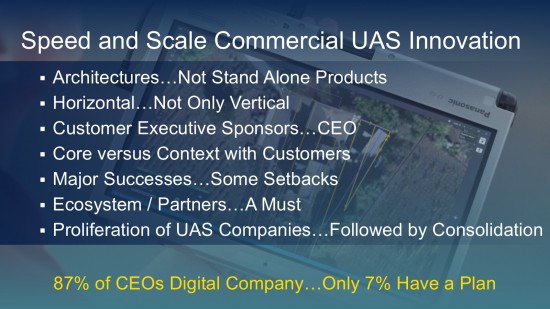
Our Executive Chairman cautioned drone companies on common mistakes to avoid during a recent keynote address at the AUVSI Xponential drone conference in New Orleans. He said that an ecosystem of partnerships is a recipe for success that will encourage commercial drone innovation.

Speed_JC

We believe that companies interested in the commercial use of drones have an opportunity to create an ecosystem together. There’s never been a better time to develop the commercial use of drones, and we look forward to collaborating with like-minded companies.

We have been asked whether Cisco will play an active role in commercial drone-related lobbying. Although we recognize there is a place for these conversations, we’ll leave that to groups like the Commercial Drone Alliance. Rather than join the Alliance, we will focus instead on fostering an ecosystem that can take the industry to new heights.

Authors

Biren Gandhi

Head of Drone Business & Distinguished Strategist

Corporate Strategy Office

Avatar

Throughout history, we’ve used labels to describe the attitude and characteristics of certain time periods in our past such as The Dark Ages, The Age of Discovery, and The Space Age to name a few.

During the last 30 years of the Information Age, Cisco has been committed to changing the way the world works, lives, plays, and learns. With you, we’ve been able to help our customers innovate, manage market transitions, and turn technology into business advantage. Software is the key to that transformation and Cisco is there. We’re continuing to help customers around the world digitize their business through software.

Del Cust


The Software Opportunity

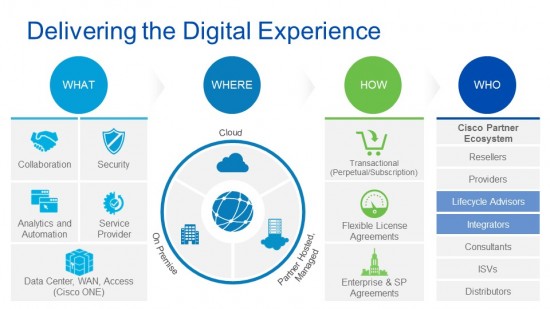
The software opportunity is ours for the taking and together, we’re ideally positioned to execute. Our Cisco Partner Ecosystem is evolving to allow you to develop the practices that will enhance the roles you play with your customers, and so you can profit and grow. Let’s look at the roles you play and how we can help.

As a Reseller, whether you are Gold or Premier you’re likely already reselling Cisco ONE, security, or collaboration—you have access to our entire software portfolio today. New licensing agreements and buying terms are available to provide you with the more flexible consumption models in order to meet all the needs of your customers

As a Provider, you’re deploying technology in the way that works best for your customers. That’s why we made our software available in the cloud, on-prem, or as partner hosted/managed service – so you can choose what fits your company and customers best.

To really drive top line and profitability, as a Lifecycle Advisor you can drive to the worldwide adoption, expansion, and renewal of every offer. If you’re reselling software, developing a lifecycle practice is a natural extension of what you’re already doing. Increase the stickiness of your customer relationships by continuously showing them the value of the outcome you originally sold them.  You can easily make more money by expanding into that role.

If you want to further expand, enhance or even leverage existing capabilities to deliver custom software solutions, become an Integrator and develop the capabilities yourself. When you integrate a custom software solution, you’ll earn incentives as well as high-margin professional services that often far exceed the value of software deal. Or, you could acquire a company that’s already doing it really well, or partner with someone else in the ecosystem. It all depends on what you want to do with your business.

You have thousands of customers in your base—every one of you is sitting on a gold mine. The easiest way to grow your business is to grow and enhance your relationship with your existing customers. What better way to grow than to start helping your customers with adopting the solutions you sold them, helping them expand into new parts of their business, and preserve your own annuity revenue by being proactive in capturing those renewal opportunities as they come up.

Now is the perfect time to begin planning your own digital transformation and to identify the products, services, and solutions that will help your customers achieve theirs. In the next few weeks Jason Gallo will share how to take the next step while Grace Lo will show how we’ll help you accelerate growth and profitability.

So, how do you determine what role you’d like to play in the software space? Take a few moments to build your knowledge base on the existing and new roles now available within the Cisco Partner Ecosystem.

Authors

Sandra Flinders

Senior Director

Global Partner Programs

Avatar

$81 million is what was stolen, undetected, out of a Bangladesh Bank account at the Federal Reserve Bank of New York. Unbelievable how the malware modified the SWIFT software and bypassed validity checks.

This Bangladesh Bank breach highlights the wide range and new, creative ways hackers are innovating. And the challenges in protecting the financial services network. In yet another example, a few weeks ago several Russian banks lost $25.7 million due to a network worm. The worm is a new form of malware, introduced through a phishing attack where emails were masquerading as legitimate correspondence from the Russian Central Bank.

http://www.slideshare.net/CiscoBusinessInsights/security-for-financial-services-step-it-up-a-level

Continue reading “Hackers Are Challenging Banks Every Day”

Authors

James Cronk

Director

Enterprise Business Group, EMEAR

Avatar

Software engineering and developer communities are driving the market for cloud consumption and leading each industry into a new era of software-defined disruption. There are no longer questions about elastic and flexible agile development as the way to innovate and reduce time to market for businesses. Open source software plays a key role in the transformation that’s taking place to cloud native and understanding how your business strategy needs to address this next disruption in software development is crucial to the success of your business. The role that developers have today is continuing to evolve and, as a developer, you will want to take an active role in understanding your part in this transformation as well as what specific open source communities in which to actively participate.

With open source as the de facto standard for software architecture and development, it’s more important than ever to remain current and deepen your knowledge around the strategies that are driving this transformation, specifically infrastructure, security, performance, collaboration and community, architecture, open hardware, and data analytics. The innovations happening in these areas are changing the way we think about business strategy and how competitive we can be in this continuously evolving business cycle.

However, physical and cloud infrastructure does not enable application development platforms natively nor provide the ability to create applications that are cloud native with elastic services. In addition, businesses are moving to application development architectures that leverage open source, which are becoming more strategic to their business strategy. When making the decision to build and operate an application on a physical or cloud platform, open source strategy becomes central to your application architecture and strategy.

It’s important today to determine how you plan to architect your applications for the business in an agile and flexible way – cloud native. The cloud native model consists of Secure DevOps, Mesos and Kubernetes orchestration, CI/CD, and a fully integrated data platform. It’s important to look for projects that have hardened the microservices infrastructure and created differentiation in the orchestration, service discovery, and networking areas. At Cisco, we have hardened and fully integrated an end-to-end solution with innovations in mantl.io architected with improved network performance in both the user and control planes.

In the user plane with open source, FD.io takes the approach that containers must be portable. With FD.io, you take your known-good net stack with you everywhere. We tackle the IP per container, which has become the norm, vs NAT (overlays, native IP etc.) to provide near wire speed routing. We incorporate high-performance APIs to address the state of the containers and address the possibility that a container change could potential result in a route change. For the network administrators, we have added a number of advanced container network functions ‘in stack’ (Multipath, VRF) and with multi-million entry FIBs you can rest assured scalability is addressed.

For the control plane, our innovations in application policy and Application Intent from open source Contiv and Shipped are enabling enterprises to extend their network control to multiple clouds while, at the same time, abstracting the complexity from developers.

Flexibility and extensibility are required capabilities for the cloud native model and the concepts of Consumption Interfaces have been architected to allow some choices and extensibility to be added into the consumption model for the developer of the cloud native application or service(s). This model allows us to support Kubernetes for the developer and Mesos frameworks for the data scientist. This is also how we integrate with Platform as a Service (PaaS) offerings.

The business of open source is being Community Sourced – Organic and Open

  1. Community is the key to any success. The value of open is critical not only from the contributions but also the individual’s ability to get involved for the greater interest in general.
  2. GitHub has forever changed the landscape of development in a positive way.
  3. Open source architecture platforms that support the agile needs of the application developer are starting to emerge and, for the most part, are organic in nature. Over the next several years, the ability of these platforms to embrace and extend open source to the communities of interest will be accelerated.
  4. Strategic moves that you need to consider today are to learn more about the specific open source communities that are of interest to your career and/or business, get involved and contribute your knowledge, and code projects that either solve critical issues for your business or enable your business to gain a strategic advantage over your competition by leveraging the power of community.

This year, Open Container Day is part of OSCON. As a technical contributor to CNCF and OCI, I invite you to come to Open Container Day and hear from my peers on the state of container-based solutions, infrastructure, cloud native computing and networking, and much more.

Please join the community at OSCON 2016 where you can quickly go from consumer to contributor to your favorite open source projects and find out how open source can be a strategic advantage for your business. Visit Cisco at booth #209 and learn how Mantl and Shipped can accelerate your business.

We have the following sessions you’ll want to attend as well:

Ignite OSCON

Monday 5:00-6:30pm

Ballroom A

Don’t Fix it – Throw it Away! Intro to Disposable Infrastructure

Tuesday 1:30-5:00pm

Meeting Room 19

Open Source and Microservices: Your Badass, Next-gen Application Architecture

Wednesday 2:40-3:20pm

Meeting Room 17B

Authors

Kenneth Owens

Chief Technical Officer, Cloud Infrastructure Services

Avatar

I’ll make a bet. If you ask any of the leaders in broadcast television to sum up this year’s National Association of Broadcasters (NAB) convention in three words, they would say: IP, Virtualization, and HDR.

And that’s no surprise. Collectively, our entire video ecosystem is searching for ways to apply the same technological advances from IT to their services so they can support the massive shifts in video we all know too well: multi-screen viewing, binge viewing, immersive entertainment.

This year’s NAB Show was an especially exciting time for us, because we spent the last two years redesigning, from scratch, our full broadcast TV portfolio. The impetus, truth be told, was the emergence of 4K/UHD video, and its core enabler, HEVC compression. Essentially, it was one of those product design moments: Well, as long as we are making this shift, what can we do to bring in the other advancements in video delivery – like virtualization. Like IP-based distribution. Like the modularity that enables software-based appliances and cloud-based operations.

IMG_4250

In short, we’ve overhauled the line so as to give our broadcast-side partners the mechanisms to drive service velocity, revenue growth, and technological adaptability. So, the 2016 NAB Show was a sort of coming out party for us, and in particular, for our new D9800 Network Transport Receiver, and supporting applications from our Virtualized Video Processing platform: the Virtual Digital Content Manager, and PowerVU Network Control system.

Here’s some background: When you put yourself in the shoes of someone tied to satellite-based distribution, things are different than if you’re accustomed to terrestrial and IP-based delivery. Very different. You’ve likely made multi-year, multi-million dollar arrangements to lease satellite transponders. And the more networks you operate, the more transponder space you need. Plus, you’re probably carrying the same show in at least two formats: Standard Definition/SD, and High Definition/HD.

Up until now, that meant leasing transponder space for all of it – SD and HD, no matter how duplicative. Take the case of one of our broadcast-side customers, who wanted to address this particular challenge by way of “transponder consolidation” – sending only the HD stream, at the uplink, and deriving both it and an SD version, at the downlink. Our analysis quickly showed that by moving to the D9800 and taking advantage of the multi-transport input, they could do just that – and save 40-50% on the capital expenditures associated with not having to buy duplicative transponder carriage.

But wait! There’s more…like the potential onslaught of 4K programming, which is four times larger than HD. That’s where HEVC comes in, to compress 4K content as much as possible, without degrading picture quality, before distributing it. This is where the Cisco Virtual DCM plays a role.

This all rolls up into the category of “virtualized primary distribution,” which is good because it lets broadcasters support new capabilities – like the HEVC they’ll need to convey 4K programs – in software, with the Virtual DCM. This also simplifies operations, by way of template-based workflows and RESTful APIs to related distribution components, like encryption and IRD management/control for event scheduling, blackout control and other use cases. And, perhaps more importantly, it positions broadcasters to evolve to new architectures, like IP distribution.

Similarly, the D9800 Network Transport Receiver was specifically and modularly designed to support multiple applications (decode, transcode, decrypt, de-multiplex), with full IRD control, template-based workflows, and an on-board and “pay as you grow” licensing, which can be activated when and as needed.

And here’s a little known fact from our demonstrations at NAB: We actually had our D9800 receiving and decoding High Dynamic Range (HDR) encoded 4K content. Something we are confident to say is an industry first. While the industry is still waiting to see how HDR standards are being implemented, we took the opportunity to highlight how one approach – Hybrid Log-Gamma (HLG) –provides backwards-compatible implementations of HDR for any resolution. This is a great benefit to our customers who want to feed a single HDR encoded stream to the satellite, and be able to distribute to both HDR and non-HDR compatible systems. And we had our D9800 showing just that: playing out pristine 4K/HDR content on a compatible screen with one D9800 decoder, while a second D9800 decoder played back the same stream to a regular 4K screen.

That’s why this NAB was very exciting for us. Whenever you can do things that help your customers grow and thrive – like supporting new functionalities and new transport stream types, while simplifying workflows for encryption and event scheduling (things they need!) that’s a very, very good thing.

Authors

George Tupy

Market Manager

Service Provider, Video Solutions

Avatar

Guest Blogger: Nithya Natesan, Technical Marketing Engineer

Coopetition really does create great results. That’s what Cisco and VMware realized many years ago when we started working together. We compete and we continue to cooperate on projects like the Cisco UCS Management Pack for VMware vRealize Operations. The latest version of the management pack, version 2.0(1), was recently released after a lengthy beta, and it supports vRealize Operations (vROps) version 6.0 and 6.1.

Continue reading “Working Together – UCS Management and VMware vRealize Operations”

Authors

Ken Spear

Sr. Marketing Manager, Automation

UCS Solution Marketing

Avatar

As I drove to the office one Friday in March, little did I know that my day would end with me eating four beetles. Yes, you read that correctly, BEETLES! The little critters that you find in your garden that look quite like cockroaches.

Why on earth would you do that?” I hear you cry.

I am often heard saying “I have the best job in the world.” I work for a company that changes lives, I report to a manager that I have a great relationship with and I regularly get to appear on CiscoTV as a host and presenter – which is a lot of fun. As a CiscoTV anchor, one day I can be interviewing a CEO or a NATO official about digitisation, and the next day I’m hosting a charity event.

One such event was in support of ‘Sport Relief’, one of the UK’s biggest fundraising events. Sport Relief brings the entire nation together to get active, raise money and change lives in both the UK and the world’s poorest countries. Over the course of five days, Cisco employees in the UK and Ireland (UK&I) supported participated in activities such as triathlons and cooking competitions.

Sport Relief photoI had the honour of hosting a very fun event called the ‘Yuck Tucker Trial.’ Employees donate money to see an executive eating something very disgusting in front of a large (in-person and virtual) audience. The executive that had received the most donations had to eat the ‘yuck tucker’.

Phil Smith, the CEO of UK&I, was one of the executives participating in the trial and the most senior person attending. It was pretty obvious that Phil was going to have to eat a critter, in this case a beetle. What I hadn’t been told by the show’s director was how many beetles Phil should eat. So, in the excitement of the moment as I announced that Phil had received the most donations, I told Phil that he had to eat four beetles! Being the great sport that he is, Phil ate the beetles – to the sound of great delight from the audience. When Phil had finished crunching his gruesome afternoon snack, I admitted that he probably actually only had to eat one beetle. Phil was about to get revenge.

He took the microphone from my hand and announced to the audience that he would personally donate £200 if I ate four beetles. The colour drained from my face. The thought of eating the beetles quite frankly made want to squeal (which I later realised I did after seeing video evidence on Twitter). However, I knew that Phil’s donation would provide the following:

  • £150 could help three children, working on a rubbish dump in Sierra Leone, to go to school by paying for uniforms, books and their travel for a year.
  • £50 could buy 20 mosquito nets to protect children in Kenya from contracting malaria while they sleep.
Eating Beetles
After eating my first beetle.

Spurred on by the thought of making a difference to people’s lives, I took four beetles from the dish, (did I mention I squealed?) and ate them as fast as I could. The audience chanted, cheered and moment was incredible.

I’m sure you want to know what they tasted like. They were hard, crunchy and both tasted and smelt like…farmyard. It was gross. For the remainder of the show I was pulling beetle legs from my teeth – but it was totally worth it.

At Cisco, giving back to the local community is something we care deeply about and during my eight years here, I’ve witnessed some incredible events where employees have given up their time to transform the lives of others. It makes me very proud and I truly love where I work.

So I ask you this dear reader, what have you done today to make you feel proud?

(Editor’s note: We’re hiring marketing folks like James in UK&I, and we have openings around the globe. Take a look and see if there’s a way you can change the world at Cisco.)

Authors

James Bedford

Office of the Vice President

EMEAR Marketing

Avatar

Programmable Infrastructure

Some hardware vendors are talking about their products as if they invented the concept of infrastructure as code. Cisco UCS was architected as programmable infrastructure from its inception seven years ago. We’ve continued to enhance the programmability we offer you with application program interfaces (APIs), tools, orchestration and integration to fit your coding desires and requirements.

Unified UCS Management

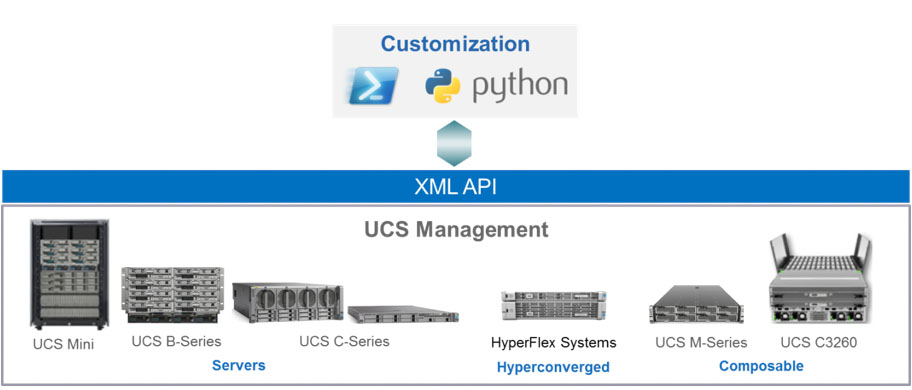
The latest release of UCS Manager, version 3.1, brings together into one place support for the 2nd generation UCS hardware and the latest 3rd generation UCS hardware. It includes support for UCS Mini, the UCS C-Series and B-Series servers, Cisco HyperFlex hyperconverged infrastructure, and Cisco composable infrastructure – the UCS C3260 and M-Series. It features a new HTLM5 interface.

bog-ucs-management-02

UCS PowerTool Suite, It’s Sweet

I’m really excited about UCS Manager 3.1 and I think you should be too, because it is supplemented by some really great programmability tools. There is the UCS PowerTool 2.0 suite with support for Microsoft’s Desired State Configuration (DSC) , PowerTool has a unified installer, support for UCS Manager, UCS Central and UCS IMC on C and E-Series, as well as consolidation of duplicated Cmdlets across the suite. For example, Set-UcsCentralConfiguration, and Set-UcsPowerToolConfiguration are combined into Set-UcsPowerToolConfiguration. These changes as well as a listing of all the newly added Cmdlets are fully described in the UCS PowerTool Release Notes.

Be sure to read the release notes and the user guides as well as download the software.

Continue reading “Programmability and UCS Management”

Authors

John McDonough

Developer Advocate

DevNet

Avatar

Many of today’s systems are built on telemetry, the automated gathering of remote data measurements to gain insights and manage performance and operations.

One industry that has been quick to embrace telemetry is auto racing. Winning racing teams are outfitting their cars with around 100 sensors that monitor thousands of components. Every race weekend, hundreds of gigabytes of real-time telemetry are generated. This data is then shared with on-site engineers, those located at its headquarters, and with the car’s engine manufacturer. The data monitors a variety of factors including tire pressure, fuel consumption, brake temperature, and wind force to identify problems and ensure optimal performance.

In the past, racing was just about getting as much horsepower as possible, but today’s racing outfits recognize the need for real-time data analysis, to understand if there are any problems with the car and fix them immediately. Wins are the result of driver intuition, mechanical efficiency, and now, telemetry analysis.

Telemetry became mandatory, and with the right analytics, it drastically improved system performance. But the value of telemetry isn’t confined to performance optimization in race cars.

Large, cloud-based services are also built on top of telemetry, which provides the insight necessary for elasticity and dynamic resource management. Hyperscale systems such as those used in video streaming and social media services must be able to expand and contract with the ebb and flow of consumer demand. You simply cannot design a dynamic, modern service without each part of the microarchitecture sending data about its current state.

Security practitioners use it to obtain valuable insight into network behavior and early threat detection to identify malicious activity and gain a leg up on threat actors.

NetFlow is the language of network activity

Network telemetry comes in the form of NetFlow. You can think of NetFlow as a phone bill for network activity. It contains aspects of each conversation such as the time, date, IP address of the sender and receiver, length of conversation, and amount of data transferred, but it doesn’t include the content of the transaction.

In addition, NetFlow is collected directly from network infrastructure devices such as switches, routers, and firewalls. This makes NetFlow inherently scalable, able to dynamically adjust with network changes, and forgoes the cost of deploying expensive probes. Security professionals can realistically collect and store NetFlow on every conversation of the network, building a comprehensive audit trail of activity.

Analytics transform this telemetry into actionable intelligence. There are two primary types of NetFlow-based security analytics: detection of known bad behaviors and anomaly detection.

Detecting know bad behaviors

Sophisticated threat actors and complex threat surfaces create innumerable attack vectors, making it nearly impossible to prevent all threats from gaining access to the internal network. In addition to traditional defenses, security professionals need a way to identify threats on their internal environments before data is stolen.

Fortunately, an attack isn’t complete when the threat actor gains access to the network. They still must conduct various activities in order to locate the target data and exfiltrate it to hosts outside the network. These activities are detectable, giving the security team a window of opportunity to mitigate the attack before it is complete.

Behaviors such as network scanning, lateral movement, worm propagation, segmentation violations, and exfiltration have distinct behavior patterns. Since NetFlow documents all activity, sophisticated analytics tools will identify these behaviors in real time.

Stealthwatch is Cisco’s NetFlow-based threat detection and internal network monitoring tool. By collecting, parsing, and analyzing network telemetry, Stealthwatch reduces the time to detect (TTD) of advanced threats from hours or days to minutes.

For instance, an internal host begins scanning the network on TCP ports, which triggers an alarm. Threat actors often scan networks to find available services that can be used to escalate privileges and extend their reach within the network. This behavior is rarely legitimate unless it comes from certain specialized hosts, which should be whitelisted. Once the scanning host begins communicating with scanned hosts, it is likely there is some form of malware propagation taking place. Looking at the Stealthwatch propagation tracker, security operators can identify the scope of the infection and determine the initial point of compromise in a matter of minutes.

Likewise, security teams can mirror their network policies within Stealthwatch to verify they are being enforced correctly. With comprehensive visibility, Stealthwatch can quickly identify conversations taking place between two hosts that should be segmented or traffic involving prohibited protocols such as peer-to-peer. These activities could be signs of a threat or at the very least errant user behavior.

Anomaly detection

Advanced persistent threats are skilled at avoiding traditional forms of detection, so a different type of behavioral analysis is needed to find them. NetFlow provides a complete view of communication taking place on the network, and the right kinds of analytics can be used to detect traffic that is abnormal and suspicious.

Many attackers utilize login credentials stolen from legitimate users, allowing them privileged access to the network. To help identify this activity, NetFlow-based analytics tools like Stealthwatch build profiles of expected behavior for every host on the network. When activity falls significantly outside of expected thresholds, an alarm is triggered for suspicious behavior.

For example, if a user in marketing usually only accesses a few megabytes of network resources a day but suddenly starts collecting gigabytes of proprietary engineering data in a few hours, they could be hoarding data in preparation for exfiltration. Whether the activity is the result of compromised credentials or insider threat activity, the security team is now aware of the suspicious behavior and can take steps to mitigate it before that data makes it out of the network.

Stealthwatch turns telemetry into security intelligence

Telemetry is no longer optional for organizations seeking to protect themselves from today’s threat actors, but telemetry on its own isn’t valuable. The data must first be parsed, combined with other sources of contextual information, and analyzed before it is useful. Cisco Stealthwatch does all of this to transform telemetry into actionable intelligence.

Stealthwatch facilitates both detection of known bad behaviors and anomaly detection, but can also be used for forensic investigations because it creates a network audit trail complete with traffic and host information. Additionally, Stealthwatch is integrated with a number of other Cisco products including the Identity Services Engine (ISE), which attributes activity to user identity information and further streamlines investigations.

To compete with advanced attackers, organization’s must collect telemetry from the network to gain complete visibility and leave threat actors with no place to hide. After all, to protect your environment, you must be able to see it.

For more on the network visibility and security analytics of Stealthwatch, see our page on Cisco.com.


Authors

TK Keanini

No Longer at Cisco