Technology plays a critical role in today’s K-12 school systems. As the need to become more connected increases, the demand on managing each connected device efficiently and effectively also increases. Energy consumption is the largest unmanaged organizational expense and IT infrastructure is often the biggest consumer of that energy. As school systems look to manage expenses and data center capacity across a distributed environment, the need for increased network transparency becomes essential.
The Lower Hudson Regional Information Center (LHRIC) is a nonprofit consortium that provides educational and administrative technology services to 62 school districts in Westchester, Putnam, and Rockland Counties of New York State. One of LHRIC’s goals is to control and reduce IT and education technology costs and their services are in high demand. The information center works with more than 225,000 students in roughly 300 buildings in the state. They offer services that schools could not otherwise provide due to budget concerns, time constraints, and staffing.
With Cisco Energy Management, LHRIC is setting a precedent in New York and for other Regional Information Centers across the country. Since implementation, sites are reporting savings up to 60% from energy consumption control and increased network transparency. This has helped regions reduce their collective footprint and save money, while still using digital learning solutions to get closer to attaining 21st century learning goals.
What could your school system do with 100% visibility over all physical and virtual devices in your organization? Hear from LHRIC and Energy Management experts as they share how you can turn your network into an energy management solution.
During the early days of human evolution, humans could not communicate, were more focused on self and depended on physical strength to survive. Slowly as they evolved they developed good language interface to connect with others. Language and writing can be seen as analogous to the very first versions of GUI. Gradually, they learned to share and evolved into a collaborative society. This helped them use resources effectively.
The digital journey of networks is not much different than the history of mankind. In early days network devices were standalone physical devices without any fancy user interface. They were performing all functions of control plane and data plane individually. In the wireless world, these are the original access points, which were, pretty much limited in performance by their underlying hardware platform. Each access point was configured and managed individually. The only available interface was command line.
The next generation of wireless evolved towards a collaborative community-like architecture with the introduction of wireless controllers. Controllers helped in network scaling, re-use by separation of some control functionality and easier management of the access points. Unlike Neanderthals, access points did not need to be self sufficient or physically superior to function efficiently. They could collaborate with wireless controllers. Wireless networks also developed language a.k.a. Graphical user interface (GUI). The GUI made it easier to communicate with each wireless controller and manage the access points connected to the controller. Evolution of a UI was a big leap in the evolution of wireless network.
Now with Cisco’s recently announced Digital Network Architecture (DNA), we stand on the cusp of collaboration at a larger scale where focus is on brain rather than brawn. Similar to the evolution of human society, wireless networks are evolving to meet the need for faster scale than ever before. With the use of Cisco Prime and a centralized network control, like Cisco APIC-EM, it shall be possible to manage a network comprised of many wireless network devices. The DNA journey will continue to move forward with virtualization by introducing virtualized controllers completely detached from the physical device. We already see examples of this now with Cisco Wireless LAN Controllers that can be deployed virtually anywhere, including virtual machines or traditional appliances. This greater degree of collaboration will provide horizontal scalability and fault tolerance. Just as every human society needs a leader with excellent communication skills, so does a wireless network. That capability will be filled with an intuitive GUI specially designed to orchestrate virtual wireless controllers.
As is evident from the history of mankind, closed communities could not flourish as much as open communities who were ready to adapt and collaborate with other communities. Within the Cisco DNA framework, wireless networks will follow suit with a software defined wireless control plane, which can be orchestrated together with the control planes of other network devices (e.g. switches and routers), so that policies can be automated consistently network-wide. In addition this wireless control plane will adapt to requirements of different market segments like enterprise and Managed Service providers. It shall also be flexible enough to integrate with existing monitoring platforms like Prime or future data telemetry platforms.
Of late humans have become more eager to take control of their destiny and predict their future with the latest innovations in artificial intelligence. Likewise, the wireless domain will leverage innovations, such as predictive analytics to make network management and troubleshooting more deterministic with the goal of 100% accuracy. Achieving this aspirational goal for wireless will signify an important milestone for Cisco DNA. With DNA we are on the road to a brave new networking future, and wireless is an integral part of that future.
In the first part of my IT Service Management (ITSM) blog, I summarized how digital transformation is profoundly changing IT service delivery operational model and causing tectonic shifts in top three ITSM market segments. Today, the second part of my blog will focus on how to build future-proof ITSM 2.0 with cloud based service model & life-cycle management tools running on top of agile Hybrid IT infrastructure, so that IT organizations can quickly and flexibly deliver services to create operational differentiation for businesses.
In the midst of multi-dimensional digital enterprise disruption, ITSM stakeholders – service catalog modernizers, legacy ITSM transformers and ITSM 2.0 mavericks – are asking themselves the following question
How do I create a unified operational model for next generation ITSM which:
Brings new products and services to marketplace faster
Provides on-demand and self-service marketplace
Streamlines multiple organizations, users and roles – Private and Public Clouds
Converges on single pane of glass – financial controls, usage metering, reporting, multi-tenant governance
Mixes and matches application services with vertical industry services
De-couples business service value from infrastructure dependencies
Focuses developers on solving customer problems – not Infrastructure
Provides unlimited scalability on-demand and deploys “as a Service”
Enables simple and non-technical e2e service design and programming environment
Creates a single system of record and consistent operating model in multi-vendor or hybrid cloud environments
Enhances agility of public clouds while addressing standardization, cost and security issues
Provisions private clouds and virtualized environments on demand, making them as fast and easy to use as public clouds
Addresses not just cloud infrastructure, but complete business services that run in the cloud
To address these requirements comprehensively, the common denominator is the integrated Cisco business centric enterprise services stack consisting of Cisco ACI, Cisco Cloud Center (CliQr) and ServiceNow ITSM suite. Now, let us take a look at what is under the hood.
Cisco Cloud Center is an enterprise cloud management platform that provides IT visibility between tenants, users and applications offering a common management experience across public, private and hybrid clouds. With Cisco CloudCenter, IT organizations can model applications using an application profile only once and they can then deploy these applications in any cloud, without re-writing the application once for the Private Cloud, another time for Azure and third time for Amazon AWS. In addition, CloudCenter’s built-in decision making tool provides real-time analysis of cost and utilization rates across multiple public cloud environments allowing end users to balance platform performance and cost efficiency.
Cisco ACI, on the other hand, provides an application-level policy model that abstracts the infrastructure details all the way up to service requirements so that the underlying infrastructure can be automatically configured based on application requirements. With ACI integration, CloudCenter is now an extension of Cisco’s ACI automation capabilities – automating network placement, end point groups, policies and security settings.
ServiceNow is a leading enterprise service management suite that offers applications in the areas of Service Management, Business Management and Operations Management (ITOM). ServiceNow’s service management suite provides critical service modeling capabilities including service/application discovery, service dependency mapping through configuration management database (CMDB) and visibility into increasingly complex IT infrastructure across server, storage and networks.
ServiceNow, Cisco ACI and Cisco Cloud Center together automate and orchestrate service provisioning & activation workflow by completely hiding complexities of infrastructure from IT or LOB end users through software defined abstraction. Using this powerful integrated solution, IT organizations can achieve accurate service mapping and extremely fast service provisioning, while having automated coordination between dynamic Hybrid IT infrastructure and relevant business services.
If you want to see how the Cisco ACI/Cloud Center integration with ServiceNow works and allows end users to create new services and deployment workflows in a completely automated multi-cloud environment, please watch the following video
Digital disruption can be a frightening! IT leaders and LOB executives can better understand the threats they confront in rapidly evolving ITSM 2.0 space and search more proactively for their own opportunities by exploring their options in building a solid business centric enterprise service stack. Cisco ACI/CloudCenter together with ServiceNow ITSM Suite provides complete business centric platform that profoundly changes the game and converts digital service disruption into a competitive advantage in the digital enterprise service revolution.
If you are attending the premier ITSM event of the year, ServiceNow Knowledge16, the Cisco CloudCenter and ServiceNow solution will be showcased at Booth # 1627, please make sure to stop by to check it out!
For further details about Cisco CliQr Cloud Center and Cisco ACI, please see the following resources:
A successful 5G evolution will be more than just a new radio access technology – it will be a new architecture. Cisco is leading the way by driving development toward a virtualized architecture that extends complex intelligence from end to end. The 5G architecture will see automated service creation and SLA. It will see a reduction in the cost to deliver new services. 5G will also be a mix of access technologies addressing the needs of enterprise including IoT and customized network slices. 5G will also see a new protocol called Information Centric networking ICN, aka CCN and NDN). ICN in some ways encapsulates what 5G is really all about – a flat “any-access” architecture where content distribution, mobility and security are inherent parts of the routers. No more overlays of a CDN and no more bolting on security appliances that failure to protect the actual content.
Cisco is releasing a series of nine (9) white papers beginning with two (2) that are now posted on Light Reading http://www.lightreading.com/5g.asp in their “Educational Resources” column (right side). Watch this site as we will release additional white papers every couple of weeks.
These papers have been authored by some of the most established experts in their individual fields of service provider mobility. Most are Distinguished Engineers or Principal Engineers at Cisco.
I used to hate meetings. But we all know meetings are critical to running a business. They are basically the operating engine of a company. Meetings are just how people get work done… even though they are often boring and occasionally painful.
Which is why I love WebEx. With WebEx, meetings are better: simpler, easier to run, and more personal. Because of WebEx, my work life is easier. It allows me to run my business wherever I am, whether in my home office, at headquarters, or halfway around the world meeting with customers. And it allows me to connect personally through the power of video.
With the latest WebEx releases, we’ve made meetings even simpler and more personal. You now have a new place to start your meeting: a virtual, personal meeting room that feels like your physical office. We made it look like a real room, from pictures on your “wall,” to a desk, and a virtual beverage of choice. We made the Start Meeting button bigger so you can’t miss it. And we further optimized the time to join a meeting, down from 20+ seconds to less than 5 seconds.
This WebEx has a modern, interactive design with avatars for all participants. No more interchangeable gray blobs. We aligned the icons with our portfolio. We created a fluid, flexible, responsive layout that lets you have your WebEx meeting how you want it; maximize shared content or show video only. Everything about this update is faster. And the design is more beautiful than ever.
I could go on and on, but my real point is the video.
Do you know how many times I hear “What?! WebEx has video?”
Hard to believe! But in fact, many people don’t know video is an integral part of the WebEx client. It’s high-quality and we’ve offered it for more than eight years. Others know it’s there, but don’t realize that video is the best way to have a great meeting: to build trust, gain context, and get work done. At the end of the day, not everyone uses video.
This may be in part because, frankly, we used to charge extra for video conferencing. Our bad. If we want people to experience the power of video, and how it can improve meetings and the way you run your business, we have to change the paradigm.
So we’ve put video “back” into web conferencing. As of May 2nd, anyone can use video in WebEx – from within WebEx, a telepresence system, Microsoft Lync, anything. Because all video in WebEx is now available to anyone with a WebEx subscription. Anyone.
I believe in the power of video. And I want everyone to have the delightful experience of joining a WebEx meeting from a video system (preferably a Cisco one!). So let me reiterate:
WebEx includes video conferencing from any standards-based video-enabled device, including mobile, desktop endpoint, soft-client, or room-based video systems, and Microsoft Lync / Skype for Business clients at NO additional charge. Seriously.
Everyone can have the same conferencing experience with integrated voice, video, and content sharing. You no longer need to be concerned about separate video and web conferencing. Or think about what type of meeting to have or which one will require video interoperability. It’s just one meeting. Simple. Easy. Personal.
And my favorite new innovation? We’ve added a “video dial-back” feature. Simple: have WebEx call you. It works with any video system – both on-premises and in the cloud – and makes joining meetings pretty simple. No one else in the industry can do this. No one.
Now do you see why I love WebEx? At Cisco, we have built the world’s best video systems, the best endpoints, and the best web conferencing, integrated to create one amazing experience. All powered by the world’s best infrastructure.
We all deal with massive amounts of data in our day-to-day lives. Sometimes it may feel like we’re sinking under the weight of that avalanche. Meanwhile there is so much talk about Big Data, analytics and the Internet of Things, one wonders if there is more volume, velocity and variety in talking about Big Data than actual data!
In the next decade and perhaps this century, data will be one of the most critical assets that businesses must harvest to create value. Unlike other assets, data doesn’t show up on your balance sheets or income statements, yet this asset flows like lifeblood across your organization as well as outside it.
The real challenge is how we use this intangible asset to derive insights and take action to create sustainable value. In this post, let’s look at a framework to do this.
Creating Value from Data: The Dance of the Decade
Technology is at such an exciting stage where we can meet that challenge of creating value from data using a systematic approach. How we do that effectively will be the dance of the decade for IT and broader industries.
This dance will involve how we gather and connect data, breaking down the steps between all that data and the actions that create value. In order to master this art of converting data to action to create business value, let’s look at:
how value is created in the physical world of goods and services
how value can be created from data
how marrying the data value chain to a physical value chain digitizes and enriches the physical value chain to create more value.
Physical Value Chains and Data Value Chains
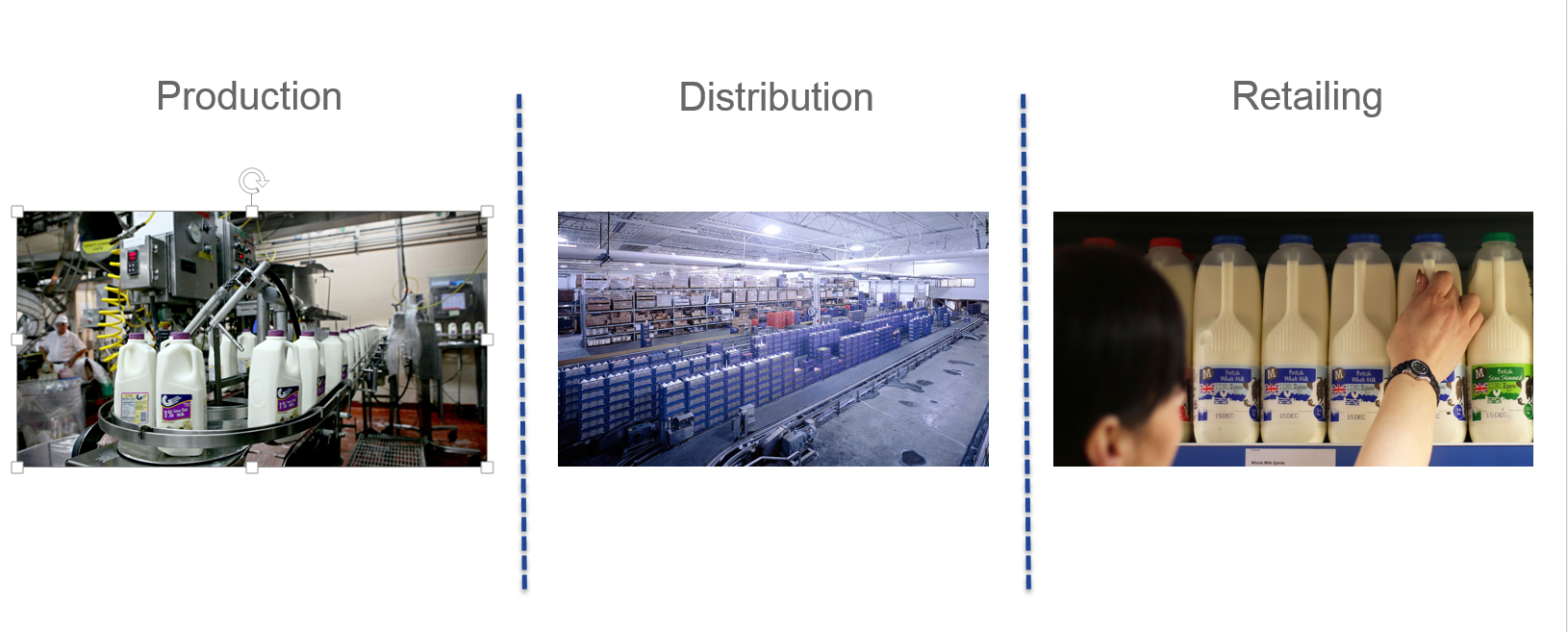
We know businesses produce goods by sourcing materials, building their product and using channels of distribution to get to the end customer, who consumes the product and derives value from it. Every actor in this value chain enriches the goods or services for the end user.
For example, for a product like milk, here is a simplified view of the physical value chain:
Milk Value Chain: Production to Consumption
Now let’s think of data as part of a value chain – a data value chain that enriches data at every stage it’s processed through the actors in the chain, in each location the data traverses.
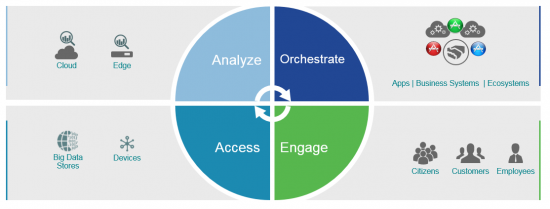
To build a data value chain, you need capabilities that will help you access data from everywhere, analyze it anywhere, orchestrate the processes and entities that help move relevant data between applications, and finally use the data in context to engage your customers and employees and prompt them to take action in real-time. We’ll discuss the technological capabilities needed to realize this data value chain in a later post.
Data Value Chain: Access Data from Everywhere, Analyze and Act Anywhere
As the business environments de-centralize, we will have data originating outside the data center in new centers of data that are closer to where events happen and where actions need to be taken (for example, in a field office or a remote operations location).
So when we think of implementing a data value chain, we have to think of accessing and analyzing data and orchestrating processes where it makes the most sense: where the event occurs and where the action is needed.
Consequently, instances of the data value chain need to run anywhere we have connectivity and anywhere we can process data. Pervasive network connectivity and distributed computing on the network enable us to do that efficiently, balancing the costs and responsiveness needs of the business.
A Matter of Time
Time is a critical factor for the value of data. For example, when a customer walks into a store, you have a narrow window of time to capture their attention and engage them to buy. This data needs action, such as sending a relevant coupon to their mobile device. Without quick action, the value of the data reduces exponentially with time.
In other cases, data aggregated over a period of time may be equally valuable. A customer might visit a store five times in a month and look for specific departments. That is valuable trend information to act on, such as sending the customer promotional coupons for categories they have historically shown interest.
To benefit from the time value of data, data value chains need to operate across the business environment all the way from the cloud to the edge and any combinations therein.
Fresh Milk and Happy Customers
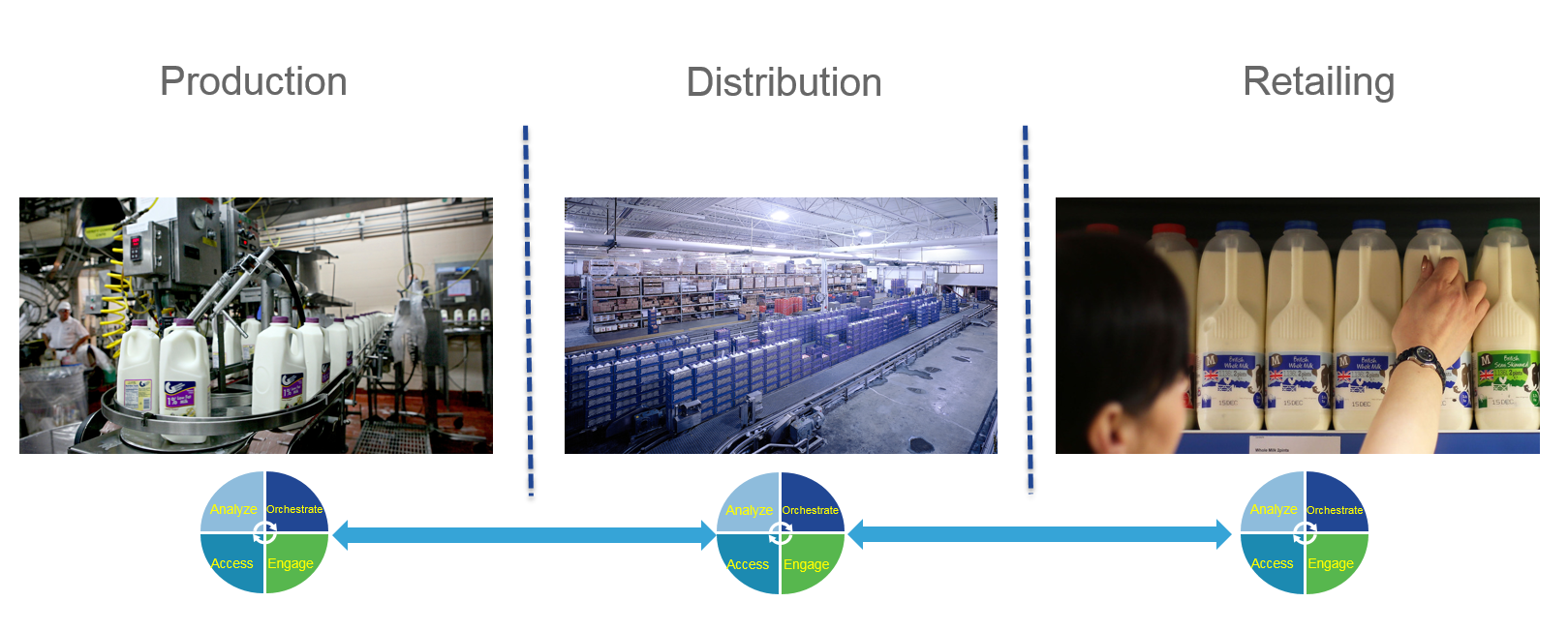
Going back to the milk value chain, you risk spoiled milk unless you continuously monitor the milk temperature and other data – during distribution, transportation and merchandizing – and take relevant action. We can digitize a mundane milk value chain and reduce waste by applying a data value chain approach:
Access the parameters about the conditions around milk
Analyze milk temperature readings and compare with other ambient data
Orchestrate the exchange of relevant information among apps (If-This-Then-That) to take automatic action
Engage people for action: Alert workers if automated actions such as temperature control fail, or in a retail setting, engage customers with promotions or shopping assistance.
Milk Value Chain Digitized Using Data Value Chains
This is just one example of how the dance of the decade is beginning to play out, and how a value chain approach to data can bring transformative value. We see this happening across many industries such as manufacturing, hospitality, retail and government, and we’ll discuss more on that in my next post.
Consider how you are getting insights and action from the data in your organization, and how a data value chain approach can help you milk your data for all it’s worth.
Learn more about data value chains by listening to my recorded session from Cisco Live Berlin.
Learn more about Cisco’s Analytics and Automation Software Portfolio:
About 18 months ago, members of my engineering team conducted customer site visits and came back with a most interesting challenge. They met a Spanish teacher who needed to teach a physical/virtual class over video, but current technology constrained her ability to move about the classroom. Any teacher will tell you that it’s an unnatural experience to spend the entire class in a fixed position.
The school already had video-conferencing equipment, but the experience just wasn’t right for what this teacher wanted to do. The IT team couldn’t figure out a simple way for her to move around that didn’t require a complicated room and equipment set-up, and maybe even a producer and film crew involved to direct cameras.
We’ve done a lot to make video conferencing more natural and easy to use. But, until now, it’s pretty much still a seated experience. This goes against the natural tendencies of many people (including me) who would prefer to move when presenting. Even when rooms are set up so that the presenter could stand, they didn’t allow presenters the flexibility to move beyond a fixed a point. And, the far-end audience was often left with a view of the back of the presenter’s head.
What’s the point of video conferencing if you can’t see faces and reactions?
I’m happy to report that we solved the problem for that Spanish teacher. And just last month, we made the technology – PresenterTrack – available to the rest of the world.
https://www.youtube.com/watch?v=qpGBbc_oPXc
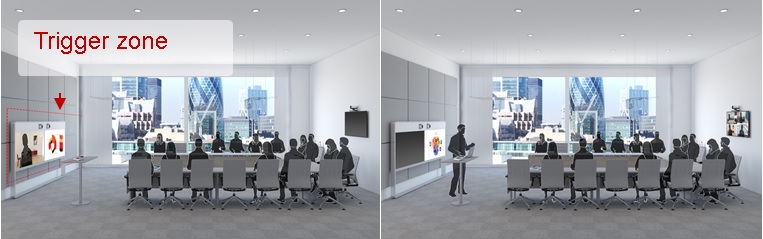
How It Works PresenterTrack* dynamically finds and follows presenters as they stand to present at the front of a room, and perfectly frames them for the far-end audience. This is achieved with face detection and image processing software along with a Cisco TelePresence Precision 60 Camera mounted at the back of the room.
When a presenter enters a predefined “trigger zone,” it activates PresenterTrack and allows the presenter to move comfortably across the “stage.” When the presenter moves out of the zone, the camera switches back to show the broader video conference.
All this happens intelligently, seamlessly and automatically. You won’t need help from your IT staff or an on-site producer. Not surprisingly, PresenterTrack has been very popular with organizations looking for a briefing or training room solution. But, it can give any video-conference room a “stage.” It offers a more natural experience for presenters and a face-forward view of the presenter to the far-end audience.
How to Get It If you already have our MX700 or MX800 room systems, or a SX80 codec, adding PresenterTrack is simple. All it takes is a software download and a Precision 60 camera. You get a polished, TV-studio look and a great experience for all meeting participants.
PresenterTrack is part of our “Intelligent Views” group of technologies, which also includes the very popular SpeakerTrack 60 dual-camera technology for active speaker tracking.
Going to InfoComm? Visit our team in Las Vegas June 8-10 for a live demo of PresenterTrack at the Cisco booth (N1204).
*PresenterTrack requires an MX700/MX800 system or SX80 Codec as the in-room videoconferencing system running Cisco Collaboration Endpoint Software 8.1. The download is free for customers with active service contracts.
When I hear the term “power trio”, I think of Geddy, Neil and Alex. A band, where there’s just a bass, drums and guitar, with one of ’em singing. By the way, if you like Rush, I’m guessing you’ll like Winery Dogs too. Both are outstanding examples of power trios. Another great example, in, umm, a very different genre, was unleashed on the world earlier this spring. That’s when Cisco announced a power trio that makes our overall Data Center solutions sound even better than before. CliQr, HyperFlex and new Nexus 9000 switches with Cloud Scale technology make hybrid cloud better. These allow customers to optimize and integrate private clouds running in their own data centers with public clouds, leveraging policy to enable automation.
Why did we introduce these new components? And was that too rapid a turn from the musical metaphor? (I suspect the response is contingent on your musical taste. In any case, I’ll only address the former question below.)
Hybrid cloud will be the norm for most enterprises.
Integrating all the pieces and moving apps across multiple clouds can be complicated.
Most customers currently have their own data center(s). They’re migrating to private cloud, so they can respond more rapidly to business requirements, etc. They’re also using public cloud, and often public clouds (plural). So, by definition, they are moving toward hybrid cloud environments. ZK Research estimates that 84% of organizations plan to deploy hybrid clouds.
So, given these thoughts, a couple questions:
What happens when public cloud provider A raises pricing and you want to move your workloads from provider A to provider B?
What about provider C, who provides SLA’s at a level nobody else can match, that are absolutely necessary for a subset of your critical apps?
How ’bout your own private cloud, that is now tricked out to the point that you can deploy apps as fast as any external provider, at a lower overall cost, with higher security?
Maybe you just wanna move from dev on provider A to production in house?
Changes aren’t permanent, but change is. The point is, workloads can/should be able to move to/from different clouds for different reasons over time. But doing this can prove to be quite complicated for a variety of reasons. Typically, this can involve cloud specific scripting and image formats, the need for code modification, yadda yadda.
In any case, in an optimal scenario, it would be good to:
Get to a point that your private cloud is ‘all that’…So the local data center network can handle things such as the imminent explosion of endpoints resulting from containers and the micro services that reside on top of them.
Leverage a hyperconvergence solution to do rapid rollout of storage and compute with simplified operations.
Move workloads from cloud to cloud with the lowest amount of time, hassle and cost.
Key in doing much of this is the notion of a generalizable profile, that expresses the requirements for the application in a way that is portable across different clouds, and to have it work in tandem with policies that automate as much as possible. This should sound familiar…UCS…ACI…there’s a pattern emerging here with this whole policy based profile thing.
In any case, if these topics interest you, please check out this report from ZK Research that investigates Cisco’s power trio and read how it makes hybrid cloud sound better than ever. Also, check the links up top if you want to hear a couple other great power trios. Go ahead. Click the links now. If you choose not to decide, you still have made a choice.
(Note: Italicized phrases are Rush lyrics. But you probably already knew that.)
If you get a chance, please reply because I’m interested in hearing what you think about any of the links!
The American Telemedicine Association (ATA) Annual Meeting and Trade Show is fast approaching! If you’re planning to attend ATA 2016 from May 15-17 in Minneapolis, be sure to visit the Cisco booth to see how Cisco video and collaboration solutions power telehealth interactions, whether you are providing care in a hospital, patient home, remote clinic, or local physician office.
You will find us in booth 1502, right near the exhibit hall entrance. We will be showcasing innovations that overcome the barrier of distance, organized in vignettes that follow the continuum of care:
Primary Care: DX80, Jabber, Extended Care
Patient Home: Extended Care, Jabber on iPad, Video on demand
Remote Specialist: Extended Care, Virtual Expertise






 need for faster scale than ever before. With the use of Cisco Prime and a centralized network control, like



 Cisco is releasing a series of nine (9) white papers beginning with two (2) that are now posted on Light Reading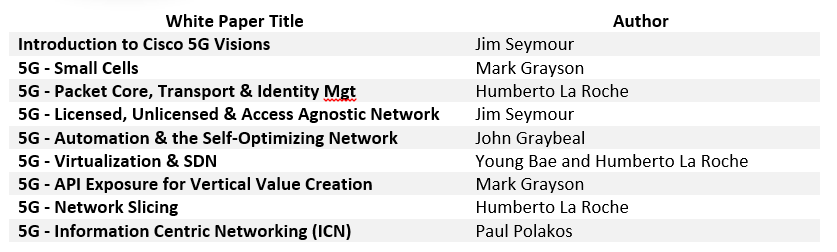






 While you’re in our booth, let us scan your name badge so you’ll be entered for a chance to win a $250 American Express gift card!