Four of today’s top ten incumbents—in different industries—will be displaced by digital disruption in the next five years. Four! This stat has kept me up at night.
Which organizations will thrive? Which will cease to exist? How can organizations successfully navigate the digital age?
I believe it begins with the right strategy to stay ahead of change. The right reactions to new innovations in the market. The ability to recognize actual business challenges versus new ventures just making noise.
But to create a solid strategy and navigate these ambiguities, business leaders need a clear picture of what our world could look like in the future.
That’s why our team worked closely with the Global Center for Digital Business Transformation, an IMD and Cisco initiative, to provide executives with an up-close view of potential business world scenarios in 2025.
Our partnership with the DBT Center reaffirmed for me that there’s never been a better time to leverage technology to transform your business and grab your chance to lead in the coming digital age. And I’m sleeping a bit better, too.
To share our research, we created an amazing report—The Business World in 2025. It zeroes in on the trends that create the pressure cooker executives face today. It also provides compelling scenarios that will help executives prepare their organizations for the future.
Along the way, we engaged with the best minds in the business, including experts and thought leaders from different backgrounds and industries. This included strategy, leadership, and sustainability across multiple lenses such as economics, technology, geopolitics, and consumer behavior. Experts included:
Business Writers
Corporate Executives
Economists
Innovation Professors
Lawyers
Leadership Coaches
Management Researchers
The report presents four business scenarios for 2025. Each scenario is a plausible, challenging, and rigorously constructed story. We’ve built the scenarios on external driving forces—forces that individual organizations have little or no control over.
Among the multiple pressures impacting the business landscape, we’ve identified the three most important that will create the greatest uncertainty and change.
These include:
Shifting geographies
How will the global economy’s operating system look by 2025?
Blurring industry boundaries
How will companies organize around new ecosystems of value in 2025?
Evolving digital behavior
How will the consumer react to Internet ubiquity in 2025?
We’ve analyzed each of these pressures to help outline considerations for the future. These are the four scenarios:
Global Bazaar—a scenario of fundamental business transformation and continuous change, where new revenue streams are unlocked due to technology, new consumer preferences, business-friendly regulation, and an open geopolitical environment.
Cautious Capitalism—a global and open business landscape challenged by a distinct shift in consumers’ digital behavior.
Territorial Dominance—an increasingly difficult international environment, where many countries step back to protectionism.
Regional Marketplace—a world divided into regional clusters, each following its own rules in trade, business policy, and Internet governance.
In the next several weeks, I’ll dig into each scenario, sharing the meaningful insight you need to stress-test your strategy. If you want to read ahead, you can access The Business World in 2025 report here.
Meanwhile, you might sleep a bit better, too, knowing you’re not alone on your digital journey—and that your organization can thrive as the digital era continues to unfold before our eyes.
Classifying and compartmentalizing information has been around within the Department of Defense before it was even called the Department of Defense. However, as DOD information that was once secured in vaults and safes has become digital data, many new regulations have been introduced that mandate how this data should be processed and handled. These regulations address the classification of the data, but they also address the segmentation of data and users.
Over the past few decade, as DOD data has moved to digital formats stored in data centers across the network, the same regulations that were used to govern the data classification and compartmentalization have also been applied to the network. And as networks have become increasingly complex over the past ten years, new requirements have been released that not only dictate data classification and compartmentalization, but also how different types of networks within the same classification are to be segmented from each other. These requirements also apply tighter controls on enclaves within the organizations’ larger network, segmenting the network even more.
Despite the new regulations, network segmentation is nothing new to DOD. Traditionally, DOD network segmentations were accomplished with access control list (ACL) on an enclave firewall or router. However, today’s networks are much more complex than the networks were just ten years ago. The DOD has responded to the increased complexity with more and more requirements, making it more and more difficult for edge devices such as firewalls and routers to be the lone enforcement device for network segmentation. As complexity and requirements increase, manageability decreases. This makes DOD network segmentation a daunting task for any network and cyber administrator.
But network segmentation is nothing new to Cisco either. Our cybersecurity solutions make network segmentation easily manageable, despite the complexity. Cisco’s Identity Services Engine (ISE), along with Cisco TrustSec and StealthWatch, build network segmentation directly into the network itself. Our technology uses policy-driven segmentation based on identity to simplify the provisioning of network access, accelerate security operations, and provide consistent enforcement anywhere in the network. Best of all, Cisco TrustSec is embedded technology in Cisco switches, routers, wireless controllers and security devices. It’s what we mean by “Network as an Enforcer”: the network itself can enforce segmentation policy, all from a centralized console that makes the policy easy to manage. And in the face of today’s challenge of recruiting and retaining cybersecurity professionals, effective management becomes an absolute must.
We know how important it for DOD agencies to keep their data safe, and we also understand that the more manageable a security solution is, the better it work. It’s why we enabled Cisco’s networks to become the effective enforcer, and why we’re laser-focused on making everything simpler and easier to manage. To learn more about how Cisco is helping the DOD with network segmentation, check out our Cyber Threat Defense here.
7-Zip is an open-source file archiving application which features optional AES-256 encryption, support for large files, and the ability to use “any compression, conversion or encryption method”. Recently Cisco Talos has discovered multiple exploitable vulnerabilities in 7-Zip. These type of vulnerabilities are especially concerning since vendors may not be aware they are using the affected libraries. This can be of particular concern, for example, when it comes to security devices or antivirus products.
Cisco’s hackathon with a Silicon Valley school empowers students to solve problems in their community with the Internet of Things.
If we want to ensure that the talent pipeline is robust and plentiful for the digital world, we need to invest in it now. Academia alone cannot keep up, nor can it sustain the kind of momentum and rapid change that business and technology are seeing today.
Taking young people out of the classroom and into real-world experiences and scenarios (also known as project-based learning) is the cornerstone for preparing students for the future and enabling the dynamic and well-rounded talent pool that the digital business demands.
While learning outside of the traditional classroom setting isn’t a new concept, experiential education has yet to be broadly embedded in the education curriculum, rather it has been treated as more of an “add-on” (with the exception of a few universities). But, it needs to be a core tenant of early education. These real-world, hands-on experiences can give young talent unparalleled insight into the working world and future careers, help them develop job-related skills, and contribute to the welfare of their communities.
At Cisco, we see investing in these young, bright, inquisitive minds, as investing in our own future.
That is why we recently hosted a hackathon event at a school located right here in the Silicon Valley, to demonstrate this much needed hands-on approach to learning and education.
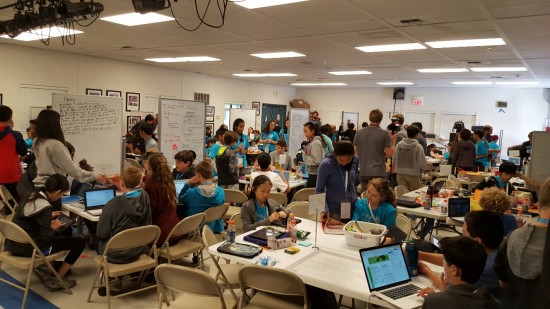
In March, Cisco’s Services Innovation Excellence Center joined with Bullis Charter School in Los Altos, Calif. to run an “Innovate Together” event for students in grades 6-8. This marks a growing trend we are seeing with the number of K-12 and higher education systems that have started experimenting with experiential learning models.
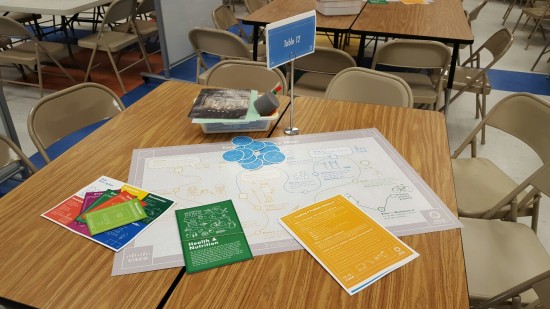
These students were asked to develop an idea using Internet of Things technology that would have a positive impact on their community. In all, 165 students participated with creative ideas ranging from an app for parents to control the amount of time their children spend on technology devices, to an app that utilizes image recognition to identify if a product in a store was tested on animals.
Indeed, research has shown that experiential and project-based learning is linked to significant improvements in student test scores, attendance and classroom engagement as well as improved higher order thinking and problem solving skills, and speaks to a broader range of learners. For instance, in one study funded by the National Science Foundation, students in project-based physical science classes performed an average of 8 percent better on end of unit learning assessments than their peers in traditional classes.
The Bullis students’ ideas were judged on criteria including creativity and originality, magnitude of community impact, ease of use, incorporation of IoT technology, and presentation.
The winning proposal was “The Sellery,” which would distribute fresh salads through vending machines. The team won $250 to donate to the community charity of their choice. Just as important, if not more so, this event helped the students gain invaluable skills empowering them to help their communities while learning about leading technology applications in the Internet of Things. From a broader perspective, these types of programs will ultimately help to close the current technology skills gap we face as a society.
What we witnessed from these bright young students in our own backyard was far more valuable than just a hackathon event. We saw eyes light up at the idea that they could invent, create, build and make a difference in their own community.
This partnership with Bullis Charter Schools is the kind of opportunity we must provide to our youth – the talent of the future. Our approach to experiential learning will continue to foster innovation, collaboration across business disciplines and industries, and create new pathways for future entrepreneurs.
Because Cisco and Learning@Cisco has been in the education and learning business for over 20 years now, we see it as both an opportunity and a moral duty to continue to invest in the future. We will continue to lead the industry in providing training and certification to further the educational evolution and collaborate with organizations, large and small, across the globe and in our own backyard.
The investment we make today in early education opportunities will have an even greater impact beyond business and into our communities, creating future leaders and new innovations that could change the world.
It is spring time in Vienna now, the music is pervasive, and the Stadtpark is transforming into a place of epicurean delights. I vividly remember my student days when “Ichmöchte nach Wien” was the most popular phrase for vacationers. Next week, I am going to experience prima facie, what Vienna will be like. I am heading off to F5 Agility Vienna.
During May 16 – 18, we will hear Cisco and F5’s leaders, customers, and partners share how the latest solutions from F5 are transforming what’s possible for today’s organizations. Over the last couple of years, Cisco ACI and F5 partnership has demonstrated significant success in our joint solution momentum and customer adoption. I am pleased to invite all of you to attend this premier industry event and get insights on how F5 and Cisco are bringing the power of Hybrid cloud, Application services, and Security solutions together to enable fast, efficient, and secure application delivery in today’s challenging hybrid environments.
F5 Senior VP EMEA Sales Lizzie Cohen-Laloum kicks off day 1 (17 May) by setting the scene and highlighting some of the key industry trends driving both challenge and opportunity for our business. F5 CEO John McAdam then takes to the stage for the first keynote to review how far F5 has come, and how we are gearing up for future success in today’s increasingly app-centric world. Other day 1 highlights include EVP of Worldwide Sales John DiLullo and SVP F5 Services Ian Jones focusing on the latest security issues and hybrid cloud potential.
This year Cisco sponsored Executive Breakout is delivered by Ed Baker. Ed brings a special touch in the context of Viennese music. Great conductors have a special skill. One hand marks the beat and the other hand changes the music. That’s a bit like the task we all face in the digital world. We’ve got the traditional world that we all grew up with. Referred to as the mode-1 world, it’s all about IT efficiency…..keeping the beat going…..making the beat faster. It’s predictable…..its mature……and we can’t stop doing it. At same time we need to change the music for this world of mode-2 which is completely different. It is about speed and agility, and most of all, it is about the APPLICATION. If you’re a customer, you might see rise of shadow IT. If you are a partner, you might be losing business to cloud or new breed of application developer.
The Application is that music, and we need to keep the music playing. What we want to do in conjunction with F5 is to help you keep the music playing, and help you be the conductor of the orchestra. So how do we do that? To find more details, I encourage you to attend Ed’s breakout on May 18, 10.20 am at the Park Congress 1 location. What’s unique about this Breakout Session? Well, you will get to not only hear Ed eloquently walk you through the role of Cisco ACI in today’s Application-Oriented Economy, but also see Martin Lipka from Pulsant join him on stage and share his success stories deploying ACI.
For the technically oriented among you, we also have two technical breakout sessions in the F5 DevCentral zone by Andrea Verri, Jan Heijdra, and Ravi Balakrishnan. The breakouts occur May 18, 9.50 am and 1.20 PM local time, and feature ACI-F5 solution architecture and deployment best practices.
That is not all. Cisco ACI brings you additional customer engagement opportunities in the solutions expo hall. We are featuring cool demos showcasing our joint solutions — namely, ACI-BIG IP and ACI-BIG IQ on May 17 and 18 during the solution expo hours. Stop by the Cisco booth where our product experts are available to engage in white-board sessions and hands-on demos. We’ll also run short duration presentations in the Cisco theatre at periodic intervals. Should you desire, we are happy to meet you in 1-1 meetings, so let us know how we can help enrich your experience at the event.
Solutions Expo Hours
Tuesday, May 17 10:30am-1:30pm and 5-6:30pm
Wednesday, May 18 12-1pm
In typical gala style, F5 is hosting a Party to attendees on the evening of May 17 at the historic Hofburg Imperial Palace. Do not miss this opportunity to network with your peers while enjoying tasty food and drink, entertaining music, and knowledgeable guides. Surprises are awaiting you on the music front.
I am eager to see you all in Vienna next week. Please check out some useful links below before your visit, and get a quick understanding of how Cisco ACI and F5 work together on the innovation front.
In a recent blog on “Why You Should Care About Model-Driven Telemetry”, I reviewed the need for streaming telemetry and the high-level architecture that makes it possible. Today I’m going to drill down on some specific design choices we made in order to quickly export large amounts of data.
Tell Me How You Really Feel About XML
When we first started working on streaming telemetry, one of the key questions was how we should encode (or “serialize”) the data on the wire. XML, that warhorse of NETCONF fame, seemed like an obvious first choice. XML is a well-defined, text-based markup language that encloses everything in tags. Now some people like XML and some people really do not. But one thing is for sure: XML is not a compact encoding. All those tags are strings and strings simply take up more space than, say, integers. Moreover, string operations are just plain slower in most programming languages. Since high performance was one of our key goals for telemetry, XML was not really the best fit.
After some experiments and customer engagements, we settled on Google Protocol Buffers (aka “GPB” or “protobufs”) as a widely adopted, highly efficient way of encoding telemetry data (we also support JSON encoding, but that’s another story). In our first release (XR 6.0.0), we went all-in on performance with a “compact” GPB format that represents the ultimate in efficiency and speed. However, that compactness came at a cost of some operational complexity. So in XR 6.0.1, we introduced an alternative format (“key-value” or “self-describing”) that is less efficient but simpler to use.
The main difference between the two GPB telemetry formats is how they represent keys. Any piece of data is only interesting if you know what it is. For example, if a router sent you an integer like “449825”, it could represent anything — uptime, packets in, bytes out, etc. In order to know what “449852” is, you need a key. So let’s take a closer look at how these keys are represented in the different encodings.
Compact GPB
Compact GPB was the original format supported in XR 6.0.0. In compact GPB, the “key” that the router includes in the telemetry packet is just an integer. So, for the interface statistics, you’d get data that looked like this:
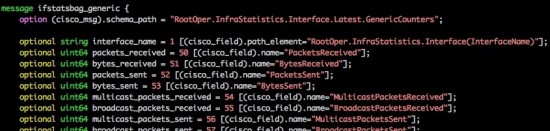
You might guess that “1” stands for the interface name, but what about 50, 51, 52? In order for you to decode this, you need a decoder ring. The decoder ring for GPB is called a “.proto” file. With compact GPB, you need to generate a “.proto” file on the router for every path that you want to stream and upload it to your collector. For example, if you wanted to stream the interface statistics, you would need to generate a “.proto” (‘int_stats.proto’ below) as follows:
Here’s part of the int_stats.proto I just generated:
With this “.proto” file, your collector can determine that key (or “field number”) “50” means packets_received, “51” means bytes_received, and so on.
Now you might be wondering why anyone would bother with all this secret-squirrel-decoder-proto stuff. The answer goes back to the name. This encoding is compact. It is far more efficient to send integers like “54” across the wire than strings like “MulticastPacketsReceived.” And GPB is really good at sending integers on the wire: it uses the concept of “varints” to serialize integers even more efficiently (i.e. a 64 bit integer doesn’t actually need to take up 64 bits on the wire most of the time). As you can see from the sniffer trace, GPB allows us to get 35 counters for 5 interfaces in 833 bytes. So if efficiency, speed, and performance are paramount for you, you might be willing to put up with the operational headache of managing the “.proto” files on your collector.
Note: Unfortunately for those of us who like to read sniffer traces, GPB’s heavy use of varints means that you can’t easily “eyeball” the trace and pick out field numbers and values. You’ll have to take a deep dive into the mysteries of varints to understand why 0x0A16 indicates that field number “1” (InterfaceName) with a length-delimited value of 20 bytes will follow (“GigabitEthernet0/0/0/0”).
Key-Value / “Self-Describing” Format
In the key-value format, the key is sent as a string. Strings are much less efficient on the wire than varints, but they are self-describing. This means that you don’t need a “.proto” file decoder ring for every path. You use a single “.proto” file for all paths, then read the keys to figure out what the values refer to. The sniffer trace for key-value encoding “scans” more easily because of all the strings:
That’s much friendlier to look at, but note how much bigger the data is. Instead of 833 bytes in a single UDP packet, you now have more than 4000 bytes across 4 TCP packets (plus the overhead of the TCP session itself).
Base Proto Comparison
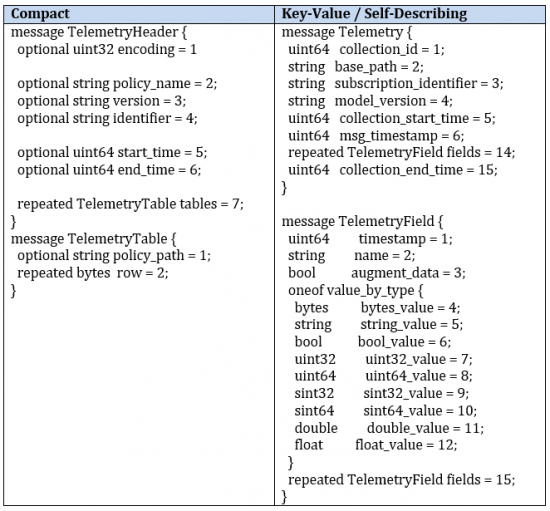
The following table compares the “.proto” files for compact GPB vs. Key-Value. Note that the “policy_path” in the Telemetry_Table of the compact GPB is used by the collector to select which path-specific “.proto” (like the int_stats.proto above) to decode the data in the repeated “rows” that follow. In contrast, the key-value “.proto” is the only file the collector needs.
Transport
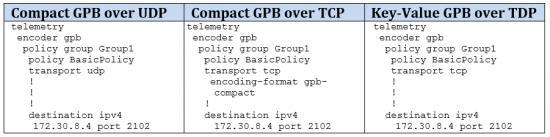
Because it’s so compact, the compact GPB encoding can fit even some of the longest “rows” of data in XR into a single packet (tables can be split across multiple packets but rows cannot). Therefore, UDP can be used as a transport for compact GPB and it is the default. If you really like TCP or encounter one of the few rows in IOS XR that can’t fit in a compact packet (even with IncludeFilters), then you can optionally enable TCP (which handles fragmentation for you). For key-value, TCP is the only supported transport since the packets will be so much bigger.
Configuration
The following table summarizes the differences in configuration for compact GPB (over UDP and TCP) and Key-Value GPB in XR 6.0.1. As you can see, the key-value encoding is the default if you specify TCP transport for GPB.
The Bottom Line
The key-value GPB encoding has a lot of appeal from an operational perspective since you’re managing a single static “.proto” file on the collector. On the other hand, the compact GPB encoding is (on average) three times more compact and at least twice as fast in our early performance testing (and that’s not counting any improvements on the collector side that come from avoiding a lot of string manipulation). Another relevant point is that the performance of key-value GPB encoding is in the same ballpark as compressed JSON. So if protobufs are unfamiliar or intimidating, you can always use the JSON encoding and know that you’re getting a good balance of usability and performance. Ultimately, the one that’s right for you will depend on your use case and your toolchain. Give them a try and let us know what you think!
Data Storytellers: Each month we’ll be highlighting experts and advocates to share their data stories, knowledge, and insights into the future of data and analytics. Subscribe to the RSS feed to get the latest updates.
Data is created fast and in the farthermost places, whether it is from Internet-of-Things (IoT) devices, appliances, transactions or mobile usage. Yet there is still a need to reach and gain insights from all this information. That means you have to do analytics in places you didn’t before and in a very distributed manner, but traditional analytics is done centralized and much, much later.
Why wait? No Time to Standby
Imagine the possibilities for companies if employees were to make profound decisions each day based on the right knowledge at the right time. Streaming analytics solutions are able to capture perishable insights on real-time data to bring immediate context to all IoT, mobile, web, and enterprise apps.
Forrester evaluated the strengths and weaknesses of the top streaming analytics vendors in the recent report: The Forrester Wave™: Big Data Streaming Analytics. I am pleased to share that Cisco’s Connected Streaming Analytics (CSA) was selected in the 15 leading vendors featured in the survey. Forrester ranks CSA as a strong performer in the market with the remark that it has a “sweet spots that differentiates the solution” from the rest of the market.
The Sweet Spot? Accurate Insight on Data Just Created at the Edge
The Forrester report highlights that” Cisco Systems’ streaming solution starts at the edge of IoT” and this “gives it the power to collect data as close to the edge as possible.”
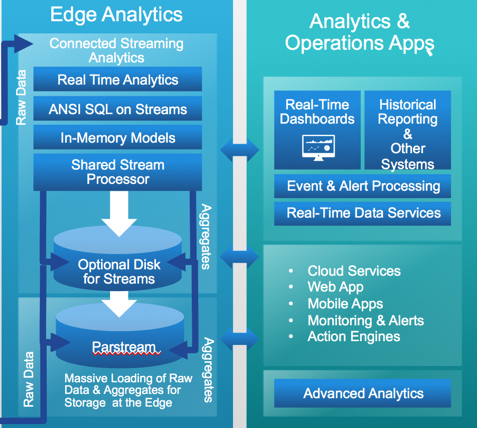
Cisco’s approach to streaming analytics starts at the edge of the network, right where the data that flows from IoT devices is being created. Edge analytics means that data is preprocessed or filtered closer to its source. The edge could be a manufacturing plant floor, a retail store or even a moving automobile. The data quickly aggregates where it is created, as opposed to being relayed to a central data center, congesting the network and adding IT costs.
Having the ability to quickly gain intelligence from smart devices in the field—at the edge of the network—can make big differences for a business, both operationally and financially.
Our Connected Streaming Analytics solution, combined with our powerful ParStream software, helps companies successfully capture perishable insights and bring them in context to take action and get value on a moment’s notice. This has huge implications for industries that can use this information to predict operational issues and detecting anomalous activity.
Explore the new CSA DevNet page
Create and find inspiring applications in the CSA Sandbox and connect with other developers in our communities. Learn, code and get inspired! CSA DevNet page
I’d like to draw your attention to a Cisco blog that came out recently from our Vice President of Global Marketing Karen Walker. Cisco has launched a new brand campaign based on the theme of There’s Never Been a Better Time.
In talking to our customers, partners, and other influencers like you, we are finding that there is a general spirit of optimism about how technologies can help move the enterprise forward. This is great to see after so many years of hard struggle in retail and across all industries. This campaign focuses on how digitization is driving new approaches now – today – to help businesses succeed.
Patch Tuesday for May 2016 has arrived where Microsoft releases their monthly set of security bulletins designed to address security vulnerabilities within their products. This month’s release contains 16 bulletins addressing 33 vulnerabilities. Fourteen bulletins are rated critical, addressing vulnerabilities in Edge, Internet Explorer, Office, Graphic Components, VBScript, Windows Shell, and Adobe Flash Player. The remaining bulletins are rated important and address vulnerabilities in Internet Explorer, Office, Windows Kernel, Exchange, IIS, Media Center, Hyper-V, .NET, and several other Windows components.
Bulletins Rated Critical
Vulnerabilities in Microsoft bulletins MS16-051 through MS16-057 and MS16-064 are rated as critical in this month’s release.
MS16-051 and MS16-052 are this month’s Internet Explorer and Edge security bulletins respectively. One vulnerability is shared between IE and Edge, meaning that both Edge and IE are affected. The IE security bulletin addresses three memory corruption vulnerabilities marked as critical, one information disclosure vulnerability and one security feature bypass marked as important. The Edge one has four memory corruption vulnerabilities all marked as critical. For both Edge and IE, some vulnerabilities are potential remote code execution vulnerabilities. For Internet Explorer these critical vulnerabilities are: CVE-2016-0187, CVE-2016-0189 and CVE-2016-0192. For Microsoft Edge: CVE-2016-0186 , CVE-2016-0191 to 0193. IE CVEs flagged as important are CVE-2016-0188 and CVE-2016-0194.













 Now you might be wondering why anyone would bother with all this secret-squirrel-decoder-proto stuff. The answer goes back to the name. This encoding is compact. It is far more efficient to send integers like “54” across the wire than strings like “MulticastPacketsReceived.” And GPB is really good at sending integers on the wire: it uses the concept of “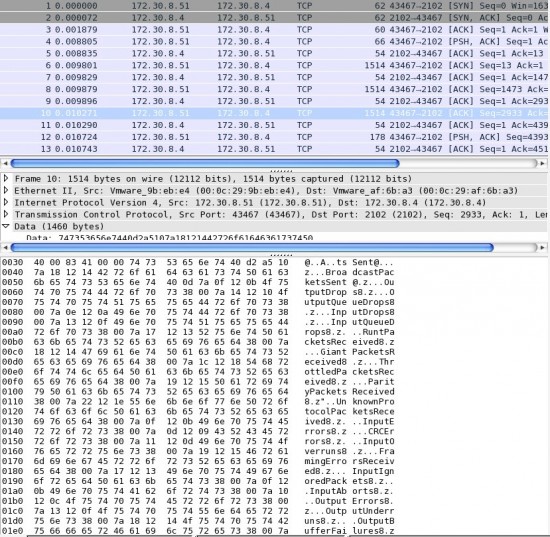

 Data Storytellers: Each month we’ll be highlighting experts and advocates to share their data stories, knowledge, and insights into the future of data and analytics.