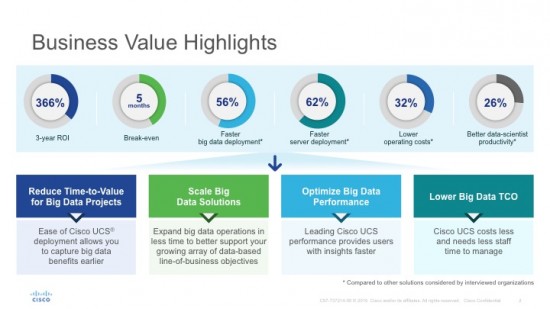
Most of us in the industry already know the importance of big data and analytics. For those of you who are further along, you might even be in the process of retiring the phrase, “big data.” Dealing with “big” amounts of data is no longer the main problem; getting the real insight fast and accurate from various sources is the goal. No matter what you believe in, or which stage you are at, it’s better to start the big data and analytics projects sooner rather than later.
International Data Corporation (IDC) forecasted the big data technology and services market growing at a compound annual growth rate (CAGR) of 23.1% over the 2014-2019 forecast period with annual spending reaching $48.6 billion in 2019. By 2020, organizations able to analyze all relevant data and deliver actionable information will achieve an extra $430 billion in productivity benefits over their less analytically oriented peers.
Talos has continued to observe ongoing attacks leveraging the use of JBoss exploits. Through our research efforts, we have identified an additional 600 or so compromised hosts which contain webshells due to adversaries compromising unpatched JBoss environments. In response to this, Talos has been working to notify victims of these compromised hosts so that appropriate remediation may take place.This blog post outlines the notification process and provides additional indicators which you can use to review your own JBoss environments, such as a list of the 500 most common webshells we have observed in the wild.
Why Did I Get Notified?
After identifying the IP address of the hosts with one or more webshells, we extracted the contact email addresses provided in the WHOIS record of the organizations identified as the owner. The notification email contains a link which you can use to view this information. We are sending notifications via email to all listed email addresses as we have found many organizations where the designated abuse contact email listed is no longer valid. By emailing all available contacts we maximize the chances of successful notification.
We’ve all watched as companies like Uber, Airbnb, Square and even Amazon have fundamentally changed the way we interact, consume and buy. Traditional business models have been completely flipped on their heads and the lines between business sectors have become blurred.
Whether you are an IT network professional or managing an intelligent, IoT-based infrastructure, these changes require new skill sets to stay competitive. Fortunately, these changes also bring a huge opportunity.
Student researching material on the internet
Networking is currently one of the fastest growing occupations in the U.S. In fact, The U.S. Bureau of Labor Statistics projects employment of network administrators will increase through 2024, with demand for those working in computer systems design and related services projected to grow as much 31 percent. That upward trend is seen at the global level as well, as businesses continue to digitize, leverage IoT technology, and scale through cloud and mobile networks.
The CCNA Routing and Switching certification has long served as the benchmark for associate level network engineers across core routing and switching as well as other technology segments of enterprise networks. But as technologies evolve, our certifications must also evolve to meet the changing demands. It’s no longer enough to just know about routing and switching.
That’s why the CCNA Routing and Switching certification is being updated to address the changing skill sets required for core network engineers. These upgrades address the fundamentals of programmable networks, including the related controller types and tools that are available to support software-driven network architectures. That’s in addition to an understanding of how virtualized and cloud services will interact and impact enterprise networks.
The revised program also includes Quality of Service (QoS) principles and applicability, along with additional focus on IPv6 and basic network security.
The move comes as part of our overall shift toward programmable networks throughout the Cisco certification portfolio. In November 2015, we introduced a new framework at the expert (CCIE) level to address these emerging technologies. These updates to the CCNA R&S represent the continued evolution of our training and certification programs.
The revised CCNA certification provides you with industry-recognized skills for today and the future and will give you the knowledge and tools needed to evolve the network.
Technology will pass you by, and quickly, if you don’t have the needed skills. Start the journey to update yours at our CCNA Routing & Switching page.
By JT Taylor, Sr. Marketing Manager, Service Provider Marketing, Cisco
Here’s something you undoubtedly already know: As consumers, we’re getting more and more connected. By some estimates, we fiddle with our phones every six seconds, on average. (Not you or me, of course. Absolutely not.)
But some flavors of connected stuff we visit much less frequently — when was the last time you spent some quality time with your connected thermostat, for instance? Sure, it was fun and shiny at first — maybe that first month — but now it’s a trusted household helper, operating in the background. All the better, really, because there are certainly limits to how much or how frequently we want to interact with what are, in essence, appliances.
But let’s revisit that “trusted” descriptor. It’s a fact that pretty much all connected devices can be breached. Not a biggie when it’s a thermostat (although yes, and anecdotally, there is a tale of breakup angst that involved a jaded spouse turning the heat up and down in their former home.)
On the other hand, what if it’s the garage door? Unfettered access to your home, and thus all your stuff — not good. What if it’s the webcam in the baby’s room? Yes, the mere thought of it is gross, and yes, it happens. The sad fact is that a hacker can gain control of any connected device in your home simply by tricking you to think you are interacting with a legitimate sever when actually, you’re engaging with their servers. From there, the level of nefarious that can happen is beyond problematic. It’s downright scary.
Which is a teaser to do one of two things, or better yet, both: Download the INTX Spring Technical Forum paper, and/or see me deliver the corresponding presentation. The session is titled “The End of Guesswork: Big Data Analytics and Implications for Content Delivery,” and it goes from 8-9 a.m. on Wednesday in room 157 at the Boston Convention & Exhibition Center. Hope to see you there!
The Cisco dCloud team recently got our entire management team on video, and apparently it was one of the scariest things they ever did. Or was it?
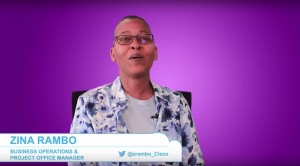
“Video doesn’t scare me,” says our Business Operations & Project Office Manager, Zina Rambo. (Find her on Twitter here.) I find it a great way to communicate, and feel that it really helps to connect at a personal level with our customers and users.”
Besides having the coolest name of any employee at Cisco, Zina is helping revolutionize how we tell the #WeAreCisco story. She has built the Cisco dCloud Social Media team, which focuses on video and real-time community building. Every new dCloud employee goes through social media training, and is empowered to share about the projects we are working on. We work transparently.
In the spirit of said transparency, it was time to put the dCloud leadership team in front of the camera. How do you think they did? Watch here.
https://www.youtube.com/watch?v=0utMieQScDg
What is “dCloud,” and why is our team so awesome?
If you have a Cisco.com username and password, you have access to all the demo content on dCloud.cisco.com. It’s open to Cisco employees, partners, and customers. We think we have “d best team at Cisco.”
“dCloud for me is a very special team that I have been fortunate to be part of” says Platform Architect, John Maliakal (find him on Twitter here.) “We can proudly say we did something that made our users really happy. The coolest thing of dCloud is that it has a character – it’s easy, flexible, friendly, user-focused, funny …. I believe it takes it from the team and really represents who we are. It’s an honor to be part of this team and to be able to tell our story.”
In case you can’t tell, either on this blog, in the video, or on social media, we think our managers are special. When a great team has great managers, anything is possible.
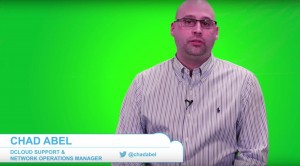
“Our number one priority for team members is ensuring that users are happy with our product and that service issues are addressed in a timely manner,” says dCloud Support & Network Operations Manager, Chad Abel (He Tweets from here.) We hold ourselves accountable. When we make mistakes, or if the service fails for any reason … we acknowledge the problem and do everything we can do to make things right. We are agile and our product engineers, content developers and service teams are all truly driven to offer the best experience to our users.”
This culture of excellence in customer experience is one of the main reasons why the management team have asked all team members to become proficient with social media tools. We respond to our community questions and concerns ourselves, real-time, around the clock. We are a global team, and we’re “always on” to make things happen.
“There are a number of reasons why the dCloud team is such a great place to work at Cisco!” says Content Development Manager, Brad Caplan. (Tweet him here.) “First, we have a very tight-knit group that feels comfortable sharing ideas, taking risks and trusting one another. This environment really lends itself to one that fosters innovation. Also, everybody on the team appreciates that our work directly impacts customers – whether those customers are our sales force or Cisco’s customers, it gives the work we do tangible impact and a true sense of importance. Plus, there’s the FUN – who wants to work with people that aren’t having fun?!? ”
So there you go, now you’ve met the dCloud “suits.” You think they’re nice? You should meet the rest of us! Say “Hello!” by using our hashtag #dCloud across social media channels. Let’s see which #dCloud team member replies first!
By now we’re all very, very familiar with the concept of the “video anys” – any content, any device, anytime, anywhere. But for the most part, we’re familiar with it in a consumer context, as it relates to how and where and when they watch video, on whichever device.
But what if the “anywhere” also applied industrially, to service and content providers, and as it relates to building out the kind of video cloud that supports the consumer-facing “anys”? What if the stuff of the “cloud” was wherever they wanted it to be – in their own, private data centers, or using any of the public, hosted cloud resources?
That’s the topic of the video referenced in this blog, which is all about how our Virtualized Video Processing (V2P) platform and Infinite Video solution work together. So: If the “under the hood” aspect of the video cloud is a big deal for you, the video is certainly worth a look, for three reasons
1. It’s real. Let’s face it – we’re not the only one out there building video clouds. The difference is, we have integrated real products, and in such a way as to now be able to bridge between clouds.
2. It’s synonymous with “speedy delivery.” We’ve seen Infinite Video help customers go live in as little as two weeks! And with V2P it’s a matter of standing up the virtual machines and virtual applications across any private or hosted environment, and turning on the cloud. Because of that, service providers can turn up new services very, very fast.
3. It’s resource-friendly. The Infinite Video and V2P platform enables our customers to use available resources and infrastructure, no matter where it is – their data centers, our data centers, Amazon’s data centers, doesn’t matter.
I like to explain it as “one pane of glass” across all infrastructure. Meaning it’s transparent, and because of that, operational costs are lower – as much as 33% lower, using the math of my colleague, Ben Bekele, who blogged on the topic last week.
That’s the quick recap – but do check out the video, because it goes much deeper, and shows an actual video workflow being set up across disparate clouds to deliver an OTT channel. Thanks!
Broadening their boundaries by establish themselves as a more international company, Il Palato Italiano relied on Cisco hardware as a main ingredient to their recipe for success.
Il Palato Italiano is an Italian-based club that’s devoted to the enjoyment of Italian cuisine. Whether it’s in the preparation of the food or the art of eating it, Il Palato Italiano’s mission is to bring the experience of great Italian cuisine to its customers. The Bolzano, Italy-based organization was facing a problem: how to expand their brand world-wide with a product that needs to be so close to Il Palato Italiano’s headquarters.
Thinking out of the box, the company tried a new idea called “Digital Telecooking Experience”. This involves chefs teaching students who sign up to be taught through the Il Palato Italiano website, to cook traditional Italian meals. The chefs and students work in separate rooms (oftentimes in completely separate countries) but stay connected via video screens and wireless microphones. The world-class chefs give equal attention to each student by being able to carefully watch their actions are via video screens.
In creating this solution, Cisco Collaboration products such as Cisco TelePresence Integrator C Series and Cisco TelePresence Codec C90 were deployed—as well as IBM system integration capabilities. However Cisco Routing and Switching hardware, specifically the Cisco Catalyst 2960-S Series Switches, were integral in creating the backbone of the solution.
Business has been heating up since the Digital Telecooking Experience launched and Il Palato Italiano has Cisco to thank for proving its business case. The company is so happy with the results and the Cisco solution that it’s considering project expansion.
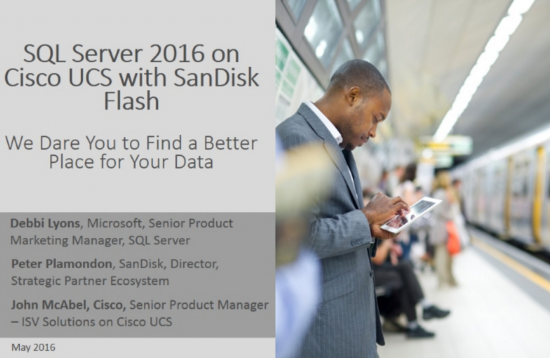
Your mission-critical data needs to be available, protected, and secure. With the launch of Microsoft’s SQL Server 2016, there’s an opportunity to transform your data platform with breakthrough mission-critical capabilities, in-memory performance, and built-in operational analytics. In addition, enhancements to AlwaysOn technology deliver world-class high-availability and disaster-recovery solutions.
Is your infrastructure ready to capitalize on these new enhancements?
Microsoft, Cisco and SanDisk have teamed up to demonstrate how SQL Server 2016 installed on the Cisco UCS server platform with SanDisk Flash changes time-to-value, advanced analytics, visualized business insights and more – all in an incredibly high-performing, economical, and efficient way.
The webinar will cover:
– What’s new in SQL Server 2016
– Benchmark test results of the combined solution
– Performance, economic, and manageability benefits
– A Customer case study with Microsoft SQL Server installed on the Cisco UCS server platform with SanDisk storage.
With the End of Support for Microsoft SQL 2005 and the support for Microsoft SQL 2008 coming right on its heals, many SQL customers are migrating their platform to the latest version of Microsoft SQL. This also requires an upgrade to their infrastructure to handle the increase functionality of the product. The Microsoft, Cisco, and SanDisk solution ensures you are implementing a flash-optimized SQL Server platform to achieve maximum performance, greater capacity, and high availability, with reduced operational and management costs.
If you are like 72% of organizations globally, your network still has some or all TDM and/or analog endpoints according to Nemertes Research. This is an astounding fact. Almost nowhere in the industry (including in this blog) do people talk about time division multiplexing (TDM) anymore. What’s more, some IT leaders believe that an all-IP environment will never be a reality in their organizations. Does that resonate with you?
If so, let’s bring the conversation back where we started: The benefits of an all-IP environment are significant. And with the evolution of technology, it is easier and more affordable to move. Nemertes Research just published a report detailing these benefits. Here is some of what they found…
Significant Saving and Improved Efficiencies Still Exist! Nemertes interviewed ten companies and each achieved significant savings with an all-IP environment. In fact, operational costs dropped by 21% and total costs dropped by 9% on average.
Nemertes shows where IP telephony shines over old-school TDM.
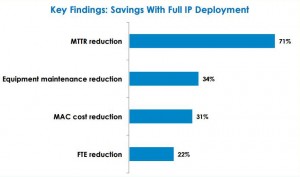
71% Reduced Mean Time to Repair (MTTR). In an all-TDM or mixed-TDM/IP environment, research participants said they spent an average of 20.8 hours to identify a problem, determine the cause, and resolve it. By far, the most time was spent was on the repair – especially finding parts and waiting for technicians. Some even complained that they had to find replacement parts on eBay due to the age of their systems. Not good. In hybrid environments, isolating the problem took longer because they had to assess both TDM and IP systems to find the root cause. By comparison, once in an all-IP environment, the average time for MTTR fell to 4.65 hours. And what is unquantifiable but equally important is improved end-user satisfaction.
34% Reduced Equipment Maintenance: TDM environments can be costly due to aging equipment, expensive service agreements, and resources required to keep the system running. The IP telephony market, however, is more competitive which allows organizations to negotiate better maintenance contracts and drive down costs. Not all participants saw maintenance costs drop, however. Some hadn’t allocated budget for equipment maintenance because they could not find anyone to do the work. When they moved to IP, many took on a maintenance contract.
31% Lower Cost of Moves Adds and Changes (MACs): Back in the day, MACs were a huge driver to move to IP. It not only lowered costs but freed IT resources for other tasks. Things have not changed: With IP telephony, you can skip the visit to the phone closet to punch down those wires. Users can simply do bring their phones with them to a new office location. Research participants saw these costs drop by 31% – big savings considering the cost could easily be $50 to $150 per MAC. And for someone like me, who had five different offices in six years, it also improved my productivity. I moved myself: All my files fit into one box, I plugged in my phone at my new location, and I was up and running on my own time – not someone else’s.
Up to 44% Fewer Full-Time Employees: We are all doing more with fewer resources today. In fact, being stretched thin on resources is this is one of the most common complaints we hear from our own customers. Moving to an all-IP environment can free up your full-time engineers by up to 44%, allowing you to focus on the priorities that drive your business forward.
What about the Benefits of Unified Communications and Collaboration? The results from Nemertes focus solely on the quantifiable benefits of IP telephony. Moving to all-IP also provides benefits for productivity and efficiency as users adopt unified communications and collaboration. Mobility, video, conferencing, and messaging drive further return on investment. And simply giving all users similar capabilities can improve communications while eliminating eliminate the “have” vs. “have not” mentality at work.
So here’s the equation.
IP Telephony +
Unified Communications & Collaboration =
Savings, Efficiencies, and Productivity
I encourage you to learn more about the benefits of an all-IP environment. An all-IP environment can be a reality.