Avatar

IT is at the foundation of many of today’s businesses and organizations. When done right, IT can vitalize a business’ day-to-day operations from the inside. Employees can achieve more with less, bringing greater value to your customer base.

Certainly, doing IT right can be complicated. Beyond performance, there are many important factors to manage: security, reliability, cost, capacity, and scaling, among many others.   Every organization is different and so each needs a unique blend of on-premise and cloud-based IT resources.

Some people mistakenly believe that the cloud is primarily for enterprises. They think because these companies need to be able to scale a great many resources quickly that they can best benefit from the economies of scale the cloud enables. The cloud, however, offers much more than just massive scalability.

As Scott Mayers from rediCloud shares in The Cloud You Need, “The cloud can be many things to a company.” By this he means that the wide range of cloud services available can play a vital role in increasing the agility, effectiveness, and profitability of a business.

One of the greatest benefits of cloud is that it brings big business capabilities to businesses of any size. Smaller businesses often cannot afford to outfit a complete data center with all the capabilities they need. Even large companies can find it difficult to acquire the expertise to implement effective security to protect company data and applications.

With the cloud, every business can leverage the investment a cloud provider makes. It doesn’t matter how much capacity you need: every virtual machine and server is secure, whether you need one or ten thousand.

The same applies to enterprise-class performance and reliability. A small business running its mission-critical applications in the same cloud as a Fortune 500 company can rely on them with the same level of assurance.

And this is what makes the cloud the great equalizer. In the past, only the largest companies could afford to build a world-class data center. That’s all changed with the cloud. Today it doesn’t matter if your organization is a startup, established company, or multinational corporation; you still have access to the latest IT technology through the cloud.

How will the cloud transform your organization? Share your thoughts by commenting below.

Authors

Xander Uyleman

Senior Manager

Global Partner Marketing

Avatar

Cisco Firepower NGFW recognized with Best of Interop 2016 Award for Security

Each year at Interop, a group of the most influential IT practitioners, analysts and professionals vote on the technologies that are having “the most significant technical impact on their segment and are helping to move business technology forward.” Cisco took home top honors in four categories this year, including Firepower NGFW for security.

Let’s look at a couple of the reasons why Firepower NGFW is a winner.

Traditionally, the act of “improving” network security has involved adding yet another security appliance to the dozens of existing products that all needed to be managed and monitored separately. The amalgamation of technologies and consoles quickly becomes a management nightmare for shorthanded IT teams. More boxes add more complexity, but does that always mean better security?

What if we could create a solution that improves security effectiveness while actually reducing complexity and saving time?

That was the challenge that we took on when building Cisco Firepower Next-Generation Firewall (NGFW). Unveiled in February, Firepower NGFW is the first threat-focused, fully integrated NGFW. It’s the only NGFW with market-leading protections from integrated functions such as Next-Generation IPS and Advanced Malware Protection. It offers unified policy management of firewall functions, application control, threat prevention, and malware protection from the network to the endpoint, all with a single management console.

Simpler security with software licenses

We know security isn’t easy – but does it always have to be so complex? Let’s say for example you’d like to add advanced malware protection and sandboxing. Not a bad idea – threats like ransomware aren’t going away anytime soon. One option is to buy, deploy and manage another security appliance for sandboxing. But wouldn’t it be easier to utilize what you have in place? We sure think so. We suggest using the Firepower NGFW you have in place and merely activating the software license that turns on Advanced Malware Protection (AMP).

Best of Interop Security

It is fast and easy – advanced threat protection is in place in minutes with nothing more to manage. It is far more cost effective too.

In case you were wondering, our Advanced Malware Protection stops more breaches than anyone. We’re just saying.

Firepower NGFW utilizes Cisco’s ‘Smart Licensing’ – making software additions a breeze. We now have this easy and flexible software license approach for URL filtering, AMP and next-generation intrusion protection (NGIPS) – just activate the license on any NGFW and you are up and running.

Let’s also consider protecting mobile users – a task for most IT teams today. Many other NGFW vendors require you to not only deploy an endpoint agent on all laptops, but just to make life complicated, add an additional database and server to make it all work. And they make you really want to pull your hair out with an additional management pane too.

Firepower NGFW protects mobile users by deploying a lightweight endpoint agent, seamlessly tied together by the cloud. We feel this approach is best – seamlessly connecting the network and endpoint with nothing extra to deploy or manage.

Gain focus with streamlined management

Firepower NGFW consolidates all security functions in a single management interface. Why does this matter? It matters because teams gain more insight and focus with all security managed from one place. Unlike competing solutions with separate panes for managing firewalls, advanced malware and endpoint, we put in all in one spot making it easier to focus.

All of our security functions – from access controls, to intrusion policy, to file disposition, and even remediation workflow are tied together. This reduces complexity with one NGFW appliance offering unified visibility and policy management so teams have a single robust console for device management, event handling and policy enforcement.

We continuously maintain a ‘map’ of network assets, and then use that context to uniquely prioritize threats and their impacts. This lets people know what they need worry about and what they don’t. And we even automate security, activating appropriate security measures based on what is happening in a network – all without requiring human intervention.

Since the unveiling in February, we’ve heard great feedback about Firepower NGFW from customers and partners alike. It is truly a resounding recognition that Interop has named it the new security product that has made the most significant impact on the industry.

Let your IT team be more productive and stop more threats so that your business can focus on what you do best. Learn more on the Firepower NGFW webpage or watch it in action on TechWiseTV.

Authors

David C. Stuart

Director, Network Security Product Marketing

Security Business Group

Avatar

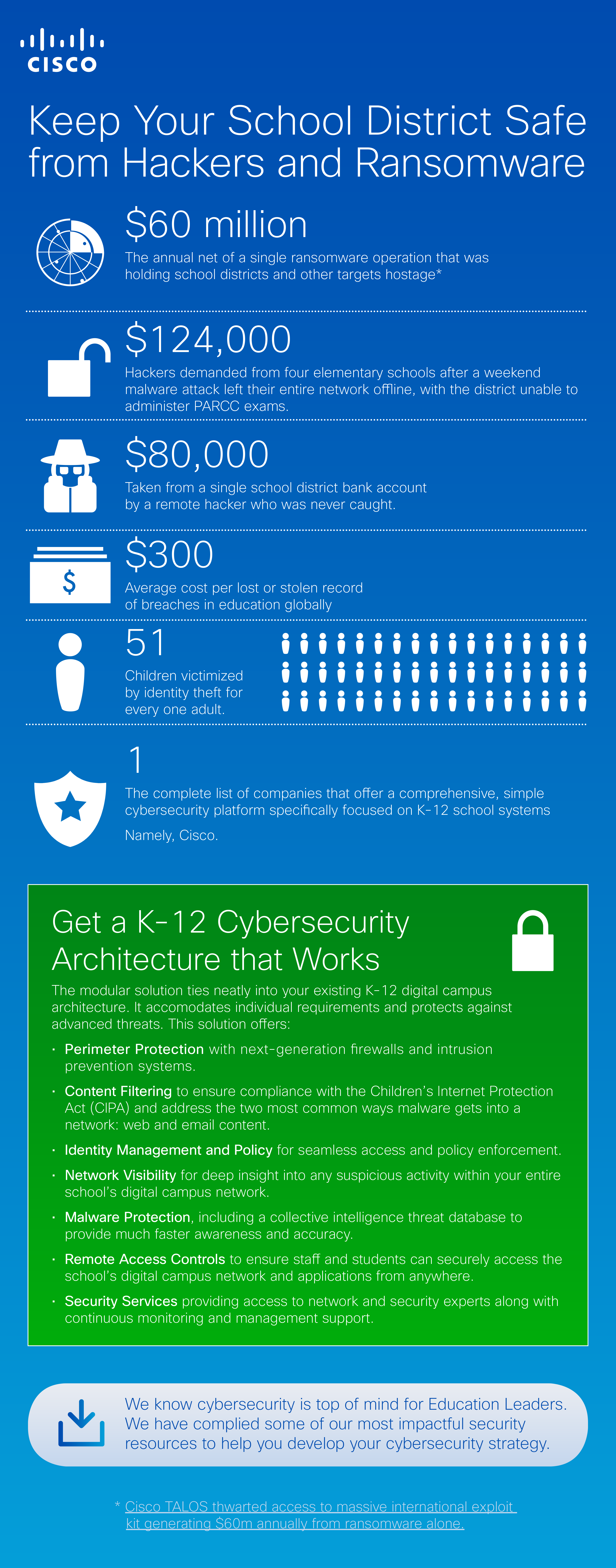
With the costs associated with a cyber attack rising and the vast number of children victimized by identity theft each year, it’s imperative to develop a cybersecurity strategy for your school or district.

See why cybersecurity is a growing issue amongst education leaders and how Cisco can help protect your school before, during and after a security breach. Check out our infographic, then download this kit with helpful cybersecurity resources.

Infographic- K-12 Cybersecurity


Authors

Matthew Gibbs

Solutions Architect

U.S. Public Sector Sales

Avatar

Las Vegas, double-headers and technology events hold a special attraction for me. Early in May, I blogged about my back-to-back events in Vegas covering EMC World and Interop 2016. I am just completing a big DC Event in Vienna this week with Citrix Synergy 2016 ready to roll next week in Vegas. Amidst these synergies, I want to bring to your attention the significance of this year’s Citrix Synergy event.

synergyvegas1

The theme this year is around “Delivering Innovation Together,” and how it enables companies to find new ways to work better together. Cisco ACI aligns very well with this theme given that ACI is a market leading software defined networking (SDN) solution, and at a broader level, sets the tone for how Cisco and Citrix help organizations in their digital transformation.

Citrix Synergy Event 2016 is particularly exciting to me as our joint Cisco ACI and Citrix NetScaler solution has picked up considerable customer momentum since its market introduction last year. Woolworth, DU and several other top customers have recently given testimonials on their positive experiences with the ACI-NetScaler joint solution, and I look forward to hearing more of these at the event. In addition, the visionary keynotes, technology training, access to industry’s top thought leaders and the customizable agenda and experience makes Citrix Synergy a valuable investment of my time year after year. You may recall earlier in March, Citrix exec, Steve Shah, blogged about the “3 SDN lessons learned in 3 years of production.” It attests to both the joint  solution momentum and the possibilities ahead in the evolving world of containers.

Where should we start? There is no better place than Citrix CEO Kirill Tatarinov’s keynote, to start the Synergy experience. Kirill kick-starts the proceedings on May 24 by sharing his unique perspectives on how Citrix is uniquely positioned to be our trusted partner for digital transformation with a vision and strategy that is focused on the secure, and unified delivery of apps and data.

Cisco Exec Soni Jiandani is delivering a super-session “SYN 130”, May 24, 1:30PM – 2:30PM, and will cover SDN and Cisco-Citrix strategic partnership from a broad Data Center perspective. Preceding Soni, Rohit Mehra from IDC will be giving a broad overview of the SDN market to set the context.  I do not want to take away all your excitement by divulging the full details, so I ask you to attend in person to get the full immersion experience.

Besides, there are quite a few sponsored breakout sessions featuring Cisco that I’d recommend. Aniket Patankar from our HyperFlex product management team is going to talk about MeanderMC’s accelerated application deployment experiences in deploying Cisco HyperFlex with Citrix. Mark session SYN 120 in your calendar. More fun awaits you. Renowned speakers Raj Gulani from Citrix PM team and Farid Jiandani from Cisco are ready to rock the stage with their technical session SYN-233, 10.30 am on May 26, featuring NetScaler integration with Cisco ACI.

synergyvegas2

After the keynote, the world of solutions beckons you with a wide range of technology showcase from industry-leading vendors, and I want to welcome you to the Cisco booth #505G where it the action is unlimited. This year we are offering solution demos and Mini-Theater presentations featuring Desktop virtualization, Networking and SDN, Mobility, and Cloud technologies to name the highlights.

synergyvegas3

The Cisco ACI – Citrix NetScaler joint solution features prominently at the Cisco demo Pod and the Mini Theater this year. We have 6 mini-theater presentations on this topic alone.  Stop by our booth and get a live demo from our experts, and learn how to automate deployment of NetScaler L4-L7 services using ACI policy framework.  In fact, we can give you a modular walkthrough of the solution whether your interest centers are around the ACI Fabric, Cisco APIC policy controller, or Citrix NetScaler. In addition, we can provide you with a quick overview presentations at our Mini theater that runs round the clock. There will be daily presentations on the ACI-NetScaler joint solutions, and I hope the theater experience will complement the insights you gain via demos. We also have white-boards to dive deeper into cross-architectural discussions should you decide to explore further. There is never a dull moment at our Cisco booth this year as Cisco UCS and HyperFlex with Citrix desktop virtualization, Nvidia GPU, NetApp FlexPod based demos offer the latest in technology innovations from Cisco and its Partners.

In closing I want to touch on the entertainment scene.


falloutboy

On Thursday night, Synergy will wrap up several days of digital business transformation with a transformation of a different kind as downtown Las Vegas becomes an exclusive food and music festival just for Synergy attendees. You’ve never seen Fremont Street like this: the classic neon face of Las Vegas offers a taste of the cooler, edgier side of the city that most conference attendees never experience. Headlining this unforgettable block party under the desert stars—Grammy Award–winning Fall Out Boy!

I look forward to seeing you all in person next week.

Related Links

www.cisco.com/go/acicitrix

http://blogs.cisco.com/datacenter/3-sdn-lessons-in-3-years-of-production-learn-from-cisco-aci-and-citrix-netscaler-best-practices

Authors

Ravi Balakrishnan

Senior Product Marketing Manager

Datacenter Solutions

Avatar

About the Author: Eric recently joined Cisco in 2016 to cover manufacturing and energy vertical marketing. He was previously the Director of Marketing at Belden where he led strategic programs and digital marketing efforts for Industrial Networking and Connectivity, Enterprise Connectivity, and Cybersecurity business units.

I have attended UTC Telecom & Technology for many years but this was my first event with Cisco and it’s been interesting to see how the issues have evolved throughout the year. Presenters and thought leaders tackled many compelling issues impacting IT and telecom initiatives in the water, electric, and gas utility industries. What were the prevailing themes at UTC 2016? We’ll be discussing this and other questions during our next #CiscoChat on Wednesday, May 25th, 2016, 9AM PST/12PM EST.

logo-2015

Meet our Hosts

Moderator: @CiscoUtilities

Panelists: Bob Lockhart (@BobLockhartUTC), Eric Ehlers (@egehlers), Rick Geiger (@ciscobtxenergy), Peter Granger (@PGrangerCISCO), and Jenny Gomez (@JRGoGreen).

Join the Chat!

We invite you to join us in discussing these questions:

  • What themes did you hear at #UTC2016?
  • One big trend is that compliance is not enough to thwart cyber threats – what are your thoughts on this?
  • Where do you think utilities are going in IT/OT convergence?
  • What approaches are you seeing companies take when it comes to cyber & physical security in Utilities?
  • What’s the future of the grid?
  • What’s the value of Digitization?

How To Participate:

  • Make sure you’re logged into your Twitter account.
  • Search for the #CiscoChat hashtag and click on the “Live” tab in the middle of the page. Be sure to follow this hashtag to follow the conversation and participate.
  • The Chat moderator @CiscoUtilities will begin welcoming guests at 9AM PST/12PM EST and will start questions after intros are done. Introduce yourself to us and the other attendees! Funny memes and photos from the event are encouraged.
  • Be sure to use the #CiscoChat hashtag at the end of each tweet, so that others can find your contributions to the discussion. Refresh the page over the course of the chat to see all the responses.
  • Preface each tweet with “1A, 2A,” etc. in order to make it easier for others to follow along with the conversation.
  • For @ replies to specific participants in the discussion, please use a “.@” at the beginning of the tweet, so that your question or comment will appear in your public twitter feed.
  • Prepare any links or images you want to share during the discussion in advance of the chat

Be sure to bring your own questions to the discussion as well. See you there!

Follow us at @CiscoUtilties and view our past Ciscochats here and here.


Authors

Eric Ehlers

No Longer at Cisco

Avatar

Andy Grove, the late co-founder of Intel who pioneered the semiconductor industry, often said, “Only the paranoid will survive.”

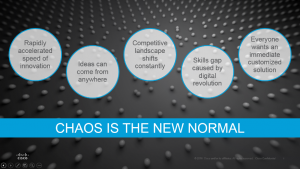
Looking over your shoulder and worrying about oncoming competitors will always be a healthy practice to stay relevant and ahead of the pack. To remain an industry leader in today’s digital era, however, I would add, “Only the innovative will survive.”Chaos is the New Normal

Digital disruption of business and society

Today’s digital revolution is disrupting business and society everywhere, accelerating the pace of change at warp speed. It’s predicted that more than 40 percent of today’s major corporations won’t exist in 25 years (source: Babson Olin School of Business).  And according to Richard Foster at Yale University, the average lifespan of a company listed in the S&P 500 has decreased from 67 years in the 1920s to 15 years today. Continue reading “Disrupt or Die: Only the Innovative Will Survive”

Authors

Alex Goryachev

Senior Director, Innovation Strategy & Programs

Corporate Strategic Innovation Group

Avatar

Is video conferencing coming to your workplace? According to a recent survey from Nemertes Research, 32% of organizations plan to deploy video-conferencing in small meeting rooms. Much of this investment is driven by two key trends:

  • Increased use of shared workspaces is driving a need for private areas that employees can use to meet with remote colleagues
  • Greater employee demand for video

I use video every day for meetings. I meet with colleagues based throughout the U.K., Europe, and across the U.S. The increased demand for video makes perfect sense to me. If we weren’t able to see each other, our meetings would be more time-consuming and much less productive.  Seeing each person in the group as we discuss a topic really helps with ensuring that we avoid misunderstandings that can create such havoc.  Like figuring out who just asked a question, and whether someone else is getting ready to answer it!

At Cisco, we are lucky to have access to video in every meeting. We can join from shared offices, meeting rooms, or using desktop systems such as the DX80.  Attending meetings from smartphones or laptops is also straightforward.

Nemertes cites increased employee demand as the primary driver behind investment in small-room video conferencing. Secondary is the recent improvement in user experience.

In my opinion, user experience becomes even more important in meetings with many participants.

As meetings include more people joining from different types of systems, each person’s experience is a crucial element of the value that they gain from the meeting.

Many organizations are reaping the benefits of cloud-based video conferencing solutions such as CMR Cloud, where the experience is defined by the service. But many IT organizations need to deliver that experience via on-premises video infrastructure. And they need to meet budget restrictions in the way that they deliver services. Traditionally, it’s been difficult to manage conferences spanning multiple premises-based video conference bridges, requiring high bandwidth usage and resulting in high costs.

Enter Acano
For these organizations, Acano (acquired by Cisco earlier this year), provides a very clever solution. As people join an Acano video meeting, they’re automatically “homed” to the closest video bridge, which hosts all participants closest to that bridge.  Each video bridge then communicates with the other bridges in the same conference. Acano manipulates the video connections so that all attendees experience the call as if everyone were using the same video bridge. The bandwidth between each bridge is equivalent to that required by a single meeting attendee. This means you can distribute video bridges in different locations, based on where employees are located – allowing you to carefully manage bandwidth costs.

In short: Everyone enjoys a great experience with reduced IT costs.

As organizations move toward new ways of working, and more employees look to use video in virtual meetings, investing in the right solution is crucially important for every IT manager.

We will be showcasing the Acano solution in our booth at Infocomm in Las Vegas, June 6 to 10. Come see us there!

As always, we welcome your perspective. Let us know how you feel that using video in meetings is bringing benefits to your organization.

Authors

Angela Murphy

Senior Product Marketing Manager

Cisco IoT

Avatar

The partnership between Cisco and Flinders University in Australia is focused on developing an enhanced digital learning experience for students, showcasing digital campus innovation, and enabling research excellence in digital health.

Flinders has always prided itself on being one of the most innovative academic institutions in Australia and through embracing the vision of a digital campus and its strategic investment in the foundation of digital infrastructure, it is well placed to capture the value of digitization. Furthermore, through having access to Cisco’s global network and industry experience, Flinders remains at the forefront of the digital transformation, so it can continue to attract the best staff and students.

To showcase the partnership and to better understand the impact that digitization can have on higher education institutions, we’ve interviewed Robert Saint, the Vice-President and Deputy Vice-Chancellor of Flinders University.

https://www.youtube.com/watch?v=qGWAnSEibcI

How have educational institutions become more dependent on technology to meet the needs of students and educators?

Robert Saint (RS): Technology affects every aspect of what we do in a university. The students come to our university deeply skilled in current technologies, and they want an experience that matches the way that they use technology.

Educators want to use technology to provide a high quality of teaching, and to revolutionize the way that teaching happens. The old idea of a classroom with a couple hundred people and someone standing in front of them has passed its time. We can replace that using technology in innovative ways.

Of course, research activities at a university revolve around technology in every aspect and every discipline as well. We need to be able to communicate and collaborate with each other, and we need to be able to work with partners. All of these requirements, including the work itself, require technology.

How has technology specifically impacted your campus?

(RS): Technology has impacted our campus by creating a stronger, communicative, collaborative environment for both teachers and students. For example, we have in place a wonderful networking system, and a unified video phone system that enables us to talk ‘face-to-face’, to have meetings at a high level and to provide the technological capacities for learning and communication that students require.

How has technology impacted research on your campus and beyond?

(RS): The research world is now driven by technology. For me personally, that means that I can talk to my collaborators anywhere in the world. It’s a remarkable thing to be able to do this as opposed to relying on email or phone calls. To be able to talk face-to-face changes the nature of the discussion.

In terms of the technologies themselves, they are driving the research. For example, I am a geneticist and with the advent of genome sequencing, now vast amounts of data can be produced in the new technologies that have come online. What’s actually holding us back now is not the DNA technologies, but the computational technology.

How important is digital transformation to your university?

(RS): We really can’t underestimate the importance of technology to what we do on campus. It’s the way in the future that we’re going to interact with our students, not because we’re asking the students to interact in that way, but because that’s what they expect.

They want a seamless experience when they come to the campus. They want it to be ubiquitous, they want to be able to open their mobile phones anywhere in the world to connect and engage with our faculty. The researchers and teachers want to be able to provide teaching tools, and their own lectures online. Technology really touches every aspect of what we do.

From a university perspective, we want to engage our employees and have them working with each other effectively, even if they’re working in separate buildings or separate campuses all over the world. Technology allows us to do that.

How has Cisco helped in achieving that vision of digital transformation?

 (RS): Our partnership with Cisco has been really important in establishing the right technologies across the university. Cisco has set up systems that we use for networking and for conferencing, both of which have been absolutely crucial. These technologies are only the start of a much greater engagement that we want to have with Cisco in developing new and innovative tools to create the fully-connected campus.

Watch this video to learn more about how universities are leveraging digital technologies to transform higher education around the world, and visit cs.co/digitalcampusanz to see more. 

https://www.youtube.com/watch?v=q8lNisqbuSg

Authors

Reg Johnson

General Manager, Education

Cisco Australia and New Zealand

Avatar

Digital Transformation. We hear that phrase a lot these days, and for good reason. Companies are focused on delivering the best digital customer and workforce experiences using technology. Most of the time, this digitization is enabled by software.


As this accelerates, are you prepared to keep up?


More importantly, are you poised to take advantage?

Software creates a tremendous opportunity for you to move from selling boxes to selling software solutions that address your customers’ specific needs. As their consumption requirements shift, we can help drive new opportunities for you to build out your software practice and increase profitability.


Here are three ways you can make money with Cisco software.


Expand your software and solution sales motions

You probably sell software today. Most likely you sell Cisco WebEx, Unified Communications, security, and analytics software. There’s more. By selling Cisco ONE infrastructure software for specific use cases, you can help customers achieve their business objectives. To maximize profitability, expand your software selling capabilities by helping customers choose the best buying model for their business goals.


For example, you may sell collaboration Enterprise Licensing Agreements (ELAs) with unlimited access to software. But do you understand the merits of offering software through other flexible consumption models? This includes software subscriptions, or the ability for customers to consume software licenses and services against an available balance up to a pre-defined ceiling of usage.  Thus, you can grow your sales by using the flexibility of buying models to elevate the conversation to why the customer is buying, not just what they are buying.


Go beyond the sale by offering Lifecycle Advisor Professional Services

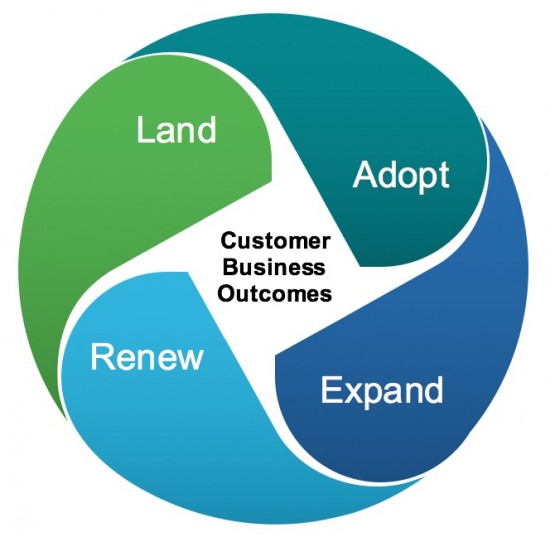
Landing the sale is just the first step. That’s where the relationship begins. By offering Lifecycle Advisor professional services, you stay connected with your customers as their trusted advisor, while growing your revenue, and ultimately make the renewal a “non-event.”

Building an adopt, expand, renew Lifecycle Advisor practice is critical for your success.

  • The first step after deployment is to drive Adoption of the software, when customers realize and appreciate the value of their investment.
  • Then you can Expand your business by selling more licenses, identifying cross-sell and up-sell opportunities, and developing a digitization roadmap for the customer.
  • When it’s time to Renew licenses or subscriptions, you’ll be that trusted advisor who has been with them along the journey.

To develop a practice, we advise you to hire Customer Success Managers, invest in Software Asset Management tools, and define adoption use-case catalogs. This approach improves customer loyalty and differentiates you from competition, and increases sales pull through. It will also provide higher rebates and incentives from Cisco.

LifecycleAdv


Develop custom software integration capabilities

Your customers want their software to be worth the investment. They want new customer experiences that differentiate them from their competition, new employee experiences that help them attract and retain top talent, and new manufacturing processes that save money.

Software developers are finding that an agile, DevOps approach to application development must be adopted to meet the needs of lines of business, which can shift quickly depending on market demands. Rarely can IT departments design, build, and deploy applications at the speed of business. To meet these challenges, you should build competency as a Software Integrator.

There is a significant opportunity for you to expand your services with software development capabilities to help customers with advanced integration of enterprise applications running on Cisco infrastructure. This means having access to software code and using Cisco APIs for Collaboration, IoT and Data Center – available through our DevNet developer community.  You can build your own practice by hiring software integrators, team with other Cisco Partner Ecosystem firms that specialize in software development, or acquire an advanced software integration company.

Growing your software revenues and high-margin, high-value services means investing. But the results can be impressive for your business. As we continue to evolve our programs, enablement, and incentives, we want to help you along this rapid transformational journey. Let’s do this together.


Wherever you are, take the next step.

Get started with Cisco Software

Visit our Cisco One Software Community to join the conversation

As always, feel free to chat with me on Twitter or provide any questions and feedback below in the comments


Authors

Jason W. Gallo

Vice President

Global Partner Value Acceleration