Avatar


There has never been a better time to change the world together. Now is the time to work together, leverage our partner ecosystem, and use the power of the Cisco brand to be better together in the digital future.

What’s New?

Our recent Brand Campaign Launch clearly reflects the importance of how we can combine our strengths to drive customer success and profitability. If you haven’t seen or heard about it, I encourage you to check out the social conversation by tracking the #NeverBetter hashtag. You’ll notice this brand campaign is different. This time, our partners play a huge role because they are an integral part of the digital transformation we are driving together. There are phenomenal stories demonstrating the amazing things we can do together. Expect many more stories to come as we continue to prove that there’s never been a better time for us to change the world together.

https://www.youtube.com/watch?v=aDJcSozYJBE&list=PLF390A3A7152E5BF4&index=2

Why Now?

Digitization isn’t going to wait for anyone. According to the Global Center for Business Transformation, 40% of companies are at risk of being displaced because they’re not equipped for the digital future. This is where we can work with partners to help ensure those companies aren’t falling behind.  Digitization is happening at a rate that is paced by end-user and customer demand; a rate that we can’t tackle alone. Those who are reactive may lose the race.

In order for us to be proactive and monetize digital now, we must move as one with agility, speed and the vision to anticipate what’s around the corner. At Cisco, we know our extensive and experienced Cisco ecosystem combined with an established and powerful technology brand is a tangible advantage and sturdy ship that can pierce through the strong waters of the digital future.

During Partner Summit back in March, I told our Americas partners about my 3 E’s: Engagement, Enablement & Evolution, as a launch-pad for executing and monetizing digital today. The foundational message of our brand campaign and the approach we are taking with our partners are aligned, and that’s what excites me the most today.

Empowering our Partners

Engagement. The time is now to listen to you and for us to listen to our mutual customers. Together we can customize solutions for desired business outcomes. When we engage this way with you, we become your trusted advisor. This empowers you to do the same for your customers, earning their loyalty and opening up faster paths to revenue.

Enablement. The time is now to train, provide tools and resources, and enable you to be relevant to the desired business outcomes of customers. Together we can be relevant to our customers’ needs.

Evolution. The time is now to evolve together. Disruption means change and change means opportunity. What was once valuable 10 years ago, is no longer today.  In order for us to deliver customer success, we must evolve in a way that allows the partner to adapt to customer demands and capitalize on the digital opportunities that arise.

I will continue to share more in the near future around the programmatic benefits and next steps for our partners regarding these 3 E’s. I’ll also be engaging more from a social and blog standpoint moving forward.

If you are not a partner with Cisco, learn how to get started today.

Partners, learn more about our new brand campaign and how you can leverage Cisco’s brand here. Connect with your Cisco rep to tell us your story of how we have or can change the world together.

Be sure to join the brand campaign conversation using #NeverBetter.

Feel free to connect with me on Twitter and send me questions – or you can leave any comments below. Your feedback is always important.


Authors

Rick Snyder

Senior Vice President

Americas Partner Organization

Avatar

We’ve all heard that digital business transformation is upon us. Organizations are transforming processes and business models in order to get to market faster and foster innovation. Disruptive business models are replacing established players, from Netflix vs. Blockbuster to Uber and the taxi industry; we’re all familiar with the many proof points.

An important step in this digital business transformation is to build a digital workplace that helps achieve team goals, fits with the company strategy and facilitates business agility. This is where desktop and app virtualization has a big role to play by providing secure access to core business applications to a mobile and elastic workforce.

By decoupling the applications from the end device and keeping data safely in the data center organizations can provide their employees, partners, contractors the right tools to get their job done the way they want and IT can concentrate on helping grow the business rather than spend time updating OS on end points.

Citrix Synergy

What better place to showcase what Cisco’s infrastructure has to offer for desktop and app virtualization than Citrix Synergy? This year Cisco will present a number of exciting Citrix-based solutions that help make the digital workplace a reality.

https://www.youtube.com/watch?v=6Lq_CjVShSQ

First, we have a new Cisco Validated Design (CVD) for 5,000-seat XenDesktop/XenApp implementation on all-flash FlexPod that provides an enterprise-grade, pre-integrated solution for large scale deployments. See CVD here.

Then we have a winning combination with a 2,500-seat SmartStack VDI deployment on XenDesktop coupled with a 500-seat bare-metal XenApp RDS deployment on UCS M-series. This solution uniquely matches the right Cisco platform with the workload to provide higher desktop density and great TCO. See the CVD here.

A common theme in these two CVDs is the incorporation of graphic acceleration to deliver superior user experience. We used the NVIDIA M6 TESLA card with GRID 2.0 on UCS B200 M4 blade servers on both the FlexPod and SmartStack solutions. On the UCS M-Series M142 cartridges we used the Intel Iris Processors for graphics support to provide graphic acceleration to XenApp workloads.

Cisco Infrastructure for VDI

The strength of Cisco infrastructure for desktop and app virtualization is the breadth of our portfolio. We cover everything from component based solutions with our blade and rack servers, composable infrastructure with the UCS M-Series modular server, edge-scale computing with the UCS Mini and converged infrastructure with FlexPod (NetApp) and SmartStack (Nimble Storage). And we recently introduced Cisco HyperFlex Systems, our hyperconverged platform to round up our offering.

Cisco HyperFlex seamlessly unifies networking and compute with a next generation data platform enabling end-to-end simplicity for IT velocity. It is a purpose-built, high-performance distributed file system delivering a wide range of enterprise-grade data management and optimization services.

Attend our session on Wednesday May 25 at 3:30 PM, SYN120: Accelerate your Path to Digital Workplace Transformation with Cisco HyperFlex and Citrix to learn more about Cisco HyperFlex and what it can do for your VDI deployment.

We will also be showing a HyperFlex demo in our booth as well as the actual gear. Also in our booth, we will be demoing our solution for graphic-accelerated VDI using NVIDIA GPU cards along with our FlexPod and SmartStack solutions based on our recently released CVDs.

If you’re interested in Software Defined Networking check out our Cisco ACI demo in the Cisco booth and on Thursday May 26, at 10:30 our joint session with Citrix, SYN233: Integrating NetScaler into Cisco ACI environments.

There’s never been a better time for desktop and app virtualization. So come by the Cisco booth at Synergy and catch a session in our mini theater, you’ll get a Starbucks gift card and be entered into a drawing to win a $50 Visa gift card. Stop by our demo pods and talk to our experts about deploying XenDesktop and XenApp on Cisco UCS and HyperFlex. Check all the details here.

See you there!

Authors

Francoise Rees

Marketing Manager

Customer Solution Marketing, Cisco Intersight

Avatar

The thoughtful placement of technology in our education environments can greatly enhance the way students learn and educators teach. As we all know, it’s possible for students to partake in mobile and distance learning, to access a plethora of remote resources from anywhere on any device, and to extend learning beyond the classroom.

However, with any movement or shift towards digitization comes the creation of a digital divide. Not providing comparable access to all members of the community has severe consequences. Equitable access to resources, content, and experts is essential, especially when talking about the education of the future members of our society.

QuoteGraphic1

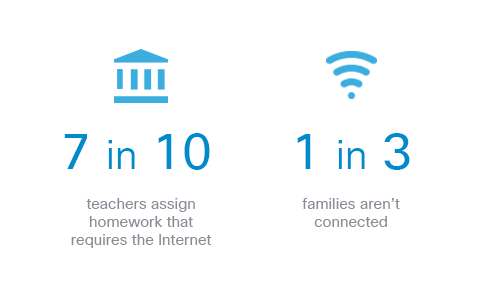
According to a recent study by CoSN (Consortium for School Networking), 7 in 10 teachers assign homework that requires the Internet, yet 1 in 3 families aren’t connected. And, when polled, 51% of principals interviewed said that ensuring access to technology outside of the school is a major challenge.

From an educational perspective, not only is this divide causing inequitable opportunities to complete assignments and perform well in school, but it also squelches the curiosity of students that takes place beyond the traditional school hours.

Studies show that today’s learners, the millennial learners, require a learning environment that is personalized, learner-centric, location-agnostic, social and collaborative, time-agnostic, and accessible lifelong. When we look at what’s engaging today’s students, it becomes apparent that we’re doing them a great disservice by not providing equal access to the technology that motivates them.

So, how can we as a society address this growing digital divide?

Change is only possible when implemented with both technological fidelity and appropriate pedagogical shifts. In order for technologies to enable enhanced learning, the digital environment must be reliable, accessible, secure and thoughtfully applied in the curriculum.

Quote2

Solving the problem of connectivity and access is an issue that we can elevate globally, but it has to be solved locally.

The first and most important step of creating a fully connected community that bridges the digital divide is to create a holistic, common vision. Assess what connectivity can do for your community, and then you can begin to address how to make that happen.

Next, garner community support of this cultural shift. You must secure the support of key stakeholders, partners with traditional and non-traditional constituents as well as the community at large, then you must address the necessary changes in policy and funding models to implement your vision. For sustainability of the community’s digital vision, educators have partnered with county supervisors to ensure every new house built has Internet access.

Lastly, bring in trusted technical advisors to help set your vision into motion. At Cisco, we’re helping communities architect and design networks that enable current and future engagement.

While our society as a whole has yet to bring equitable access to all, there are some communities who have already begun to bridge the digital divide.

AM63062

One such community is Imperial County, a southeastern California county with approximately 175,000 residents, 37,000 students, and 64 schools. They built their own last-mile fiber network to support local government functions, the school system and other community needs.

In addition to connecting schools and government buildings in Imperial County, the local public libraries also provide free public access to Wi-Fi, even after hours. Computers are available that enable citizens to look for jobs, apply for jobs, write resumes, and more. For K-12 students, both live and remote tutorial and homework assistance are available.

Imperial County has demonstrated that even remote communities can effectively plan, build, and manage the full benefits of a community-owned fiber IT infrastructure, leverage strategic partnerships, seek technical expertise, and achieve economies of scale for rural and remote communities.

And they’re not the only ones. We have partnered with many more communities making similar shifts, and in the future, we will continue to partner with innovative communities and school districts around the country, ensuring that the digital divide will no longer inhibit equitable access and learning for the next generation of students.

Authors

Avatar

It’s a wrap: Charter “Spectrum TV” customers who also own Roku devices can stream to their hearts’ delight — and Charter can have the peace of mind knowing that their content arrangements are safe and secure. That’s because Cisco and Roku are working together to simplify and speed up the deployment of Cisco VideoGuard Everywhere video service protection for streaming apps on Roku devices.

Roku is pre-integrating our VideoGuard Everywhere in its firmware, starting next month. It will be on all Roku device models, and will be auto-upgraded on Roku devices already in homes. Integrating security into an app is done easily using our APIs (Application Program Interfaces) with the Roku BrightScript development language.

Hands.Tablet.Cheerleaders

Ease of deployment is one important factor — feature richness is another. With VideoGuard Everywhere, Charter is inserting advanced security functionality into the Spectrum TV app on Roku, including secure VOD and linear content, and enforcement of device concurrency limits — meaning the number of devices that can be simultaneously used to watch content from a single account.

Charter is a leading VideoGuard Everywhere customer, having deployed our software-based security solution across its service suite — on Worldbox, for television viewing, and the Spectrum TV app running on PCs, tablets and phones.

We’ve been delighted to work with both companies to deliver the protection Charter needs while allowing a consistent multiscreen experience for subscribers.

If you wish to read more, check out the press release and see what everyone had to say about it.

Thanks, Charter and Roku, for the enjoyable and rewarding collaboration!

Authors

Michal Brenner

Marketing Manager

Service Provider Video Marketing

Avatar

By Todd McCrum, Sr. Director, Strategy & Product Management, Cable Access BUTodd McCrum

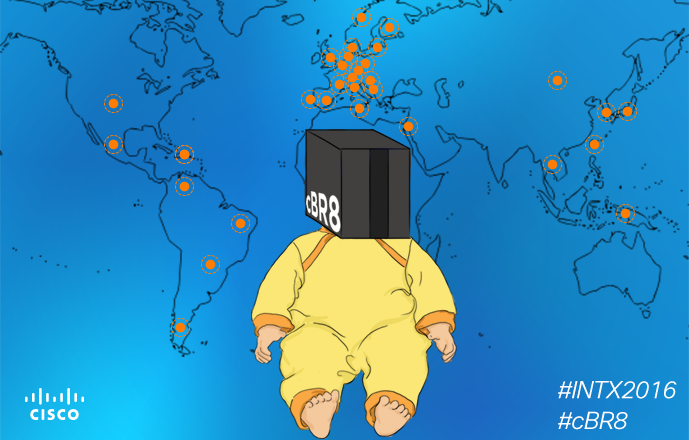
It was at last year’s INTX, in Chicago, that we launched the cBR-8 (remember the “Giga-Baby”?) as a way to help our cable service provider customers affordably and quickly offer faster broadband speeds, with converged equipment.

And here we are, 12 fast months later, with nearly 100 “Giga-box” customers spanning 32 countries. Crazy. Here is a snapshot of the progress we have made with the cBR-8 platform:

  • Evolved CCAP: The hardware shipping today supports full ‘Evolved CCAP’ functionality, which includes DOCSIS 3.0, voice and MPEG video + DOCSIS 3.1 downstream and upstream + Remote PHY.
  • Video: cBR-8 currently supports 96 unique channels of data and video per service group, with full MPEG VOD and switched digital video support for both Cisco and Arris encrypted video.
  • DOCSIS 3.1:  The current hardware supports both downstream and upstream DOCSIS 3.1 with software available for two blocks of OFDM.

Gigababy_LI

We have other great things to say in today’s press release, but what is not in the release per se, is what’s happening beyond the palpable momentum for multi-Gig speeds in the downstream (customer-facing) direction. And by that I mean how fast our one-year-old “Giga-baby” can already run in the upstream signal direction (facing the Internet.)

Who cares? Bandwidth providers, for one. Why: As we, as consumers of bandwidth, start shipping around more webcam-sourced video, to more connected devices — over Wi-Fi or hard-wired — so will grow the need for more upstream speed, which ultimately leads to more symmetrical services.

Our view is that it’s a pretty urgent need. Think about it as it relates to your digital life: How many gadgets do you have, that can shoot video? (Don’t forget webcams.) How often do you shoot video with your phone, and send it to people over Wi-Fi? A lot, right? This matters because video is big (really big) compared to most other things moving over the Internet.

Which is why I wanted to take a moment, in this blog, to sketch out what’s happening under the hood of the cBR-8, as it relates to the upstream signal path. Which, pretty much forever, topped out at about 5% of total available capacity. So when you’re at home, connected to your cable provider’s Wi-Fi, sending all that video? It’s heavy on the system sometimes. And it’s going to get heavier, the more we record our lives in video.

So here’s the interesting sideline news about the cBR-8: We have tested and proven the ability to get to 700 Megabits-per-second / Mbps in the upstream path. For context: The prior speed record, in the upstream signaling direction, in the DOCSIS 3.0 days, was 100 Mbps.

We got there by running OFDMA across 96 MHz of spectrum, using 1024 QAM. This tends to be especially of interest for operators interested in expanding their upstream paths beyond 42 MHz, to 85 MHz or 200 MHz — it gives them the spectral “elbow room” to get there cleanly.

Some of you might be saying — yah, that’s nice, Todd, but what kind of signal-to-noise ratio do I have to have, to afford such a high order of modulation? Answer: We’re seeing customers get to 4096 QAM with N+2 and N+3 plant (where the “N” means “node,” and the digit means how many amplifiers are in cascade after it.) Granted, these are operators with pretty serious “clean plant” workflows, but, the point is that it’s doable.

Combine 700 Mbps of throughput in the upstream with the 3.5-5 Gigs of throughput already available in the downstream signal path — it’s huge, I’m telling you. Huge!

Unless I missed something, it’s a first. A big first. And it’s just the beginning. So. come by and talk to us about our “Giga baby.” She’s looking really good for one — and she’s really, really fast.

Authors

Greg Smith

Sr. Manager, Marketing

Cisco Solutions Marketing

Avatar

By Marc Aldrich, SVP, Global Service Provider, CiscoMarcAldrich

We hereby interrupt this helter-skelter year in news, workload and general busy-ness to offer a moment of Zen, in the form of appreciating three trailblazers in our midst.

By “trailblazers” I’m talking about Yvette Kanouff, Conrad Clemson, and Rajeev Raman, who, by their own respective merits, earned noteworthy attention, to be celebrated here and at INTX this week, in Boston.

YvetteAllow me to elaborate, starting with Yvette, SVP/GM, Cisco Service Provider Business, who will be inducted into the “Cable Pioneers” at INTX on Sunday, May 17. But wait, there’s more: She’s also included in the CableFAX 100, “commemorating the cable industry’s most iconic power list” (results to be announced at INTX,) which she has been included in for years.

Insider background: The table stakes to be a Pioneer are a relatively do-able 20 years of service. That said, few get in who haven’t stretched well beyond their salaries to make a difference in ‘Stuff That Matters’. In Yvette’s case, it’s a list too long for a blog, but if I had to bucket her extra-curricular activities, I’d spotlight her Emmy win and patents on VOD-related digital technologies, and countless hours of service in the Department of More Women In Tech! She’s relentless, and thank goodness we have her. Thank you, Yvette!

Conrad Clemson headshot dec2015 HiRezAlso in the “good people” category: Conrad Clemson, SVP/GM, Cisco Service Provider Video Software and Solutions, and not just because he’s a likable guy and always nattily dressed. He’s also a part of the CableFAX 100 list of heavy-hitters, because of his conversationally clear way of explaining the particulars of content protection, headends, clouds, client software, streaming, encoding, you name it. He’s a rock star. Congrats and thank you, Conrad!

RajeevRaman.3One more, in the last-but-not-least category, is Rajeev Raman, Sr. Director of Strategy, Studio Design, and Product Management, Cisco Service Provider Video Software and Solutions, who was ranked #28 in VOD Professional’s Top 50 VOD Professionals in North America. A “serial entrepreneur,” he came to us via our acquisition of 1Mainstream, which he founded in 2012 with colleagues from Roku and Apple — and he’s a huge part of the reason we’re at the front of the pack with multi-screen everything.


He’s one of those guys, like Conrad, who can see around the corners of video trends — the latest being that yes, yes, yes, mobile viewing is growing and great, but that thing on the wall called the TV still garners more engagement than anything else. One the one hand, it’s because we’re getting information and news elsewhere than TV; on the other, it’s because our lives and days are much busier than , and it’s the place we go unwind and veg out. Thank you, Rajeev!

So — should you bump into Yvette, Conrad, or Rajeev, please join us in offering them a bow and a tip of the hat. Thanks!

Authors

George Tupy

Market Manager

Service Provider, Video Solutions

Avatar

Automation is a key element in our Cisco Digital Network Architecture (DNA). The immediate –and let’s admit it, somewhat negative- association with automation is that the human element in production is almost entirely replaced by robots. While that might be a trend in certain manufacturing environments, IT Departments are not a production plant. Especially as enterprises increasingly adopt digital strategies, IT becomes a vital business transformation element.

Let’s make it perfectly clear: the most business relevant elements of IT cannot be automated, because they require creativity, vision and architectural savvy. That’s not to say automation doesn’t have a very important place in IT Departments today. It plays a critical role by freeing up IT resources for the more strategic planning required to enable digital initiatives. The repetitive configuration of a network element to a certain operational standard can be automated. But building an automation strategy, or any other strategic IT initiative, cannot be automated.

https://www.instagram.com/p/BFXL-LMrogS/?taken-by=ciscoenterprisenetworks

Let me give you an example: with Cisco DNA, we provide an application that runs on our SDN Controller, the APIC-EM.  Cisco DNA provides 85% faster provisioning of network services and 79% reduction in installation costs. So now, instead of configuring every branch router’s capabilities manually, the network manager uses the app to abstracts details and provide automation based on a few pre-defined, optimal configurations available from a catalog. Now here’s the thing – I still need experts to define and build those standard, optimal configurations. Through this process, others are able to re-use and quickly apply easy to understand standard configurations. This means my experts can keep innovating and developing new automation strategies, instead of having to engage in the tedious, repetitive exercise of manually replicating such configurations throughout the entire enterprise.

In a world in which we are always asked to achieve more business outcomes with fewer resources, the only way IT will flourish is by focusing on innovation, and not by merely operating the enterprise infrastructure to “keep the lights on”.

That is the goal of DNA: to allow us to automate the trivial tasks, and thereby have time to focus on the essential: innovation that directly delivers on new business capabilities. The Cisco DNA network vision is about a network that enriches business processes with network analytics we have thus far underused; a network that defends the necessarily open and thereby more exposed nature of Digital Business with innovative network capabilities. In a nutshell, a network that optimally supports the needs of the digital enterprise – and automation is the necessary first step to accomplish that important goal.


Authors

Raakhee Mistry

Senior Director

EN & Cloud Marketing

Avatar

Next week at the O’Reilly Open Source Conference (OSCON) in Austin, Texas, I’ll be teaching systems administrators and developers how to throw away their servers each time they want to make a simple change. Sounds ridiculous? That’s what I thought as first too. But ask any experienced sys-admin how many times a “simple, one line change” has taken down a production service, causing loss of service to customers. You’ll might be surprised.

Let’s take a step back and talk about how traditional computer systems infrastructure management looks. You need to stand up a new service, so you procure a server, wait for it to be delivered, set it up with a fresh OS and your configuration, install it in a rack in a data-center, and most likely manage it remotely over SSH. Want to upgrade the software or make a change? SSH in and make the change. Or maybe you’ve figured out that this is not scalable, and are using some sort of configuration management tool like Puppet or Chef or Ansible. But what happens when a deployment goes south? How easy is it for you to rollback? Why did it go bad in the first place anyways – is your test environment low fidelity compared to your production environment? Did you even test the change before “shipping” it?

Virtual machines came along, and so did “the cloud.” They saved us enormous amounts of time and money by reducing the process of provisioning a new server down to the click of a button and a few minutes time. But wait – why are we even clicking a button? These are virtual servers after all – just more lines of code. We had grown so used to the model of treating our servers like they were pets, constantly needing care and attention, and making sure they stay up and running as long as possible – because no one wants to be the one to drive down to the data-center on Saturday night to fix the server that has a faulty power supply. Somehow we did the same thing with our virtual machines – we were doing it all wrong!

Enter disposable infrastructure. Here’s the idea: you build a virtual server with your latest and greatest production code, and put it out there in the wild. Want to make one of those “simple, one line changes?” Build an entire new one. Test it thoroughly. Slowly put it into rotation, like dipping its feet in the water, so that you can always pull it right back out if something wasn’t quite right with it. All of this should be defined in code, as some call “infrastructure as code.” Never touch an instance that is already in production, as some call “immutable infrastructure,” but instead just dispose of it. Write well defined and through tests, all automated through your build system, to reduce the human element as much as possible.

In the course at OSCON, we’ll dive into this idea in a more practical sense, by getting our hands dirty with some of the most popular open source tools for accomplishing this model: Vagrant, Puppet, Packer, and Terraform. We’ll use the tools against AWS, where many attendees already have infrastructure hosted. But most importantly, we’ll all become much more confident about pushing changes to production, which allows us to become more innovative, move fast, and provide much more value to our customers.

Authors

Chris Dorros

Sr. Systems Security Engineer

Security Business Group (OpenDNS)

Avatar

Research has shown that businesses who leverage their data are statistically more likely to be successful in their respective industries. The opportunity granted by big data enables businesses to boost their competitive advantage, improve the business decision making process, and increase revenue.

Using insights from big data, companies are:

  • 5x as likely to make decisions faster than market peers
  • 3x as likely to execute according to established plans
  • 2x as likely to outperform 75% of competitors, landing in the top 25% financial performers in their industries

Some of our customers were able to achieve that by building a joint solution with Cisco UCS Integrated Infrastructure for Big Data and MapR’s Converged Data Platform. Cisco UCS Integrated Infrastructure for Big Data is a highly scalable architecture that includes computing, storage, connectivity, and unified management capabilities. The MapR Converged Data Platform integrates the power of Hadoop and Spark with global event streaming, real-time database capabilities, and enterprise storage, enabling customers to harness the enormous power of their data.

Here is one customer example:

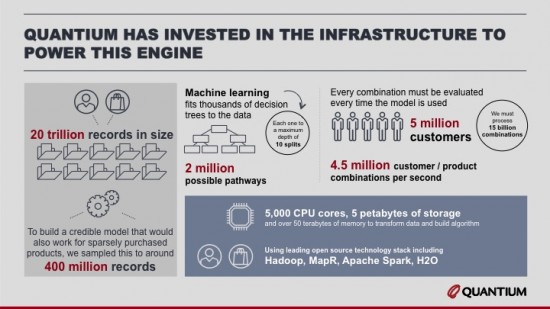
Founded in 2002, Australian-based data analytics firm Quantium—whose customers include Australia’s largest companies, including Woolworths, National Australia Bank and Foxtel— revolutionized its analytics approach and expanded its footprint into new market segments. With the Cisco and MapR platform, Quantium realized a 92% reduction in query time with improved accuracy, and a 30% reduction in time spent managing data clusters.

Quantium

Continue reading “Why Quantium Chose Cisco and MapR to Transform Its Analytics Approach”

Authors

Renee Yao

No longer at Cisco