Cisco Champion Hosts
Tim Miller (@broadcaststorm), Senior Engineer
Denise Donahue (@ladynetwkr), Business Architect
Bill Carter (@Warcop), Senior Solutions Analyst
Brad Haynes (@GK_bradhaynes), Client Solutions Specialist
As the second largest municipality in Florida, Orlando Utilities Commission (OUC) is responsible for providing its 310,000 customers across Orlando, St. Cloud, and Orange counties water and electricity 24 hours a day, seven days a week. Because the utility serves such a large number of customers across a wide range of cities, OUC management found it difficult to keep all of its different branch locations connected using an outdated data center infrastructure. With a vision to develop a more centralized IT structure to better serve its customers, OUC decided it was time to explore data center and network equipment options.
As a long-standing customer and Cisco Nexus Series Switches user, OUC trusted Cisco to help pinpoint exactly what it needed to improve its network. After learning more about its variety of data center options, OUC decided to deploy Cisco Nexus 9000 Series Switches for data centers. This solution would not only update its current infrastructure and centralize information across the multiple branches, however it would also help OUC employees collaborate and communicate more efficiently in addition to automating many of its daily processes.
Although still in the deployment phase, OUC has already experienced a variety of positive results with its 9000 series data center. Using the Cisco Nexus switches, OUC can now instantaneously connect its several branches through a shared platform that minimizes technical complications. OUC also has greater room for data usage and a more redundant network that can reconverge in just milliseconds for a faster response time and ultimately, better customer service.
Increasing business efficiency and network automation were two key factors in OUCs decision to continue working with Cisco, and with its new Cisco Nexus data center solution OUC can continue serving its customers and upholding its lasting reputation as “The Reliable One.” If you think reliability is something that your organization needs, check out Cisco’s switching solutions here.
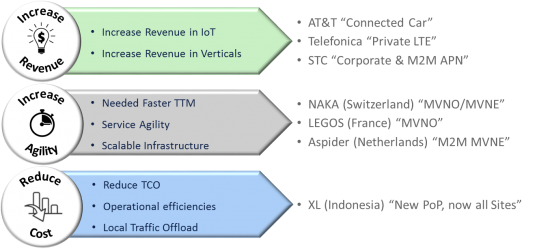
We are seeing more and more Mobile Network Functions Virtualization (NFV) being deployed in commercial networks around the world. The recent case with XL Axiata in Indonesia (XL Axiata teams up with Cisco to launch Indonesia’s first 4G LTE network with Virtualized Packet Core), is one of the first to support what I would call a “vertical” use case, i.e. full EPC functionality for all existing Mobile services.
Up until recently the Early Adoption of Virtual Packet Core has been for “horizontal” use cases, for a specific function and service. For example for M2M gateways, private or enterprise services, or for MVNO gateways. In a way these are additional network slices which have been deployed for a new service. A business case based on new revenue or faster time-to-market.
Virtual Packet Core Business Drivers
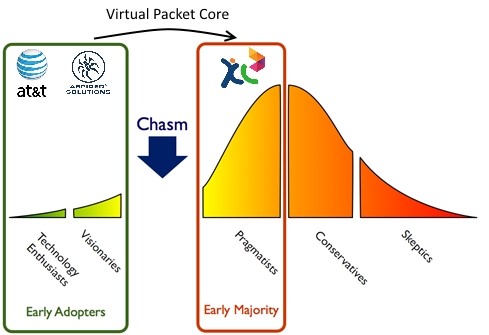
In the case of XL Axiata though, it is a migration of existing services to a new virtualized core. This vertical use-case is about creating a new environment with a lower total cost of ownership. This is significant as it represents recognition that NFV technologies are moving from niche application to majority adoption; in effect “crossing the chasm”, aka the Moore model for technology adoptions (see figure below).
VPC Crossing the chasm model, by Geoffrey A. Moore
In the next few months we will see other Service Providers becoming part of the “Early Majority” in NFV, with mainstream adoption by the end of the year.
I’m looking forward to providing the latest updates on Mobile Virtualization at the upcoming MWC Shanghai event. See you there.
I’m very excited to be at CANNES LIONS INTERNATIONAL FESTIVAL OF CREATIVITY this week. It’s going to be my first time at this festival and Cisco’s first time exhibiting in the innovation summit. It really feels like we are making history.
It all started with Digitization, a big word everybody likes to use these days. Many organizations and enterprises are thinking about or beginning to plan how to digitize their processes, production, and products. When it comes to full blown digitization, Cisco can help companies with their digitization strategies.
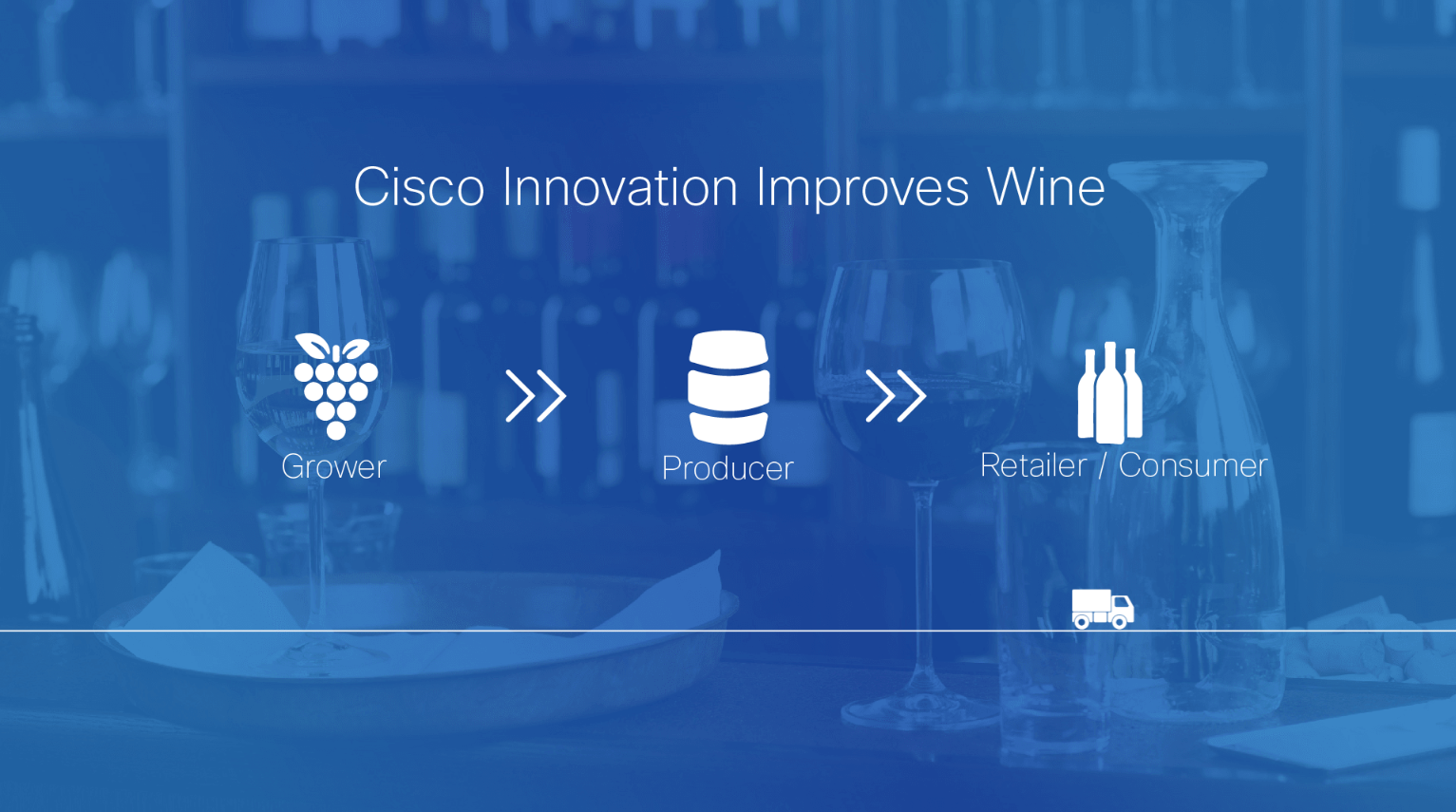
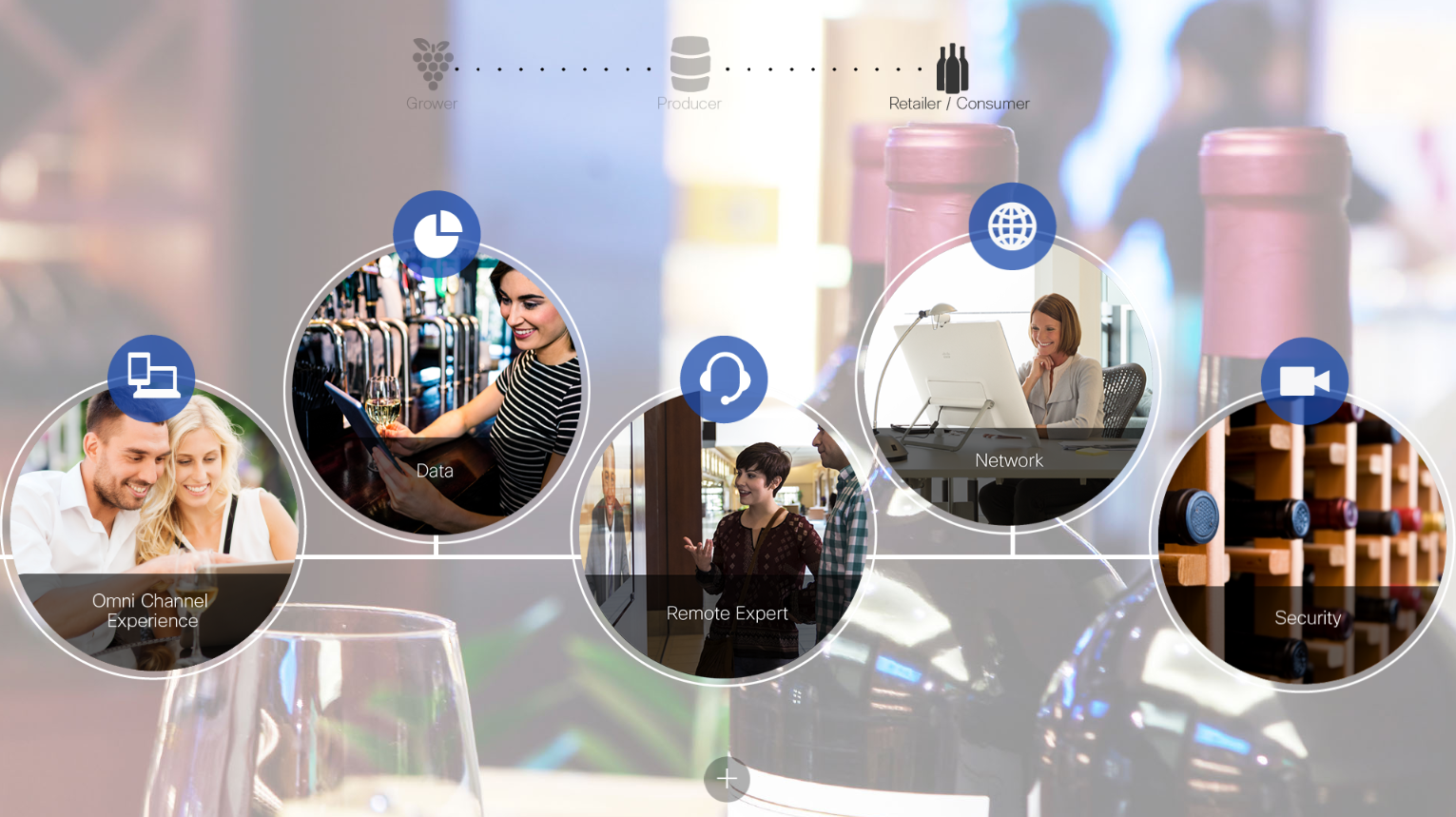
In our booth at Cannes Lions, we’ve created a fun example to show attendees how we can enable and digitize any business. By taking the whole process of wine-making from where it starts in the field, through the production facility and distribution, and all the way to retail, we share our vision through an interactive demo. I’m not saying we are making wine, but we are arguably making wine better and more profitable by digitizing the entire process.
Let’s take a look at the three key stages of wine-making: Grower, Producer, and Retailer.
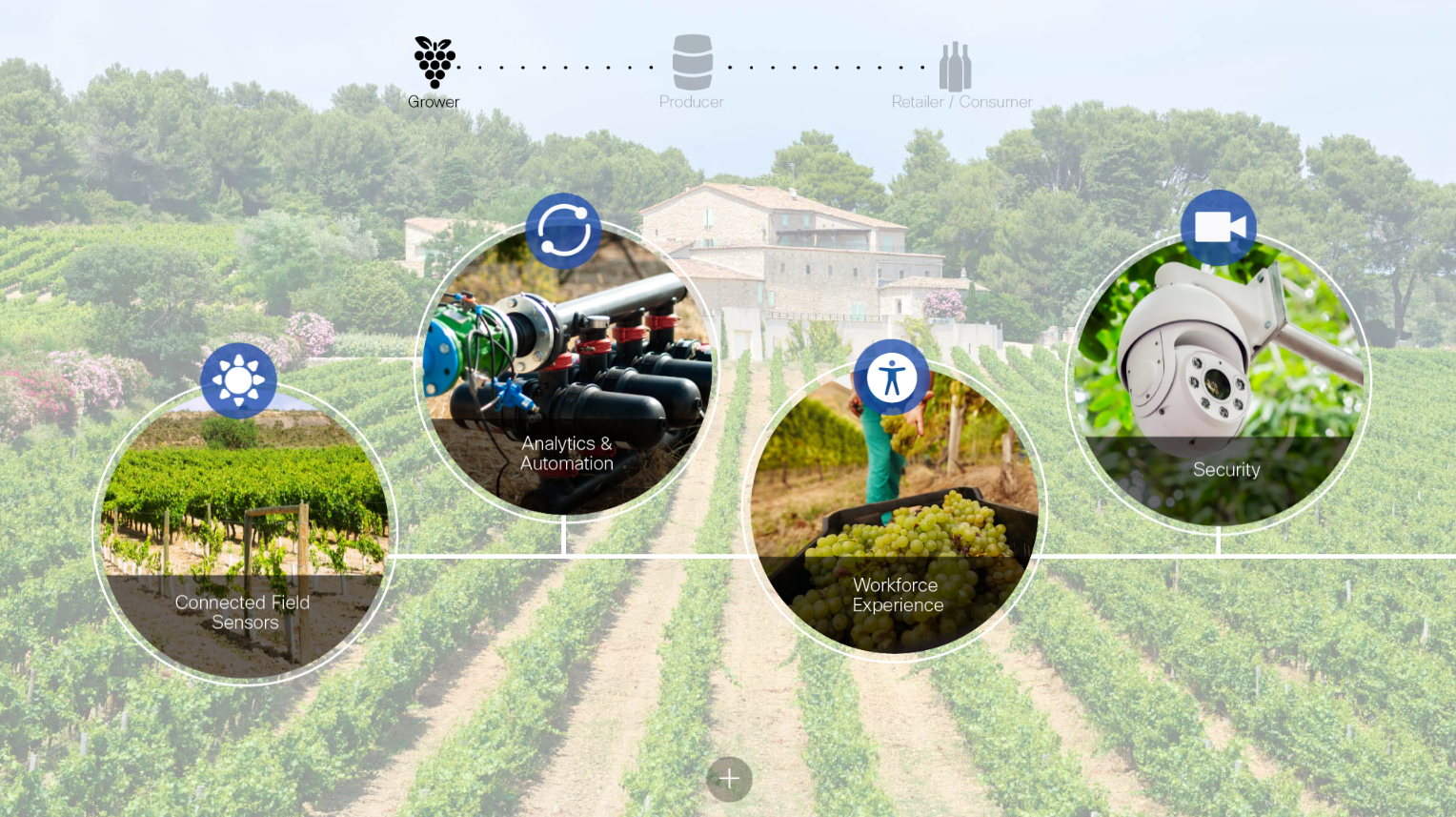
The Grower: By connecting the field with ground humidity sensors and analyzing the data locally and in the cloud, the grower can optimize their cost and produce a better product (grapes) when automating the irrigation system based on changing weather conditions. They can also leverage remote experts. Physical security like video surveillance and access control are key to maintaining a safe environment in the field, while providing a better workforce experience for employees.
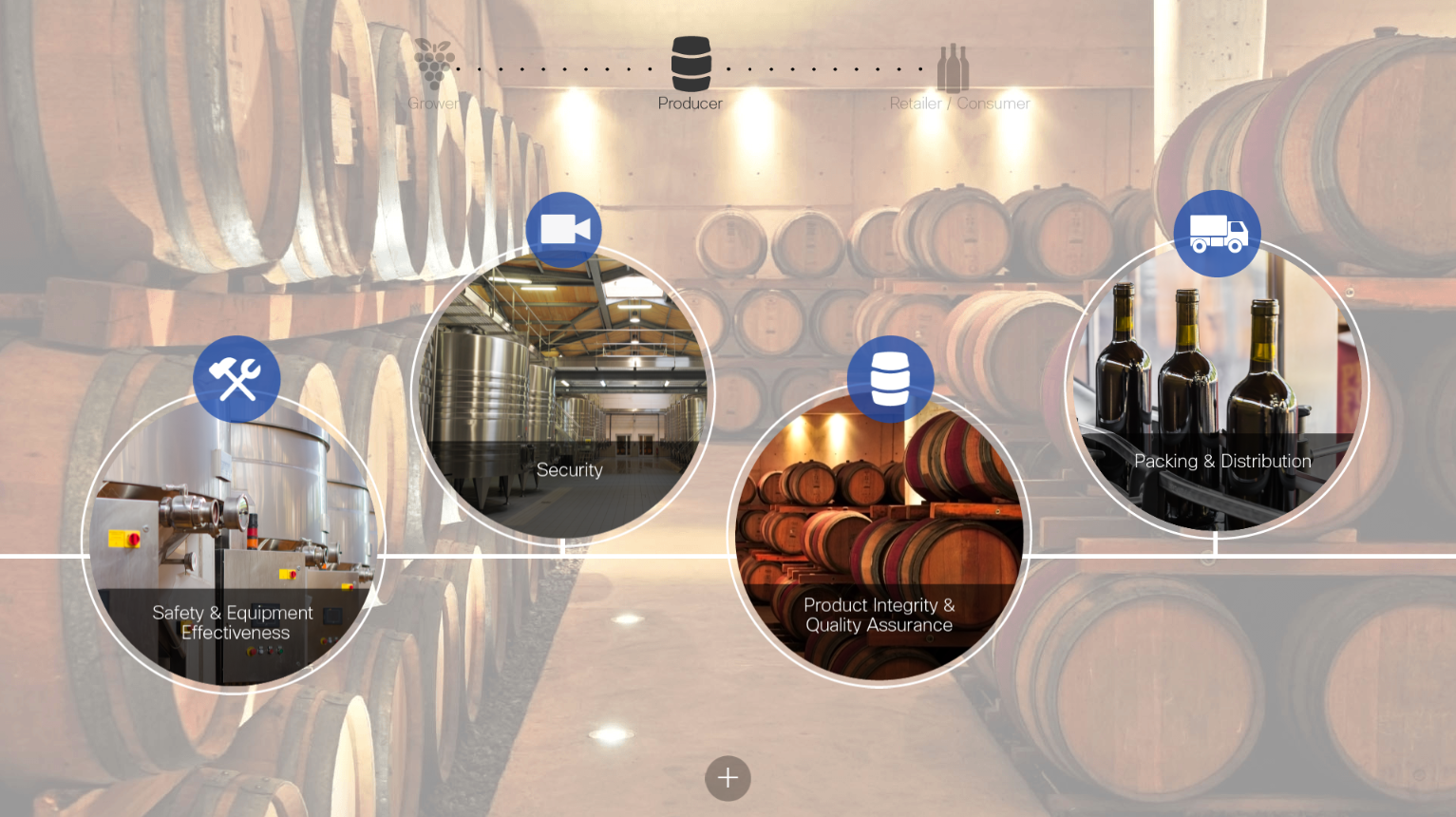
The Producer: By tracking and protecting assets, the producer can better handle workloads—everything from processing and storing wine barrels in optimal conditions, to bottling and shipping. This is a great example of how we can help optimize the business by combining technologies such as location-based service, data analytics, and connectivity.
The Retailer: Using Cisco Connected Mobile Experiences (CMX), we can really make a difference in upselling and personalizing the shopping experience. It may not be economically possible to staff each store with product experts for each type of wine. However, remote experts can use telepresence technology to bring expertise into the store experience. Additionally, Video Surveillance Management can help secure the wine stock. With the Omni channel experience across mobile, web, and physical locations, we can also help deliver personalized, targeted, and direct marketing opportunities. Web coupons can be used to entice users to purchase, while in-store coupons can be targeted at buyers based on their previous purchasing patterns. All of this helps the retailer expand and upsell purchasing decisions.
Do you have industry examples where technology has changed things for the better? If so, tell us about it in the Comments field below.
And, if you’re attending the festival, please drop by the Cisco booth and say hello. Have a glass of Rosé with us.
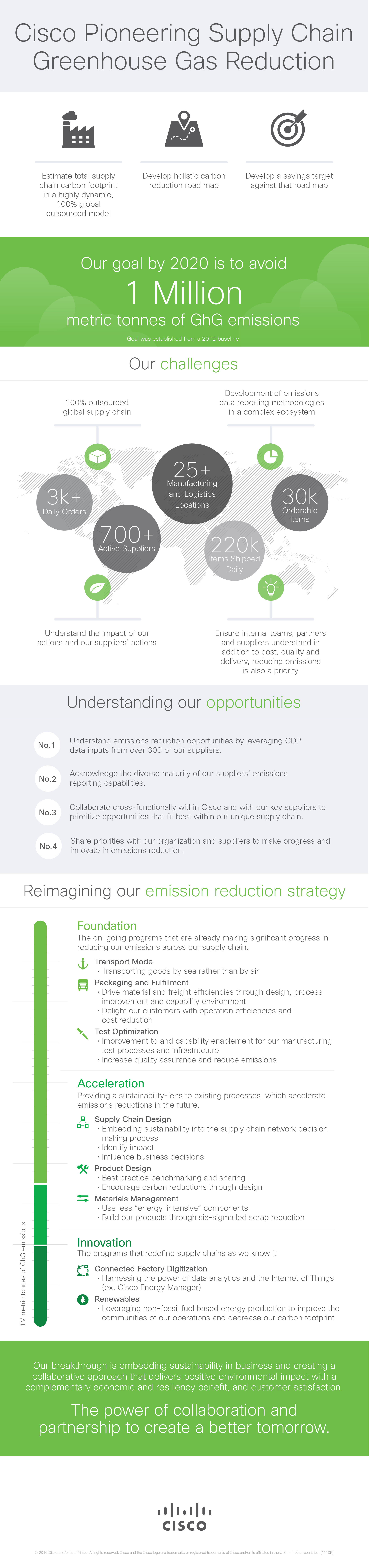
Cisco’s sustainability journey took a big step forward last month with the announcement of a new goal to avoid one million metric tonnes of greenhouse gas (GhG) emissions from our supply chain operations by the year 2020, which will drive emissions reductions related to our outsourced manufacturing and logistics.
Click to expand
In March of 2016, we rolled out our Integrated Greenhouse Gas Reduction (IGR) roadmap to bring together a diverse set of initiatives aimed at further reducing our carbon footprint. We previously set targets encouraging suppliers and partners to report emissions.
What’s new about this goal is that it’s our first quantitative emissions goal to encompass the supply chain activities that Cisco directs or influences, such as sourcing strategies, product fulfillment model designs, manufacturing-related energy use and transport mode optimization executed by third parties.
Partnering closely with multi-industry organizations, such as the Carbon Disclosure Project (CDP), supplier participation in CDP’s Supply Chain program is steadily improving. So are transparency efforts around our supply chain carbon footprint.
We use the supplier data reported to CDP to gain insight into GhG emissions contributors among the major classes of components used in Cisco products. This insight then helps guide and build on our emissions reduction initiatives.
More than ever before, we are seeing new pathways to advance sustainability, especially where Cisco can have the biggest impact. The best example is digitization, which is a key enabler in our progress and is advancing sustainability by creating access to big data—helping us to measure, analyze and communicate related metrics.
We see many benefits in how digitization can accelerate our ability to integrate sustainability performance data into our day-to-day business decision-making processes.
The bottom line is that we don’t view sustainability as a trade-off that needs to be made; instead, we see it as an integrated business imperative in our global supply chain. And while this new goal gives us a solid start, we are already looking ahead.
We have some exciting opportunities on the horizon, and each step forward demonstrates how connected systems can save time, money, energy and materials, while also improving customer satisfaction and doing right by the planet.
Keep up with Cisco’s sustainability progress in our CSR Reports.
“Cisco Tetration Analytics provides pervasive and unprecedented visibility across the data center, via a mix of network/hardware sensors that monitor every single packet at line rate and server/software sensors with very low overhead (<1% CPU).”
“Tetration Analytics is an solution to monitoring, analyzing and replaying datacenter traffic. If you’ve had a attack a few weeks ago and a fix is available now, the traffic of the attack can be replayed to verify if the fix is working (awesome!).” … “Cisco Tetration Analytics is a new product which fits into Cisco’s datacenter portfolio. It’s an solution for a problem which exist for many many years: data analytics was never possible with this kind of detailed information. Everyone was looking for this information for the last 5 years and it finally came available, thanks to Cisco.” (Read Rob’s Blog.)
“Over and above the obvious analogy of having complete visibility, It’s probably no co-incidence that Tetration was being launched on the 102nd floor of One World Observatory New York, as its main initial market is likely large financial institutions. Back in 2008 I was called in to do some work for huge investment bank that sadly went into administration, and while I was engaged I worked alongside a digital forensics team, that spent several years piecing together exactly what happened and accounting for all the banks financials and assets. I can only imagine how much that would have cost and the benefit to the administration process had they had a “digital forensics time machine” that could go back in history and show any information at any point to granular detail, and view or replay those flows that interested them. Well the Forensics module is just that.” (Read Colin’s Blog.)
libarchive is an open-source library that provides access to a variety of different file archive formats, and it’s used just about everywhere. Cisco Talos has recently worked with the maintainers of libarchive to patch three rather severe bugs in the library. Because of the number of products that include libarchive in their handling of compressed files, Talos urges all users to patch/upgrade related, vulnerable software.
No Private vs Public cloud debate or microservices Hybrid cloud Utopia talk here. Just a little Cloud geeking and philosophy on the nature of the universe that was reignited by Elon Musk.
The Elon thought experiment?
Is cloud computing powering the universe and reality around us as one big simulation?
“There’s a billion to one chance we’re living in base reality,” Elon Musk said.
Elon’s head in the Clouds
This Sci-Fi metaphysics question was posed to Elon Musk the other week at Recode’s Code Conference. Crazy tech talk you say? To relate to Elon’s vector of thinking, imagine Moore’s Law and the trajectory of cloud computing in say 10,000 years. Keep in mind we have lived through only 60 years! For added rocket fuel to the simulation argument, throw in Quantum computing. The holy grail of computing based on quantum electrodynamics that promises exponential compute vs our primitive binary approach to date that is encountering the bounds of Moore’s Law. Bill Gate’s claims that this break through technology is only 6-10 years out.
Envisioning that level of cloud computing in 10,000 years is almost incomprehensible. Whether it takes hundreds, thousands, or even millions of years (still nothing on the evolutionary time scale of the universe), that computing capability for a civilization makes the simulation argument both intriguing and scary. Based on technology trends and logic, one can not dismiss the possibility.
For all his inventions, this argument did not start with Elon Musk however. One PHD geek (Nick Bostrom) made a now famous argument, The Simulation Argument. Given enough time and advanced cloud computing, a civilization has the capacity to simulate prior evolutionary timescales of space and time. Too see how Elon calculated the “A billion to one chance we’re living in base reality”, let looks at the Simulation Argument.
The Simulation Argument Simplified:
Nick Bistro’s simulation argument has 3 main premises. Mainly centered around if us humans destroy ourselves before reaching an advanced human state.
The human species is very likely to go extinct before reaching a “posthuman” stage. Basically we blow ourselves up.
Advanced human civilizations gain the capabilities, but basically get bored and stop conducting simulations
Advanced civilizations conduct simulations, as such most realties in the universe are simulated ones vs. being base reality.
One thing that later generations might do with their super-powerful computers is run detailed simulations of their forebears or of people like their forebears. Because their computers would be so powerful, they could run a great many such simulations. Suppose that these simulated people are conscious (as they would be if the simulations were sufficiently fine-grained and if a certain quite widely accepted position in the philosophy of mind is correct). Then it could be the case that the vast majority of minds like ours do not belong to the original race but rather to people simulated by the advanced descendants of an original race ~ Nick Bostrom
Sobering Statistical Probability
The beauty of the argument is, even if you think we are in base reality and that this is hog wash, we are still likely to develop those capabilities at some point in time. So whether it’s the Truman show on steroids or a benign version of the Matrix, who knows? I can envision one hell of a VR game though. Only 100,000 years ago planet earth was inhabited by Homo Sapiens and 5 other Homo genus species (e.g. Homo Erectus and Homo Flores). Imagine rolling the evolutionary dice 10 times and seeing how a Neathrandal government might turn out (some argue we are in that now). Or even doing this experiment on the grand scale of the Universe and Big Bangs. Sounds crazy, but 60 years ago we only had pong the video game. What if you gave us a million years? If we do go down that road, that means of all the “realities” that occur within the universe through time, a large majority will be simulated vs real ones. Statistically speaking and egos aside, with random probability we are more likely to be within a simulation vs. “base reality”. With that statistical condition, the nature of our reality comes down to a race amongst interstellar space civilizations.
At least we didn’t all kill ourselves.
So if we are in a simulation, the good news is civilizations advanced far enough that it didn’t implode on itself somehow! And if not, I guess that makes life even more precious!
Your turn?
So where do you stand on the cloud powered simulation argument?
Elon puts it at 1/1,000,000,000 that we are in base reality. I guess he is short on humans being the first to achieve such feat considering the size of our known universe (or multi-universes). Intellectual circle? Or just interesting intellectual masturbation? Ohh, the power of cloud computing. Let us know what you think @CiscoCloud via #CloudSimulation.
Two weeks ago, I posted a blog highlighting the growing customer momentum for Application Centric Infrastructure (ACI), particularly in the context of customer successes in ACI-F5 joint deployments. I am seeing a growing trend among customers of late to directly deploy the Nexus 9k series of switches in ACI mode. At F5 Agility Vienna, in May, I met with quite a few customers who expressed a keen interest in integrating L4-L7 network and security services with ACI.
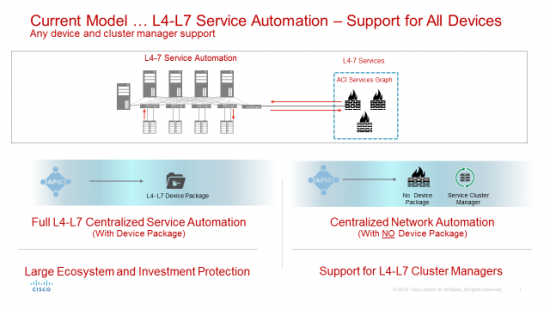
I had the privilege of understanding customer perspectives on how they plan on deploying the device package, the glue software that integrates Cisco ACI with a given vendor’s L4-L7 service device. In recent months, the Insieme Business Unit has built flexibility and choice with regard to the modes customers can deploy the L4-L7 service devices with ACI and Cisco CloudCenter. This blog is intended to create an expanded awareness on various L4-L7 service integration options with Cisco ACI.
It is best if I start by explaining the various modes of deploying L4-L7 services with ACI. They include:
– Managed Mode (a.k.a Service Policy Mode)
– Unmanaged Mode (a.k.a Network Policy Mode)
– Hybrid Mode (a.k.a Partially Managed Mode)
Service Policy Mode: When ACI first launched with the concept of L4-L7 service automation, it went to market with service policy mode (also known as managed mode). The main purpose and forward looking approach at that time was to have one single source of management, the Cisco APIC, to fully automate the entire L2-L7 stack. This was done through a device package uploaded to the APIC that contained a list of features and policies to configure the service device (ADC or FW for example). You can think of the device package as a plugin with a list of features presented to configure your service device. An important thing to keep in mind is the device package is provided by ACI L4-L7 ecosystem partners who decide which features are exposed or hidden compared to going directly to the device.
We have several customers who have deployed this mode and experienced smooth and seamless operational experience. Whether you have a small DevOps team or separate teams to manage various sized data centers, this can be a solution for you. You can use the GUI, CLI, or API to configure the APIC, which configures all of your network (ACI) and L4-7 services. Another major benefit is when you automate everything through northbound APIs without the need for a GUI or CLI. Again, many different use cases can be addressed, but ultimately, Cisco stands behind this operational model and its ecosystem partners who support this methodology.
I found this great section that goes into more depth on the managed mode, and here’s the link if you need to read more.
Network Policy Mode: With everything being said about the Service Policy Mode, some customers were not yet ready for the APIC to be in full control of their service devices. So, the second mode that was brought to market is called Network Policy Mode(also known as unmanaged mode – since the service device is not being managed by the APIC). ACI is still automating the network for you until the traffic gets to the device. Here’s the simple flow:
ACI Fabric will deliver the traffic to the service device (ADC or FW, etc…)
The service device will perform its task(s)
The ACI Fabric will handle the traffic once it comes out the service device
This mode requires manual network stitching, meaning you provide information about the ports to which it connects, the ports that are part of a cluster, and the device operation mode: go-to mode, go-through mode, or one-arm mode (link to read more). With the proper hardware and software (ACI or service devices), customers can always migrate to Service Policy Mode at a later time when they are ready. This is to show again that ACI is able to adapt to the market, and address customer needs.
Hybrid Mode: The Hybrid mode, also known as the partially managed mode, is the third model of managing your service devices. Hybrid mode enables L4-L7 service devices to be jointly managed through Cisco APIC and a service device controller. It enables L2-L3 network configuration of service devices through APIC. With Hybrid mode, more nuanced L4-L7 feature configuration can be done through a specialized service device controller. Hybrid mode requires a device package. The key difference here between Service Policy Mode and Hybrid Mode is the function of the device package. Hybrid mode allows device package developer to customize and manage subset of L4-L7 features through APIC. To keep things simple, the APIC has a version of a device package that enables it to communicate with service device controller, and there can be many different flavors.
The configuration command comes from the APIC to the service device controller and then pushed down to the service device with the full configuration. This allows simplicity on the device package side and management through the APIC while keeping the full native functions and customizable parameters available for the 3rd party vendors. Hybrid mode enhances security devices like firewalls, IPS, IDS etc., management through APIC. It allows security administrator to manage security policies through a dedicated security controller, while configuring the network parameters and associating security policies to a network through APIC.
The one thing that is common in all Hybrid Modes is that the network portion is still fully automated through the APIC. In other words, don’t worry about L2-L3, but we’re still configuring L4-L7 in a slightly different way.
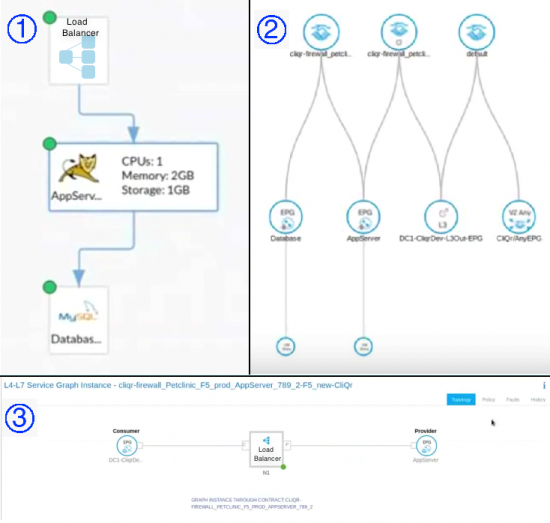
I am excited to say that we have more for you. Cisco’s recent acquisition of CliQr CloudCenter (now called Cisco CloudCenter) is a strategic tool for delivering simple, self-service application deployment to end users while letting network and IT administrators apply complex automated rules and policies in the background. During the application deployment process, Cisco CloudCenter dynamically deploys and creates objects like APIC managed services, ACI contracts, and endpoint groups. In the image below, you can see how the Cisco CloudCenter application profile models the inclusion of a load balancer managed service (1), the resulting translation of that model into an APIC application profile (2), and lastly the load balancer managed service supplying L4-L7 features, displayed in the APIC service graph (3).
Maybe the best part of all this — no APIC API coding for the networking administrator (Cisco CloudCenter has all of that built in already)! All objects are managed throughout the application lifecycle–ultimately cleaned up upon application termination.
Cisco continues to innovate in the SDN market and address customer needs. Whichever mode is needed, green or brown field deployments,we highly encourage you to get on the SDN journey with us.
In closing, I want to extend my thanks to Insieme’s L4-L7 engineering experts Sameer Merchant and Ahmed Dessouki for their insightful conversations with me on this topic. Also, I extend my appreciation to Zack Kielich of Cloudcenter team for sharing what’s new and exciting on ACI-CloudCenter front.



 Get the Podcast




 Cisco Tetration Analytics