Avatar

My role has always involved connecting with external partners and suppliers. Not knowing what platforms they used for video conferencing created a challenge, and often resulted in using an audio-only bridge. This meant I couldn’t see the people I was meeting with, and there was no opportunity to share content, such as presentations and ideas.

When I joined Acano, it was refreshing to use tools that broke down these barriers and enabled every participant to join on video.

For businesses like BW Offshore, it is important that people can easily work with teams and clients across geographies. BW Offshore is a leading global provider of floating-production services for the oil and gas industry. Its global operations and projects cross continents and time zones. As a consequence, video collaboration tools are key.

https://www.youtube.com/watch?v=U641iuSZwnU

BW Offshore had deployed Cisco video conferencing in its main conference rooms and Microsoft Lync on employee desktops. To simplify communication between employees, BW Offshore deployed an Acano solution to seamlessly connect Lync and Cisco whilst retaining a great video experience.

Adopting Acano not only provided advanced interoperability, but it also gave employees access to team spaces. Each department and vessel has its own dedicated virtual meeting rooms. In these rooms, employees can hold audio and video meetings, chat with each other, and share their work. Each space has a unique video address, audio dial-in and web link, along with a persistent chat wall. This has been an effective way for BW Offshore’s global teams to collaborate.

Equally, the solution simplified communicating with clients outside of the company. External participants can join a meeting in a web browser via one link, regardless of device. Anyone inside or outside of BW Offshore can join meetings using:

  • Any standards-based video system, client, or application
  • Web browsers on desktops or smart phones
  • Microsoft Lync or Skype clients and apps
  • Regular telephony systems

BW Offshore decided to deploy Acano on-premises, which enabled it to remain fully integrated with its own network and retain control for future upgrades. Every organisation is different and has unique IT requirements. For those that want more control over the video infrastructure, Acano provides this either on an Acano server or a VM hosted on a standard server.

Learn more about how Cisco Acano solutions can help you use video in more meetings.

Authors

Claire Stephenson

Field Marketing Specialist

EMEA

Avatar

When I think about the future of business, the behavior of consumers gives me serious pause. Their demands are changing how we do business—even how we innovate. I know we’ve heard this before. But something’s quite different. The digital era is like nothing we’ve ever experienced before.

It’s going to play a role in everything. Everything. From how we drive (uh, don’t drive, that is) to how we receive medical services. Robotic surgery, anyone? Already, banks, mobile network operators, and financial technology companies are battling to capture and retain fickle consumers.

And these battles for market share are only just beginning to heat up. Now is the best time to get your arms around the coming “new normal” to position your organization for success.

surgery

To help, our team partnered with the Global Center for Digital Business Transformation, an IMD and Cisco initiative, to create the Business World in 2025 report. It’s a look into the future, providing the insight you need to spark an important boardroom conversation.

In my previous blog, I shared my thoughts on the scenario Global Bazaar and what it means for your business. The second of these scenarios is Cautious Capitalism, which I’ll cover here.

Cautious Capitalism Requires Early Thinking

Even now, early indicators show that we may soon be entering a scenario of Cautious Capitalism. This scenario is based on the following three forces:

  • Global markets – international trade flourishes and companies can scale globally
  • Blurring industry boundaries – regulation supports business to compete across different verticals (e.g., by using technology to expand services)
  • Internet skepticism – while Internet access may be ubiquitous, cybercrime, personal data, and privacy violations mean that people are skeptical of the online world and disengage from it

The signs are clear, by 2019, cybercrime will cost businesses $2 trillion a year. That’s an incredible number—and it puts your organization in the crosshairs of financial ruin. Even worse, a huge 48 percent of mobile app users indicate they’ll limit their use of apps unless they felt sure their personal information was better safeguarded.

Losing customers in large numbers could put a stranglehold on your business. But it’s a reality that can’t be avoided. We expect consumers to take back control of their data—and turn to privacy-friendly companies. This triggers a new competitive environment. A risk to your organization’s very survival.

So what’s the answer?  What can you begin doing today to protect your turf? Or at least give your business a fighting chance to lead as everything continues to come online?

As an example, let’s look at a smartphone mobile wallet provider in India. What could they do now to secure their place at the table in 2025? Well, their focus should be to retain consumer trust.

But rising cybercrime makes this almost impossible and trust in online services will inevitably plummet. The solution might be to partner with a trusted brand, like a bank, or perhaps merging or partnering with big trusted tech players like Amazon.

For smaller players, doing the above is easier said than done. In fact, in the world of Cautious Capitalism incumbents and big brands have a substantial competitive advantage.

Startups and smaller providers need to be on the lookout now for strategies to bump consumer confidence. This includes coming up with innovative new ideas, but also means taking basic strategic decisions like whom to partner with, or how to build services that create trust.

The point is the providers—regardless of industry—shouldn’t stand still.

Every single organization will be affected in some way. The time to take meaningful action is now. What’s your organization’s long-term strategy? Have you taken the possible impact of cybercrime? What about consumer trust and your Internet engagement strategy?

Are you prepared to create the future you and your company want? Look at the report’s four scenarios, and then discuss them with your executive colleagues and with your teams. Stake your claim for the future—now.

Want more insight? Read the complete report here. In my next blog, I’ll share my thoughts on Territorial Dominance and how your organization can play to win in this environment.


Authors

Stephan Monterde

Director, Corporate Strategic Innovation

Chief Strategy Office

Avatar

HIG00822

When we talk about digitization and “There’s Never Been a Better Time”, the assumption is that we’re only talking about the future—and putting aside the past.

That’s not true.

The city of Biel, Switzerland has been settled for hundred of years, but they are getting in on digitization too. For older cities, this can be quite an undertaking, but the rewards are rich.

The network administrators in Biel were faced with two problems: manage a network in an old building that hasn’t been updated in years and proactively address the city’s future needs. That’s not easy when you’re talking about a network that supports 2,400 employees over 60 locations – including 20 schools.

Thomas Bodenmann, CTO, City of Biel says that he chose Cisco because it allows them to leverage their existing foundation for future initiatives.

What Biel needed was an uncomplicated network that is scalable enough to meet any future demands. Armed with Cisco Catalyst 6800 Series and Nexus 5000 Series switches along with Cisco 5508 Wireless Controllers and the Cisco Catalyst Virtual Switching System, Bodenmann and his network engineers were able to create a robust wireless network backbone.

Once that backbone is in place, network administrators can work on making sure that the rest of the city is connected and communication can be delivered with ease. For example, the city’s ambulance division has already received network services and it has worked out so well that other divisions are requesting the same. Biel is pleased with the way that their improvements have been received and are on record as saying that they anticipate growing their wireless network.

“We plan to implement Cisco ASR 920 Series Aggregation Services Router to push MPLS on a Layer 3 architecture,” said Bodenmann. “Cisco’s robust portfolio of solutions will help us reach the next level in the quality and responsiveness of our services.”

To date, the upgrades have saved the City of Biel a lot of time and money, making the program a big success.

Saving time and money, while planning for a more connected future? Sounds like there was never a better time for the City of Biel to upgrade its networks!

To read more about this case study, click here.

Authors

Byron Magrane

Product Manager, Marketing

Avatar

tmobileImagine that about 24 months ago that T-Mobile US was rumored to be up for sale. Since that time T-Mobile has become one of the most disruptive forces in mobile video delivery industry. Not stopping there, the “Un-carrier” just announced last week that they are expanding the Binge On service for the 6th time in 7 months to 90 content partners.

In the seven months since it launched, T-Mobile’s Binge On has fundamentally changed the way T-Mobile customers watch videos—and is one of the Un-carrier’s most popular initiatives of all time, if not the most popular.

T-Mobile customers are video streaming more than ever:

  • Customers are watching twice as many hours per day, in longer and more frequent viewing sessions, than before launch from free streaming services on qualifying plans with limited high-speed data.
  • More than 57 million GB (57 petabytes) have been streamed without burning up customers’ high-speed data. That’s like watching Adele’s 15 minute Carpool Karaoke with James Corden more than 460 million times.
  • Un-carrier customers have already streamed more than half a billion hours of video or the equivalent of more than 57,000 years of video without using their high-speed data since Binge On launched.

One video of the content providers has seen the number of active viewers spike 90% and watch-times nearly triple from customers with limited high-speed data.

T-Mobile’s zero-rating represents one of numerous pricing mechanisms by which operators encourage video consumption on mobile networks. Traditionally, mobile video services have been prohibitively expensive for consumers, especially compared to video viewing on TVs or on fixed broadband. However, operators around the world are starting to actively make mobile video delivery more affordable to end-users.

“Mobile devices have redefined the way we live our lives and online video is in the midst of that redefinition. For example, YouTube has seen a 100 percent growth in watch-time on mobile devices vs. last year. Driven by consumer momentum, I expect mobile video to dominate the video conversation in 2016.” – Cenk Bulbul, Google Head of Agency Marketing

Customers are in control. Not T-Mobile. Not content providers,” John Legere says. But T-Mobile controls the default settings, which have an inevitable power, because most people don’t notice or change defaults. Yes, you can turn Binge On off, but most less-technical people live with default settings; that’s why search engines work so hard to become the default home pages of browser makers, for instance. The only group with no power here are the non-partner content providers. That’s far from what Legere calls a “pro net neutrality capability.” It’s a system that shifts power over content quality from the video providers to T-Mobile.

The Problem for Mobile Operators… Managing Mobile Video is not Easy

Slide1dfsdNew mobile devices are emerging every day, from tablets and smartphones to smart cars. Each device can have a different screen resolutions, processing power, amount of memory, what network it is accessing from 3G/4G/or Wi-Fi enabled, what content can receive they receive (DRM), security, and so much more. With these new devices also come new OTT video applications and services, and widely varying traffic patterns. Much of the video traffic is encrypted so a determination of how the video traffic is to be delivered (resolution, quality, network) can be difficult to figure out.


According to the Cisco Mobile Visual Networking Index (VNI) data traffic has grown 4,000-fold over the past 10 years and almost 400-million-fold over the past 15 years. Global mobile data traffic reached 3.7 exabytes per month at the end of 2015, with Mobile Video accounting for 55% growing to 75% of mobile traffic by 2020. (One exabyte is equivalent to one billion gigabytes)

The Opportunity, a Piece of the Content Consumption Pie

Consumers are set to spend $180 billion on digital content next year, a new report by market analysts Juniper Research says. That represents a jump of almost a third (30 per cent) compared to last year, when the figure was at $140 billion.

Juniper’s researchers believe this jump will be fuelled mostly by the continuing migration to video streaming services. What’s more, telecom operators and broadcasters are also looking into creating their own on-demand and IPTV content, as means of competing with over-the-top businesses.

So what else can a Mobile Operator do to Manage Mobile Video and Make Money at It?

Attend our June 28th Cisco Knowledge Network Session at 11:00am ET entitled, “How Does a Mobile Operator Manage Video Traffic and Make Money at It?” register at here.

For more details download and read our white paper “A New Approach for Mobile Video Services

Read the latest Cisco Visual Networking Index.

And watch this space for a series of blogs on Mobile Video.

Authors

Jim O'Leary

Sr. Manager Mobile Solutions Marketing

Avatar

Last week, Gartner published their Top 10 cloud security predictions for 2016. They predict that “by 2020, one third of successful attacks experienced by enterprises will be on their shadow IT resources.”

As Gartner rightly points out, the reality is your business is engaging with shadow IT resources and they shoot a big hole in your security strategy. Based on Cisco Cloud Consumption engagements, large enterprises on average use over 1,200 cloud services—over 98% of them are Shadow IT.

Gartner also highlights that, “by 2018, the need to prevent data breaches from public clouds will drive 20% of organizations to develop data security governance programs.” They recommend that organizations “Develop an enterprise-wide data security governance program. Identify data security policy gaps, develop a roadmap to address the issues and seek cyberinsurance when appropriate.”

You Can’t Protect What You Can’t See

With more data and business critical operations residing in the cloud, now is the time to identify what cloud services you are using and put in place a cloud governance program to help address risk. Cisco Cloud Consumption as a Service can help you with both.

Specifically, it can help you discover and put in place ongoing monitoring of your cloud use across SaaS, PaaS, and IaaS. It also provides data security tools to identify risky cloud vendors (based on 150+ risk parameters), identify cloud anomalies, and trace cloud use to specific groups and individuals. These tools combined with creating a cloud governance office can help you reign in the risks of Shadow IT.

At Cisco Live Las Vegas, I will be hosting a session on “Managing Adoption & Business Risks of Cloud.” During this session, I will share more about the explosion of cloud use and Shadow IT within organizations and how Cisco can help organizations manage cloud use and risk. We will also be sharing how you can leverage your existing Cisco Security investments and combine Cloud Consumption to extend powerful security features of Cisco Secure Web Gateways to protect cloud services.

Also, please stop by the CiscoLive World of Solutions and visit with us! The Cloud Consumption booth will be located in the Data Center & Cloud area, and our partner Presidio will be demonstrating Cloud Consumption as a Service in the Cisco Powered Booth area.

Not attending CiscoLive? We’d be happy to schedule a personal consultation or demo to speak with you about how you can reduce the risks of cloud use and Shadow IT.  Schedule a demo and personalized Cloud Shadow IT & Risk consultation today.  

What are your top cloud risk concerns? Let me know on Twitter @robertdimicco or Linkedin.

Authors

Robert Dimicco

Senior Director

Advanced Services

Avatar

Tribal knowledge rules! As more millennials enter our companies and our existing workforce retires, we must share not only best practices but also our best information and processes with them.

tribalknowledge1

“Many large, older companies are caught up in a tsunami of baby boomers retiring and are unaware of how much tribal knowledge they are taking with them,” – Dorothy Leonard, professor emerita at Harvard Business School.

BusinessDictionary.com defines tribal knowledge as “a set of unwritten rules or information known by a group of individuals within an organization but not common to others that often contributes significantly to overall quality.”

A large amount of knowledge is held by existing manufacturing employees and is not documented and shared in common repositories. As a result, only those in the know have the specific details necessary to make our businesses better. These unwritten processes can’t be measured, can’t be scaled, and can’t be improved.

What’s the problem?

We, as manufacturing supply chain and operations teams, value our staff who have the information and data we need. We focus our efforts on gathering and assembling data from all our sources. We apply our costly resources to share and marshal information. By the time we are ready to take action on our information, the information is out of date.  With the information being out of date, we make sub-optimized decisions on stale data.

Why wasn’t information documented or captured in common systems?

Our systems often run as islands of automation and are not connected.  Our information lives in the equipment, robots, spreadsheets, reports, laptops, and just about everywhere but a common accessible repository. Our disparate systems prevent us from having a uniform view of the information we need – no single source of truth.  We spend our time converging on a single view and establishing data facts. We rely on tribal knowledge, custom integration, and expensive long lead-time projects to consolidate information.

That was then.

Back when emailing a spreadsheet was considered digitization.

This is now.

Now it’s possible to:

  • Empower your people with instant access to all the data they want, any way they want it
  • Respond faster to your changing analytics and business intelligence needs

Data Virtualization allows you to bring data together from disparate systems.

tribalknowledge2

View the full infographic here.

Data Virtualization allows you to establish an agreed upon set of facts and a single source of truth so you can focus your efforts on making decisions in real-time. You can shift your resources from collecting and sharing data to automating your processes and running your business by exception. Your data virtualization platform will automatically tell you when to take action.

A global computer manufacturer we work with saves more than $1M USD in operational costs by gaining visibility into orders and manages inventory more effectively across six regional procurement systems.

tribalknowledge3

There’s never been a better time to stop watching your data and allow dashboards and mobile interfaces to tell you when to take action. You will move from reacting to your data to taking a prescriptive event management approach. At Cisco we use our own Data Virtualization (DV) platform to virtually integrate data from multiple sources in real-time. This allows us to avoid the cost and overhead of physical data consolidation.

Learn more about data virtualization use cases here.

#NeverBetter

Authors

Neil Heller

Manufacturing Industry Solutions

Manufacturing

Avatar

Schneider Electric and Cisco recently hosted their first industry Customer Advisory Board meeting on Smart Connected Pipelines, featuring representation from key major North American pipeline operators. The board appreciated that the technology met their highest needs and industry requirements, and that we completed extensive testing and validation in our joint labs in Houston, Raleigh, and Calgary.

VL00505

The validated guidelines allowed them to leverage the best of IT technology while lowering their total cost of ownership (TCO) and improving their ease of use. At the same time, this solution delivers the level of security and reliability required for critical operational environments.

Along with a detailed review of the first phase of the initiative, the event covered key topics such as: IoT Cybersecurity, Big Data Analytics, Fog Computing, Internet of Things (IoT) in the pipeline industry, and new innovations.

Schneider Electric and Cisco are planning the second iteration of the Smart Connected Pipeline to launch this year with enhanced security capabilities. It will also feature recommendations for non-operational environments such as physical security, video surveillance, and collaboration tools. The next iteration will continue to deliver cost savings and optimized operations, all in one package.

If you are interested in the current or future Smart Connected Pipeline, contact us here or visit our Connected Oil and Gas website.

To receive future blogs straight to your inbox:

subscribe

Authors

Sergey Konovalov

Head of Business Development, Blockchain

Corporate Strategic Innovations Group

Avatar

There has never been a better time for Cisco to show up as an innovator in a space not normally associated with our business in order to expand the conversation beyond the wall of IT. At this year’s Cannes Lions Festival of Creativity, Innovation Summit attendees will experience Cisco’s ability to enable the business outcomes that they and their clients need to thrive, and help customers create a story by bringing data to life.

In order for businesses to get in front of the curve to capture mindshare, we must approach our evolution from a space of disruption and creativity—with a focus on real stories from our customers and partners that tell how our technology is transforming entire industries and countries. Relevancy and context for the solutions Cisco enables impact more than the bottom line. At Cannes Lions, we will answer not only how do we do it, but why?

Below are the top reasons Cisco is an essential part of integrating innovation, technology, and creativity at Cannes Lions 2016:

Technology + Innovation = Creativity
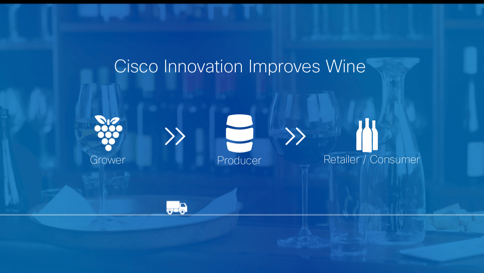
For our Cannes debut, we focused on finding a way to tell our story that would resonate with attendees. Conversations in the Cisco booth at the Lions Innovation Summit will provide a pivot point to discuss solutions that are becoming increasingly relevant to the creative community. Our Wine Demo is an onsite experience that highlights how technology impacts everything organizations build and sell, as well as how they communicate. Conversations will revolve around big data, analytics, networking, security, mobility, remote expert, and Omni channel experiences—all of which are enabled by Cisco technology. We’re excited to bring this experience to the event and celebrate creativity through technology with delegates.

Picture1

Audience Experience
The audience at Cannes Lions is looking for data-driven insights. Cisco is able to provide rich content that is relevant to the unique mix of attendees and the diverse platforms they rely on to accomplish their objectives. We will discuss everything from how mobility enables consumption on-the-go to how it helps people use devices to shop intelligently, track environmental conditions, or create revenue using apps. We’ll show how everything is managed and enhanced by the evolution of Cisco solutions. Explore our customer stories to see what’s possible today.

Brand Relevance – Sharing Cisco’s Story
One of the biggest trends at Cannes Lions will focus on how brands are presenting themselves creatively through an association with what they do best. Companies will share how they leverage technology and data to spur innovation. Cisco’s new brand campaign—“There’s Never Been a Better Time”—embodies how communities are connecting, consuming and sharing data, and using insights to create a strong, encompassing strategy quickly and easily. #NeverBetter. We’d love to hear your story!

Community Impact Through Technology   
Even in a B2B environment, community is essential for validation, influence, and growth. Customers seek companies with strong cultures to which they feel aligned. Cisco will discuss the value of context and community relevance to create a platform for people to act differently. We have learned through our Corporate Social Responsibility (CSR) programs that companies want to start movements, not campaigns. Cisco’s CSR platform is a great example of how trends of human behavior let big brands challenge the status quo for increased relevancy. From an outsider’s perspective, Cisco provides companies with network capabilities. But, we do more than that.  Learn how using a company’s or an individual’s core competencies can make good things possible, along with a challenge for all of us to innovate in the CSR space in this great blog on Cisco’s CSR and Creativity here.

Picture 3

Please join the conversation about Cisco @CannesLions2016  


Authors

Molita Sorisho

Product Marketing Manager

Collaboration

Avatar

These vulnerabilities were discovered by Yves Younan.

Pidgin is a universal chat client that is used on millions of systems worldwide. The Pidgin chat client enables you to communicate on multiple chat networks simultaneously. Talos has identified multiple vulnerabilities in the way Pidgin handles the MXit protocol. These vulnerabilities fall into the following four categories.

  • Information Leakage
  • Denial Of Service
  • Directory Traversal
  • Buffer Overflow

The following vulnerabilities were identified (listed numerically by CVE):

CVE-2016-2365 – Pidgin MXIT Markup Command Denial of Service Vulnerability
CVE-2016-2366 – Pidgin MXIT Table Command Denial of Service Vulnerability
CVE-2016-2367 – Pidgin MXIT Avatar Length Memory Disclosure Vulnerability
CVE-2016-2368 – Pidgin MXIT g_snprintf Multiple Buffer Overflow Vulnerability
CVE-2016-2369 – Pidgin MXIT CP SOCK REC TERM Denial of Service Vulnerability
CVE-2016-2370 – Pidgin MXIT Custom Resource Denial of Service Vulnerability
CVE-2016-2371 – Pidgin MXIT Extended Profiles Code Execution Vulnerability
CVE-2016-2372 – Pidgin MXIT File Transfer Length Memory Disclosure Vulnerability
CVE-2016-2373 – Pidgin MXIT Contact Mood Denial of Service Vulnerability
CVE-2016-2374 – Pidgin MXIT MultiMX Message Code Execution Vulnerability
CVE-2016-2375 – Pidgin MXIT Suggested Contacts Memory Disclosure Vulnerability
CVE-2016-2376 – Pidgin MXIT read stage Ox3 Code Execution Vulnerability
CVE-2016-2377 – Pidgin MXIT HTTP Content-Length Buffer Overflow Vulnerability
CVE-2016-2378 – Pidgin MXIT get_utf8_string Code Execution Vulnerability
CVE-2016-2380 – Pidgin MXIT mxit_convert_markup_tx Information Leak Vulnerability
CVE-2016-4323 – Pidgin MXIT Splash Image Arbitrary File Overwrite Vulnerability

Read more>>>

Authors

Talos Group

Talos Security Intelligence & Research Group