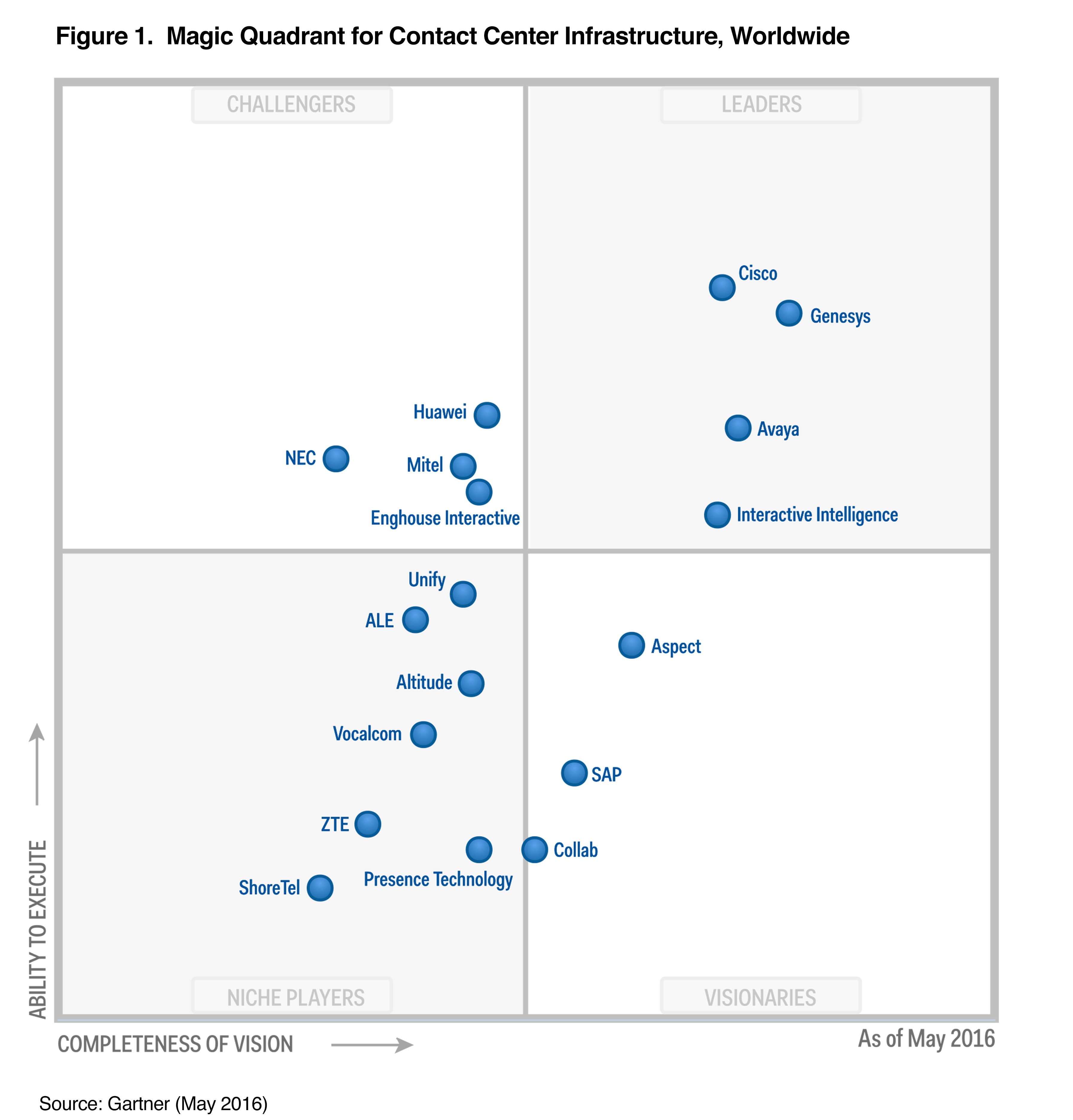
Gartner bases Ability to Execute on several criteria, including the breadth, quality, and overall maturity of vendors’ applications; their customer support capabilities; and their ability to deliver solutions that enable contact center operations in the formal contact centers of midsize or large enterprises.
We believe Cisco’s position shows that our contact center business continues to excel. We start with Agile development, which involves close collaboration with our customers to ensure that we’re meeting your requirements. It also lets us move forward when we’ve finished a new feature, freeing up resources. Agile is one way we maximize the quality and breadth of our contact center applications.
We believe ability to execute involves more than just creating capable, high-quality products. A vendor must actually deliver solutions to end-customers. Cisco does this through an unmatched worldwide network of trained channel partners. We host regular events around the globe with our partners and sales teams, for two main reasons:
Sharing Information: This includes our latest product features, roadmaps, and best practices for deployment and support.
Listening: We’re eager to learn from our partners. We value their insights and the feedback they relay from customers.
This open dialogue helps our partners stay equipped to support Cisco’s customer care solutions.
We’re thrilled at Cisco’s showing in another Gartner Magic Quadrant. It reflects the hard work and collaboration from our developers, sales teams, and worldwide partners. Together, they deliver for our customers.
This graphic was published by Gartner, Inc. as part of a larger research document and should be evaluated in the context of the entire document. The Gartner document is available upon request from Cisco. Gartner does not endorse any vendor, product, or service depicted in its research publications, and does not advise technology users to select only those vendors with the highest ratings or other designation. Gartner research publications consist of the opinions of Gartner’s research organization and should not be construed as statements of fact. Gartner disclaims all warrantees, express or implied, with respect to this research, including any warrantees of merchantability or fitness for a particular purpose.
Looking to move away from purpose-built physical network appliances and take advantage of the benefits of NFV? NFV is about much more than cost savings, it is about moving at the pace of software.
But how do you get started? If you look at ETSI, you need a ton of hardware and software just to get started. That’s why Cisco created the Cloud Services Platform (CSP) 2100 – an Enterprise NFV Platform for the DC and Hybrid Cloud.
The CSP 2100 is a platform without all the complexities and overhead that come with Openstack deployments. You can start with ONLY one host, then add additional hosts as needed to scale-out. It’s that simple.
See how to bring up a new service within minutes here:
We are bridging the gap between the network and systems/server/DevOps teams by allowing multiple ways to manage the platform. There is 100% consistency between all the management interfaces: GUI, CLI, REST API, and Netconf/Yang interfaces. This allows the network, server, security, and/or DevOps teams to manage the platform using the interface they are most familiar with.
You can deploy any Cisco or 3rd party KVM-based Virtual Network Function (VNF) on the CSP 2100. Rack and cable the the CSP 2100 once, then never step foot in your DC again.
Don’t take my word for it, give the CSP 2100 software a try for yourself in the cloud:
It’s that time of the year again – the Cisco Meraki team is packed and ready to attend ISTE 2016 for the 5th year! If you’re also planning to attend, be sure to stop by booth #2537 and say hello to the Meraki team. There’s no way to miss us in our bright green Meraki T’s!
New Products and Dashboard
Just like every year, we’re bringing all our latest products – including the brand new MC 74 – and will be giving 1:1 demos of our dashboard each day. After 4 successful ISTE shows, we have a pretty good idea of what it is you’re looking to learn from us. That’s why we are switching it up (no pun intended) for ISTE 2016 and featuring more than just demos in the booth.
Mobility Management Lab
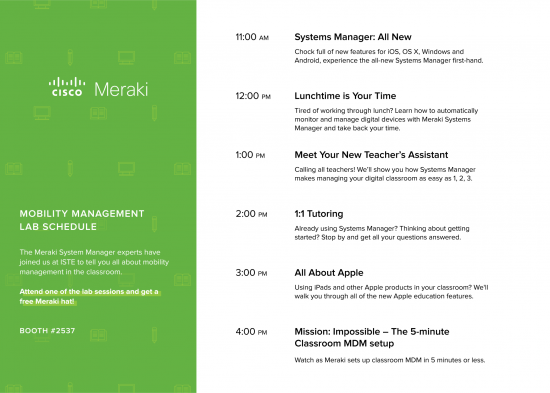
There’s no denying how important mobility management is in today’s classroom, so this year we are bringing along our Systems Manager experts to show off just how easy it can be with Meraki. Attend one of our hourly presentations in the Mobility Management Lab and you’ll walk away with a FREE Meraki hat! Here’s what we’ll be covering:
Cisco Collaboration Products
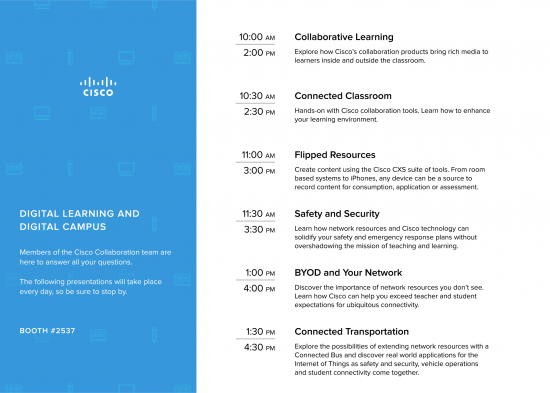
The Cisco Collaboration team will also be in the booth to talk about the newest features for digital learning and the digital campus. One feature they’ll be talking about in particular is the Cisco ecosystem partner and Learning Management System integrator for education, CirQlive. Each presentation will take place twice a day, so swing by at a time that’s convenient and check out what they have to share
No matter what you’re interested in learning this year at ISTE, the Cisco Meraki team is here to help.
We can no longer debate the reality of digital disruption and its impact on each of us in all we do, at work, at home and at play. Today’s challenge is to embrace the connected world and address security on a comprehensive continuum to ensure its optimum impact. To do this, we must look at every touchpoint of connectivity and consider the who, what, when, where and why within this continuum.
At Cisco, the continuum is our value chain—the end-to-end solution lifecycle for products (tangible or intangible) and services. At every stage of the value chain, from design and planning to the product or service’s end-of-life, security must be at the forefront. Not just security, but pervasive security. That is, the right security in the right place at the right time.
There’s never been a better time to design, deploy and monitor pervasive security throughout the value chain’s complex interconnections to ensure our products and services deliver on our promise to our customers.
How is Cisco addressing pervasive security in our value chain? We are intertwining security technology, physical security and logical or operational security in the right parts of the value chain to drive a higher degree of protection. Applying this layered approach allows us to focus on the third party members of that end-to-end lifecycle to identify core exposures and threats.
Watch this video to learn more about the importance of driving pervasive security Together.
Together with our customers and partners we can securely embrace the potential of digital disruption.
Cooperation, co-development, co-opetition. What does it take to succeed in the “co-economy”? Just as the “sharing economy” has changed the basic assumptions upon which the hotel and taxi industries are built, the “co-economy” is changing some of the fundamental ways we think about developing and bringing innovations to market.
Today, I want to focus on the process of co-innovating with customers and partners to succeed in the co-economy. There are as many ways to co-innovate with these companies as there are companies in the world.
In some industries, co-innovation has become a standard way of developing new products and solutions. The cable industry is a case in point. Years ago, for example, Comcast and Time-Warner invested in and provided Cable SP technical direction for a video-on-demand (VoD) solution with a small startup that was later acquired by Cisco. Today Cisco’s Tony George, who was part of that startup, and his colleagues are continuing these types of relationships. A new co-development effort with a large scale service provider is focused on cloud-based DVR solutions. Interestingly, this will be an open-source, non-proprietary solution: the partner SP will use it in its own network, and Cisco will help to make it available to other SPs. According to Tony, “The view is, if more people use the technology, more issues can be fixed, and the better the solution becomes.”
In other industries, open source and co-innovation are relatively new concepts. But this is changing because of the convergence of IT and operational technology (OT) and increased adoption of industry standards. Fifteen years ago, Rockwell Automation and Cisco might have been operating on different planets. But new customer opportunities have led us to bring together diverse skills and business models in a long-standing strategic partnership.
In a recent conversation, Rockwell Automation’s Senior Vice President and Chief Technology Officer Sujeet Chand outlined the foundations of this successful relationship: “We started with a common vision and commitment to standard Ethernet. We then had a strong focus on the customer—we took lots of customer input up-front, and continue to work closely with our Customer Innovation Council. And finally, we have a great collaboration process between the Rockwell and Cisco engineering teams, with each one bringing their own strength and expertise to the table.”
The transportation and technology industries also used to be worlds apart. But today, the siloes are down and these industries freely collaborate, as cities build smart infrastructures, automakers build smart cars, and tech companies develop self-driving vehicles.
Co-innovating with customers and partners has become such a valuable concept that Cisco has established Innovation Centers around the world dedicated to cultivating these projects. A couple of examples:
In Perth, Australia, the Innovation Center has been working with Curtin University and Woodside Energy Ltd. on developing battery-powered sensors for different use cases that have turned out to be surprisingly synergistic, according to Tom Goerke, who leads the Cisco team in Perth. The University is using wireless battery sensors, combined with network data and user survey data to track space utilization and environmental health throughout the campus. At the same time, Woodside is interested in using the same sensor for industrial applications in production facilities. For example, by adding acoustic and vibration sensing capabilities, Woodside and Cisco are developing models to predict the failure of fan belts and bearings to enable proactive maintenance and reduce downtime.
Meanwhile, across the world at the openBerlin Innovation Center, Cisco is partnering with Bosch to develop an optimal way to manage power tools on the shop floor for our mutual customer Airbus. Mitko Vasilev, CTO at openBerlin, calls this project “Connected Factory on steroids,” showing what the right team with a focused objective can do in a very concentrated time frame. The project brought together people from Bosch, Airbus, and other partners for three weeks of intensely focused work, integrating business processes into the technology solution. The team delivered a working demo at Bosch Connect World and have documented and published the solution for other customers to use.
Cisco Hyper-Innovation Living Labs (CHILL) is yet another model for co-innovation, bringing together teams from multiple non-competing customers and partners to develop solutions for a single common issue. In this model, 48 hours of intense collaboration and rapid prototyping actually culminate in a working prototype and an on-the-spot funding decision for the winning concept.
These examples illustrate the vast possibilities of the “co-economy,” where seemingly unlikely partners come together to accelerate solutions for the common good using some of the best practices I have outlined earlier. As my colleague Tony George said, “It used to be that innovation was about building your intellectual property war chest. Today, it’s about the betterment of mankind. The money will follow.”
As I author this, I am in my hotel room in Chicago and its Thursday evening. Our core Cisco Big Data team has been here for the past two days focused on planning our worldwide 2017 activities. One thing that is stuck in my mind now after our meetings is the phrase “Infrastructure is Cool!” – it’s a phrase that was repeated often during our meetings where we discussed Cisco; our Data Center solutions for Big Data leveraging products such as UCS, Nexus, and Cisco Management software; and our customers Data and Analytic needs.
Cisco is a proven and recognized leader in Big Data infrastructure solutions. Offering customers broad choices for their Hadoop environments covering Cloudera, Hortonworks, IBM, and MapR. We extend as well into the world of Analytics with solutions from Splunk, SAP, and SAS. All of these offerings are applicable to your Red Hat ecosystem, too.
Our “cool” factor is apparent in many areas… First, performance and speed. Here Cisco has led the way in Big Data benchmarks. We are #1 in several TPC-H benchmark areas. Second, ROI and TCO, helping to make the most of your budgets. Our UCS platform is a proven contributor to positive ROI and TCO measurements. The Analyst firm IDC reports on UCS here. Third, productivity, people working faster and smarter. Our Big Data solutions, as recognized by many customers, drive increased productivity – be it for the I.T. staff (300% improvement in cases) or Data Scientists (30% improvement). Read Forrester’s report on Cisco and UCS. Continue reading “Big Data is a Big Deal for Your Infrastructure (and it is Cool!)”
My first InfoComm experience proved to be quite insightful, especially regarding the 100+ degree days we faced in Las Vegas! As a booth tour guide, it was interesting to see the parts of the Cisco booth that gained the most attraction. Here are some of my observations from the show:
Integrators Provide Value-Added User Solutions
Cisco’s extensive network of channel partners, integrators, and resellers provide comprehensive collaboration solutions. PresenterTrack and In-Room Control are two new solutions that integrators use to meet end-user needs.
https://youtu.be/BUO2SHuyuhE
PresenterTrack essentially turns your video meeting room into a “stage.” Video conferencing had traditionally assumed a seated experience. But in larger environments, presenters typically stand and move across a room or stage. PresenterTrack detects and tracks people as they stand and naturally move about in front of the room. This gives presenters more flexibility and audiences a much better visual experience.
One of the challenges of conference rooms can be all the different controllers. The lights are on one wall, the thermostat on another, and so on. In-Room Control allows you to manage not only your Cisco video endpoint, but also room peripherals like lighting, A/C, and blinds. This frees up space on your meeting room table and simplifies your meeting experience.
Companies Show More Movement toward Cloud Cisco Spark provides a complete collaboration service, including message, meeting, and call capabilities. At InfoComm, we announced the capability to register room endpoints to the cloud. Registering Cisco SX and MX room systems to Spark eliminates the need to invest in an on-premises infrastructure solution. It’s exciting to see the progression of Cisco Spark and the delightful collaboration experiences that will come with it.
Demand Continues for Pervasive and Flexible Video Options
As momentum builds toward cloud, many organizations still prefer on-premises video deployments. That’s why we to continue to invest in providing industry-leading solutions for those customers. A great example is Acano, Cisco’s recent acquisition and lead on-premises meeting solution. Booth visitors were especially interested in how Acano delivers interoperable and scalable conferencing.
In an Interactive Multimedia & Collaborative Communications Alliance panel, I learned how several vendors, including Cisco, are addressing mobility. The panelists agreed that people want to be able to join meetings from any device, at any time, without compromising experience. The increase in BYOD policies and mobile workers require flexible and interoperable collaboration systems. Interoperability is no longer an option.
Learn how you can use PresenterTrack and In-Room Control to improve the conferencing experience.
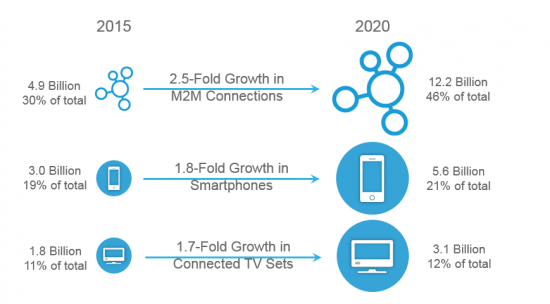
In the latest annual update to Cisco Visual Networking Index (VNI) Complete Forecast, 2015-2020 we forecasted that the global number of IP connected devices and connections will grow from 16.3 billion in 2015 to 26.3 billion in 2020 – adding net new 10 billion device and connections. What could be exciting about the consistent growth year after year in the total number of devices and connections, you ask? If the average 3.4 devices and connections per capita by 2020 for a forecasted global population of 7.8 billion (that’s every man, woman and child – including a newly born infant) is not exciting, perhaps the ever-changing mix and network implications might interest you more.
While growing up in India, I was a late inductee in 1990 to the then limited number of households that owned and watched a colored analog TV set. In 1991, I got my first exposure to a desktop PC, which needed to be in an air-conditioned room for fear of melt down. I did not see a cellphone until 1994, when I first came to the US and had the opportunity to own one in 1996. It was a clunky piece with a battery that was thicker than any phone available and functioning in the market today. I did not realize then how pivotal that single device would become to our daily routines as human beings – evolving from a basic feature phone to a smartphone that is a hub of our communication, information and entertainment and much more.
The device and connections landscape is consistently changing in form factors, computing capabilities, network connectivity, portability and mobility. Over the last few years, we have seen introduction and adoption of tablets and phablets that have eroded the personal computer installed base. The increased digitization has made IoT or machine-to-machine (M2M) connections all pervasive in our personal and work lives. Non-smartphones continue to see a global decline while smartphones lead with a phenomenal growth. We have seen transformation of TV from analog to digital and from being within the “walled garden” to now, Internet connected.
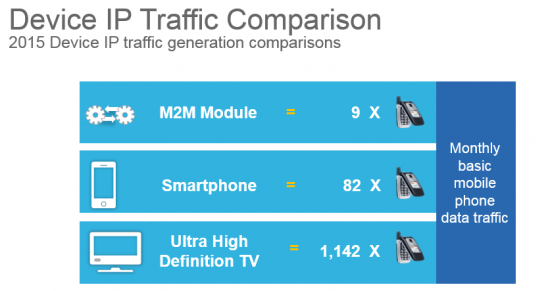
In the M2M category, we find a wide plethora of connections having different network resource requirements. On the one hand, we have smart meters, asset and personal trackers that could utilize LPWA with very low bandwidth requirements and tolerance of high latencies. On the other end of the spectrum, we have smart self-driven cars with in-car entertainment, and telemedicine type of applications that require ultra-low latency and high bandwidth. On an average, a single M2M connection generated 9 times the traffic generated by a non-smartphone in 2015.
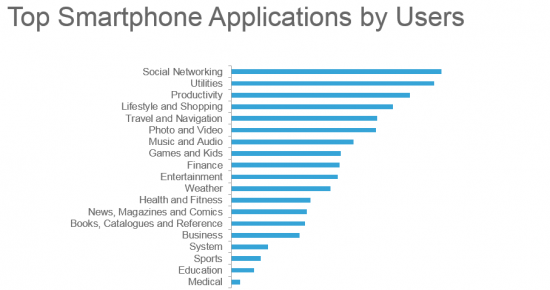
Smartphones are increasingly becoming the single most important communication device in the lives of global citizens. By 2020, contribution of smartphones to the global IP traffic will surpass PCs. Whether it is checking one’s appointments first thing in the morning, replying to emails and texts, consulting for the optimal route to work, social networking, and buying tickets, making payments on the go, fitness tracking, video chatting or simply watching video and playing games in our free time, smartphones are at the center of it. The number of users that use smartphone for activities other than mere calling is on the rise.
Television viewing as well as the TV set has also evolved – from being limited to watching the channels provided by the service provider to an open platform where the viewer can chose from syndicated channels to overt-the-top provider (OTTP) videos or even user-generated content. The definition of video has also evolved from standard (SD) to high (HD) and now to ultra-high (UHD) or 4K. By 2020, 40% of connected flat panel TV sets will be UHD capable – consuming two and a half times more bandwidth on an average than HD and nine times more than SD bandwidth. This will contribute to UHD share of IP video growing from under 2% in 2015 to over 16% by 2020 while the standard definition becomes not so standard and decline from 48% share in 2015 to 21% share by 2020.
As a consumer, I appreciate the excitement and improved experiences that the above underlying shifts in the mix of devices and connections represent (instant information, higher definition video content, and hyperconnectivity). As an industry analyst, I understand the challenges and concerns that global service providers face in delivering next-generation services that meet our expectations (scalability, reach, quality, and security). While we may take much of the technology innovation that is happening today for granted, we should occasionally consider the amazing transformations that are deepening our reliance and demands on global networks. Please feel free to share your comments and experiences with the evolving “connectedness” that’s reshaping human lifestyles on a daily basis.
Since our Digital Ceiling launch earlier this year, together with our ecosystem partners, we have been successfully implementing a good amount of customer implementations. This year’s RealComm/IBCon conference, right in the heart of Silicon Valley, seemed for us the right catalyst to announce our next set of partners with core areas of expertise in innovative Infrastructure Solutions, Building Automation, Sensing and world leading Smart Building Consultancy practices. We are announcing following new ecosystem partners today:
Extending the Digital Ceiling ecosystem with new partners
Delta Controls
Delta Controls is a global leader in building automation technology. It believes in total building control, encompassing HVAC, lighting, and access. Delta Controls leverages intuitive BACnet technologies to deliver buildings that are Earthright™.
DGLogik
DGLogik’s open, distributed services architecture and intelligence platform facilitates device inter-communication, logic, and applications from the edge to the cloud and everything in between.
EllisDon
EllisDon is a Global Construction Services company embracing technology in everything they build. From billion-dollar hospitals to high-rise buildings, they are a leader in building Digital Ceilings as the lead Technology Integrator.
Emerson Network Power provides critical infrastructure technologies for information systems. Emerson SmartSolutions facilitate the deployment and maintenance of customers’ Digital Ceiling infrastructure.
IGOR
Save 80% of installation and energy costs with Igor’s plug-and-play PoE lighting, sensor, and data platform. It connects to any manufacturer’s LED fixtures. The platform offers operational savings, effortless configuration, reporting, and granular control.
Intelligent Buildings
Intelligent Buildings is an industry-leading, smart-building consultant company that guides operational, technical and financial decisions on over 1 billion square feet of existing portfolios and $2 billion in new construction.
Legrand
Legrand is a complete, end-to-end solutions provider with connectivity, physical infrastructure, cable management, power and cooling solutions to support data center, building networks and AV applications.
PointGrab
PointGrab provides an innovative, edge-analytics sensing solution for tracking how and where occupants use a building. This actionable information enhances business operation performance, saves energy, and improves safety.
Now with over 20+ ecosystem partners we will continue to innovate the Smart Building space to make it into a truly open and interoperable technology enabled environment where new business outcomes will drive the further integration of IoT capabilities inside new and existing buildings. If you’d like to learn more about moving to a Digital Ceiling, check out http://www.cisco.com/go/digitalceiling or contact us at digitalceiling@cisco.com



 We believe Cisco’s position shows that our contact center business continues to excel. We start with Agile development, which involves close collaboration with our customers to ensure that we’re meeting your requirements. It also lets us move forward when we’ve finished a new feature, freeing up resources. Agile is one way we maximize the quality and breadth of our contact center applications.




 In some industries, co-innovation has become a standard way of developing new products and solutions. The cable industry is a case in point. Years ago, for example, Comcast and Time-Warner invested in and provided Cable SP technical direction for a video-on-demand (VoD) solution with a small startup that was later acquired by Cisco. Today Cisco’s Tony George, who was part of that startup, and his colleagues are continuing these types of relationships. A new co-development effort with a large scale service provider is focused on cloud-based DVR solutions. Interestingly, this will be an open-source, non-proprietary solution: the partner SP will use it in its own network, and Cisco will help to make it available to other SPs. According to Tony, “The view is, if more people use the technology, more issues can be fixed, and the better the solution becomes.”
 In
In