Avatar

Mark Watney is “The Martian”, in case you haven’t heard. In the movie, he’s a Botanist stranded on Mars. But in the book, he’s first a mechanical engineer, and a botanist as his second skillset. It’s hard to if he’s an engineer-botanist or a botanist-engineer, but he’s a pretty cool guy. Think McGuyver with better one-liners. Cool enough for Matt Damon to play his character in the movie.

THE MARTIAN

It’s great when we IT folks have more than one specialty as well. The Martian (Watney) picked Mechanical Engineering and Botany – a great combo when you happen to get stranded on Mars. It seems like Networkers are never just networkers any more as well. It always seems to include some route/switch, but then… voice? Security? Data center? Development?

Which brings me to Cisco DevNet, the topic of today’s post. The name even sounds a Watney-esque: DevNet – sounds like Developer-Networker. But it’s really the single best resource to network with others and find resources about software development related to Cisco products. That includes the complete spectrum of people – from networkers who just cracked a book to start learning Python to people who make their living developing software.

Personally, I find Cisco’s DevNet to be pretty useful, and I have loved the DevNet Zone at Cisco Live. But I wondered how to get you excited DevNet. And the best way I think is for you to try a few features. So my goal today is to introduce you to a few features, and give you a few links as places to launch.

You can pick my suggestions or try your own. I’d love to hear what you tried, and how it worked – If you do, post it here, or tweet me your favorite, @WendellOdom, and put a #CiscoChampion in the tweet if you think of it! Continue reading “Getting Started in Cisco’s DevNet”

Authors

Wendell Odom

Founder, Certskills

Avatar
Guardian Center drone training exercise - cmprssd
Model of Guardian Centers training facility

Emergency readiness is one of the most frequently practiced and probably one of the least frequently exercised drills. However, when it counts on saving human lives, it really counts.

One such massive effort in emergency preparedness took place during the week of Sep 28 at the Guardian Centers in Atlanta, Georgia area.  Guardian Centers is an 830-acre training facility containing 75 acres of multi-story cityscapes that hosts up to 7000 participants for a variety of tactical trainings.

Guardian test site from drone1_cmprssd
Actual photo of test site
Guardian Test Site from drone2_cmprssd
Drone produced 3-D model of test site

I participated in the disaster preparedness drill, along with my colleague, Nico Darrow, on behalf of Cisco involvement with DreamHammer, which leverages drones to carry out CONOPS.  this exercise was a clear example of how innovation and the Internet of Things is having an impact on the world today.

A number of organizations, including the New York Fire Department, FEMA, CNN, AIG Insurance, law enforcement agencies, and drone startups also joined this collaborative exercise.  A simple drone flight around the affected structure generated a rich and realistic 3-D model of the area, which was invaluable to first responders, media outlets and insurance agencies in particular.

Continue reading “Life Saving Drones Aid First Responders”

Authors

Biren Gandhi

Head of Drone Business & Distinguished Strategist

Corporate Strategy Office

Avatar

In a recent post, “Evolution of attacks on Cisco IOS devices”, we discussed how threats against network devices have evolved. There was no evidence that a remote attack vector or vulnerability in Cisco IOS was related to these attacks. This reinforces the value of creating more hardened and resilient systems.

The strategy for creating more secure technology has an unending goal, yet it’s a journey worth sharing.

Much has been written about and shared on our secure development lifecycle and our efforts to ensure security in the supply chain. However, there are two lesser-known initiatives that have had significant impact on Cisco product security: 1) the use of Common Security Modules and 2) sophisticated attack-focused penetration testing.

Continue reading “Trustworthy Systems: A Peek Behind the Curtain”

Authors

Graham Holmes

Director

Advanced Security Initiatives Group

Avatar

Location, Location, Location. While location is always important in real estate (never more of an understatement than here in the San Francisco Bay Area), it’s becoming crucial in, well, LIFE itself.

Don't Get Spooked by Location Services_ Image 1_28OCT2015

November 3-4 | Palo Alto, CA

Let me explain the slightly dramatic statement. Continue reading “Personalizing Consumer Engagements with Location Data and Analytics – Find Out How at Location & Context World”

Authors

Jolene Tam

Product Marketing Manager

Security

Avatar

One of the biggest issues state governments face in their day-to-day governing is the sheer size of the state itself. Even in average sized states, it can take quite some time to get from place to another, and it’s particularly burdensome for state government workers who live and work in cities far from the state capital. It can be difficult to effectively communicate with other employees in the capital and in other cities, and employees spent precious time and money traveling all across the state.

One such state with this issue is Alabama. The Alabama Department of Transportation (ALDOT) manages all forms of transportation in the state, including one of the longest navigable inland waterways in the nation, six commercial airports and a large seaport on the Gulf of Mexico. To ensure these multiple forms of transportation run smoothly, ALDOT has over 5,000 employees spread out across the state. Its large number of employees and their geographic sprawl, however, meant ALDOT was having trouble getting everyone to meet in one location for mandatory training sessions.

While training was the main issue, ALDOT generally needed a more sustainable way to host meetings with employees scattered across the state. Years ago, ALDOT division chiefs from distant corners of the state would have to drive to Montgomery, Alabama, every Monday to attend one meeting, which was not a productive use of time and incurred costly travel expenses. Clearly, it needed a cost-effective solution to make it easier for the department to host trainings and meetings for its far-flung department. Continue reading “Customer Spotlight: Alabama Dept. of Transportation Reduces Travel Expenses with Video Solution”

Authors

Tony Morelli

Vice President, SLED East

Avatar

When we launched UCS Mini, it pushed us into new territory with an exciting offering that bundles servers, storage and networking into a single solution — much like the traditional UCS — but in a smaller form factor and lowered the cost of entry to a UCS solution. It allows customers of any size (SMB, ROBO, and distributed enterprises) to take advantage of UCS.

Building off of infoTECH Spotlight and Best of InterOp Finalist awards, I wanted to catch you up on some recently posted customer’s success stories for UCS Mini. Most interesting is that they are five very different business from the Australia, Belgium, Mexico, and the United States.

Continue reading “Cisco UCS Mini Customer Success Stories”

Authors

Bill Shields

Senior Product Manager

UCS Solutions Product Management

Avatar

The rise of multi-sourced IT delivery models is well documented, and multi-sourcing is now accepted as the new normal. Today’s outsourcing market demands solutions that anticipate and respond to business activity inside and outside the organization while simultaneously dealing with a rapidly shifting landscape of providers. This drives the need for a global digital infrastructure in which information is used to help organizations create real time links between IT organizations seeking to manage support complexity and a growing and ever shifting array of external service partners that includes traditional outsourcers, managed service providers, telecom operators, and cloud service providers. Enabling this shift are three key success factors:

  1. The dynamic nature of this ever shifting landscape becomes a defining point in new strategies and new tools are needed to address that new reality.
    .
  2. Decisions being made 24/7 are profoundly impacted by an organization’s capacity to have every available piece of information, from all sources, accessible immediately.
    .
  3. The ability to deliver services of all kinds faster, more reliably and more affordability is of prime importance in today’s market.

Sourcing is becoming a critical success factor for IT management;  in fact many now consider the CIO the “Chief Integration Officer”. The multi-sourcing challenges that IT and business managers are facing today have never been so complex. In addition to cost considerations there’s a simultaneous laser focus on security, agility, alignment between sourcing and business strategy are more and more in focus.

Conquering Complexity in a Multi-Sourced Ecosystem

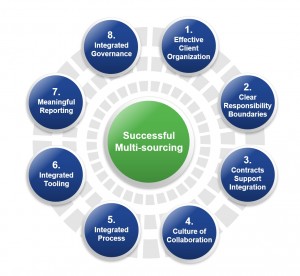
Multi-sourcing is not as straightforward as it might appear. There are challenges even for organizations that have spent time developing their future operating model and included a Service Integration and Management (SIAM) function. The  factors in the figure below underpin successful multi-sourcing with SIAM:

Key Success Factors for Multi-sourcing
Figure includes success factors for effectively operating in a multi-sourced environment.

 Critical Components

  • Effective client organization:
    In any sourcing arrangement, the client IT department is accountable for the IT services delivered to their business. When multi-sourcing, the client has multiple direct contracts with many suppliers, so a strong commercial management function is also required.

Continue reading “3 Key Success Factors for Multi-sourcing”

Authors

Jim McDonnell

Director, General Manager

ServiceGrid, CMCP, UCSF Alliance

Avatar

Female Leaders Cisco Japan

Lots of people think of the number 13 as unlucky, but sometimes, it can be a LUCKY number.

It was for the 13 women at Cisco Japan who were chosen to participate in a program called Project Quantum – a year-long program that would help them take quantum (rapid) leaps and accelerate their leadership development.

The 13 were so inspired by what they experienced during their training that they wanted to pay it forward to other women (and men.) So they decided to put their thoughts on paper – 200+ pages and 5 chapters of them – in a book called Discover the Aspiring Leader In You.

“I’m very fortunate to be a part of the journey with those 13 passionate ladies! They’ve got the most out of the learning opportunities and now they are giving back to the rest of Cisco employees, including males and females! By reading this book, you can join and enjoy the journey together!” says 山中朋子Tomoko Yamanaka, Inclusion & Collaboration Manager.

“I want to create an organization that can continue to create new values where people can shine as much as possible,” says Rutsuko Yoshida, a cross-functional product manager for Cisco who participated in the program “If I could tell what I got through this program, it would be that Cisco is a wonderful company that knows the importance of inclusion in innovation, these women are now my role models, mentors and friends, and that if I want to climb up, I have to challenge myself.”

Cisco Japan women leaders
The 13 women chosen to participate in Cisco Japan’s project quantum were inspired to share what they learned!

Here are 13 tips straight from the book and the women that wrote it that you can use to inspire your inner leader.

  1. Enjoy change. It is important to see change as a friend. Change does not go away. Change is an opportunity to learn new things. Learn to adapt, learn to lead in a new environment. Have fun!“Since the company gives me some authority, I can work in a relaxed manner even when there’s tension.” 吉澤 浩美 Hiromi Yoshizawa, Senior Manager Technical Services
  1. Make things fun. Work, challenges, new project new tasks, new targets…. It is easy to get overwhelmed, bogged down. So much to do, so little time. We need to remember the fun, the excitement, the joy that comes with the effort on working on ourselves. Be creative: Find ways to bring fun and joy into everything you do!“Always keep passion and motivation for work and enjoy every minute to move forward.” – 上野 由美 Yumi Ueno, Sales Business Development Manager Collaboration Architecture.
  1. Welcome opportunities. Stand up. Take the challenge. Overcome your fears and hesitations. New opportunities come to you to help you grow and develop. Make the most of it.“You can achieve multiple tasks by not pursuing too much completeness, but rather thinking to avoid jams and work effectively.” 佐藤 菜穂子 Sato, Naoko Echigoya
  1. Go one more step. Obstacles can appear to block your way to success. Persevere and do not give in. Gather the strength and go one step further. You impose on you your own limitations. You have the power to expand your mind and go the extra mile.“Stepping up is fun! I want to engage myself in anything with a strong passion.” 田名部 朋子 Tomoko Tanabe, Senior Account Manager Public Sector Sales
  1. Speak up. Whatever the reason, remember that if you do not speak up, you will not be heard. If you do not voice your thoughts, the discussion will be less rich, less diverse, less innovative.“I can discuss a good program or tactic for the organization when doing my work. There is not rigid formality but freedom.” 原田 慶子 Keiko Harada, Marketing Manager Japan Marketing
  1. Set your goals high. Who knows the extent of your boundless potential? Nobody has the answer to that question. You can stretch and achieve more than you can possibly imagine, if only you take the time to set goals that are inspiring and challenging.I want to forego easy decisions, and respect the image of myself that I aspire to” –吉田 留津子 Rutsuko Yoshida, cross-functional project manager for Advanced Services.
  1. Elevate your point of view. Look at the issue from the point of view of your manager, of your manager’s manager. Look at problems thinking a bit higher, a bit broader.“It’s important to think about what the other person really wants by standing in his/her shoes, and produce results.” –千田 恭子 Kyoko Senda, Business Operation Manager APJC Business Partnership
  1. Have a plan B. Not because you plan to fail or give up, but because a Plan B will give you the freedom and extra peace of mind to know that you will know what to do regardless of what happens.“My work policy is always find the best solution for creating a win-win situation.” 前原 朋実 Tomomi Maehara, Product Manager, Enterprise Networking Division
  1. Be a skillful communicator. Are you a skillful communicator? If yes, you know that communication is a flow: a flow of words, a flow of meaning and a flow of understanding. And the flow works both ways. Communication is a skill that is ever aware, ever present, always conscious of the other party.“I want to consider things according to someone else’s perspective, such as by understanding the customer’s needs.” –長崎 友美 Yumi Nagasaki, senior account manager, Global Service Provider.
  1. Have the courage to say no. It could be your boss, your partner, your friend or a project manager… They have an ask from you. They want you to comply, they want you to agree. There are times when YES is indeed the answer to give. But there are times when you need to prioritize and for one reason of another you need to push back, you need to say NO.“In the future, I want to focus on ’Dan sha ri’ (decluttering). Organizing my belongings by thinking about whether I need each object to help me better organize my mind. There are many people who have capacity to take on more, even when they are busy.” 佐藤 麻子 Asako Sato, Program Manager, Service Sales
  1. Have a mentor. A mentor is like a friend, someone you can trust. A mentor is not necessarily a coach. It is someone you can be open with, someone who has your best interest in mind at all times, and with whom you can share your dreams, aspiration and doubts without any fear of being judged.My personal motto is ‘Alone we can do so little; together we can do so much.’” 山田 晴香 Haruka Yamada, Product Manager, Technical Services
  1. Listen to your heart. Yes, planning, thinking and having a schedule are critical part of a framework to be successful. But at the end of the day, remember that they are just tools that are supposed to serve you, not you serve them. So allow time and space for moments of spontaneity. Listen to the voice of your heart if you feel you need to re-prioritize, if you feel you need to adjust course, do so, being true to your own voice.“My personal motto is ‘Ichi-go, ichi-e’ (Meeting only once in a lifetime). I hold respect for each meeting and each moment.” –平田 Kai Hirata, Senior Account Manager Enterprise Sales
  1. Kill the parrot! We all have a parrot inside our heads. That internal voice that questions and shakes your confidence, that repetitive voice that makes you wonder if you are well-prepared or not. The parrot can be persistent, it can keep on saying things that make you doubt yourself. You know what you know. You have put efforts and energy into what you are doing. Believe in yourself and deliver the best performance you are capable of!“Challenge difficult things as great opportunities.” 田村 亜弓 Ayumi Tamura, Marketing Manager, Japan Marketing.

Cisco is a great place for leaders, current and future. Won’t you join us?

Authors

Carmen Shirkey Collins

Social Media Manager

Talent Brand and Enablement Team, HR

Avatar

You might know that many companies run “tests” in their web and mobile experiences, where they’ll pit one design, layout, or content set against another. It’s a way to see quickly which one works best.  For instance, you might have one page with a slick graphic at the top, vs another one with text and a form at the top, to see which one gets the best interaction and form completion. At Cisco, we’ve been doing this at a component level for a while, and have begun to do these kinds of test with whole pages on Cisco.com. These tests help us understand which of two experiences is the easiest and most straightforward to use, and then we can apply that knowledge to our page designs in general.

But, it’s easy to over-complicate testing, which can lead sometimes to results that are hard to interpret or that generate too much data that can’t be readily analyzed.  So, I asked our team on the Digital Support Experience to give us their best practices for how to plan page vs page tests the right way. Here are some great tips from the teams:

  1. Identify your success metrics (“Overall Evaluation Criteria,” see below) at the beginning of your planning, so you can make clear the #1 thing your are optimizing for.
  2. Establish Baseline performance for the KPIs/success metrics before you start the test. (understand where you’re starting from — how were things performing before the test?)
  3. Before the experiment starts, state what will happen if the test a) succeeds, b) is inconclusive, c) fails.
  4. Don’t do two new competing designs for A and B. A better model is to use the current design as “A” and a new design as “B” so you have a good control group.
  5. Limit the number of variables that differ between the two versions.
  6. Let the experiment run long enough to get a volume of data on the key items that will yield statistical confidence in the result.
  7. Validate setup with an “A/A” test. The purpose of this is to check that your “system” for branching the users isn’t itself adding in a bias. (If you do a split of incoming users and you are directing them to pages that are exactly the same and you don’t get equal results, then your A/B branching system is adding bias itself.)

Overall Evaluation Criteria

“Overall Evaluation Criterion (OEC) forces you to ask the question: “what are you optimizing for?”

To do it right, only one OEC (think KPI) should be specified for your test. The reason for just one criterion is that multiple criteria can lead to muddy results. Version A improved KPI #1 but version B improved KPI #2 so which one was better? Therefore, it’s crucial to to specify one and only one KPI and optimize for that.

And, an Ultra-Tip

Perhaps the top tip of all is to improve your designs, content, and journeys based on the tests that you run. And, if you don’t understand why a particular experience is performing in a certain way, it’s probably time to supplement your A/B testing with some observational usability tests, so you can watch users interact with (and comment on) the experience they’re having. Test similar experiences on other sites, too, and you’ll a fuller picture.

What Do You Think?

Have you been running A/B and other kinds of tests on your digital experiences? What tips would you offer to your colleagues?

Authors

Martin Hardee

Director, Cisco.com

Cisco.com