Avatar

OilComm2015

OilComm2015-CiscoGet the edge and agility to innovate, compete, and win with Cisco’s digital solutions for oil and gas. Connect machines, assets, and people across your business with proven architectures and technologies. Secure it all from board room to field worker to remote, unmanned site.

Ever wondered about how to tackle the security risks the Oil and gas industry is facing? Well, if you’re at the OilComm Conference and Exposition in the George R. Brown Convention Center Houston, TX during November 4th to 6th, check out the 10.00am to 11:30am session with joint leader Robert Albach, Cisco Product Line Manager, IoT Security: How to Build New Risk Reduction and Communications Security Strategies from Scratch
Room: 360 DE

The details are on the right, and if you attend you’ll get new insights into how to secure your critical infrastructure, how to go about assessing the risk factors, and get practical tips from a no-nonsense panel.

To add the workshop to your outlook, click here.

After you’ve attended, let us know what you think by commenting on this blog!

To find out more about Cisco in Oil and gas, go to www.cisco.com/go/oilandgas.


Authors

Peter Granger

Senior Sales Transformation Manager

Avatar

CiscoChampion200PXbadge#CiscoChampion Radio is a podcast series by Cisco Champions as technologists. Today Cisco Champions share their experiences as  team members and talk about how the program benefits them professionally and personally.

Get the Podcast
Listen to this episode
Download this episode (right-click on the episode’s download button)
View this episode in iTunes

Cisco Champion Contributors
Bill Carter @ccie5022
Chris Brown @ChrisKnowsIt
Denise Donohue @LadyNetwkr
Eric Perkins @perk_zilla
Erick Bergquist @erickbe
Jon Hildebrand @snoopj123
Pantelis Stoufis
Scott McDermott @scottm32768
Stewart Goumans @WirelessStew

Moderator
Rachel Bakker (@rbakker)

Highlights
Benefits of being a Cisco Champion
Connecting with peers as a Cisco Champion
Memorable Cisco Champion Moments
Being a Cisco Champion at Cisco Live
How being a Cisco Champion helps give back to the IT community
Advice on becoming a Cisco Champion

Cisco Champions Program Overview
Cisco Champions are an elite group of technical experts who are passionate about IT and enjoy sharing their knowledge, expertise, and thoughts across the social web and with Cisco. The program has been running for over two years and has earned two industry awards as an industry best practice.

Resources and Links
About the Program
How to Apply for the 2016 Cisco Champions Program (nominations end November 15, 2015)
Contact the Cisco Champions Management Team

Authors

Rachel Bakker

Social Media Advocacy Manager

Digital and Social

Avatar

No, I’m not talking about schematics for the Hyperloop (although I’m pretty excited about flying through California in a suction pipe). I’m talking about an even more important network in today’s digitized world: the WAN.

Recent trends such as bring-your-own-device, mobility, and cloud computing have led to a surge in the number and types of devices connecting to the network. With these challenges, how can an enterprise manage demand for WAN bandwidth and fast, secure connectivity with a flat or decreasing operational budget? Continue reading “Tunneling: Faster, More Secure, and Cost-Effective Connectivity for Your Network”

Authors

Jason Liu

Product Marketing Manager

Enterprise Networking and Mobility

Avatar

EUW2015

pcouturaGuest blog by Philippe Couturaud, Cisco Business Development Manager, EMEAR Utilities:

This week you have the opportunity of meeting up with Cisco at the European Utility Week event in Austria. Cisco has become synonymous with providing advanced critical infrastructure for our utility customers enabling higher availability, greater reliability, and stronger security.

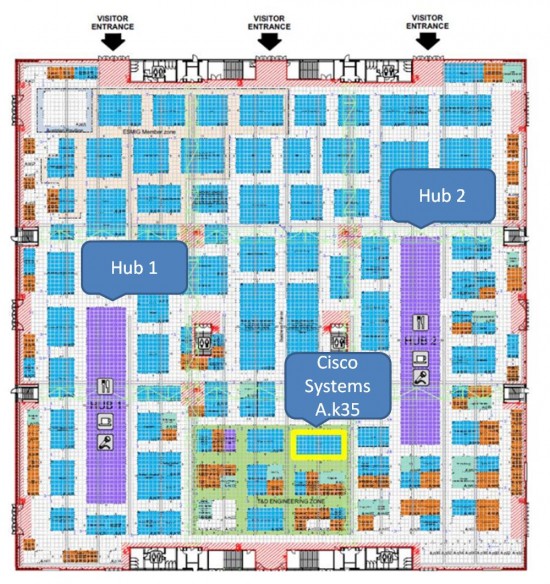
At stand A.k35 in the exhibition area (Hall ‘A’, Stand k35) you can come by our booth and learn how Cisco continues to expand our portfolio to better serve our customers. You can talk to our experts and experience our industry use case demonstrations showcasing new solutions for Cyber/Physical Security, Teleprotection, MPLS, and a lot more:

EUW2015Booth* Demonstrations at the booth will include “Unify Your Field Area Network Deployment”, “Effectively Manage Substation Operations“, “Teleprotection Over MPLS WAN“, along with “Fleet & Field Worker Solutions“.

  • * Cisco will be part of the GRID4EU Hub presentation on Nov. 4th, 9.15 AM to 12.30 PM. The Demo leaders will present the results of the most promising approaches and solutions developed within their demos – session 34 in the Hub.

Come visit us and find out about smarter, safer, more highly secure power grids offering reliable, efficient service. See how you can monitor, log, and diagnose systems with Cisco’s substation security solution. Find out how you can unify your field area network deployment with Cisco. See how Cisco is making a difference in the industry!

We’re looking forward to seeing you there!

For more information check out www.cisco.com/go/utilities.


EUW2015#3

Continue reading “European Utility Week Showcases Cisco Leadership”

Authors

Nicolaas Smit

Director

Energy Industry Global Industries Center of Expertise

Avatar

Today, most employees access public cloud solutions by bypassing IT. This is concerning for CIOs/CEOs given that it puts their organizations at substantial risk for data security and compliance challenges.

But, what if it isn’t actually the public cloud that you need to worry about? What if it’s your own internal processes that are the biggest risk when using cloud?

Untitled

Recently, Gartner released their top predictions for IT organizations and users for 2016. According to their report, Gartner predicts, “Through 2020, 95 percent of cloud security failures will be the customer’s fault.”

Let’s think about this for a moment. For years, companies have claimed they avoided public cloud solutions due to security concerns. This included multi-tenancy/shared resources (noisy neighbors), authentication/access control, availability needs, and meeting compliance requirements. Yet, it’s not necessarily public cloud providers who need to be companies’ top concern— rather, it’s their own internal procedures that lead to compliance failures and increased levels of business risk

Organizations need to look at external factors as well as their internal processes to reduce risks from and gain the benefits of using public cloud.

As Gartner states in their prediction, “The characteristics of the parts of the cloud stack under customer control can make cloud computing a highly efficient way for naive users to leverage poor practices, which can easily result in widespread security or compliance failures”.

Therefore, it is increasingly important for businesses to develop a holistic cloud management approach to properly address risk.

Cisco Cloud Consumption as a Service helps organizations begin their journey to managing cloud by identifying cloud usage throughout the business for complete visibility. With this visibility you can begin to evolve your cloud management capabilities, including:

  • Meet compliance and properly mitigate risks by defining cloud usage policies while working with your DLP (data loss prevention) solutions
  • Reduce cloud spend by identifying redundant services
  • Identify and meet the cloud needs of internal groups
  • Benchmark cloud use against peers
  • Compare providers to find the right cloud services to meet your needs

Establish Cloud Management To Avoid Unnecessary Risk

To learn more about how you can mitigate risks by using our cloud management tools, register for our webinar, Reducing Risk of Shadow IT, on November 12th at 10am PT to understand how Cisco Cloud Consumption as a Service can help keep your business secure while still leveraging strategic cloud services. Register here.

Can’t attend? Learn more about how our software can help you better manage public cloud services by signing up for a free trial of Cloud Consumption as a Service at www.cisco.com/go/cloudconsumptionfreetrial

As always, feel free to chat with me on Twitter for questions and comments.

Authors

Robert Dimicco

Senior Director

Advanced Services

Avatar

Guest Blog by Alison O’Brien, Product & Solutions Marketing Manager

Small Carriers and the NMS/EMS

Small carriers and rural local exchange carriers (RLECs) often forgo Network Management Systems/Element Management Systems (NMS/EMS) platforms because they don’t have dedicated IT departments. They often have limited staff, time and in some cases lack the breadth of technical IT skills needed to manage complex NMS/EMS platforms. In addition, finding a NMS/EMS solution that is priced to match their network size and that is easy to use and deploy can be a time consuming (if not impossible) task.

The Value of Network Management

Even though they may not use a NMS/EMS platform, these service providers do recognize the value of using a management tool. They know how an NMS/EMS can efficiently perform device management, network provisioning and network assurance tasks. They also know that an NMS/EMS can provide insight into network operation and performance, enabling their staff to more accurately respond to potential problems as well as automate manual tasks. And finally, they know the added value that an NMS/EMS can provide as they grow their business – particularly how it can support the expansion of new services.

EPN Manager ScreenShots_AO_03NOV2015


EPN Manager: Cisco’s Solution – Even for Small Carriers

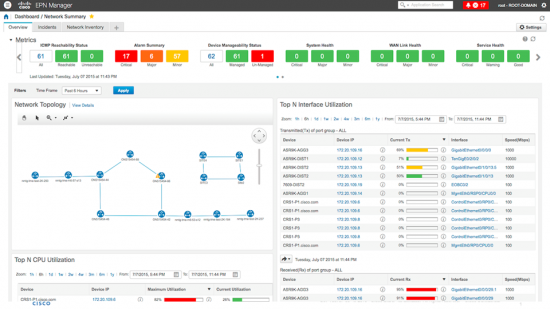
Introduced in June of this year, Cisco’s Evolved Programmable Network Manager (EPN Manager) is Continue reading “Simple Device Management, Network Provisioning and Network Assurance for Small Carriers & RLECs”

Authors

Greg Smith

Sr. Manager, Marketing

Cisco Solutions Marketing

Avatar

An often overused yarn of our day is that “we live in an increasingly more connected world.” While overused, I can’t think of any better way to describe what Cisco is doing in our security ecosystem with Cisco Platform Exchange Grid (pxGrid). And it has been quite an active first year since release of pxGrid for use in customer deployments, from building an ecosystem of 30 partners to work in multiple security standards groups in the IETF.

Cisco pxGrid is an information grid that security and other IT platforms can integrate with to share relevant contextual information with any other platform connected to it. Cisco platforms can exchange information with Cisco platforms. Partners can exchange information with Cisco platforms. Partners can exchange information with other partners. It is one of the main methods used by technology partners to create use-case focused product integrations within the Cisco Security Technical Alliance Ecosystem Program.

Continue reading “Cisco pxGrid Caps First Year in Market with Nine New Ecosystem Partners and More Security Standards Work”

Authors

Scott Pope

Director, Product Management & Business Development

Security Technical Alliances Ecosystem

Avatar

Availability is essential to smooth business operation. Many organizations think of availability in terms of network access. After all, if you can’t access your servers, you can’t do business. Availability in this sense is measured by how long the network is down per year. The cost of such downtime can be measured in millions of dollars per hour for some companies. To be enterprise-class, availability needs to be four or five 9s, meaning the network is up 99.99% or 99.999% of the time.

But availability involves far more than just whether you can get onto the network. If your data or applications become unavailable for any reason – storage corruption, hacking, or accidental deletion – it doesn’t matter whether the servers are blinking green. Similarly, if there is a local disaster, such as a storm taking out the power to your data center for several hours, you aren’t going to get much work done.

For the highest robustness, consider taking the three-level approach to availability – data/applications, servers, and site. When any one of these three is disrupted, your business operations can be shut down. Therefore, your availability plan needs to protect your organization at all three levels. This requires a blend of technologies, from simple data backup to the ability to recover critical applications at a secondary site during a disaster.

In “The 3-2-1-0 Rule to High Availability,” Doug Hazelman from Veeam describes how backup is one of the foundations of availability. As a foundation, however, it is not the entire solution. Rather, it is a starting point upon which a comprehensive availability plan is built.

Consider how traditional backup technology offers only limited protection against data loss. Because system backups occur off-hours, users can lose an entire day of data and work. Today, virtualization technology makes it possible to backup at the virtual machine level. In addition, backup can be implemented without the use of agents to eliminate any negative impact on application performance or availability. This also significantly increases how often critical data and applications can be backed up. Finally, the cloud provides a cost-effective, flexible, and highly scalable way to implement a secondary data center without large CAPEX outlay.

Together, these technologies decrease the recovery time and time to productivity for any restoration. Because it is the virtual machine that is backed up, not just the data or application, the system is able to quickly and automatically restore the working environment itself. The result is that IT can achieve a 15-minute recovery for all data and applications, regardless of whether a single email is being recovered or an entire site restored.

The key to operating a reliable network is to focus on the end result rather than any of its underlying technologies.   Organizations that continue to think in terms of backing up user data limit themselves to a 24-hour recovery point and slow, manual recovery when a problem does arise.

Instead, focus on what is important to your organization: the availability of your data and applications and the infrastructure you need to access them. In this way you can take advantage of multiple technologies that, when integrated together, protect your organization at every level.

Learn more about how you can protect your organization by taking a 3-level approach to availability.

Authors

Xander Uyleman

Senior Manager

Global Partner Marketing

Avatar

Today’s storage area networks (SANs) face tremendous pressure from the phenomenal growth of digital information and the need to access it quickly and efficiently. Worldwide data is projected to multiply by an astonishing 1000 percent by 2020. It’s little wonder, then, that storage administrators rank slow drain and related SAN congestion issues as their number-one concern. If not addressed in a timely fashion, these can have a domino effect, even degrading the performance of totally unrelated applications.

A Slow Drain Device is a device that does not accept frames at the rate generated by the source. In the presence of slow devices, Fibre Channel networks are likely to lack frame buffers, resulting in switch port credit starvation and potentially choking Inter-Switch Links (ISLs). Frames destined for slow devices need to be carefully isolated in separate queues and switched to egress ports without congesting the backplane. A decision then needs to be made about whether the frames are considered stuck and when to drop them.

Cisco provides a Slow Drain Device Detection and Congestion Avoidance (referred to Slow Drain) feature that helps detect, identify, and resolve the condition exhibited by slow devices.

Register Now:

Join us for this live 60-minute webcast and learn the common causes of slow drain and other typical SAN congestion issues. See how Cisco Nexus and MDS switches now include hardware-based congestion detection and recovery logic for precise, fast detection and automatic, real-time resolution.

Watch this Video to learn more: This video demonstrates slow drain diagnostics using Cisco Prime DCNM . See how DCNM can be used to detect Slow Drain devices and troubleshoot the situation within minutes in a large fabric with thousands of ports. Deploy Cisco Prime DCNM today to bring down Slow Drain troubleshooting time from day or weeks to minutes.

Reasons for Slow Drain include:

1) An edge device can be slow to respond for a variety of reasons:  Server performance problems: application or OS, Host bus adapter (HBA) problems: driver or physical failure ,  Speed mismatches: one fast device and one slow device ,  Nongraceful virtual machine exit on a virtualized server, resulting in packets held in HBA buffers , Storage subsystem performance problems, including overload, Poorly performing tape drives

2) Inter Switch Links (ISL) can be slow due to:  Lack of B2B credits for the distance the ISL is traversing and the existence of slow drain edge devices ( in the fabric)
Any device exhibiting such behavior is called a Slow Drain Device. Cisco MDS 9000 Family switches constantly monitor the network for symptoms of slow drain and can send alerts and takes automatic actions to mitigate the situation.  Read this whitepaper to learn more.

Also attend this webinar : Nov 10th, 2015, 8:00 AM PST – Eliminating Congestion Problems in Storage Area Networks

Register Now:

More info:  www.cisco.com/go/mds
Subscribe to youtube Channel:  https://www.youtube.com/user/ciscomds9000

Tony Antony
Sr. Marketing Manager


Authors

Tony Antony

Marketing

Solutions