Avatar

Server load balancer (SLB) has become very common in network deployments, as the data & video traffic are expanding at rapid rate. There are various modes of SLB deployments today. Application load balancing with network address translation (NAT) has become a necessity for various benefits.

Cisco Intelligent Traffic Director (ITD) is a hardware based multi-terabit layer 4 load-balancing and traffic steering solution on the Nexus 5k/6k/7k/9k series of switches.

With our latest NX-OS Software 7.2(1)D1(1) (also known as Gibraltar MR), ITD supports SLB NAT on Nexus 7k series of switches.

In SLB-NAT deployment, client can send traffic to a virtual IP address, and need not know about the IP of the underlying servers. NAT provides additional security in hiding the real server IP from the outside world. In the case of Virtualized server environments, this NAT capability provides increased flexibility in moving the real servers across the different server pools with out being noticed by the their clients. With respect health monitoring and traffic reassignment, SLB NAT helps applications to work seamlessly without client being aware of any IP change.

ITD won the Best of Interop 2015 in Data Center Category.

BOI15_Data_Center_728x90

ITD provides :

  1. Zero latency load-balancing.
  2. CAPEX savings : No service module or external L3/L4 load-balancer needed. Every Nexus port can be used as load-balancer.
  3. IP-stickiness
  4. Resilient (like resilient ECMP), Consistent hash
  5. Bi-directional flow-coherency. Traffic from A–>B and B–>A goes to same node.
  6. Monitoring the health of servers/appliances.
  7. Handles unlimited number of flows.

Documentation, slides, videos:

Email Query or feedback:ask-itd@external.cisco.com

Connect on twitter: @samar4

Authors

Samar Sharma

Intelligent Traffic Director for Nexus 9k/7k/6k/5k

Avatar

Some random, yet strangely connected, thoughts the night before Halloween…

  1. Zombies can be scary:

zombie

  1. Death Metal* can be scary:

Click here to listen.

  1. Learning new skills and using new tools to automate your network can appear to be scary if you don’t have a coding background. But that doesn’t need to be the case…

In a previous blog post, I discussed Cisco’s SDN Strategy for the Data Center. I mentioned that it is built on 3 key pillars: Application Centric Infrastructure, Programmable Fabric, and Programmable Network. Regarding the 3rd pillar, I wrote that network programmability has largely been the domain of big Web SP’s, and/or those whose propellers seen to spin faster than others. However, the reality is that tools are available that are useful for networks of pretty much any size, and the tools are within reach of pretty much everybody.

Rather than rattle off a list cool features that are part of Programmable Network (some of which are summarized here), I thought it more useful to consider common things network people actually do on a daily basis, then show how we can apply programmability tools to do those things with, for lack of a better phrase, “the 3 S’s”:

  • Speed – enabling you to do things much faster;
  • Scale – enabling you to do things to a much larger group of devices; and
  • Stability – enabling you to make far fewer errors (thereby also increasing Security…oops, now that’s 4 S’s…)

In upcoming posts, we will consider use cases such as switch provisioning. For example, you need to put a bunch of VLANs on a bunch of switches. Unless you have a battalion of minions to carry out your wishes, this can be a tedious, time consuming task. There is a better way, and we’ll show you how.

What’s that? You say you’re a network geek, but you moonlight as a server admin? You’ve been using Linux tools to monitor and troubleshoot servers and want to use the same tools for the network? Okay, we can cover that too because tools like ifconfig and tcpdump are all part of the party.

If you can’t wait for the future posts and/or you want to dive deep, this recorded webinar should tide you over.

Anyhow, I need to go carve a pumpkin now…Happy Halloween!

*For music aficionados…Yeah, I know – the link was Heavy Metal not Death Metal, but I used one of my own songs…and this is about as close to Death Metal as I get. That whole guttural screaming thing never worked for me…

Photo compliments of commons.wikimedia.org


Authors

Craig Huitema

No Longer with Cisco

Avatar

1It’s a new world out there for all the service providers I get to talk with globally. Advances in technology are not only changing their customers’ behaviors, but they’re also disrupting established industries and business models. The result is a wealth of new opportunities—in existing markets and in new ones, within their footprint and beyond.
To compete in these markets, speed is everything. Whether you want to roll out new content, expand geographically, introduce new applications, or develop a business model for a new customer segment, you need to act fast. Success will be measured by how fast you can enter a market, establish a leadership position, and capture improved profitability early on.

You can’t afford to stand still.

You need to continue to innovate, dream up new things, and get them to your customers quickly. It’s OK if every effort isn’t successful. Quickly move on and repurpose any technology investments you may have made.

What if you get a little behind? You could find that much of what you hoped to gain is no longer available, attractive, or what you thought it would be. But don’t stop your innovation engine. Speed it up. If you’re not sure how, get a trusted partner.

What stands in your way?

The major challenge for any service provider today is Continue reading “Expanding Your Market Opportunities: the Capabilities You Can’t Afford to Ignore”

Authors

Wayne Cullen

Senior Manager, Service Provider Architectures

Avatar

“Bankers’ hours” started disappearing with the advent of ATMs in the 1970s and 1980s. Today, online and mobile access has made the transactional side of banking a 24/7, anytime, any place proposition. And that’s just the beginning. Innovative financial institutions and startups are also bringing disruptive new business models to deliver higher value banking interactions, such as financial advice and wealth management. The drive to the branch has been replaced by the drive to digital.

How can financial institutions stay ahead of this wave of disruption? I hope you’ll join me @pdjameson on the upcoming #CiscoChat to tackle that question next Tuesday, November 3rd at 1:00 PM EST / 10:00 AM PST. Together, we’ll consider such questions as:

  • In an age of commoditized transactions, how can banks differentiate themselves?
  • Where should banks focus as they seek to evolve their current business models?
  • What kinds of on-demand services do customers want?
  • What’s the key to winning wallet share of the digital customer?

Continue reading “No More Bankers’ Hours: Join the Live Chat”

Authors

Paul Jameson

Global Senior Director, Financial Services

Marketing and Solutions Development

Avatar

Enabling Digital Manufacturing means not just embracing the Industrial Internet of Things (IIoT) but also taking the time to get smart on the latest best practices, technologies and solutions. There’s no better place to do that than the upcoming Automation Fair #AutoFair15. As always, this event is a ‘can’t miss’ conference for all of you who are in controls, operations or IT for industrial companies.  This year, Automation Fair will be held in the MidWest, in Chicago’s McCormick Convention Center from November 18th thru 19th.

As part of our strong strategic relationship with Rockwell Automation, Cisco will once again have a significant presence at this event including speaker presentations, participation in industry forums and our own booth (#1045) as well as participation in the Industrial IP Advantage booth (#1340).

Our goal is to help customers start their own digital manufacturing transformation and to showcase how they can– connect theAUTOMATION_FAIR 2015_BANNER_AD_150x685 factory to the enterprise, protect company assets, collect the right data and effect performance. Here’s a quick snapshot of the exciting solutions that enable digital manufacturing which we will be demonstrating in the Cisco booth:

  • Connected Machines: This week at Discover 2015, we are struck by how well received by customers our joint SmartBox offering with machine builder Mazak has been. Literally every machine shop customer, big and small, with whom I spoke with is struggling with visibility on utilization and actual quality throughput. Enabling OEE dashboards on every machine tool is going to be a huge hit. Mazak themselves achieved +17-pts improvement in utilization across their 800,000 sq-ft production operations by deploying the SmartBox beta within their own facilities over the last several months. This Connected Machines demo leverages our work with Mazak and leading robotics manufacturer Fanuc to showcase several leading edge manufacturing solutions such as predictive maintenance, plant PC virtualization, remote and mobile access, energy management, video collaboration and security.
  • Connected Assets for Location: Inventory control and WIP management are critical to driving production efficiency. Missing or misplaced material can bring a plant to its knees. With factory wireless and real-time location services, your assets are tracked and location immediately known. Historic views of paths taken by assets can reveal opportunities for efficiency.
  • Training Certification: Operational and informational technologies are converging into a united industrial infrastructure. While these technologies are evolving at a rapid pace, there is a growing skills gap, creating a need for individuals equipped to manage and operate the manufacturing facilities of the future. Learn more about the Cisco Certified Network Associate Industrial (CCNA Industrial) certification which is for plant administrators, control system engineers and traditional network engineers in the manufacturing.
  • Security for Manufacturing: Manufacturing is the number one targeted Industry for cyberattacks and security breaches. Combined with an aging industrial machinery infrastructure, there are significant security risks and challenges. The security for manufacturing demo showcases an effective before/during/after solution. This holistic security solution addresses the critical needs of securing manufacturing operation while improving productivity and reducing operation downtime.

Continue reading “Countdown to Automation Fair: Spotlight on Digital Manufacturing”

Authors

Chet Namboodri

Senior Director

Global Private Sector Industries Marketing

Avatar

onug schedule

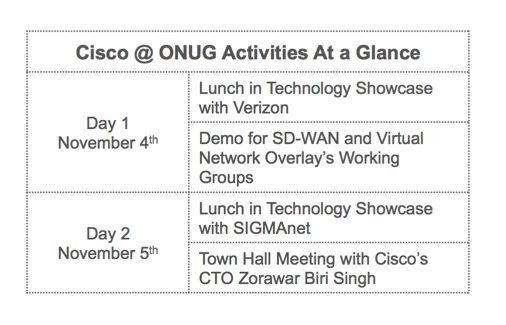
Next week (3rd-5th November) the Open Networking User Group (ONUG) meets at New York University in New York for its fall conference. For those of you not familiar with ONUG, it is a community of IT business leaders who exchange ideas and best practices for implementing Open Networking and Software-Defined Networking (SDN) designs.

Our enterprise customers continue to show significant interest in simplifying and automating their WAN network infrastructure and datacenter. Our ACI solution has reached over 1000 customers and we continue to see enhancements to Cisco Intelligent WAN (IWAN) with APIC-EM and the IWAN ApplicationContinue reading “SD-WAN and ACI Momentum at Open Networking User Group”

Authors

Kiran Ghodgaonkar

Senior Manager, Enterprise Marketing

Intent-based Networking Group

Avatar

“Did you say compostable infrastructure? That means using a biodegradable cardboard chassis that can go in the compost bin, right?”  🙂   This conversation is more common than you think right now as people are introduced to this for the first time.   So what exactly does composable infrastructure mean?  Perhaps the best description I’ve heard comes from James Leach who recently told me “our customers need us to wrap code around the server, not sheet metal.”   I think that concept gets at it pretty well, and no surprise since he’s one of the people behind our M-Series Modular Servers and Cisco System Link technology.  Still, it’s early days for this concept in the industry and many customers we talk to haven’t been exposed to the term.

We took some time recently to interview Jed Scaramella from IDC to help explain it all.  Here’s another segment in that series, this one focused on answering the question, “What is Composable Infrastructure?What Is CI Screen Capture

Composable infrastructure is is emerging out of two trends: disaggregated servers and software-defined infrastructure. Both are prerequisite capabilities: you need be able to take humpty dumpty apart AND put him together again. Disaggregation is where we unbind local shared storage and network I/O from the processor and memory.   Subsystems are no longer bound by the server chassis or the traditional motherboard. Then, with a unified control plane and API, these physical and logical resources are pooled and management software composes the resources on demand, so the system can be created to conform to the unique requirements of the workload. That’s the software-defined part.

Path to “Infrastructure as Code”

While many are just beginning to talk about composable infrastructure as a future strategy (“Houston, we have a vision…”) Cisco has been executing on disaggregated systems and software defined infrastructure since the introduction of UCS, through three key areas of innovation:

Continue reading “Composable Infrastructure, Part 3: “What is it??””

Authors

Todd Brannon

Product Management Senior Director, Cisco Compute

Avatar

Hello from EDUCAUSE 2015! I’m checking in from Indianapolis to share a little bit about what has been discussed so far. Yesterday, I heard an excellent general session from Daniel Pink, had the chance to attend multiple sessions on everything from the affordability of course materials to the personalization of the student experience, and spoke to multiple educators and IT professionals about trends they’re seeing in the education technology space.

One of the biggest things that everyone is talking about this year is online learning. EDUCAUSE named e-learning and online education one of its top 10 information technology (IT) issues, and multiple sessions discussed how to best approach the trend. One key takeaway is how e-learning will help engage a new type of student, but presenters stressed that online learning is much more than simply putting your regular course material online—it is a new way of reaching students. I also heard in one session that online education must be both scalable and well-sourced to be successful. It is this insight from technology companies and educational institutions that make EDUCAUSE such a great show!

Building off of the concept of online learning was the much-buzzed-about topic of mobile device management. Data shows that students are on their phones more than ever, and educators are trying to figure out how to best harness mobile devices for use in their classrooms and how to integrate them into the curriculum.

And the undercurrent to both of these ideas is something that we’re passionate about here at Cisco: security. When EDUCAUSE presented their top 10 IT issues for 2016, information security was number one on the list. And for good reason – while the benefits from connected classrooms and e-learning are huge, this interconnectedness also greatly increases the risk of security breaches. Hacks of information in the education world often start from phishing scams, and schools need holistic and agile solutions to help secure their networks and protect their data.

That’s just scratching the surface of what’s being talked about here at EDUCAUSE. Other sessions covered everything from women in higher education IT to envisioning the future of the CIO to how the CIO can collaborate with faculty and administrators to optimize education technology. The Cisco team and I are looking forward to another full day of learning here in Indiana, and will be sharing much more about our key takeaways in a wrap-up blog post after the event concludes. If you’re at EDUCAUSE this year, stop by booth #1302 to say hello to our Cisco team, and make sure to follow along on social media using #EDU2015 and #CiscoEDUCAUSE!

Authors

Renee Patton

No Longer at Cisco

Avatar

Service Providers Poised to Disrupt the VPN Market

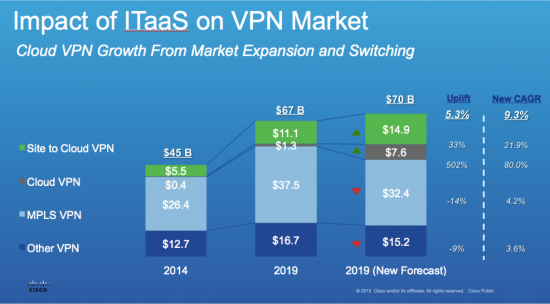
Clouds are rolling into our lives and our economy more and more each day giving us full control. My kids were streaming a movie to their iPad in the backseat of our minivan, as we drove from Atlanta to Disney World last week. Many of the resources I use daily in the office are actually in the cloud rather than a Cisco data center now. According to Cisco’s GCI (Global Cloud Index), by 2019, 55% (more than 2 billion users) of the consumer Internet population will use personal cloud storage up from 42% (1.1 billion users) in 2014. To facilitate this trend, standard bodies like ETSI have been hard at work defining the architecture for network function virtualization (NFV) that will enable service providers to seamlessly deliver communications and other IT services from their own clouds.

impact-of-itaas-on-vpn-market

Combining NFV with software-defined networking (SDN) should make service providers more agile. They can react to market and customer needs more quickly. That may mean rapidly releasing an updated service with new options, or it may mean designing, testing, and introducing a new service. The services based on Continue reading “Delivering Winning Customer Experiences with SDN and NFV”

Authors

Ben Bekele

Director Prouduct Management