
Businesses are setting ambitious net-zero targets while facing increasing demands for transparent, verifiable data on their Scope 3 greenhouse gas (GHG) emissions. For many, this is where the carbon footprint of purchased products, like Cisco hardware, can become a critical piece of the sustainability puzzle.
The challenge is getting data that is usable in real workflows: by product, by year, and at the scale required for procurement, reporting, and target tracking. To address this challenge, we evolved our product carbon footprint (PCF) data to not only estimate the GHG emissions of a product over its life cycle, but to incorporate the impact of growing electricity grid decarbonization over time.
Why static PCFs are evolving
Michael King, senior leader of carbon accounting and analytics at Cisco, recognized that a static carbon footprint number often misses the significant decarbonization efforts happening across the supply chain or the ongoing shift to cleaner energy grids.
“Companies ask for product carbon data they can use in their own accounting that’s aligned to their base year, reporting year, and net-zero timeline,” says King. So, he developed a robust methodology that goes beyond traditional static calculations to dynamically adjust PCFs, reflecting real-world decarbonization.
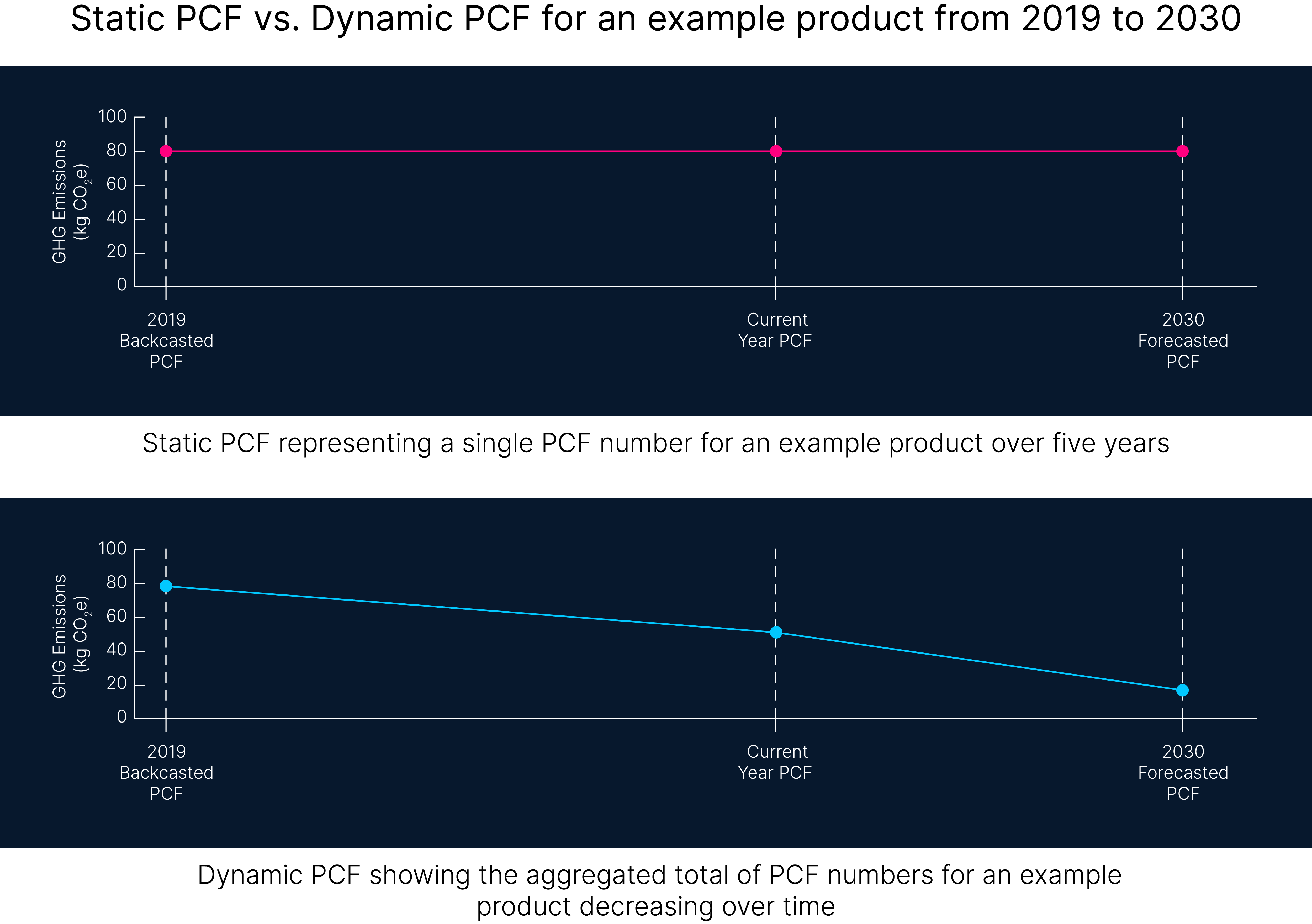
For example, a product purchased today will have a lower carbon footprint than the same product purchased five years ago, even if the physical product is identical, due to the cleaner electricity powering its production.
Here’s how Cisco is approaching dynamic PCFs:
- Identify hotspots: We start by pinpointing the components within Cisco products that contribute most significantly to GHG emissions. These “hotspots” can include printed circuit boards, integrated circuits, and the energy used in testing and assembly.
- Isolate electricity emissions: For these hotspots, we determine the portion of emissions directly attributable to electricity consumption during manufacturing (representing Scope 2 emissions of our suppliers).
- Adjust dynamically: We then leverage reputable global energy grid data and projections from organizations like the International Energy Agency (IEA). This allows us to:
- Backcast: Recalculate historical PCFs, showing how a product’s footprint would have looked in past years as grids were more carbon intensive.
- Forecast: Project future PCFs, illustrating the anticipated reductions as energy grids continue to decarbonize based on forecasted scenarios.
From disclosure to decision-making
Dynamic PCF data offers a powerful advantage. It allows companies to:
- Track progress: Measure the reduction in their Scope 3 emissions over time, directly linked to their procurement of Cisco products.
- Set realistic targets: Use projections to inform net-zero pathways and demonstrate tangible progress to stakeholders and regulators.
- Make informed decisions: Understand the benefits of upgrading to newer Cisco hardware, which often incorporates further design and manufacturing efficiencies.
Fraunhofer, a leading German research institute, has critically reviewed our static PCF methodology to facilitate alignment with international standards, like ISO 14067. We plan to have them review our dynamic PCF calculation as well, providing third-party validation that ensures the accuracy and reliability of our data.
Built to scale
We’re operationalizing this data so partners and customers can access it in the tools and workflows they’re already using.
- For partners: PCF data is available through Cisco’s price list API for eligible products. Reach out to your Partner Account Manager to learn more.
- For customers: Cisco’s Product Sustainability API provides direct access to PCF data, helping streamline reporting and meet specific decarbonization targets.
- For industry collaboration: Cisco is exploring partnerships with third-party data aggregators to improve consistency of Cisco verified PCF data across the ecosystem.

Power an Inclusive Future for All
Driven by our Purpose, we combine our technology, people, and broader networks to address society’s greatest challenges.
Learn more about our Purpose