
Enterprise applications no longer live in one cloud. Today, a single workload can span compute, data, and AI services across multiple cloud providers—while users across thousands of branches and campuses need to access applications wherever they run, and those applications need to communicate across clouds.
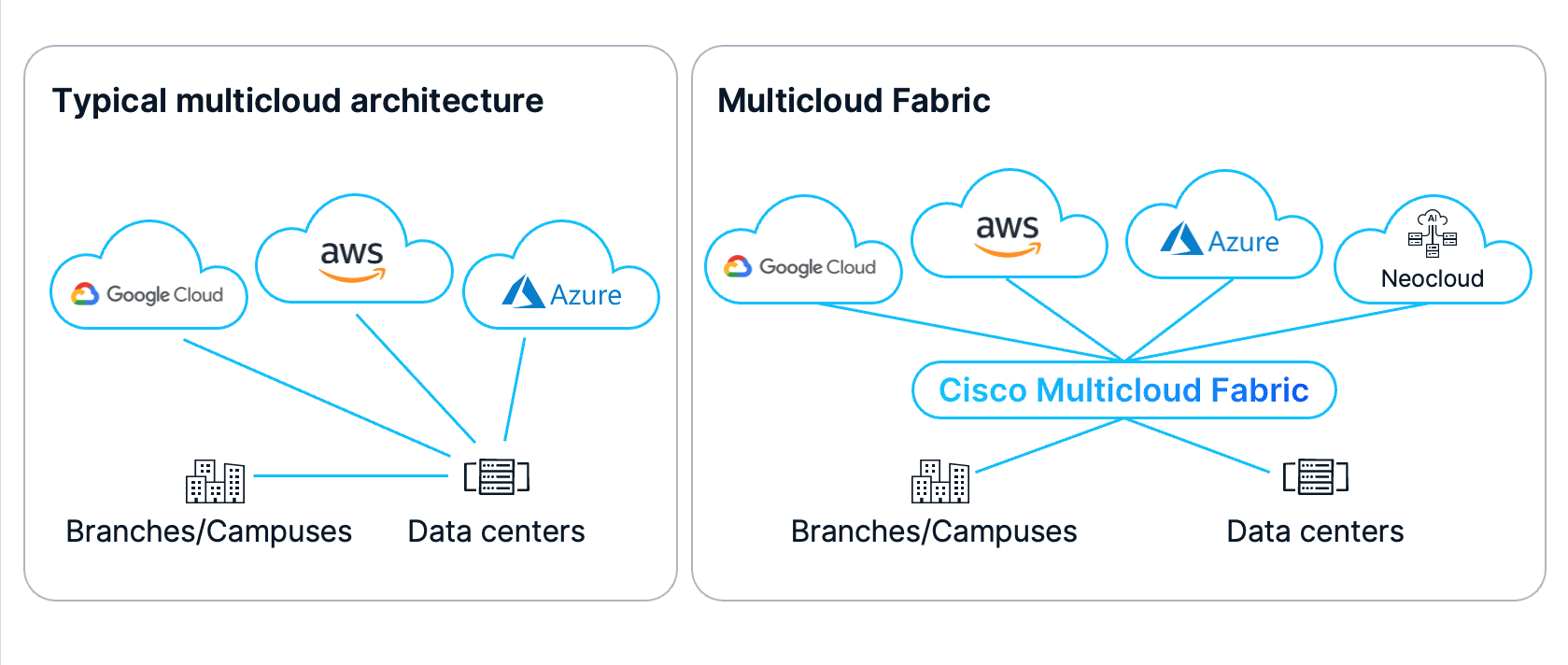
The underlying network has not kept pace. Traffic funnels through centralized hubs before reaching the cloud-hosted enterprise application. Each cloud runs its own networking stack with no common management layer. Stretched IT teams are left navigating fragmented operations across clouds; centralized cloud connectivity architectures can add latency, failure points, and scale limits; and bolted-on security can increase risk.
AI raises the bar further. According to the AI Impact on Wide Area Networks report from Cisco, agentic AI workflows generate approximately 450% more network traffic than the same tasks performed manually—with roughly 70% of that traffic being AI inference that chains across large language models (LLMs), SaaS platforms, and private data sources that could be hosted in different clouds. Each cloud boundary can create a visibility gap. These workflows are latency-sensitive, multi-step, and span providers by design—yet many enterprises lack a unified way to see, secure, or troubleshoot the entire path.
A simpler, more scalable approach
Today at Cisco Live 2026, we’re introducing Cisco Multicloud Fabric—a multicloud network-as-a-service offering available through Cisco Cloud Control. It delivers a single fabric for secure site-to-cloud and cloud-to-cloud networking that scales on demand and is operated by Cisco.
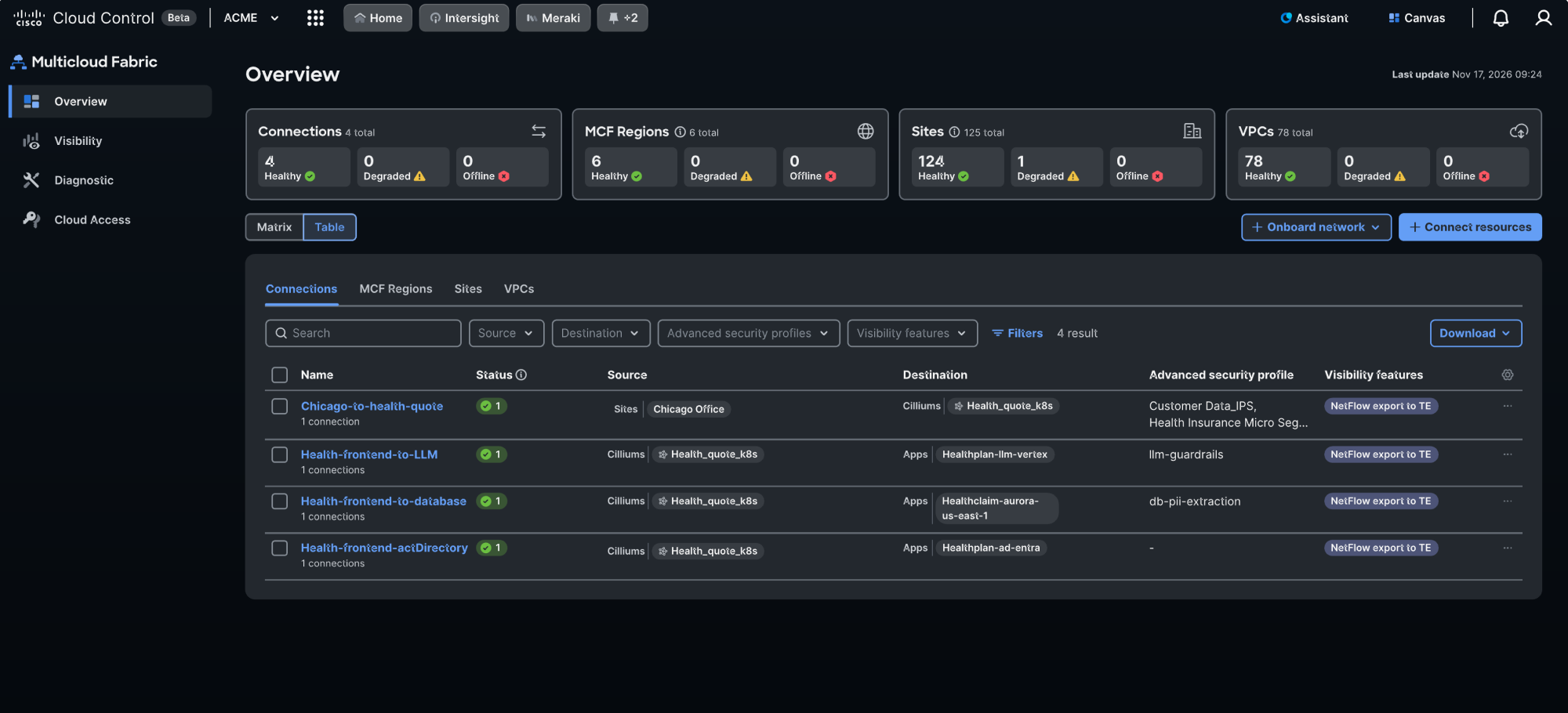
Three things set it apart:
One unified platform. Manage site-to-cloud and cloud-to-cloud connectivity from Cisco Cloud Control. Onboard sites and cloud environments, define intent-based connectivity, set security policies per connection, and monitor performance—all in one place.
An on-demand global fabric. Cisco deploys and operates virtual points of presence (vPoPs) across cloud providers and cloud regions. Whether it’s a new workload in an existing cloud or a site that needs to reach a new environment, connectivity is ready when you are.
Security and visibility built in. Zero Trust routing helps ensure nothing connects by default—every connection must be explicitly defined. Security policy follows the traffic, with cloud firewall service chaining enforceable per connection. Cisco ThousandEyes agents embedded in each vPoP provide detailed monitoring from branch to cloud as well as cloud to cloud.
Today, customers with Cisco SD-WAN deployments, starting with Cisco Meraki MX, can connect across Amazon Web Services (AWS), Microsoft Azure, and Google Cloud using Cisco Multicloud Fabric. Applications in brownfield cloud networking deployments can be migrated onto the fabric at your own pace.
“We are evolving our network architecture to better support hybrid and multicloud environments. Cisco Multicloud Fabric will enable us to establish consistent connectivity, centralized policy control, and improved end-to-end visibility across clouds and on-premises infrastructure. This helps reduce operational complexity while maintaining the performance and reliability required for our business.”
—Carsten Breuer, Pfeifer & Langen
Extending the AI-ready secure network
Cisco Multicloud Fabric extends our strategy for building networks that are simpler to operate, secure by design, and ready for AI.
It brings operational simplicity and AgenticOps capabilities to multicloud environments, with AI-driven insights that help teams detect, diagnose, and resolve issues across clouds with the same speed and confidence they have with campus and branch today. And because Multicloud Fabric is delivered as a service, Cisco deploys and operates the vPoPs across cloud environments—so teams do not have to. It provides capabilities to natively integrate security into the connectivity fabric.
As AI agents begin to operate across clouds, the network is no longer a passive transport layer—it becomes part of the intelligence stack. Cisco Multicloud Fabric is built for that reality.
“As a Cisco partner, we’re excited about the potential of Multicloud Fabric to solve real connectivity challenges our enterprise customers face. It will provide an easy way to control site-to-cloud and east-west traffic across multiple clouds and organizations, something our customers have struggled with for years.”
—Matthias Wülfert, Computacenter
Cisco Multicloud Fabric At a Glance
Additional resources
Cisco Multicloud Fabric solution page
Cisco Multicloud Fabric Solution Overview
See more Enterprise Networking news from Cisco Live Las Vegas 2026:
The Agentic Workplace Runs on Cisco by Anurag Dhingra
Trust at Machine Speed: Building Secure Campus Networks for the AI Era by Michael Dickman
Cisco Unveils Multicloud Fabric in Cloud Control: Network Ready for the AI Era by Rohit Agarwalla