

Organizations today face a critical challenge: VMware’s licensing changes and the upcoming end of ESXi 8 support in October 2027 are forcing a reassessment of hypervisor strategies and edge architectures. Remaining on aging ESXi environments risks escalating costs, increased support exposure, and operational disruptions. The pressing question has shifted from “if” to “where” to migrate edge workloads without adding cost or operational risk. At Cisco, we recognized these risks as critical barriers to digital resilience, the ability to keep organizations securely up and running amid any disruption. Our mission was to deliver a unified, resilient platform that simplifies migration and reduces risk for ourselves and our customers.
Crafting the One Cisco edge experience
To address these challenges, we leveraged our hardened KVM-based Network Function Virtualization Infrastructure Software (NFVIS) on UCS C-Series servers. NFVIS consolidates routing, security, observability, and collaboration workloads onto a single platform, enabling unified ownership and streamlined lifecycle management. This integration supports digital resilience by providing end-to-end visibility and faster issue detection across the entire digital footprint—on-premises, cloud, and edge.
Our approach also incorporates ThousandEyes for network observability and expanded collaboration workload support, including Unified Communications Manager, Meetings and Contact Center applications. NFVIS supports ESXi Open Virtual Appliance (OVA) images and offers APIs for lifecycle automation, easing migration complexity. Importantly, NFVIS includes compliance features such as FIPS 140-3, reinforcing security operations critical to maintaining uninterrupted service delivery and meeting stringent requirements.
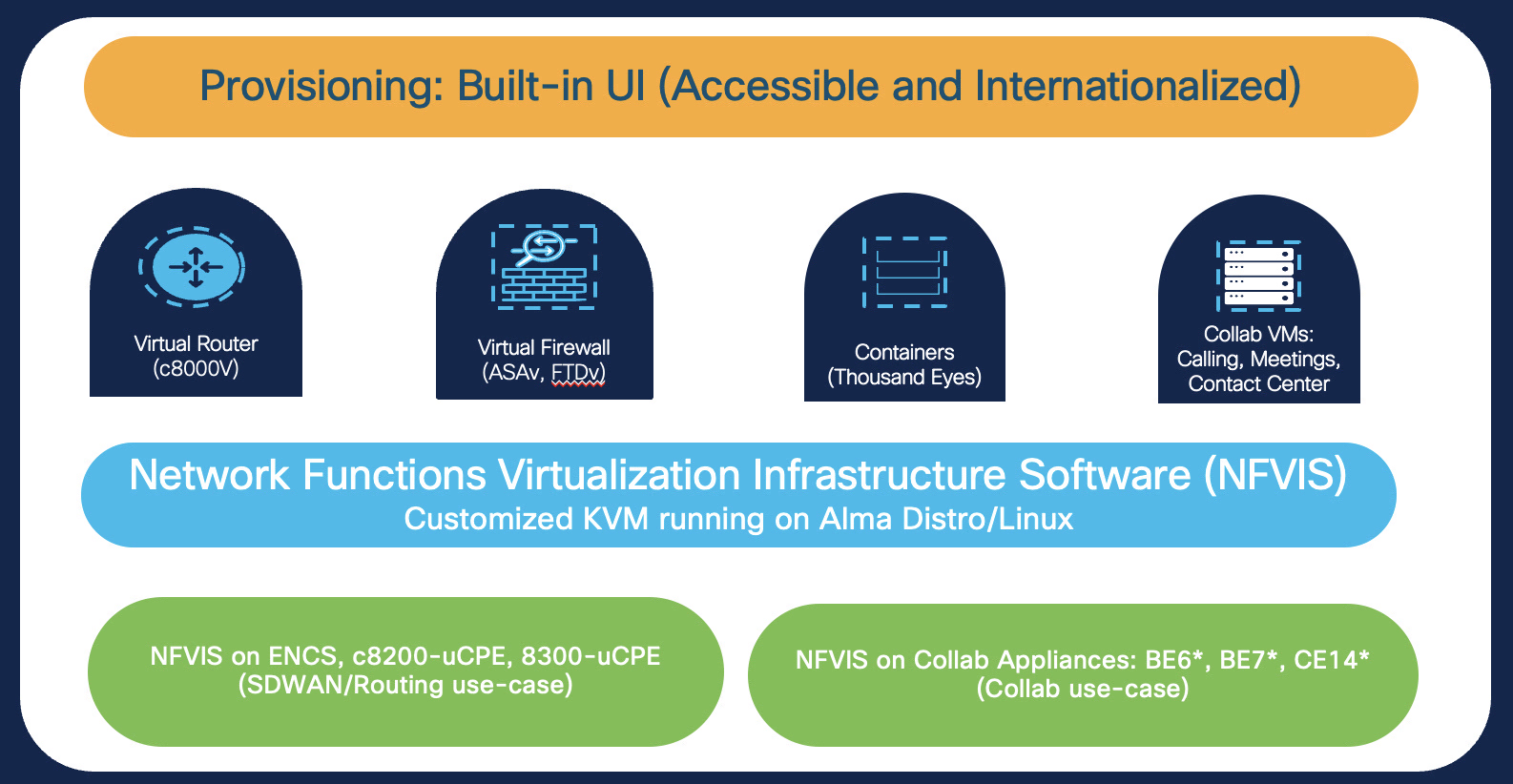
Together, these technologies form a cohesive platform that reduces operational risk, accelerates remediation, and enables organizations to adapt quickly to evolving business needs.
The proof is in the platform
Since NFVIS became generally available for collaboration workloads in March 2026, customers have begun migrating from ESXi, utilizing our approach as their blueprint. Early deployments demonstrated significant benefits: customers experienced fewer support handoffs, faster issue resolution, and lower migration risk. The unified Cisco support model proved especially valuable in addressing security issues across the stack, minimizing downtime and operational disruption. By consolidating workloads on NFVIS, organizations simplified their operating model, reducing fragmented support and lifecycle management overhead common in ESXi environments.
This streamlined approach translates into improved uptime, enhanced security posture, and a more resilient edge infrastructure—helping organizations prevent major incidents and remediate faster when disruptions occur.
The journey and what lies ahead
We began with proven NFVIS deployments in large retail routing environments. Over time, support expanded to ThousandEyes and collaboration workloads and key migration feature gaps were addressed. Our journey underscores the importance of unified visibility, integrated security, and automation in achieving digital resilience.
Collaboration across teams and technologies is essential to proactively detect and respond to disruptions before they impact business operations. Our experience shows that standardizing on a single, integrated platform not only lowers migration risk but also accelerates innovation and operational efficiency.
Looking forward, Cisco continues to expand NFVIS capabilities and ecosystem integrations, empowering customers to build resilient, future-proof edge environments. We invite organizations to learn from our experience and partner with us to navigate their digital resilience journeys, ensuring they remain securely up and running no matter what disruptions lie ahead.
Learn More:
- Install and Configure NFVIS-for-UC
- Supported Cisco Unified Collaboration VMs
- NFVIS ThousandEyes Support
- NFVIS FIPS-140-3 Support
- Learn More on how Cisco Professional Services can help
- Explore more ways Cisco uses its own technology: Visit Cisco on Cisco