

AI is changing what organizations need from the network. As teams adopt AI-enabled applications, automation, and edge workloads, the network becomes even more critical to business performance. These systems depend on reliable connectivity, predictable performance, and visibility across the environments where users, devices, and data meet.
Yet many IT leaders are flying blind into this new era. Are you truly prepared for the demands of AI, or is your current infrastructure hiding a critical failure point? Let’s look at how to bridge the visibility gap and turn your network into an AI-ready asset.
Understanding the reality of network growth
Most networks weren’t built with AI in mind. They grew through new locations, acquisitions, and years of practical decisions made to keep business moving. While Cisco and Cisco Meraki infrastructure power the core, the rest of the network—including branch sites, legacy locations, and specialized systems—often relies on a mix of vendors.
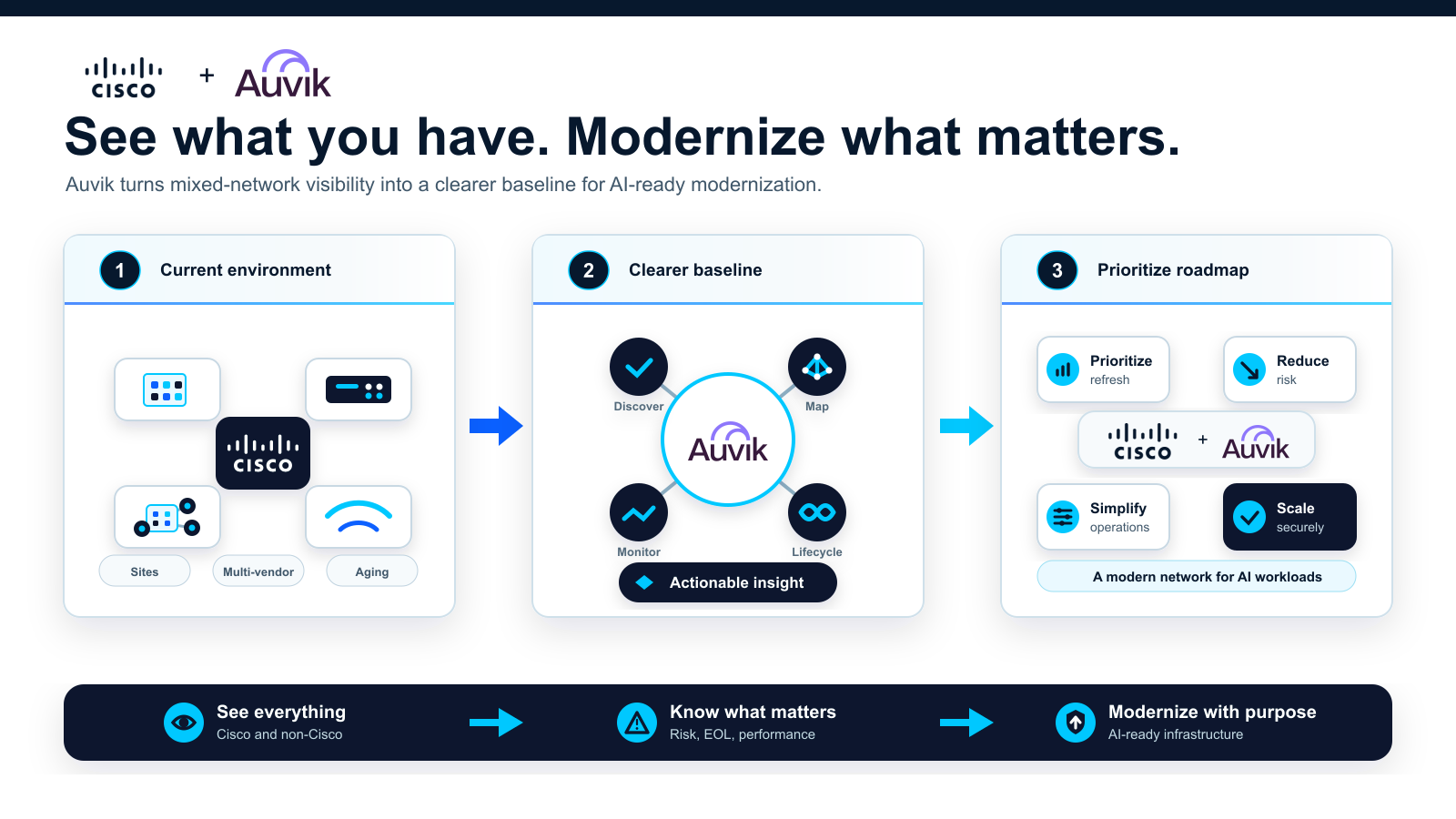
That fragmentation makes planning for AI-ready modernization difficult. Before teams can decide what to refresh, standardize, or optimize, they must first understand the network they already have. Without a clear baseline, teams struggle to identify constrained sites, aging devices, or undocumented dependencies that could slow down new workloads.
Establishing a clear operational baseline
Cisco and Auvik have collaborated to close this visibility gap. By combining Cisco’s robust networking foundation with Auvik’s automated discovery and mapping, IT teams gain a comprehensive view across Cisco, Meraki, and multi-vendor environments. Instead of relying on manual documentation, teams can now:
- Automatically discover and map devices: Build a real-time inventory across Cisco, Cisco Meraki, and multi-vendor environments, reducing blind spots as the network evolves.
- Monitor performance and traffic: Use alerts, traffic insights, device context, and user experience data to troubleshoot faster and identify issues earlier.
- Simplify configuration documentation: Maintain up-to-date device configurations, historical configuration snapshots, and the ability to export or compare configs with ease.
Prioritizing modernization with data
With a clear baseline, teams can accurately prioritize how to strategically prepare for AI-enabled operations. A branch supporting edge analytics requires different attention than a location with standard connectivity needs. A site with aging switches or recurring performance issues can be moved higher in the refresh plan, while mixed-vendor environments may need better documentation before teams can standardize more of the architecture on Cisco solutions.
The goal is not visibility for visibility’s sake, but the ability to prioritize modernization based on actual network conditions. Through Auvik’s API access to operational data, such as inventory, alert history, and historical statistics, teams can integrate network intelligence directly into broader Cisco Meraki and IT operations workflows.
Modernizing with purpose
Together, Cisco and Auvik help users modernize with purpose. Cisco provides the trusted networking foundation for secure, scalable connectivity, while Auvik adds the context teams need to understand what’s connected, what’s changing, and where to invest first.
For IT teams preparing for AI-ready infrastructure, the path starts with seeing the network clearly, reducing manual friction, and planning the next phase of growth based on reliable, evidence-based insights. By removing these operational barriers, teams can finally ensure their infrastructure is as agile as the AI applications it supports, turning network reliability into a clear competitive advantage.
To learn more, visit Auvik on the Cisco Networking App Marketplace.