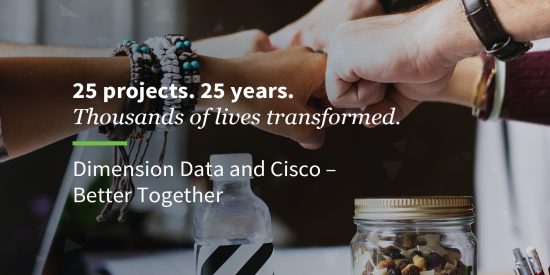
I’d be willing to bet the first thing that popped into many of your heads is to go somewhere new or exotic. You’d be able to experience something life-changing and reflect on the past 25 years – all while continuing to grow and learn about one another. For Cisco and Dimension Data’s anniversary, that’s exactly what we did.
Cisco and Dimension Data have reached 25 years of partnership, and we wanted to celebrate this milestone by doing something even bigger than either of our companies. We, too, wanted to go somewhere new and experience something life-changing, so we decided to do just that – 25 times. I’m not talking about an extended vacation. Our partnership evolved from business partners to partners in service and we set out to complete 25 service projects together, one for each year of our partnership. We served local communities across five continents and made an immediate and lasting impact. You can see all 25 of them in this new eBook.
The projects and communities were diverse and focused on education, healthcare, fighting hunger, homelessness, and much more. One of the projects I’m most passionate about took place in East Africa, where we were able to help educate girls in a remote village. Building Minds In South Sudan (BMISS) is headquartered in New York and has worked to support gender equality at a school they founded in the South Sudan. We jointly funded one of the BMISS founder’s travels to the region and provided them with essential school supplies and backpacks for girls in the same school that local community members spent two years making bricks to build.
One of the reasons Cisco and Dimension Data have such a strong, trusted partnership is because of the character of our people. These selfless projects reflect the passions and shared priorities of the individuals that make up our organizations. I feel honored to have been a part of this effort and I’m extremely proud to say that we positively impacted lives all over the world, and were left positively impacted by the powerful stories we heard and wonderful people we encountered.
This is one of my favorite times of year at Cisco because September is our Global Service Month, a timeframe to empower employees to pursue their passions for giving back. For Cisco employees, visit our Jive page to learn how you can create or lead a volunteer event, or become a virtual volunteer. For everyone else, I hope the 25th Anniversary eBook featuring our service projects with Dimension Data inspires you. If you have a story of what you or a colleague has done recently to make a difference, I’d love to hear about it in the comments or on Twitter (@MichChiantera).
Dimension Data, we really are “Better Together.” Thank you for 25 great years of partnership and cheers to 25 more!
Collaboration is changing the face of healthcare, enabling agile strategies like telemedicine, remote monitoring, care-team communication, and specialist engagement. When clinicians and patients can collaborate—seamlessly and securely—they can break through traditional barriers to care and innovation.
Cisco collaboration solutions foster a streamlined, adaptable healthcare environment, empowering care teams, researchers, and patients to work together safely—on any device, anytime, anywhere—from the patient’s bedside to the doctor’s home, from the administrative back office to the research laboratory.
Our open, agile portfolio includes integrated, easy-to-use solutions for messaging, meeting, calling, care-team communication, whiteboarding, and more, enabling healthcare organizations to:
Personalize patient experiences and improve health outcomes
Increase access to care and close gaps in reach
Streamline communications and optimize workflows
Improve knowledge sharing and innovate faster
Cisco delivers collaboration through the cloud, on site, or through a hybrid combination of the two, with always-on solutions that deliver high-quality interactions among patients and care teams, scalability across facilities and branches, and end-to-end security—from the network to the edge.
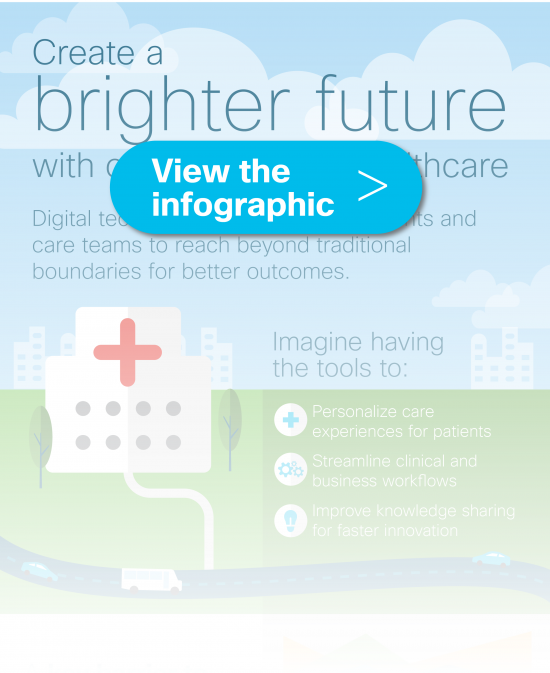
Learn more about how Cisco Collaboration can help your teams work better together and create a brighter future for healthcare. See the infographic below.
Talos is disclosing the presences of remote code execution vulnerabilities in the processing of Yet Another Markup Language (YAML) content in Ansible Vault and Tablib. Attackers can exploit these vulnerabilities through supplying malicious YAML content to execute arbitrary commands on vulnerable systems.
YAML is a data serialisation markup format which is designed to be readable for humans yet easily parsed by machines. Many tools and libraries have been developed to parse YAML data. The Python YAML parsing library PyYAML provides two API calls to parse YAML data: yaml.load and yaml.safe_load. The former API does not correctly sanitise YAML input which allows attackers to embed Python code to be executed within YAML content.
Have you been powerfully, positively impacted by where you work? I have! Cisco cares about their employees in many ways, but one way that they truly show this is through an initiative called Moments that Matter.
The Moments that Matter are the critical touch points between the employee and the company that leave an imprint – like your experience on your first day, making a difference within the company, and even as you transition out of the company.
Throughout our lives, we all have moments that matter, and I’ve walked many of mine with Cisco by my side.
From marriage and our first baby to professional transitions and sickness, these are the moments that mattered to me and my family:
Getting Married
In 2011, my (now) wife and I were just dating, and we were based in two different locations. I’m from Mexico, and had just finalized my MBA in the US. She was based in Arizona, but a project she was involved with was taking her to rural Cambodia, where she is originally from. That’s when I was offered a position with Cisco at their headquarters in San Jose, CA. At this point, a job offer at pretty much any other company would have been an almost insurmountable obstacle for our relationship because of the distance.
Cisco’s flexibility played a major role in this early stage of our relationship.
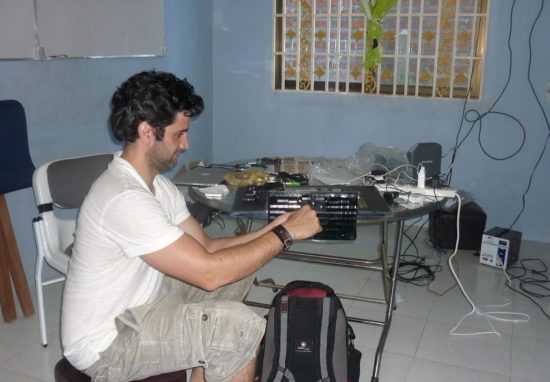
When I explained the situation to my manager, her response was simple. She just wanted me to get my work done – WHERE that work happened was a detail. Now, many companies offer the possibility of remote work, but Cisco takes it to the next level, and thanks to Cisco’s technology, I was able to work from different cities in Mexico, the US, Europe, and even in rural Cambodia.
Did that require me to join meetings from Cambodia at midnight, with spotty internet access, a Vietnamese cell phone provider for voice – and a Tokay lizard singing in the background (obviously, I muted my line) – Yes. 😀 But was it all worth it? Absolutely.
Cisco’s flexibility gave me the opportunity to do my best work while pursuing the love of my life, and a few years later, we got married in a traditional Cambodian ceremony in Seattle.
Without Cisco’s flexibility and technology this moment that mattered may not have been possible.
And Baby Makes Three
During one of our trips to Mexico, while my wife was pregnant with our first baby, we were told that it would be better for us to stay in Mexico for the remainder of her pregnancy – and ultimately for a much longer period than anticipated.
I called my new manager and our HR team to tell them the news – and true to the Cisco way of life, everyone I spoke with only had support to offer. We were blessed with our first son, and we were delighted to receive a gift from Cisco which included a baby bag, a couple of great books on babies, and access to a breastfeeding specialist that was very helpful – another moment that mattered!
Not only was their understanding a gift to us, but Cisco relocated us to Mexico as requested, in a transparent process that allowed us to focus on what mattered: our new baby.
The fact that Cisco is there for its employees, no matter the milestone – or hurdles that milestone may present – says something special about this company.
Having a Career, Not Just a Job
I would’ve understood if I had to sacrifice some personal development in in exchange for the flexibility and support I had received from Cisco. Instead, during these times I was promoted and offered a new position! At Cisco, I mattered.
In my new role, I was responsible for co-designing a new program that would help develop Cisco’s Top 2% of their global talent. This, by itself, was a phenomenal opportunity that allowed me to work with some of the world’s foremost experts on topics such as emotional intelligence, happiness, hidden bias and crucial aspects of business strategy.
From this position, I was able to lead a team to create Startup//Cisco, an initiative to help support internal innovation following a startup ethos and best practices. The interesting thing is that creating this initiative was not part of my role – yet the freedom to do the right thing for the company was a crucial component in allowing me to pursue this achievement.
The initiative has now been adopted as a corporate-wide offering to help employees accelerate innovation. Instead of being limited to pursue something outside of my role, I was supported. This led to so many other opportunities in my career, and is yet another example of what I love about Cisco’s culture.
In Sickness and in Health
Recently, Cisco offered me a new position in Europe. Along with the offer came an exploratory trip for my family, which now included a 3 year-old and an 11-month old. During our stop in London, where I needed to facilitate a Cisco course, my wife and infant child got extremely ill. Not knowing how to navigate the British healthcare system, we walked to a nearby public hospital at 4am hoping for the best.
In this moment of difficulty, Cisco was there for us again – with benefits and support that came to our aid. The International SOS connected us to the right doctors, made the appointments, and coordinated with the insurance company to cover us during this business trip. We received great attention and care because of this, and that allowed my wife and son to recover a week later. It was a very difficult experience – but having Cisco’s support through this trying time made all the difference.
To be in another country, and not knowing your way – there is nothing quite like having Cisco there to help you through it all.
Five years and dozens of cities later, from the very beginning when my wife and I were dating, to experiencing the incredible moments we have today with our two boys, Cisco has truly been a part of the Moments that Matter to us – and for that we are deeply grateful.
Are you looking for a company that supports you in the Moments that Matter? We’re hiring!
Cloud security is the kind of topic that can make you sigh, shake your head, and quickly look for some other, less daunting project to deal with—no doubt about it. I mean honestly—what do you even define as “cloud” in your particular environment, and what constitutes “secure”? Is your only job to worry about your on-premises private cloud? Do you have to worry about the public cloud too? The entire Internet? The answers to these questions—even within the same company—will vary wildly. And that makes it difficult to even get started.
But what if there was a quick, simple, and relatively inexpensive step you could take that would reduce your vulnerability instantly? One that would predict attacks before they happen and prevent employees from accessing malicious domains. Would you be interested? If the answer is “You betcha!” then be sure to tune in to this week’s Cloud Unfiltered. In Episode 18, Cisco’s Chris Riviere will talk about a different take on cloud security. Specifically, he’ll explain:
What Cisco Umbrella is and why it’s different from other security solutions
What type of companies are using Umbrella
Some of the security breaches he has personally uncovered using Umbrella
The growth of cryptocurrency and the different ways it’s being used (no, this has nothing to do with security—it’s just something else Chris is into)
How to get started with cryptocurrency
See the video podcast on our YouTube page, or listen to the audio version on iTunes. And if you like what you hear, we invite you to subscribe to our channel so you don’t miss any of the other exciting podcasts we have scheduled over the next several months.
September sees two significant events in the Service Provider world – the launch of the new iPhone, and the annual IBC gathering in Amsterdam. It was only a few years ago that these events wouldn’t really have been linked, yet now the mobile and video industries are closer than ever, with the lines between the two becoming increasingly blurred.
We’ve witnessed the spread of Binge viewing services into mobile, with consumers being offered all you can eat connectivity and bundled content, mirroring what happened in the fixed world only few years ago. In India the launch of the Jio phone has the potential to bring high quality video to tens of millions, completely by-passing fixed line connectivity. Content providers are starting to create mobile first, and mobile specific content, and the IOC recently announced their first Olympic mobile broadcaster.
Visual Networking Index (VNI) research is predicting a 9 fold increase in mobile video traffic in the next 5 years And, of course, this growth will be biased towards audiences who expect to consume the content they want how and when they want it.
Commonly referred to as Millennials, we classify these consumers as rapidly transitioning audiences, who are moving through their life stages quickly, and want services to match these transitions. They will likely leave their childhood home, may live in shared accommodation and then ultimately become the bill payer themselves. Their viewing habits and needs will change with these transitions, and so mobile services are perfect for these consumers. For the Service Provider there is an opportunity to build market share and loyalty, with the potential to provide primary screen services as well.
So what needs to happen to create these successful services? What is the critical path for the Service Provider looking to be the single vendor of mobile connection and content?
We’ve identified three key areas that the Service Provider needs to focus on to create and maintain successful bundled products:
Service creation needs to be able to leverage the network, and the network needs to be aware of the Service. The network can no longer just be a dumb pipe, it needs to be smart, and to be able to understand the context of the content flowing across it, and to automatically configure itself for maximum efficiency.
Service delivery needs to be able to take advantage of the intuitive network. There needs to be data and analytics gathering across all parts of the delivery chain, which can be used by the Service Provider to generate insight into the customer experience, and continually improve it.
Quality of Experience (QoE) needs to be predicted, not just measured. By understanding the bandwidth required to deliver an appropriate QoE the network can pro-actively self-configure to make sure that the consumer is getting the best possible service without interruption, keeping the consumer happy and reducing the likelihood of churn.
With this network infrastructure in place the Mobile Operator is able to start delivering their services at high quality and at scale. And they will be able to start doing it today, so that as 5G begins to roll-out their brand is already synonymous with the best bundles and services already on the market.
Cisco is uniquely placed to provide this capability, with our experience in fixed and mobile networks, and our knowledge and skills in delivering high quality live and on-demand video for some of the world’s leading Pay-TV operators
It’s the last holiday weekend of the summer as I write this, on a perfect afternoon, filled with no prior engagements, or camp pickups/drop-offs. Excellent conditions for blogging.
As I consider how to characterize the “state of the state,” as it relates to the technology partner “ecosystem” of the broadcast/media segment, I keep going back to something I heard Michael Phelps, former Olympic Gold Medalist, say at Cisco’s annual gathering of global sales staffers.
He was talking about what it takes to be at the front of the pack. The word he used was “deposits.” All the hours in the pool and the weight room, seven days a week, for five years — all deposits toward that time when he needed to make the really big withdrawal. In his case, the Olympic Games, and his 28 medals.
Here on the brink of the 2017 IBC show, the technology trend that is the progression of broadcast/media creators along the continuum to all-IP (Internet Protocol) operation is well past the “incubation” stage, and somewhere between a walk and a jog.
Which is saying something, because it wasn’t all that long ago that a common refrain was more “it’s not a matter of ‘if,’ but of ‘when.’” Well. You know you’re beyond the “if” of something happening, and deep into “when,” when you look back at your to-do list for the last year and count up numerous new software partners, and several dozen very active projects, in the pipeline. It’s the work of building out channel partnerships, and collaboratively extending the reach of what’s possible with IP. You can even hear it in our partners words here:
Here’s a few actual use case examples:
The age of the “media factory” is upon us. More and more content networks are up to their elbows in “media factory” details, to centralize the voluminous amount of content coming in, and going out. The work of it — the deposits — involves spinning up curation functions that are highly orchestrated and automated. In real-time, With an end goal of getting it out quickly and easily — to an OTT app, web stream, or (pick your flavor of) IP-based methods.
The early results are provocative enough to attract high profile, high commitment deployments. There comes a place in every major technology transition when the benefits start to stack up faster and higher than the alternative, even if it’s the old tried-and-true. As broadcast and media companies progress along the continuum to IP, some are appreciating the early fruits enough to go big. Like the BBC Wales, which is enthusiastically public about its intent to be the world’s first completely IP facility — no SDI, no hybrid. It’s hugely gratifying to be part of that endeavor — which took an ecosystem approach to execute, by the way, and thanks again, Grass Valley!
New requirements are highly focused on “business as usual” necessities, like training programs and overall “operationalizing.” Not that any customer ever begged for another PowerPoint presentation (understatement), but, today’s requests are about things that matter to the day-to-day. That’s why we’re introducing a Cisco Learning series, with a curriculum co-developed with our broadcast-side partners. It’s specifically focused on the 100,000+ broadcast engineers seeking more specialized, IP-centric experience. (Fact: Estimates range, but the average IP engineer earns as much as 30% more than the average broadcast engineer. Training matters. Ours come with actual teachers and classrooms!)
And that’s before we even get to the new partners we’re bringing into our Media Blueprint — starting with our excellent colleagues over at EVS, longtime partners in the Sports & Connected Venue space. We’re rapidly expanding our relationship with EVS by way of media and entertainment projects, and as evidenced by our collaborative execution of this year’s Cisco Live event. The work of it was providing all of the IP-based broadcasting, in and out of the event, to around 25,000 attendees.
And I’d be remiss if I didn’t shine some light on Snell Advanced Media (S-A-M), Cloudian, Nevion and all in our growing roster of systems integration partners — and, yes, I’m talking about you, Videlio, WWT, and Diversified Systems. Thanks to all of you for placing “deposits” with Cisco, to partner up and advance this crazy transition.
The work of getting to this point is the work all of us do, in one form or another: Stay on it. Figure out which partners to recruit, how to align the businesses and stakeholders, how to get support internally — for marketing, for enablement, for funding. (And that’s just on my “Cisco side.”) With partners, it’s the work of building a comprehensive business strategy, both technically and commercially. Listening to their goals. Bringing our deep roots in IP to a market segment perfectly poised to put it to work.
It’s not necessarily a sprint to the finish line to pick up a gold medal, but it’s the same idea — we, and our partners, and all of us traipsing around IBC this week, we’ve spent the last year making deposits. We’re all investing in those moments when it’s time to pour it on; to win. Like now, for instance. Here’s to a vibrant partner ecosystem!
My last experience of Amsterdam came when I was 21. Spending six months “finding myself” in Europe, I stepped off a train in this beautiful city, and “found myself” staying a couple of weeks. The city then – as now – was welcoming. My passes through youth hostels and strangers’ homes introduced me to a city of tilting gabled buildings, quiet canals, the art of the Old Masters, and tiny cafes. The people welcomed me with open arms, and they escorted me through jenever (Dutch gin) tasting houses, fields of tulips, and cozy boat rides along streets both beautiful and some notorious. Here, years later, I am very much looking forward to returning to the wonderful memories of my youth while attending the 2017 European Utility Week, October 3rd – 5th.
Nothing demonstrates the need for utilities to digitize more than the hurricanes hitting the United States over past few weeks. With 6 million households currently without power, a digital grid will point utilities to the source of the outage more quickly and efficiently, and rerouting protocols will help get those customers back online in a much shorter time than in the past.
Also in the news last week, a hacker group calling itself Dragonfly 2.0 apparently gained direct access to the US and European power grid controls (Hackers gain direct access to US power grid controls. Wired. 2017, September). In several instances, the hackers reached deep enough into US and Turkish systems to post actual control panel screenshots of their victims. These attacks seem to be probing events, looking for weaknesses to possibly exploit at a later time, but this, too, demonstrates a critical need for utilities to modernize and lock down their systems with the latest secure encryption technology.
This is what European Utility Week is all about.
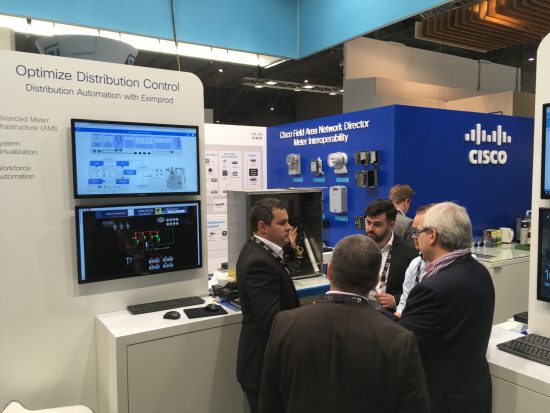
At European Utility Week, you will find innovative ideas on how to connect, optimize, and secure global energy systems. You will see the latest developments in grid optimization, renewables, energy storage, smart metering, smart cities, smart homes, energy services & efficiency, energy trading, intelligent buildings, data management, analytics, IoT, cybersecurity, and smart gas and water systems. And at the center of all of this will be Cisco.
Cisco will demonstrate how our digitization solutions empower utilities to thrive today, to monetize the grid, and to ensure agility for tomorrow. You will see how to reduce risk, improving the network with the latest IoT security, and doing so while increasing safety, operational excellence, and compliance. You will also learn how Cisco can enable smart meters, and connect your assets, fleets, and consumers to add value through new services.
We’ve got a couple of new introductions for you to see, too. Come visit us at booth 1H11 and take a look at our new 807 Industrial Integrated Services Router. This small footprint cellular router has powerful capabilities and a very low power draw, allowing you to put 3G/4G LTE where it’s needed. It’s perfect for field device enablement.
Also at our booth, we’ll be demonstrating some new features for our popular 829 Industrial Integrated Services Router. I talked about this powerful piece of equipment in my augmented reality blog post a few months ago (Augmented Reality: A New Reality for Utilities). We’ve expanded the cellular capability of this unit to include dual SIM “active-active” radios. What does this mean? It means you can enable the router to connect to two separate cellular carrier services. Why is this important? Modern utilities often span widely disparate geographies, with random coverage offerings from cellular networks. With dual SIM “active-active” radios, a repair truck can traverse two different carrier coverage areas and still maintain connectivity. It’s all about reliability and efficiency, and Cisco offers that and so much more.
There’s much to see and do in Amsterdam next month. I hope to see you there!
When you begin remodeling an older home you realize that some walls are there for good reasons. Others block our modern, open-floor-plan lifestyles and can come down. Years ago, factories and utilities separated their Information Technology (IT) and Operations Technology (OT) teams. The thinking was that such walls helped ensure reliability and uptime so that critical systems stay running. The Internet of Things (IoT) is challenging this old model and causing a shift in how OT and IT work.
Gartner estimates that there will be 20 billion connected things by 2020 in all economic sectors including healthcare, manufacturing, and utilities. And the promise of the IoT is a wealth of benefits. Our research shows that these industries stand to gain trillions of dollars in digital value, be it from increasing uptime, productivity, and global competitive advantage, to the efficient and confident delivery of power everywhere it is needed. Connectedness makes this possible. Yet it also brings a whole new generation of risks.
Industroyer uses industrial communication protocols that were designed years ago when industrial systems were walled off from other systems. The malware communicates using a language the systems understand and can control electricity substation switches and circuit breakers directly, disrupting power, creating other failures, and even destroying infrastructure.
In addition to serving as stepping stones into corporate networks, IoT devices are being hijacked for use in IoT botnets. Over the last year IoT botnets have infected hundreds of thousands of devices, turning them into armies capable of launching powerful, coordinated attacks against major corporations and Internet infrastructure that other enterprises rely on. One of the most destructive is BrickerBot, which not only compromises devices but can damage them so severely that the hardware must be reinstalled or replaced. You can read the Cisco 2017 Midyear Cybersecurity Reportfor more details on these types of attacks and how they work.
Our researchers have been monitoring for years how mobility, cloud computing, and other technology advancements are redefining the security perimeter that you’re charged with defending. As IoT devices proliferate, adversaries will have ample opportunity to exploit vulnerabilities and security gaps for maximum impact. So what can you do to more quickly detect and stop malicious activity at the endpoint, including IoT devices, and even detect ‘infrastructure harvesting’ – where adversaries use infrastructures as a launching pad for attacks?
As walls come down that expose organizations to threats, other walls must come down to strengthen defenses. I’m talking about the traditional wall between IT and OT. But that’s only possible with a proven solution that extends security from the corporate network to the industrial control network and the IoT devices they connect to, while respecting and upholding performance requirements for both.
Cisco’s new IoT Threat Defense solution is a portfolio of products and services to detect and defeat IoT threats. It starts with awareness of every endpoint on your network, including IT and OT devices, through Cisco Identity Services Engine (ISE). Cisco ISE also facilitates authoring and provisioning software-defined segmentation (such as Cisco TrustSec) policy for both IT and OT networks. With this visibility, when an authorized endpoint connects to the Internet directly, Cisco Umbrella and Umbrella Roaming deliver a first line of defense against infections by blocking connections to bad IP addresses, URLs and domains. Cisco Umbrella protects any and all devices using any ports and can be easily activated in AnyConnect to provide seamless protection from malware, phishing, and command-and-control callbacks.
Complementing Cisco Umbrella, Cisco AMP for Endpoints provides protection on the endpoint itself. If a user clicks on a site that has been recently infected with malware or attempts to download a malicious file, Cisco AMP for Endpoints stops these types of known and unknown attacks. Even if user devices don’t have an AMP for Endpoint agent, AMP can tell you if the system is compromised. You can see how AMP for Endpoints works by downloading this cool, new, instant demo. Instead of just watching a video demo, you can interact with the console. An audio tour guides you as AMP for Endpoints uses various methods to prevent breaches and continuously monitors all file behavior to uncover and contain stealthy threats that evade defenses and get inside.
Cisco Cognitive Threat Analytics extends threat detection and protection to devices where AMP for Endpoints can’t be installed, like IoT-type devices and personal devices. It blocks attempts to establish a presence in your environment and pinpoints unusual traffic before data can be exfiltrated.
Our IoT Threat Defense solution builds on our Cisco Firepower next-generation firewall which includes endpoint security capabilities to prevent an attack in the first place. But if a threat gets through, it uses segmentation, network visibility and continuous analysis, and expert guidance to respond to incidents.
No organization wants to leave value on the table. As walls come down, the potential for upside is huge in the digital age. Cisco is here to help with the most comprehensive cybersecurity solution set for the IoT – one that balances the right walls with the right level of interconnectedness and helps deliver on the true promise of the IoT.