Avatar

Big issues call for big solutions. Declining community health, poor economic sustainability, and insufficient access to education are just a few of societal challenges we face. But when governments, companies, and nonprofits collaborate strategically, their powerful public-private partnerships (PPPs) can help to overcome them.

Working to leverage the best, locally relevant solutions–while also developing scalable policies and programs–successful PPPs are uniquely positioned to have large-scale impacts on our world. And later this week, you can be an integral part of driving these impacts!

Join us as we discuss these topics and share insights and strategies for success in our upcoming #CiscoChat, Thursday, September 21st, at 10 a.m. PST.

The chat will be led by the Cisco Corporate Social Responsibility Twitter account (@CiscoCSR), and we’ll be joined by four industry experts:

  • Cisco Vice President of Corporate Affairs Laura Quintana (@CiscoNetAcad)
  • Mastercard Director of International Development Sasha Kapadia (@SashaKapadia)
  • Camden Dream Center Executive Board Member Keith Davis (@CamdenCDC)
  • World Bank Senior Infrastructure Specialist Jane Jamieson (@janejamieson05)

By participating in the chat, you’ll learn how businesses can develop and drive productive PPPs with the right combination of people power and transformative technology.

To participate in the chat:

  • Make sure you’re logged into your Twitter account.
  • Search for the #CiscoChat hashtag and click on the “Latest” tab (or follow this link).
  • Follow the moderator’s account to participate.The Twitter chat will be moderated by the Cisco CSR Twitter account administrator (@CiscoCSR), who will begin welcoming guests at 10 a.m. PST (1 p.m. EST) and posting questions for discussion.
  • If you need multiple tweets to answer a question, preface each tweet with “1A,” “2A,” etc. in order to make it easier for others to follow along with the conversation.
  • Be sure to use the #CiscoChat hashtag at the end of each tweet, so that others can find your contributions to the discussion.

Don’t forget to bring your own questions to the #CiscoChat. We look forward to talking with you!


Authors

Austin Belisle

No Longer with Cisco

Avatar

The promise of virtual reality has been a staple of science fiction – think The Matrix or the holodeck from Star Trek – an exciting yet elusive vision. While we are nowhere near having a holodeck in our homes, VR has the potential to be big. Right now, most applications focus on gaming, but that’s just a starting point. I see a possibility where VR could become a professional tool with practical applications for engineering, the travel industry, sports, education, and collaboration.

Cisco Spark is built around the concept of virtual spaces, where all your work lives, like messaging, files, whiteboards, etc.

Here at Cisco, we started thinking about the possibilities for VR in the business world – and ways to integrate that with our best-in-class collaboration technology. People are using VR for rich, fully immersive, gaming experiences. And naturally, as avid gamers themselves, our Cisco Emerge team started thinking about the practical applications of VR, specifically in meetings using the Cisco Spark platform.

Cisco Spark is built around the concept of virtual spaces, where all your work lives, like messaging, files, whiteboards, etc. It is designed to allow people to work and meet together, effectively, no matter where they are. And VR headsets let you go virtually into new worlds, rooms, and spaces. You have new ways for people to connect, even though they are thousands of miles apart. Bringing these two together has the potential to create an amazing work experience.

Which is why I am excited to introduce Cisco Spark in VR, a new experiment with the potential to improve team collaboration. It is available for download today from the Oculus Store.

Cisco Spark in VR is another way to access Cisco Spark content, just like the apps we have for the web, Windows, Mac, iOS, and Android. It runs on the Cisco Spark platform, using the same APIs, and is tightly integrated with the Cisco Spark application. All your files, whiteboards, and conversations are available in virtual reality.

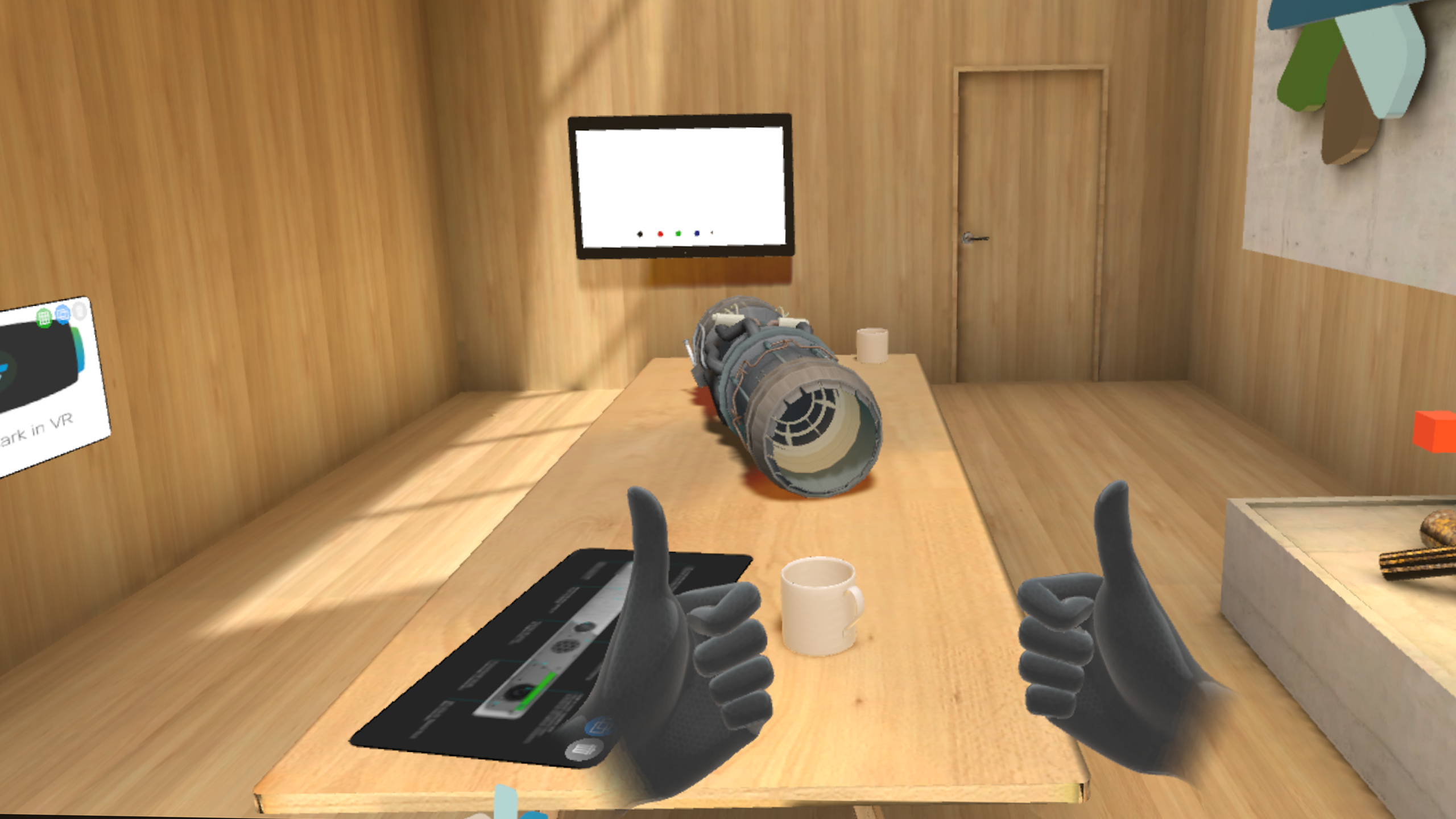
The Cisco Spark in VR experience has the added dimension of being able to interact, in 3D, with your files. You can grab, open, share, and present files – using just your hands. Using VR enhances the current (two-dimensional) collaboration environment, like being able to interact with a 3D model of a car engine, or stepping into an architectural design and see the building before any concrete is poured. This is just a start. I believe there are even more use cases for virtual reality in a work environment.

Cisco Spark is a great tool for real-time collaboration – and when you can design, draw and create together in virtual reality, it makes the experience better. The white-boarding capabilities with Cisco Spark in VR allow teams to create content together by drawing on the same virtual Cisco Spark Board… in virtual reality. But we’ve also built it so that you access the virtual board on your physical Spark Board or mobile device – with everything synchronized – collaborating in real time, both virtually and physically.

Cisco Spark in VR is a concept launch, an experiment. Our testing with early VR adopters led to some interesting results, not least of which was that users enjoyed the experience. We are continuing to work with this group to identify previously unexplored collaboration experiences with VR.

We know our customers and partners have great ideas and that’s why we want to work with you.

Download Cisco Spark in VR, and tell us what new collaboration experiences you discover.


Authors

Jens Meggers

No Longer with Cisco

Avatar

Combating hackers is tough. They’re always out there, searching for new ways to attack. But for effective network security, Telecom service providers can learn something from nature. And look at the way that bees protect their hive from bears. Here is the story

SECURITY BEFORE, DURING AND AFTER AN ATTACK

The queen bee is very important. To protect her, the worker bees use a sophisticated defence system.

It starts before an attack happens. As the bees buzz around the hive making the honey for the queen, they’re also keeping an eye out for threats. They spot something heading their way… a bear. The bear walks up to the hive, pawing at it to get at the honey. He’s trying to knock it from the tree.

But the worker bees swarm him to distract him.  And finally, they drive him away. Their queen is safe.

Now it’s time to assess the damage.

And begin repairing the hive. To strengthen it against a future attack.

HOW CISCO TECHNOLOGY CAN HELP

Your business is much like a bee hive.

It’s full of precious contents that bears – or hackers – want. To make sure they can’t get it, Cisco follows the holistic approach of the bees. We help service providers monitor the environment for threats. Fight back strongly when they’re under attack. And recover effectively afterwards.

MANAGING EVER-PRESENT SECURITY THREATS

Bees can’t get rid of bears, but they can manage them. And while hackers will always be out there, we can help you stay one step ahead of them. We combine best of breed solutions into an integrated architecture. That protects networks before, during, and after an attack. And creates a solid platform for success.

Together, let’s secure your future business growth. Learn more now.

Authors

Yves Padrines

Vice President, EMEAR Sales

Global Service Provider

Avatar

This post was authored by: Edmund Brumaghin, Ross Gibb, Warren Mercer, Matthew Molyett, and Craig Williams

Introduction

Supply chain attacks are a very effective way to distribute malicious software into target organizations. This is because with supply chain attacks, the attackers are relying on the trust relationship between a manufacturer or supplier and a customer. This trust relationship is then abused to attack organizations and individuals and may be performed for a number of different reasons. The Nyetya worm that was released into the wild earlier in 2017 showed just how potent these types of attacks can be. Frequently, as with Nyetya, the initial infection vector can remain elusive for quite some time. Luckily with tools like AMP the additional visibility can usually help direct attention to the initial vector.

Talos recently observed a case where the download servers used by software vendor to distribute a legitimate software package were leveraged to deliver malware to unsuspecting victims. For a period of time, the legitimate signed version of CCleaner 5.33 being distributed by Avast also contained a multi-stage malware payload that rode on top of the installation of CCleaner. CCleaner boasted over 2 billion total downloads by November of 2016 with a growth rate of 5 million additional users per week. Given the potential damage that could be caused by a network of infected computers even a tiny fraction of this size we decided to move quickly. On September 13, 2017 Cisco Talos immediately notified Avast of our findings so that they could initiate appropriate response activities. The following sections will discuss the specific details regarding this attack.

Read More >>

Authors

Talos Group

Talos Security Intelligence & Research Group

Avatar

Written by Joey Bischof, Sales Lead – Sports Broadcaster & Leagues

Sports: Few (if any!) other categories of live entertainment garner as much “return on emotion,” to borrow a clever phrase coined by my colleagues over at EVS. And they’re right. Consider this: Sports is the least time-shifted genre of TV. According to research from TiVo (Tivo Research, 4Q 2015), less than 18% of viewers go back to watch a recording of a sporting event. That’s opposed to the 72% who go back to watch shows they’ve recorded in the “drama” category.

In other words, nothing says “viewer engagement” more than dropping everything, just to see a game “live.”

Sports, is (pardon all puns) sprinting ahead in the all-IP transition that we see so many media and entertainment companies considering. Why, because sports drives the majority of pay TV value, and it constantly pushes the edge of technology. Sports, perhaps not surprisingly, is driving the shift to 4K — in cameras, infrastructure, and the TV sets themselves. It led the linear category in the shift to multi-screen viewing. From teams to clubs to leagues to stadiums, it’s all about creating the best possible fan experience.

Sports will be a major component of the demonstrations you’re likely to see this week at IBC — our stand #1.A71 included. We’ll be showcasing a sports-heavy sampling of our overall Media Blueprint, with our friends at EVS. Our intent is to combine the state of the art, in our respective wheelhouses, so that sporting content providers (networks, clubs, franchises, etc.) can do things like:

  • Seamlessly send custom video content (live and replay) to giant scoreboards, digital signs, and the mobile gadgetry of the fans
  • Keep fans more engaged with what’s happening, whether or not they’re actually at a particular game
  • Increase fan retention and build new sources of revenue
  • Press a button to fast forward on live TV, to know who scores next (ok, ok, just kidding on that one.)

All of this is happening, perhaps not surprisingly, with an “ecosystem” / partner-fueled mentality, which is important to all of our customers (sports aficionados and otherwise.)

The goal is to help media and entertainment companies in Sports with the build-out of an IP fabric, with next-generation data centers that manage workflows a lot more easily, and across larger areas — in a self-sustaining way that gives them “control over their own destiny,” while lowering operational expenses.

In a way, it’s sort of a “Sports Media Blueprint” — a mission-specific microcosm of our overall Media Blueprint. Because the sports vertical is changing just as much, and as fast, as it is for broadcasters and content providers. The transition is just as impactful.

That’s a long way of saying — there’s a huge amount of action happening at the intersection of “sports,” in general, and the IP transition. Plus, because it’s sports, it makes for some cool demos. Why not stop by and take a look at how it’s all coming together?

Authors

Roger Sherwood

Sales Manager

Media & Entertainment

Avatar

It’s been a few months since we’ve reported in on the storage trends we’re seeing in the media and entertainment segment. Last time was at the 2017 NAB Show, in April, when object-based storage was the big thing (still is.) Why, because more and more content providers want a way to store video in the cloud, yet still be able to access it and manipulate it, on the fly and at scale.

Heading into IBC this week, we’re seeing tons more nuance and momentum around object-based storage. And as trend-spotting goes, when nuance and momentum get together, it’s a pretty good indicator of a growing market segment.

The nuance is the overall progression of the category. In general, nuance happens when stuff starts getting more tricked out, because the people who use it want more out of it. Example: The widespread desire, from media and entertainment creators, for S3 (Simple Storage Service) compatibility with their local storage arrays.

The logic goes like this: There’s a lot of footage — long tail, archival and otherwise — still sitting around in formats that can’t be directly (or indirectly) accessed. Maybe it’s still on physical tape; maybe it’s digital, but not in a way that can be easily retrieved or manipulated, in an online sense.

Simultaneously, S3 is rising as a much-used way for content developers to API (Application Program Interface) into both public and private clouds. Some may already be using S3 to get to the assets they stored in the public cloud; more are adopting it as a way to get into the stuff stored on their own, private clouds. Later, should they want to shift it to a public cloud, they can use that same S3 interface. Less work, less fuss of re-learning; more agility, more happiness.

The momentum is the expansion of the tapestry of vendor partners building solutions together — because another clear trend is the shift away from proprietary, “one or two vendor” solutions, and toward those committed to open source and working together in their customers’ behalf.

Which brings me to our announcement this week that we’ve expanded our partnership with the fabulous folks at Cloudian, who are building ways for content providers to use S3 for private cloud access. Specifically, Cloudian’s “HyperStore” object storage software is now available as part of our Media Blueprint, and is certified as compatible with our UCS S3260 storage server and integrated UCS Manager.

It’s all about solving for capacity-intensive media formats, at scale, and regardless of object size — from Terabytes to Petabytes. Plus, HyperStore makes it easy for content developers to apply S3-compatible storage on Cisco servers and industry-standard servers.

(Without chest-pounding too garishly, it’s worth noting that our UCS line of servers is used by 85% of Fortune 500 companies, and have broken over 100 world records for sheer performance. Which is to say: They’re pretty badass.)

So: That’s what we’re seeing as a major trend going into this year’s IBC, and as it relates to media and entertainment providers. It’s all about object-based storage for long-tail and mainstream video assets. On top of that, it’s all about working with an ecosystem of partners conversant in S3, as a way to API into those assets. Why not come by and check it out? We’re in Hall #1.A71. Hope to see you there!

Authors

Roger Sherwood

Sales Manager

Media & Entertainment

Avatar

By Orly Amsalem, data scientist at Cisco

Who is Stealing Credentials?

Imagine a hacker.  You’re probably visualizing a blurred image in a white mask or a black hoodie, typing lines of code, determined to hack into secure sites, steal credit cards, and collect valuable, previously private data.

Now imagine a video pirate. You’re probably thinking of the same type of shady character, stealing video content and sharing it illegally for profit of in the name of a major cause, right?  Well, guess what: There are other forms of video piracy that occur in the general population. It could be the neighbor next door, it could happen among friends or work colleagues, or among family members. It could actually happen to me and you.

Credential Sharing

It goes like this: You sign up for an Over-the-top (OTT) video service, and get your own login and password. Later, you share your credentials with a friend. Isn’t that ok?

Research has shown that the extent of the sharing phenomenon in the market is large. For example, a Reuters/Ipsos poll cited in a recent Reuters article, has discovered that that one-fifth of young adults that access IP video services, are using the credentials of someone else who does not live with them. Password sharing for TV streaming apps can turn into a profitable yet illegal business, since illegal accounts can be purchased for one tenth the cost of a legit account. The revenue loss to service providers is huge.

Data is our Weapon

So, what can we do? How can we fight theft that seems so innocuous?

Here at Cisco, we decided to tackle this problem, by bringing Data Science into the scene.

IP-based video delivery systems, like our Infinite Video Platform (IVP), collect masses of data. Terabytes of data stream into our systems and are stored in our data centers, creating a treasure trove of information. Using Machine Learning, we are helping our customers turn data into desired business results.

Our goal: To detect illegal credential sharing. Our weapon: Data.

What Are We Looking for?

We started by taking raw subscriber account logs. Each log documents all actions generated by all of the accounts. In the logs, we’re looking at information such as account identification, a unique identifier for the device, the time of action, the content that was consumed, and a few more data points. It may sound like very little, but for the goal we set out to achieve, that’s all it takes.

We then laid out some initial assumptions on how illicit password sharing behavior could be detected in the data. For example:

  • The same account being accessed from two distant locations in a short timeframe
  • A marked change in genre preferences over time, or
  • A larger than reasonable number of devices used to access a single account

But, a deep investigation into the data showed us that one feature is not enough—for best results, we need to consider a large set of features and the way they interact.

Methodology

The first phase in any data science task is to do some cleaning. We cleansed, transformed and enriched the data, and extracted more features that we found relevant for the analysis. Now our data was ready.

Next, we modeled the behavior of each account using the processed data, and set a threshold for what counts as “normal” behavior. For example, it is reasonable that a given household will have 2-3 devices per resident. If a household exceeds that number, it is flagged as suspicious.

We used a normalization of the Mahalanobis distance to determine the level of deviation from the normal behavior. This is our “Sharing Score”, ranging from 0‑1000. The bigger the deviation, the bigger the Sharing Score—or the likelihood of sharing behavior.

The next phase was to refine the results, and categorize accounts based on the extent of the sharing that is occurring. We differentiated between casual sharing that occurs within a family or between friends, and business sharing, that is used to turn a profit.

We expanded our model to support this enhancement. Motivated by graph theory, we created dynamic graphs, which model the account behavior over time. These graphs show us, for example, if an account is activated from different locations repeatedly over time, which is suspicious behavior, or if it’s an occasional single access from a remote location that likely signifies service access during a trip. We created a decision tree based on the graphs, which outputs a prediction as to whether a certain account is demonstrating casual sharing behavior, business sharing behavior, or no sharing at all.

Armed with all these insights on account sharing behavior, service providers can take control and define their own policy of action. They can draw their own Sharing Score threshold windows for which they will address the sharing accounts, for starters. They can also establish the specific response actions, for example sending a challenge question to verify the authenticity of the user, offering a promotional package to entice sharing users into becoming subscribers, forcing a password change, or suspending the account.

Detecting credential sharing is challenging. There’s a thin line between finding a real sharer and harassing a customer. Our model is an effective tool that uses science to differentiate between casual “here’s my password,” and not-so-casual “let’s share this account password among many people and make a hefty profit.”

Want to hear more? Join us in the IBC Paper Session: Novel Ideas and Cutting Edge Technologies on Sunday, September 17 at 10:15. Or, come see us at booth #1.A71.

Read more about TV streaming app credential sharing:

Authors

Michal Brenner

Marketing Manager

Service Provider Video Marketing

Avatar

Virtual reality and real collaboration? Though the exciting new technology is typically associated with gaming and entertainment, our Cisco Emerge team is picturing its more productive possibilities. And exploring how to put VR to work for you.

As we look forward to the day when VR technology is in every conference room, we’ve been experimenting with what Cisco Spark will be like in that realm. (Get a sense of what it’s like in our video.)

And we’re just getting started. What’s next? Join our upcoming #CiscoChat, Tuesday, September 19th, at 11:00 a.m. PT. We’ll look at how teams are already using Cisco Spark in VR, before seeking out expert perspectives on this still-emerging technology. I’ll be leading the chat on @CiscoCollab and joined by:

  • Jens Meggers, Senior Vice President and General Manager of Cloud Collaboration, @jensmeggers
  • Andy Payne, Senior Director of Cisco Emerge, @andypayne
  • David Reeckmann, Engineering Manager for Cisco Emerge, @CiscoEmerge
  • Kim Austin, Senior Marketing Manager for Collaboration, @ciscokima

To participate in the chat:

  • Make sure you’re logged into your Twitter account.
  • Search for the #CiscoChat hashtag and click on the “Latest” tab.
  • Follow the moderator’s account to participate. @CiscoCollab will moderate and begin welcoming guests at 11 a.m. PT (2 p.m. ET) and posting questions for discussion.
  • Preface your responses with A1 for Question 1, A2 for Questions 2, etc.
  • If you need multiple tweets to answer a question, preface each tweet with “A1a,” “A1b,” etc. to make it easier for others to follow the conversation.
  • Be sure to use the #CiscoChat hashtag at the end of each tweet to include your contributions in the discussion.


Have questions for Jens Meggers and the Cisco Emerge group? Bring them to the #CiscoChat.

More VR!

  • September 19, Facebook Live: Right before the chat at 10:30 a.m. PT, we’ll have a Live@Cisco event on Facebook. Andy and David will discuss some of the latest VR and augmented reality (AR) advances from the pioneering Cisco Emerge team.
  • VR Podcast, September 27: Keep your eyes out for a podcast with the Cisco Emerge team for a focused discussion on the recent history and near future of VR in Cisco Spark.

We look forward to talking with you. See you on September 19th!


Authors

Eric Chu

Leader

Global Communications

Avatar

Today, Talos is publishing a glimpse into the most prevalent threats we’ve observed between September 08 and September 15. As with previous round-ups, this post isn’t meant to be an in-depth analysis. Instead, this post will summarize the threats we’ve observed by highlighting key behavior characteristics, indicators of compromise, and how our customers are automatically protected from these threats.

As a reminder, the information provided for the following threats in this post is non-exhaustive and current as of date of publication. Detection and coverage for the following threats is subject to updates pending additional threat or vulnerability analysis. For the most current information, please refer to your Firepower Management Center, Snort.org, or ClamAV.net.

Read more »

Authors

Talos Group

Talos Security Intelligence & Research Group