Avatar

Your internet connection is slower than usual, your PC is also very slow, and you notice that your CPU fan is running faster when you are on a given website.

All the above symptoms indicate that you could be a victim of cryptojacking. This is a new kind of menace in which malicious users or the hosts of a given website try to capture the visitor’s computer CPU cycles to mine cryptocurrency like Bitcoin or Monero.

Cryptocurrencies are generally reliant on users “mining” – or dedicating CPU resources to solving a complex algorithm – to create new units. In effect, time and CPU resources are used to generate money.

What makes this attack stealthy and nasty is the fact that for the most part the end user is not even aware that this is happening to him. The websites make money at the expense of the user’s computing power. Ideally, it could be termed “theft of computing resources.”

The concept of “end-user” consent is not enforced which raises serious ethical concerns on this issue.

In addition to ignoring end-user consent, cryptojacking can cause wear and tear on their machine, potentially effecting the machine’s lifespan and performance. In an enterprise environment, this could equate to significant costs if large numbers of its machines fell victim to cryptojacking.

An overview of how this attack works

The malicious user plants a JavaScript on the web browser that uses up the CPU cycles to mine cryptocurrencies. The malicious user can start the process of mining and make free money!!!!

One legitimate script miner states that a website that gets a million visitors in a month may earn up to an average of $116 worth of Monero.

The diagram below illustrates how one threat actor can use a few lines of JavaScript code to hijack a multitude of innocent users’ computation power to make money mining cryptocurrency.

Some of the legitimate script miners have received negative press because they didn’t provide an opt-in or opt-out option to the visitors of web sites that run their mining technologies. Of greater concern, malicious actors have copied and injected the JavaScript into popular websites to take advantage of the sites’ large userbases. While one of the legitimate miners eventually stated that they would ensure that users are notified that their computers were being used to mine cryptocurrency, it still casts a doubt on the efficacy of this approach.

Some reasons as to why this is unethical and dangerous:

  • Cryptojacking is not only a threat but a theft when no opt-in/opt-out mechanism is provided to the user. Note that even with an opt-in approach, potential issues, such as computer wear and tear, cannot be ruled out
  • Gaining access to a user’s resources without his consent is deemed illegal in many regions including European Union. This would call for data protection and privacy laws to be revisited
  • If a user visits multiple sites with this kind of injected script and opens them in multiple tabs, then his system resources can be exhausted
  • The visitor’s computer’s performance may degrade over time as system resources are reallocated to mining processes

How to protect the systems

Some ways to protect your systems:

  • Use the Task Manager (Windows) or Activity Monitor (Mac OS X) utilities to monitor for sudden spikes in resource usage when visiting a given website. Such behavior could indicate that you are affected by cryptojacking by that site
  • Disable JavaScript in the browser
  • Browser extensions like “No Coin” are available on Google Chrome and Firefox

Threats like these indicate the need to be proactive in educating the users of the system to secure their browsers. The add-ons, themselves, could be used to deliver potential malware, modify the web page content, perform file execution, etc.

This calls for a greater diligence in sharing the do’s and don’ts with the users of the systems, having a best practice checklist, refined security testing strategy to detect these kind of stealthy issues, identifying vulnerabilities in the front-end code which can be exploited to make this attack even worse, and staying up to date with the security documentation of UI technologies like Angular JS, Java-script etc.

List of References

http://mynewsfit.com/what-cryptojacking-how-hacker-using-your-computer-and-mobile-phone-to-make-huge-amount-of-money/

https://www.wired.com/story/cryptojacking-cryptocurrency-mining-browser/

https://steemit.com/crypto/@fknmayhem/cryptojacking-the-new-advertising-alternative-for-ruthless-webmasters

https://www.theregister.co.uk/2017/10/10/cryptojacking/

https://www.pcrisk.com/internet-threat-news/11713-coinhive-innovative-but-abused

Authors

Harini Pasupuleti

Engineer

Security Engineering Organization

Avatar

Written by Priya Maratukulam, Product Manager, Transceiver Modules Group, Cisco

This is the first part in a series on the basic principles of fiber optic communication.  Have you ever wondered how the data we transmit through the internet is able to travel thousands of miles around the globe?  Well, for the majority of the distance, the data travels as light signals in fiber optic cable.  Signal propagation through optical fiber is based on the phenomena known as total internal reflection (TIR).  When light travels through a material and encounters a new material which has a different refractive index, that light changes direction, or bends, when it enters the new material.  The amount the light bends is determined by the indices of refraction of the two materials and the angle of incidence.  A special case is when light travels from a medium with higher refractive index to one with lower refractive index. If the incident angle exceeds a critical angle, the incident light will be totally internally reflected and remain in the first material.

A great example of this is in water, whose index of refraction is greater than that of air.   Have you ever been swimming and looked up at the sky from under the water and noticed that the surface of the water is mirror like? That effect is due to total internal reflection.

Turtle Swimming In Sea

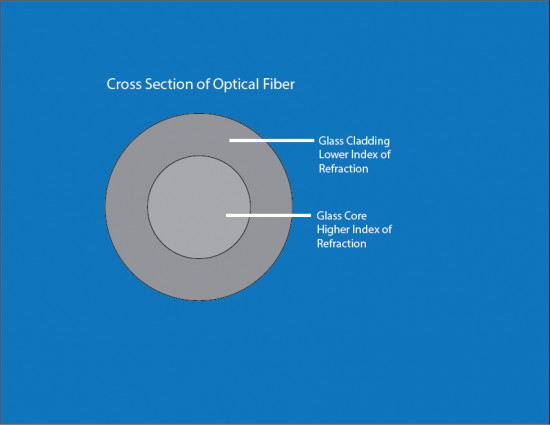
Fiber optic cable takes advantage of this property of light with its internal structure.  The glass fiber has a cylindrical core that is surrounded by a cladding. See the figure below for a cross-sectional diagram.

The core has a higher index of refraction than the cladding so that light traveling down the core is totally internally reflected and remains in the fiber as it travels. The difference in index of refraction between core and cladding is small, but it’s enough to trap the light traveling at glancing angles.  That is how light signals can travel long distances, in some cases over 100km, in fiber optic cable. Imagine looking out a window that is 100km thick, while still seeing the other side!

Internet content rides on top of data communication between switches, routers, and servers, and fiber optic links play a key role at all distances, even less than 1 meter. These links help support traffic at the fastest rates possible so that you can stream your movies and music videos reliably.

In the upcoming second part of this series we will discuss two different types of optical fiber: single-mode and multi-mode.


Authors

Pat Chou

Product Manager

Service Provider - Transceiver Modules Group

Avatar

In no more than two years, ChatBots have raised from a techie’s gadget to strong interest from all industries, due to their unique ability to smoothly engage with end-users via messaging. More recently, bots have also found their way inside the corporate walls –  making enterprise workers more productive, locating a SalesForce report, helping book a meeting room, or providing a secured and quick access to business data.  As such, ChatBots have entered most enterprise digitalization journeys, delivering improved end-user support and optimized interactions for business workflows.

To support this effort, industry software vendors have provided off-the-shelf enterprise-ready bots that integrate with common enterprise 3rd party services. These bots can be explored and integrated through the Cisco Spark Depot. Lately, as some enterprises expressed their wish to deploy these new assets on-premises, the Cisco Spark Ambassadors community has come up with a set of opensource, self-deployable Bot Starter Kits. These bots interface with popular products such as AppDynamics, Jira, SalesForce, ServiceNow, Trello…

You get the message…if you’ve been contemplating taking advantage of the growth and maturity of the ChatBot industry, there is no better time to jump on the bandwagon, and join the ‘ChatBot’ developer community. To help you on this journey, DevNet has assembled a set of learning labs that will take you from zero to creating and deploying enterprise ChatBots.

Where to start?
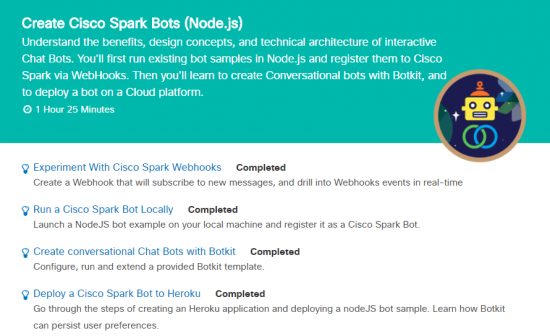
The “Create Cisco Spark Bots” module of the Getting started with Cisco Spark API learning track will ramp you up with the skills necessary to understand ‘ChatBot’ architecture principles, and have a full-featured Enterprise Bot up and running in less than 90 minutes.

Since each lab can be taken individually, we noticed that experienced developers tend to take a shortcut and jump straight to the advanced lab: “Create conversational Chat Bots with Botkit.” The latter leverages the Botkit framework that comes among the most popular community libraries to build chat bots. Moreover, Botkit is largely used by the Cisco Spark Ambassadors Starter Kits mentioned above: don’t miss the opportunity to dig into the sources of these community bot samples in search for inspiring code blocks.

Throughout the labs, guidance is provided for Javascript. If you are new to Node.js, the introductory lab will help you setup your Javascript developer environment. Nervertheless, the concepts taught all along the module apply to other programming languages. If you’re willing to continue your bot development journey with another programming language, we recommend you browse the awesome Cisco Spark github repository where the community has gathered a curated list of SDKs, bot frameworks and code samples for C#, Golang, PHP, Python, Ruby…

Join the Bot Developer Community, and promote your work
Equipped with these new bot skills, you’ll certainly be interested to join a developer community sharing your nascent passion for bots. Apply to join the Cisco Spark Ambassadors and make sure to be identified as a professional bot developer.

Finally, we recommend you take the time to promote your bots on the Cisco Spark Depot  where they will have a better chance to meet their audience …. well more chances than in your Christmas tree 😉


We’d love to hear what you think. Ask a question or leave a comment below.
And stay connected with Cisco DevNet on social!

Twitter @CiscoDevNet | Facebook | LinkedIn

Visit the new Developer Video Channel

Authors

Stève Sfartz

Principal Architect

Cisco Developer Relations

Avatar

Until now, the Internet-of-Things revolution has been, with notable outlier examples, largely theoretical and experimental. In 2018, we expect that many existing projects will show measurable returns, and more projects get launched to capitalize on data produced by billions of new connected things.

With increased adoption there will be challenges: Our networks were not built to support the volumes and types of traffic that IoT generates. Security systems were not originally designed to protect connected infrastructure against IoT attacks. And managing industrial equipment that is connected to traditional IT requires new partnerships.

It’s going to be a dynamic year as the communities that have been experimenting with IoT shift into high gear, and more new businesses and government organizations, more sensors and mobile devices, and more data streams come online. A lot of value will be created, opportunities surfaced, and fortunes made and lost across industries.

I asked the leaders of some of the IoT-focused teams at Cisco to describe their predictions for the coming year, to showcase some of these changes. Here they are.


IoT Data Becomes a Bankable Asset

In 2018, winning with IoT will mean taking control of the overwhelming flood of new data coming from the millions of things already connected, and the billions more to come. Simply consolidating that data isn’t the solution, neither is giving data away with the vague hope of achieving business benefits down the line. Data owners need to take control of their IoT data to drive towards business growth. The Economist this year said, “Data is the new oil,” and we agree.

Historically, there have been multiple challenges preventing companies from maximizing the value of their IoT data, including issues of directing data from different types of devices through different kinds and levels of networks, and into a growing variety of apps. In 2018, IoT data platforms will let businesses take control of the distribution, use and monetization of their data. Businesses will be able to:

•  Decide where data needs to go and coordinate its movement
•  Define and enforce policies determining who has access to data
•  Implement new business models that deliver value for companies, partners and customers
•  Guarantee that these processes are easily automated, reliable and secure

This level of data control will help businesses deliver new services that drive top-line results.

– Jahangir Mohammed, VP & GM of IoT, Cisco


AI Revolutionizes Data Analytics

In 2018, we will see a growing convergence between the Internet of Things and Artificial Intelligence. AI+IoT will lead to a shift away from batch analytics based on static datasets, to dynamic analytics that leverages streaming data.

Typically, AI learns from patterns. It can predict future trends and recommend business-critical actions. AI plus IoT can recommend, say, when to service a part before it fails or how to route transit vehicles based on constantly-changing data.

Live analytics is of course only as good as the data it has access to, and for AI systems, quantity of data has a quality of its own: The more information AI has, the more impactful its results can be. With AI as the brains of the operation and IoT as the body, these two technologies will create a powerful new force for business transformation in 2018 and beyond.

– Maciej Kranz, VP, Strategic Innovation at Cisco, and author of New York Times bestseller, Building the Internet of Things


Interoperable IoT Becomes the Norm

The growth of devices and the business need for links between them has made for a wild west of communications in IoT. In 2018, a semblance of order will come to the space.

With the release of the Open Connectivity Foundation (OCF) 1.3 specification, consumer goods manufacturers can now choose a secure, standards-based approach to device-to-device interactions and device-to-cloud services in a common format, without having to rely on, or settle for, a proprietary device-to-cloud ecosystem.

Enterprise IoT providers will also begin to leverage OCF for device-to-device communications in workplace and warehouse applications, and Open Mobile Alliance’s Lightweight Machine-to-Machine (LwM2M) standard will take hold as the clear choice for remote management of IoT devices.

In Industrial IoT, Open Process Communication’s Unified Architecture (OPC-UA) has emerged as the clear standard for interoperability, seeing record growth in adoption with over 120 million installs expected as 2017 draws to an end. It will continue to grow into new industrial areas in 2018 driven by support for Time Sensitive Networking.

Standards organizations will continue to consolidate and cooperate to clear barriers to enterprise and industrial IoT. Instead of standards groups trying to be all things to all industries and use cases, a realization that there is no single IoT – and hence no one-size-fits-all IoT standard – is leading to cooperation and a reduction in duplicated efforts as different groups tackle more focused challenges. For example, the Open Connectivity Foundation has focused on solving one problem: device-to-device communications and management and wisely merged with the AllSeen Alliance and UniversalPlug and Play (UPnP) who were solving similar problems, and continues on a mission to defragment IoT standards in the smart home and enterprise arenas.

– Chris Steck, Head of Standardization, IoT & Industries, Cisco


IoT Enables Next-Gen Manufacturing

Manufacturing is buzzing about Industrie 4.0, the term for a collection of new capabilities for smart factories, that is driving what is literally the next industrial revolution. IoT technologies are connecting new devices, sensors, machines, and other assets together, while Lean Six Sigma and continuous improvement methodologies are harvesting value from new IoT data. Early adopters are already seeing big reductions in equipment downtime (from 15 to 95%), process waste and energy consumption in factories.

The interconnectedness of systems has forced attention on security. Last year brought significant security threats to the manufacturing space. Escalating risks mean that manufacturing – an industry generally slow to implement security measures – has to be more expeditious about taking action. Today, manufacturers working to launch Industrial IoT (IIoT) projects are collaborating with IT groups and are exploring security assessments that evaluate risk and ultimately provide comprehensive protection.

The security market in manufacturing will grow aggressively in 2018, in spite of an escalating shortage of security experts in the manufacturing space.

– Bryan Tantzen, Senior Director, Industry Products, Cisco


Connected Roadways Lay the Groundwork for Connected Cars

Intelligent roadways that sense conditions and traffic will adjust speed limits, synchronize street lights, and issue driver warnings, leading to faster and safer trips for drivers and pedestrians sharing the roadways. As these technologies are deployed, they become a bridge to the connected vehicles of tomorrow. The roadside data infrastructure gives connected cars a head start.

Connected cities will begin using machine learning (ML) to strategically deploy emergency response and proactive maintenance vehicles like tow trucks, snow plows, and more.

Instrumenting and connecting the roadways to get the data out is the first step in delivering value today. This is critical as the transportation value equation changes: Services become more efficient and automobiles become autonomous. People are beginning to envision and even embrace mobility as a service, diminishing the historical importance of owning a personal vehicle. This trend, coupled with the rise in the use of electric vehicles, is already resulting in a reduction in state and local revenue from gas taxes, tolls and other forms of vehicle-related recurring revenue that would normally help maintain infrastructure. In 2018, local governments and their transportation agencies will look to recoup these losses in innovative ways and find new revenue streams. This will include monetizing the data collected, while improving citizen roadway safety.

– Bryan Tantzen, Senior Director, Industry Products, Cisco


Botnets Make More Trouble

Millions of new connected consumer devices make a nice attack surface for hackers, who will continue to probe the connections between low-power, somewhat dumb devices and critical infrastructure.

The biggest security challenge I see is the creation of Distributed Destruction of Service (DDeOS) attacks that employ swarms of poorly-protected consumer devices to attack public infrastructure through massively coordinated misuse of communication channels.

IoT botnets can direct enormous swarms of connected sensors like thermostats or sprinkler controllers to cause damaging and unpredictable spikes in infrastructure use, leading to things like power surges, destructive water hammer attacks, or reduced availability of critical infrastructure on a city or state-wide level.

Solutions for these attacks do exist, from smarter control software that can tell the difference between emergency and erroneous sensor data, and standards that put bounds on what data devices are allowed to send, or how often they’re allowed to send it. But the challenge of securing consumer-grade sensors and devices remains, especially as they connect, in droves, to our shared infrastructure.

– Shaun Cooley, VP and CTO, Cisco


Blockchain Adds Trust

Cities are uniquely complex connected systems that don’t work without one key shared resource: trust.

From governmental infrastructure to private resources, to financial networks, to residents and visitors, all of a city’s constituents have to trust, for example, that the roads are sound and that power systems and communication networks are reliable. Those working on city infrastructure itself can’t live up to this trust without knowing that they are getting accurate data. With the growth of IoT, the data from sensors, devices, people, and processes is getting increasingly decentralized—yet systems are more interdependent than ever.

As more cities adopt IoT technologies to become smart—thus relying more heavily on digital transactions to operate—we see blockchain technology being used more broadly to put trust into data exchanges of all kinds. A decentralized data structure that monitors and verifies digital transactions, blockchain technology can ensure that each transaction—whether a bit of data streaming from distributed air quality sensors, a transaction passing between customs agencies at an international port, or a connection to remote digital voting equipment—be intact and verifiable. Having IoT data on a blockchain means we have new ways to audit the sources of data, identify the data’s value as it is monetized, and add trust to information carried between devices.

In 2018, we expect that more cities will look to blockchain as a way to secure operations and improve citizen services. Governments around the globe are already adopting blockchain to safeguard the integrity of all types of transactions. The technology could also allow private citizens to participate directly in the delivery of urban services (perhaps renting out private parking spaces or making package deliveries), with blockchain verifying and protecting transactions at the edge of the network, instead of centrally.

For all connected organizations, the possibilities are legion for blockchain to improve security, data transparency, and recordkeeping for myriad transactions, and to lend trust to any digital connection.

– Anil Menon, SVP & Global President, Smart+Connected Communities, Cisco


Authors

Rowan Trollope

Senior Vice President and General Manager

IoT and Collaboration Technology Group

Avatar

In Phuket, Thailand stray animals are all too common. That’s why the Soi Dog Foundation set up shop. The non-profit’s mission is to make sure fewer cats and dogs will suffer on the streets. And since 2003, they’ve neutered 170,000 animals and cared for countless more. But while Soi Dog was ready to help more and more animals, their tech wasn’t keeping up.

Dimension Data says…

After years of using patched together home office equipment, Soi Dog’s IT system was unreliable and overworked, and it was holding them back from helping more dogs. “It was time to look at our IT needs,” said John Higgs, the foundation’s CEO. With this in mind Soi Dog set out to find a new stable IT environment. They knew they needed a solid server and cloud system, and as a charity they’d have to find a partner to help them get their IT system up to standard.

The animal lovers at Dimension Data and Cisco were ready to volunteer. Cisco chipped in with $115,000 worth of Meraki hardware ranging from routers to security cameras – all of which could be operated from a single web-based dashboard. And our team at Dimension Data gathered a group of 40 engineers to rip, replace and set up the new equipment.  Cisco Meraki products gave Soi Dog the robust networking infrastructure they needed. Its simplicity and ease of use were a perfect match because it meant Soi Dog could concentrate on their mission and not nursing their network.

A reliable network connection ensures data integrity and an accurate record of the medical treatments Soi Dog provides. Vets can upload important data on animals’ treatment plans from any mobile device and anywhere on the property.

Now Soi Dog’s vets can access animal records with ease, accept donations, run a global adoption program, upload patient data directly to the cloud and reliably access drug information from the web. They can even get remote consults from vets in other countries or cities for tricky cases. Vitally, the Soi Dog IT staff can manage everything on the go from any mobile device and anywhere on the property. We like to think that’s teaching a dog some new tricks.

Thanks Dimension Data for helping Soi Dog achieve their mission!

The story doesn’t stop there…

Check out this video:

https://www.youtube.com/watch?v=9okmUNYJM-c

Discover how our other partners are helping customers around the world.

Connect with Dimension Data and other Cisco partners with our Partner Locator, and check out the Cisco Marketplace for more solutions from partners.

Authors

Gioia Ferretti

Partner Stories and Communications

Global Partner Marketing

Avatar

Today is a big day for Cisco Spark – we’ve officially received our ISO27001 certification!

For those unfamiliar with it – this certification gives our customers confidence that we’re following best practices around operating a secure cloud service. Indeed, many customers even require their vendors to have this certification. It’s a very formal process which defines a long list of operational requirements that a service needs to meet, document how it is meeting them, and then prove that it keeps on meeting them. It covers everything from incident management to inventory control to access controls to vulnerability scanning and even personnel management. Customers want to be sure that we’re doing all of these things and doing them well. Rather than having to ask about every single detail, they can instead know that – because we have this certification – we’re doing all of that stuff, and following best practices for them.

Achieving this certification is a LOT of work. Fortunately, we were starting from a great place. Cisco as a whole has very strong operational requirements in place for all products. And if you follow those, you end up doing most of what these certifications require. Furthermore, we built upon the success of WebEx, which has had ISO27001 certification (and a long list of others – SOC2 type 2, Safe Harbor, FedRamp, and SSAE16). Cisco as a whole also has ISO9001 certification, which helps.

If the application doesn’t have ISO27001, there is really no security protection at all. Cisco Spark has this certification for the entire application, inclusive of the underlying data centers.

Because of this strong foundation, we were able to achieve this certification very quickly – just six months from the start of the process. Much of that time was spent collecting information and documenting all of the things we do, as the certification process is very heavy on documentation.

Unfortunately, it has become common for vendors – particularly startups – to make claims like, “runs on ISO27001 certified data centers.” What this actually means is that their software runs in an Amazon or other data center that has the certification, but the certification does not apply to the application itself. Getting the certification for the actual application itself is what really matters – since the application is what holds and processes customer data. If the application doesn’t have ISO27001, there is really no security protection at all. Cisco Spark has this certification for the entire application, which is inclusive of the underlying data centers too.

Another aspect of this that I’m really proud of is that our certification isn’t just for Cisco Spark. It’s a certification that covers Cisco Spark and WebEx. These services share infrastructure, and through our Flex Plan subscription, are also sold together. With a shared certification, customers can feel confident in the security of their data no matter what products they use.

Of course, we’re not resting on our laurels. More is to come as we work toward being the most secure collaboration tool on the planet. When you combine this certification with other application innovations like our end-to-end security and on-premises key servers, no one comes close to the type of security offered by Cisco Spark.

Learn more about security compliance with Cisco Spark.


Authors

Jonathan Rosenberg

Cisco Fellow and Vice President

CTO for Cisco's Collaboration Business

Avatar

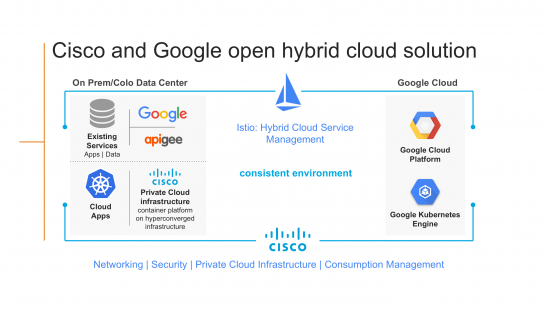
When we announced the joint hybrid cloud partnership Cisco has developed with Google, Kip Compton revealed the pieces of the solution with this high level diagram:

Between now and GA, I’ll be discussing some details on the individual components of the solution that make up the combined whole, starting with a Google component you may not be familiar with called Apigee.

What Is Apigee?

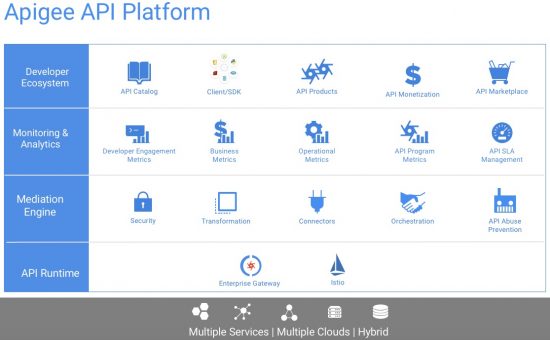
Google acquired Apigee back in September of 2016 but the core technology dates back as far as 2004 and prior to becoming part of Google, Apigee had their IPO in August of 2015.  As the name implies, Apigee makes it easier to create developer-friendly APIs with modern REST interfaces and access keys.  It can automate the creation of documentation and SDKs for an API as well, including monetization services so that an organization can easily create a community for developers interested in their back-end data.

Apigee includes a ton of monitoring and analytics tools and a sophisticated security model so that any company can take an existing back end and safely expose some or all of it to outside developers.

Apigee and the Cisco/Google Hybrid Cloud Partnership

A refreshing aspect of Google’s attitude towards public cloud is its admission that not all workloads will leave the corporate data center.  Many SAP implementations contain data some feel is not appropriate outside the friendly confines of a corporate firewall and some Oracle databases are large enough that getting them into a public cloud environment without interrupting service is tricky.  For those and other reasons, there are just some things that organizations might want to keep in their data centers.

But how do you balance the desire to keep some data in a traditional corporate data center with the needs of line of business team developers eager to innovate?

This is exactly where Apigee can make such a big difference by putting a modern API front end to legacy data stores.  Now developers can deploy business logic on either the same private data center or the public cloud and access corporate data in a modern way.  IT Operations can analyze metrics to see who and how the data is being used.  A fundamental tenant of the Cisco and Google Hybrid Cloud solution is giving developers the ability to access data from anywhere, no matter where it resides.

Through access keys, Apigee provides Layer 7 security to this data, but what about setting up a secure connection between a piece of business logic running on the public cloud with this new API endpoint in a corporate data center?  That will be the topic for next time, as we discuss how virtualized network devices can be set up to form an encrypted and redundant connection using Google VPN and Cisco CSR100v’s.

Authors

Pete Johnson

Principal Architect

Global Partner Organization

Avatar

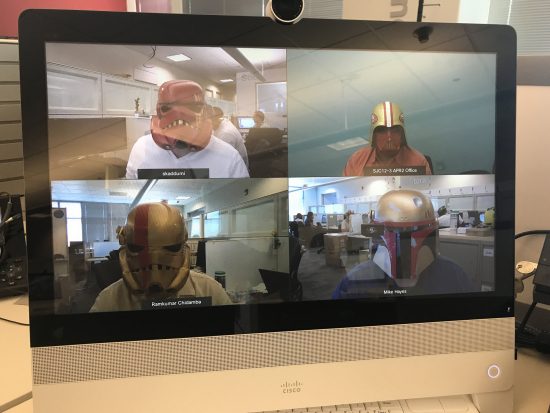
You may have heard rumblings throughout the galaxy that Cisconians are pretty big fans of Star Wars. And everything you’ve heard, it’s true. All of it.

Our employees are such huge fans, in fact, that we celebrated #MayThe4th with a contest where we partnered with NASDAQ and employees were encouraged to showcase their Star Wars (and Cisco) geekdom by posting images on Instagram. Some employee’s images were even featured on the NASDAQ Tower in Times Square!

On #MayThe4th Cisco Employees helped celebrate in Times Square with NASDAQ.

Being yourself at Cisco is just part of our culture, and employees know that celebrating who they are and their love of everything from Jedis to Storm Troopers is a year round event. “Be you, with us” is more than just a saying here — it’s a way of life, and if you’re asking me, it’s our “Do or do not, there is no try.” 😉

Whatever you love, and whatever you’re passionate about — Cisco embraces that and believes it’s the true Force for what makes our culture out of this world.

Want to use The Force daily? Here’s a few tips (and quotes) we’ve come by:

1. Innovate “Close your eyes. Feel it. The light…it’s always been there. It will guide you.” – Maz Kanata

It’s no surprise that Cisco is always innovating, and Star Wars was an innovation in its own right! How do we always keep the creative, forward-thinking juices flowing?  Easy! We just know that it’s all around us, and always within us.


2. Have Goals – “Never tell me the odds.” — Han Solo

It’s important to have goals so you have a direction in your career journey and in life! Just like Luke and Leia (and, heck, even that Vader guy) — everyone in Star Wars has a goal. But, as Han notes — never focus on the odds! Sure, you might fail — but you might also succeed, and success requires an attempt! What’s important is to know the direction you’d like to go in, and then get to work on making that happen!

3. Flexibility – “Impossible to see, the future is.” — Yoda

Yes, Cisco has a flexible work life and our tech enables employees to work from anywhere in the world.  But, THIS flexibility is one we often don’t talk about. The flexibility to fail! Sometimes goals don’t pan out, and that’s okay! At Cisco, we love “failing forward” – so much so that we don’t really consider much a true failure.  If it didn’t work, it’s a learning and a way for us to grow and try a new method to get us to where we want to be with our goals. None of us know the future, but if we keep going — even in the wake of a set back — that’s how we succeed.

4. Team Work“You will find only what you bring in” – Yoda

Very few successes can be attributed to one lone person, often it takes a village! That’s no different at Cisco. Yoda mentions that you’ll find only what you bring in — which is to say that if you’re able to bring your full self to work, and you give it your all on the daily people start to take notice that you’re a dedicated teammate. Your work speaks for itself, so go all in and bring your unique skill-set to the office each day.

Cisco employee Faina Segal won our #MayThe4th contest with this amazing photo!

5. Diversity – “You will find that many of the truths we cling to depend greatly on our own point of view.” — Obi-Wan Kenobi

We love our diversity at Cisco, from our incredible Employee Resource Organizations (ERO) to amazing #WomenInTech we know that everyone should have an equal opportunity to succeed in the world of tech. Having a diverse team is just part of our strength as it offers unique view points, ideas, and collaboration across the globe.


How do you use The Force daily, Cisconains? Are you excited about Star Wars: The Last Jedi coming to theaters? Let us know in the comments below, but – psst! NO SPOILERS! 😉


Want to work for a company that encourages you to be you, with us? You can! We’re hiring!


Authors

Casie Shimansky

Content Strategist | Provider of Pixie Dust

Employee Storytelling

Avatar

We’re excited to announce the availability of the Cisco Security Connector app for iOS, a first of its kind enterprise security solution for iPhone and iPad. Working with Apple, our team of engineers used new platform capabilities and APIs embedded into iOS 11 to deliver the deepest visibility and control for enterprise-owned iOS devices.

So how does the app work in the real world? Let’s walk through a scenario:

Meet Ian

Ian is an IT manager for a large hospital, in charge of all desktop, laptop, and mobile endpoints. The hospital provides the nurses, doctors, and other staff with supervised iOS devices. He, and the hospital’s CISO, love that Apple is secure by design.

However, the supervised iOS devices that Ian manages don’t always stay on the hospital network. The hospital provides an in-home care service, which means the nurses and doctors connect to cellular and other Wi-Fi networks.

Initially, Ian evaluated a VPN and a global HTTP proxy. Neither solution was designed to solve Ian’s problems and both provided a poor experience for users.   

Enter the Cisco Security Connecter

Between his own frustrations and the piling complaints from users, Ian needed a solution that could provide  him with visibility and control and his users with a zero-touch experience.

The solution? You guessed it, the Cisco Security Connecter. This single app is powered by Cisco Umbrella and Clarity. Umbrella is a secure internet gateway that provides the first line of defense against threats on the internet wherever users go. Clarity is a component of Cisco AMP for Endpoints, which gives insight into all network traffic — even HTTPS URLs without decryption — generated by the user, applications, and device.

Deploying the app

Ian used the Meraki Systems Manager to deploy the app because of its ability to deliver a seamless end-to-end experience.

Thanks to the unique bi-directional connection between Systems Manager and Umbrella and Clarity, policies are automatically pulled from the Umbrella and Clarity (AMP) dashboards. With the app and the configurations ready to go, Systems Manager installs the Cisco Security Connector app and configurations onto the supervised iOS devices that it has automatically enrolled. This process happens behind the scenes without any end-user interaction.

The iOS devices then automatically register themselves to the Umbrella dashboard and Clarity (AMP) dashboards belonging to Ian’s organization and the devices are immediately enrolled.

Enabling the app functions

Ian only has to provision a single app, but it supports two extensions –– Umbrella and Clarity. Both extensions work anywhere –– on and off of the hospital’s network. This includes cellular networks. Ian was happy he was able to leverage the hospital’s existing investment in Umbrella and AMP for Endpoints.

How it works: Umbrella

All app or user-initiated network requests are intercepted by the Umbrella app extension. All internet domain requests are forwarded and resolved by the Umbrella global network. All intranet (i.e. internal) domain requests are forwarded and resolved by the local authoritative DNS server. Umbrella delivers both DNS-layer encryption and enforcement, plus it uses an intelligent proxy for customizable URL and file inspection of risky domains. In real-time, Ian sees these requests in the Umbrella dashboard.

This gives Ian real-time visibility and control for where users go on the internet. His users are defended against phishing attacks and accidental browsing to bad sites. Plus, Umbrella protects against data exfiltration to malicious destinations and encrypts internet (DNS) requests.

How it works: Clarity

All Internet or intranet flows are audited by the Clarity app extension.

Clarity only forwards each flows’ metadata to the AMP cloud. These app-based flows are correlated in a similar, but different, fashion to file-based trajectories. Ian can then see the results that are reported in the AMP console he uses every day.

Now, Ian is able to audit all traffic flows generated by iOS devices, apps, and system processes before encryption to gain URL-level granularity. Clarity correlates traffic flows to gain insights per app or device; which helps Ian and the security team facilitate incident investigations. And it surfaces the most and least used apps across the organization, which helps Ian identify policy issues.

It’s a win-win-win for Ian. He gains a simple solution that provides him the necessary visibility and control, his users are happy and the hospital stays safe.

Enable business, protect users

With a unified architecture across Meraki Systems Manager, Umbrella, and Clarity, your organization gains simple and effective visibility and control. Visit the Cisco Security Connecter page to see how you can start using the app.

https://youtu.be/alEcihS7FOQ

Authors

Kevin Rollinson

Product Marketing Manager

Security - Cisco Umbrella