#CiscoChampion Radio is a podcast series by technologists for technologists. In this episode we’re talking about collaboration endpoints with John Yost.
In two weeks, 11,000 of the world’s most prominent financial services professionals from 4,500 banks, fintech companies, insurance and wealth management firms will attend Money2020 in Las Vegas to discuss topics like digitization, blockchain, open banking, regtech, customer experience, Internet of Things (IoT), and artificial intelligence. Cisco’s Director of Industry Solutions, Jason Bettinger, will take part in a discussion on Tuesday, October 24 about the future of technology in banking.
However, before you can become a bank of the future, you first have to future-proof the bank. Below are three areas to focus on as you think about how to secure your place in the digital future.
1. Use data to help customers manage their money
Some interesting findings about consumers’ relationships with money emerged from a 2017 survey by ReD Associates and Cognizant:
37% of consumers say finance and money challenges are their biggest source of stress, far surpassing stress from their jobs and health issues
Twice as many consumers described their financial providers as wanting their money (42%) vs. helping them get more out of their money (21%).
Financial institutions are seen as utilities: 90% define their relationship with their bank by simple transactions, such as depositing money and checking account statements.
Less than one-third of consumers have experienced a financial services professional from their bank reaching out to ask them about insurance, retirement savings, or maximizing their assets.
The study concludes that overall, consumers feel like they don’t have control of their finances. But at the same time, banks are uniquely positioned to help customers achieve financial goals and guide them through complex financial decisions.
Perfecting the customer experience isn’t about developing the next, best digital tool. It’s about allowing the customer to interact the way they expect to, not the way their provider wants them to.
Translate consumers’ financial data into information that is meaningful for them.
Banks that build better models to inform predictive analytics and behavioral forecasting while respecting consumer privacy will better understand when their customers are about to experience life events with big financial implications. Migration to a hybrid-cloud based infrastructure allows financial institutions flexibility to leverage big data for real-time insights, identify patterns, and offer better probabilities. When banks begin to leverage their massive data stores to help customers gain control of their finances, they can become more relevant and differentiate themselves as digital leaders.
2. Empower staff to collaborate
Even though it may seem that transactions are migrating to digital experiences, customers still want the option of human interaction. According to the Accenture 2016 North America Consumer Digital Banking Survey, 87% of U.S. consumers plan to visit branches and want to interact with humans when they do. Banks must integrate digital and physical channels to improve the customer experience and operational efficiencies.
72% of bankers believe corporate bureaucracies are stifling productivity and innovation. Yet bankers are less likely to consider an increase in innovation via dynamic teaming (36%) as the top motivator for an agile workforce.
76% of bankers agree that organizations that are able to build a strong agile workforce will win the war for talent.
81% agree that organizations that successfully integrating an agile workforce into their business model will gain a significant competitive advantage through innovation.
Excessive bureaucracy and cumbersome processes are at the root of organizational drag and the slow-to-innovate nature of financial services. Process-focused employees try to run the bank, whereas those with an agile mindset try to change the bank.
Through collaboration technology, bank employees can develop greater business agility by breaking down the silos that naturally develop between lines of business, and by identifying better ways to work together inside today’s challenging regulatory environment. A collaborative culture that encourages innovation through iteration will ensure digital bank models work.
3. Support a future-proof digital business model with a future-state core network
Nearly 90% of the banking executives participating in the Accenture 2016 North America Consumer Digital Banking Survey agree that their organization must innovate at an increasingly rapid pace just to remain competitive, but less than half (47.8%) say they are investing comprehensively in digital as part of their overall strategy.
The U.S. financial services industry is hampered by immense, monolithic software and a conservative approach where change takes place slowly. Financial industry analysts from Gartner maintain in their 2017 Strategic Roadmap for Networking that this traditional culture has paralyzed the industry, resulting in U.S. banks falling behind not only agile fintechs but also financial services peers around the world. As open banking begins to take hold in the U.S. as it has already done in Europe, network components in financial institutions will be required to become more modular, API-driven and often controlled by systems outside network operations.
The number of digital devices that must connect on a daily basis to the network is steadily increasing and mobility is taken for granted due to customer Wi-Fi access, the IoT, and employees bringing their own devices. According to Gartner, to meet emerging digital business demands, the digital banking network of the future must become simpler at all stages.
Join us at Money 20/20
The digital future is upon us, and it requires a foundation strong enough to support the rapid pace of change.
Join @JasonBettinger during Lunch with the Innovators at #Money2020 on Tuesday, October 24 from 12:00 p.m. – 1:00 p.m. PST. He’ll discuss where financial technology will move the industry in the next 3-5 years, along with fellow panelists from @ACI Worldwide, @DBS Bank, and @Infosys.
Please use code CISCO250 to save $250 off your registration fee. Register now.
Are you a financial services leader attending the conference? Register to attend a complimentary luncheon on Monday, October 23 to learn how your organization can leverage the Apple and Cisco partnership to accelerate mobile transformation and reinvent customer experience from inside out!
Cisco Talos previously published research into a targeted attack that leveraged an interesting infection process using DNS TXT records to create a bidirectional command and control (C2) channel. Using this channel, the attackers were able to directly interact with the Windows Command Processor using the contents of DNS TXT record queries and the associated responses generated on the attacker-controlled DNS server.
We have since observed additional attacks leveraging this type of malware attempting to infect several target organizations. These attacks began with a targeted spear phishing email to initiate the malware infections and also leveraged compromised U.S. state government servers to host malicious code used in later stages of the malware infection chain. The spear phishing emails were spoofed to make them appear as if they were sent by the Securities and Exchange Commission (SEC) in an attempt to add a level of legitimacy and convince users to open them. The organizations targeted in this latest malware campaign were similar to those targeted during previous DNSMessenger campaigns. These attacks were highly targeted in nature, the use of obfuscation as well as the presence of a complex multi-stage infection process indicates that this is a sophisticated and highly motivated threat actor that is continuing to operate.
Cisco Stealthwatch and Identity Services Engine (ISE) are key components required to transform your network into a sensor capable of enforcing your security policies. But how do you incorporate automation on your network to full advantage? How do you validate that the existing policy aligns with the company’s overall security posture? And how can you utilize ISE and Stealthwatch to simplify your security in an ever-growing network of devices, IoT, and applications?
You can’t protect what you don’t know, so know what’s on your network
As more devices enter the enterprise, the requirement for visibility into the environment is more important than ever. We are far removed from the days of simple device characteristics as profile criteria. The benefit of ISE, combined with Stealthwatch, allows you to increase the fidelity of profile characteristics of devices in your network. However, if you don’t know your network and the devices accessing it, you can’t write good policies for those profiles. In order to understand how assets should communicate, you need, with a high degree of certainty, to be able to classify it.
One of the first steps we take in Cisco Services is to help our clients better identify internal assets that are critical to the business. Our subject matter experts create device profiles based on multiple variables, including traffic analysis to ensure that each device has the appropriate level of access. We are able to audit existing device profiles to ensure that they align with the appropriate security policy. There is a wealth of information provided via Netflow that we can utilize to understand device classification. This will allow you refine existing and create new policies that align with critical assets.
Bad guys don’t sleep and neither should your network security
Oftentimes, due to the advancing nature of technology and talent shortage in cybersecurity, once profiles are set, clients are not auditing policies as their network grows. Most often administrators don’t find out about new applications until they mysteriously appear on the network or we get a request that the applications aren’t working. This typically kicks of a series of meetings with application and network owners to identify what applications are required for communication and what level of access is needed. Security issues can arise as new devices or applications are added without knowledge, or there may be availability issues along with angry business stakeholders who want their latest SaaS application.
Get the full benefit of automation
Imagine having alerts and information the minute new applications show up on your network. Even better, what if the network was smart enough to understand not only are they new, but would have the ability to combine them into applications and group them by specified criteria?
You can’t always have eyes on glass, so when our Cisco Services team is implementing ISE and Stealthwatch for clients, we’re always on the lookout for ways we can automate more security. With ISE and Stealthwatch, we create automated responses to alerts that are generated in your environment. Take the new application use case, we can create a network through learning and automation that allows it to create application groups. The network then sends that information to ISE, and based on predetermined criteria, allows you set the policy automatically if desired.
The time taken to deploy new services with Cisco has been drastically reduced, which enables allows you to spend less time with the network and more time on running your business. These ideas are all key to the network intuitive and with Cisco ISE, Stealthwatch and Cisco Services you will be well on your way to a digital ready network with Cisco DNA.
Welcome back! In Part 1: Embrace NetDevOps, Say Goodbye to a “Culture of Fear”, I introduced my definition of NetDevOps and talked about how we need to dispel the “Culture of Fear” as we move to NetDevOps. We also considered the two stakeholders of NetDevOps, the builders and consumers of the network. In this post I’ll be picking up where I left off discussing the core principals of NetDevOps. Let’s dive in!
The NetDevOps Pipeline
Managing the Current Pipeline
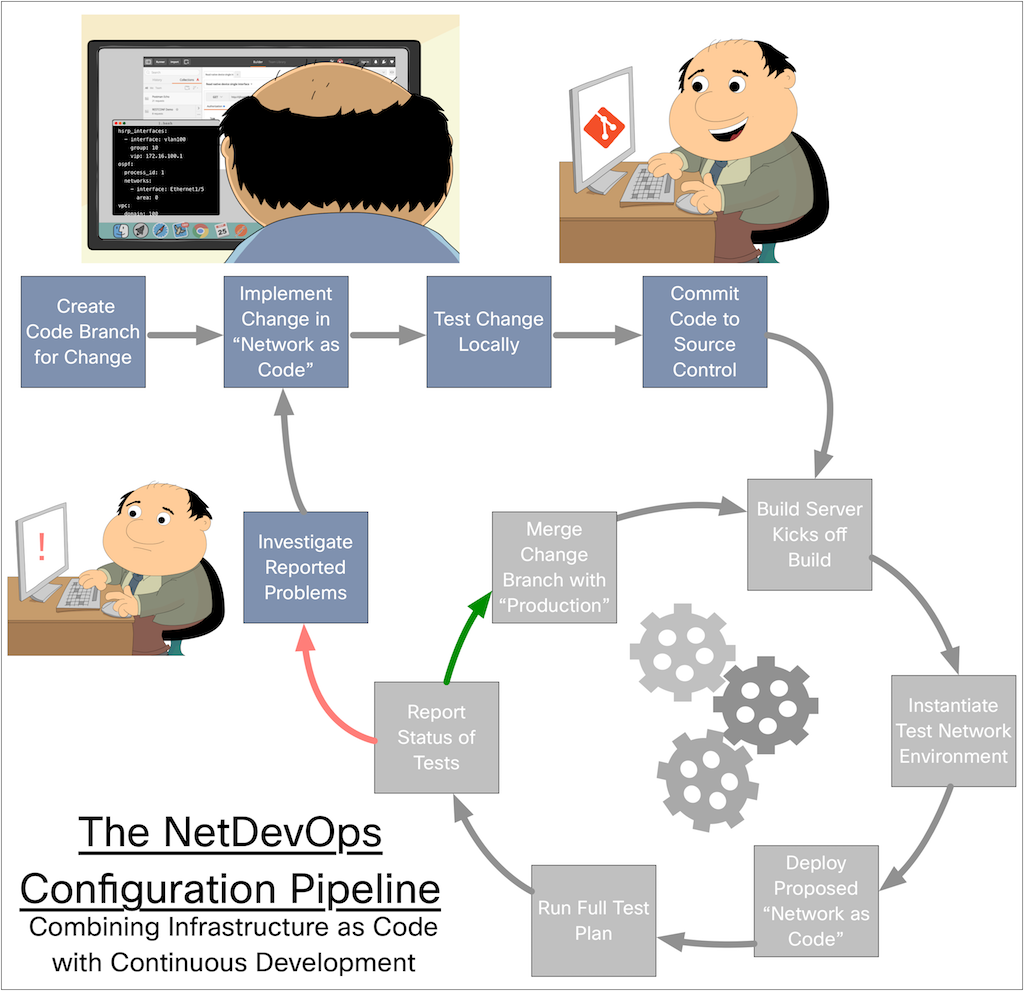
A “pipeline” simply defines the process by which an activity is completed. The concept of a “software delivery pipeline” is well understood today in IT, but network configurations also follow a pipeline. Today’s network configuration pipeline is a complex maze of forks, bends, off shoots, dead ends, and paths that require special timing, keys, and phases of the moon. The current network configuration pipeline needs to go, and be completely replaced in NetDevOps.
It is in this aspect of NetDevOps where Infrastructure as Code is relevant, and it must be driven by DevOps principles of automation, testing, and verification. In NetDevOps, it is standard to have a “Continuous Development” approach to network changes. Proposed network changes are picked up by build servers which manage the progression from “Development” to “Test” and into “Production”. NetDevOps will mirror what is becoming commonplace in software development teams.
The NetDevOps Pipeline
There is great work being done in network automation, network automation tooling, to help make a proper NetDevOps pipeline come to life. In fact I am spending much of my own time within DevNet in this space, and you can look for new blog posts in this space from me very soon!
Rethinking Network Monitoring for NetDevOps
Active monitoring of software performance and user experience is core to the DevOps principles and culture. And NetDevOps needs to bring with it a strategy and technique for network monitoring. It isn’t that we aren’t monitoring the network today, however for many networks it’s a haphazard combination of SNMP and syslog used more as a forensic research tool than as an active part of the day to day strategy of gauging the health of the network.
The networking industry is already adopting and moving to new technologies and strategies for monitoring. “Streaming Telemetry” solutions that provide near real-time access to structured data based on standard data models are becoming quite common. Further these new solutions are fitting into the same monitoring framework and systems that are being used by software DevOps teams.
However, replacing older protocols with newer ones isn’t a full solution. The more critical question that we need to answer today is what to monitor. What are the key performance indicators (KPIs) for the network? A strategy of collecting everything available isn’t possible or practical today. There is just too much available data, coming at too high a rate to reasonably transport, store and process it all. As an industry, we must figure out what to gather. And further… we can’t sit around and wait for an engineer to take a look at the data. We must develop strategies and plans to process the data as it comes in and take action immediately.
In NetDevOps, monitoring is about continuous health and improvement, not forensics.
The NetDevOps Engineer
Carl Working
Networking engineers must adopt new skills for NetDevOps, but this isn’t new to us as network engineers. We’ve had to learn new skills for IPv6, MPLS, 802.1x, and so much more. Not to mention the list of new technologies that have flooded us in the “Software Defined Networking” era. First and foremost, network mastery is still a critical skill. I scoff a little bit at all the doomsday talk I see around these days about “the death of the network engineer”. Network engineering is as strong as ever, but it is changing. Just look at what has happened to our cousins in software development as DevOps has flourished.
NetDevOps Engineers are skilled in programmability as well as networking. Many of us are already well on our way down the programmability path picking up familiarity with API interfaces and new scripting languages like Python. To these we’ll need to become familiar and fluent with DevOps tooling in areas like configuration management, build servers, and testing suites and tools. For me the biggest challenge in this space is the sheer variety and velocity in the tools that are available today and being developed for tomorrow. Don’t let this discourage you, embrace it as an opportunity, but realize you’ll need to become comfortable with not knowing them all.. there are just way too many out there.
The OSI Model
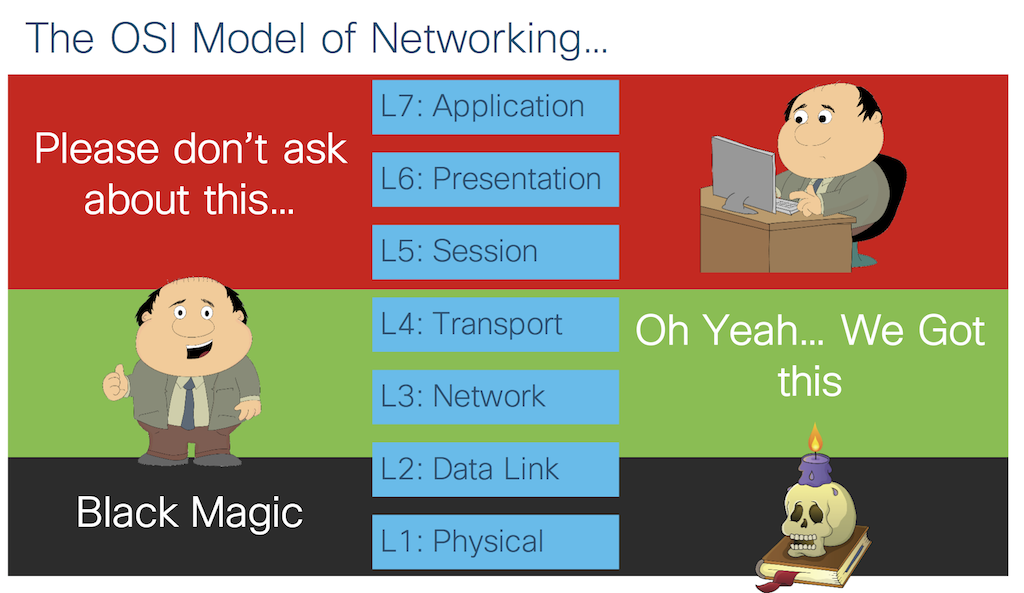
And lastly I turn back to an old friend of us all, the OSI Model (or Open Systems Interconnection Model). I do not doubt that you all look nostalgically on learning the 7 layers of the OSI model, but let’s be honest with ourselves… many of us are really are only comfortable with layers 2 – 4. Well, in order to successfully understand, troubleshoot, and test network health for applications running today and going forward, we must embrace the upper 3 layers of the OSI Model. Session, Presentation and Application skills and understanding are going to become more and more critical. With REST APIs becoming pervasive, you really need to know how HTTP works in detail…
As a reminder of the key elements we’ve discussed about NetDevOps, here they are again:
Organizations practicing “NetDevOps” see network changes as routine and expected.
NetDevOps builds and manages a network that enables network services to be consumed in a DevOps approach.
In NetDevOps, it is standard to have a “Continuous Development” approach to network changes.
In NetDevOps, monitoring is about continuous health and improvement, not forensics.
NetDevOps Engineers are skilled in programmability as well as networking.
This transition has me so excited that I’m re-branding myself as a “NetDevOps Evangelist” and am spending as much time as I can exploring all the topics and elements I’ve outlined in this article. Check back often for more blogs as I dive into each area and test out new theory, technology, and ideas. And you can be sure I’ll be building new Learning Labs, Sample Code and DevNet Sandboxes for you all to explore along with me.
And we’ve made it to the end, but the discussion on NetDevOps is far from over. In these two posts I’ve just started exploring my own thoughts on the topic, and framing up a discussion I look forward to having with all of you. Leave me a comment here on the post, or drop me a note over on Twitter (@hfpreston) or on LinkedIn (hpreston) and let me know your thoughts. And as always be sure to follow #DevNet on Twitter and Instagram for all the latest adventures in coding!
Until next time!
Hank, NetDevOps Evangelist!
We’d love to hear what you think. Ask a question or leave a comment below.
And stay connected with Cisco DevNet on social!
“Dad, I love your vintage Porsche! But is it safe?” This is the conversation my 90-year old neighbor recently had with his adult children. The Porsche he inherited from his late father-in-law is a thing of beauty – sleek, classic body, and driven once or twice a week. The low-mileage 911 has been maintained meticulously over its 47 years of service. It still exudes the chic sports car styling and handling but guess what? It has no seat belts! No airbags, no back-up camera, and no collision avoidance systems! However, over those 40+ years, automobile designers have not only designed faster and more stylish sports cars, they are now extraordinarily safer.
I can immediately see the parallel in the security industry. I can’t tell you how many IT managers I’ve run into lately who say: “Why should I replace my firewall, it still works?” My neighbor’s beautiful old Porsche and the IT manager’s aging stateful firewall still perform to what was the state of the art at the time they were introduced, in the case of firewalls, 20+ years ago. Like the sports car safety innovations, firewalls have added advanced inspection and analysis capabilities. As cyber threats have gotten more sophisticated, stateful firewalls have been reinforced with new next-generation security technologies that integrate across your network to keep the bad guys at bay and keep you safe.
Enter the Next-Generation Security Architecture
What modern capabilities have been added to Cisco’s stateful firewall that has 23-years of experience protecting Cisco networks? Today’s Cisco Firepower Next-Generation Firewall starts with the same, trusted inspection technology that allows or blocks traffic based on state, port, and protocol. It monitors all activity from the opening of a connection until it is closed. Filtering decisions are made based on both administrator-defined rules as well as context, which refers to using information from previous connections and packets belonging to the same connection.
The NGFW’s Collision Avoidance Systems: AVC, NGIPS and AMP
We’ve added robust application visibility and control (AVC) capability. Applications, both on premise and in the cloud, are a leading vector for bad guys, and we’ve integrated application awareness and controls to see and block access to known risky applications. This is a must-have for any NGFW as more than 80% of all new malware and intrusion attempts exploit weaknesses or un-patched vulnerabilities in applications.
Next-Generation Intrusion Prevention (NGIPS)
NGIPS is the cornerstone of modern next-generation firewalls and Cisco continues to be ranked industry leader by NSS Labs testing year after year. How do we provide the best intrusion prevention? Cisco NGIPS inspects network traffic against known attack signatures. We update our signature database constantly with up-to-the-minute intelligence gathered by Cisco’s worldwide threat visibility and analysis organization, Talos. Their efforts result in more than 35,000 vulnerability-focused IPS rules, advanced malware detections, and embedded IP-based, URL-based, and DNS-based security intelligence ensuring that our customers have the best protection on the planet. And that is only the beginning!
Advanced Malware Protection (AMP)
You might have noticed that the three technologies I’ve outlined so far address known threats. What about the new ones that we don’t know about yet? Cyber criminals are constantly innovating fiendish new attack vectors, it is inevitable that some are going to get past perimeter defenses. That is where Advanced Malware Protection comes in. Not only does AMP maintain a database of known malware to block, it records network traffic and the movement of files that have entered the network, whether the user was behind the firewall or on a device at a local coffee shop. Suspicious files can be immediately quarantined and detonated in a safe sandbox environment before they do damage. And in the event that an innocent looking file becomes malicious we can roll back the clock to understand the extent of infection it caused and begin the clean-up effort. You can rest assured knowing that Cisco AMP was named a leader in breach detection by NSS Labs for 3 years running! In fact, the industry average to detect a breach is 100 days, ours is just 3.5 hours.
Routing out Stealthy Malware
And now you might be thinking: how do you detect malware when it becomes active? Bad guys infiltrate networks for a wide range of lucrative reasons: theft of identity data is the top target, be that customer’s personal information such as social security information, credit card numbers, financial institution passwords. If this type of theft is underway, data will start moving in uncharacteristic patterns within and out of your network. The same could apply to classified design data for your next tech product, medical record information, or customer databases that your competitors are salivating to get their hands on. The ways in which criminals can ruin your business and reputation are endless.
Security Cameras of the Network: ISE, TrustSec, and Stealthwatch
Our aim is to detect and stop malware or bad actors from stealing valuable data. First, by segmenting your network and defining who belongs where, you take the first step towards limiting access to sensitive information and detecting when unauthorized access is made. Then, by monitoring network traffic and detecting any anomalies, you can contain data loss.
So, how do we do that?
Identity Services Engine (ISE) enables you to gain deep visibility into the users, devices, and applications accessing your network resources. It gives you the control to make sure that only the right people with trusted devices get the right level of access to network services. ISE works hand in hand with Cisco TrustSec technology to construct network segmentation policy that is shared with firewall management to contain any infected endpoints for observation, remediation, or removal.
And when you are thinking about Cisco, who on earth is better to defend the network? We know how your network works. We establish a baseline of known good traffic patterns, using Cisco Stealthwatch in your network, and when any deviations from the norm are detected, such as malware accessing your customer database, you are able to pinpoint the source and begin remediation.
So, you see, like today’s hi-tech sports cars, the evolved stateful firewall exists within a hi-tech Network Security Architecture that provides greater protection to enable your digital business. Protection that extends beyond the network perimeter to the endpoint, cloud and across your entire network.
Be sure to check out this cool video to see a Cisco NGFW in action.
I have spent the past decade talking about the positive impact of innovation and technology on educational outcomes, including for regional, rural and remote students. The transition to a knowledge-based economy is demanding changes in our education system and skills mix, especially in ensuring that traditionally disadvantaged groups are able to participate fully in a digital world. Focusing on regional and rural education is critical to ensuring that remoteness does not equal disadvantage.
The decision by the Australian Federal Government to undertake a review of regional, rural and remote education is both timely and critical. The review of rural and regional education is occurring against a backdrop of global volatility and accelerating change. These changes have significant implications for the Australian economy, and the ability of our education system to respond to the demand for future skills and new education requirements for a digital world.
We know that students on average in regional, rural and remote areas underperform on just about every education measure. Incrementalism is not going to cut it – we need to ensure that regional students have access to even more opportunity, even better capability and richer, more immersive technology than their metro counterparts. The objective shouldn’t be helping regional students `catch up’, but rather how to leap ahead and turn regionality into a competitive advantage.
Doing this will require using technology as a lever for improved education outcomes. In my view this will require a focus on three areas. The first is providing students with access to tools and technology that will drive engagement and reduce the achievement gap for learning in a digital world.
One of the best examples of using technology to address rural and regional advantage is in the Pilbara, Western Australia. The region presents unique challenges, including a high proportion of schools in rural locations and some of the most remote in the world. The WA Government has made a commitment to ensure all students in the state have access to a high-quality public school education. To do this they have invested in a range of proactive initiatives to mitigate the effects of isolation for rural and regional students, including live video, augmented by investment in network optimization technology to ensure schools can make the most of available bandwidth.
The second focus area is teaching students to be more collaborative and entrepreneurial to thrive in a digital economy.
One of the most important contemporary skills required by students is the ability to collaborate. Effective collaborators tend to possess a number of the following: communication, capacity to work in teams, accountability and critical thinking. Technology is an enabler of collaboration. A range of tools are available to enable students and teachers to share, co-author, network and analyze information in a variety of forms. True collaboration happens in real time and is immersive.
The importance of entrepreneurial skills also cannot be underestimated. If regions are to create new jobs to replace those that are being automated, they will almost certainly need to tap into the start-up economy and ecosystem. Entrepreneurship needs to be taught in all three sectors (K12, TAFE and higher education) to create the next generation of start-ups, but also to help young people navigate an increasingly freelance economy and volatile job market.
And lastly, to improve education outcomes, students must build STEM skills and apply them.
It is estimated that 47% of today’s jobs will be able to be automated over the next decade or two.[1] What is less understood, as the economy transforms, is the specific nature of ‘reconfigured jobs’ that will be required as replacements, and the foundational skills required to do them. While the answer is not straightforward, there is overwhelming evidence to suggest that STEM competencies will continue to be in high demand in the future. It is estimated that 75% of the fastest-growing occupations require STEM-related skills and experience and 90% will require digital skills.
The Australian Government has adopted the right approach by looking at the issue of rural and regional education holistically. The decision to review potential responses in all sectors of education simultaneously recognizes that education, training and learning is increasingly integrated. It also recognizes that in regional and rural areas, educational infrastructure is a shared community asset and increasingly becoming a more critical asset.
Government has an important role in not only supporting the education system to innovate and improve practice, but also in accelerating the pace of change that occurs. The attached response submitted by Cisco in collaboration with Optus to Government demonstrates that corporations are prepared to step up when it comes to contributing to what is a critical challenge for our nation.
Read the executive summary here and full response can be downloaded here.
[1] Frey, Carl B. and Osborne, Michael A., The future of employment: how susceptible are jobs to computerisation?, 2013.
Sometimes reading the dictionary of engineering terms you can find very nice, good sounding, easy to use acronyms; sometimes, instead, you will find something really obscure and difficult to pronounce as well.
Look at this, for instance—BVLOS—that stands for Beyond Visual Line Of Sight.
What does it mean? And why should anyone want to go BVLOS?
Well, if you are a drone, there are a lot of good reasons to fly BVLOS. First of all, there’s the $13 billion the drone market is going to generate by 2025—assuming it’s allowed to take off (literally) by aviation regulatory frameworks.
Not everyone knows that in most countries, drones can only fly in a limited space within sight of the pilot, generally not more than 500 meters horizontally and 120 meters vertically. That essentially makes commercial drones not fully useful except for specific tasks, such as local difficult inspections and risk prevention.
By the way, there are many good reasons for aviation authorities to restrict drone operations, including the obvious need for safety, privacy and data security. These are things that have not yet been properly addressed by current drone technology.
Unfortunately, those restrictions also restrict the potential value of the drone market. A large part of the value drones can generate will depend on their ability to fly long distances—beyond visual line of sight.
For instance, think about the possibility of inspecting oil pipelines or rails or power lines. Or providing remote surveillance for sensitive areas (parks, properties, farms)—preventing fires, and reducing risk for people. There are billions of dollars behind all of these opportunities, but today this is not addressable, simply because it is not allowed.
Why Cisco?
Now, I can see the question popping up in your mind: “Why is this all relevant to Cisco, or better, why is Cisco relevant to the drone market and BVLOS operations?”
The answer is very simple: a drone is nothing more than a carrier for sensors. In fact, it is a sensor itself, capable of generating data relevant to the phenomena and events happening around us, and data relevant to the drone itself, such as the telemetry that allows the drone to be controlled. Drones generate tons of data that, to be commercially relevant, need to be secured, transported and analyzed. This generally happens in the cloud (on the net, not in the sky!), very far from the location where they are generated. That’s why Cisco!
Proof of Concept
Let me share with you a very interesting experimental session (as one of the initiatives of Cisco Italy Innovation Hub) we had this summer with Italian aviation regulators (ENAC and ENAV) and drone partners, ADPM Drones, NeraTECH and Sky4APPs. This was the first experimental session for BVLOS day and night operation in Italy—and one of the first in the world.
We started with a real problem and use case (because we don’t sleep well if we’re not solving customer issues). In this case the problem was significant theft and damage suffered by very valuable fish farms located seven kilometers off the coast of Tuscany. Sometimes thieves cut the nets and stole the fish. Even worse, many more fish escaped from the farm causing hundreds of thousands of Euros in losses.
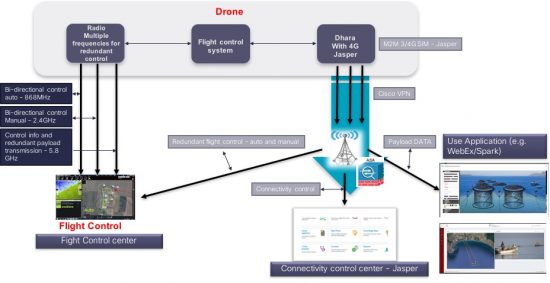
Solution architecture for the BVLOS experiment.
As you can imagine, it’s not easy or cheap to survey or patrol such an area regularly.
So, in collaboration with ADPM, Sky4APPS and NeraTECH and with the endorsement of Italian aviation authorities, we developed a drone surveillance solution. We equipped the drone with a fog computing capability that completely encapsulated data (both telemetry and payload) into a very safe Cisco VPN with QoS, carried over a 4G connection. To make things even safer, we added an extra level of control by using Cisco Jasper SIMs in the drone.
Finally, we used Cisco Collaboration solutions (WebEx and Spark) to keep everyone in the loop, sharing drone-generated real time video, telemetry and thermal video with anyone who was required to achieve the scope of the mission.
How cool is that?
The funny thing is that, having an engineering soul, I always love to make schemes and show the technology behind a cross-architecturalapproach like this, because it’s a unique value that only Cisco can provide. But I would have never thought to do it on a drone for fish risk reduction!
Left: Ground-based controllers track off-shore flights. Right: Infrared image of the fish farm.
We’ve been able to fly multiple missions controlling the drone (a fixed wing flying up to three hours) far over the sea. We used multiple levels of hardware redundancy and shared information in real time with people at the site of operation, and in other locations, via WebEx.
This has been, a great opportunity to test leading edge technologies from Cisco and partners to better solve a customer problems. Today it is asset surveillance, and tomorrow we could address many other use cases. Perhaps even more important, this experiment was also the first, instrumental step to test, identify and validate the technological and procedural framework to enable BVLOS drone operations for future commercial value.
You are officially forgiven if data breach headlines don’t surprise you anymore.
I mean honestly, can there be anything scarier than a hacker having access to all the data we each have stored with Equifax?
Equifax?!
They’ve got my SSN, my address, my driver’s license, and all my credit card numbers. They know where I’ve worked for my entire professional life, where I went to college, and they know my bank balance. Shoot, they probably know what I had for lunch today and whether my cat is due for a checkup. It’s all information that I’d have preferred to keep out of the hands of hackers (well, most of it anyway–I’m proud of my alma mater and open about my cat care practices), but now they have it, and all I can do is hope that they’re too lazy to do anything with my tiny little part of the data goldmine they helped themselves to. Too overwhelmed by the sheer volume of the windfall at their disposal to be able to exploit it thoroughly.
I do not love that that is what it has come to.
And it makes me wonder: Are these companies just completely reckless with our data? Are they not even trying to protect it because the cost of doing it right would be prohibitive?
This week’s guest on Cloud Unfiltered is Bryan Doerr, the former CEO of Observable Networks (acquired by Cisco in July of this year), and he’s got some awfully interesting things to say about information security. First off, he says that companies today are up against tremendous challenges when it comes to protecting data. He sees the vulnerabilities in their systems, he understands how the stakes have risen for hackers, and he’s not at all surprised that these breaches are happening. Not so much because the companies getting hacked being irresponsible—but because it’s an inherently tough game, and there are a lot of ways to make mistakes when you’re playing it.
That part of the discussion alone is worth tuning in for, but in addition to his data-breach riff, Bryan also touches on:
What startup life was like and what happened that finally allowed Observable Networks to break from the crowd
How Stealthwatch Cloud uses behavior anomaly detection to protect data
How the motivations behind cyberattacks have changed
Which steps you should be taking to protect your personal information at home
How you can access a 60-day free trial of Stealthwatch Cloud
See the video podcast on our YouTube page, or listen to the audio version on iTunes. And if you like what you hear, we invite you to subscribe to our channel so you don’t miss any of the other exciting podcasts we have scheduled over the next several months.













 Not everyone knows that in most countries, drones can only fly in a limited space within sight of the pilot, generally not more than 500 meters horizontally and 120 meters vertically. That essentially makes commercial drones not fully useful except for specific tasks, such as local difficult inspections and risk prevention.