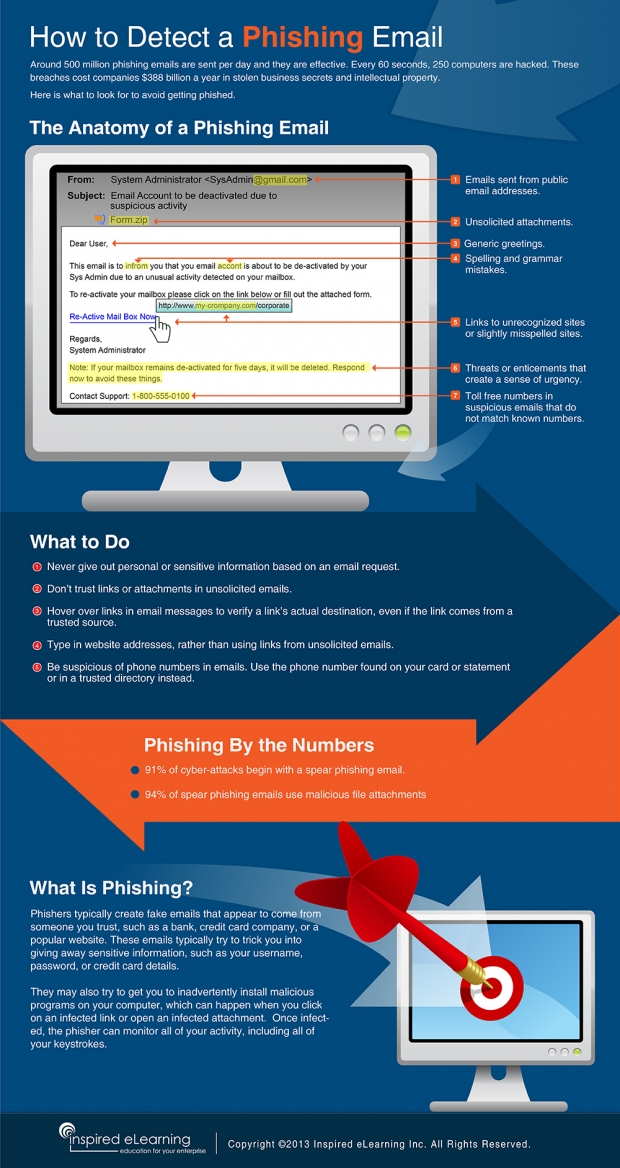
There’s no doubt that general awareness for cybersecurity has been on the rise in recent years. The importance of using strong passwords, for example, is now common knowledge. But one very popular and effective threat continues to fly largely under the public’s radar: phishing.
Why phishing? Researchers found that 30% of phishing messages are opened according to the 2016 Cisco Annual Security Report and adversaries know how effective a phishing campaign can be. To give you an idea of the scope of the problem, www.phishing.org reports that over 100 billion phishing e-mails cross the internet each day. They also report that about two thirds of all attacks start with a phishing campaign.
There are several reasons for these figures. All of them rely on human psychology. For the attacker, it can take days or weeks to break through the cybersecurity of an enterprise. Spend a few days building an attractive phish e-mail, spam 1 million copies of it across the Internet and in a few days you might have 120,000 hits, including stolen login credentials for thousands of businesses, personal bank accounts, who knows what they might find?
The attacker will use psychological manipulation to persuade the target to click the link. This is a real problem for organizations. Everyone should understand what the psychological buttons are that these guys are using every day. Here’s a few links that summarize what those tricks are and how the attacker will exploit them.
Sans Institute has an archive of research papers done by students working toward technical certifications. This one is a well-organized breakdown of phishing hacks into four broad psychological categories, with a discussion of specific tactics used in each category.
Network World offers a different breakdown of the how hackers exploit our psychology, with a tighter focus on what emotional buttons are successful in getting the reader to CLICK.
Merchant Link breaks down the psychological buttons into 7 categories. I don’t really care if it is 4 or 5 or 7. For me, it is being aware that the buttons exist to be pushed.
In many cases, users may come up with excuses as to why they should be able to safely avoid cybersecurity issues. There is another way to approach this problem.
Encourage your users to be curious instead of fearful. Make a game of spotting phishing clues. Use some of the links I provide and others you find (google “how to spot phishing email” for a start) to learn what clues to look for to determine if an email is a phish.
I’ll wrap up with a few more links if you want to know more.
Phishing is a form of social engineering. Turns out, there are sites focused on just that topic, like this one.
If you’re looking to improve your organization’s email security approach, check out the resources at: cisco.com/go/emailsecurity
You can also learn what five features your next email security solution must contain to combat threats like phishing, ransomware and business email compromise in our Email Security Buyer’s Guide.
October is Cyber Security Awareness Month, and Cisco is a Champion Sponsor of this annual campaign to help people recognize the importance of cybersecurity. For the latest resources and events, visit cisco.com/go/cybersecuritymonth.
Microsoft has released its monthly set of security advisories for vulnerabilities that have been identified and addressed in various products. This month’s advisory release addresses 63 new vulnerabilities with 28 of them rated critical and 35 rated important. These vulnerabilities impact Graphics, Edge, Internet Explorer, Office, Sharepoint, Windows Graphic Display Interface, Windows Kernel Mode Drivers, and more.
After a while, all of the hopeful press on futuristic health technology can start to feel like, well, hype. Breathless headlines touting telemedicine, artificial intelligence, and related technologies sound cool—but somewhat disconnected from reality.
Last week, these perceptions were shattered during our virtual event, “Digital Health Across the Continuum of Care.”
On Tuesday, October 3rd, three stand-out Health IT leaders shared some of the ways they’re using technology to make a real difference in the patient and workforce experience—not in some far-off vision of the future, but today.
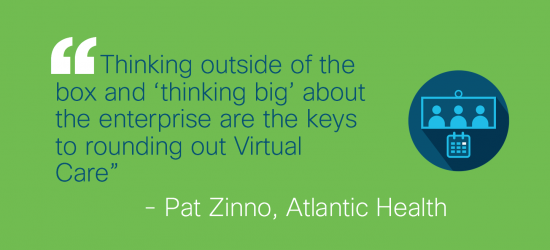
First, Pat Zinno, Director of Infrastructure Information Services and Support at Atlantic Health in New Jersey, presented the ground-breaking work his organization is doing around Virtual Care. Like all healthcare organizations, Atlantic Health is trying to enhance efficiencies and quality of care—and discovering that technology can help bridge the gap.
“We’re trying to map virtual care technology to the entire patient care continuum—from admitted inpatient to the general population,” said Pat. “When patients are in the building the engagement is really high. We want that to continue throughout the entire care experience.”
Pat and his colleagues have devised a multitude of offerings, including the e-ICU, in-room patient-provider communication, telestroke, telepsychiatry, and much more. And patients are responding: Pat reports that ICU patients really enjoy the feeling that they’re being watched 24-7. “They like the sense of the camera, someone being at their bedside,” he said.
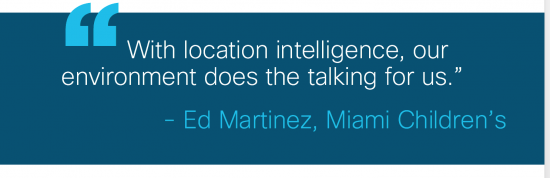
Next, Ed Martinez, SVP and Chief Information Officer at Miami Children’s Health System shared his organization’s journey to improve workflow efficiencies by tracking equipment, people, and processes. They started, as many companies do, with RTLS (real-time location services), but soon found that the cost-to-value ratio was limiting. So they turned to another technology: BLE (bluetooth low-energy).
“With RTLS, you can track with a one to three meter accuracy and the devices cost between 20 and 90 dollars each. With BLE, we can track within one to three inches of accuracy, at a cost of less than two dollars per tracking device,” he said.
BLE allows the facility to track processes like hand hygiene, a mundane—but critical—step that helps prevent the spread of infection. “Imagine being able to understand when a provider walks into a room, accesses a geofenced environment, and clicks on the dispenser,” said Ed. “And now imagine that an LED light in the room turns from red to green, letting the patient and family know that the provider they are about to interact with will have clean hands.”
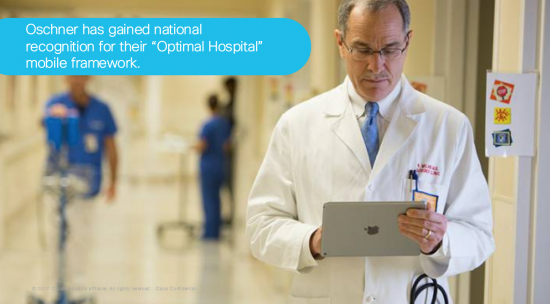
Rounding out the panel, Steve LeBlond, VP of Technology and CTO of Oschner Health System, demonstrated what’s possible with mobile technology in healthcare today. “Mobile is both a platform and a concept,” he said, before unveiling a framework his facility invented called “Optimal Hospital.”
Under Optimal Hospital, all nurses nave smartphones, and all patients and providers have iPads. Nurses can receive alarms and engage in secure messaging with providers. Physicians can use their iPads for messaging and entering notes into the electronic health record. And patients can review their treatment plans and get more information on their conditions.
And the innovation doesn’t stop there. Steve’s team is using mobile for outside-of-the-box tasks like sound monitoring—so they can alert nursing staff if the noise on the floor is too loud after hours. Their work extends to home care as well, with a new mother’s program that allows women to skip routine OB appointments by monitoring basic vital statistics at home using digitally-connected devices.
Following their presentations, all three leaders engaged in a panel discussion on topics ranging from the power of partnerships to future health IT innovations to the evolving role of the healthcare CIO.
As the session ended, the message was clear: The future of health IT is already here. And with brilliant minds like Pat, Ed, and Steve leading the charge, innovation is just getting started.
Missed it the first time? No worries, just click below to watch the recording.
Today, Talos is disclosing two vulnerabilities that have been identified in the Simple DirectMedia Layer library. Simple DirectMedia Layer (SDL) is a cross-platform development library designed for use in video playback software, emulators, and games by providing low level access to audio, keyboard, mouse, joystick, and graphics hardware. SDL, via its SDL_image library, also has the capability to handle various image formats such as XCF, the default layered image format for GIMP.
An attacker could compromise a user by exploiting one of these vulnerabilities via a specifically crafted file that SDL would handle, such as a XCF file.
Given that numerous applications make use of SDL, Talos has coordinated with the SDL community to disclose these vulnerabilities and ensure that an updated version of the library is available to use.
Most of you know Sting, the Grammy-winning solo artist and singer/bassist for English rock band The Police. So many great hits over the years. But how many of you know his late-80’s song “Englishman in New York?”
I’m an alien
The song opens with Sting, the Englishman, feeling somewhat out of place in New York City: His accent when he talks, a preference for tea over coffee, the walking cane by his side on Fifth Avenue. All of these differences make him an “alien” because he’s an Englishman in New York. If you haven’t heard the song before, you should check it out. It’s very well done, and Branford Marsalis is absolutely spectacular on the sax.
Okay, full disclosure. The Englishman in the song is really supposed to be about someone else, not Sting, but let’s just roll with it for now. No, scratch that. Let’s say that you’re the Englishman, and you’ve moved from London to New York. Since you’re not Sting — no chauffeured Jaguar for you — then you’ll need to learn the city’s subway system. Now let me ask you: How much help will your London tube map be as a guide through New York City?
Modesty, propriety can lead to notoriety
I should probably acknowledge that there’s simply no agreed-upon definition of IoT. It means different things to different people. But it’s worth taking a very close look at those “things” that are connected specifically with the Internet Protocol (IP) – you know, the language of the Internet. Everything from web pages to email to mobile apps and social media sites use IP.
Of course, connecting things with IP is nothing new. At Cisco we’ve been connecting things this way for decades. What’s new under the “IoT” guise now is the wide variety of devices — new and old — that are being connecting to IP networks. Not just traditional servers and workstations, and not just mobile phones and tablets. We’re talking about connected factory floors, connected medical devices, connected utility equipment. Pumps, gauges, lighting… all kinds of things.
So where’s the risk in that? Great question. Let’s talk about how these modest and proper devices can become notorious on your network.
Confront your enemies, avoid them when you can
Without proper planning, these IoT devices can actually become your enemies. Many of them lack critical security protections that leave them vulnerable to threats made possible by the openness of IP and the prevalence of the Internet. No doubt the ever-changing threat landscape will bring new risks in the future. Who knew ten years ago that a thermostat would be based on a small Linux server someday? Or that someone could exploit a thermostat vulnerability and use it to launch a cyberattack?
It’s obvious by now that Internet-borne threats have evolved rapidly over the years. It’s also becoming clear that there’s a lot of incentive for hackers to turn their skills against these newly-IP-connected things. We aren’t suggesting that you avoid IoT devices because of the risk. We’re saying that you can confront the risks and successfully manage them.
He’s the hero of the day
Are you changing the way you’re connecting existing things? Are you moving them from legacy methods to IP-based networking? If you’re connecting all-new things to IP networks, then you can’t rely on your old London tube map to secure them. You’re in New York now, and you need a new map to guide you to truly effective IoT cybersecurity. Enter Cisco IoT Threat Defense, the map you so desperately need.
Sting’s lyrics include a line that says “At night a candle’s brighter than the sun.” Well, if you’re still feeling in the dark about IoT security, then please join us for a candle or two at our upcoming IoT Threat Defense webinar. We’ll take you through everything you need to know. You can be the hero by leading your organization through the cybersecurity maze yet still reaping the benefits that IoT promises.
And Sting, don’t worry. We’ll have your toast done on one side.
“Innovation distinguishes between a leader and a follower.”
Steve Jobs
Vodafone engineers are constantly trying to innovate within their network to improve their customers’ experiences. To that end Vodafone Ireland has teamed with Cisco to create the world’s first trial using machine learning algorithms in Cisco Centralized Self Optimizing Network (C-SON) to predict where 3G traffic will peak in the following hour.
According to McKinsey & Company, the advent of machine learning and other advanced-analytics techniques, combined with the ability to now digitize large numbers of operator processes, creates a new paradigm that allows for an unprecedented change in operator cost structure. Applying analytics to the vast customer data available to operators delivers new insights about needs and preferences and what may cause customers to leave. By digitizing processes, for the first-time operators can act on this information both cost effectively and at scale, tailoring products, services, and interactions to individual customers. These new technologies are just as valuable in managing network infrastructure, guiding investments in new capacity, and adjusting wireless networks automatically.
C-SON provides a centralized architecture where the optimization algorithms reside in the network management system or a central SON server that manages all edge radio nodes. It can orchestrate the behavior of radio network equipment across the entire network of multi-vendor and multi-technology environments.
By monitoring the network traffic trends, to predict the future network behavior based upon data processing and pattern recognition. By doing this the network can self-configure itself automatically to balance the traffic load amongst neighboring cell sites and improve the customer experience.
According to Santiago Tenorio, Head of Network Strategy & Architecture at Vodafone, “Vodafone customers could experience significant benefits from the use of machine learning in our networks. For instance, the network could identify if there is high traffic at a mobile cell site every Thursday at 8pm – perhaps generated by weekly concerts at a popular music venue – and automatically increase the cell’s capacity before people arrive, returning to normal after they go home. Customers would benefit from the uninterrupted ability to call, message or share videos and photos on social media throughout the night. Initial results confirmed an average 6% improvement in the mobile download speed and lower interference at the cell sites (the cause of dropped calls, problems connecting and higher device battery drain).”
Imagine entering a room with mostly strangers, and being tasked with improving the company. That’s what the recent HackIT event was for me (there’s another this week!), and as I sat down at a table only knowing one other person, I wasn’t quite sure what to expect. What I found was a team that became true friends, and worked together tirelessly to make an impact on Cisco.
From discussing the problem, and how we could potentially solve it through digitization and collaboration – we wanted to provide a more streamlined process to enhance the experience and strengthen it for both Cisco and our customers. Through these conversations we started to see our idea develop. And, just like that, the idea for DigiTRAC – the first real time digital shipment tracker for Cisco’s priority one business customers – was born!
With DigiTRAC, we wanted to ensure two things – that network replacement parts got to our customers in a timely manner, and that both Cisco and our customers could track the parts effectively. We even decided to integrate it with Cisco Spark so our customers could get even faster responses. We wanted DigiTRAC to provide real-time updates and tracking capabilities, allow for a more streamlined communication between Cisco and its Priority One customers, shorten network down time, decrease revenue loss, minimize damage to the brand, and increase customer loyalty – all while preventing lost opportunities and negative financial impact.
It was incredible to see how our team, which consisted of people from various Cisco functions, rally around this idea. And because our roles were varied this also enabled each individual on our team to shine and share their expertise from their field.
Our team meshed so well it was as if we had already been working together for years, and I wanted to share some of what I experienced to help you develop a quality team dynamic:
1.Communication – Not only were we constantly communicating via WebEx, Spark, and in person – we were open and honest with that communication. We spoke our minds without fear of having another team member judge or shoot down the idea, and discussed everything as a team, before moving forward in a direction we all felt comfortable with.
Before we even started working on this project, we learned about each other first – a key element I think most teams miss. We got to know each other personally – what our teammates liked to do outside of work, what they were passionate about, etc. Taking the time to do this added the ability to see how our team members might be able to contribute outside of their role at Cisco!
2.Respect for Each Other’s Individuality – Everyone brought different strengths to the project, and various backgrounds, functions, and levels were represented. Everyone was always treated with respect. One of the greatest things I noticed about this team was that we all truly wanted what was best for the TEAM. I’ve seen elsewhere that people become focused with having their moment in the spotlight during presentations, but when a HackIT judge advised we might want to try only having ONE presenter – it was a no brainer to us. No one was offended, no egos got in the way, and our team acted as one when choosing one teammate who would present for us. I loved this about our team, and it speaks so much about Cisco’s people and overall culture. A team can’t exist without individuality and unique experiences and skillsets – it’s when we bring those all together, we can make such a larger difference in everything that we do!
3.Diversity – Especially Gender Diversity! Having a team of three men and three women helped us to see the different aspects and ideas we all had. No one ever said, “I know more about this than you, so that’s the direction we’re going.” Everyone’s input was valued. This is what a team is all about!
We were all excited to learn and grow, and it resulted in us becoming more of a family than just co-workers. This is also part of the Cisco Culture! So many of us are constantly asking questions – How can I learn? How can I make this better? How can I connect with this person beyond just what we do at Cisco? – and it takes us all so much further in changing the world.
4.Our Team had a Mantra – “Don’t Settle!” When times got tough, as they always do — we just kept pushing, pushing, pushing! We met with anyone who would meet with us, and were constantly discussing how to make DigiTRAC better. My greatest piece of advice would be – don’t settle for less than greatness, keep going! You never know if that next meeting or trial will lead you to success!
Our team made it to the HackIT Semi-Finals! And, while we didn’t make it to the final rounds, we are all still actively developing our friendships beyond DigiTRAC – I recently even participated in a volunteer event with a HackIT team member! We are still bonding and do our best to stay connected via Spark and WeBex meetings, but through this – our network is growing and our long term relationships are looking bright!
Want to work with a company that encourages you to innovate while making new friends? We’re hiring!
NetDevOps is one of many new terms coming into the IT lexicon as “DevOps” has become widely adopted and lauded as a positive and valuable approach to software development. As the IT industry looks to expand DevOps to other areas, NetDevOps has emerged along with other new terms such as “ChatOps”, “SecDevOps” and even “NoOps”. It is so new a term and idea that the name “NetDevOps” hasn’t even been fully agreed upon… I’ve also seen “DevNetOps” being kicked around by some… and despite being a member of “DevNet” at Cisco, I personally prefer the moniker “NetDevOps”.
But what exactly is “NetDevOps”? Like its “grandfather”, there seem to be as many definitions for NetDevOps as there are people asked, so here is mine.
“NetDevOps brings the culture, technical methods, strategies, and best practices of DevOps to Networking.”
So what is DevOps? DevOps is a term applied to a new approach to software engineering that combines the “Development” and “Operation” of software into a single unified team and mindset. DevOps is a full lifecycle approach where “if you build it, you own it” and accountability for success is forefront in everyone’s mind. Technical principles such as automation and monitoring are key to DevOps, but it is much more than just a “Continuous Development” practice. DevOps is a cultural change in IT focusing on providing solutions faster, more often, more reliably, and aligned with business requirements. There are entire books on DevOps and for a great place to start see The Phoenix Project by Gene Kim.
I’ve been seeing more and more about “NetDevOps” come up on social media, at conferences, and in discussions with peers. The majority of these discussions focus on strategies for network automation and embracing “Infrastructure as Code” within the network. And while I am a HUGE believer and evangelist for both of these topics, I think we are cheating ourselves in the networking industry if we simply make “NetDevOps” another word for automation. Yes, Infrastructure as Code (IaC) should be a major part of NetDevOps… I’m actually quite fond of the term “Network as Code” But if we are going to work to make “NetDevOps” as important to the networking industry as “DevOps” has been to software development it must be as transformative. And it should start with culture.
NetDevOps Culture
Many organizations today have a “Culture of Fear” about the network and network changes. The network is one of the most critical elements in IT, every other system relies on it for communications and to function properly, but it is seen as complex and fragile. In discussions with engineers, leaders, and executives from companies of all sizes and verticals, I have heard variations of the phrase “if it ain’t broke, don’t fix it”. Network changes are to be avoided if at all possible, and when they must occur they are subjected to rigorous, costly, and lengthy vetting. And despite this vetting, time and time again network changes are fraught with problems and unexpected impacts. The majority of these problems occur due to cases of human error and lack of thorough testing and validation.
The culture and approach to networking within organizations have created a reinforcing loop of fear and distrust that paralyzes networking teams from being able to deliver the agility required by “digital businesses” today.
Organizations practicing “NetDevOps” see network changes as routine and expected. This doesn’t mean that network changes are performed without plan and structure. It is actually the opposite. Because network changes are so routine, there is a well defined and practiced process for designing, testing and deploying network changes. By making them routine, network changes can be small and simple. And because they happen so regularly, the implementation team is practiced, and the larger organization doesn’t see the change as something unusual and of high risk.
Network Stakeholders
There are two stakeholder groups for the NetDevOps movement, the Network Builders and the Network Consumers.
NetDevOps Stakeholders
The Network Builders are made up of traditional networking teams. These are the architects, engineers, administrators and analysts. They are responsible for designing, building, and maintaining the network “utility” at an organization. Their focus is the care and feeding of the network, making sure it’s available for the “consumers”.
The Network Consumers are the users of the network. They simply want to consume “services” from the network. Services such as connectivity, analytics, power and security are all of interest to the consumers. These stakeholders are not from the “networking team”. They come from application, server, and security teams. They may even come from non-IT teams such as human resources and accounting! They have a limited core networking knowledge, and expect to treat the network like a utility – it “should just work”.
In NetDevOps, the network consumers should be able to consume the “Network as a Service”. That is through APIs, from a catalog, and in a self-service fashion. In order to meet that demand, network builders must build and operate the network using the NetDevOps practices and principals.
NetDevOps builds and manages a network that enables network services to be consumed in a DevOps approach.
Conclusion
Whew… NetDevOps is pretty exciting and I’m just getting started. In this first part we’ve defined NetDevOps and talked about its culture and stakeholders. We’ve explored how NetDevOps will dispel the “Culture of Fear” that exists across the industry today, and how it will bring together the Network Builders and Consumers. In Part 2, NetDevOps Goes Beyond Infrastructure as Code, I’ll consider “The NetDevOps Pipeline” that will control how we bring Continuous Development practices to networking, how DevOps principles of monitoring will impact NetDevOps, and lastly a look at ourselves – “The NetDevOps Engineer“.
I’m very excited to be involved in this transition and look forward to seeing it take shape and learning from all of you about your own thoughts and experiences as you embrace NetDevOps. Leave me a comment here on the post, or drop me a note over on Twitter (@hfpreston) or on LinkedIn (hpreston) and let me know your thoughts. And as always be sure to follow #DevNet on Twitter and Instagram for all the latest adventures in coding!
Until next time!
Hank, NetDevOps Evangelist!
We’d love to hear what you think. Ask a question or leave a comment below.
And stay connected with Cisco DevNet on social!
Although we don’t often publicly sing the praises of individual team members, we’re making an exception today to recognize Steve Cox, who was named this week to CRN and The Channel Company’s “100 People You Don’t Know but Should” list. The annual list recognizes the unsung heroes and under-the-radar leaders in our industry who create, promote and manage programs and policies that support and advance the IT channel.
Having Steve’s name land on this year’s list reflects his growing importance to our partners’ success. The timing also couldn’t be better: Steve represents the new breed of servant leader that is making a difference in the channel today.
In the Cisco Global Virtual Sales & Customer Success organization, Steve is a transformational leader for many reasons. His role at Cisco is to work cross functionally to help build a digital sales platform that will help transform how our partners go to market in a software and subscription world. Steve connects the dots between data and analytics to create an exceptional customer and partner experience, and he has earned a reputation as a digital visionary. Along with his high-performing team, he has mastered the art and science of using data to elevate customer health through improved product and service adoption, and deliver ongoing value so that customers—and partners—can compete more effectively in the changing market.
Creating New Opportunities for Partner Success
Steve’s group has put in place the analytics, content and a Lifecycle Advantage digital platform to enablepartners to approach each customer at the right time, with the right message. This approach is critical today because our customers want to interact on their terms, which often means digitally. They now move through the lion’s share of the sales cycle – 57 percent – before ever talking to a human. By 2020, that number will rise to 80 percent, according to the research firms Forrester and Gartner.
As the role of digital grows, we’re continuing to evolve the way we engage with our customers—both online and offline. We’re paying close attention to their preferences, feature utilization patterns, product and service lifecycles, and more. With Lifecycle Advantage and other partner-focused programs, Cisco is putting the data intelligence we gather to work for our partners to fuel personalized and timely digital touchpoints, across a variety of channels—using automation for scale and consistency. This is where Steve’s expertise lies, and it’s where he’s making a tremendous impact for Cisco and our partners.
Whether he flies under the radar or not, Cisco is extremely fortunate to have Steve play a leadership role in making digital happen and navigating our course for customer and partner success. Please join me in congratulating him.
You can see Steve’s online profile in CRNhere. Go here to check out one of his recent blog posts, “Fueling Customer Success with the Right Mix of Digital Engagement.”















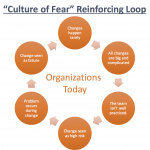 Many organizations today have a “Culture of Fear” about the network and network changes. The network is one of the most critical elements in IT, every other system relies on it for communications and to function properly, but it is seen as complex and fragile. In discussions with engineers, leaders, and executives from companies of all sizes and verticals, I have heard variations of the phrase “if it ain’t broke, don’t fix it”. Network changes are to be avoided if at all possible, and when they must occur they are subjected to rigorous, costly, and lengthy vetting. And despite this vetting, time and time again network changes are fraught with problems and unexpected impacts. The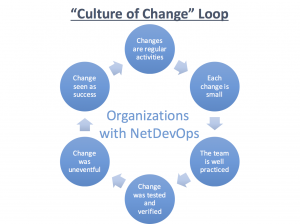
 NetDevOps Stakeholders