Avatar

I’d like to share some of my favorite things inside Cisco Digital Network Architecture (DNA). Before we get going, I thought it would be fun to just spend a moment on what DNA is, from a layman’s perspective. Cisco DNA revolutionizes the way you deploy and manage your network for the digital era through a software-driven architecture focused on automation, security, and analytics. The diagram below may not be perfect, but it should suffice to explain this perspective.
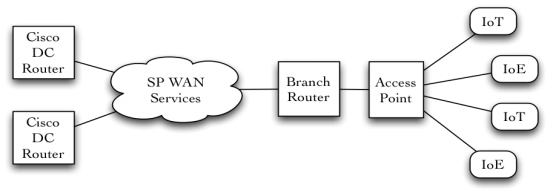
Picture1Cisco DNA creates a platform that makes it so you can connect everything from the data center to the IoT device, with security and high performance. Furthermore, the parts that are not readily apparent in a network diagram, are actually even cooler than the parts you can see. While all of the networking is handled superbly, in typical traditional Cisco fashion, there’s a few extra really interesting things that I want to talk about:

First, and my favorite thing in DNA, if you add CMX to this network, you can create indoor location services. Imagine you walk into a big hardware store, and you want to find the electrical expert. Now imagine that you bring up the store’s app, and you see a store map. The map has a blue dot showing where you are and a pull down menu to select what you want.  You select “Electrical” and up pops a dot showing where that expert is. You walk up and say, “Hey are you the electrical expert?” And, now you are connected! Fast and efficient, life made easier by a mobile application. Here’s the question: if you didn’t have a Cisco DNA platform, with CMX and its Hyper-Location services, how would you actually do that? Yeah, good luck, their locator feature doesn’t work like this.

Second, if you have a mobile application that requires some priority in the network, you can set that up lickity split with APIC-EM. Maybe you want to prioritize video over Wi-Fi inside the app and you want it to be high quality. Or, maybe you just want to push a bunch of data back and forth with high performance. Whatever the reason might be, if you want to make sure that when someone goes from using their phone as a guest, and then logs into your app, that their network traffic gets first-class treatment, APIC-EM can do that for you.

Finally, let’s talk about security. Cisco DNA has a robust set of security features designed into it. One example of that is Cisco Identity Services Engine (ISE). Cisco ISE is easily configured to work with your Mobile Device Management software and it has an API that makes it easy to use from within your mobile application. So, if you want your application to be secure, the DNA platform and its security APIs make that possible. Below, is a diagram of what that might look like.
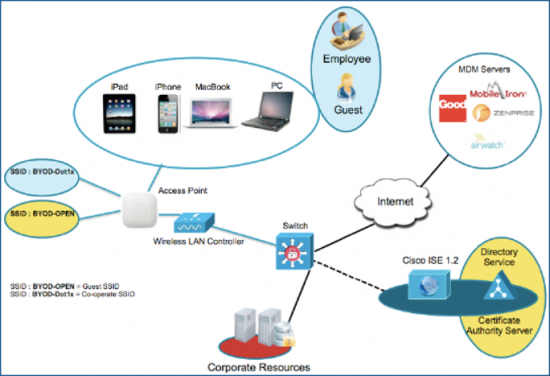
Picture2

Moving forward, I’ve just explained three elements of Cisco DNA, which can be utilized by a mobile application to make it more innovative, more secure or higher performance. What do all of these things have in common? They all have the high-level architecture diagram, below, in common. As you can see in the simple diagram, at the bottom of the stack is a Cisco DNA platform. Above that is the “middleware”, depicting the APIs that are part of Cisco DNA. And on top of that, is the application, which makes calls to the various APIs in order to work. Obviously, there are going to be other APIs, like customer databases, which are not part of DNA, required. But this platform, developers, is why you should check out Cisco DevNet – where you can learn all about these APIs.
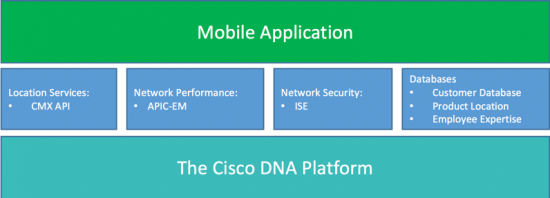
Picture3

For me, mobile application development is awesome. In one of my recent blogs, written to describe how partners could accelerate innovation with Cisco DevNet, I brought up this data point: The Global Center for Digital Business Transformation says that about 40% of businesses will fail because of digital disruption by 2020. The full report is available on their web site.
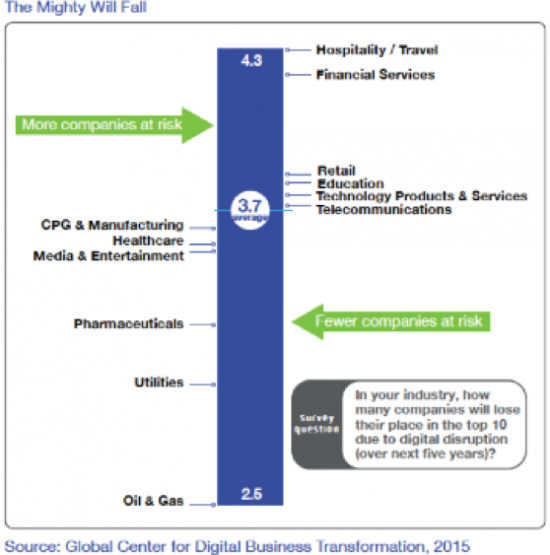
Picture4

We know this digital disruption is critical. But, what does it look like? Well, the way I see it, mobile applications are the primary way digital transformation is being done. As I’ve shown in other blogs; healthcare, retail and food services are all seeing heavy digitization via mobile applications. Auto insurance companies are also modifying the way you do business with them. I heard a commercial the other day where a woman “moved a tow truck 25 miles with a couple fingers”– using the insurance company’s mobile app to get a tow. At any rate, after 35 years in the technology industry, I’m just loving what companies are doing with their digital transformations – and how mobile applications improve my life.

I’ve discussed three specific APIs built into the Cisco DNA platform, which show how the network can truly be more than just the network. I’ve also shared some data that shows why innovating for your business is going to be crucial over the next few years. And finally, I’ve proposed an idea that this digital transformation is highly likely to need a mobile app. I think that’s adequate reason to see if the Cisco DNA platform might be just what you need to make your mobile application more innovative.

If you would like to take a look at these APIs, I would like to invite you to visit Cisco DevNet. That is where you can learn about these APIs and many others, which might help you you’re your digital transformation. If you want to jump right in, you can go directly to the APIC-EM, ISE or CMX pages on DevNet.

Thanks for reading. If you have any questions or comments, please leave them below or tweet me at: @coggerin.

Authors

Chris Oggerino

Technical Marketing Engineer

Enterprise Networking and Mobility

Avatar

No matter which lens you look through, it’s easy to see the importance of digital and the enormity of transformation taking place in the marketplace today. Both Gartner and Forrester predict that by 2020, 80% of the buying process is expected to occur without any direct human-to-human interaction. IDC says that the digital shift doesn’t only apply to B2C, with up to 92% of B2B buyers preferring to start their journey online. And when looking at digital preferences from a persona and organizational hierarchy perspective, SiriusDecisions says 34% of executive level buyers prefer to conduct online research before speaking with a colleague or industry analyst.

Watch the On-Demand Customer Success Talk webinar “Building a Foundation for Digital Engagement.”

While these indicators show how digital has become more relevant than ever in transforming customer engagement, we must keep in mind that none of these statistics hit the 100% mark. This will always be the case with digital transformation because every customer has their own preferences and is at a uniquely different point on their own journey. And that’s why we need to look at physical interaction alongside digital engagement as we optimize the way we reach each customer and strive, ultimately, to help them make more informed decisions.

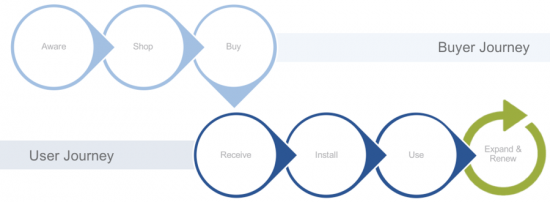
Determining the right approach for your organization requires that you evaluate customer experience and recognize that there are two personas in any customer lifecycle: the buyer and the user.

Jan17 in blog

Define Your Engagement Model

Historically, when we have talked about selling, the focus was mainly on the point of sale and then we would move on. Today, we’re focused on linking the buyer journey to the user journey so that we can effectively deliver a full customer experience, achieve customer value realization and drive loyalty after the sale. The challenge is using the right method(s) of engagement to reach the customer at the right time, with the right message for their stage in the lifecycle—using the medium or communication channel they prefer.

Bringing all of this together begins with data. At Cisco, we typically look at three data sources to gather customer insights: external listening (to determine propensity to buy, for example), enterprise data (purchase and service contract history, for example) and telemetry data (utilization rates and more). Once you thread all of these data insights together against a single customer view, you can then begin building an end-to-end engagement model that maps to the customer journey—across the second chance attach, adopt, expand, renew and refresh stages.

For your biggest accounts, a high-touch engagement model is best, and a moderate touch model is the right approach when greater scaling is required. At other times a low-touch automated model is the optimal strategy. Digital is embedded in all of these, and the challenge lies in finding the best mix of human interaction versus digital engagement (and that’s where ongoing data insights and measurement come in). Always, the goal is to move adoption to a healthy level as soon as possible, and to deliver value as often as possible.

If a customer doesn’t see value within 90 days, there’s only a 10% chance they’ll remain loyal, according to Totango.

At Cisco, we use marketing, sales and customer success technology platforms to provide a framework for our digital foundation and optimize the mix of digital and physical interaction across our customer engagement processes. All of these platforms are driven by an ongoing influx of data and at the same time help us to create a trigger-based journey for the customer.

Build Your Digital Foundation

As we’ve moved forward in our own digital journey at Cisco, we’ve recognized that the digital economy has made sales and customer engagement processes more complex – not less. But we’ve also learned that the rewards of adapting for this new economy are more than worth it: the payout is huge in terms of building customer loyalty and driving the kind of value realization that has an impact on customer success. And that’s why we want to bring our partners along on the journey with us.

To learn how to get started, watch the on-demand webinar, “Building a Foundation for Digital Engagement

Authors

Steve Cox

Vice President, Employee Experience

Avatar

If you’re looking for something to watch on Netflix, might I suggest Jack Taylor? For you Game of Thrones fan, it stars the lovely Iain Glen, who plays a fired detective turned private investigator.

Jack Taylor filming at Cisco Galway

My recommendation has everything to do with the fact that it’s set in Galway, Ireland, where I live (and where my Cisco office is!) Speaking of Cisco, I’ll just stop here to mention that one of the episodes was FILMED HERE ON SITE!

Jack Taylor filming at Cisco Galway
Filming “Jack Taylor” at Cisco Galway.

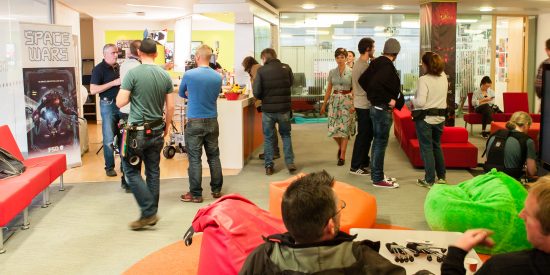
You see, I received an email from a TV production company based here in Ireland saying they were going to start filming Jack Taylor in Galway. To my excitement, the email also said that they were looking for a location that would serve as a young, dynamic, modern, hip, sophisticated, software company with attractive people (okay, I added the last one for fun) and they thought that Cisco Galway would be the perfect fit.

Um, yeah!

I could hardly contain my excitement (which had just a little bit to do with gorgeous Iain Glen, but more because it would be cool to watch a TV production being made on site at Cisco!) Maybe we would even get walk-on parts (and Oscar nominations.)

I spoke with the management team here in the Galway office, and they were as excited as I was. Because we ARE a young, dynamic, modern, hip, sophisticated office and it would also be a bit of fun. We told the production company that we were in!

The cameras arrived along with set dressing, props, makeup, wardrobe and the actors/actresses. Next thing we know, we’re a TV set for real!

Filming Jack Taylor at Cisco Galway
There’s “Jack Taylor” himself, with Cisco tech in the background.

All day, we would hear “rolling!” and “cut!” We did keep working in the background, but for sure, it was hard. Two of our Cailíns (that’s Irish for “ladies”) got asked to do a walk-on part. I kid you not, they were pure professionals. Though, all they had to do was walk by on their mobiles looking like engineers – our office is full of engineers, so the people here do that in real life every day! Filming went on all day and featured much of our Cisco technology – including the IX5000.

Jack Taylor filming at Cisco Galway
Just a typical day, posing with Iain Glen.

I just watched the episode where Cisco Galway was featured, and it was fun to relive the day in my mind again.

Cisco Galway is always exciting, but this was extra exciting. Something different is always happening here, and you just don’t know who you could meet in the office. 😉


Want to work at a dynamic, modern, hip, sophisticated company like Cisco? See opportunities here.

Authors

Sheila Greaney

Office Manager

Unified Communications Galway Dev Center

Avatar

In the new digital era, the ability to connect data, processes and experiences are becoming critical elements of successful digital business transformation.

Enterprises need to access data from anywhere, analyze it, and make real-time decisions to fuel innovation and accelerate data-driven business outcomes. A 2014 Cisco survey found that 40 percent of enterprises believe that most data will be processed at the network edge on smart devices by 2017.

Not surprisingly, the market for big data solutions is looking pretty robust. IDC predicts the big data and business analytics market will hit $203 billion in the 2020, up from $130.1 billion today.

New skills are required

To ensure continuous delivery of business-critical initiatives, you’ve got to have an enterprise-class data center.  A data center that is able to support new business models that use the Internet of Things (IoT), big data and cloud to modernize existing business critical applications, is essential. Such a next-generation data center requires people with next-generation skills.

Cisco is helping customers modernize their older IT infrastructures with a hybrid-IT solution that maximizes application performance, mitigates risk, and increases operational agility in order to guide their digital transformation journeys.  This requires a complete view from on-prem networking, and data center through to end points across the cloud infrastructure.

AR48426

Cisco’s architectural approach ties analytics, simplicity, automation, and protection (ASAP) tightly with a consistent policy across a hybrid cloud built with industry-leading data center networking, security, converged Infrastructures, and software-defined solutions.

Organizations are looking for skilled workers who can design, deploy and manage next-generation data centers and extract actionable insights from organizational data.

At the same time, IT professionals work to keep their skills in alignment with the demands of this new digital era. Cisco is continuing to enrich its certification portfolio in support of the latest skills and technologies needed for world-class digital business transformation.  

Uniquely qualified for today’s job demands

To upgrade data center architectures for the digitized world, data center and analytics professionals need a broader skill set that enables the next-generation data center, including policy-driven infrastructure, software-defined networking (SDN), unified computing, and automation and orchestration.

The demand for IT practitioners that are Cisco-trained and -certified in these rapidly-evolving fields cannot be overstated.

These next-generation data centers, like Cisco’s ASAP architecture, integrate data center and cloud offerings to deliver a consistent policy-defined model across the entire hybrid cloud, letting the company scale performance, mitigate risk and extract actionable insights through analytics.

AV31050

A new kind of benchmark

Today, Cisco is introducing a brand-new data and analytics portfolio that focuses on integrated data management and virtualization.

The new analytics training portfolio provides powerful skills for data professionals to connect data, processes and experiences to extract actionable insights. Beyond the new training being introduced today, we will continue to build out this portfolio to meet the customer and market demand.

In conjunction, we are also rolling out extensive updates to our data center certification portfolio. We have thoroughly revised the CCNA and CCNP Data Center certifications to skill professionals in key roles required of complex data center environments. The CCIE Data Center has been updated as well to include mastery of both foundational and evolving data center technologies, including IoT, network programmability and cloud.

These roll-outs are the latest proof points of our ongoing evolution of the Cisco certification portfolio to equip our customers with the skills they need to stay competitive and confident in today’s changing market.

These data center and analytics offerings supplement the recently introduced cloud, IoT and cyber security certification programs. Together, they help professionals manage and control enterprise-wide deployments in a secure and consistent manner.

Looking ahead

The results are faster deployments, more efficient data center operations and higher return on investment with IT infrastructure powered by Cisco-certified IT practitioners. And for the IT professionals, added confidence in new skills and abilities that support the organization on its journey to digital transformation.

I welcome your thoughts and feedback in the comments.

Learn more about the new analytics portfolio and the training options available today. To discover the changes to the data center certification portfolio, visit the following sites: CCNA Data CenterCCNP Data Center and CCIE Data Center. For more information about Learning@Cisco, visit our site.

Authors

Tejas R Vashi

Senior Director, Product Strategy & Marketing

Learning@Cisco, Cisco Services

Avatar

Tomorrow, more than 3,000 global leaders from business, government, academia, and civil society will convene at the 2017 World Economic Forum (WEF) Annual Meeting in Davos, Switzerland. Cisco will be in attendance, collaborating with other global problem solvers in strategic discussions about the political, economic, social, and technological transformations reshaping the world.

This year marks Cisco’s 15th as a WEF Strategic Partner, putting us in a group of 100 companies committed to improving the state of the world. WEF gives us the opportunity to build and strengthen the relationships that help us address some of the planet’s greatest challenges. This year’s theme is Responsive and Responsible leadership; the idea that global leaders can come together to promote inclusive development and equitable growth for all, as well as a more sustainable planet.

As Cisco CEO Chuck Robbins wrote in his recent WEF blog, “combining technological advances with innovative thinking can yield a wealth of possibilities, drive growth and value for companies, cities, and countries, and address a number of sustainability issues that affect millions around the world.”

Innovation is at the heart of Cisco’s commitment to accelerating global problem solving. We believe impact multiplies and innovative solutions arise when passionate people and transformative technology come together, which is at the core of WEF’s theme this year. Cisco’s commitment to building skills through the Cisco Networking Academy, investing in our nonprofit partners’ early-stage IT-based solutions, and applying circular economy principles to our business are a strong step in the right direction toward this goal.

On Tuesday, January 17, Chuck will participate in a live-streamed panel on The Future of Innovation at 8:45 am GMT (12:45 a.m. PST). He will join four other tech executives and industry leaders to discuss the major drivers transforming innovation globally and how they can prepare for the digital transformation.

A few other highlights of Cisco’s Davos engagement include:

  • John Chambers, Cisco’s Executive Chairman, will attend an informational gathering of world economic leaders and meet with WEF’s technology pioneers.
  • Cisco’s SVP of Corporate Affairs and Corporate Social Responsibility, Tae Yoo, will take part in the “Partnerships for Digital Development Special Broadband Commission.”.
  • Chris Dedicoat, Cisco’s EVP of Worldwide Sales and Operations, will serve as the “firestarter” for a panel session on “Accelerating the Circular Economy” and attend the Telecommunications Governors Meeting.
  • Kelly Kramer, Executive Vice President and Chief Financial Officer at Cisco, will be a participant at the “Wall Street Journal – CFO Network Breakfast”

By combining Cisco’s leadership in embracing digital transformation with Corporate Affairs’ focus on accelerating global problem solving, we are empowering a new generation with the tools and knowledge they need to innovate and change the world.

Collaborating at the highest levels of government and business to improve our planet is what the World Economic Forum is all about. We look forward to participating and reporting from Davos this week.

Please watch our video with Cisco CEO Chuck Robbins and SVP of Corporate Affairs Tae Yoo on the power of digitization to solve our world’s greatest challenges:

And please follow Cisco CSR on Twitter and use #WEF to join the conversation, or, follow the live stream on csr.cisco.com.

Authors

Kathy Mulvany

VP Corporate Affairs

Corporate Affairs

Avatar

Late yesterday, the U.S. Customs and Border Protection (CBP) agency revoked its November 2016 finding that Arista’s supposedly “redesigned” products don’t infringe a key Cisco patent.  You can read CBP’s letter of revocation here. The revocation covers all Arista products.  This means that Arista has lost the authorization to import or continue selling its products in the U.S., or to import components to build those products.

Arista has previously stated that it will fully comply with the ITC’s orders on infringing products. We therefore call on Arista to 1) stop importing its products or their components (we hope CBP will now commence seizing any products or components Arista seeks to import); 2) stop selling its products imported or manufactured under the authority of the now-revoked November 18 ruling; and 3) recall any products sold in the United States since the ITC exclusion order went into effect in August 2016.  All products sold since the ITC orders went into effect in August are infringing and continue to be subject to the ITC’s orders – our view is that the “redesign” is a sham.  If the ITC concurs that the “redesign” does not avoid the patent, our enforcement action that is pending before the ITC can result in Arista’s forfeiture of all revenue from the sale of products since last August.

As noted in earlier posts, Arista decided last year not to submit its purported redesign to the ITC where each side could present evidence, instead somehow believing that CBP would approve the redesign without a full inquiry. The revocation of the initial ruling that was in Arista’s favor shows that their bet that CBP would not do a full review did not pay off for Arista, a fact that other infringers should note.  Arista’s customers have been left bearing the risk of a potential dead-end deployment.

Yesterday’s revocation also brings into sharp relief the breadth of the court and regulatory findings that Arista has simply not told the truth in claiming its products were developed from a “clean sheet of paper”. For instance, even in deciding not to impose damages on Arista, a federal court jury in San Jose found in December that Arista had in fact copied Cisco’s user interface.  And a few weeks ago, in a separate ITC case, a judge found Arista infringed two additional Cisco patents. As in the earlier ITC case, where Arista demanded massive redactions before publication of the ruling, Arista in this case is also seeking substantial redactions, denying customers and investors the chance to see the full story of Arista’s pervasive culture of copying. We hope that investors and customers ask Arista to allow the complete rulings to be made public, and that the proceedings ahead provide the transparency needed for them to make informed decisions about the risks they run in doing business with a company built on misappropriation.

Authors

Mark Chandler

Retired | Executive Vice President

Chief Legal and Compliance Officer

Avatar

Happy New Year all!

As we settle comfortably into January, making the turn into 2017, we look forward to what the year promises. 2016 was a good year, with new models announced, nice opportunities closed, and new plans put in place. With new hopes at the start of the year, comes the refreshing excitement to start the year with a bang.

KQ58066

With this start, Nasser Tarazi, our Wireless Product Manager sent a video over for you all to take a look. Nasser, one of my favorite people in the world, had this to say:

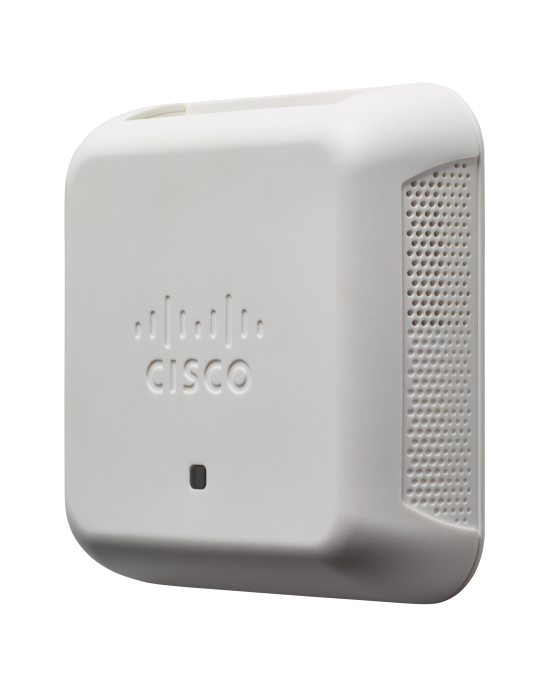
Hello all! Our team in Asia Pacific took this energy and come up with nice video on the Cisco WAP150 Access Point. The WAP150 is a Dual Radio AC/N Wireless Access Point. It is capable of up to 1.2Gbps!

The video shows what kind of performance this little box can do. Please take a look and let us know what you think!

https://www.youtube.com/watch?v=Fg_U_BjmaeY&feature=youtu.be

For more information on this dynamo:
http://www.cisco.com/c/en/us/products/wireless/wap150-wireless-ac-n-dual-radio-access-point-poe/index.html

From Marc, Nasser, the wireless team, and the rest of the Product Team,

Thanks for taking the time with us today.

Authors

Marc Nagao

Product Manager

Small Business RV Series Routers

Avatar

One of my favorite hobbies is trying out the latest new technologies and services.   I have an Amazon Echo and Google Home (patiently waiting on Cortana from Microsoft).  I ride-share, home-share, and even bike-share. For me, combining my work in digital transformation with retail and other consumer industries is one of the most exciting aspects of working at Cisco.

This weekend, I’ll be attending Retail’s Big Show in New York City – the National Retail Federation (NRF) Show 2017! More than 30,000 attendees from around the world will come together to learn about the technologies and solutions that are helping to redefine the shopping experience.

The holiday season just wrapped up, and results are looking up for retailers this year, with a 16% increase from 2015 in consumer holiday shopping, according to the International Council of Shopping Centers Post-Holiday Shopping Survey (ICSC). The ICSC report also stated that 91% of consumers are still buying at physical stores. Eighty-six percent of Millennials used their mobile devices while inside a store to compare prices, check inventory, look up discounts, and read reviews. Closing the gap and creating a seamless experience between the physical store and the omnichannel shopping experience has never been more important for retailers.

Right now, retail industry is seeing a dramatic shift in consumer shopping behaviors, preferences, and expectations. Today’s biggest concern continues to be how to appeal to and reach the digital consumer. Advancements in technology will continue to enable new business models and services that are relevant to the always-connected digital consumer.

According to eMarketer, US mobile commerce sales will see close to 50% increase year over year in 2016. New and engaging digital capabilities are not only necessary to enhance the overall customer experience, but they can provide great value in driving a retailer’s workforce productivity, new growth opportunities, brand value, and customer insights.

In today’s world, all industries are affected by digital transformation. According to our Digital Vortex research, retail is the third most likely industry to see major disruption. Retailers need to digitize their business in order to keep up with consumer demands, outpace the competition, and ensure they are not disrupted by online-only or omnichannel businesses who are adapting to digital transformation more quickly.

Cisco has the technology, services, and partners to help retailers to digitally transform their business. To see this in action, join us at Booth 1963 to see our Cisco solutions. And, be sure to join Cisco VP Inbar Lasser-Raab on Tuesday, January 17 at NRF, as she hosts Ratnakar Lavu, CTO of Kohl’s, and Denise Taylor, CIO of Westfield. In this one-hour session,  the panel will discuss how digital transformation is helping them achieve significant business outcomes, innovate faster, and engage customers in new ways.

Exhibitor Insights: How Two Global 1000 Retailers are Driving Digital Transformation

Date: Tuesday, January 17

Time: 1:30 – 2:30 pm

Location: Level 1, Hall A, 1A 06

We look forward to meeting you at #NRF17!  Visit our Cisco at NRF website to learn more. Follow us on Twitter: @CiscoRetail

Update (March 16, 2017): Ed was interviewed at NRF 2017 by Deal Crunch. Take a look at the resulting article, “Cisco Helps Retailers Ease Into the Digital Transformation: An In-Store Analytics Fabric Connecting Virtual Beacons, Mobile POS, and Digital Signage” written by Jon McDonald.


Authors

Ed Jimenez

Business Transformation Lead

Retail & Hospitality

Avatar

From cloud and mobile proliferation to smart cities and the Internet of Things (IoT), today’s digital technologies touch and influence nearly every aspect of the way we live and work. The insurance industry is no stranger to the impact of digital transformation. In the last few years, insurance companies have invested in applications, customer relationship management tools, and other digital solutions for supporting the expectations of the modern consumer. So what will the next few years bring for digital disruption in the world of insurance? How are insurers configuring existing agent distribution models to align with digital strategy? What’s the right approach to IoT?

Join us at 9am PST (12pm EST) on January 25th for our #CiscoChat, ‘Insurance for the Digital Era.’ We’ll answer pressing questions about insurance in the digital era and predict what’s on the horizon for insurers. During the chat, we’ll be joined by Cisco financial services experts including Rob Cornwell (@RobCornwell), GM FSI Market Management & Strategy Lead, Global Transformation Group, and Jeff Tumpowsky (@jefftump), Industry Advisor, Global Digital Transformation Group, as well as Tom Filep (@tjfilep), Industry Advisor, Global Digital Transformation Group.

To participate in the chat:
● Make sure you’re logged into your Twitter account.
● Search for the #CiscoChat hashtag and click on the Live tab.
● The chat will be moderated by D’Auria Henry on the Cisco Financial Services channel (@CiscoFSI) on Twitter. Be sure to follow the account to participate. They will begin welcoming guests at 9am PST (12pm EST) and posting questions for discussion.
● For @ replies to specific participants in the discussion, please use a “.” at the beginning of the tweet, so that your question or comment will appear in your public twitter feed.
● If you need multiple tweets to answer a question, please preface each tweet with “1A, 2A,” etc. in order to make it easier for others to follow along with the conversation.
● Be sure to use the #CiscoChat hashtag at the end of each tweet, so that others can find your contributions to the discussion.
Don’t forget to bring your own questions to the discussion as well! See you there!

Authors

Danny Vicente

No Longer at Cisco