Healthcare providers across the globe are recognizing the need for digital technology in their hospitals and practices. But with ever-tightening budgets and numerous priorities, where exactly should they focus their investments? What will really drive the most value?
In our report on Connected Futures, we shared the latest research on just that – the economic analysis of the Digital Value at Stake. The study shows that the biggest impact comes from digitizing the ways clinicians, healthcare workers, and administrators do their jobs.
Check out the infographic below for highlights from the report, and learn more about our offerings for healthcare providers.
The application development landscape is changing. Innovation that has its roots in startups, APIs, cloud computing, containers and microservices is quickly making its way into the enterprise and into verticals such as manufacturing, healthcare, retail, and transportation.
IoT and Edge computing offer developers indoor location data, and IoT sensors with real time data analytics.
Using voice and chat as an interface for IoT offers an ease of connection between the user, the physical world and the cloud that has never before existed.
IT and network operators are using automation and orchestration to deliver high performance, scale, and built-in security.
New programmable infrastructures make it possible to extend DevOps toolchains and concepts to the infrastructure and network layer.
We are launching DevNet Create to bring together the application developers, infrastructure engineers, designers, innovators, DevOps engineers and IT Pros who want to define and build this new landscape.
DevNet Create (details below) is are developer conference where you can challenge, discuss, and create.
What is DevNet Create
DevNet Create is hands-on. We love to see code and demos whenever possible.
DevNet Create is about practical lessons learned and your experiences in the real world.
DevNet Create is about what is possible or almost possible.
DevNet Create is about finding other people who are working in the same areas as you and sharing your passion.
DevNet Create is a 2-day conference with the following types of sessions:
Learn: 45 minute classroom sessions that teach a specific technical skill or concept. Working code and demos encouraged. Even better if the participants get to be hands-on in the session.
Code: Online Self-Serve Tutorials. We will be accepting a limited number of outstanding tutorials by guest authors featured in the DevNet Community Learning Tracks. These tracks will be available during and after the conference.
Inspire: 30 minute Use case, lessons learned, thought leadership talks. Tell your story and inspire others.
Connect: Want to start a community around a topic you care about? We will be hosting a number of Birds of a Feather Connect groups at the conference.
DevNet Create is also about continuing the conversation after the conference. So we have a focus on creating ways you can easily share tutorials, and continue developing with your colleagues after the conference.
How can you contribute to DevNet Create
The Call for Papers (CFP) will open next week and we encourage you to submit. We welcome first time speakers! Below are some of the topics we hope to see at DevNet Create.
How to Design and Build APIs
Where Apps meet Infrastructure
Where Infrastructure Meets Apps
Software Defined Networking
Cloud Native, Containers, and Microservices
Bots, Chat, APIs and Enterprise Collaboration
IoT & Edge Computing
Security for Apps and Infrastructure
Industry & Vertical Solutions
Multimedia, AR/VR, Next Generation Interfaces
Analytics & AI
UX & Design
Be a part of the community that builds the new technologies, protocols, architectures and designs that define this new landscape.
Join us at DevNet Create 2017 in May. Be on the lookout for the Call For Papers (CFP) next week. See you at the event!
Get a head-start! Create or update your account at developer.cisco.com. Check out our latest TechWise TV video to learn more about @ciscodevnet
Primary Author Bio – Lori MacVittie is responsible for education and evangelism of application services available across F5’s entire product suite. Her role includes authorship of technical materials and participation in a number of community-based forums and industry standards organizations, among other efforts. MacVittie has extensive development and technical architecture experience in both high-tech and enterprise organizations, in addition to network and systems administration expertise.
After a year, I am happy to back to Cisco Data Center blogs. And this time, I want to talk about DevOps.
While most of the world focuses on the digital transformation of businesses, a complementary and just as critical effort is underway within the card-key, access only halls of the data center. That transformation is also digital in nature, focusing on moving the burden of complicated network and app service deployment processes from people to technology. Technology that relies on programmability.
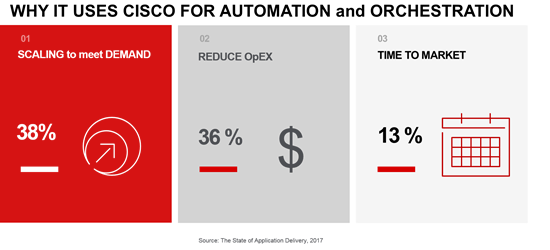
In the past year, the percentage of organizations using tools and frameworks to digitally transform IT into a lean, mean deployment machine more than doubled, rising from around 20% to nearly 50%. Amongst those benefiting most from that rise is Cisco, whose platforms saw its usage more than double. And not just with infrastructure and network oriented folks. Every role – from application development to security – shows a strong preference the use of Cisco’s toolsets to automate and orchestrate the deployment of network and app services necessary to ensure faster, safer application experiences for users.
Programmability implies APIs today, and that’s a good place to start. The API is the new CLI, and enables faster, smarter integration across IT in order to automate the processes that drive the deployment of everything app-related. The majority of IT recognizes the importance of programmability in general and in particular APIs; it was considered more important by only 32% of folks in 2016, but in 2017 shot up dramatically 20% to a whopping 52% of respondents in F5’s annual State of Application Delivery survey.
While DevOps focuses heavily on improve time and frequency to market by adopting application methodologies and continuous integration/delivery, NetOps has more pressing concerns that is no doubt behind these dramatic shifts in how programmability is viewed within the data center. Those concerns are primarily focused on scale and costs. Indeed, though much digital ink is given to the dearth of security talent available, little mention is given to the same deficit that exists across IT, particularly for those with IP networking skills. That gap was noted by the Global Talent Competitiveness Index 2014 at 1.2 million in 2015 and there is little chance that gap will close any time soon. In fact, Eric Roberts, former Stanford computer science department associate chair, estimates there will be a million more jobs than computer science students by 2020 (source: code.org). Which means there aren’t likely to be enough folks with the skills needed any time soon.
These are the skills that every NetOps must have whether they’re deploying network services or application services such as load balancing, app acceleration and security, or protocol gateways. Yet that deficit will undoubtedly hinder growth of the entire business. It doesn’t matter how fast app dev can build and deliver an app if production processes remain the purview of manual processes executed by a limited set of NetOps.
This is why programmability is the future of NetOps. Not because it’s going to replace them. On the contrary, there are not enough talented NetOps out there right now to fill the consoles necessary to scale to meet the demand created by business’ digital transformation efforts. No, programmability is necessary for NetOps to scale to meet demand by enabling automation and integration of the deployment processes required to implement continuous deployment’s “last mile” – the network. APIs – and increasingly templates – are critical pieces of the programmability toolset that provide the means to integrate systems across various production domains (network, security, compute, storage). They enable IT to automate the processes that provision the unique set of services each application needs to be safe, to scale to meet demand, and to execute with the responsiveness necessary to maintain the attention of an 8 year old.
Lest you think programmability has little to do with the speed of those deployments, let me assure you it does. It may not be the primary goal driving IT to digitally transformation itself with APIs and templates, but it’s a welcome and desirable side effect. Automation and orchestration of production processes necessarily compresses the time required to execute on them, which means they happen faster and, one might also conclude, more frequently if desired.
Programmability is the future of NetOps – and the network – because we’ve reached a critical tipping point in IT. We’re no longer just supporting the business, in many cases we are the business. Business lives or dies, succeeds or fails based on the ability of IT to deliver apps that scale on demand, secure data, and perform with alacrity. To deliver that at the speed of business today means not just adopting but embracing programmability to automate and orchestrate as much of IT as is possible.
I will be back in near future with a continuation of my passionate experiences with DevOps.
Customers are increasingly expecting flexible, on-demand services. Changing your network through virtualisation is key to being able to meet these demands
These days, people’s lives are busier and less predictable. Circumstances change quickly, and plans can be adjusted just as fast.
To meet this situation, we are seeing huge growth in on-demand services provided through apps. Whether it’s taxis, cleaning or laundry, it’s now possible to order what you want and receive it within minutes.
And what’s true for consumer services also applies in the world of networks. Service provider customers want flexible, convenient products that can be scaled up and down quickly, and are available at a moment’s notice.
This presents a great opportunity. But if providers try to offer this kind of service using their existing infrastructure, they’ll quickly become overwhelmed.
That’s why major players such as AT&T, Verizon, and Deutsche Telekom are making big investments in virtualising their networks.
These companies know that virtualisation is the key to being able to offer customers agile services. Technologies such as orchestration, automation and virtualised infrastructure can be used to transform network operations.
They make it possible to create bespoke services and deploy them rapidly.
Agile services, agile network, agile organisation
The idea of agility runs through all of virtualisation.
The reason it enables service providers to offer more agile services is that the functioning of their network also becomes more agile.
This makes it much easier to create and deploy new services. And to succeed in using an agile virtual network, your organisation will need to change its way of working, so it also becomes more agile.
There should be people on your team who understand the technical aspects of virtualisation.
But it’s not just about technology – it’s also to do with ways of working. You’ll need to think differently about how your organisation operates, and break down traditional silos.
Your employees will need to be familiar with more fluid approaches, like Agile and DevOps, which involve more collaboration and continuous, fast iteration.
You should be aiming for a dynamic environment that enables your network to easily launch and test new functions.
And you’ll also need to think about effective security practices in a virtual network environment. Agile doesn’t mean less secure.
Developing a strategy for virtualisation
All these considerations and more need to be brought together into a comprehensive strategy.
You’ll need to make sure that processes, tools and structures are all aligned. And the nature of virtualisation means it’s likely you’ll need to maintain the new virtualised infrastructure next to the existing platform.
This will create a hybrid setup that draws on both virtual and physical resources.
Get the most from your investment
So there are certainly a lot of things to think about. That’s why so many service providers rely on our expertise, giving them the confidence that their investment in virtualisation will really count.
Virtualisation means transforming a whole organisation. And there are as many different ways of implementing it as there are service providers. But whatever you do, don’t let the scale of the challenge put you off, because the biggest cost would be not to do it at all.
This is one opportunity that you really don’t want to miss.
Find out how virtualisation can help you transform your network and create agile, bespoke services to meet your customers’ expectations. Read more about the Cisco Network Services Orchestrator.
Key takeaways
– Service provider customers are increasingly expecting flexible, on-demand services.
– Virtualisation enables providers to transform their network, bringing the agility necessary to meet these new expectations.
– To succeed in using a virtual network, organisations will need to develop ways of working that are just as flexible.
– Staff will need to be familiar with working approaches like Agile and DevOps, which allow rapid iterations to be made to systems.
– Virtualisation is no simple matter. It’s worth getting expert advice to make sure you get the most out of your investment.
I’ve spent a lot of time hearing from our customers about cloud adoption and there are three things they all agree on: (1) it’s essential to digitization, (2) not everyone starts the journey in the same place, and (3) there is no one-size-fits-all strategy. Some customers need support for new cloud native as well as older technologies like bare metal, multiple types of virtual machines, containers and clusters, and open technologies. Most want to balance private and public cloud but have valid concerns about security and control. And others have added cloud capabilities and now want to scale in order to provide more value for their own customers. There are many reasons and varying starting points at which customers adopt cloud, but rarely is it “point A” to “point B.” Regardless of the starting point, enterprises are looking for flexibility, openness, and options. They don’t want just a roadmap – they want the tools for successful digital transformation.
Many customers have resolved to do more with cloud in 2017. To be successful they will need a complete strategy that takes in to account the starting point of the journey, identifies business outcomes, and connects the right tools for successful digital transformation. In today’s multicloud world, the difference between success and failure can come down to a piecemeal strategy that fails to recognize a company’s unique requirements or potential roadblocks along the way.
Cisco is all about cloud. Everything we do is tied to cloud and enabling capabilities that our customers and partners need in today’s digital world. We cover the complete landscape, including data center, private cloud, hosting and colocation, public cloud, and the edge and IoT. And we are continually innovating and expanding our cloud offerings to meet demands and provide the freedom to choose the best environments and consumption models for our customers.
Over the next blog posts, I look forward to diving deeper in to our offers and sharing what some successful companies are doing to drive better business outcomes with cloud.
I want to hear from you. Have you resolved to transform your business to digital this year? How’s that going?
What do the Kansas City Royals, Pittsburgh Penguins, and Leicester City FC have in common? If you guessed they were all league champions in 2015 or 2016, you’re right. But in addition to winning it all, each had an abundance of team chemistry.
Yes, chemistry. As every sports fan knows, talent wins games. Chemistry wins championships.
Chemistry bonds players from different backgrounds and experiences together, uniting them in a common goal. More often than not, it makes the team more than the sum of its parts. While it’s true the teams listed above had talented – and, in some cases, all-star – players, none were considered the most talented in their league.
Photocredit: nbamixes.com
If talent alone equaled championships, the Miami Heat would have won every season LeBron James played with Dwayne Wade and Chris Bosh.
Without chemistry, success is possible – but not plausible.
And just as chemistry elevates a team’s performance, a digital network – the routers and switches that move data – elevates a business’ performance. In manufacturing this is especially true on the plant floor, where the network is the foundation of Industrie 4.0 (also known as the Industrial Internet of Things).
Consider that the right digital foundation elevates your plant floor into a place where you can improve inventory management, streamline operations, better secure intellectual property, reduce waste, and reduce unplanned downtime. And that’s just to start.
Simply put, a digital network makes it possible to achieve things you never thought possible in your factory.
But team chemistry isn’t always easy to achieve. In fact, it can be like trying to catch lightning in a bottle. Striking the right balance is key and deliberate decisions are required if a team wants to win it all.
The same is true when laying the foundation for Industrie 4.0. It’s important to consider factors such as how simple your network is to manage, as well as whether it will meet your needs in 10 years, before making a purchasing decision. Otherwise you might have to start all over again real soon.
One of my favorite examples of the difference the network can make is our work with Rockwell Automation for Daimler Truck North America (DTNA). With a Cisco network as the foundation, DTNA has been able to increase agility on the plant floor, maximize uptime, and reduce operating costs. For example, through the wireless network DTNA can perform remote diagnostics via video and troubleshoot issues in real-time.
Watch the video below to learn more:
https://www.youtube.com/watch?v=zi_Y1zYnALg
If you’re ready to take your plant floor to championship heights, we can help. Leave us a comment below and check our website:
Over the last two years the blockchain space has evolved at a fevered pitch. We have seen new business models emerge, new approaches to old problems, and numerous business pivots. We have also seen a number of announcements of early adopters making fantastic progress in vetting and proving the technology in some really great use cases. One thing for sure is, there is a lot of excitement about this technology, and also some healthy skepticism. We are definitely seeing some barriers fall, but in all the excitement, we may overlook new barriers that arise as a result of disruptive innovation—including the interoperability challenges of all these new solutions.
On January 27, Cisco joined some of the industry’s most innovative blockchain startups and enterprises in announcing the Blockchain IoT Protocol Initiative. This consortium is dedicated to ensuring interoperability among multiple blockchains. It represents a major step toward meeting the challenges of deploying blockchain technologies at a global scale in a decentralized and heterogeneous competitive and operating environment that bridges physical real world assets and their digital representation.
Blockchain transactions involve multiple, diverse networks.
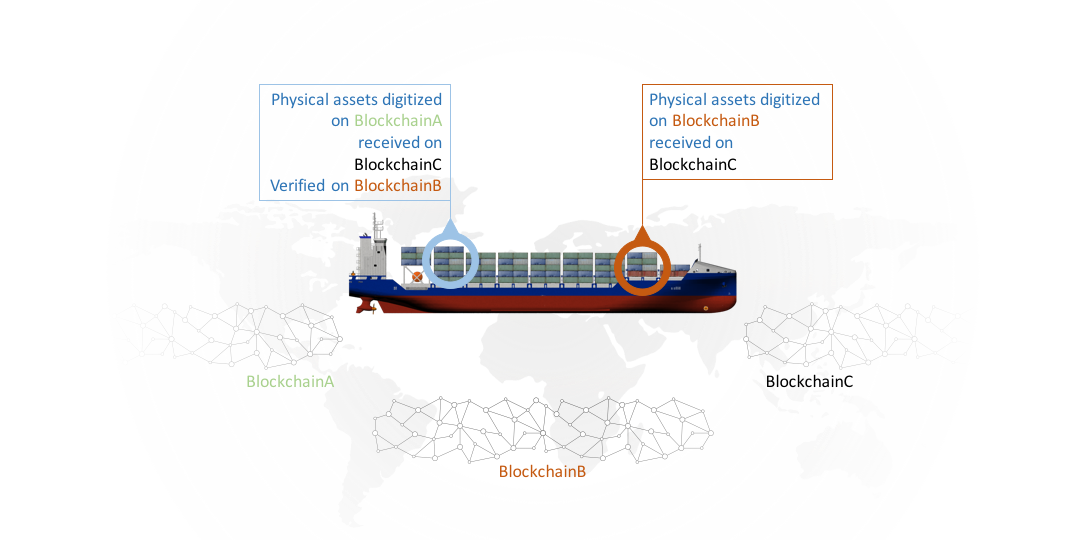
A standardized approach to interoperability is needed for blockchain to be effectively used in such an environment. For example, blockchain can take the friction out of supply chain processes, providing traceability and auditability of parts and components throughout the product life cycle—but only if different blockchain networks can talk to each other. A container ship may carry a variety of goods governed by different block chain networks and different “smart contract” solutions. The various ports along the ship’s journey need to have interoperable solutions that record the transactions of offloading the goods from the ship to a truck, and again when final delivery and payment are made. Today, blockchain solutions are being developed so rapidly by so many different parties that without standards, incompatibility is a virtual certainty.
“It is safe to assume that this industry will evolve to have many, many blockchain networks,” Maciej Kranz, Cisco’s vice president, Corporate Strategic Innovations, commented after the announcement. “The ecosystem of workflow specialists and application developers will continue to grow over the coming years. As this evolving network environment becomes even more complex, the Blockchain IoT Protocol Initiative will lead the effort to ensure interoperability.”
Those that have been following the evolution of blockchain technology closely will know that it promises to deliver an immutable operating environment where multiple parties can interact with data objects in a manner that is not only highly secure, but also tamper resistant and tamper evident. Blockchain technology records transactions globally, and can easily observe and identify manipulations, malicious or otherwise. The goal is to increase secure and confidential value flow in order to reduce the complexity of establishing and maintaining trust across multiple parties. This ability will bring about dramatic changes to the auditability, forensics, and real-time operations of workflows that involve a multitude of actors, each with their own administrative domains.
The consortium is about to undertake work to explore how to drive the interoperability of digitized physical assets created in one blockchain solution and transacted or received by a completely different blockchain solution. By addressing the challenges of interoperability, the group aims to identify a common model at the intersection of IoT and blockchain that ensures contiguous resiliency and trust, while at the same time removing potential barriers to adoption.
The newly announced consortium is one of many factors coming together to accelerate the development and adoption of blockchain technology. The journey is starting, and Cisco is excited to be a part of it.
The media and entertainment industry is struggling to deal with piracy. While investment in content protection technology is growing, determined attackers always find a way to extract content. Once the content is out on file sharing networks, there is very little that can be done to block its redistribution.
But for live content the story is a little different. Live content has a unique property – it is very valuable for a limited period of time and its value diminishes very quickly afterwards. If you manage to protect your content during its live airing, then you secured most of its value. Additional factors that make live content piracy different are the fact that devices used to pirate the content are actively connected to the legitimate service, which means that some measures of control are still available to the authorized distributor of the content. And pirates are limited in the ‘anti-anti-piracy’ measures they can employ, because the content must go out to their unauthorized viewers with as little delay as possible.
To protect live content you need a concerted effort to monitor illicit streaming sites and subscription-based networks to locate your content during its live airing, identify the devices on the legitimate service being used to source the content and quickly shut down those source devices. Tight integration and automation of these three steps enables the real-time response which is the key to achieving measurable results.
An effective monitoring system for locating illicit content requires a combination of expertise and technology. You need experts to collect intelligence from dark forums where pirates share knowledge and trade content, and to locate where pirated content is on offer. This intelligence can then be fed into a monitoring technology that can sift through a large number of illegal streams in real-time to find your content.
Once you’ve identified content that you suspect is being sourced from your service, you need to identify the devices responsible for leaking it. Forensic watermarking is the technology for the job, but not all watermarks are the same. The better known watermarking technologies in the market today are very robust against attack and maintain high picture quality (i.e. imperceptible), but they require many minutes of video in order to extract a unique identifier from the video stream. For live events, where detection time is of critical importance, this is not good enough. What is needed is a watermarking technology that can detect in seconds – not minutes – even if it means that it might not meet the highest standards for imperceptibility.
Like most security technologies, forensic watermarks are not a silver bullet. You should expect that a skilled and determined hackers will find a way to defeat any given watermarking technology. So in order to stay on top, you need a set of watermarking technologies and a system that can switch between technologies, so if one is compromised, you can quickly swap in another. Using an adaptive watermarking solution will ensure the long term effectiveness of your leak identification efforts.
When the identity of the device responsible for leaking your content is known, you need to take swift action to block it. Blocking can be done through the video security system, but like watermarking, not all video security systems are suited for the job. The security system needs to be able to effect a real-time (or near real-time) rights revocation action in order to block leaking devices. But most video security systems are not built with this job in mind and therefore not equipped with mechanisms for real-time revocation/blocking actions. This is especially true for systems protecting OTT content. So to close the loop on piracy, video service providers need a video security system that can effect real-time control over rogue devices.
Finally, integrating the pieces and enabling automation is not just a means to save cost, it is what enables the anti-piracy system to disrupt the unauthorized redistribution in real-time, and frustrate the consumers of illicit live content. Locating the content, identifying its source and blocking the leaking device needs to happen quickly and continuously. This can be done only through tight integration between the different technologies at play and automation of the process end-to-end.
Cisco’s Streaming Piracy Prevention service has been proving out in the field the concepts outlined above and helping Cisco customers fight piracy. For more information you may read our blog on Streaming Piracy Prevention.
Change is never easy. And network management teams are facing unprecedented change as Service Providers are under pressure from their enterprise customers to deliver and support more agile service offerings. New technology innovations like programmable networks and network functions virtualization (NFV) can give service providers the operational agility and increased scalability needed to meet these growing demands and for providing the true end-to-end digital experience that users seek. However, these same technologies—especially NFV—can make service design and delivery vastly more complex.
So, how can SPs position themselves for success by driving automation and agility approaches to network management? Choosing the right automation and orchestration solution here is crucial to maximizing on these technologies but can be challenging and often bewildering.
Fortunately, there is new industry guidance available to help SPs select the path to make even the most advanced network evolution a lot simpler.
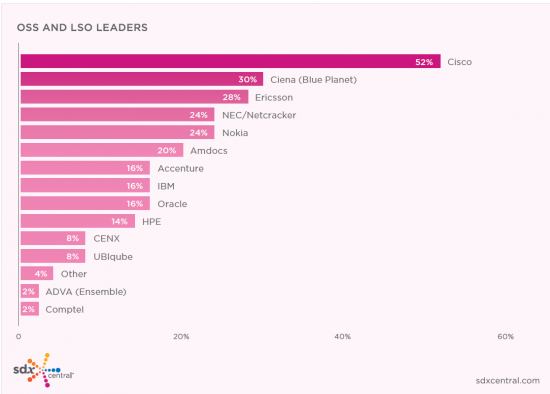
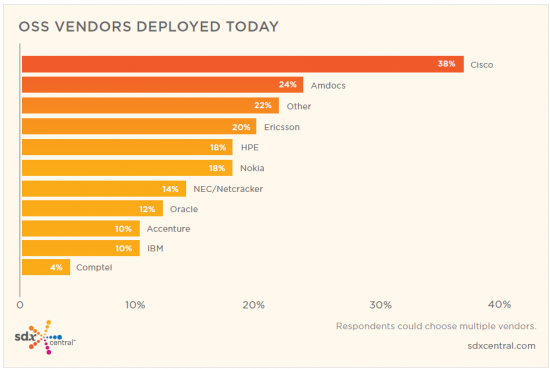
The market has voted Cisco NSO as the clear market leader in the LSO & Next Gen OSS space according to a new survey by SDxCentral, the trusted news and resource site for SDx, SDN, NFV, Cloud and Virtualization Infrastructure.
The SDxCentral research team asked a variety of SP and Enterprise customers key questions regarding next-generation operations support systems (OSS) and lifecycle service orchestration (LSO) software. The survey defined LSO software “as integrating OSS systems with software-defined networking (SDN) and network functions virtualization (NFV) to deliver automated provisioning, management, and monitoring of network services.”
When asked which vendors they considered leaders in the next-gen OSS and Lifecycle Service Orchestration (LSO) software space, Cisco was selected overwhelmingly by customers over other competing vendors in the space.
When asked which OSS vendors their organizations were currently using, Cisco came out on top again.
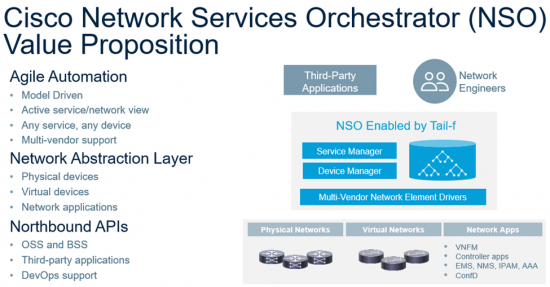
A key factor behind Cisco’s leadership in the LSO space is Cisco® Network Services Orchestrator (NSO) enabled by Tail-f®, the most advanced and flexible service orchestration platform in the industry. It provides end-to-end lifecycle service automation to design and deliver high quality services faster and more easily. Leading Service Providers, such as Level3, Equinix, and SoftBank, are increasingly leveraging the advantages of Cisco NSO to provision, manage, and assure services end-to-end across their networks.
What makes NSO standout?
NSO is entirely model driven. NSO lets you create and change services using standardized models without the need for time-consuming custom coding or service disruption, as well as, solving the challenge of massive scalability. You’ll gain the agility you need to bring services to market ahead of the competition.
NSO is unique in that it works in multi-vendor environments and technology stacks delivering consistent, seamless performance across a broad scope of environments. We have the broadest multivendor support in the industry and constantly adding new vendor drivers to the platform. Our NSO solution works with today’s legacy network challenges, such as layer two or three VPN provisioning as well as next generation networking based on NFV and SDN.
NSO offers full life cycle management supporting creation, updating, and deletion of network services.
NSO also provides transactional integrity which ensures fail-safe operations based on real-time view of the network. If something happens such as a device failing to update, NSO makes sure the network manager has a reliable rollback path and meet even the most stringent service-level agreements.
NSO is a fully proven solution with 10 years of experience, running right at scale now in a diverse set over 70 global customers’ networks worldwide spanning major Tier 1 services providers to large enterprises, cloud smaller providers, and larger enterprises in the financial services segment.
So, if you are looking to achieve true service agility through network automation, go with the market leader and choose Cisco NSO. Extract simplicity and take cost out of managing your network!
Find Out More
To find out what Cisco Network Services Orchestrator can do for your business, visit www.cisco.com/go/nso.
And for more details on SDxCentral’s 2017 Next-Gen OSS and the Rise of LSO Report, the download is available here.
If you’re joining us in Barcelona for Mobile World Congress on February 27 – March 2, 2017, visit the Cisco booth which will feature a demo of Cisco® Network Services Orchestrator (NSO) enabled by Tail-f®.















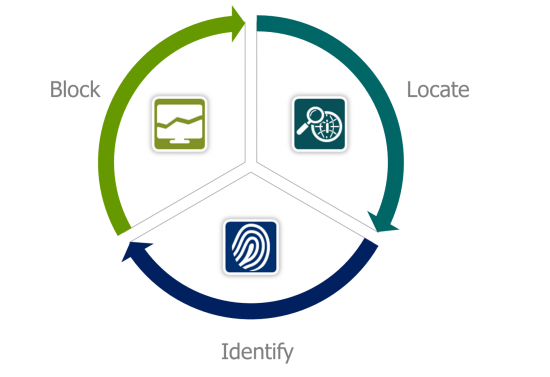 To protect live content you need a concerted effort to monitor illicit streaming sites and subscription-based networks to locate your content during its live airing, identify the devices on the legitimate service being used to source the content and quickly shut down those source devices. Tight integration and automation of these three steps enables the real-time response which is the key to achieving measurable results.