Talos has observed a small email campaign leveraging the use of Microsoft Publisher files. These .pub files are normally used for the publishing of documents such as newsletters, allowing users to create such documents using familiar office functions such as mail merging. Unlike other applications within the Microsoft Office suite, Microsoft Publisher does not support a ‘Protected View‘ mode. This is a read only mode which can help end users remain protected from malicious document files. Microsoft Publisher is included and installed by default in Office 365.
The file used in this campaign was aimed at infecting the victim with the, well known, Pony malware. Whilst Pony is well documented in technical capability it has not been known to use the .pub file format until now. Pony is a credential harvesting piece of malware with other trojan capabilities. In addition to credential harvesting, it is also commonly deployed as a malware loader and used to infect systems with additional malware in multi-stage infection chains. Pony is still used heavily as the sources of multiple Pony versions leaked thus making it much easier for other malicious actors to implement Pony into their infection chain.
Over the decades’ many songs have been written about Germany’s capital city with one song stating that “Berlin ist eine Reise wert” or Berlin is worth a visit. I have been to Berlin a few times and agree if your time allows I encourage you to explore the many sights and attractions the city has to offer. With Cisco Live EMEA 2017 happening in Berlin from February 20 – 24, one additional attraction and reason to visit is just around the corner and you may want to register and book your trip ASAP. Whether you are alumni (aka a NetVet) or a first-time attendee, we want to make sure that your experience is like our motto says: Your Time is Now.
In this blog, I’d like to be your tour guide for our Data Center activities and learning opportunities for you to make the most of your time while attending this year’s event.
On Tuesday, February 21, after catching the opening keynote‘Future Proof Your Business’ from 9:30 to 10:45 a.m. make sure you block your calendar from 2.15 to 3.45 p.m. as you don’t want to miss the ‘Next Generation Data Center’Innovation Talk [Session ID: INTGEN-2002].
Click on banner for schedule of all Keynotes and Innovation Talks
Cisco is Your foundation for Digital Transformation, see here for more information and customer stories that have made the journey with us. Berlin itself has undergone tremendous change over the years and is constantly reinventing itself which makes it worth a (repeat) visit. With digital disruption redefining what it means to be successful for industries and companies, states and cities, the city has its own Center for Digital Transformation. While with that many sessions and opportunities to learn, network and engage, you probably don’t want to venture too far from the Messe Berlin grounds during the week of Cisco live.
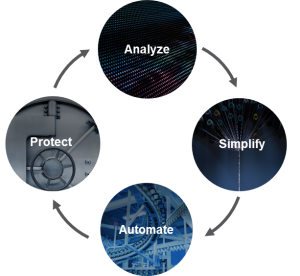
I encourage you to not only attend the above-mentioned keynote and innovation talk but also the over 200 Data Center sessions overall and to see us in the World of Solutions to find out more how Digital Transformation starts with an ASAP Data Center. ASAP stands for Analyze, Simplify, Automate, and Protect.
The article Why Data Centers Are More Important Than Ever introduces the importance of a consistent policy model for analytics, simplification, automation, and protection in the ASAP data center. I recommend to read it before your trip to Berlin.
Let me highlight the Product or Strategy Overview (PSO) sessions among the many Data Center sessions to help you plan your days. Click on the Session ID PSO number to enroll:
Learn with hands-on solution demos, check out latest products on display, interact in the education zone and get a T-shirt, play games, and sign up for a DC User Group
Days and Hours:
Tuesday: 10:30 a.m. to 7:30 p.m.
Wednesday: 10:30 a.m. to 7:00 p.m.
Thursday: 10:30 a.m. to 5:00 p.m.
Cisco Live delivers education and inspiration for technology innovators worldwide. Join us and transform your outlook, your career, and your potential with 5 days of education, networking, and fun!
Cloud.
The teenager’s internet.
The celebrity’s nightmare.
The IT salesperson’s most favorite or most hated word, depending on where you work.
The Cristiano Ronaldo of IT.
(true reaction of CEO after reading memo from CIO on Cloud)
We are living in one of the most exciting and interesting times ever for Information Technology. Capabilities, roles and processes are transforming organisations. Entire industries are being reshaped – including the IT one. Perspectives are being redrawn.
Everyone has a different definition on what “the Cloud” is, depending on where his or her view is from (this blog is not about providing yet another definition by the way – although there will probably be another one on that, most likely talking about the links withSOA 😊).
The challenge here comes predominantly from our human, our instinctive desire to turn intangible concepts into something tangible in an effort to understand them better.
Well, it’s not that simple any more for IT, given the pace at which the industry is driving. Sorry.
Yet, there seems to be this perception that if you don’t have a “Cloud” these days, meaning a website that someone can connect to or a list of services you offer that they can consume easily with a credit card, then you missed your chance to get attention in an elevator ride.
You are out of the “cloud game” apparently, if you are not able to respond quickly to the following questions:“Where is your cloud? Can I see it? Can I access it?”
Fair points and indeed, not being able to “showcase” your cloud in a simplistic way could be considered a big issue if you arejustin the business of selling your “cloud” to customers or your specific type of cloud functionality, I guess.
But Cisco is not in the business of selling our “cloud.”
We’re in the business of helping and enabling our customers to navigatea multi-cloud world.
And there is no right or wrong approach. There is no single secret recipe. There is no one website. Every business, every environment (especially in UK and across Europe) is different. This is why every organisation should adopt a different approach. Different use cases to achieve their goals and associated strategies. Not just for cloud, but also for any other paradigm out there, aligning business and technology in order to maximise value.
Rather than a “cloud” to sell, Cisco has a wide portfolio of cloud-enablingproducts and services from the network layer up to public cloud (actually, evenin public clouds), as a result of years of engineering and investment in organic innovation and via acquisitions.
The above, along witha brave culture of not being afraid to “fail fast” rather than not trying at all– unique value for a company of Cisco’s legacy and size, in my opinion – position us amongst the leaders in the cloud space.
Ultimately,the “cloud” does not define us and it should not define us.
Enabling our customers to accelerate their cloud and digital transformation with our partners is.
That is what Cisco stands for.
Taking the first step towards your unique cloud (or digital transformation or… [insert latest hype word here]) journey is simple. Cisco has partnered with IDC to develop a unique, vendor-agnostic framework for you toassess your organisation’s cloud maturity, discover practical insights on what your competitors are doing with cloud, so you can get started with your using solid, down-to-earth advice.
Try ithere– And please stay tuned forthistoo – not to mention more updates on our own cloud journey!
A friend and colleague suggested an awesome book to me last week called Winning the Brain Game: Fixing the 7 Flaws of Thinking. Although the book focuses on limitations in our thought process, I could see how these same flaws are perfectly applicable to innovation initiatives at companies of all sizes and scope.
What follows are some of the parallels I discovered.
Flaw 1: Leaping
One of the most common human tendencies is to propose conclusive solutions without taking the needed time to understand the situation completely. Innovation often undergoes a similar fate without appropriately framing the context. “We’ve never done it this way.” Or, “We’ve always done it that way.” These are classic innovation inhibitors.
Flaw 2: Fixation
This is a generic term representing what Stanford psychologist and renowned author Carol S. Dweck calls “fixed mindset” in her bestseller Mindset: The New Psychology of Success. Some sort of mental rigidity and short-term tactical thinking always cloud our judgement when faced with a complex challenge. Innovation is an ocean of constant challenges and unforeseen storms. Leaders with an open thought process demonstrating a “growth-mindset” can swiftly navigate these uncertainties. Everyone else perishes in the darkness of irrelevance.
I don’t divide the world into the weak and the strong, or the successes and the failures, those who make it or those who don’t. I divide the world into learners and non-learners.
– Benjamin R. Barber
Flaw 3: Overthinking
This is the enemy of simplicity. Many times, we spend unnecessary time overanalyzing situations and scenarios that are hardly ever going to happen in real life. This may sound like a counter example to “leaping” discussed earlier, but there’s a fine line between not-at-all-analyzing something and practically-analyzing things. In absence of any other insights, following the Pareto principle or the 80/20 rule is good enough.
Faster Horses are the perfect innovation!
Flaw 4: Satisficing
A term coined by Nobel laureate Herbert A. Simon in 1956, the term satisficing combines the effects of both satisfy and suffice, preventing human brains to favor “what’s easy” instead of “what’s right.” Sometimes, we get into the trap of an obvious solution and stop looking for an optimal one. Innovations powered by optimal solutions could have higher probability of remaining sustainable over longer periods of time. However, satisficing might coerce leaders to under-allocate resources for seemingly easy and obvious solutions to some of the toughest challenges.
What’s right vs. what’s easy is a perpetual battle between the human heart and the human mind.
Flaw 5: Downgrading
This is the classic human tendency to use delusion to fool oneself about achieving a goal, despite being far away from the actual goal. For example, when the initial goal appears too difficult to achieve, we reduce the goal itself instead of putting in more effort and resources. Experts call this strategy “gaming the goal.”
Anecdotally, GE leadership during Jack Welch’s time fell through this trap for a short period. In order to meet Welch’s strict requirements of maintaining No. 1 or No. 2 market positions, some GE leaders redefined and recategorized the markets to be very small to prove they were leading the market as top leaders. Downgrading hurts innovation through false satisfaction.
Flaw 6: Not Invented Here (NIH)
As one of the most poisonous attributes of corporate culture, Not-Invented-Here or NIH syndrome is another big deterrent to innovation and growth. It not only promotes repeated, wasted, and reinventing the wheel efforts, it breeds a culture of negativity around external efforts and destroys the corporate team spirit at large. Fortunately, the Open Source Software movement has brought some appreciation towards software contributed by people not even in your company. However, a similar feeling within a given corporation needs to be promoted to take innovation to the next level.
Flaw 7: Self-Censoring
As one of the deadliest flaws stifling innovation and creativity, self-censoring is a highly contagious characteristic. On the surface, it appears like “learning from your experience” or in more recent terms, “fail fast.” However, looking beyond the obvious clearly reveals its ill effects on corporate culture and employee disconnectedness.
Labeling certain innovation projects as not in line with current corporate strategy, reorganizing teams to kill any innovation attempts, not trying hard enough to retain creative employees, focusing only on short-term tactical priorities, not being open to experimentation, and countless other symptoms proliferate the deadly virus of self-censoring and dismantle the innovation fabric of a corporation.
What can you do to overcome innovation’s fatal flaws? How can we collectively promote creativity, passion, and engagement in our teams? Learn the answers in my next blog post.
The City of Schenectady, with a population of just over 66,000, has bold vision for growth. Schenectady’s leadership wanted to address its growing challenges, such as increasing traffic, resource constraints, safety concerns and inadequate infrastructure. Thus, the city developed a plan to integrate a combination of Smart LED technology and Wi-Fi throughout the downtown area to reduce expenses, conserve natural resources, foster business and empower government employees and residents.
https://youtu.be/57HBbB6oAng
In the initial phase of its city-wide upgrade, Schenectady modernized its street lighting system. It replaced more than 5,000 existing HID street lights with sustainable LED lights and made the entire network accessible through a secure web browser. Additionally, Schenectady enhanced its network of video surveillance cameras to assist the local police department and provide officers with a better means of instant face-to-face communication. Residents and tourists can also access a live feed of cameras through a smartphone app or secure online browser to see street activity. Additionally, Schenectady deployed environmental sensors to provide city officials with data on issues such as pavement conditions and traffic routes. Now the city can respond more quickly to weather situations and better manage traffic overflow in real time.
With its wireless network that combines people, processes and technology with linked devices, sensors and other machines, Schenectady has demonstrated that not all smart cities have to be big cities. Schenectady’s leadership has leveraged modern technology to save money, improve employee productivity across departments and generate new revenue – all while creating quantifiable benefits for its citizens.
If you’d like to find out more about how Cisco solutions can improve operations for your community, go here.
As Gartner puts it “The journey to digital business is a team sport.” The days when people worked heads-down in cubes by themselves is quickly giving way to a more interactive business world. Teamwork is more relevant – and prevalent – than ever before. And it extends beyond employees and the walls of the organization to partners, customers, and more.
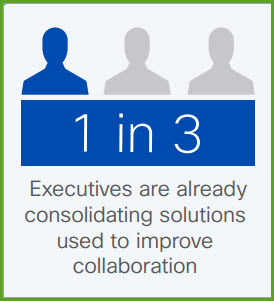
This is one place where executives and employees agree. Digital technology makes the difference. In fact, 88% of CEOs believe digital technologies are creating high value in operational efficiency. Meanwhile, 91% of employees believe digital technology can transform the way they work for the better.
So how do you find the right technology to support that shift? First, it’s important to find out two things:
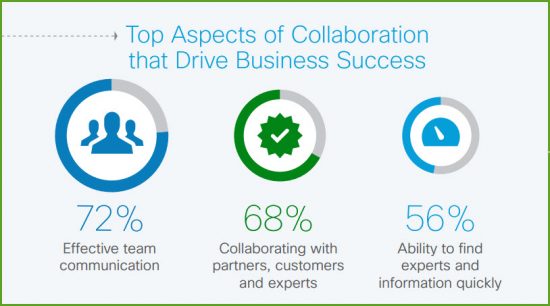
#1. What do people need? Harvard Business Review Analytic Services (HBRAS) recently asked executives to identify the top aspects of collaboration that support business success. The top three responses were effective team communication (72%); collaborating with partners, customers, and experts (68%); and the ability to find experts and information quickly (56%).
#2. What gets in the way? Finding the right tools to meet these needs hasn’t been easy. Or an application doesn’t deliver on its promise when you put it in the hands of employees. Why? Many times it’s a matter of simplicity. Or the lack of it. HBRAS researchers asked executives to identify where typical collaboration tools fail:
44% — Used too little by employees
38% — Not integrated with other business processes, or overly siloed
35% — Not aligned with user workstyles/ preferences
Cisco designed Cisco Spark to address the things that get in the way. It’s designed to make these issues disappear. That’s a good thing. It means teams can focus on what they’re doing, not the tools they’re using to do it. Integrate Cisco Spark with your existing tools and the way people actually work. Use bots to help automate your work. Help bring teams together. It’s not about telling employees to adapt a whole new paradigm. It’s about giving them tools to simplify the way they interact and move work forward.
It’s having everything you need in one place wherever you are:
Meetings
Messaging and content sharing
Calling
White boarding
At the end of the day, you’re giving people what they need. New tools can spark new ways of working together. And new ways of working together can help stimulate new ideas. And that’s what teamwork and innovation are all about.
Free Trial
Cisco Spark Plus is a business messaging app, conferencing solution, and phone system all in one. Learn how a free trial of Cisco Spark Plus can help you explore more about how teamwork is changing – and what you can do to stay ahead.
Get the Report Harvard Business Review Analytic Services surveyed 300+ worldwide execs, revealing teams are paramount to business success. Register to download.
Responding to security threats requires time, talent and money — resources that most security professionals would agree are in seemingly short supply. As discussed in the Cisco 2017 Annual Cybersecurity Report (ACR), security teams seek out strategies such as automated security solutions or cloud-based tools to overcome these resource constraints.
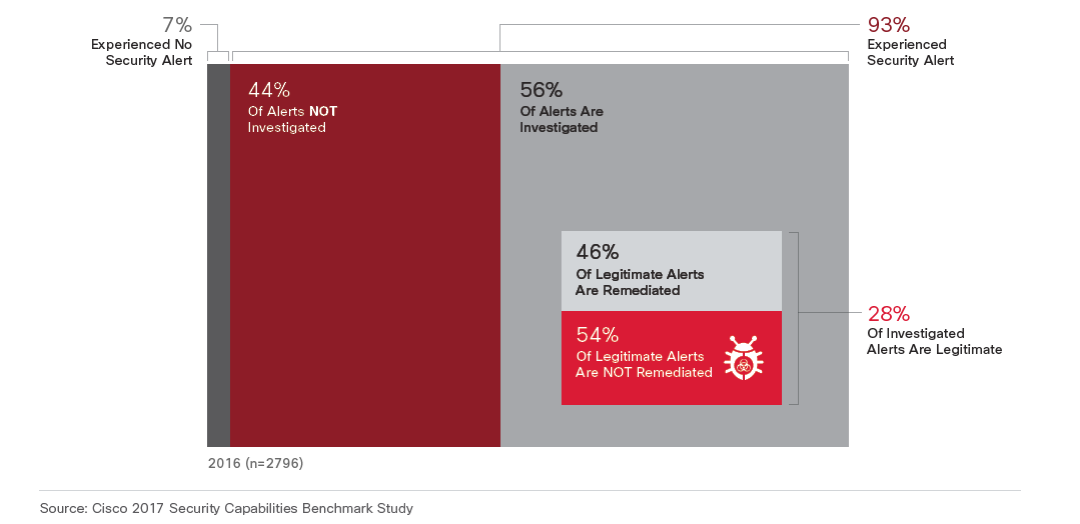
Effective security requires automation and the need is urgent. As uncovered in the 2017 Security Capabilities Benchmark Study (explored in-depth in the ACR), resource challenges can significantly impact an organization’s ability to investigate and remediate threats. According to benchmark study respondents, their security teams can only investigate 56 percent of the security threats they receive daily – leaving 44 percent of alerts, or nearly half, unexplored.
What’s worrisome is what’s hiding in the unchecked alerts. Do they point to low-level threats? Or are they indicating more dangerous threats that could result in a network outage or a ransomware incident? It only takes one incident to realize that 56 percent is not acceptable when your business is on the line.
As explained in the ACR, the picture got more sobering when we asked survey respondents about how they handle the threats that are investigated. Of the 56 percent of alerts they evaluate, 28 percent of those are deemed legitimate threats. Of these, only 46 percent are remediated—leaving 54 percent of legitimate alerts unresolved.
To illustrate exactly how many threats we’re talking about, if an organization detects 5,000 alerts per day:
2,800 alerts are investigated, while 2,200 are not
Of those investigated, 784 alerts are legitimate
Of the legitimate alerts, only 360 are remediated, while 424 are not
If organizations leave so many alerts uninvestigated, could these potential threats undermine productivity and customer trust? As we learned from the benchmark study, organizations that suffer even minor network outages caused by threats (much less broader security breaches), must wrestle with long-term implications to the bottom line. For example, 22 percent of benchmark survey respondents told us they’d lost customers due to attacks; and 29 percent experienced a loss of revenue.
Automation can help organizations understand the threats they may not have time to study. It helps security teams maximize precious resources, and reduce the time spent on detection, investigation and remediation — so they have more time to manage previously uninvestigated threats.
Helping teams through these challenges is something we think a lot about. We build our security solutions to be open, so products integrate into a compelling architecture. We embed automated services so that customers don’t have to manage every alert or incident individually. This creates a force multiplier effect, removing the burden from teams drowning in alerts while simultaneously expediting detection and response. For example, Rapid Threat Containment can automate security responses and rapidly contain infected endpoints. And Cisco Advanced Malware Protection (AMP) sees a threat once and instantly blocks it everywhere.
This isn’t the last you’ll hear from us on this – it keeps us awake at night, too.
Download the Cisco 2017 Annual Cybersecurity Report to learn about other findings from our study and how to close the windows adversaries seek to exploit.
We are in the midst of a historic transition in education, in which we are providing more options and flexibility in creating learning cultures that significantly raise the expectations of what our students can accomplish. We now can effectively support students who traditionally have not succeeded. You have heard it before; learning can be available anywhere, securely on any device, in any format, and potentially connected to anybody 24×7.
So, what does this really mean for leaders who are responsible for setting the vision for their campuses? We now can rethink the allocation of physical space and how courses are scheduled to support various students’ learning styles. What is really exciting is the sense of student empowerment that can emerge from a highly flexible learning design, enabled by a robust digital campus. For example, we can tap the natural behavior of young people who we know are social with powerful community-based and collaborative tools that can create a deeper sense of shared learning. Traditional boundaries, such as the end of the semester, are giving way to continuous social interaction and support of lifelong learning. It is an exciting time to be in education.
Where to begin in leading this shift? There are many possible first steps. This article focuses on two broad areas of digital design that can provide the foundation for an empowered culture of learning:
Multimedia content
Online communities of social interaction with classmates and professors
I have experienced this transformative shift of expanding the boundaries of learning with my own college-age children. My daughter, Jessica, graduated from university in 2010 and my son, Dan, will graduate in 2017. They both will earn equivalent grades at two different but highly competitive universities. How they studied, how they were supported in their learning, and how they interacted with classmates and professors represent two different worlds. Both of my children are convinced that Dan, the younger sibling, will be much better prepared for the world of work because of this transformation.
Access to Content
My daughter had a textbook for every class, often written by the professor as many as ten years earlier. At that time, these expensive books cost $160. Multiply that by 32, the number of courses she had to take to graduate, and you’re talking about more than $5,000 in additional expenses.
Danny, on the other hand, will not buy a single textbook in four years. Essentially, all of the learning resources he has needed were accessed online. The biggest change is that his professors have organized resources from all over the world, whether they created the content themselves or not. One of Danny’s professors shared with me that one of the biggest mistakes he made when he first created his online community was to only include his “stuff.”
“I realized that I did not have to invent everything for my students as I used to do,” this professor told me. “Indeed, I can be a model for how my students can access resources from around the world.”
In many ways, Danny will be better prepared for the world of work, because he was required to develop individual criteria to evaluate information from multiple perspectives. The difference between his experience and Jessica’s is not in learning how to manage content in the digital age, but in the different opportunities he has had to develop empathy and judgment. As Jessica reflects, “Whereas I was handed a singular viewpoint from lectures based on one professor’s ideas, my brother had to learn to integrate many perspectives in considering how to solve a problem.” Danny added: “I was taught to find the best possible resources. I still do that now that I’m no longer in the class.”
One simple advantage for Danny was the rewind button that Jessica never got to use. Watching online videos became a routine for Danny, as many of his classes had a full library of video lectures, tutorials, and explanations of assignments. He would review lectures and check his notes after he attended class. Re-watching the recorded lectures from his classes proved extremely helpful when he was doing his homework or preparing for an exam. The full-text search capability built into the videos, from solutions such as VBrick, allowed Danny to zoom immediately to the sections he needed to review. He said he came to rely on the video library, noting: “I just missed so much when I was taking notes in class.”
When I asked him to compare university to his middle and high school experience, Danny reflected, “When I was in school, if you could not follow the textbook, you were in trouble. Textbooks often were not engaging, and they did not provide the kind of support that I needed. Now, I have multiple resources from around the world. One of my professors explains why he has so many different resources this way on his website: This particular set of resources is how I understand best. You might not learn in the same way as I do. That is why I am pointing you to many resources from around the world. You will have to choose what works best for you.” He sums up: “I was taught how to learn how to learn.”
In comparison, some of Jessica’s professors handed her printouts of PowerPoint lectures. According to my daughter, they thought they were ahead of the curve. Her university also had a policy whereby you could sign up for notes transcribed by a classmate if you had a learning disability. In Danny’s classes, any student could control the speed of the video playback for the entire lecture. Given the agility of the technology, video playback was available immediately after each class. Compare the special services for a few on Jessica’s campus to the total control of all class content by every student on Danny’s campus. Moreover, Danny had access through all three of his devices: phone, laptop, and iPad. He often would play back the video on his phone while he rode the bus home.
In his more sophisticated classes, video also was used to help Danny and his classmates understand the requirements of an assignment. The content would include videos explaining, “This is what we are looking for. You should be thinking about this. We are not looking for this.” Clarity of expectations can take pressure off of the professor, who no longer has to answer the same questions over and over again: “What do I need to do to get an A?”
From Danny’s sense, watching these video walkthroughs was the equivalent of sitting down one-on-one with the professor. He had a crystal-clear sense of exactly how to think about each problem. The teaching assistants who worked with the video crews thought through all of the questions that students might have. Students literally had no excuses for being confused about the direction of the assignments. Clarity of design did not limit students to a lock-step approach, however. Indeed, the confidence of clarity would empower students to go beyond the expectations of the professor. As one of Danny’s professors, Dr. David Malan, commented: “I only know that I have added real value to my students when they are inspired to go beyond my expectations.” As his father, I can attest to how “on fire” Danny was to conquer his assignments to the very best of his ability. There are no limits with this kind of learning.
I asked Danny if he thought that video libraries could have helped him in middle and high school. “Sometimes in middle and high school, I would have no idea what the teacher wanted,” he replied. “Video access would have saved me from asking embarrassing questions in front of my classmates. Often, the potential for embarrassment would prevent me (and my friends) from asking for help at all.”
Social Tools and Online Communities
When Danny’s video tools were still not enough to make concepts clear, he had the option of shooting off an email to his online community of peers, his professor, or his section leader for specific help. Many of his courses used the university-sanctioned learning management system, Canvas. Danny was able to access every imaginable learning resource (text, video, documents, slide decks), securely, from every possible device, at all hours of the day and from every imaginable location.
And Learning Management Systems aren’t the only way that students communicate today. Online meeting services like WebEx allow students to meet virtually with peers, or the professor. And as a forum for student conversations, sharing content and meeting instantly, services like Spark are growing in popularity.
“That’s what helped me get through my classes,” he acknowledged. “In fact, in one course, many of the students felt the professor was not providing us what we needed. Students rallied and we built our own online community. It is just automatic and natural for me to engage online with my classmates to support one another.”
What really impresses me is Danny’s sense of responsibility to help his peers in an online community. Danny matter-of-factly points out: “If I see that classmates are struggling with something, it is really easy for me to jump in and help out. And I benefit by doing this as well. When I am helping a classmate with a problem, I have to really think through the material in order to write out an explanation or shoot them a screencast.”
Danny often chooses to ask his classmates for help before asking his professor. For many students, this peer-to-peer tutoring can be the most effective way to learn. Why would students choose to ask a classmate for help when they have access to an instructor’s office hours? It is possible that some educators suffer from the “curse of knowledge.” This happens when an expert’s knowledge creates a blind spot in understanding what a new learner is missing in his or her background knowledge to comprehend a lesson. As high school student and award-winning video tutorial pioneer Shilpa Yarlagada observes, “Teachers know the material so well that they sometimes forget how to explain to students who are learning for the very first time. In these cases, I wish I could just turn to a friend who is in the class with me and (who) understood the material. Because they recently learned, they (are) in the very best position to explain it to me.”
Professor Eric Mazur, Dean of Applied Physics at Harvard University and a very early pioneer in building online communities, learned that students would ask more questions in an online community than in a face-to-face class. He had collected thousands of questions online from his Introduction to Physics class. When I asked him if he noticed any pattern from the questions that would be useful to him as an educator, he observed: “In more than 25 years of teaching, I had never heard of 80 percent of them during class. I never realized the extent to which my students were struggling with misconceptions and gaps in their basic knowledge of science.” Professors and teachers certainly know their subject area. What they might not know are their students’ questions.
What fascinates me is that Dan continues to be actively connected to many former classmates and professors across various social media channels. He explains, “A few professors have Twitter, LinkedIn, or Facebook. Many professors will not ‘friend’ students during the semester but will after the course ends. It’s kind of cool when you have access to their thinking without worrying about handing in your assignments. They all have disclaimers that their personal views do not reflect the school view. You definitely get to know them much better, including their interests. One professor is a horror movie fan. Another is a Dungeons and Dragons guy. I’m in touch with one of my former professors via email about design ideas I have for various projects. I have connected with past professors as a resource for real-world problems. I am also interested in some of my professor’s ongoing research—really interesting stuff.”
In some of Dan’s classes, the students were required to use Twitter. “I still have the Twitter list with my classmates,” he said. “I continue to follow all of them over Twitter. It is effortless for me to stay in touch. Professor Malan invites all his former students to the CS50 Fair, where students present their final computer science projects. CS50 is notorious for involving past students via social media. One professor reached out to me across social media to invite me for a paid research project based on my prior academic work in her course. It was wonderful.”
Unlike Jessica, Danny will graduate with a vibrant professional network of active classmates and professors. This network is already helping Danny line up job interviews and shared knowledge about how to launch his career. Dan’s network will continue to be a living, vibrant, and expanding community of mutual support that will propel his lifelong learning. Jessica will make sure that the next university she chooses for graduate school will provide the same opportunities.
Here are five guidelines for leaders who are planning to maximize the investment in network technologies to improve teaching and learning:
Provide all students with immediate access to subject content in all formats (full text, video, audio)
Support a community of learners who can continuously help one another
Provide educators with insights into how students are thinking in online communities
Encourage educators to teach students to “learn how to learn”
Allow students to continue to tap their campus networks as a lifelong resource
Done carelessly, network virtualisation can have the opposite effect to what’s intended. Considering the network as a whole makes it possible to provide agile services while retaining carrier class reliability
Networking is changing fast, as customers come to expect more agile services, delivered from the cloud, and consumable on mobile devices.
And as the world continues to go digital, there’s growing interest in virtualisation among service providers.
It’s not hard to see why. Virtual networks have the potential to deliver the flexible, on-demand services today’s customers are looking for.
Service providers know that if they carry on using physical networks to try and meet these new expectations, their costs will quickly begin to exceed revenues. As a result, they’re beginning to create virtual networks that are more adaptable and scalable.
This enables them to provide customers with the flexibility they need. It also lets them spin services up or down rapidly – enabling a business to meet demand whether it needs to create a network for a sporting event in a remote location, or is expecting a surge in traffic as it live-streams a major announcement.
Not as simple as it seems
But when service providers begin to consider virtualisation in more detail, they often meet unexpected challenges.
Today’s networks often include many different elements. And as they begin to be virtualised, they become even more complex. They combine both physical and virtual technology.
In short, virtualisation can be carried out in different ways. And experience shows that unless you take the right approach, you can run into difficulties, rather than creating new opportunities.
Taking a holistic approach
To make virtualisation work, service providers need to consider the network as a whole, and make sure all the different components are working effectively together. This way, they can transform not only their network architecture, but their operations and business, too.
A well-functioning virtual network brings simplicity and visibility, making it easier to provide flexible services, improve operational efficiency, and take a holistic approach to security.
Successful virtual networks combine a dependable infrastructure with powerful automation.
The key to making this possible is a Network Abstraction Layer, enabled by an orchestration engine, which can provision capacity in real time, deploying resources where they’re most needed.
It can also help them reduce the time it takes to deploy new services from weeks to minutes, while retaining the carrier-class reliability their reputation is built on.
Case study: Level 3
One service provider that has used virtualisation to transform its offer to customers is Level 3.
The company recognised that its customers’ needs were changing. The businesses were adopting Agile and DevOps approaches to constantly develop and iterate new services.
To support this, they wanted to be able to set up new network services instantly, and integrate them easily with cloud-based applications.
In response, Level 3 developed a growing portfolio of network as a service (NaaS) solutions, powered by the Cisco Network Services Orchestrator (NSO).
It can now automatically activate services and offer customers the capability to scale bandwidth up to 300 percent in response to demand.
Innovation and expertise – helping you get it right
We are committed to producing the innovative, high-quality technology that makes innovations like this possible.
The Cisco NSO, an industry-leading orchestration engine, uses NETCONF and YANG to model network infrastructure and services in a flexible and open way.
This in turn allows service providers to realise the potential of virtualisation. It enables end-to-end automation across a whole network, and is sophisticated enough to deal with the growing number of hybrid networks.
These capabilities mean that service providers can make their networks simpler and more automated , while maintaining their dependability.
And because the technology is built to open standards, it can evolve with your business. So you can be confident you’re making an investment for the long term.
Virtualisation has huge potential – but nothing is guaranteed. Our expertise, experience and commitment to innovation means we can help providers choose the right technology, and get the best out of it.
And because we understand the complexity of modern networks, we can help providers make their services as simple as possible.
Find out how technology can help you combine reliability and agility to transform your network and business operations. Read more about the Cisco Network Services Orchestrator
Key takeaways
– Many service providers are seeing virtualisation as a strategic way of sustainably meeting new customer demands.
– But virtualisation alone is not the answer – if not implemented in the right way, it can actually lead to more complexity.
– A successful virtual network combines a reliable infrastructure with powerful automation.
– An orchestration engine is the key to making this possible, because it can take a broad overview of the network, allocating resources where they’re most needed.
– Our industry-leading Network Services Orchestrator provides end-to-end automation across virtual and hybrid networks, enabling providers to reduce the time it takes to deploy new services.



 you to not only attend the above-mentioned keynote and innovation talk but also the over 200 Data Center sessions overall and to see us in the World of Solutions to find out more how Digital Transformation starts with an









 As
As