Avatar

The shift from paper to electronic health records (EHRs) has brought fundamental change to healthcare operations.

Boosted by the 2009 HITECH Act, EHR adoption by hospitals is now near-universal at 96%, according to a HHS report. Digital medical records have helped streamline workflows, reduce errors, and improve coordination of care. Thanks to technology, we’ve said goodbye to thick manila folders, unsecured paper, and cumbersome filing cabinets.

Of course, electronic data still has to be “stored.” And unlike the medical record, the world of data storage had been the same for decades. While costs for spinning disk storage fell dramatically and capacity increased, much of the underlying technology had remained the same. Today with the advent of “flash” storage, racks of spinning disks are being replaced with faster and more energy efficient storage solutions, and most healthcare IT organizations are moving to flash storage to improve the performance of their EHR.  With most storage solutions, you have to “rip and replace” infrastructure every time you want to upgrade, usually every 3 to 4 years. That’s time consuming – not to mention expensive.

Cisco is excited to announce that we’ve teamed up with partner Pure Storage to revolutionize the world of data storage. FlashStack combines Cisco UCS with industry-leading flash storage in one powerful package. This is especially good news for for customers of Epic, the leading EHR software vendor in the U.S., because FlashStack is Epic-compliant. It meets – or exceeds – Epic hardware specifications.

When customers build Epic on FlashStack, they get an instantly upgradable platform for Epic deployment. Additional capacity and capabilities can be added seamlessly in minutes, with no need for rip-and-replace upgrades. A simple, unified management interface gives the IT team the ability to manage UCS and Pure Storage resources using familiar Cisco management tools and processes.

FlashStack gives facilities the ability to scale on-demand, drive always-on high performance for Epic (even under heavy use), and deploy a cloud-like infrastructure for flexible growth. In fact, FlashStack is already making waves in the industry. One early adopter achieved a 234% ROI on a VDI deployment with all-flash storage from Pure Storage. (Read the case study here).

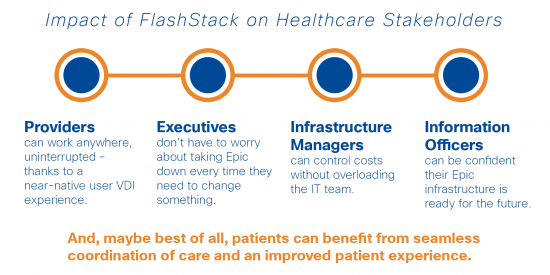
So what does this mean for healthcare stakeholders?
Want to learn more? Visit Cisco (Booth 1850) and Pure Storage (Booth 6081) at the upcoming HIMSS17 conference in Orlando. Or visit our websites Pure Storage and Cisco, and read Pure Storage’s blog.


 

Authors

George Kerr

Business development Manager

US Partner Organization

Avatar

Happy Valentine’s Day! Love is in the air. Especially when you #LoveWhereYouWork!

The second annual #WeAreCisco #LoveWhereYouWork contest is in full swing, and employees are CRUSHING on last year’s number of entries. In 2016 over 1000 photos were submitted in the month of February, and this year in the FIRST WEEK submissions are nearing those totals! Keep ‘em coming!

Cisconians around the globe are submitting photos on Twitter, Instagram and on the internal Jive page using the hashtags #WeAreCisco and #LoveWhereYouWork to show off the awesome people that work here, the fun we all have and how we give back to our communities. (And food, Cisco employees love food!)

From Lunar New Year celebrations to bring-your-dog-to-work days to the best “work-from-anywhere” views, here are a few of the great photos entered so far. (Note, this doesn’t affect the judging for the prizes. These are just a sampling!)

Want to join us? We’re hiring!

Authors

Carmen Shirkey Collins

Social Media Manager

Talent Brand and Enablement Team, HR

Avatar

Service providers are at a junction – they can either drift into irrelevance, or join the fast-moving digital world

The business world has changed – and digital companies are leading the transformation.

One successful business powering the new digital future is Amazon, through Amazon Web Services, its on-demand cloud computing service. And Google is also driving change in the same direction, through its similar cloud-based offer.

Why are these companies investing in on-demand cloud computing?

Because they know that today’s customers want fast, flexible services. They want to be able to buy these services easily, access them immediately, and adjust them whenever their needs change.

A similar trend is happening in the world of networks. As businesses and consumers come to expect more and more personalised, versatile services, the importance of networks that can support these will grow.

So service providers now find themselves at a junction. They can continue in their current direction and become legacy companies. This is likely to mean they’ll come to be seen as utilities, with limited opportunities for growth or innovation.

Or they can join the fast-moving digital world, gaining the opportunity to win their share of the huge amount of new business on offer.

Smarter and more agile

But to succeed in this world, businesses will need to be smarter and more agile.

They’ll have to be able to respond flexibly to changing circumstances, and allow customers the freedom to shape their own products and services.

A lot of things remain uncertain about this future. But one thing we know is that providers won’t be able to succeed in it using yesterday’s technology.

A key way that service providers can meet the changing demands of their customers is through virtualisation, enabled by orchestration. A virtualised network is one that has been decoupled from its hardware. While still rooted in physical equipment, it can be operated independently of it.

This enables service providers to work a lot more flexibly. Why? Because they can be driven by what their customers want, rather than by their hardware’s limitations. They can provide bespoke cloud-based services, available instantly, using à la carte and pay-as-you-use models. This offers both businesses and consumers the visibility and control they’re looking for.

And these services can be activated elastically, being scaled up or down easily as needed.

Rapid innovation through orchestration

Digitisation, powered by virtualisation, is expected to increase hugely in the coming years. One service provider that has taken advantage of this opportunity is service provider, Softbank, in Japan. Softbank is using Cisco virtualisation technology to deliver more agile services to its customers.

The key technology that allows Cisco to support flexible virtual networks is its Network Services Orchestrator (NSO). This helps automate and simplify complex network tasks.

Sadahiro Sato, the senior vice president of ICT innovation at Softbank, said that the new architecture, based on Cisco’s virtualisation and network abstraction technologies, will enhance the company’s future business opportunities by enabling much greater agility.

He said: “The flexibility and open nature [of the new Cisco architecture] will equip us with the tools to innovate new services at a rapid pace and keep ahead of our competition. Automation and elasticity on demand will also help us dramatically reduce both our operating and capital costs as we grow the offering.”

When a business really understands network hardware, it knows how to harness its capabilities into agile virtual networks that can power tomorrow’s services.

Because of its experience in creating reliable, efficient networks across the world, Cisco is well-placed to support service providers like Softbank as they build the networks of the future.

Its technology which features advanced orchestration, comprehensive security and adaptable open-source coding, has everything needed to anchor high-powered, flexible networks.

As digitisation gathers pace, customers have already come to expect self-service and on-demand services. It’s now time for service providers to decide whether to be spectators or take their place in this new world.

Find out more about how Cisco technology can support the networks of the future. Read more about the Cisco NFV Infrastructure

Key takeaways

– Top digital companies like Amazon and Google are investing in on-demand cloud computing because they know today’s customers want fast, flexible and on-demand services.

Virtualisation[cisco.com/go/nfv], enabled by orchestration and automation technology, brings service providers the opportunity to join these companies in the fast-moving digital world, and to meet new customer needs.

Digitisation, powered by virtualisation, is expected to increase exponentially in the coming years.

Authors

Volker Tegtmeyer

Senior Manager, Product and Solution Marketing

SP Cloud Virtualization

Avatar

This post is the second part of my series around the impact of encrypted protocols on network security. You can find the first article about HTTP/2 here:
http://blogs.cisco.com/security/the-impact-on-network-security-through-encrypted-protocols-http2

Now let us focus on the new and upcoming specification of TLS 1.3. It is important to understand what advantages TLS 1.3 brings to us, but also what is the impact on certain parts of our network security: firewalls and transparent proxy systems.

Lets start with a quick comparison of the functionalities and improvements of TLS 1.3.

TLS 1.3 is currently , at the time of writing this article, in draft stage:
https://tools.ietf.org/html/draft-ietf-tls-tls13-18

Continue reading “The impact on network security through encrypted protocols – TLS 1.3”

Authors

Tobias Mayer

Technical Solution Architect

EMEA Security Architecture Team

Avatar

As we transition from the Internet Era and move quickly into the Digital Revolution, we are faced with a digital economy powered by IT and the network. Don’t miss the opportunities digitization brings. As Charles Darwin put it, “it is not the strongest of the species that survive, nor the most intelligent, but the one most responsive to change.” If you don’t adapt, you’ll go extinct.

Throughout every conversation at Cisco Live Berlin, the common denominator will be implementing a secure network as the foundation for Digital Transformation.

On February 22nd, 11am-12pm CET (local Berlin time), join @CiscoServices for a special #CiscoChat to discuss the challenges and opportunities of network readiness and support for Digital Transformation. The hour-long discussion will feature ZK Research (@zkerravala), @CiscoEnterprise, industry thought leaders, and more. Catch Joe Cozzolino (SVP of Cisco Services) and Russell Hoch (VP of Cisco Services) making their #CiscoChat debut!
For a sneak peak into Joe Cozzolino’s take on Enterprise Networking for the Digital Economy, be sure to check out his Innovation Talk on Tuesday, Feb 21, 11:15 am.

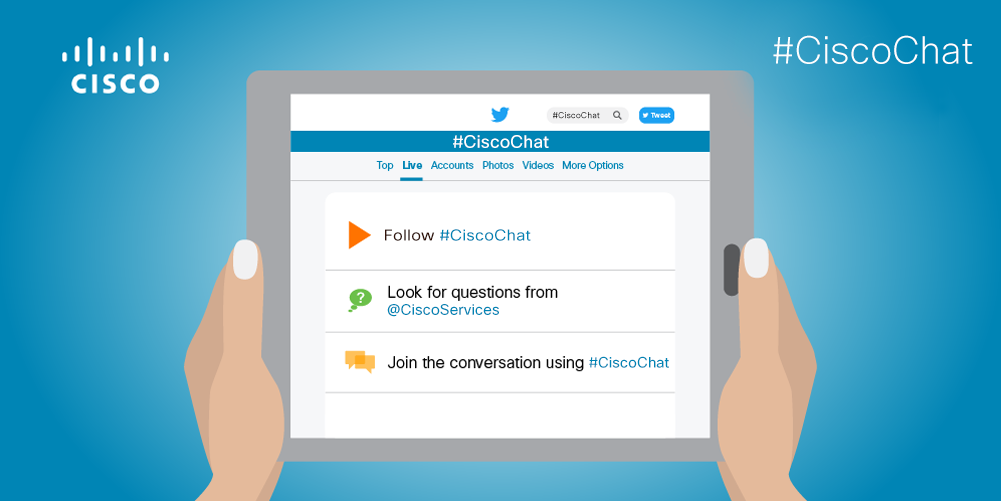
  To participate in the #Ciscochat:

  • Make sure you’re logged into your Twitter account.
  • Follow @CiscoServices on Twitter.
  • Search for the #CiscoChat hashtag and click on the Latest tab.
  • Add to the conversation by using the #CiscoChat hashtag in your tweets. This way, others can find your contributions to the discussion.
  • When replying to specific participants, add a “.” at the beginning of the tweet so your question or comment will appear in your public twitter feed.
  • If you need multiple tweets to answer a question, preface each tweet with “1A,” “2A,” etc. This will make it easier for others to follow along with the conversation.

Welcome introductions and questions will begin at 11am CET (local Berlin time). Don’t forget to bring your own questions to the discussion, too. See you there!

Authors

Jaishree Subramania

No Longer with Cisco

Avatar

By now, I hope you have your trip planned and bags packed for Cisco Live Berlin. Taking place February 20-24, our Advanced Services team has lots of exciting things to share with you this year. From informative demos to 20+ learning sessions led by our very own AS experts, and opportunities to win fun prizes – I am beyond thrilled to welcome you to our event!

For a Cisco Live Berlin event you will not forget, don’t miss out on these 5 tips to maximize your Advanced Services experience:

1) Attend the Enterprise Networks Innovation Talk with Joe Cozzolino

Join Cisco Services Senior Vice President Joe Cozzolino talk about how Cisco Digital Network Architecture (DNA) enables you to tap into the power of your network to deliver on real business outcomes for faster innovation, reduced cost and complexity, and lower risk. You will also learn about new deployment models that meet both business and IT requirements.

2) Visit the Cisco Services Zone

Come check out the Cisco Services Zone (Hall 3.2) in the World of Solutions where we are hosting 9 Advanced Services demos covering our Advisory, Implementation and Optimization capabilities. Demos being featured will showcase these capabilities across our Security, Data Center, Enterprise Networking, Cloud and DNA portfolio.

In addition to the Cisco Services Zone, Advanced Services will also be featured in various technology Architecture Zones located in the World of Solutions.

3) Sit in on an Advanced Services presentation in the Services Theater

Join us on several 20-minute Services sessions held in the mini theater in the Services Zone. No need to pre-schedule or register, just find your session date and time here. Advanced Services will be hosting a total of 21 sessions, each focusing on different technologies and outcomes that Services can provide in Optimization, Security, Networking, DNA, Data Center, Cloud and IoT.

4) Participate in the passport programme to receive giveaways and a chance to win a Raspberry Pi

Pick up a passport at the Services booth to get started on your Advanced Services adventure. Collect 4 stamps as you tour the Cisco Services Zone: a booth demo, a mini theater session, the Cisco Architecture Zone and finally, the Learning Booth where you can get information about navigating your digital transformation. Complete your journey back at the Services booth with your newly-stamped passport and get entered in our daily drawing to win a Raspberry Pi.

5) Connect with us on social media

  • Join us on Twitter for a #CiscoChat hosted by @CiscoServices on February 22, 11 AM local Berlin time. We will discuss the topic: Is your network behind the digital curve?
  • Look out for Facebook Live-from-Berlin broadcasts on com/ciscoservices
  • To keep up with all the exciting updates throughout the week:

Useful Links

For more information on Cisco Live Berlin, visit http://www.ciscolive.com/emea

Content catalog: http://www.ciscolive.com/emea/learn/sessions/content-catalog/

Cisco Campus exhibitors: http://www.ciscolive.com/emea/activities/exhibitors/campus/

I’m excited for you to discover all of the technology innovations and education Cisco Live has to offer. Get ready to be inspired and take your digital transformation to the next level with Cisco Advanced Services!

For everything Cisco Live Berlin:


Authors

Amelie de Marsily

Senior Director

Cisco EMEAR Delivery Services

Avatar

Many pieces of forensic evidence come into play when investigating a crime scene – analysis of fingerprints, DNA, shoe prints, videos/photos, ballistics, etc. By analyzing the data, a picture of the crime emerges, which in the case of a serial killer often includes his or her MO or method of operation.

In the cyber world, analysts do the same thing. They analyze indicators of compromise (IoCs) or observables as they are often called – IPs, domains, URLs, hashes, etc. Pieces of information that describe an incident that has already happened. Many cyber criminals reuse tactics and techniques that produce the same observables and therefore create a pattern that can be used to detect and prevent future attacks by the same actors.

Many analysts extract the observables from the investigation to create blacklists or pattern-based signatures containing hundreds of observables of the same type, however, these “simple” lists are prone to false positives and can generate volumes of generic threat alerts. These must be manually reviewed and can overwhelm security teams, putting effective security at risk.

So in order to sift through the massive data to better identify and stop threats, the cyber security industry has focused more and more on developing improved cyber threat intelligence. Today cyber threat intelligence is everywhere thanks to efforts to augment sharing through open standards for threat intelligence like STIX and TAXII and a variety of threat intelligence vendors. Nevertheless, making use of threat intelligence from multiple sources can be time intensive and complicated without the right tools.

But imagine this…

You receive intelligence from an industry sharing group like FS-ISAC warning you of a new attack targeting financial institutions. Several organizations have already been hit and because they didn’t have protection in place, they are having to go through an expensive incident response process. Those organizations have shared critical IoCs via FS-ISAC’s TAXII feed. Based on the warning, your team can review the indicators and increase the response on your network sensors from “monitor” to “block.” Within hours your organization is targeted but because of the extra intelligence and the ability to automatically block, you stop the attack before it can cause any damage.

Well, you don’t have to imagine it. You’re able to do this today with a new set of capabilities now built-in to your Firepower Management Center.

Improve Your Security Posture with Threat Intelligence from Multiple Sources
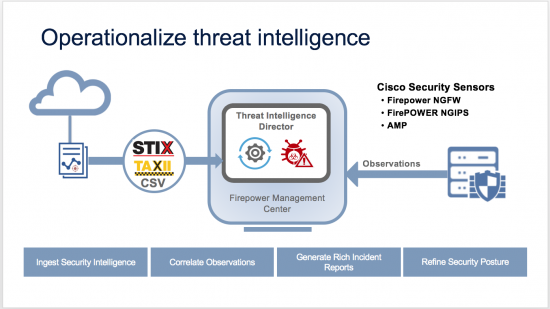
The new Threat Intelligence Director operationalizes cyber threat intelligence in Firepower next-generation firewalls and intrusion prevention systems. By leveraging open industry standards such as STIX and TAXII or simple delineated ASCII, the Intelligence Director can easily ingest third-party threat feeds and data from Threat Intelligence Platforms (TIPs) to your network sensors and next-generation firewalls. Based on your confidence in this additional intelligence, you can direct your network sensors to use it to automatically monitor or block traffic inline. Confirmed incidents are published from Cisco Firepower sensors to your Firepower Management Center so you have better visibility into attacks against your network.

Save Time and Stop Adversaries in their Tracks
Threat Intelligence Director reduces the time you might have spent manually copying and pasting observables from intelligence reports into sensor-specific blacklists or chasing down the right piece of intelligence with context related to a generic alert. Working with your sensors, it confirms and correlates events across multiple devices, matches against indicators, and creates incidents with all your contextual data in one place. Security operations can make faster, more informed decisions on the right course of action.

I know I have hit this theme repeatedly but I cannot resist pointing out that the Threat Intelligence Director is yet another example of how Cisco is making security more effective with solutions that are simple, open, and automated. It is also an excellent example of what “actionable intelligence” is all about – enhancing your ability to rapidly and accurately analyze and respond to security threats.

Intelligence analysts in both law enforcement and cyber security, use similar techniques to identify and prevent serialized crime and campaigns. With Threat Intelligence Director and Cisco’s Firepower devices you have the best technology to leverage intelligence and to stop adversaries in their tracks.

Threat Intelligence Director is just one of the many innovations we’re showing at the RSA Conference in San Francisco on February 14-16, so please stop by the Cisco booth to learn more.

Authors

Jason Lamar

Senior Director

Security Product Management Group

Avatar

This week, Cisco released the 2017 Mobile Visual Networking Index (VNI) Forecast. Not surprisingly, most people focus on the cellular (2G, 3G, 4G and 5G) aspects of the forecast. But there are also some rather exciting insights that can be drawn from our analysis of “the other” mobile technology – Wi-Fi. In some ways, Wi-Fi suffers from an inferiority complex compared to other types of connectivity. But you can’t deny Wi-Fi’s versatility – it can provide network access for your laptop, your smartphone, your smartwatch, and a growing number of other things. According to the Wi-Fi Alliance, more than three billion Wi-Fi enabled devices will ship in 2017, joining more than eight billion devices already in use.

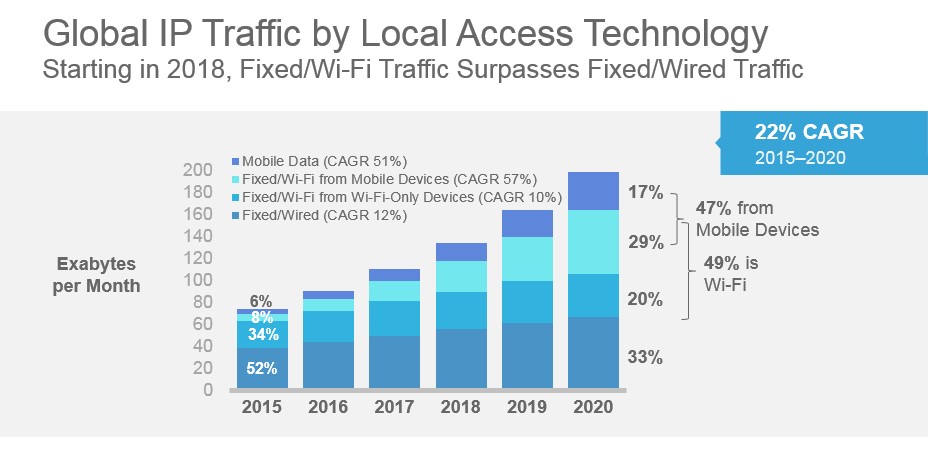
In 2015, Wi-Fi traffic was 7 times greater in volume than mobile data (cellular) traffic, though mobile data traffic does have a higher growth rate than Wi-Fi (it’s growing from a smaller base level). By 2020, Wi-Fi traffic will be about 3 times greater than mobile data traffic. And starting in 2018, Wi-Fi traffic will even surpass Fixed/Wired traffic. 63% of global mobile data traffic will be offloaded by 2021.

Figure 1: Global IP traffic by local access technology

Source: Cisco Mobile VNI, 2017

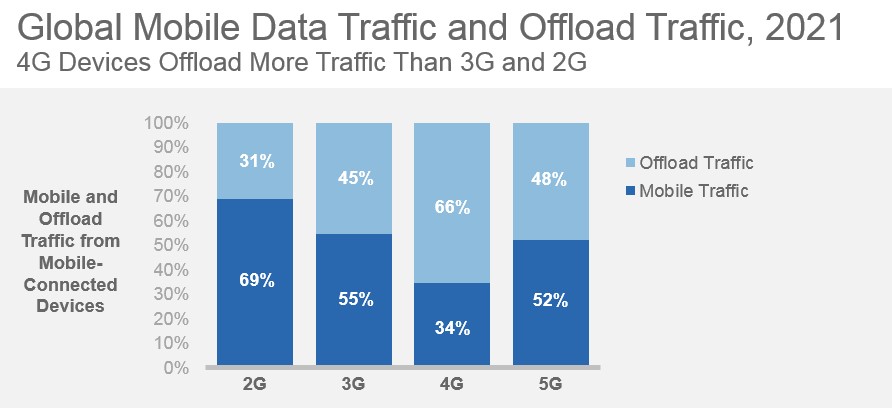
By 2021, 29 percent of the global IP traffic will be carried by Wi-Fi networks from dual mode devices (i.e., offloading from cellular to Wi-Fi). Offload is even higher on 4G networks compared to 3G networks because 4G devices are more media-centric. 4G users consume more video and often switch to Wi-Fi to avoid data cap overages. Offload on the much-anticipated 5G networks is expected to be lower initially. Historically, new cellular technologies with higher speeds than their predecessors tend to have lower offload rates. 4G also had a lower offload rate when it was first launched. At the outset, new networks have more availability and operators may offer more generous data caps in this promotional phase.

From a performance perspective, average Wi-Fi speeds are generally higher than average cellular speeds, which can create a user preference for Wi-Fi (when available). Globally, the average mobile connection speed was 6.8 Mbps in 2016, and this will grow 3-fold from 2016 to 2021, reaching 20.4 Mbps by 2021. Comparatively, the average Wi-Fi connection speed from dual mode devices will reach 32 Mbps by 2021, up from 18.2 Mbps in 2016. Individual countries may experience higher mobile speeds based on widespread 4G deployments or lower fixed broadband speeds due to leapfrogging.

Figure 2: Offload Traffic by mobile technology by 2021

Source: Cisco Mobile VNI, 2017

The higher experienced speeds are also due to great hotspot partnerships by operators, high fixed broadband speeds due to fiber deployments as well as the use of 802.11n, the dominant Wi-Fi standard which currently continues to be replaced by 802.11ac, the latest ratified standard even beyond the forecast period 2021.  While still a small portion of the overall offload traffic is from public Wi-Fi hotspots, they are a popular Wi-Fi offload opportunity for consumers as well as the emerging IoT connections and verticals such as connected car, healthcare, etc.

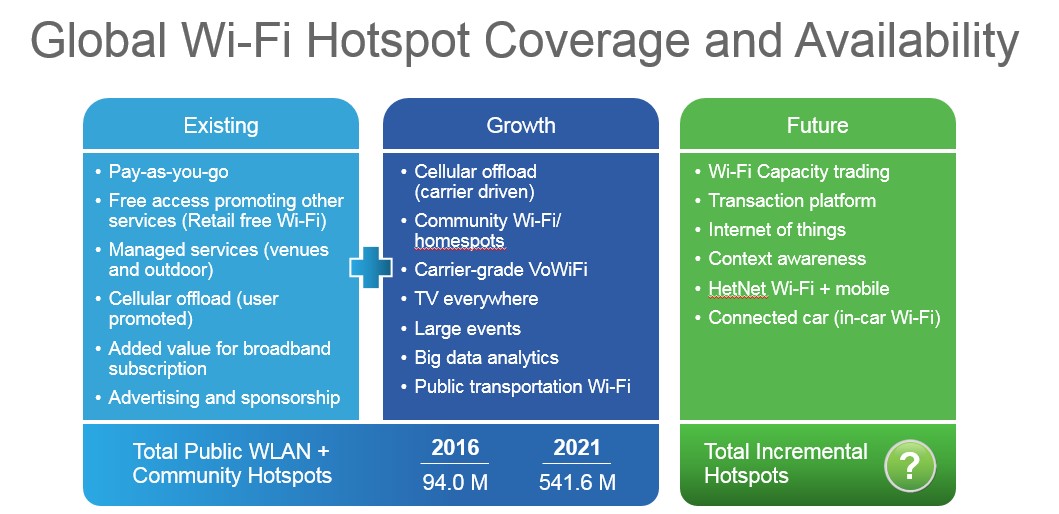
Globally, total public Wi-Fi hotspots (including homespots) will grow 6-fold from 2016 to 2021 from 94 million in 2016 to 541.6 million by 2021. From a regional perspective, APAC leads with 246 million or 45% of the global hotspots by 2021 followed by Western Europe with 23%. Leading hotspot countries are China (170M by 2021), the United States (86M by 2021), Japan (33M by 2021) and France (30M by 2021).  Homespots are a significant portion of the public Wi-Fi strategy and are emerging as a potentially significant element of the Public Wi-Fi landscape where subscribers allow part of the capacity of their residential gateway to be open to casual use. Homespots are actually home gateways that are used (upgraded) to offer home and commercial /public Wi-Fi for other users in their area by means of a second SSID. This is widely implemented and can result in substantial mobile traffic offload.

Figure 3: Global Public Wi-Fi Hotspot Growth

Source: Cisco Mobile VNI, 2017

Wi-Fi offload is also a major networking consideration for mobile carriers, particularly in  regions with intense cellular competition, spectrum challenges and large broadband installed bases. The networking and business dynamics in these markets make them prime targets for extensive homespot rollouts.

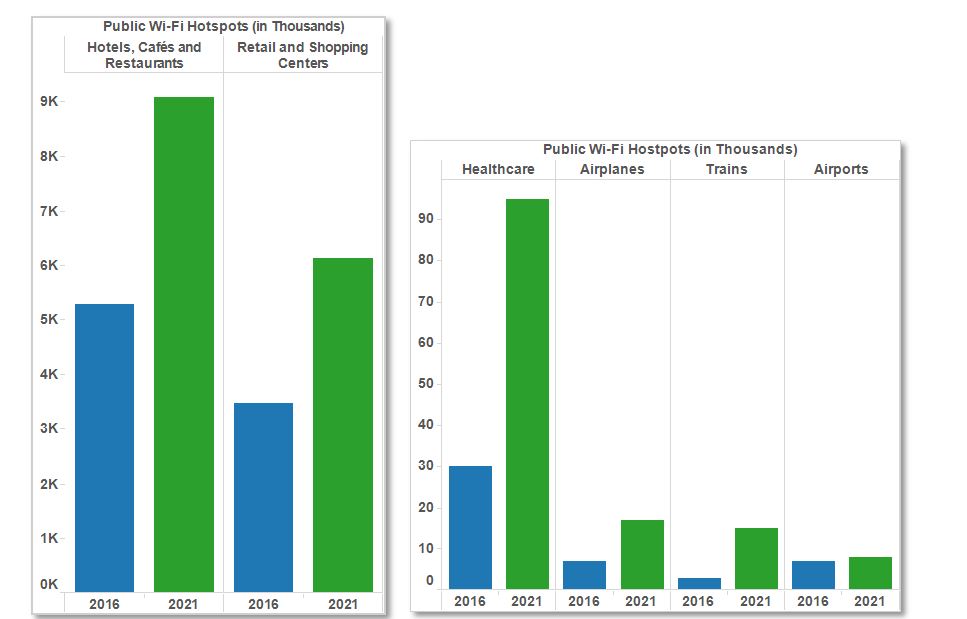
Public Wi-Fi hotspots (minus homespots) will nearly double from 8.8 million in 2016 to 15.4 million by 2021. Hotels, cafes and restaurants will have the highest number of hotspots by 2021 globally, and the fastest growth is in healthcare facilities (hospitals) where hotspots will triple over the forecast period. The primary objective of Wi-Fi in hospitals is to improve the delivery of healthcare services and staff productivity, with a secondary benefit being Internet access for patients, their families and guests.

Figure 4: Public Wi-Fi Hotspot Growth by Vertical

Source: Maravedis, Cisco Mobile VNI, 2017

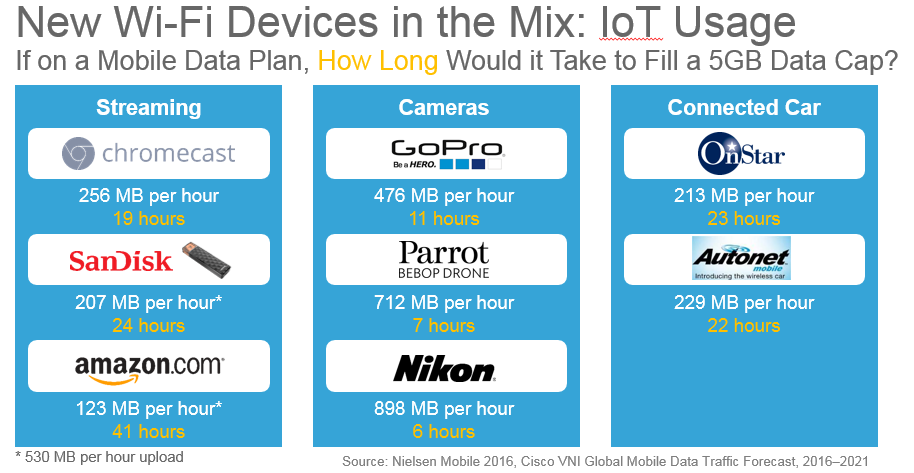
Integral to these verticals and looking into the future are the game changing IoT devices and connections. According to Maravedis/Rethink research and the WBA Alliance, more than two thirds (67%) of mobile operators and 78% of cable companies expect to use Wi-Fi to support IoT services by 2020. Wi-Fi is widely used as a mobile offload mechanism for IoT applications as well since cellular connectivity can be costly with data caps applied to most mobile data plans. Figure 5 looks at commonly used consumer IoT devices and connections, and their Wi-Fi usage. Assuming that this usage in MB per hour was on a mobile/cellular network, a common 5 GB plan for some of these devices (if used uninterruptedly) can take less than a day to fill or use up a month’s worth of allotted mobile data.

Figure 5: IoT Wi-Fi usage, what if it were on a cellular data connection?

During the recent Superbowl sporting event in the US, hundreds of drones were used as lighting props during Lady Gaga’s half time show. They were prerecorded, however, have the capability of doing the light show live. One couldn’t help but wonder if they had cellular or Wi-Fi connectivity or both technologies to communicate with the server/s.  Each IoT market vertical is evolving rapidly and in 2017 we are likely to see more segment specific standards for IoT (e.g., healthcare, transportation, utility monitoring, agriculture, etc.). Each industry has different needs and will benefit from different architectures based on what it’s looking to achieve with IoT. For example, agriculture may value long-distance connectivity and more edge operation while a smart home works with shorter distances and can rely on the cloud more and healthcare will require the most stringent data security. Each industry will start to mature and settle on protocols, hardware and more to define its specific standard and choice of connectivity — enabling billions of devices and things to choose more paths to satisfy their Wi-Fi wanderlust.

Related Links:

Authors

Usha Andra

Leader, Product Marketing

Data Center and Cloud Networking

Avatar

A few weeks ago at NRF 2017, we spoke with a number of retailers looking to improve the customer experience in their stores. Challenged by today’s online competitors, brick-and-mortar retailers are doing their best to reimagine their stores with new services and technology.

However, we also found that many of the same retailers were overlooking the most basic of all customer experience requirements – making sure that the workforce is able to provide good service based on the same capabilities. Wi-Fi, mobile, collaborative, and analytics tools aren’t limited to the customer. They also help to ensure that the front lines–the associates–are able to do their jobs as well as possible.

Day-to-day staffing: One of the most critical roles of an associate manager is managing day-to-day staffing. Determining how many people to bring in and when, and where to place them in the store, is a major cost point for store locations. This problem is often complicated by outside factors such as headquarters’ requirements of service per square foot, for example.

The good news is that new technologies can give you access to previously unavailable, more granular sources of customer and employee traffic data. Based on a network of device-derived heat maps, sensors, traffic counters, cameras, and other tools, retailers can draw on real-time metrics for a more detailed understanding of how to make best use of staff within the store.

Workforce productivity: Senior managers also can use such analytics to guide and motivate the workforce to improve productivity and efficiency. Your analysis helps associates understand who’s in the store, what they’re doing, where they are, and why. As a result, employees can assist shoppers faster and give them a more personalized experience.

Performance tracking: Access to advanced analytics makes it possible for you to measure performance, revenue per employee, and other metrics to incent and encourage your best workers. By monitoring and tracking performance and using online tools and apps to set realistic goals, you can have confidence that you’re rewarding and promoting employees with a robust skillset, good work ethic, and strong company loyalty.

Collaboration: Advances in automated scheduling and labor planning tools let managers improve motivation and store performance. Performance metrics can encourage increased collaboration among management, employees, and customers. For example, Gartner suggests using mobile collaboration and gamification to better connect motivating actions with customer outcomes (2015).

To see what a day in the life of a tech-enabled retail associate could look like, check out our new Infographic.

https://twitter.com/CiscoRetail/status/829764811642769413

Follow me at @Digital_Mary

Authors

Mary Freeman

No Longer with Cisco