Avatar

Cisco Live EMEA is just days away, and we can’t wait to meet customers, partners and peers at the Digital Communities space!

For those of you that are new to Cisco Live, the event brings together thousands of technology professionals from around the world to share ideas, sharpen their expertise, and get inspired. At Cisco Live, there will be more than 600 educational sessions and numerous Cisco and partner sponsored demonstrations which all offer a unique opportunity to acquire cutting-edge knowledge and skills on the technologies you already use, and those that you will rely on in the future to achieve digital transformation.

If you’re joining us in Berlin at this year’s Cisco Live EMEA, be sure to stop by the Digital Communities area in hall 4.2 of the World of Solutions to experience our public safety, smart cities & communities and education demonstrations.

In the public safety space, we’ll have a number of experts and partners on hand to explain how digital transformation is profoundly changing business and government priorities. For those visiting the booth, we welcome the opportunity to discuss how Cisco and our partners can deliver safer communities and countries in a digital era by providing a digital architecture that’s the foundation to connect people, process, data and things together.

We are very excited to be joined in Berlin by BlueLine Grid and Klas Telecom, as well as other key partners.

We’ll be demonstrating BlueLine Grid’s critical collaboration platform, which enables government agencies, corporate security and emergency teams to share information in a secure, compliant and timely manner.

We’re also demoing mobile emergency response from Klas Telecom (Klas), which specializes in providing first responders with broadband data, location-based services, and rich collaboration on a network that can support critical communication.

In the smart cities and communities space, we’ll be showcasing our Smart+Connected Digital Platform, which aggregates and organizes data from city infrastructure sensors and other data sources in an easy-to-use format while enabling a multitude of use cases across the community. This integrated platform can help cities and communities improve service delivery, cut operational costs, better coordinate emergency response, promote environmental sustainability, ensure economic vitality, and much more.

We’ll also share live demonstrations of our Smart+Connected lighting, parking, urban mobility and safety and security solutions.

For municipalities, street lighting is an essential maintenance effort to help improve public safety and the overall community experience, influencing a city’s ability to create a lasting environment for residents’ happiness, business and tourism. Unfortunately, community lighting is also a major energy and cost drain. Our lighting demo will feature our work with strategic partners, like Tvilight, to turn city streets into powerful light sensory networks that can help leaders to proactively manage and lower energy consumption, cut costs, and simplify maintenance.

The search for a parking space is not only terribly frustrating; it is also a major contributor to traffic congestion and carbon emissions. Come by to see how our parking solution can link drivers to parking availability and payment options in real time, enable law enforcement agencies to more efficiently catch violators, help reduce traffic congestion, and open new opportunities for increasing highly profitable revenue streams.

Preventing crime is vital to developing vibrant and safe communities. With our Smart+Connected Safety and Security solution, see how you can better manage public safety threats and emergencies to deliver mission-critical value in new ways.

As urban population centers grow, so does the demand on transportation infrastructure and the concept of accessibility. In the space, we’ll demonstrate aspects of our urban mobility offering that can help city leaders manage the commuter shift to public transit and transform services like waste collection to be on demand rather than inefficiently cadenced.

In the education space, we’ll be demonstrating how our solutions help inspire learning for improved student outcomes and enable intelligent campuses for better student and faculty experiences.

Our featured Digital Education Platform transforms campuses and enables digital learning and collaborative research by integrating solutions, services, and partner capabilities, all in a safe and productive digital environment.

In the space, we’ll also be showcasing our Spark and WebEx integration with leading Learning Management Systems (LMSs), which expands the opportunities for learning from any device, anywhere, any time.

Have questions about our demonstrations at Cisco Live Europe? Leave them in the comments below.

We’ll see you in Berlin next week!

Authors

Cecile Willems

Director, Global Public Sector

Global Sales Organization

Avatar

Virtual networks need to be built on solid foundations. Once these are in place, use cases can take them to the next level

It’s clear to service providers that their customers are now looking for a new kind of service – one that’s fast, flexible, and can be adjusted on demand to suit their needs.

Agile digital companies have led the way in creating these expectations, and the growth of mobile internet, online video, and the Internet of Things (IoT) is accelerating the trend

Building your network on solid foundations

Virtual networks are generating more interest because of their potential to enable the services that today’s customers want.

So how do you go about building the solid, open, and innovative foundation that a virtual network requires?

 Standard IT cloud infrastructure is not well suited to virtualisation, because it isn’t designed for high-bandwidth service provider network applications. You’ll need a purpose-designed infrastructure if you want to be able to guarantee availability and performance.

At Cisco, we understand this. That’s why we’ve worked with our partners to create a virtual network infrastructure that provides all the essential compute, storage and network functions.

A key component of our virtualisation technology is the Virtual Topology System (VTS), which supports virtual networks without sacrificing the reliability and performance of traditional physical network architecture.

 The VTS brings more visibility, automation and simplicity to your network, helping you make the transition to a software-defined data centre. It’s designed to work with the Cisco Network Services Orchestrator (NSO)

And it uses open standards, which means you can adapt and evolve your systems as your needs change.

But why Cisco?

The Cisco VTS doesn’t act in isolation. It’s part of a comprehensive range of technology that supports service providers who want to create a virtual network infrastructure.

Of course, it’s also possible to put together an infrastructure yourself.

But while you might save some upfront costs this way, the process is complicated. It involves a lot of different risks, and you’ll need to recruit and retain specialist engineers.

So which option really offers the best value?

To compare the two approaches, we carried out a total cost of ownership (TCO) analysis

While the equipment cost of the DIY solution was lower than using Cisco, the labour cost was significantly higher, because of the need to hire software engineers and the time taken to carry out upgrades.

In the end, for a virtual network infrastructure with 300 servers, using our services proved to be 40 percent more cost effective that the DIY approach.

Taking it to the next level

Once the foundations of a virtual network are in place, our use cases enable providers to take their services to the next level.

Use cases are network solutions designed for specific purposes, ready to be deployed straight away. They enable providers to shape the personalised, flexible services that really benefit customers.

One use case is the Cisco Ultra Services Platform, which is being used by mobile network operators like Korea’s SK Telecom to create agile mobile network services.

The benefits of the platform include centralising service creation and control, handling huge amounts of traffic, speeding up the introduction of services and automating deployment through a user-friendly interface.

“SDN holds much promise to make things easier and faster for our consumer and enterprise customers,” said Park Jin-hyo, senior vice president and head of Network Technology R&D Center at SK Telecom. “It helps our network keep up with the growing demands as customers digitise. Cisco’s approach of integrating SDN into the mobile services core will enable our customers to be served better with exactly what they want, when they want it.”

But service providers won’t benefit from advantages like this unless they’re careful to plan their new networks from first principles.

Cisco can help service providers ensure they enter a new world of possibility rather than a dead-end.

Yes, you’ll need to invest in it – but in the long run, not doing anything will cost you a lot more.

Find out how Cisco technology can enable you to provide flexible, bespoke network services. Read more about the Cisco NFV Infrastructure

Key takeaways

Virtual networks are generating interest because of their potential to enable flexible, personalised services.

– Standard IT cloud infrastructure isn’t well-suited to virtualisation, because it’s not designed for high-bandwidth, service-provider network applications.

– Cisco offers a wide range of technology to support service providers who want to create a virtual network infrastructure.

– Among Cisco’s products are use cases that build on the basic network infrastructure, and enable service providers to fulfill specific functions, like providing agile mobile network services.

– Setting up a virtual network infrastructure themselves might save service providers some upfront costs, but it’s likely to prove more expensive in the long run.

Save

Authors

Volker Tegtmeyer

Senior Manager, Product and Solution Marketing

SP Cloud Virtualization

Avatar

It’s Valentine’s Day, are you looking for a new technology partner?

What’s it like to be a communication or collaboration-focused reseller in today’s technology market? With the industry evolving at such a rapid pace – in terms of both technology and shifting revenue streams – the vendor landscape is changing dramatically. Resellers have an important decision to make. With whom are you willing to risk your company’s long-term well-being? Who can you trust to be by your side as you navigate the challenging, yet opportunistic waters of digitization?

I spent three years as the president and CEO of a reseller, and what I wanted was a partner that could provide a mutually beneficial relationship, who was in it for the long haul, and someone that understood our needs. Choosing the right collaboration partner can be like dating (with consequences for choosing poorly).

Important traits to consider when seeking a new technology partner:

  • Dedication– A partner who understands the importance of maintaining a mutually beneficial relationship to deliver success to mutual customers.
  • Responsibility – Someone committed to making the right decisions with your business needs and goals top of mind.
  • Flexibility – Someone established, yet dynamic and forward-thinking and willing to disrupt and capitalize on change.
  • Conviction –A self-aware partner that knows who they are, where they stand, where they are going, and transparent on how they will get there with you.
  • Commitment to the future – Someone who not only embraces change, but also has the vision and financial wherewithal to help lead it.

Some resellers in this UC and collaboration space may be finding themselves in a difficult position, with their company’s future on the line. I believe business owners should be analytical and realistic when it comes to choosing the right path to success in a digital world. It’s important to know when to seek a new opportunity or a new partner for what lies ahead.

For those resellers currently pondering their future, looking for a new, stable partner to find success and happiness, we invite you to join the Cisco family.

In honor of Valentine’s Day, here’s our ‘dating’ profile: 

  • Cisco’s Dedication – We know that Cisco’s partners are key to our go-to-market, and we are dedicated to their
    (your) growth and profitability.
  • Responsibility – We are committed to making the business choices that will continue to maintain our position as a globally recognized leader in the Collaboration space.
  • Flexibility – Our current products and solutions are well respected and proven, and Cisco is evolving our portfolio as a technology provider of the future. We will continue to make the proper partnerships and acquisitions to adapt to our rapidly changing industry (more below).
  • Our conviction – We build the best technology in the industry – and when someone else beats us to it, we acquire.
  • Our commitment to the future – Cisco has a history of embracing change, and we plan to continue that track record by pioneering this exciting collaboration revolution (because that’s how we see it – technology is a key factor in shaping the way we all connect, communicate and relate to one another).

Cisco’s commitment to the future of collaboration and its partner ecosystem is evident through:

Extensive Investments and Strategic acquisitions

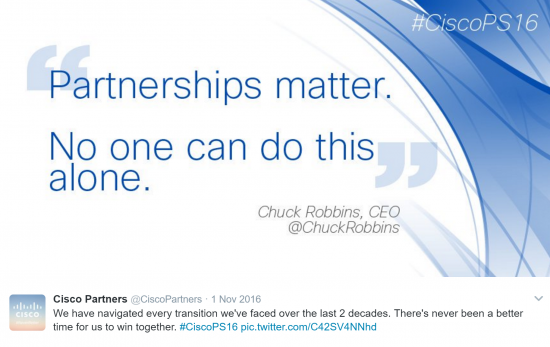
 “One key element of Cisco’s strategy is collaboration… Cisco has $2.1 billion invested in startups around the world, and has acquired 190 companies.”  — Cisco CEO Chuck Robbins in a 2016  ZDNet Article

Forging Strategic Partnerships with some of the world’s biggest technology innovators such as Apple, IBM and Salesforce.com.

Channel Insider 2016 article Cisco, Salesforce Alliance a Boon to the Channel: “Every once in a great while two great channel ecosystems come together in a way that holds the promise of creating a raft of new opportunities that many would have otherwise overlooked… on tap is a jointly developed customer service platform that will combine communications and contact center technologies developed by both companies While opportunities stemming from this alliance should be abundant for the channel, the most intriguing are perhaps the IoT projects. Cisco is in an especially good position to use its networking dominance to collect data from thousands, perhaps millions, of endpoints.”

The pursuit of new technology & product categories

“We are completely reinventing how the world connects and communicates. We are right on the cusp of massive change… Our goal is to get amazing technology into everyone’s hands.”  — Rowan Trollope, eWeek 2016

According to 2017 CRN article 12 Reasons Why Cisco’s Spark Board is Its Coolest Product Ever, “Cisco Systems is making technology in the workplace cool again.”

So, if you’re looking for a change in your current technology relationship and the reality of an uncertain future in your current situation is forcing you to reconsider your commitment, consider Cisco. The breadth and depth of our technology is unrivaled. We are committed to innovation, especially in the collaboration market. And, we are in it for the long haul.

But most importantly, we know that our partners are at the heart of our success.

Cisco’s Collaboration Solutions

Partner with Cisco today

Authors

Todd Meister

Vice President

US Partner Organization

Avatar

We are bringing it! That’s right – we are bringing the entire DevNet Zone to Berlin. We are not only bringing boxes full of equipment for learning labs, workshops for hands-on coding, classrooms and panels – it’s more than that. It’s the DevNet Zone experience where you learn, play, and get hands on with APIs and more. We want you to come learn, code, get inspired, and connect!

Start Your DevNet Zone Journey Here

Not exactly sure where to go in the DevNet Zone to learn, code, get inspired, and connect? For the answers, enter the mobile-friendly, digital DevNet Zone Activity Guide. Use the guide to find panels, classrooms, workshops, demos, and more. You can also use it to dive into what we offer by each technology. Maybe you want to check out what’s happening with Networking? We’ve got that. What about IoT and Collab? We have that too.  Here’s a couple of guide highlights (be sure to click the arrows in the book to read more about each topic):

  • Welcome from Susie Wee and watch the TechWise TV episode
  • Don’t miss meeting Devvie, our very own Cisco DevNet Sparkbot – you will be seeing a lot more of him on-site
  • Get to know the DevNet team and register for DevNet before you go

Hope you take this guide with you and use it during the event. It’s the first time we are delivering content in this format, last year we printed the activity guides but this year we are going digital. Go us. 😉

Have a question, comment or suggestion? Reach out to me, twitter DJ for @CiscoDevNet.


Authors

Janel Kratky

Project Manager

Cisco Marketing

Avatar

This guest blog post was written by Nolan Greene, Sr. Research Analyst with IDC’s Network Infrastructure group covering Enterprise Networks.  Nolan can be found on Twitter here.

There is justifiably a great deal of hype around the rise of Software-Defined WAN (SD-WAN). Organizations are becoming more digitized and increasingly rely upon a mixture of public and private cloud-based applications for day-to-day functions. This shift toward digitization has exponentially increased the need for a new networking paradigm for distributed enterprises (organizations that operate with a headquarters and multiple remote locations) as the exponential increase in cloud applications renders legacy remote connectivity options (such as exclusively relying upon MPLS) untenable.

Security is also an important factor in this shift. A breakthrough of SD-WAN is its ability to deploy consistent security throughout the network of branch locations, leveraging integrated next-generation firewalls in many cases. Perhaps, one of the more attractive features of SD-WAN is the ease of management for branch locations. Centralized, GUI-based management interfaces make deployment, troubleshooting, and ongoing management easier.

Distributed enterprises rely on network connections to the headquarters network to support applications such as POS systems (in retail enterprises), unified communications and collaboration platforms, and systems monitoring, among others. As the ecosystem for these applications becomes more complex, a one-size fits all approach to connectivity becomes less effective. Enter SD-WAN, which is revolutionizing branch connectivity through the intelligent and dynamic matching of applications to connectivity methods (such as Internet, LTE, and MPLS). As this promises to improve performance and reduce cost, enterprises have been expressing strong interest in SD-WAN and a number of solutions have popped up, with some emphasizing lower cost.

However, it is important to look beyond the sticker price. It is important to ensure that any potential SD-WAN solution can:

  • Integrate with existing infrastructure and applications while providing the transport options for dynamic path optimization needed by your organization.
  • Support the broader ecosystem–Does it offer service chaining and life-cycle management of individual components?
  • Flexibly scale according to your organization’s needs–Digital transformation requires network agility and linear scalability, so it is important not to defeat the purpose of investing in SD-WAN in the first place.

Despite its status as a newer technology, there is already a wide variety of SD-WAN solutions on the market today:

  • Some leverage existing investments in layer 3 (WAN) and areas such as WAN optimization, and others do not.
  • There are choices regarding on-premises hardware, software that runs on VMs on industry standard hardware, and cloud-based platforms.
  • A fairly robust roster of SD-WAN offerings from managed service providers (MSPs).

Ultimately, the choice comes down to what best supports your network infrastructure and application ecosystem, while providing proper support and tools that can evolve as network and application requirements will inevitably change. There is no “one-size-fits-all” approach. Undertake a careful evaluation of current and future needs to help in the selection of an optimal solution that provides dynamic, scalable performance in a cost-effective and secure set of capabilities.

Learn more about the benefits of a fully featured SD-WAN in this IDC report.

Authors

Kiran Ghodgaonkar

Senior Manager, Enterprise Marketing

Intent-based Networking Group

Avatar

#CiscoChampion Radio is a podcast series by Cisco Champions as technologists. Today we’re discussing Cisco Spark Board.

Get the Podcast

  • Listen to this episode
  • Download this episode (right-click on the episode’s download button)
  • View this episode in iTunes

Cisco Guest
Tom Richards, Cisco Spark Product Management

Cisco Champion Hosts
Justin Cohen(@cantechit), Solution Architect
Paul Giblin (@dreamlessod), Senior Cisco Solutions Architect
Amr (@amr_abari), Networking Business Development

Moderator
Kim Austin (@ciscokima)

Continue reading “#CiscoChampion Radio, S4|Ep. 1: Cisco Spark Board”

Avatar

Advanced Addressing Scheme Securely Connects Billions of Devices and Things

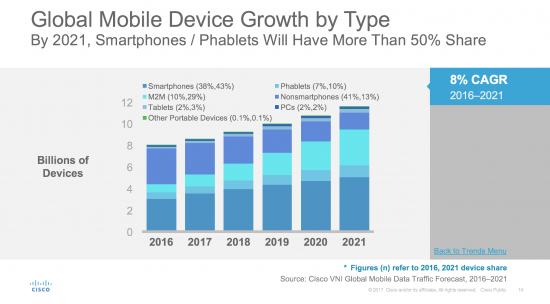
Digitization and automation is now a familiar feature in many homes. Mobile connectivity is not just for phones anymore. Today, we have lots of things that generate data or environments that we want to control (locally or remotely). And our access point for control is not limited to our smartphones – televisions, tablets, smartwatches, health monitors and even kitchen appliances can all serve as “digital control points.” Ubiquitous connectivity and control are fundamental elements of the Internet of Things (IoT) value proposition. The challenge of delivering seamless user experiences through communications between all of our devices and things that we want to control is becoming more broad and complex.   According to the 2017 Cisco Mobile Visual Networking Index (VNI), there will be nearly 12 billion global mobile-connected devices and machine-to-machine (M2M) connections by 2021, approximately 1.5 per capita. Globally, mobile networks will support about 4 billion new mobile-connected devices and connections from 2016 to 2021.


The chart above indicates that nearly a third of all mobile devices and connections (about 3.3 billion) will be some form of M2M by 2021, However, the full vision and potential of IoT can only be realized if  real-time information is transmitted securely to a wide variety of users and things. IPv6 is a key enabling component of of this aspirational networking goal. Service providers around the world understand the fundamental importance of IPv6 and the inherent innovation possibilities that it it can unlock. Service Providers like Comcast see IPv6 as much more than just a more scalable addressing scheme.


“The interesting thing with IPv6 is that we’re going to rethink how address space is used,” said Kevin McElearney, SVP of network engineering for Comcast. “Right now, everybody thinks that IP addresses are devices, but if the Internet of Things is really the Internet of virtual things then every device could have 100 or 1,000 addresses so it’s going to get interesting if you want to start addressing things like blocks of storage, application calls, or services.”


 

The Cisco Mobile Visual Networking Index (VNI) forecasts that globally, there will be 8.4 Billion IPv6-capable devices/connections by 2021, up from 3.4 Billion in 2016.


Here’s specifically how IPv6 addresses the three primary characteristics for successful IoT growth:

Real time information: One of the key metrics to evaluate the quality of information is whether it can be acted upon in a timely fashion. ‘Real time actionable information’ can be life-saving, be it the multitude of wearable health monitoring devices monitoring a patient’s health vitals or communication devices that enable pilot and air-traffic control communication. IPv6 enables faster communication by eliminating significant administrative overhead that exists in the IPv4 networks today – faster packet processing through elimination of IP checksums, faster routing through elimination of multi-layered routing and shorter routing tables and bandwidth efficiency through multi-casting in place of broadcasting, to name a few.

Security: While there are significant technological benefits that IPV6 provides in enabling IoT, one of the key benefits is the processing and transport of information in a secure fashion. IPSec, which provides end-to-end confidentiality, authentication and data integrity, is already present in IPv6. What that means is from the point where the data originates to its point of destination the data is secured and encrypted thus reducing cyber attacks where data can be hacked during transit.

User Adoption: With the plethora of devices and things that users are surrounded with, the key component of user adoption is ‘ease of setup’ and ‘ease of use’. Users now expect devices to come without extensive product manuals and work upon first power-on as soon as they remove it from the box. IPv6 offers this ‘out of the box’ experience through static IP addresses for each device or M2M connection, which eliminates the need for extensive manual configuration to connect new digital devices or things to a network. IPv6 connections can be pre-configured for first-time use, thus enabling and simplifying IoT.

So, even though the initial value of the IPv6 protocol was seen as a solution the acute IP address shortage, we now know that it delivers much more than just scalability. IPv6 can also help service providers build larger, more efficient networks with greater mobile connectivity and interoperability (especially for IoT). These networking transformations can support greater business innovations and revenue generation opportunities for service providers.

Related Links:

Save

Authors

Taru Khurana

Marketing Manager, Product/Systems

Avatar

Discovered by Tyler Bohan of Cisco Talos

Overview

Talos is disclosing TALOS-2016-0262  (CVE-2017-2372) and TALOS-2017-0275  (CVE-2017-2374), an out of bounds write vulnerability in Apple GarageBand. GarageBand is a music creation program, allowing users to create and edit music easily and effectively from their Mac computer. GarageBand is installed by default on all Mac computers so there is a significant number of potential victims. This issue was partially resolved on 1/18/17 with a patch which addressed CVE-2017-2372, the patch released on 2/13/17 addressed CVE-2017-2374 resolving the issue.

This particular vulnerability is the result of the way the application parses the proprietary file format used for GarageBand files, .band. The format is broken into chunks with a specific length field for each. This length is controlled by the user and can be leveraged to expose an exploitable condition. This vulnerability could be exploited by a user opening a specially crafted .band file.

Read more >>

Authors

Talos Group

Talos Security Intelligence & Research Group

Avatar

As part of my current series introducing concepts from my book, Building the Internet of Things here is a short excerpt from the book:

I remember a few years ago when we at Cisco decided to embrace and drive this new phenomenon of everything being connected, we had a fierce debate whether to call this trend Internet of Things (IoT) or Machine to Machine (M2M). Service providers (SPs) had been focusing on M2M for a few years by then. One SP told me at that time that they were shocked to discover that one-third of subscribers on their 3G network were M2M devices. According to Steve Hilton, president of MachNation, an analyst firm specializing in IoT and digitization research, “It was at this point that service providers realized there was a bigger opportunity in store for them and started paying conscious attention to these new types of connections.”

SPs have a significant role in smart cities and connected transportation.

Mobile operators got an early start in M2M with connecting cars and early IoT solutions as mundane as optimizing pizza delivery. Their challenge turned out to be less about technology and more about the business model. Operators built their mobile businesses based on a relatively high average revenue per user (ARPU) that smartphones delivered. Thus, they were looking for IoT solutions that could deliver similar ARPU. Unfortunately, most of the M2M services such as remote monitoring and maintenance delivered a monthly dollar ARPU in single digits. There was also a question of credibility with enterprises. I heard from many enterprise customers that SPs were just “providers of pipes” and could not be trusted with enterprise SLAs and complex solutions.

But since then, SPs have evolved: Some chose to invest in internal capabilities to develop vertical expertise and IoT services; some created ecosystems of partnerships; some attempted to buy their way into telematics capabilities and IoT platforms; some considered operating dedicated IoT networks using older generation mobile technologies; many created dedicated divisions (separate from their wireline and wireless operations) focused on M2M, vertical IoT solutions and managed services, with some becoming $1B+ businesses. Several mobile virtual network operators (wireless services providers that do not own the underlying network infrastructure), either independent or divisions of larger operators, started to offer vertical and horizontal IoT services as well. “In order to take advantage of the opportunities in the market, SPs focused on changing five key areas of their businesses: organizational redesign, partnership development, technology portfolio enhancement, network development, and market messaging,” said Hilton.

Today, most major SPs have a strategic focus on IoT. They are in the process of sorting through a plethora of Low-Power Wide-Area Network technologies and are in the early stages of pursuing 5G definitions with IoT use cases in mind. They have developed and matured vertical businesses and IoT business models going beyond connectivity. For example, they are pursuing several distinct profit pools in the connected vehicle domain, each with an additional ARPU. These efforts include the four categories of IoT solutions I have identified as fast paths to IoT payback. Almost every week, we see an announcement of an IoT partnership between an SP and an enterprise. As the smartphone market becomes saturated in the United States and Europe, connected cars and connected things have become a bright spot and a high-growth area for the operators. Many of these services now deliver a relatively high ARPU through the combination of connectivity and managed services.

So yes, SPs, after a few years of trial and error and some failed attempts and early starts, are playing a key role in the IoT ecosystem; many of them are worthy of your consideration as well.

In two weeks, I’ll wrap up this series on IoT with an overview of where we are in our collective IoT journey.

Authors

Maciej Kranz

Vice President and General Manager

Corporate Strategic Innovation Group