Technology has always been an enabler in challenging the status-quo but turbulent market shifts have accelerated the journey to becoming digital businesses for traditional enterprises.
There are many forcing functions but enterprises are striving for the intelligence that can be gained by ever increasing data proliferation to find better ways to engage with customers while thwarting the challenges posed by disruptive new entrants.
Speed wins: We all have seen the disruption in last few years that new entrants have created in different markets and while technology is the driver if we peel the onion one layer, we find the key is their ability to deliver software applications at speed unmatched by traditional incumbents. We have seen disruption even in the industries that have higher barriers to entry.
It is imperative to lay the right infrastructure foundation giving you the agility and speed for your digital business.
Choose Containerized Infrastructure and Cloud-Native Architecture to gain speed
Directly or indirectly, containers enable several key tenants of digital transformation. Portability across different platforms by standardizing packaging of applications reduces friction in deployments. It also accelerates adoption of DevOps, which is key in delivering applications faster. The rise of microservices architectures has further propelled container adoption. Containers are at the center of technology and process evolution that digital companies have embraced. While the benefits of containers are clear, the production deployment has lagged. Lack of unified security, networking, monitoring, observability and management across hybrid deployments are often cited as primary inhibitors to broader adoption.
Containers and Microservices at Cisco live! 2017, Berlin
Whether you are just starting your journey to cloud native or are already well ahead on maturity curve, we got you covered at Cisco live! Europe in Berlin. Following are just a sample of exciting learning opportunities – sessions, hands-on workshops, demos, meet the engineers and much more. Reserve your spot today!
1. Bridging the cloud gap – Cisco solutions for hybrid cloud
Learn about Cisco’s cloud strategy and cloud-native innovations.
2. Operationalizing Containers – a perspective from the trenches
Join a power-packed panel of experts from Cisco, Docker, Red Hat OpenShift Container Platform, and SAP Ariba, an early practitioner of running containers in production at scale. Get any top of mind questions answered and hear panel’s perspective on best practices to operationalize containers
3. Container Networking – Deep dive into Project Contiv
Contiv is completely open source, production grade networking fabric for your containerzied applications.This session deep dives into various differentiating features, networking and security considerations with an example 3 tier application deployment.
5. Best of Breed Container Solutions from Cisco and Docker
Want to move your containerized workloads beyond dev/test and into production? Learn the latest co-innovations by Cisco and Docker to accelerate your journey to cloud native architectures
In this instructor-led, hands-on workshop, you will go from 0 to 100 on all things Contiv – install, configure as well as deploy microservices-based application in an ACI environment with Contiv as container networking.
Containers and Microservices booth, in the Datacenter and Cloud area, is your one stop destination to know all the innovations that Cisco is delivering in this space. Hang out with us and share tips, tricks, insights or stories from your cloud-native journey. Of course, don’t forget to load up on cool Cisco Cloud swag!
DevNet Zone
DevNet Zone is Cisco DevNet brought to you live. Members from our container and cloud teams are ready to network and connect with you at DNZ. We will have guided hands-on tutorials, in-depth product sessions, and workshops. Add following DevNet sessions to your calendar:
As our customers embark on their digital transformation journey, they have a myriad of vendor, partner and technology options available to revitalize their businesses and produce better outcomes for their consumers. So more than ever – how we (vendors, resellers, integrators) work with these customers along their digital journey makes a big difference in whether we are relevant and successful. It requires a fundamental change in our go-to-market, otherwise we risk leaving billions of dollars of opportunity on the table for others to grab.
You’ve heard me and Sandy Hogan talk about the value of Customer-In Selling and why it’s important to change how we sell by starting the conversation with a customer’s business challenge and outcome in mind. The second most important part of Customer-In Selling is to change who we sell with by working with other ecosystem partners to leverage that outcome. Why is this? First, no single vendor can produce a customer’s digital transformation outcome – today’s solutions often require products and services from an ecosystem of hardware vendors, software vendors and integrators. But more importantly, to own the digital conversation with our customers, we must connect the conversation between the Lines of Business (LOB) and IT. This is intimidating to many of our traditional sellers that don’t have the experience or depth of knowledge to maintain a robust conversation with the LOB decision makers. The good news is that we have seen our success increase significantly when we engage other ecosystem partners that either have: 1) existing LOB relationships in our target accounts, or 2) relevant Customer-In Selling success stories that help build trustful relationships with those LOB decision makers. In truth, attempting to drive a Customer-In Selling approach on our own limits our success.
Early engagement of the right players from our entire partner ecosystem helps Cisco and our traditional partners:
get involved in the sales cycles well before we are labeled as “just the infrastructure provider”
build credibility with new buyers within our account
tap into new budgets
and sell comprehensive solutions with hardware, software and services that increase our margins and deal sizes
To accelerate our partners’ success with this new go-to-market model, Cisco continues to evolve the Connected Value Exchange between all of the partners that work together on a customer’s behalf. This exchange produces new skills/capabilities, business outcomes and monetization opportunities for everyone – resellers, independent software vendors (ISVs), integrators, cloud providers, etc. – that can be leveraged as best practices for future customers.
Check out Accelerating Cisco Ecosystem Sales (ACES): It’s a collection of best practices and resources that help you engage, go-to-market, and succeed when engaging new ecosystem partners
AttendCiscoPartner Day—if you’re planning to be in Berlin for Cisco Live, register for Partner Day being held Monday, February 20 from 1:00-6:00pm where you’ll hear opening keynotes from Milo Schacher, Jeremy Bevan, Jeff Samuels and me around digital transformation. (Note: you must register for Partner Day separately from Cisco Live Berlin)
Come to Ecosystem Partner Connections—when you register for Partner Day, choose our Ecosystem Partner Connections breakout. Here you’ll meet new ecosystem partners, hear business pitches from 6 independent software vendors (LiveAction, Hoxton Analytics, SAS, MazeMap, Veeam, and Purple) and learn how to own the digital conversation with your partners! (Note: you must be registered for Partner Day, to attend this breakout)
Visit the Security, Cloud/DC and Collaboration Partner Villages at Cisco Live Berlin—to find out more about our partners’ and Cisco’s solutions to drive digital transformation.
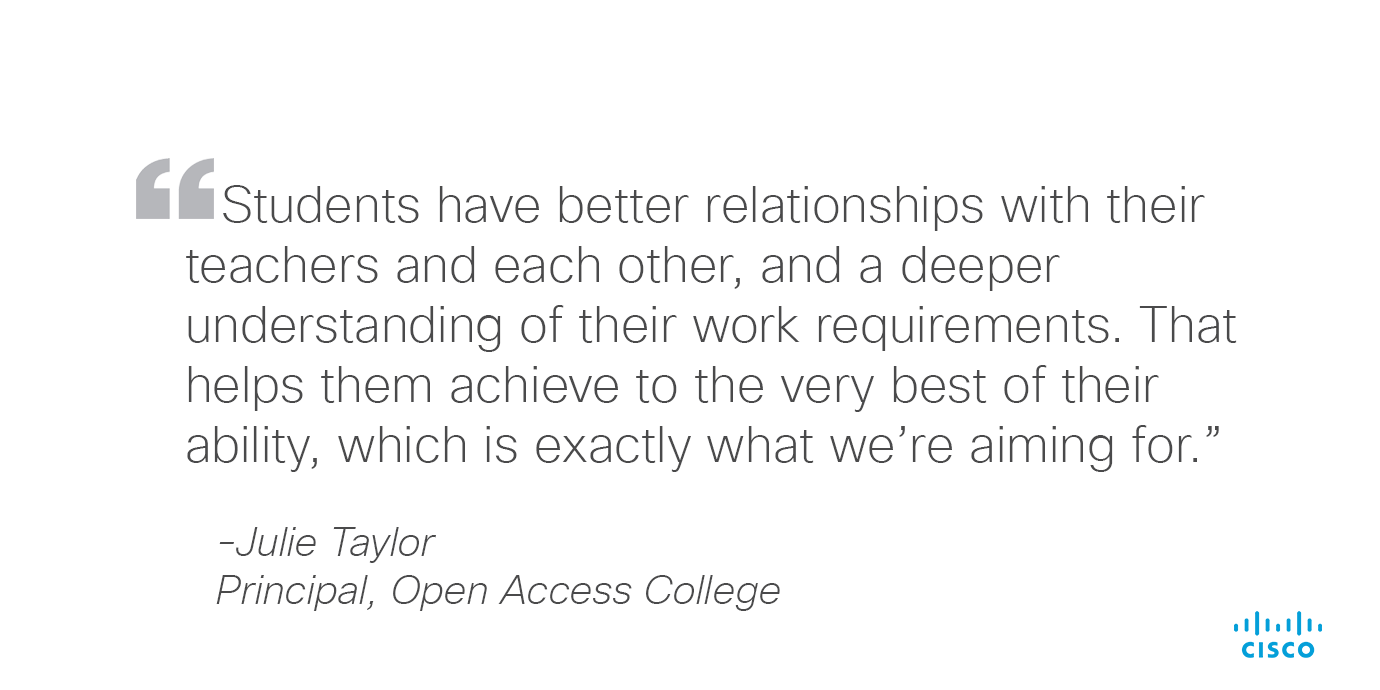
OAC delivers educational services in remote South Australia where students cannot attend traditional schooling. In the past, classes were conducted via audio-conference. Now, through a high performing network and collaboration tools by Cisco, OAC can expand access to learning.
At OAC, the staff and students now connect via Cisco WebEx, and can collaborate in digital video spaces. They benefit from working together in teams, from connecting to experts they otherwise wouldn’t be able to access in person and from being able to revisit lessons using recordings stored in the online learning system.
These students are able to access learning anywhere, any time, on almost any device, while teachers can work freely on campus with reliable connections supported by Cisco wireless access points. Quality distance learning is underpinned by highly-reliable, secure WAN connectivity to the locations where the remote students are. While on the campus itself, Cisco Catalyst® switching foundation also provides speed for bandwidth-hungry applications like graphics rendering, which is ideal for subjects like photography.
What school wouldn’t benefit from fostering a greater camaraderie amongst its students? Or from accessing experts not bounded by geographical limitations? Or from allowing staff to communicate with each other from disparate locations?
Digital learning provides all of these opportunities and opens up pathways to further benefits along the way.
2016 was a momentous year for Cisco and the world. We made key acquisitions, sponsored the Olympic Games in Rio, and continued to evolve our business to meet customers’ changing needs. It was also Cisco CEO Chuck Robbins’ first full year at the head of the company, and in the 2016 Corporate Social Responsibility (CSR) report, he stated that “our CSR programs have strengthened more than ever.” We couldn’t agree more!
We can all be proud of the progress Cisco’s made to further reduce our own and our customer’s environmental impact. These accomplishments would not have been possible without help from all of our employees, partners, and teams — thank you for your hard work this past year!
Here are some of the sustainability initiatives and accomplishments we launched and achieved in 2016:
Released Cisco’s 12th annual CSR report, which highlights our environmental performance and shows how we’re working to build sustainability into every business function and process.
Piloted and released the Cisco IP Phone 7861, which contains at least 35 percent post-consumer plastic in seven of its individual plastic components.
Used electricity generated from renewable sources for 77% of our electricity demand in FY16.
Launched an internal engagement platform called Cisco Greenhouse, on which employees can learn how to reduce their environmental footprint and inspire others to live more sustainably. Over the past six months, 1,750 employees have taken over 9,100 actions to be more sustainable.
Launched Earth Aware, a new month-long employee volunteerism and awareness campaign to support the environment and sustainability during the month of April, which culminated in a sustainability thought leadership forum called SustainX.
Launched a carpooling program for our San Jose and San Francisco locations. Employees using the program avoided 400,000 miles of driving (a carbon emissions reduction of over 145 metric tonne CO2).
Avoided 1,368 cumulative metric tonne of packaging and product material, and 7,432 cumulative metric tonne of CO2e in our supply chain through the Pack It Green 2.0 program in FY16. We saved $3.2 million through material and freight cost reductions.
Collected 238 metric tonne of e-scrap from employees at 143 Cisco sites on Recycle IT Day.
Earned a spot on the 2016 “Climate A List” for the Carbon Disclosure Project’s (CDP) investor climate change questionnaire.
We’re only a month into 2017, but we’ve already begun building on last year’s successes. Here is a sneak peak of what we’ve been up to in the New Year:
Planning our 2nd annual Earth Aware, which will feature on-campus, volunteering, and virtual methods for our employees to get involved.
Preparing for the completed construction of NRG’s solar facility in Southern California, which will supply over 10% of the San Jose campus’s electricity from solar power.
Organizing the 2nd SustainX to educate more employees on how they can incorporate sustainability into their jobs at Cisco.
Learn more about these initiatives and many others by following Cisco CSR on Twitter!
Our support of sustainability is one example of how Cisco is harnessing the power of the digital revolution to accelerate global problem solving, enabling people and societies to thrive in the digital economy. Our goal is to positively impact 1 billion people by 2025.
Making small changes to legacy systems isn’t enough – it’s time to leap into the virtual future
Thanks to rapidly developing trends like the growth of the cloud, online video and the Internet of Things (IoT), the way we use the internet is changing fast.
The Cisco 2015 Global Cloud Index forecast predicts that in 2019, more than 80% of data centre traffic will come from the cloud . And by 2020, there will be 26.3 billion mobile-ready devices and machine-to-machine connections worldwide.
As our world becomes more and more connected, none of these trends show any sign of slowing down. And it’s easy to assume service providers would be delighted by this fact. But it’s just as likely that they’re wondering how to cope with it.
Because while the demand for more sophisticated, faster internet services rises sharply, revenue is growing much more slowly.
No middle ground
This can go either way for service providers.
The rapidly changing landscape is a potential threat. But for those that can get it right, it’s also a huge opportunity.
Providers need to quickly find more efficient ways of giving customers the services they need, or they risk being overtaken by events. There’s no middle ground. And the decisions they make now will determine whether their business grows or declines.
Virtualisation technology driven by orchestration, and taking a holistic approach to security, can help them ensure they make the best of this new internet age. In effect, it moves the functioning of the network (traditionally performed by hardware) onto software.
Decoupling the network’s capabilities from its infrastructure in this way means it can offer much greater speed and flexibility. Which, in turn, will enable new products to come to market much faster.
This gives providers the agility to respond to changing customer demands. And just as it works for an expanding business that wants to quickly create self-service virtual networks, it also works for consumers who want to design bespoke home entertainment packages.
Making virtualisation work
Virtualisation brings many new opportunities. But it needs to be done well to work.
It’s also essential to use a sophisticated orchestration engine , so that complex network functions can be automated. And adopting an open source approach will mean that a system is flexible enough to adapt to different situations and evolving conditions.
An expert and proven innovator in this field, Cisco has deep knowledge and experience in these critical areas. That’s why leading service providers across the world trust the company to support their virtualisation journeys.
AT&T, for example, are investing in virtualisation to create dynamic, on-demand services, including connecting cars in Europe. They realise that this is the way to ensure that the business thrives in a connected world. And they understand this is a time for taking bold decisions.
Making small changes to old systems isn’t enough. It’s time to take the leap into the virtual future. Many businesses now see that this is an investment that can really pay off.
The real cost would be not doing anything at all.
Find out how you can respond to unpredictable traffic demands and introduce services faster. Read more about Cisco’s virtualisation technology .
Key takeaways
– Trends like the growth of services delivered from the cloud, in areas like business, mobility, video, and the internet of things (IoT) show that the way we use the internet is changing fast.
– The rapidly changing landscape is a potential threat for service providers – but for those that can get it right, it’s also a huge opportunity.
– Virtualisation brings many new opportunities, but it needs to be implemented well to work – and without delay.
Multi-layer SDN remains an area of strong interest for our customers and a recent report by ACG Research (Q3-2016 worldwide Transport/Multi-Layer SDN results) shows that we continue to maintain the top position in four individual categories (metro, edge, core, and control / application software) along with overall market share.
Although transport SDN has taken time to move from trials to live deployment, Cisco and ACG both see that network operators are starting to get there:
Transport/ML-SDN commercial deployments are under way globally
Vendors are investing in their transport SDN solutions, including the general availability of features such as segment routing from Cisco, Nokia and Juniper.
Operational considerations such as service assurance are moving to the front of vendors’ roadmaps and implementations.
Open source communities such as ODL, ONOS and ONF are active and delivering regular enhancements, including the recent “Boron” release from ODL and “Hummingbird” from ONOS.
To see our technology in action come see us next month in Los Angeles, CA at OFC, booth 1501 March 21-23.
Making a major business technology purchase isn’t something you can take lightly. And I don’t know anyone who would. It’s not the same as buying a new TV or a new phone. Those usually aren’t impulse decisions. You’ve done your research. But if it’s not what you want, you can quickly unplug the TV and exchange it for a different model. Or live with your new phone, call it mean names for the two years of your mobile contract, and make a different choice next time.
But business technology decisions affect people, processes, budgets. Deploying new tech means dealing with transitions, integration, implementation, and all that goes with those. And unlike “behind closed doors” technology that lives in the secret work of network admins, unified communications touches everyone in your business – from your employees to your customers and everyone between. And your contact center? You don’t need me to tell you how important that is.
These are the purchases that require trust:Trust in the products, trust in the vendor, and trust that your future needs are always part of the equation.
These are the purchases that require trust: Trust in the products, trust in the vendor, and trust that your future needs are always part of the equation.
Like making a purchase decision isn’t always simple, neither is deciding that it’s time to make one. Whatever brings you to shop for new tech is much more than an empty milk carton in the refrigerator. Maybe you fit into one of these scenarios:
You’re a new org with a blank page and get to build your setup from scratch.
You’ve long struggled with a pieced-together system, but now it’s time to step up to a fully integrated platform.
You’ve worked with a vendor for a long time, but you’re not confident in the company’s longevity. Or it’s not keeping up with what competitors have to offer.
You just did all that due diligence and homework. You wrote a hefty check. Now, all of a sudden, there’s a change in your vendor’s status.
Whatever the reason, it’s rarely easy. And somehow, if you’re a linchpin in the decision process, you’ll lose some sleep along the way. (If not you, someone on your team will…) Personally, I’m a fan of sleep. I like it. It’s important. Let us help you minimize that lost sleep.
Let’s not dance around it.Avaya’s recent announcements have put a lot of people into the decision process. Change and uncertainty usually do.
Let’s not dance around it. Avaya’s recent announcements have put a lot of people into the decision process. Change and uncertainty usually do. So then, what to do next? I’m not bold enough to say, “Hey, come on over and write me a check right now.” That’s not how this works. It’s not an overnight decision. You have to figure out who you trust with your unified communications and customer care solutions. And to get there means asking a lot of questions – and getting the answers you need.
Trust Cisco for Unified Communications
The industry recognizes Cisco as a leader in unified communications. We have over 15 years of experience implementing solutions for organizations of all sizes across industries, worldwide. And we don’t sit still. We’re focused on a cycle of constant innovation to improve everything we do, always emphasizing the user experience.
Does Cisco offer unified communications solutions? Yes. We have comprehensive, fully supported unified communications solutions based on proven voice, video, messaging, and mobility. We offer a range of cloud, on-premises, hosted, and hybrid solutions, including Cisco Spark, Cisco Business Edition packaged solutions, and customer care.
What should I do if I’m considering a move from my current vendor? This is a great time for a conversation with us. Together with our extensive network of partners, we’re available to talk you through your particular concerns, help you come up with development plans, and mitigate risks as you move forward.
Are there special programs to help me move to Cisco? We have several programs to help you move to Cisco, from technology migration discounts to try-and-buy offers and adoption services. Our partners can advise you regarding which ones best suit your needs.
What are some of your differentiators against Avaya? Cisco is leading the industry, with significant investments in on-premises, cloud, and hybrid unified communications solutions.
Innovation: Cisco Spark is helping to change the way people communicate and get things done with meetings, messaging, and calling in one platform.
Options: You have choices of how to bring our solutions into your organization. Depending on your needs, you might go with one of our Business Edition packaged collaboration solutions or work with a partner for a hosted collaboration solution.
Depth: If you are looking for advanced call control or customer care capabilities, we have solutions for businesses of any size.
Flexibility: The Cisco Spark Flex Plan decouples the deployment platform decision from the purchase decision so you can migrate to cloud collaboration on your own schedule.
What are the differences between the Business Edition packaged solutions? It’s all about you and what you need.
If you’re an enterprise with sophisticated unified communications requirements, consider Cisco Business Edition 7000. It’s a great fit for organizations with over 1000 employees. It comes preloaded with unified communications, contact center, mobility, video, paging, Emergency Responder, and more. It is a modular, scale-out solution. You might also want to consider an Enterprise Agreement.
For midsized organizations with up to 1000 employees, Cisco Business Edition 6000 could be a great replacement for existing Avaya unified communications platforms. It’s a complete solution with unified communications, contact center, mobility, video, paging, Emergency Responder, and more. It’s a comprehensive and flexible solution.
Cisco Business Edition 4000 provides essential voice and voicemail services, with easy-to-use management tools at an affordable price. It’s a great option if you have between 25 and 200 devices (such as phones). And it’s a great replacement for an existing Avaya IP Office system. To keep things simple, installation and ongoing management take place via the cloud.
Do Cisco solutions work alongside our existing Avaya investments? Our partners have great experience migrating from Avaya to Cisco and can work with you to plan your migration. We believe an end-to-end Cisco solution delivers the best experience and increases the effectiveness of communications and collaboration in your organization. But, we realize that you may need a phased approach.
What support can you offer? Our services team can help you plan every step of your journey, from planning, design, implementation, and adoption to ongoing support. Once your system is running, Software Support Service (SWSS) provides access to upgrades and global 24×365 access to our Technical Assistance Center. Cisco Smart Net Total Care™ Service provides options for 2-hour, 4-hour, or next-business-day advance hardware replacement. Likewise, our partners also offer a wide range of value-added services.
Cisco has been in the contact center business since 1999. Depending on region and market share reports, Cisco is either number 1 or number 2 in the contact center platform segment. Our portfolio covers the needs of contact centers from small to very large. Deployments include market leaders in all industries and more than 27,000 individual contact centers.
Have you migrated large Avaya customers to Cisco contact centers? Yes. In fact, a significant percentage of new Cisco contact center customers are existing Avaya contact center customers, including many deployments of more than 10,000 seats.
Avaya says Cisco is dependent on third parties — is that true? Yes. Digital transformation is a value chain play that can’t be accomplished via a single vendor. That’s why we focus on extensibility to valuable third-party solutions via a strong set of open APIs and interfaces.
How do you minimize risk in moving from Avaya to Cisco? We’ve developed extensive expertise in migrating customers from Avaya environments to Cisco. That expertise allows us to reduce risk and translate your specific Avaya solution to Cisco.
How long would an Avaya to Cisco migration take? As you’d expect, it depends on the size and complexity of your current Avaya environment. A Cisco environment can be up and running in as little as 90 days.
Does Cisco have a cloud contact center solution? Yes. Cisco Hosted Collaboration Solution for Contact Center is a version of Cisco Unified Contact Center Enterprise designed for hosting by service providers and other cloud partners. It provides the same capabilities as our enterprise on-premises solution in a per-agent/per-month consumption model.
Are Avaya’s existing applications, such as Avaya WFO, compatible with Cisco’s platform?Yes. Our ecosystem partners — such as NICE, Verint, and Calabrio — have WFO-compatible solutions that have been certified and tested, and that interoperate with both Cisco and Avaya.
Can you help us maintain and manage an Avaya platform and existing third-party applications during a transition? Yes. Cisco and our partners can support migration, day-2 support, and manage and maintain an Avaya solution.
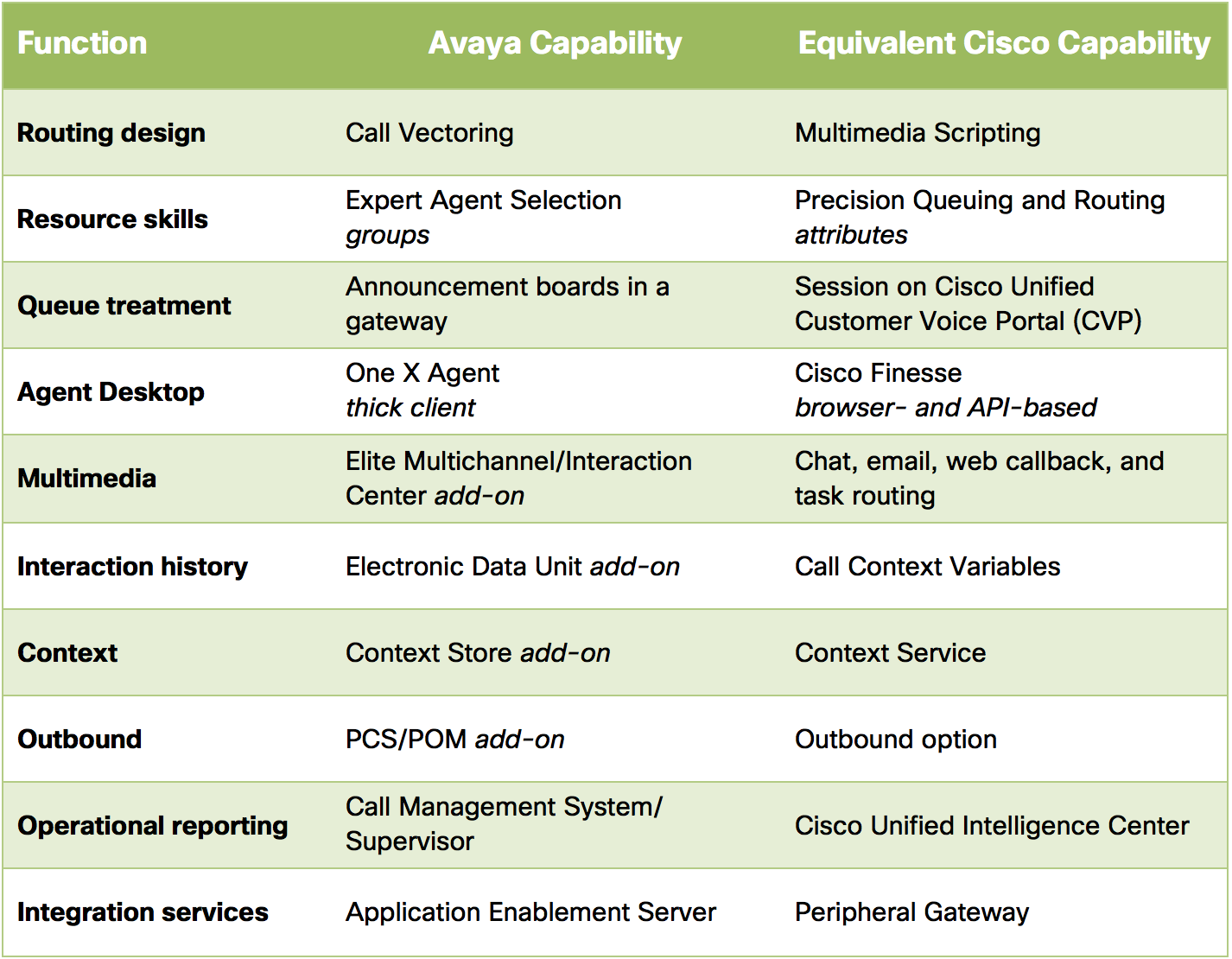
Do you have applications similar to Avaya CMS, Call Vectoring, and Session Manager? Yes. Cisco has a mature platform with equivalent or more robust capabilities due to a more modern architecture that provides greater inherent extensibility. The following table provides examples of baseline capabilities between the two companies. One significant difference: Cisco builds many of these capabilities directly into the base solution, whereas Avaya requires add-ons.
What is your global presence? Our contact center solutions have wide market presence in every operating region of the world. Our installed base scales from small contact centers to large virtual and global customer care centers. Our partners include large global as well as regional players.
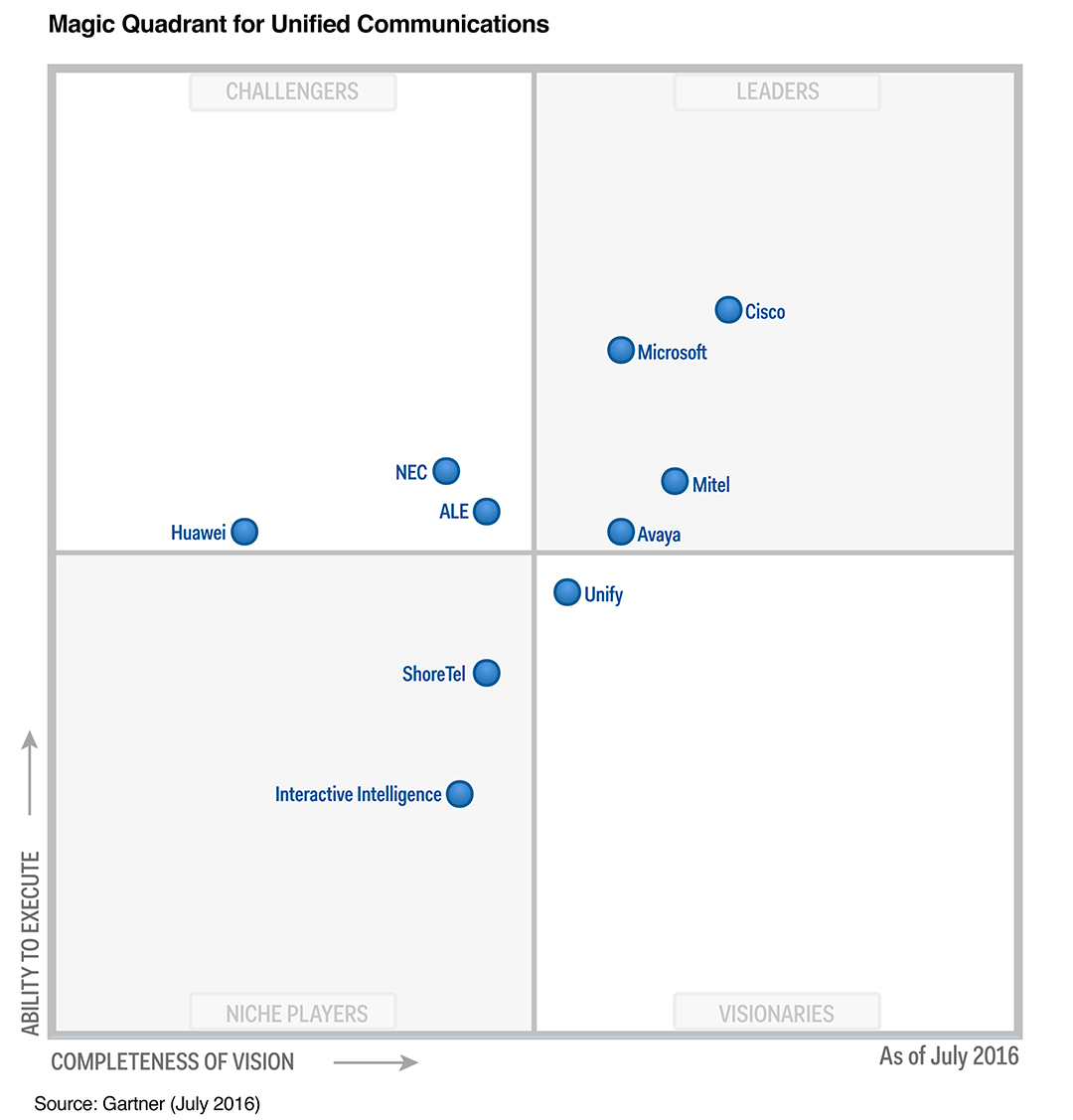
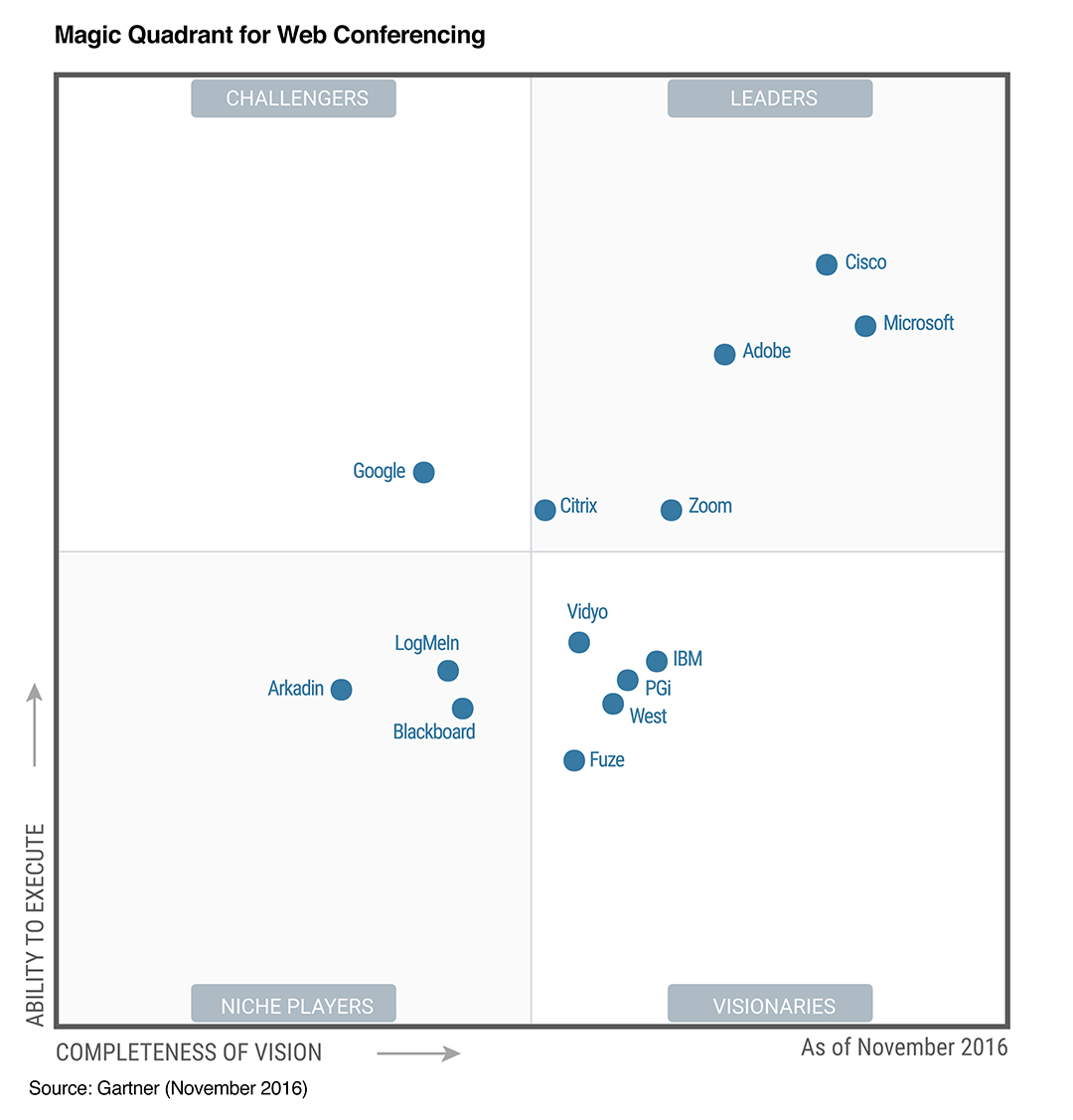
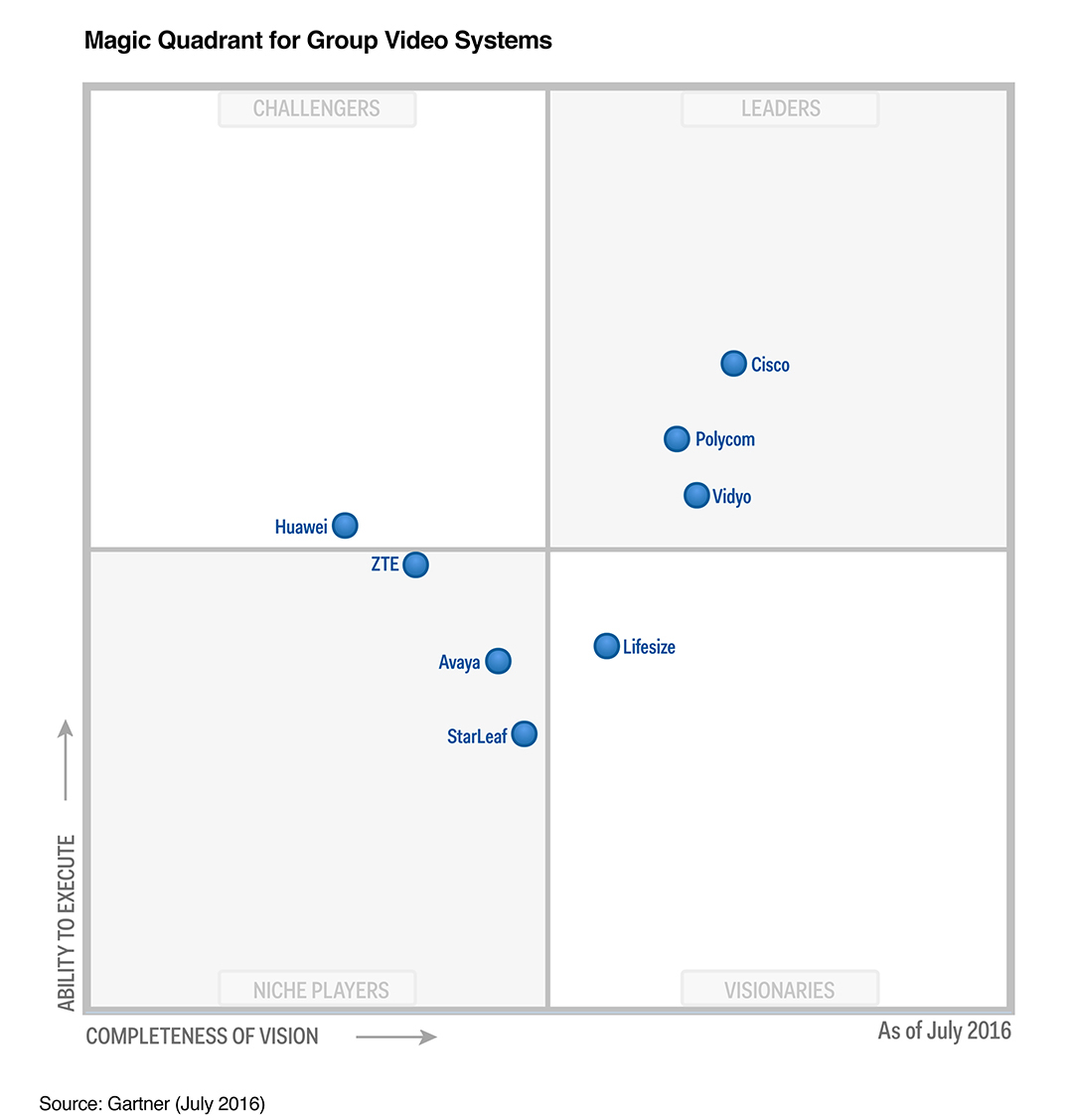
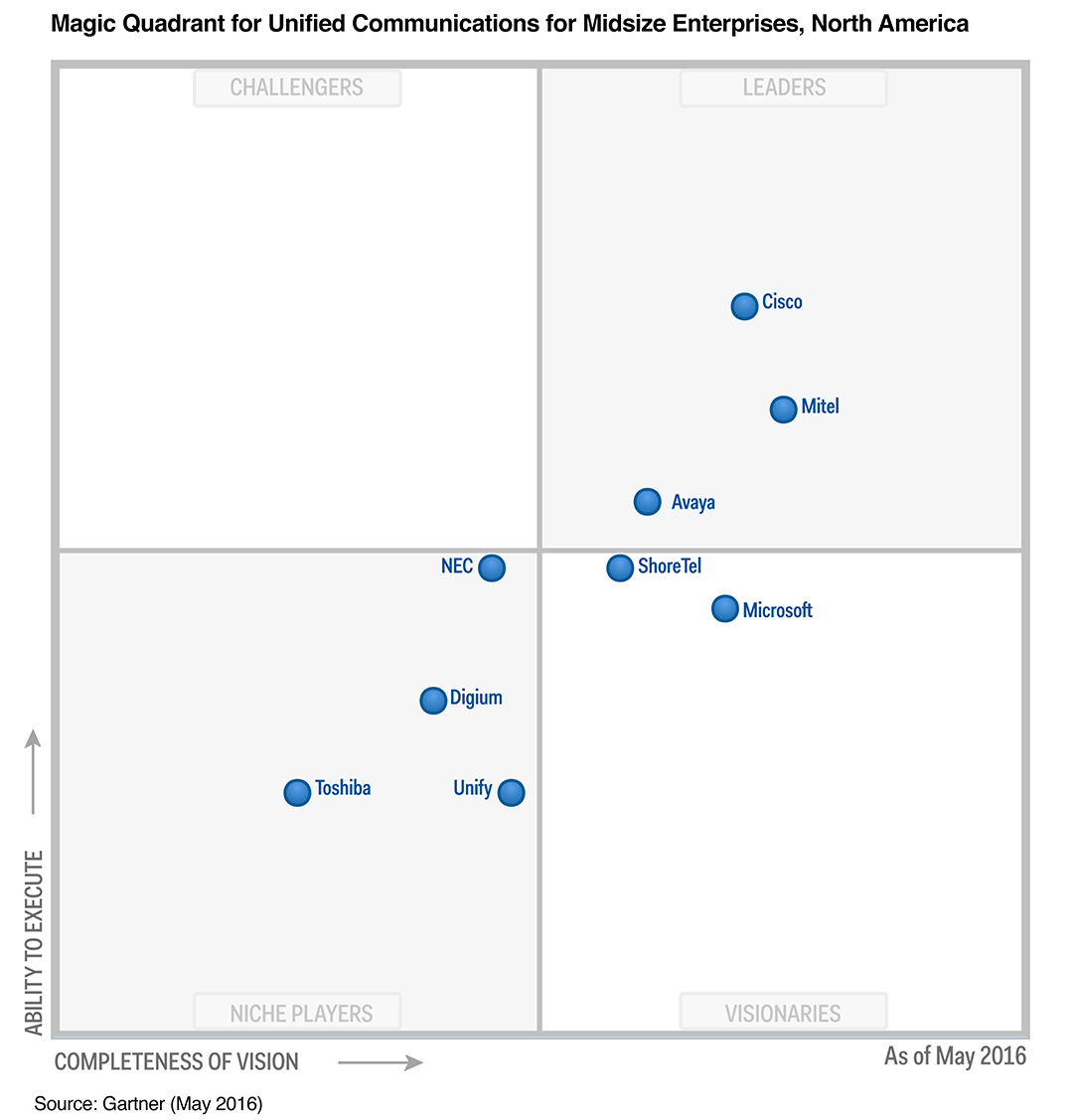
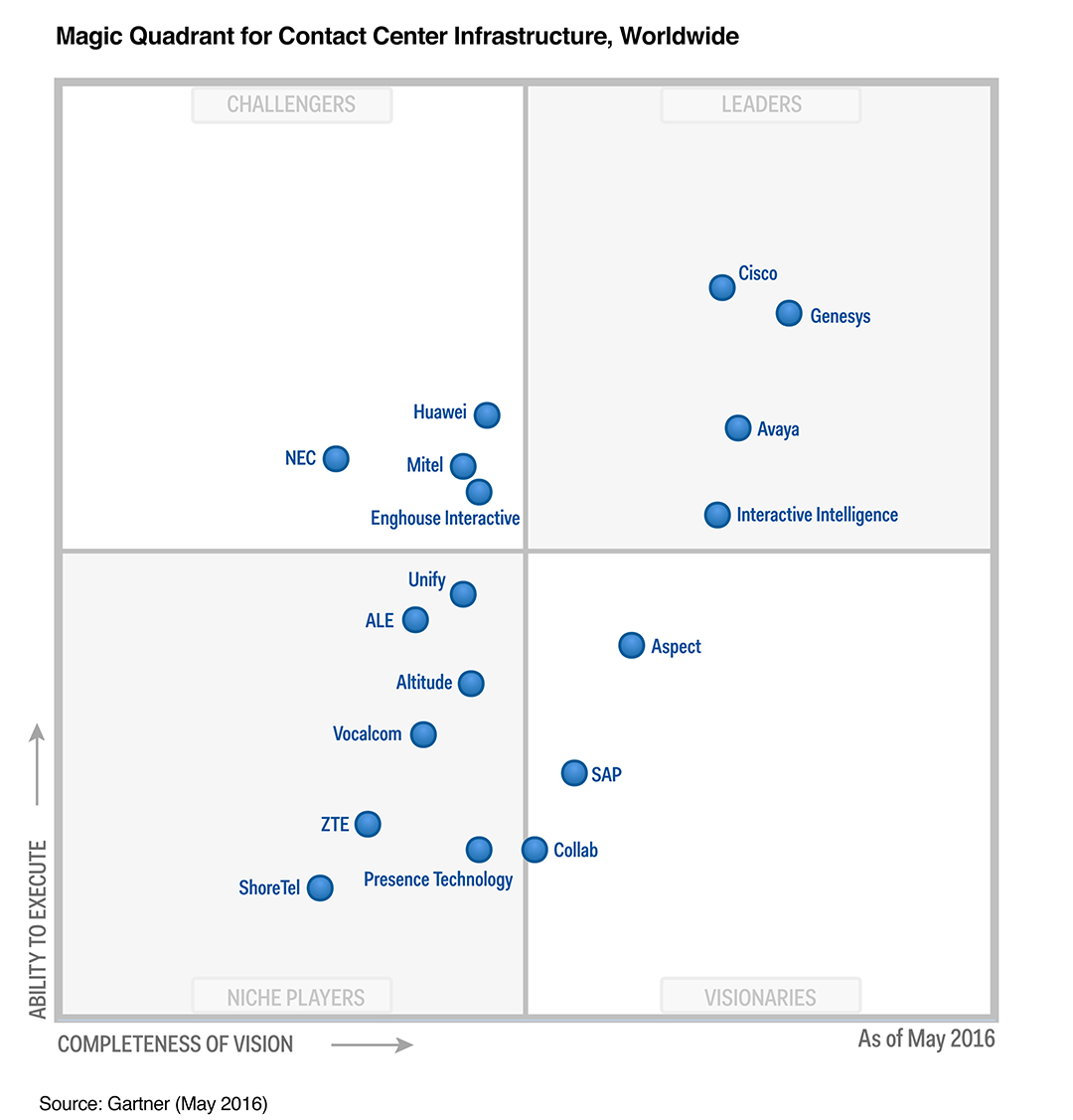
We’ve worked passionately over the last few years to deliver the best collaboration products and solutions on the market. And we continue to march toward our vision to bring all communication modes together for amazing experiences on any device. This vision includes delivery on-premises, from the cloud, or a combination of both. So it is exciting to see that Gartner positioned Cisco as a leader in not one or two, but all five Gartner Magic Quadrants in which Cisco Collaboration participated over the last year. These include:
Unified Communications
Web Conferencing
Group Video Systems
Unified Communications for Midsize Enterprises, North America
Contact Center Infrastructure
We believe that all these results are important when you’re choosing a collaboration vendor and that these leadership placements confirm both the strength of our current portfolio and our vision for the future. Here’s more detail on both the reports and the progress we’ve made with our product in recent months.
Unified Communications Gartner named Cisco a leader in its Magic Quadrant for Unified Communications for the ninth consecutive year. This year, Gartner placed Cisco highest on “ability to execute” and furthest in “completeness of vision” for our unified communications offerings. According to the report, leaders have a full UC offering, strong market presence, and can demonstrate success in the field. They have a strong presence in related markets to expand their footprint in UC.
And we have had a busy year. We continued to evolve our portfolio to better meet your needs. We:
Expanded Cisco Spark from a business messaging app to a full cloud service with meeting, message, and calling
Delivered new and better experiences by integrating on-premises unified communications with Cisco Spark cloud services
Brought video meetings to the next level – not just through our broad range of endpoints and applications. Our acquisition of Acano improved interoperability and scale, and we continue to bring web conferencing to the next level.
Web Conferencing
Gartner recognized Cisco as a leader in the Gartner Magic Quadrant for Web Conferencing. Leaders have achieved significant market share, relative to their competitors, while demonstrating an ability to respond to customers’ needs. Leaders have robust, scalable products with a wide range of features, a large installed base, acceptable financial performance and good distribution.
In response to customer’s needs this way, we built our video conferencing solution (formerly known as Collaboration Meeting Rooms Cloud) directly into Cisco WebEx Meeting Center. This means you can provide video conferencing to all your users with a WebEx Meeting Center subscription. Your users can join meetings from their device of choice, whether mobile phones, desktops, or meeting-room video systems, including Microsoft Skype for Business.
Group Video Systems
Here again, Gartner placed us highest on “ability to execute” and furthest for “completeness of vision” in the Gartner Magic Quadrant for Group Video Systems. Our Acano acquisition helps us expedite our vision to provide one consistent meeting experience for all attendees. It also helps us dramatically increase scale and interoperability. According to Gartner leaders demonstrate a clear vision for how the group video systems market is evolving and are capable of defining and anticipating trends such as endpoints for shared spaces, UC appliances, software infrastructure, and VaaS.
Unified Communications for Midsize Enterprises, North America
Gartner delivered a separate UC Magic Quadrant report specifically for midsize enterprises. These customers value simplicity, ease of UC integration, affordability, and customer service. So, we are delighted that Gartner again named Cisco a leader, positioning us highest on “Ability to Execute.” Leaders in this Magic Quadrant balance the need for some customization with end users’ desire for simplicity in their licensing structures, sales demonstrations, and UC solution portfolio.
Contact Center Infrastructure For the fifth consecutive year, Gartner positioned Cisco highest in “ability to execute” in its Gartner Magic Quadrant for Contact Center Infrastructure. We believe our unmatched worldwide network of partners and our efforts to make customer care easier for all businesses to deploy and manage are reasons for our continued success.
We believe all these results mean that you can feel confident withCisco Collaborationsolutions. You can deliver quality experiences that cater to your teams’ needs. You can offer people all the workloads they need to be productive. Video, messaging, telephony, conferencing, mobility, and more. And with our newest innovations aroundCisco Sparkand theCisco Spark Board, we believe that all these experiences will only get better.
These graphics were published by Gartner, Inc. as part of a larger research document and should be evaluated in the context of the entire document. These Gartner documents are available upon request from Cisco. Gartner does not endorse any vendor, product or service depicted in its research publications, and does not advise technology users to select only those vendors with the highest ratings or other designation. Gartner research publications consist of the opinions of Gartner’s research organization and should not be construed as statements of fact. Gartner disclaims all warranties, expressed or implied, with respect to this research, including any warranties of merchantability or fitness for a particular purpose. space
If you are one of the 40,000+ Health IT professionals planning to attend HIMSS17, you already know that few industries have seen as much disruption and as many recent changes as healthcare. Digital transformation is evolving how clinicians and healthcare organizations personalize patient engagement, deliver remote care and collaboration, and simplify clinician workflows, all while maintaining security and patient privacy.
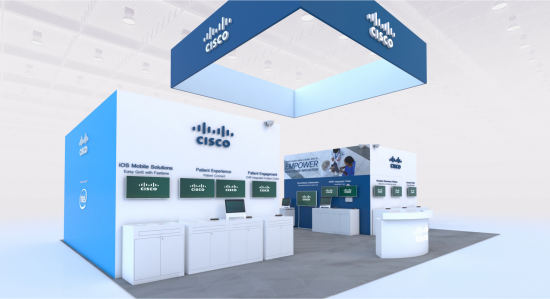
We invite you to visit the Cisco booth (#1850) at HIMSS17 to speak with our healthcare experts and to see first-hand how technology can help you:
Build Deeper Relationships with Patients
Patient Connect: Deliver personalized information and services at the point of care.
Contact Center with SpinSci: Integrate your Cisco Contact Center and EHR for a complete view of patient data.
Don’t miss seeing Cisco healthcare solutions that work together to address your pain points and empower healthcare innovation in your organization.
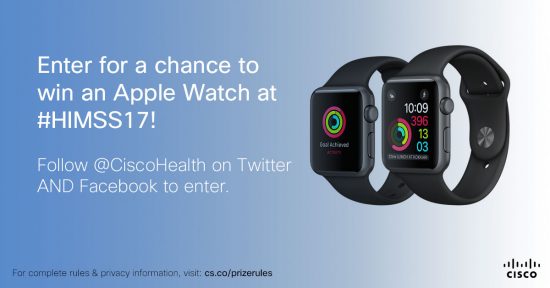
Enter for a chance to win an Apple Watch at #HIMSS17
Become a new follower of @CiscoHealth on Facebook and Twitter for your name to be entered into the sweepstakes.