We live in a world dominated by digital. As consumers, it is second nature to expect instant access to data, on demand ordering and fast service delivery. But when we change from consumers to employees our experience is quite different.
Offering a consumer-like experience requires conversion from manual processes to automated delivery providing your organization with speed and efficiency. Begin this process by focusing on the revenue engine to your business: the data center. But up until now, calculating the time and cost savings from these types of solutions has been difficult.
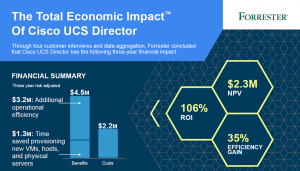
Forrester has completed a Total Economic ImpactTM for Cisco UCS Director. This report provides independent analysis based on the experience of customers using UCS Director in production environments. They combine this data into a composite organization with defined use cases. Then they calculate the benefits, risks and cost associated with the before and after.
The report contains specific financial tables and data for each use case so you can replace the data from the composite organization with your own. Financial tables walk you through costs and risks. You now have a clear understanding on the benefits and costs to deploy Cisco UCS Director. Let’s be honest. Isn’t that what you need to get budgetary approval?
Best of all, Cisco UCS Director is the foundational layer for Cisco’s hybrid cloud solution: Cisco ONE Enterprise Cloud Suite. Your transformation to digital doesn’t have to stop with your data center. Deploy applications into hybrid environments. Deliver the consumer-like experience through a self-service portal. Before you know it, you are providing your customers with a delightful digital experience.
Transformation requires automation at multiple levels of your organization. Begin your journey by transforming the revenue engine to your business. Download the report and work through the calculations for yourself. Then get ready to see what new innovation you can deliver from the 35% operational efficiency delivered by Cisco UCS Director.
With 62,000 students, 10,000 employees and 87 schools, Mesa Public Schools in Arizona had a huge undertaking when looking to maximize the use of technology in the classroom. What started as a visioning process in partnership with Cisco, led to the comprehensive re-design of the district’s infrastructure a few years ago.
Recently, the partnership with Cisco has gone beyond the previous transformation to support a more comprehensive look at enhancing the efficiency and services provided throughout Mesa’s business operations as well as the classroom and teacher instruction.
Together with Mesa, we went through Cisco’s Business Solution Methodology, which is a visioning process aimed at understanding the education system holistically, closing gaps between business strategy and technology strategy, aligning IT design with the organization’s goals, and elevating IT relevancy at the executive level.
For this methodology process, the Cisco team, comprised of a distinguished system engineer, solution architects and an education advisor, interviewed 35+ members of the organization, ranging from district leadership in business, operations, curriculum and instruction, communication, HR, and food services to teachers, principals, special education teachers as well as board representation.
The purpose of these conversations was to assess the degree to which information was being used to successfully improve learning outcomes as well as business efficiency.
Through a series of refinement and validations, Mesa and Cisco explored and analyzed the system and then sought out the thoughtful placement of technology to address core challenges, rather than finding the challenges our technology can solve.
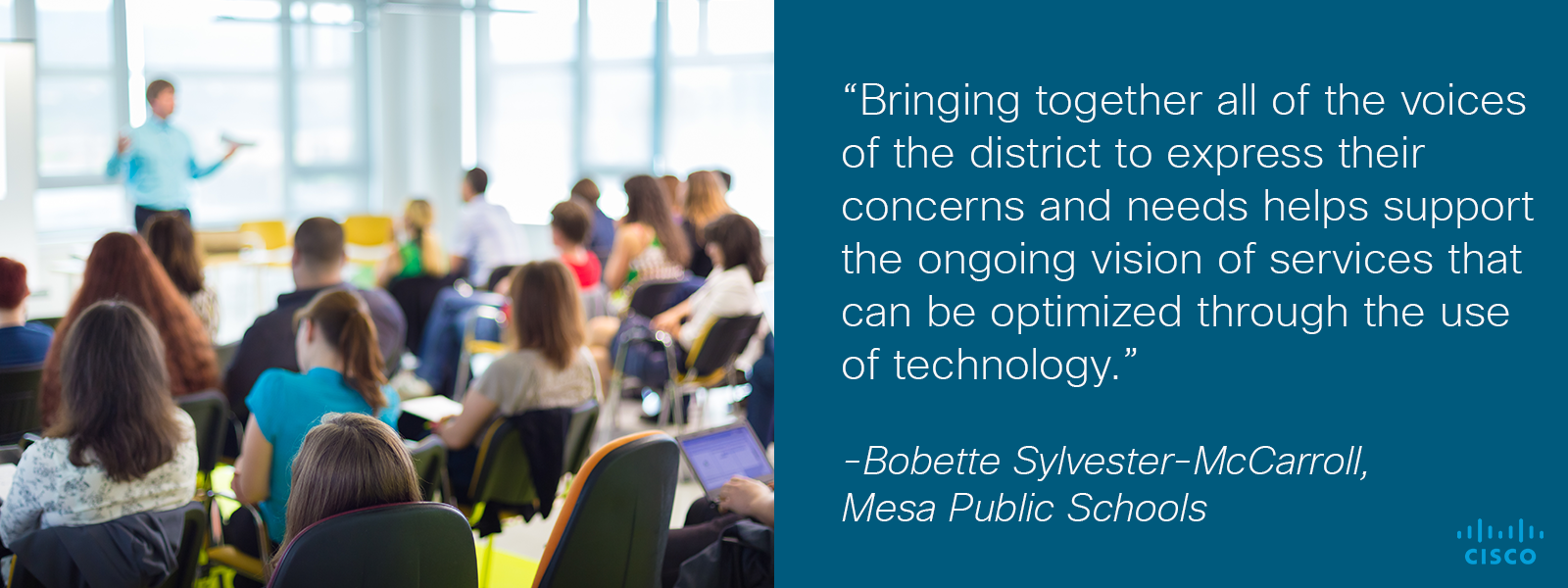
“The opportunity for staff to review the accomplishments over the past 5 years and then look forward to assessing more complex needs was invaluable,” says Bobette Sylvester-McCarroll, the Assistant Superintendent for Business and Support Services of Mesa Public Schools.
So, what’s next for Mesa? We’re using our conversations with faculty, staff and administration to assess the needs of the district, which will then be prioritized and presented to the Governing Board for consideration and potential inclusion in their upcoming 2018 bond, a mechanism for funding the next 5 years of digital expansion.
We can’t wait to see the ways that Mesa School District will be able to transform through these insightful conversations.
Mimi Corcoran, President and CEO, National Center for Learning Disabilities (NCLD)
Judy Elliott, Ph.D., Education Consultant; Member, National Center for Learning Disabilities (NCLD) Professional Advisory Board; Former Chair, RTI Action Network Advisory Board
Stevan Kukic, Ph.D., Education Consultant; Former Chair, National Center for Learning Disabilities (NCLD) Professional Advisory Board
There is no shortage of ideas on how best to support struggling learners. Education reform initiatives come and go in schools and districts as new ideas emerge in the field. One bedrock principle most educators today agree on, however, is the need to assess students’ skills, understand each student’s progress, and then adapt teaching to help build those skills.
This “evidence-based” approach hasn’t always been the norm and is the product of many efforts over the years. One such method is Response to Intervention (RTI), and the story behind its growth to national adoption serves as a model for how nonprofit, philanthropic, and public school partners can drive systemic change.
About a decade ago, the National Center for Learning Disabilities (NCLD) partnered with the Cisco Foundation to create an online network to directly support and facilitate the scale-up of RTI. At the time, RTI was viewed as a powerful new approach to support teachers in identifying students’ learning issues early and providing targeted services.
Across the country—in Florida, Iowa, Utah, Colorado, Kansas, Michigan, Illinois and other states—educators and experts were coming to similar realizations about the need for prevention, early identification, and intervention. Seeing the overlap among efforts, NCLD started convening partners who could then collaborate and develop RTI as a national solution to a common challenge in schools.
We had a big idea—which we called the RTI Action Network—and knew we would need more than conferences, white papers, and journal articles to invoke broad scale change. We needed a way to consistently deliver information and recommendations from top experts to parents and educators and engage all partners in an ongoing conversation about their students.
Where do things stand today? A national survey of school district administrators found that 94 percent of school districts in the U.S. were implementing RTI to some degree by 2011 (Spectrum K12, 2011). What might now seem like a routine practice for schools began as a gamble for both NCLD and the Cisco Foundation. Below, we share our insights on how RTI became a national movement to promote the success of all students in a classroom, and how digitization enabled it to happen.
What is RTI?
RTI is a process for determining the effect instructional activities of increasing intensity have on student learning. It works best within the Multi-Tier System of Supports (MTSS) for delivering services to students — one that considers core instruction, professional development, curricula, belief systems, and culture needed by teachers, as well as one that considers the student’s social and emotional well-being. When implemented well, MTSS decisions are data driven using an evidence-based problem-solving strategy.
When implementing RTI, teachers first screen students to see where they might have skill gaps. They then regularly check to see if students are making progress against where they started, and, if not, try a new intervention with growing levels, or tiers, of support. At the same time, teachers work to ensure evidence-based strategies are consistently used during instruction.
If, after a period of time, intensive interventions are not sufficient based on data collection and observations, then the student may be considered for the evaluation of special education services. With this approach, teachers are equipped as “problem solvers,” in which they diagnose the challenge, test new solutions, and carefully track the results.
“With RTI, students have been helped before they have reached the stage of needing special education. When this happens, it benefits everyone: students are encouraged, the teachers receive “proof” that their teaching is effective, and parents are reassured.” (District RTI Coordinator for the Bethany School District, Oklahoma)
What Did We Do?
For 40 years, NCLD has served as the national voice for people with learning and attention issues, and we’ve always worked to bring information to the people who need it most. The development of the RTI Action Network marked a significant milestone in our history, in that we looked at new technology to truly scale this support and expertise.
The use of technology was critical for keeping our different partners connected and for promoting awareness and adoption of RTI. With the Cisco Foundation’s partnership, the following were significant drivers to our success:
Added professional capacity. Through funding from the Foundation, we added new staff members to drive the work and create a centralized team to organize efforts among our different partners. The Foundation also provided a communications advisor, Rob Barlow, who worked as part of the team, lent critical perspective and informed a national communications strategy to spread the word about RTI.
Built our technology infrastructure. With the addition of a new server, videophones, and WebEx software provided by Cisco, NCLD had the resources necessary to communicate with people across the country and quickly process and share information online.
Created digital resources. With this new capacity, we could create digital resources out of the learnings emerging from our experts and district partners. We designed an online platform, RTINetwork.org in 2008 with the purpose of explaining RTI to educators and parents, and connecting them to advice from top experts in the field. This site hosts frameworks, checklists, toolkits, blogs, and videos of real-world examples of successful RTI use.
“Since developing expertise in RTI, other districts in our state have contacted me, and I immediately refer them to the [RTI Action Network] website.” (School Psychologist and RTI Coordinator. Flagstaff, AZ)
Connected with partners in-person and online. NCLD convened partners in-person and provided on-site technical assistance to more than 300 school districts across the United States. On the recommendation from our Cisco advisor, we also offered a blended model of professional development to school districts through WebEx, allowing us to reach more educators than ever before — a tactic that was in its infancy at the time.
“[RTI Action Network WebEx Webinars] are a great way to view information when life in a school district doesn’t allow me to “tune in” to scheduled meetings. Many thanks for your efforts.” (District Principal, Student Support Services. Nanaimo Public Schools, British Columbia)
The digitization of our approach broadened access to new audiences and helped us to keep educators engaged and invested in RTI. We were able to collect pockets of promising work happening in different states and create a centralized resource for all to reference.
With this powerful collective in place, we came together to successfully advocate for legislative reform — changing Federal regulations to include RTI as a viable screening for special education services, rather than solely relying on standardized test scores. This change encouraged greater adoption of RTI across the country.
How Did RTI Change Schools?
RTI adoption by school districts has exploded over the last decade. When searching for guidance on how to support struggling learners on the websites of state departments of education, school districts, and nonprofit partners, it’s common to see information on RTI and MTSS and, specifically, reference to the RTI Action Network website.
Traffic to the website is as strong as ever, with 800,000 unique visitors in 2016. One popular resource on the site has been our RTI-based Specific Learning Disabilities Identification Toolkit, developed with major education associations as partners, including the Council of Administrators of Special Education (CASE), the National Association of State Directors of Special Education (NASDSE) and the National Association of School Psychologists (NASP).
Wichita Public Schools has been fully committed to MTSS implementation. A large part of our success has been the use of the NCLD’s LD identification tool kit. This has allowed our district to focus on MTSS prevention, intervention and appropriate identification of students with disabilities. – Neil L. Guthrie, Ed.D Asst. Supt., Student Support Services, Wichita Public Schools
Moreover, a meta-analysis (Hattie, 2009, 2012) scanned experimental studies on 150 instructional interventions in schools and ranked them by effect size (or, reliable impact on students). RTI methods represent two of the top eight most effective interventions, indicating RTI’s level of scale offers the possibility of having a major impact on student outcomes. That said, there is still significant work ahead regarding the quality and consistency of implementation, and NCLD remains committed to providing resources and solutions to that effort.
It is gratifying to see RTI’s progress is emblematic of a larger push in education reform toward evidence-based instruction, as new teaching standards and student performance measures have been introduced. We believe our RTI story represents the potential of a true partnership between nonprofits and foundations.
“The RTI Action Network is helpful to my work. I like how it is fine tuned to different instructional levels. It’s user friendly, and the Network thought of parents in making the site useful to them too.” (Ph.D. Intervention Specialist, ISD 271, Bloomington, MN)
In 2007, the digitization of such efforts was still being pioneered, and today, its potential is much more sophisticated. The lessons we have learned in our partnership with the Cisco Foundation inform our work to this day: digitization can broaden access to the best research and expertise, amplify collective efforts around a shared goal, and encourage the growth of the professional community.
Our support of the NCLD is one example of how Cisco is harnessing the power of the digital revolution to accelerate global problem solving, enabling people and societies to thrive in the digital economy. Our goal is to positively impact 1 billion people by 2025.
The role of the network has been top of mind lately as another defining moment in networking history is on the horizon. In a nutshell, network engineering must change—again. It changed when voice was added to the network. It changed again when video went main stream. Now, we must respond to another change—serving the application. This means the network engineer not only needs to meet and work with application programmers, but must learn some new technologies and bring those to application developers.
In the 80s and the early 90s, the networks moved data and the data wasn’t all that complex. There were telnet sessions and file sharing servers and things like that. If a packet got dropped, or the latency of the packet was 100ms, nobody would even notice. With modems as our standard for WAN, network LAN connections seemed blazing fast.
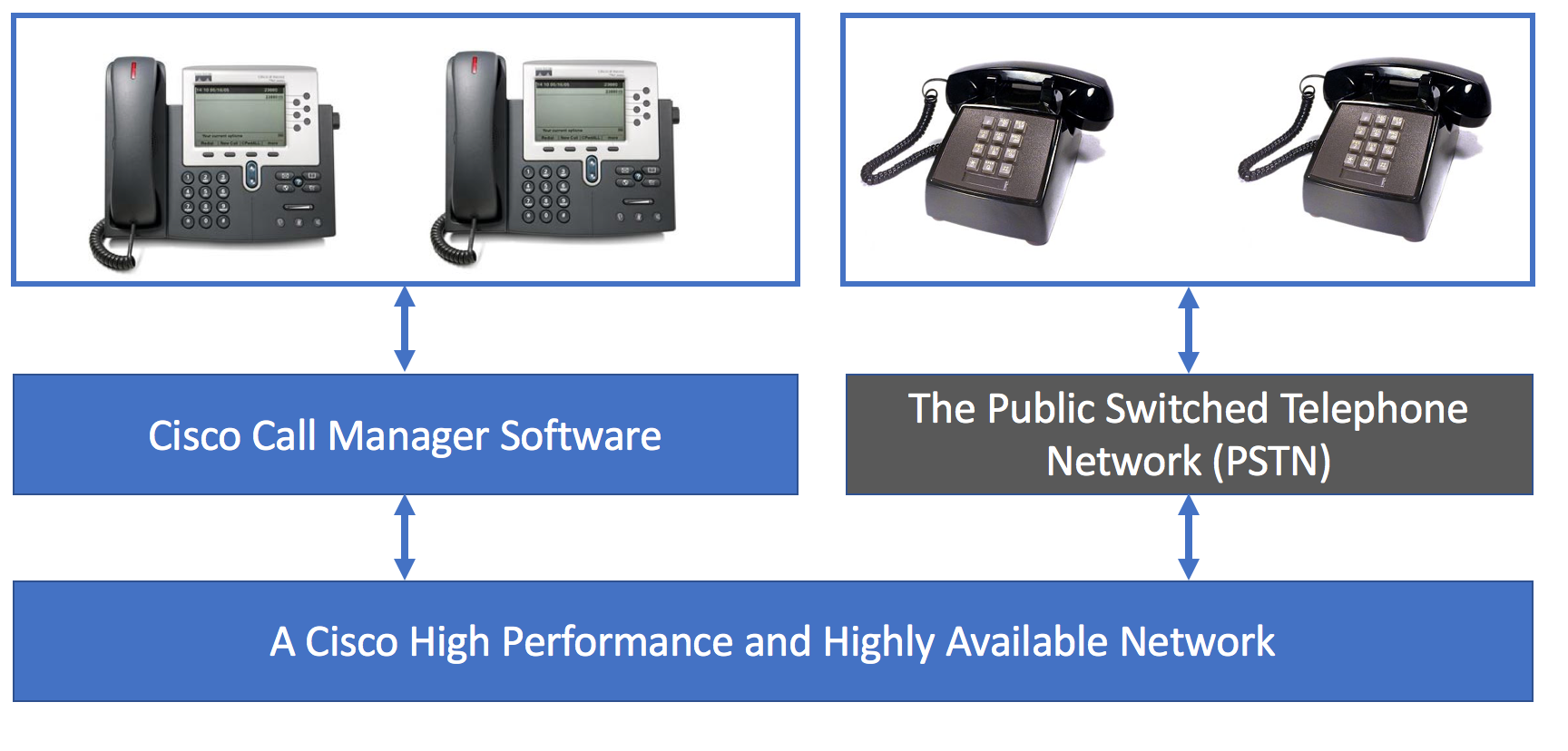
Then, in the late 90s, voice over Internet protocol (VOIP) hit the world. This was the first major network evolution while I worked at Cisco. I remember as we were building Cisco AS5X00 series access servers, delay, jitter and loss became top of mind. The ability to build and maintain highly available, high performance networks was key for Cisco. High Availability became a corporate initiative. By the year 1999, Cisco networks were voice enabled. In the figure below, you can see a very simple architecture diagram that depicts a voice enabled network with voice endpoints. The key to observe is that we now have a new endpoint on the network – phones.
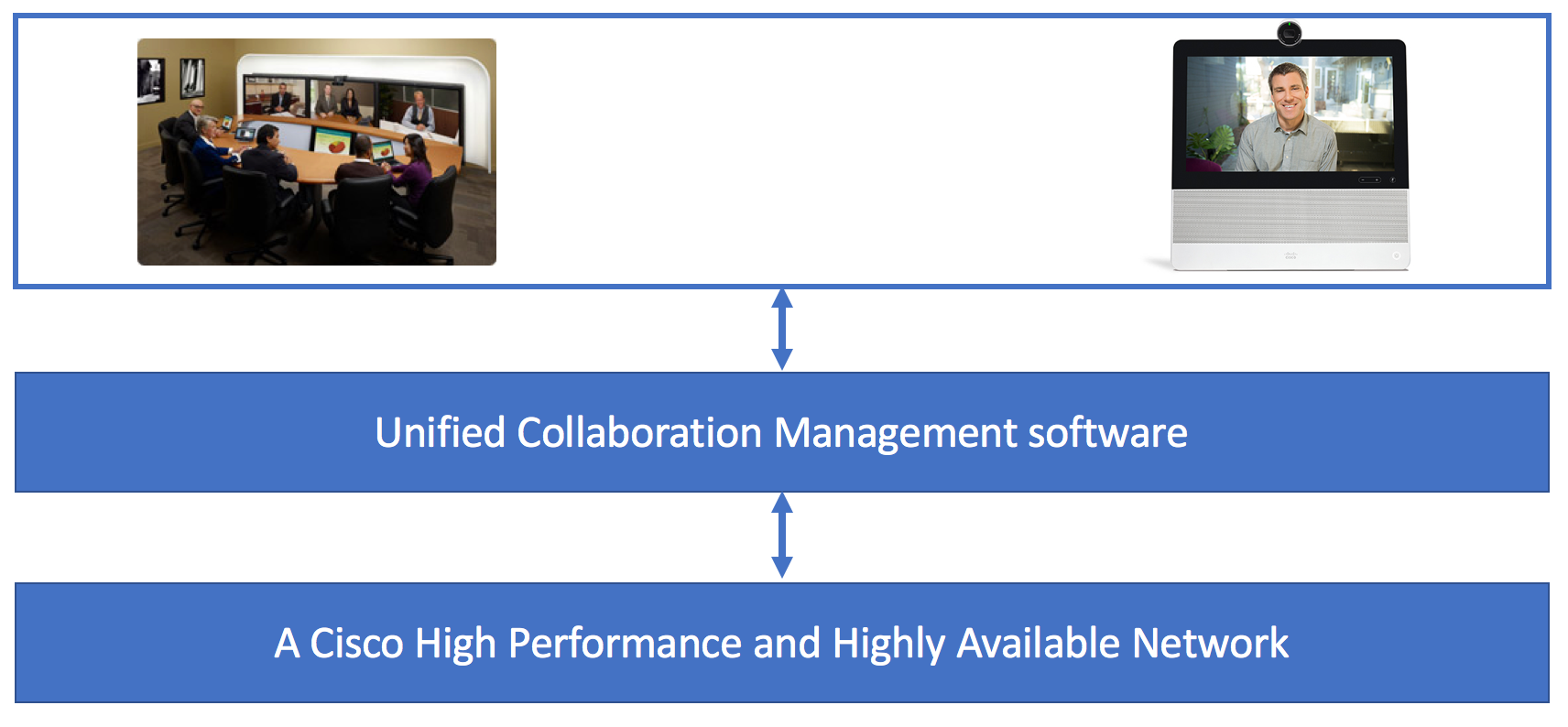
As we moved through the 2000s, there was yet another evolution–video. And the network had to be built and designed to handle another entirely new set of end points. Now, not only did the devices connected to our network have to do voice, they also had to do video. This put additional requirements on the network and required that infrastructure engineers learn how to configure more services. In the figure below, you see virtually the same architecture diagram, but the top row endpoints have changed to video endpoints.
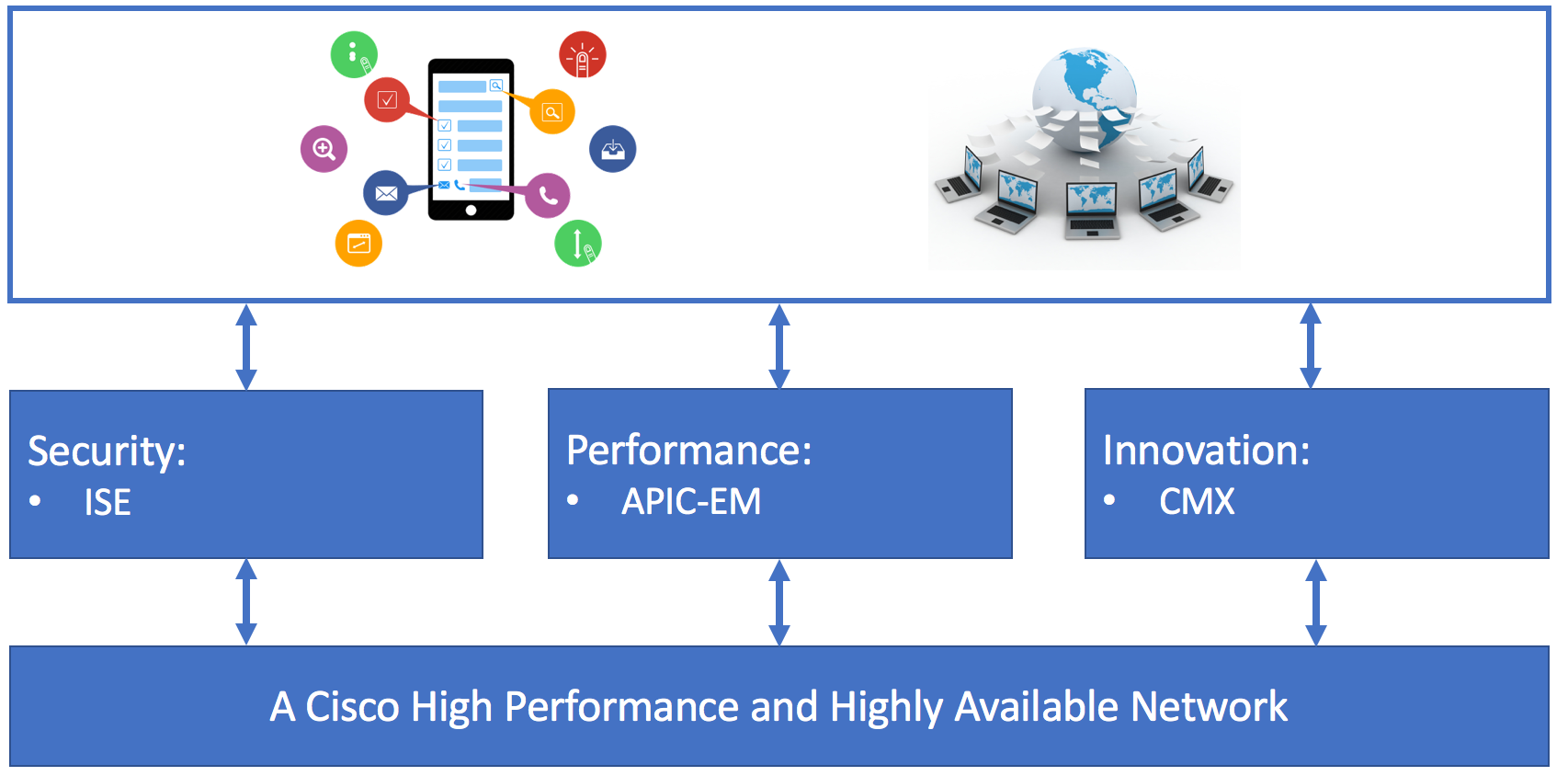
In 2007, the world changed again. The iPhone shipped that year. It didn’t take very long before the world went mobile. But, more than that, the technology world is now application driven. Whether an application is mobile or cloud based, it needs to be secure, high performing, and innovative. This is what is driving the new requirements for the next evolution of network services. Now, like when we went from data, to voice, to video, we have a new set of end points that come with a new set of requirements for the network. In the figure below, you can see two things. First, the endpoints are not phones or video devices, they are now applications. Second, applications need a variety of new and different things from the network.
As an example, one of my favorite services is Cisco Connected Mobile Experience, or CMX. CMX makes it possible to give free Wi-Fi to your customers while capturing their information and knowing when they are in your facility. Companies, like Subway, are using our CMX capabilities, and Turnstyle software, right now in order to facilitate a loyalty program, which increased the number of times their customers visited from .9 visits per month to 1.2 visits per month in one quarter in 54 stores when it was first rolled out.
You may have noticed I threw Identity Services Engine (ISE) and Application Policy Infrastructure Controller – Enterprise Module(APIC-EM) into the diagram. ISE provides the ability to work with mobility device managers (MDM) and ensure the identity of your users. APIC-EM makes it possible for an application to get the network bandwidth it needs to perform properly
If you are an infrastructure engineer, this is where the opportunity lives. Your company’s application programmers are counting on you to enable them. Their applications will be more secure, more innovative and faster if you help them. You enable the network and show them these capabilities, they write interesting applications that utilize the underlying platform. Together, you digitally transform your company.
From the programmer point of view, they access these network services via easy-to-use Application Program Interfaces (API) such as REST (Representational State Transfer, think, “Web Interface”) with JSON (JavaScript Object Notation) data. When your programmers find out they can get interesting things into the apps with REST, they’re going to be happy.
The key here is that this new application economy needs its infrastructure engineers to meet its application engineers in the middle – at the API area, where the infrastructure provides the APIs to make the applications better.
If you want to learn about these capabilities, check out Cisco DevNet. DevNet is Cisco’s one-stop-shop for learning about these APIs. Cisco DevNet has learning paths specifically designed for both infrastructure engineers and application developers. If you have questions, we have several forums where you can ask them and get answers. If you thought, “I’m already doing this” as your read this blog, we would like to talk to you about writing a paper or speaking to our DevNet Create conference in May, in San Francisco.
If you would like to discuss this with me, feel free to direct message me on Twitter: @coggerin
It’s easy to understand the value of adoption from the customer’s perspective, at least on the surface. But there’s a lot more to it than meets the eye. To connect the dots between adoption and value realization as sellers, we must first recognize the drivers behind every purchase, and the outcomes our customers are seeking to achieve—whether it’s increased productivity, reduced risk, greater brand loyalty or something entirely unique to their business.
Effective adoption for the customer should be measured by their definition of success—not just by how many times they’ve logged into the solution. Product usage is one thing, but value realization is the ultimate goal. When you truly understand the experience the customer has and how that action translates into their ability to achieve their desired business outcomes, that’s what moves the needle.
The Business Case for Adoption
For partners, the business case for adoption is clear. It drives business growth by ensuring the best customer experience possible. It increases partner revenue and wallet share, improves customer retention, paves the way to expand opportunities, and much more.
That’s powerful. And that’s why the end game for all of us as sellers is no longer just about closing sales on new products or engaging in technology refresh, but about ensuring value for the customer over time. If we as sellers work to simplify the customer’s journey and help them achieve value, we’ll earn their loyalty, reduce churn and increase renewal rates.
The Power of Consistent Engagement
Whether we’re talking about hardware, software or services, there is a fundamental process for driving successful adoption. It begins with gaining insights into the customer experience and helping them achieve their business outcomes through consistent, process-driven engagements, along with real-time data, analytics and automation. Heath scores are also critical as they provide a way to quickly identify which customers may have adoption barriers, while allowing us to constantly monitor usage to ensure a positive customer journey.
Through a consistent method of engagement, sellers can gain a deeper under-standing of the customer’s adoption trajectory—including what’s working and what’s not—to ensure long-term adoption within the account. When you see where the gaps exist, the steps for overcoming those adoption barriers with additional services, software or enablement motions become clear.
Doing all of the right things to accelerate adoption and value realization also allows us to simplify how we renew a customer, and enables us to make the renewal frictionless—because value and trust have been established. Now you the partner are able to continue building the customer’s success over time, while also tapping into additional opportunities to fuel their own business growth.
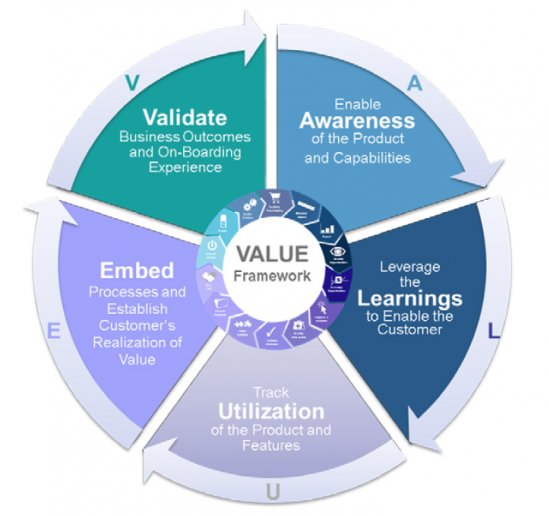
The 5-Step VALUE Framework
How can we make the renewal a non-event—an easy decision for the customer? Cisco has developed this five-step value process for creating long-term customer success:
Validate: Establish what’s important to the customer and how they define success. Everyone should have a clear understanding of roles, expectations and responsibilities. Engage the customer and understand why they purchased the solution. Know who made the purchase decision, their key KPIs and what they are hoping to accomplish as a result of the purchase.
Enable awareness: Customers only realize value when they effectively use the solutions they’ve purchased. Specifically, they need to know how the features and functions of the technology will help them accomplish their goals.
Leverage the learnings: The perceived value of a solution differs based on each person’s role within the business. It is important to address the needs of each person if adoption is to be fully realized. Identify key people who may need additional training or content, such as white papers, online self-help or a one-on-one technical conversation to achieve value realization.
Feature Utilization: Demonstrate the correlation between the solution and the customer’s definition of success. Monitoring health scores and product usage regularly makes it easier to identify areas of improvement and align product capabilities with customer goals. Map out a journey toward achieving the customer’s KPIs, and help them articulate back to their management in their own words w
hat success looks like.
Embed processes: Make a point to demonstrate the value of implementing key solution features into the customer’s internal processes. This ensures successful adoption and creates growth opportunities.
We hope you’ll make use of our VALUE Framework to stand up your own adoption practice and help your customers achieve success faster. As you do so, you’ll be able to accelerate your own success and grow your business faster, too.
The world is complex and the pace of change is accelerating. New technologies drive innovation and growth. But what happens with that growth? An increasing amount of IT challenges related to managing those support contracts within complex heterogeneous environments. We hear from customers and the industry this is a rising concern which can be a barrier to innovation.
Estimates indicate businesses have 20+ vendors based on increasing infrastructures and other projects. Over time, managing multiple support and service contracts continues to increase the complexity. Challenges arise when something breaks and not knowing which vendor to call. As customers work with more and more vendors, they need support across their entire solution, not just for individual point products. Don’t take my word for it, check out this video to find out more.
WHERE TO START? Ask yourself a few question about your business:
How many technology vendors are you working with today?
Do you have the staff and resources to manage all the issues?
Do you have the time to coordinate resources between vendors?
Can you afford downtime while you are working to resolve issues?
If answering these questions causes you concern, select a vendor that provides the right support for mixed environments and ensures you’re covered.
I am pleased to share some great news! After months of discussion, today networking industry leader Jonathan Davidson is joining our Service Provider Business Unit and my senior leadership team as SVP/GM – SP Networking.
Having served as executive vice president and general manager of Juniper Development and Innovation, and earlier SVP/GM for Juniper’s Security, Switching and Solutions, Jonathan drove strategy, development and business growth for Juniper’s entire portfolio – including networking solutions, routing, switching, data center, cloud, and security.
Earlier, Jonathan held a variety of leadership positions at Cisco, developing service provider solutions and leading the enterprise routing product management and SP services team.
We couldn’t be more excited that Jonathan joins our journey as we usher in the next generation of networking and network automation innovation. He brings extensive experience in strategy and network engineering leadership as well as strong customer relationships that will serve us well.
We are looking forward to Jonathan and our networking leadership team breaking new ground in networking automation as we transform service providers worldwide. We are thrilled to welcome him back to Cisco!
Today, Talos is publishing a glimpse into the most prevalent threats we’ve observed over the past week. As with our previous threat round-up, this post isn’t meant to be an in-depth analysis. Instead, this post will summarize the threats we’ve observed by highlighting key behavior characteristics, indicators of compromise, and how our customers are automatically protected from these threats.
As a reminder, the information provided for the following threats in this post is non-exhaustive and current as of date of publication. Detection and coverage for the following threats is subject to updates pending additional threat or vulnerability analysis. For the most current information, please refer to your FireSIGHT Management Center, Snort.org, or ClamAV.net.
Yesterday at Google Next, Urs Hölzle quoted a great stat by RightScale – users waste 45% of cloud resources that they buy. While this number is not too far from what typically happens in traditional data centers, which operate at 20-30% of capacity on average, cloud promises a pay-per-use model. You provision and pay for only what you utilize. This promise leaves the user with the impression that they will effectively achieve 100% value—reducing costs significantly compared to an inefficient data center. And while Google’s new committed pricing model tries to lessen the impact, it does not address the root cause of the problem.
So, what is the underlying problem?
The real issue is that many organizations still use cloud like they use data centers, managing their resources in the same manner. What do I mean by that? Let me give you some examples:
Virtual machines (VMs) spun up and maintained as persistent resources even though nothing is provisioned on them yet.
VMs spun up for temporary tasks but forgotten to be spun down. An example: developers launching myriad test workloads, inadvertently causing VM and cost sprawl. Then to make matters worse, it later becomes difficult to identify which VMs to spin down and which to keep active.
Workloads not using VMs at anywhere close to full capacity. This is a right-sizing problem. Users typically over provision where instead a lower cost instance type might be good enough for that workload.
And let’s not forget about managing the application lifecycle.
Traditional approaches involve writing custom scripts, creating cloud-specific VM images, and often having to re-write portions of the application to conform with the specific APIs and services of the cloud provider. One of our large customers recently told us that the typical process to onboard/change a single component of an app requires them to write about 1200 lines of code, and anytime the app or cloud changes, they have to re-write about 20% of the code/scripts. This all adds up to rising cloud costs.
Offers from cloud providers, such as discounted prices for reserved capacity, do not really help solve this problem. In fact, they only exacerbate the problem by forcing organizations to make up-front decisions and continue using the cloud more and more like a data center. And most importantly, what cloud providers often don’t offer users are the intelligent orchestration and management tools they need to solve this problem.
The cost promise of cloud will always remain elusive if organizations are not able to realize the full benefits of cloud’s flexible model. And when you consider that – according to IDC – 85% of organizations will use multiple clouds, this issue is only getting worse!
Automate and Save
Your environment is likely too complex to manage without cloud intelligent tools to help you optimize your spend—be it a single cloud or across multiple clouds.
Cisco CloudCenter can be your answer. Cisco CloudCenter is helping local and global organizations alike get the most of their cloud resources. We do this in several ways to help optimize your cloud spend. For example:
Policies like auto-aging that shut down workloads automatically after a certain time. These policies are enforced by administrators and lower your cloud costs. For example, a DevOps administrator may enforce an auto-aging policy on all workloads spun up by a development team, shutting down the tagged workloads within a certain timeframe, preventing VM sprawl.
Auto-scaling or utilization-based scale-down. Based on actual utilization, the number of nodes in a cluster can be scaled down to prevent the use of unnecessary VMs.
Benchmarking. With the ability to compare different clouds or different instance types on the same cloud, users can see where the best price-performance is achieved for an application deployment time to avoid running on sub-optimal instance types and clouds.
Most importantly, an app-centric approach. Cloud VMs are only spun-up when an application is deployed, need not be pre-provisioned, and are automatically de-provisioned when workloads are terminated.
The promise of cloud is real, and you can get what you’re paying for. By providing you the cloud intelligence you need for your hybrid IT environment, Cisco CloudCenter enables you to achieve cloud’s true pay-per-use promise. Let’s us show you how.



 Forrester has completed a Total Economic ImpactTM for Cisco UCS Director. This report provides independent analysis based on the experience of customers using UCS Director in production environments. They combine this data into a composite organization with defined use cases. Then they calculate the benefits, risks and cost associated with the before and after.
 that what you need to get budgetary approval?





 solution features into the customer’s internal processes. This ensures successful adoption and creates growth opportunities.