Avatar

Mobile is everything and everything is mobile.
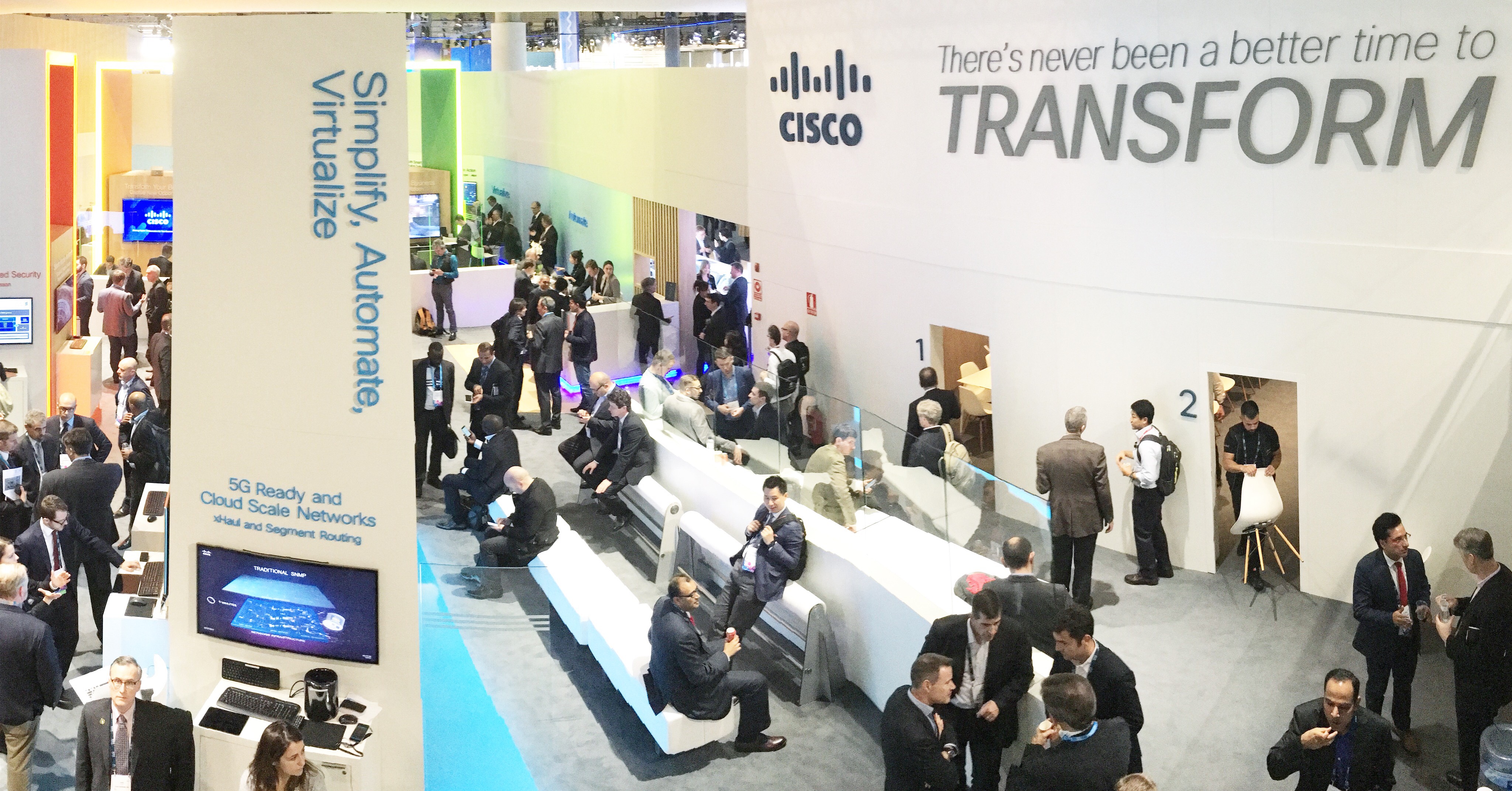
On Day 1 of Mobile World Congress (MWC), Chuck Robbins succinctly described the “mobility explosion,” as a driver for innovation and a means for anyone and everyone to take advantage of the incredible advances we are seeing in technology. This explosive growth in devices, data, and applications has SP’s thinking about the network of tomorrow and the move to 5G, a ubiquitous theme this year at MWC. It was an exciting show and I thought I would share some highlights from the week in Barcelona.
5G Pilot with Verizon

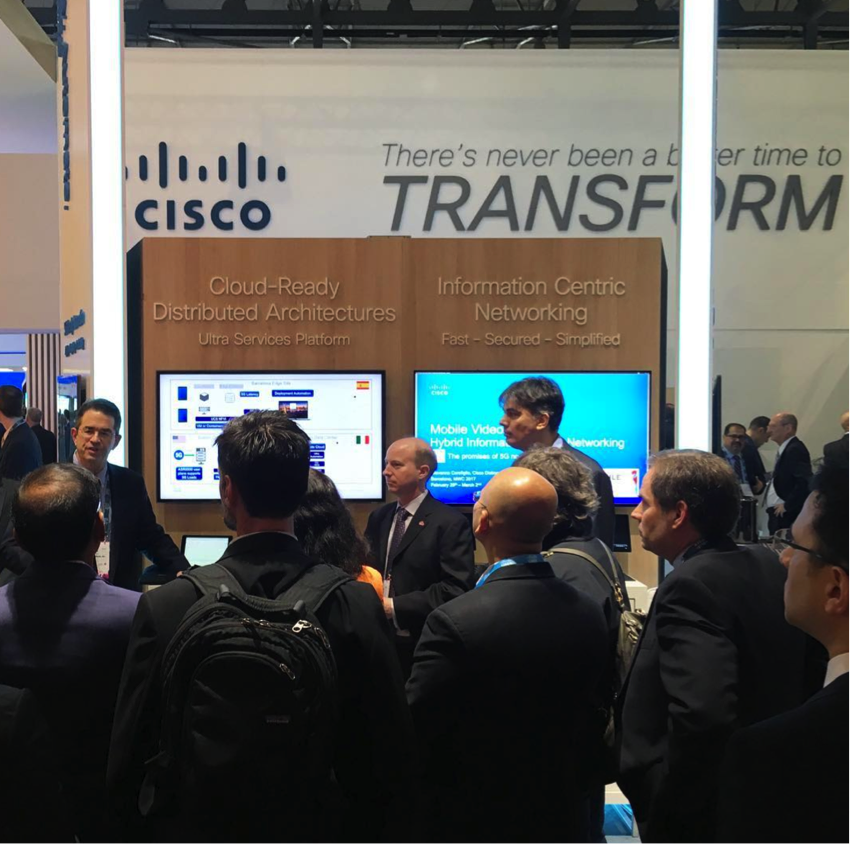
Are we ready for 5G? You bet. Cisco’s collaboration with Verizon is the first of many proof points to help our customers create 5G-ready environments. The pre-commercial pilot, announced at MWC, features a cloud-based, virtualized, 5G packet core using Cisco’s Ultra Service Platform. It will be one of the largest 5G proving grounds in the world.

What does that mean for consumers? 75% of mobile traffic will be video-based by 2020, with an expectation that mobile video quality will match, or exceed, broadcast quality. Consumers are demanding better service, faster service, higher quality video and new apps that won’t run on anything slower than 5G. The market is there, the need is there, and we are in a unique position to deliver the solutions our customers need and shape the network of tomorrow.

Altice Partnership (NFVI)

Our NFV business is another great example of how we are enabling customers to operate more efficiently and effectively by virtualizing the network. We announced a partnership with Altice at MWC to transform their business operations with new network architectures. This approach, co-engineered by Cisco and Red Hat, is based on the Red Hat OpenStack Platform and architectured for multi-vendor support.

NSO

As SP’s are experiencing incredible growth in the number of devices on their networks, their legacy management tools are reaching a breaking point. Enter the Layered Services Architecture (LSA) feature for Network Services Orchestrator (NSO), announced at MWC, which gives SP’s the capacity to manage over a million devices in their networks.

These are just a few ways that Cisco is enabling service providers to revolutionize their technology architecture, and transform the customer experience. We are delivering customer outcomes. The best part? This is just the beginning. The explosive growth in traffic demands a more efficient, simplified, and virtualized approach. We are shaping the network of the future with an architectural approach that aligns to the SP transformation. Only Cisco can deliver all of this and more to our customers.

For more information:


Authors

Conrad Clemson

Senior Vice President, SP Platforms & Applications

Service Provider Platforms & Applications

Avatar

What if you could increase your cloud knowledge—in a substantial way—without having to lift a finger? No downloading whitepapers, no registering for webinars, no traveling to distant conferences, no scouring the Internet for relevant articles.

It would be cool, wouldn’t it?

Well, I’m here to tell you that the dream is real. Starting today, Cisco is launching a new podcast series called Cloud Unfiltered. Hosted by Cloud Evangelist Niki Acosta and Software Solutions Architect Vallard Benincosa, it will be a series of interviews with the people that are working to move cloud technology and implementation forward. This includes everyone from engineers and open source project leads to IT executives, industry analysts, and cloud users. In these interviews we’ll talk about different cloud architectures, management models, and deployment strategies. We’ll discuss platform compatibility, the culture changes required for cloud success, and the complimentary technologies (open source and otherwise) that are making cloud more powerful with each passing day.

And all you have to do is sit back and listen. You can stream it during your commute, during your workout, while you walk the dog—whenever. You can subscribe to the RSS feed here. And you can also find it on SoundCloud, iTunes, and YouTube any time you like.

Will we interview people from Cisco? Of course. But we’ll be talking to just as many from outside our company as well. Case in point: Our very first guest, Rikki Endsley. She’s an editor at opensource.com, the driving force behind the Open Source Yearbook, and a Red Hat employee. She shared all sorts of interesting insights with us about who can publish what on opensource.com, why she created the open source yearbook, how she got into tech, and what she does to stay relevant in a constantly changing, hyper-competitive industry.

You can see our interview with Rikki on YouTube by clicking here, you can hear it on SoundCloud by clicking here, or if you haven’t done enough reading for the day, you can settle down with a full transcript of the discussion by clicking here.

Thank you so much. We hope you enjoy the podcast.

Authors

Ali Amagasu

Marketing Communications Manager

Avatar

I was born in the mid-80s. I started breaking down computers quite early and I had PSTN internet by the time I was 16 (having frequent arguments with my parents when they regularly disconnected me in order to hold meaningless important conversations with other members of our extended Greek family).

I witnessed all the various versions of Windows since 3.11. I loved the user experience each time there was a new version. Every time there was a tiny element going wrong, I’d format everything and start again. I wanted the computer to serve me and I would try to customize it with whatever I could find. I got “super-fast” ADSL at university. It was there I realized that the world was a much larger place than I initially thought. I was fortunate enough to experience the “download everything” revolution, where everything was available online. So besides downloading movies access to information, the internet brought something more. There was always an app. Something new and cool you could use to do something better. Buying stuff, selling stuff, downloads, P2P software, images, messengers, media players with codecs and subtitles, social networks and of course… drivers or software to be used with gadgets and devices (and didn’t we all love that great software that was outdated in five minutes*!).

Then there was the eternal frustration with tech lock-in. The TV that could read JPG images but did not play videos from a USB stick. Or the one that did not support the latest codecs. The different file systems between Macs and PCs. The different chargers for phones. The pptx and the ppt. The flac and mp3. MJ and Kobe.

But suddenly, some guys started getting it. Paypal (I guess) was the first, so you didn’t have to share your credit card details everywhere. Ebay so I didn’t have to look into specialty websites to buy used stuff. LastPass so I didn’t have to remember the billion different accounts and passwords I have and Xmarks with bookmarks. Digsby so you could connect to different IM networks. Evernote for note-taking. And then of course, Google, changing the game with its ecosystem of apps based on a revolutionary UX using a single account and one update or new app every few months. Facebook did the same, opening its platform so developers didn’t have to create accounts everywhere. Amazon selling via other websites. Now Microsoft is doing the same if you think about it.

There was also the smartphone revolution. An OS for the phone with all the above conceptual functionality. Nice. No longer did we have to painfully copy all those contacts from one make of handset to another because someone thought that the SIM card should have a limit.

Basically, APIs people. Web services. The real tech revolution of the last decade. The invisible Marie Antoinette that saved every-day users from tech starvation.

Now how is all this relevant to Cloud you might be wondering? Well, I’m putting myself in the shoes of a tech decision-maker, or someone within a business that is using technology, asking myself:

Do I really want to commit to legacy technology that will only work with other technology from the same vendor, or am I going to consume technology and customize it a la carte?

  • Am I going to use that cool new SaaS solution coming from whateverland that has this amazing new UX and new cool features so that my employees or me are happier and more productive?
  • Am I going to offer an open platform for my developers that write code in agile mode to be able to create applications tailored to my business so I can deliver better and faster results?
  • Am I going to use flexible ways to provision infrastructure on-premise or off-premise for my workloads, and be able to move things around if I want to?

Probably yes. And I don’t care if it is called Cisco or Salesforce or Gmail or AWS or Azure or OpenStack or _____________. I would want to pick the best from what’s out there to satisfy specific individual processes and then if something better comes up, I would want to be able to change to that. And in an open, connected world, it’s guaranteed there’ll always be something new and ‘better’ around the corner from some guy that happened to think about something in a different way.

No-one will get it 100% right for everyone because every business model and every business process is unique. But someone will always “get it” a bit more and offer something that solves a small problem better for my business.

And by the way, I also wouldn’t care if you call this cloud or digital transformation or IoT, it’s all tech to me.

Authors

Kostas Roungeris

Marketing Manager

Cloud Solutions, EMEAR

Avatar
Following a sparse February patch Tuesday, today’s March release brings a bumper crop of fixed vulnerabilities: 17 bulletins covering 140 different vulnerabilities, 47 of which are rated as critical. The critical vulnerabilities affect Internet Explorer, Edge, Hyper-V, Windows PDF Library, Microsoft SMB Server, Uniscribe, Microsoft Graphics Component, Adobe Flash Player and Microsoft Windows. 92 vulnerabilities are rated as important, additionally affecting Active Directory Federation Services, DirectShow, Internet Information Services, Microsoft Exchange Server, Microsoft Office, Microsoft XML Core Services, Windows DVD Maker, Windows Kernel, Windows Kernel-Mode Drivers.

Authors

Talos Group

Talos Security Intelligence & Research Group

Avatar

In my previous blog in this series, we discussed the guiding principles for implementing a successful Innovation Funding Board (IFB). In this blog, we’ll look more closely at the actual components needed for it to function effectively within an organization.

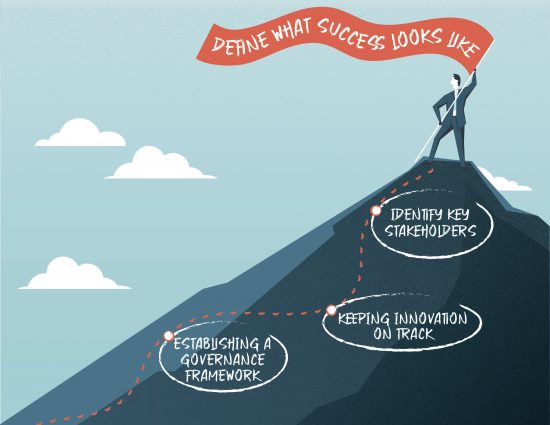
As with many initiatives of this nature, the first step is to identify key internal stakeholders who will contribute to its success. IFBs rely on far more than just the board members themselves to function effectively. They require a steady flow of ideas and concepts from Innovation Venture Teams, but also need to be championed within the wider organization by an IFB Process Facilitator. Let’s break these three main roles down briefly:

Innovation Venture Teams: The foundation of any successful IFB, these teams are responsible for proposing new innovation projects and driving them through to incubation and eventual implementation if successful. Typically, they should consist of three to four core members responsible for reporting into the IFB, with a wider support team on hand to provide additional expertise and help as needed.

Innovation Funding Board: Members of the IFB itself play the central role in reviewing, selecting, and funding projects, as well as providing guidance and feedback for innovation teams to keep ideas on track. The board typically is made up of cross-functional leaders from across the organization with the expertise required to effectively review, select, fund, and coach innovation teams.

IFB Process Facilitator: Playing a critical role, the IFB Process Facilitator must support the IFB review process, and also manage and coach the innovation teams outside of the review meetings. To be successful, the IFB Process Facilitator (whether it be an individual or group of individuals) must have both the credibility and clout to effectively navigate the tensions and ambiguity inherent in higher-risk innovation projects.

 Once you’ve identified and assembled these three teams, the next step is to define and share the characteristics of what “ideal opportunities” should look like. These will vary from business to business. The aim is to put a series of loose, non-constricting guidelines in place through which the Innovation Venture Teams can channel their creative thinking to ensure innovation remains on track.

Finally, it’s important to establish what success ultimately looks like, both to the IFB and the organization as a whole. One simple way to do this is to break it down into core business areas and ask how success would manifest itself in each. Below are three such areas and some questions to ask:

  • Governance – Has the innovation process become more consistent? Are projects being more effectively started and stopped where necessary?
  • Financials – Is the organization’s innovation portfolio being more effectively balanced across all project types? Are investment risks being minimized via delivery of funding in tranches?
  • People/Culture – Is a more entrepreneurial culture emerging from within the business as a result of the IFB process? Is engagement with the IFB process increasing over time?

A lack of clear criteria upon which to benchmark success makes it difficult for business leaders and other key stakeholders to understand how well the IFB function is performing. As such, taking the time to identify broad key performance indicators at this point can be greatly beneficial in the long run.

With key players established and a benchmark for success in place, the next step is to use the IFB to refine the innovation process itself. In my next blog, I’ll share how to do just that, taking great ideas from inception to full implementation in a fast and effective manner.


Authors

Matt Asman

Innovation Manager

Services Innovation Excellence Center (SIEC)

Avatar

You have enough on your plate – trying to operate your network while figuring out a plan on how to migrate all of your TDM circuits to IP, and your budget probably isn’t growing either. At next week’s OFC in Los Angeles, we’re excited to show you the latest innovations in our service lifecycle management platform. It takes an SDN-oriented approach to lifecycle management, enabling you to simplify and automate day-to-day management tasks including planning, provisioning, and service assurance. In the past, these functions were done in silos – with different tools, often by different teams, and possibly in different locations. With our new platform, you have one integrated dashboard that supports all these key management tasks – in one easy to use application.

Planning Capabilities

The integrated planning app dramatically simplifies how you would setup and configure your network. With just a traffic demand input file including the connectivity between COs and the desired bandwidth, the planning tool calculates the devices and line cards required to support the traffic demand. It shows you the bandwidth required (between COs) and where each of the device needs to be deployed. The planning tool’s output file specifies the number of devices, device configuration, as well as the layout of the device – including where the line cards would be positioned within a chassis. When you’re ready to deploy the network, the integrated provisioning component takes the data from the output file, downloads the appropriate software files to each device and complete the configuration. What could be easier?

Service Assurance Capabilities

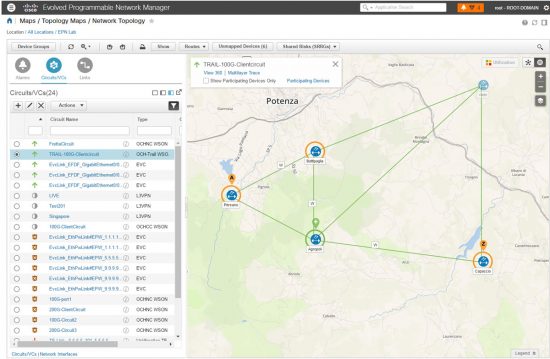
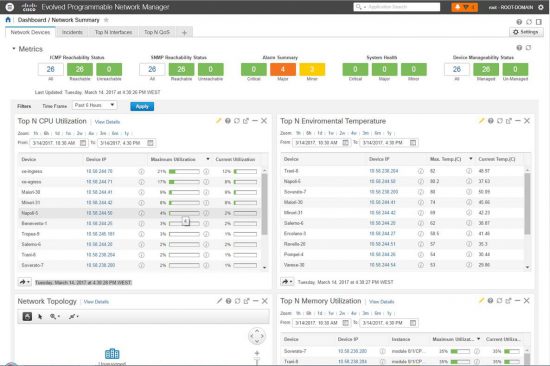
After the network setup is complete, you can use the integrated service assurance app to verify circuits are performing according to their SLA. For example, you want to examine an optical circuit connecting one central office to another. With one click, you can visualize the circuit and see the end-to-end connection, including any other COs that the circuit may flow through. The dashboard view provides all the stats you need to verify that the circuit is performing optimally, including forward error correction, optical power level, error in bytes (delivering), jitter, and latency. If there is a problem on a circuit, the app’s logical view shows you exactly what’s impacted including the intermediate ports and line cards. You see exactly where the problem exists and you can clearly associate the hardware fault to the circuit and do an impact analysis to see what customers are impacted.

Future releases will support audit based rules enabling you to quickly and easily verify that settings across devices are in compliance. If one device happens to change state, an alarm will show if it’s out of compliance.

At Cisco we’re working to simplify, automate, and virtualize the network. Come check us out at OFC Booth #1501, ask to see the Service Lifecycle Management demo or learn about TDM-to-IP migration and see our vision in action.

Authors

Alison Izard

Marketing Manager

Avatar

What makes Cisco different? It’s not rare for companies to allow some time for volunteering and giving back, yet Cisco goes above and beyond and truly adheres to the mantra, “Giving back is in our DNA.” The difference – Cisco allows me (along with all of their full time employees) the unique opportunity to have five days to give back to a charity of their choice without infringing on the use of their annual PTO. And in October 2016, with Hurricane Matthew projected to barrel through the Caribbean Islands before eyeing the East Coast, I knew this benefit was about to mean a whole lot more to me than I ever expected.

Hurricane Matthew is a storm that will not soon be forgotten. Many knew the fear on the east coast of the United States. But, prior to it threatening our coasts – Matthew devastated the already impoverished nation of Haiti with a force unlike any other. In the wake of this deadly hurricane, more than 1,000 lives were lost and over a million Haitians were left in need of humanitarian aid.

JeffSmith2

When my wife, Chrissie, and I saw the devastation on the news, we were deeply concerned. You see, we had made the decision some time ago to sponsor a young Haitian child and we had no way of knowing whether or not he and his family had survived the hurricane. Imagining what it would be like if the lives of our children were suddenly threatened and our home swept away drove us to action—Chrissie managed our home and I was off to help how I could in Haiti.

I volunteered to work with the Servant’s Heart Haiti Mission in Lefond, Haiti for a week in November. I had previously pariticipated with them in other missions trips and felt I had a bond in place with this group. Lefond is an extremely destitute village in the desert part of the country—food and water are always scarce for these humble people.

While in Lefond, I had the opportunity to assist with a number of important projects. Among rebuilding, renovating, and rewiring projects, there were plenty of odd jobs that had to be done. In the picture below, you can see the local school children took a keen interest in the work I was doing to repair a generator. I was quite amused by this, as it was the first time in my life I actually felt like a celebrity.

JeffSmith3

A week later our work came to an end and I returned home with a heavy heart, as I knew there was still so much to be done in Lefond. I saw an urgent need for improvements to the existing electrical wiring and the need for additional space for the leadership of the village. Back home, Chrissie and I discussed continuing our work with the Servant’s Heart Haiti Mission. We concluded that it would be best if I return to Lefond in 2017 (something my Cisco volunteer hours will allow for again in a new calendar year) and we have been working hard to make that happen ever since.

In May, should funds allow, I will be leading a project that will provide two new buildings in the village of Lefond.  The buildings will allow for an office for the Pastor and the School Superintendent in a shared structure and a building for a generator to run the electric for the complex.  Along with this we will also be burying electric and providing proper electrical connections from the new generator building to the other facilities on site.  This will provide an urgent need for electricity for the village and in a safe manner as well. This also has a benefit for the people of Lefond in that they earn money while they work on this project and food while performing the labor as well.

A Servant’s Heart Haiti Mission team is composed of many volunteers with diverse skill sets. Getting the team to Haiti and providing the tools and materials required to get the work done can be a difficult, but not insurmountable, task. If this is something you feel compelled to assist with or learning more about, I’ve provided links below.

Finally, and above all else, we were overjoyed to find out that the child we sponsor, Ralph, and his family had weathered the hurricane. This news brought a smile to our hearts and tears to our eyes. This is a picture of me holding the little guy, along with a snapshot of me and my beautiful and supportive wife, Chrissie.

JeffSmith1


Want to join a company that gives back? We’re hiring! Apply Now!


Would you like to donate or learn more about this this cause? A Servant’s Heart is part of the Cisco Matching program.

Cisco Employee Donations

Cisco will match your contribution dollar-for-dollar, up to $1,000 per year. Please use the following link to take advantage of this opportunity: Servant’s Heart Haiti Mission. You’ll be required to enter your CEC credentials to log in and complete the donation.

Non-Cisco Employee Donations

Please use this link to make your donation: Servant’s Heart Haiti Mission. This link will take you to a secure PayPal site. If donating specifically to fund my trip, please enter “Jeff Smith” in the memo/note.


Authors

Jeff Smith

Consulting Systems Engineer

Customer Interaction Solutions (CIS – Central Region)

Avatar

Digital Transformation is disrupting businesses in every industry and breaking down barriers between people, businesses and things. Processes are getting digitally interconnected, organizations are embracing open ecosystems and digital engagements are increasing. All these are leading to increase in overall attack surface and businesses are becoming vulnerable to attack.

Security is synonymous to innovation and growth as it drives trust and should be a fundamental part of every Digital Transformation Strategy. In order to secure the business, organization need the following three critical capabilities:

  • Comprehensive Threat intelligence
  • Faster Threat Discovery
  • Highest Security Effectiveness

Cisco provides the combined power of these capabilities together.

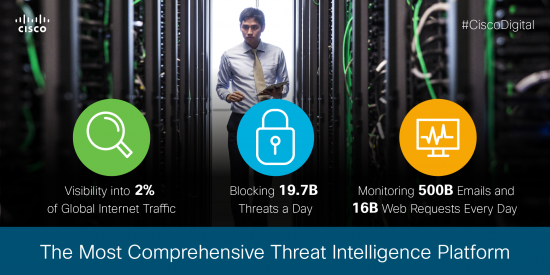
  • Cisco has the most comprehensive threat intelligence platform, Cisco Talos that detects and correlates threat data in real time at scale . Talos has visibility into 2% of global internet traffic and blocks around 20 billion threats a day. Cisco also monitors 500 billion emails and 16 billion web requests every day.  Cisco Talos feeds near real time threat intelligence to Cisco security products & solutions.
  • Faster breach detection is a must, as many breaches go undetected for months. If you can detect in time, you can not protect fast enough. Cisco provides the fastest threat discovery in the Industry as it detects 96% of threats in the first 5 mins of breach vs nearest competitor that detects only 27% threats as per independent NSS Lab report.
  • And finally, every digital business looks for highest security effectiveness. Cisco provides highest security effectiveness of 99.2% as per NSS Lab report.

At the Rio 2016 Olympic Games , Cisco detected 40 million security threats, blocked 23 million attacks & 4 million security threats and mitigated 223 major DDoS attacks.

Cisco provides effective security that works together so that you can see more, protect better and respond faster in the digital era. For more information, please visit our Why Cisco for Digital Transformation White Paper.


Authors

Pankaj Gupta

Director, Market Management

Enterprise PSM - Portfolio, Software, and Campus Switching

Avatar

In the world of finance, trading requires fast decisions and reaction speed is of the essence. So when Bellevue Group started to feel the ping of performance degradation in its VDI environment it knew it had to find a solution. Researchers in the trading department work with sophisticated spreadsheet models and they need to crunch those numbers fast.

Bellevue needed a solution that would deliver virtual desktops and applications with top-of-line performance to keep its users happy and its business humming. From an IT perspective, Bellevue wanted a solution that would scale to accommodate future growth, all the while being easy to manage and integrating well into its current infrastructure.

Bellevue was already using Cisco UCS for its core banking applications and was familiar with UCS superior management platform. The IT team was also looking to move the company’s VDI environment to Windows 10.

After taking a close look at HyperFlex, Bellevue found that it met all its performance requirements and was well suited for its VDI installation supporting the trading floor. One of the main appeals was the simplicity of the solution with compute, storage and networking all integrated in an easy to deploy appliance without the need to connect to external storage.

As Bellevue was redesigning its VDI solution, it took the opportunity to migrate its desktop environment to Windows 10. The IT team deployed a combination of virtual desktops with Citrix XenDesktop and streaming applications with Citrix XenApp and Microsoft AppV. One of the key benefits for the IT department is the ability to use the same tool, UCS Manager, to administer both its UCS and HyperFlex environments.

Last week, we announced new capabilities for HyperFlex, which will bring even more simplicity, more performance and more efficiency to more workloads. In less than a year, HyperFlex has enjoyed tremendous success with over 1,100 customers, validating Cisco’s portfolio approach of offering the flexibility to choose the best infrastructure to suit specific user needs.

Here is how you can find out more about our VDI solutions for HyperFlex:

Continue the conversation on Twitter: @FrancoiseBRees


Authors

Francoise Rees

Marketing Manager

Customer Solution Marketing, Cisco Intersight