When you’re headquartered in Ireland, you have to export… says Paul Glynn, CEO of Davra Networks, an ISV and Cisco Velocity partner. And being part of the Cisco Partner Ecosystem has introduced them to other global partners so they can build solutions together. Recently, Davra helped Presidio do more than just offer wifi on school buses. They connected all the pieces of the Cisco network to the local school district, emergency services, fleet maintenance, and even an app for parents to check which bus their kids were on, and when to expect them. Smart and connected.
Davra says…
When we first met Presidio, they had a fleet of school buses with Cisco wifi routers. And a clever service to let the kids do their homework on long drives.
We specialize in connecting people to things. And in harnessing the data those things produce. So, the question we asked ourselves was: How can we make Presidio’s system even more useful?
We figured that since the buses were connected, we could do more than send data to the students. We could collect it. From the engine. The tires. The location. From the bus itself.
So, we directed all the data from the entire fleet back to our central management system – RuBAN – in a private Cisco data centre.
Presidio could then look at all the video footage and information to make sure the buses were safe and sound. And they could use the data to be more proactive, fixing problems and sending out mechanics before anything went wrong. No nasty surprises.
Thanks, Davra!
I’m sure those kids are doing their homework and not playing games or Snapchatting, right?
Written by Ray Nering, Product Marketing Manager, Cisco
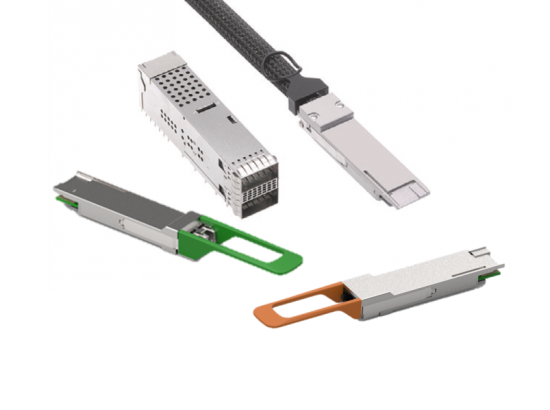
We’re excited to announce that Cisco will have two demonstrations of the QSFP-DD form factor at OFC 2017. The QSFP-DD standard is important because it supports the continued growth in network bandwidth demand and datacenter traffic, by quadrupling aggregate switch bandwidth while maintaining port density.
What QFSP-DD Means to the Data Center
Data center storage capacity will grow nearly 5 fold – from 382 EB in 2015 up to 1.8 ZB in 2020*. As services move to the cloud, network operators want to better manage cost and enable new applications in their data centers. And efficiency is the name of the game, cloud resources can be managed faster and more efficiently across many different applications and data center resources. As these data centers grow and cloud capacities expand, so will the demand for higher capacity, higher speed and higher efficiency switches, routers and transport equipment.
QSFP-DD Form Factor
As a leader in next generation Ethernet solutions, Cisco supports the QSFP-DD standard to be the next generation of pluggable optical modules for 400GbE. As the industry’s smallest 400GbE module, the QSFP-DD module form factor enables data centers to effectively grow and expand cloud capacity as needed.
Meeting Market Demand with a High-Density, High-Speed Form Factor
In addition to providing higher bandwidth density capability and higher bandwidth density optical module, the QSFP-DD form factor leverages the industry’s manufacturing capability and cost structure that supports QSFP+ and QSFP28, the industry’s de facto standards for 40GbE and 100GbE. QSFP-DD can support 36 ports of 400GbE in a single Rack Unit (RU) providing over 14Tb/s of bandwidth. And systems designed with QSFP-DD modules will be backwards compatible, allowing them to support existing QSFP modules and provide flexibility for end users and system designers
Where to See the QSFP-DD Demos at OFC 2017
At the Ethernet Alliance booth (#3709), you can see a demonstration of the 400GbE interoperability in conjunction with Ixia and Foxconn Interconnect Technology. This is the first live demonstration of a 400GbE link using QSFP-DD over passive direct attach copper cable. At the Cisco booth (#1501) you can see a demonstration of the remarkable thermal performance of QSFP-DD form factor in a 32 port chassis.
About the QFSP-DD Standard
QSFP-DD is currently supported by 52 member companies from cage, connector and cable manufactures to module and system vendors. The Quad Small Form Factor Pluggable Double Density (QSFP-DD) Multi Source Agreement (MSA) group announced the release of the 2.0 specification on March 12, 2017. More information can be found on their website.
At Cisco we’re working to simplify, automate, and virtualize the network. Come check us out at OFC Booth #1501, and see the QSFP-DD demo in action.
We have all, likely, struggled from time to time with explaining technology to our grandparents – or, even our parents, older siblings, aunts and uncles. From, “What’s email?” and “How do I copy and paste, again?” to “Do I have The Google?” and “Why do I want to know about this Facebook thing?” they are questions the younger generations tend to take for granted as many of us grew up with computers in front of us on a near daily basis.
As the world progresses and technology continues to boom, our senior generations are sometimes “left behind” as a result. Unfortunately, much of this technology is so new that they’ve never seen it, much less had a chance to learn how to use it – but Cisco Galway has been working to bridge this tech-gap since January 2014!
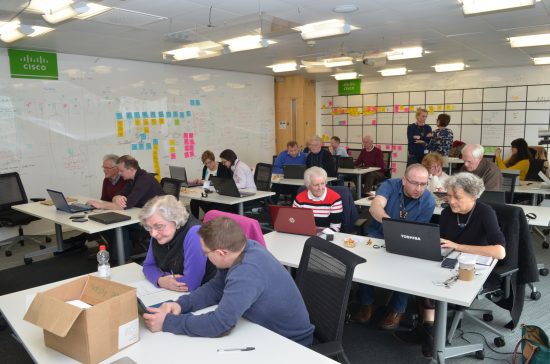
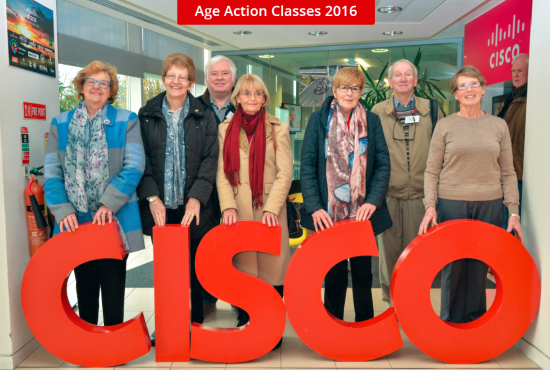
Galway Cisconians have volunteered hundreds of hours with Age Action – an organization that provides local senior citizens with the skills and confidence they need in order to embrace the connected world. Age Action is also a charity that is registered with Cisco’s matched funding – so every hour we teach, Age Action gets $10 donated from Cisco!
“The students vary in ability,” says Cisco Engineer Joe Skehill, “Some have never turned on a computer before or used a mouse, others are quite knowledgeable but just need a helping hand to figure out something that they could not quite master on their own. In all cases though, the students are hugely grateful for the volunteer’s time, knowledge and patience. They are all very eager to learn and most pick up new skills quite quickly.”
During these courses, beginner computer classes are provided, with the courses organised on a one-to-one or one-to-two basis so that everyone gets dedicated time and attention. Students also have a guide book that takes them through basic computer skills. These courses also teach the students how to navigate the internet, which enables them to keep up with friends and family, local news, and booking online travel, etc. With the ability to use a computer and the internet, an invaluable social outlet for these seniors opens as well.
In 2016, Age Action lost the use of their facility in Ballybane, Ireland. That is when Joe came to the Galway offices with an idea in mind – would it be possible to host these classes at the Cisco Galway campus? True to Cisco form – we jumped at the chance! What we saw developing, was that having the senior citizens onsite added another dimension to the Cisco office as blending these generations simply added to the conversation, creativity, and knowledge being exchanged.
Now, every Wednesday 10 to 12 senior citizens come to our Galway offices for their computer classes and on the last day of classes they have a graduation ceremony and a complimentary lunch at the onsite canteen! It’s a brilliant experience, and one we are all very proud to be a part of. It’s wonderful watching the Age Action students learn and grow – you really see their world’s open up once the technology is explained to them properly!
Joe adds, “It’s very rewarding to see the students making progress and how their new skills improve their day to day lives. Whether it’s helping them keep in touch with children or grandchildren across the world on Skype, being able look up and enjoy their hobbies online, being able to send an email to an old friend or any of the many online activities we take for granted.
The class also has a great social element and brings older folks together in person with their peers where new friendships can be made. Their new skills can also provide a communications outlet with the wider world – to help ward off loneliness for those who live alone or who have recently lost their partner.
Cisco’s culture really encourages this initiative and for anyone thinking of getting involved, I would highly recommend volunteering for these classes. Apart from the feel good factor of teaching new skills, you will meet lots of very interesting people who have lived long, rich lives – and you will end up learning plenty from them too!”
For me, personally, these classes are a reminder to us all that one day we will be the senior generation – perhaps we will feel vulnerable and unsure of the new advancements that have occurred. Maybe there will be things we haven’t seen or experienced or learned yet. It is a reminder that spending some time to provide someone with a little training and confidence is paramount in enabling all of our beautiful generations.
Think it’s time to join a company that focuses on everyone’s future? We’re hiring!
If you’ve heard little rumblings in the universe about a new careers website for Cisco – they’re true! We’ve launched a brand new site! Why did we do this? What went into the new design? Who is this site for? We’re about to answer all those questions and more!
For the past year, Cisco’s Talent Brand team has changed our look and voice. Gone are the days of corporate lingo and “hot jobs” – today is the day for employee takeovers via the WeAreCisco Snapchat account and showcasing our employee’s experiences through their eyes by way of Instagram. And we wanted this reflected in our new site!
The WeAreCisco Channels are about you, and me. They’re about the 70,000 co-workers we call family, and those waiting to apply for the Cisco Life. (You can now! Read this blog, then apply, apply, apply!)
Here’s some fun facts about our new careers website:
ALL of the 200+ images on our site feature REAL Cisco employees in their very real working environments! You want to know what life is like here? We’re about to show you! Cisco Employees love sharing their collective global experiences – from stunning campus scenery to team outings and anything with a Cisco logo on it – who better to tell you who we are and what we do than the Cisconians themselves?
Some of the photos are even BY Cisco employees! Yes, we’re hard working, tech-loving geeks – but we’re also artists, photographers, writers, and so much more! You say, “stock photography” – we say, “no thanks!”
Why did we do this? We want to change your perception of how you view Cisco (and how you view our site – it’s super mobile-friendly!) Think we’re a “stodgy 30 year old router company”? Think again. We also wanted a more user friendly site that optimized searches that were more relevant to our candidates, increased intuitiveness, and completely redesigned our navigation.
And, now, we’ll turn it over to a few Cisconians who were featured in our photoshoots and wanted to share their experiences with you all.
Gedhia Conners
I LOVE that Cisco’s new career site features images of and by Cisco employees – this site shows the real people who work at Cisco. Sure, you can get a model to act like they work here – but why not take it from us, the REAL employees, on what the Cisco Life is truly all about? Using actual Cisco employees helps tell the “WE” in the WeAreCisco story.
I’ve never done a photoshoot before, but loved being able to be a part of something so different! The entire experience was a lot of fun, but my favorite part was at the end of the shoot, I put on a crazy Mohawk helmet and one of the guys pushed me in a chair down the hall!
Just another day at Cisco? Yeah, you bet!
Rick Thiabult
We’ve all done it. You go to buy a picture frame at the store and actually laugh at the “fake family” sitting nicely within the borders – you can’t wait to get home and replace it with something real – your family, your memories. That’s what Cisco did with our careers site, and by using REAL Cisco employees and REAL moments throughout the site it also makes that visual message clear – you can be yourself here within the Cisco family.
In my career here at Cisco, I never had the opportunity to do a photo shoot. This whole experience was new to me and it was a lot of fun too. My favorite part was being able to see the behind the scenes of an active photo shoot happen. The way the team would change items, positions, and furniture to get different angles and settings – it was really eye-opening and something I’ll never forget.
Brianna Burns
Not only did I love being a part of this photo shoot – but I loved that Cisco used our own employees to show what life is like here. To be able to see user submitted photos throughout the site, and photos of other employees – it’s great! I think this gives an exciting, realistic view of what is actually important to Cisco employees.
Throughout the photoshoot, the team was so friendly and fun to work with. We enjoyed working with them so much that we all had lunch together after the shoot had concluded!
Ileana Le – Photographer
WeAreCisco is all about sharing the employee experience and showcasing why we love where we work. We don’t just talk about having a great job, we actually share it with the world because we feel everyone should have a similar experience! As an “employee photographer” working on this project, I enjoyed collaborating with fellow employees on photo ideas and exploring areas of our campus we may not have seen before. It was a lot of fun to just be creative and see how our ideas came through in the photographs. We got to eat donuts, see how many different ways we could showcase the Cisco logo, jump in the air, and we even took a minute to film a mannequin challenge video while we had everyone together. As always, it’s fun to bring a group of Cisconians together, who may not all know each other, and experience teamwork at its finest.
Excited to check out our brand new careers site? We’re stoked to have you visit! Let us know what you think, and if you’re ready to join the Cisco Life — Apply!
IBM InterConnect 2017 is in Las Vegas next week and Cisco is excited to be a gold sponsor for the event.
Today’s dynamic market puts tremendous pressures on IT to adapt operations to the latest business initiatives – whether it is an effort to reduce costs, invest in new projects, or improve efficiency. At the center of each of these business initiatives sit applications and data. Applications and data are key in delivering value to the business and the ability to deploy applications and access data in the fastest, most flexible manner possible is becoming critical to success. At IBM InterConnect 2017, Cisco and IBM will highlight our recently announced VersaStack solutions to include hybrid cloud capabilities, infrastructure automation, and software defined storage technologies. Continue reading “VersaStack Innovations at IBM InterConnect 2017”
IT has evolved from running and maintaining traditional infrastructures, to a broader role of delivering new business outcomes. Enter Hybrid IT, which recognizes that where workloads run is just one small part of an entire IT infrastructure. More than just hybrid cloud, it’s a strategy that blends cloud and non-cloud capabilities, including networks, end-points, and workloads with the best that cloud can offer in public IaaS and SaaS. Despite recent outages with public cloud, enterprises need to strike a balance.
We see hybrid IT as much bigger and broader than hybrid cloud or just running workloads – it’s the way in which many enterprises are looking holistically at their IT strategy, whether it’s adopting private and public cloud services to meet their unique business requirements or modernizing existing infrastructure. IDC findings show that cloud usage is rapidly rising and customers are embracing the fact that it is a hybrid IT world.
Source: IDC InfoBrief, sponsored by Cisco, Cloud Going Mainstream. All Are Trying, Some Are Benefiting; Few Are Maximizing Value. September 2016.
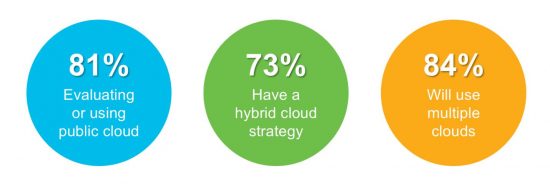
81% are evaluating or already using a public cloud. Some might use Azure for workloads that involve Microsoft technology, or Google platforms for workloads with TensorFlow or other machine-learning capabilities. They may also house data at Amazon as a default, for leveraging things like Lambda for serverless workloads. And then there are scenarios with select workloads where performance is critical, bandwidth is high, or there is very sensitive data involved in the on-prem data center.
73% of enterprises have a hybrid cloud strategy. The optimal cloud strategy for most enterprises is one that leverages the capabilities of webscale public cloud, but also on-prem private and hybrid cloud. Factoring the various types of workloads, location, performance, efficiency, and compliance requirements are also key.
84% will use multiple clouds. Many subscribe to multiple external cloud providers and run workloads using a mix of public/private cloud and dedicated IT capabilities. They want to be able to choose from multiple cloud providers based on location, policies, and governance needs.
CIOs we talk to want to solve business problems with complete, end-to-end IT architectures that extend from the data centers to campus networks, wireless, security capabilities, analytics capabilities, and even the end points. They are choosing which capabilities make the most sense to keep on-prem and which to expand to cloud, based on the outcomes they want to achieve. Hybrid IT is the new frontier when it comes to balancing the traditional infrastructure requirements with the need to expand new capabilities off-premise in the cloud.
Has your enterprise adopted a hybrid IT strategy? If not, what’s holding you back?
I was just in Austin, Texas, at SXSW. While there, I spoke at Cisco Spark Haus about the Cisco design language – and how magic happens when California meets Norway. I’m often asked about our approach, so I thought I’d share some of my Texas conversation.
The baseline question I get is: What do you do?
My job is to shape user experiences that will delight people and empower teams.
What are important workplace trends affecting design?
The rise of millennials in the workplace, and Gen Z following them, is driving the need to digitally and physically transform workspaces. Companies need to create aspirational workspaces to retain these employees – and provide the right tools for the way they work.
We see millennials democratizing the workplace, moving away from hierarchy and into teams. They also want work to fit their lifestyles, and the technology they use must move between work and home. They really drove the BYOD movement. Gen Z workers have even less patience for technology and demand brands that they identify with on a personal level.
How do these trends impact your designs?
In the past, IT teams made all the technology decisions. Today it’s often employees who start using an application that then becomes the de facto standard for a particular team.
We studied how the best teams work together and created online spaces for them. Each online space has all the tools team members need at their fingertips: messaging, file sharing, white boarding, and conferencing. And they can also access third-party tools can also be accessed from the team space. That is Cisco Spark.
Then we created Cisco Spark Board, the physical representation of a Cisco Spark space in a meeting room or for any area where team members meet physically. Together, Cisco Spark and Cisco Spark Board create a seamless workflow from home to work, and before, during, and after meetings.
Why do you think Cisco Spark Board design is receiving so much attention?
With Cisco Spark Board we have been on a journey to rethink how teams collaborate. We are adamant about creating products that are radically simple and just feel obvious to users.
We live in a world where people are used to understanding the capabilities of their personal devices by the icons on their home screens. So we “appified” the tools in the meeting room with Cisco Spark Board. People can glance at the home screen and take action. Before, they’d have to figure out all the different devices in the meeting rooms and how to get them to work for them.
We took the idea of using knowledge people already have to the physical aspects of the product.
We took the idea of using knowledge people already have to the physical aspects of the product. When you come into the room, you see a device that looks like a very large tablet. This immediately makes people comfortable because it’s familiar. Like using a tablet at home, they can touch the screen to choose an app or use the home button to get back to the home screen. Suddenly, people that used to call IT are leveraging powerful capabilities in the meeting room by themselves. When people see the Cisco Spark Board, they just know what to do. Consider it a team tablet for the wall.
What is unique about the design language within Cisco?
The Cisco Spark Board is a beautiful device inspired by Dieter Rams and the modernist industrial design tradition. You could say that his approach is where the idea of obvious design comes from. If you have a product from Braun at home, Dieter Rams might very well have designed it. Apple product design also has roots in modernism.
At Cisco, we apply modernist ideas but have evolved our own design language. We’re headquartered in California with a large contingent of designers in Norway. Our design blends Scandinavian minimalism with Californian approachability. People in Cisco call it Scandifornian design. I think there might be something to it.
Take the Cisco Spark Board home screen: It has three simple icons for the three activities you can walk up and use. It’s a very focused, minimal user interface. People often describe minimalist design as strict and unemotional, but we’ve created icons to be colorful and playful.
If you open the whiteboard activity, it has only the four drawing colors of a typical conference-room pen set. It isn’t an artist’s tool. It’s a tool for communicating ideas effectively. The interface is minimal, but the drawing colors are brighter than on an analog whiteboard. We think it makes a difference when the ideas you share appear playful and bright. That’s the little magic we put into the details. To me, that’s a good example of Scandifornian.
Sara Chipps is a JavaScript developer based in New York City. She has been working on Software and the Open Source Community since 2001. She’s been obsessed with hardware and has been a part of NodeBots since 2012. She is the CEO of Jewelbots, a company dedicated to drastically changing the number of girls entering STEM fields using hardware.
Conversing in 140 characters or less forces us to focus on what’s most important. It’s one of the great things about a Twitter Chat – it allows engaging dialogue with some really smart people doing some really amazing things in tech in a short amount of time.
And last week, I was lucky enough to do just that, participating in a Cisco Chat hosted by Cisco’s CSR team with Vicky Escarra, Global CEO of Opportunity International, and former Cisco Networking Academy student Diana Nassar. We spent the hour tweeting back and forth, discussing ways we can use technology to create more opportunities for women.
Not only did I participate, but I was also lucky enough to learn a few lessons from my peers!
We kicked the Cisco Chat off with a back-and-forth on what skills women need to be Global Problem Solvers. Rapid changes are happening in the workforce today, and we need people with the desire, knowledge, and skills to help others thrive around the world and solve the planet’s greatest issues.
Based on that, the comments around technical literacy, strong communication and focus rang true for me. We also discussed the theme of “grit” and “resilience” for women looking to start their careers in tech. Being a leader anywhere, and especially in this rapidly changing field, requires you not only know your stuff but that you’re able to adapt and change in real time.
We then touched on one of the key drivers to the success of business: incorporating diversity and inclusivity in organizations. Making a crucial decision to prioritize diversity in your management, as well as actively pursuing different applicants for entry level jobs and employment at every level of the organization is a good start. With that, conducting promotion analysis and pay analysis for gender, race, or ethnic biases is also important — the numbers don’t lie!
This segued nicely into talking about the digital revolution and its positive impact on the lives of women. This was a wonderful topic, and many of us made the point that new training tools and other digital self-led technologies create more opportunities for women in rural and underdeveloped areas, as well as for women juggling care duties.
The tools also provide access to education previously not accessible to earlier generations and are absolutely instrumental in creating a qualified pipeline of educated women into the workforce and leadership roles.
The final questions focused on mentorship and advice to others. Alaina Perceval’s response stuck with me. She said:
“Applaud the career successes of women (large and small) and champion your own successes.”
Championing other women and recognizing their successes is a fantastic motivator. However, it’s much harder to champion your own accomplishments. You can be you own worst enemy or your own biggest advocate; it’s up to you!
I never fail to be in awe of the amazing women near me along with ones I have never met before, and this International Women’s Day was no exception. I was so inspired by social media as many people shared the many women they respect and admire to celebrate the day. I hope this inspiration lasts 364 more.
Follow Cisco CSR on Twitter for even more on creating opportunities for women in tech!
This blog was created as part of a paid partnership.
As Chief Digital Officer for Cisco, nothing is more important to my work than listening to and understanding our customers. Digital disruption is a strategy driven by the voice of the customer and it means you must listen more intently than ever before.
This is why I hosted the March Cisco Beat—our monthly company employee meeting—from the corporate headquarters of Allianz, Deutschland in Munich, Germany. Hosting a Cisco Beat at Allianz underscored to Cisco employees just how important understanding our customers is to the transformation of Cisco’s own business. We need to take the time and make the effort to innately understand the impact of digital disruption on our customers, and then continue to transform our business to serve them even better.
This month’s edition was so full of important digitization insights that I want to share my top observations beyond the Cisco employee base.
I was joined by CEO Manfred Knof and CMO Bernd Heinemann of Allianz Germany who reiterated that digitization can only be successful if innovation and scale come together with the use and help of technology. Like Cisco, they are convinced the customer is at the center of our global agenda on change. This means the voice of the customer is driving the agenda and digitization is right next to it.
It’s not enough to know that digital transformation is real, you must know what it means to you. According to the Global Center for Digital Business Transformation, an IMD and Cisco initiative, digital transformation is “Organizational change through the use of digital technologies and business models to create material performance improvement.” The key here is “business model enablement” because digital disruption requires companies to make money in new ways.
Digitization must be driven by a diversified C-suite actively working together to drive transformation. About 70 percent of the more than 25,000 customer visitors to Cisco every year aren’t directly involved with IT. This doesn’t mean technology is losing its importance. It means that the digitization conversation is holistic. These business leaders are saying, I don’t want to discuss technology, I want to talk about how technology can drive my business enablement.
Technology leads digital strategy. For example, company executives now want to know the implications of technology in enabling their new business models. This is a conversation about digitization, not technology. Over the past 12 months, my customer meetings have been focused on digitization holistically (i.e., where and how will technology enable innovation and business model change).
Allianz is a great example. Their executives have visited Cisco several times to find out more about how they can consume innovation from us while focusing on what they know best—their business and the insurance industry. Dr. Knof shared how delivering new services to their customers using technology means that they are capable of making every one of their customers’ lives better and easier.
The underpinning of any digital transformation is the network. At Cisco, we have a tremendous opportunity to listen to our customers to understand their businesses and then apply innovation around the network to drive their digital transformations. For example, because security is synonymous with innovation, Cisco is building security into the network so that customers like Allianz can have the confidence to continuously innovate to transform their organizations.
The voice of the customer is guiding our digital transformation and it will guide yours. You just need to listen more intently than ever before and then apply the concepts I’ve outlined. By doing so, you will be on the path to meaningful digital business transformation for you and your customers.











 IBM InterConnect 2017 is in Las Vegas next week and Cisco is excited to be a gold sponsor for the event.


 Sara Chipps is a JavaScript developer based in New York City. She has been working on Software and the Open Source Community since 2001. She’s been obsessed with hardware and has been a part of