Avatar

We all heard the saying that time flies (when you are having fun). It certainly has been a busy start to 2017 in many aspects and when my colleague Emmeline Wong posted her blog about ‘2017 New Year’s Resolutions: Ideas for Data Center Pros’ a few months ago, it feels like yesterday.  With Cisco live Berlin and Melbourne behind us, we were both busy and had fun. Before we get ready for the next round of events and Cisco live Las Vegas in June, I like to provide an overview of the many innovations we announced as part of the ASAP Data Center Architecture in just these past couple of months.

Innovation

Cisco defines innovation as creating something significantly new, better and of value. It is not just an idea, but the ability to bring it to life. Based on five key pillars: build, buy, partner, invest and co-develop.

Flywheel of Innovation
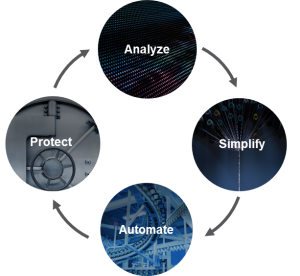
Based on four design principles of Analyze, Simplify, Automate and Protect building an integrated architecture with a consistent policy, the ASAP Datacenter empowers customers with the flexibility to run any traditional or cloud native application across any environment: on-premises, managed or public clouds.

As IDC states in this whitepaper: “Cisco is a strong believer in the merits of the flywheel effect — and thus a virtuous cycle — created by analysis, simplification, automation, and protection. Cisco’s ASAP architecture helps organizations navigate business modernization — and keep their flywheel turning — so they can simultaneously evolve in [these] four critical areas”.


Delivering across the Hybrid-IT stack and pillars of innovations

If you have the time, I encourage you to watch the on demand videos of the innovation talks ‘Go beyond automation: advancing your next gen datacenter’ at Cisco live Berlin and Cisco live Melbourne (log in required, sign up is easy). They cover all the recent announcements and provide insights how customers deploy our products and technologies of the ASAP datacenter architecture to drive better business outcomes, stay innovative and competitive to embrace the opportunities of the digital economy.

Here is a listed summary of our announcements in Q1 of 2017:

What’s Next

As I said at the beginning of this blog, 2017 has started with many memorable moments and news and it has been an eventful ride so far. So hold on tight and together (customer success stories) we keep the flywheel of innovation turning. To stay informed until Cisco live Las Vegas, join one of the Cisco Connect training events in your city or visit one of the innovation centers around the world. And if you are a developer: be part of the DevNet Create event in May, where applications meet infrastructure, to help create more magic.


Additional resources

Authors

Klaus Schwegler

No Longer with Cisco

Avatar
Today, Talos is publishing a glimpse into the most prevalent threats we’ve observed over the past week. As with previous round-ups, this post isn’t meant to be an in-depth analysis. Instead, this post will summarize the threats we’ve observed by highlighting key behavior characteristics, indicators of compromise, and how our customers are automatically protected from these threats.

As a reminder, the information provided for the following threats in this post is non-exhaustive and current as of date of publication. Detection and coverage for the following threats is subject to updates pending additional threat or vulnerability analysis. For the most current information, please refer to your FireSIGHT Management Center, Snort.org, or ClamAV.net.

Authors

Talos Group

Talos Security Intelligence & Research Group

Avatar

It is estimated that during the next three weeks leading up to the NCAA Championship game on April 3rd, that more than 70 million Americans will fill out a tournament bracket. According to estimates released by the American Gaming Association, nearly $10.4 billion will exchange hands due to overwhelming confidence that they picked the right team to win it all. $10.4 Billion, you read that correctly. And you know what? That’s a drop in the bucket compared to the total amount of money exchanging hands in the form ticket sales, merchandise, food and beverage sales, ad revenue, and the list goes on and on…

It wasn’t long ago that the $20 you owed a friend because North Carolina folded in the closing seconds and cost you the game had to be paid with cash in hand (or by check because North Carolina never folds). Truthfully you didn’t think to go the ATM and your buddy refuses to believe that you’ll pay him later…but I digress. Or that once in a lifetime trip you planned to Houston to watch the game in person; had to be paid by wire transfer.

Digital Disruption isn’t just a phrase being thrown around by tech marketing firms, it’s real and it’s happening every day whether you’re prepared or not. In fact, it happens so fast, it’s now common place to pay that ex-friend his $20 by opening your bank’s app on your smartphone and sending the money via text. That amazing Houston trip; forget about standing in line at your bank. Now that travel app you booked it through simply asks for your thumb print to verify your payment. Financial Services has embraced enterprise application adoption and can be found at the forefront, revolutionizing the way millions of customers manage their money.

A large financial services firm CIO recently shared with me they manage over 37,000 applications in their environment and this figure doesn’t take into account the countless apps being used that integrate some form of mobile payment.  An example is that app you’ll use in the stadium that allows you to order yet another drink after your team decided to take in the local night life on the eve of the tournament and only put up 43 points in a one and done tournament, I’m looking at you Pittsburgh.

Maybe you need to take a look at your investment portfolio to make sure you can cover your ill-advised wager, there’s an app for that too. We are undergoing profound changes in the way we perceive and deal with our finances. With a focus on faster and more convenient transactions, financial services firms must tackle the regulatory compliance needs, the increase in traffic demanding automation, and a network that supports the optimization of this new operating model.

Financial service firms will no longer wait weeks or months for new services and change requests. They want to join the on-demand world that we’re all used to, but these things require a high level of automation. Networks are becoming more software-driven; DevOps can be a powerful tool for managing them. It improves the relationship between network service designers and the engineers who need to make the actual operational changes to the service. To completely automate your network, you’ll need to set up a hybrid form of DevOps. That means bringing the automation capabilities of service orchestration tools into the DevOps mix.

With the right strategy, you can bring the advantages of DevOps to your organization. And with it, the power, the agility and the cost savings you need to stay ahead of your competitors. The right strategy, not like the one you used to leave the always a Cinderella story Gonzaga off your bracket, but similar to the one you used deciding to read this blog!

For more information on how Cisco is enabling the financial services industry: cisco.com/go/fsi


Authors

Danny Vicente

No Longer at Cisco

Avatar

It’s a gross understatement to say that security is critical in healthcare, where a breach can not only impact an organization’s effectiveness and reputation but also affect patient privacy and—worst-case scenario—health and safety.

If you are reading this blog, you no doubt already know the most common challenges to securing digital healthcare organizations, from ensuring data availability to protecting patient privacy, from safeguarding facilities to blocking malware and other cyber threats. The proliferation of data-collecting devices and apps across the continuum only makes healthcare more vulnerable, providing increasing access points for would-be attackers, who grow more sophisticated by the minute.

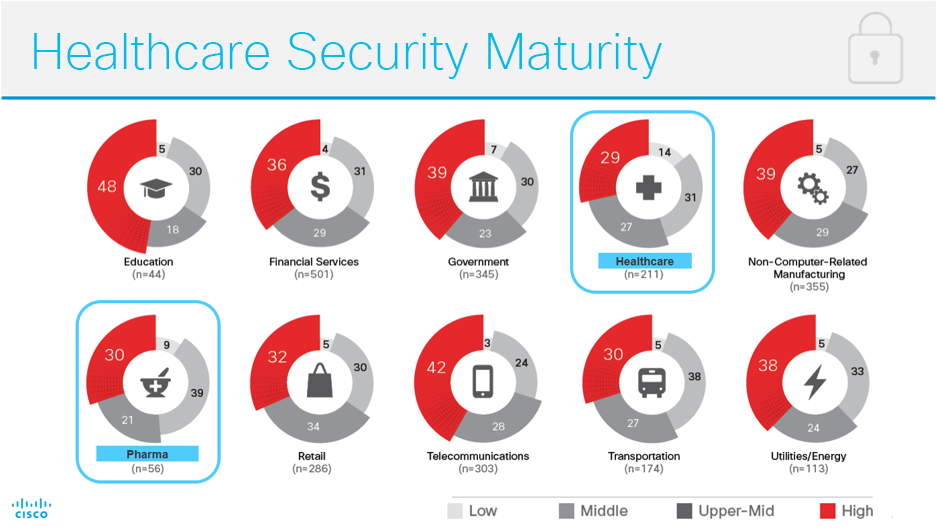
Acknowledging these common challenges, what you may find disconcerting is that most healthcare organizations—including life sciences companies—sit behind the curve in terms of security preparedness or “maturity.” Our just-released Annual Cybersecurity Report specifically calls this out, noting that less than one-third of healthcare organizations have high maturity. This means that most healthcare organizations still treat security as a requirement best relegated to IT, rather than integrating security across organizational culture, processes, and technology.

Thanks to Cisco, there’s never been a better time to examine security solutions.

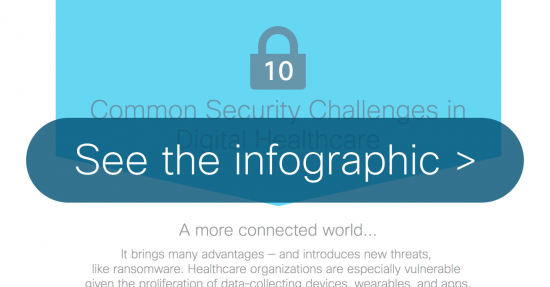
To help healthcare organizations move up the maturity curve, we’ve created an insightful infographic that offers practical solutions to 10 of the most common security challenges in digital healthcare, including data availability and DoS attacks, legacy applications and patching, network-connected clinical devices, malware and ransomware, physical security, leadership and training, and in-house threats like shadow IT. For a deep dive, there is also the accompanying white paper.

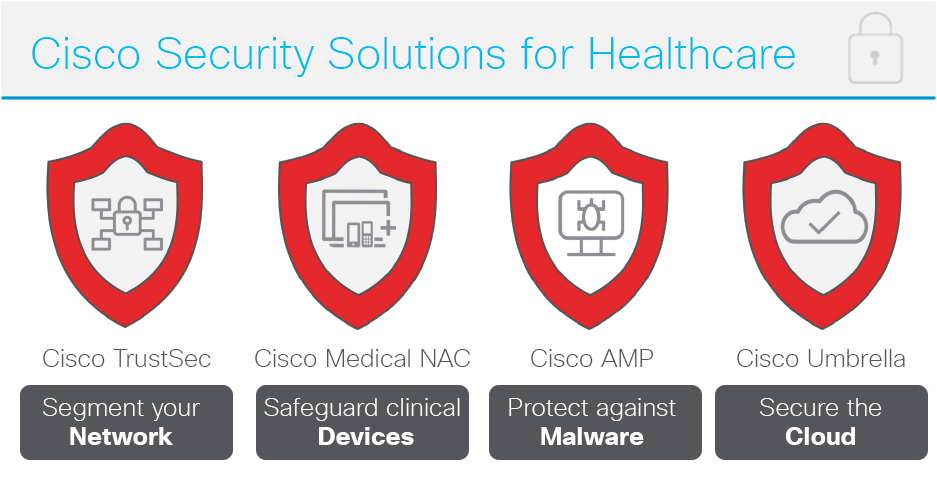
Cisco’s also here to help with 5000 security experts, 250+ threat researchers, world-class threat intelligence, an end-to-end architectural approach, and a standout security portfolio to protect your network, data, devices, and users, wherever they are.

For more information, please visit cisco.com/go/healthcare and connect with us on social media.


Authors

Jessica Kelly

Sr. Communications Manager

Office of the COO

Avatar

Written by Vy Kuchibhatla, Senior Manager, MBG Operations and Strategy

At MWC 2017, two key themes received a bulk of the focus from a network equipment provider perspective: 5G and NFV/Automation (Verizon/Cisco, Telus/Cisco, NTT/Cisco, Reliance Jio/Cisco). This article focuses on the genesis of NFV/Automation, its place in the Cloud and some key gaps that need filling.

To understand why NFV/Automation is so very key to Mobile Service Providers (MSP) everywhere, let’s dial back in time to 2014. Gartner had then predicted that by 2017, 50% of Global Enterprises will have implemented Web-Scale IT architecture. As proof positive, Cloud Native pioneers Amazon, Google, Netflix, Facebook have been and continue to implement enterprise capabilities at speeds and agility that belie their size and capacity, while at the same time reducing TCO and touting OpEx metrics that grabbed the attention of their Service Provider brethren, whose traditional networks, by comparison, require months of testing and pre-staging for feature and / or capacity roll outs.

So, what gives?

Although MSP networks adhere to standards from 3GPP, IETF and other bodies, traditional networks nodes are characterized by bespoke architectures, usually meant to reside on purpose built hardware. During the 2G, 3G, and even 4G, evolution, MSPs focused on network and capacity expansion, stoked by competitive TTM for service offerings. Sufficient ARPU margins fueled the expansion of highly custom mobile networks.

As the global wireless industry looks to overcome the commoditization of bottomless connectivity, MSP operational focus has shifted to resource optimization. Driven by revenue stagnation, the need for OTT use cases to drive top line will further increase customer-centric experiences. To address this dichotomy and in an effort to transition to efficient elastic networks, the concept of NFV/Automation has taken a stronghold as MSPs seek to adopt Web Scale-like DevOps deployment models to provide true Mobility-as-a-Service (MaaS) offerings.

However, SPs have in general struggled with providing competitive cloud based services. Unlike Cloud Native applications and simple VNFs, typically consisting of a single Virtual Machine (VM), SPs have taken “lift and shift” approaches to partially cloudify their networks or use cases.. Others are vying for private Cloud offerings as an overlay to hybrid networks with both VNF and traditional nodes. The resulting VNFs have multiple distinct VNF Components (VNFCs) with a variable number of VMs depending on feature optioning and desired performance specifications.

As traditional networking equipment vendors help MSPs scale to enterprise NFV/Automation networks, two key areas of focus emerge:

  1. Build for scale – religiously: Ease of instantiation and scaling is a core tenet of Cloud Native apps. By contrast, each mobile subscriber is a tenant unto themselves. Facebook, a $400B market cap company managing operations with only 17K employees, religiously adheres to design replication and elimination of one-off architectures, driving $23.5M of company value per headcount. Traditional “network function” (note the shift in terminology from “network equipment”) vendors need to move to a Cloud Native re-design to enable full realization of TCO benefits through Lego block like micro-services and service chaining.
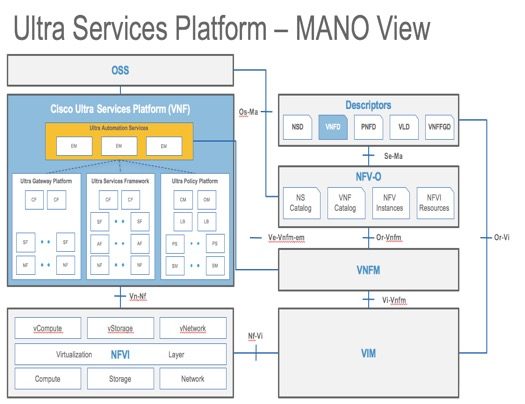
  2. Automation focus: Ease of instantiation and scaling are core tenets of Cloud Native apps. ETSI MANO references the orchestration (NFVO) layer to drive service-level automation down the stack with network function descriptors driving config changes through the VIM and VNFM. Simplifying this management flow by embedding operational simplicity of VNF on-boarding, deployment and management is essential to deploy low cost multi-vendor VNF networks. This can be achieved through standards based VNF lifecycle management automation tools and is a necessity to ease the MSP transition to a fully Web-Scale like deployment.

Cisco’s Ultra Services Platform introduces Ultra Automation Services to address VNF-level automation from IT-prep, install, instantiation and deployment. The UAS roadmap extends this automation to instrument, validate and apply SLAs to VNF performance. Watch for a white paper detailing the value proposition and architecture of UAS.

Additional Resources:


Authors

Jim O'Leary

Sr. Manager Mobile Solutions Marketing

Avatar

They say good things come to those who wait.

That wait was finally over when at the 2017 Cisco Live Berlin in February, Liz Centoni, SVP/GM of Cisco’s Computing System Product Group, revealed the Cisco Integrated System for Microsoft Azure Stack—a powerful and dynamic solution built on Cisco’s Unified Computing Systems (UCS) that provides organizations with a scalable hybrid cloud platform that can deliver Microsoft Azure services from their own data center.

Why is this important?

The demands of economics and business flexibility are driving the world’s transition to cloud computing. Simultaneously, the explosion of data in the digital age continues. While enterprises are still making sense of the business opportunity, their data center resources are consumed by managing complex infrastructures and cumbersome systems—to say nothing of security threats and compliance issues.

To address these challenges, enterprise customers, who are growing and modernizing their data centers, can often look to service providers for a solution that delivers a unified hybrid cloud experience that spans on-premises, hosted, and public cloud services Cloud service providers who can transform their services to meet these customer demands will undoubtedly generate new and diversified revenue streams. Service-based cloud providers can further differentiate themselves in the market by addressing the demand for hybrid services amidst growing concerns around data sovereignty, data stewardship, and compliance.

Cisco recognized these complex dynamics in how the cloud consumption is delivered today and took a thoughtful and deliberate approach in developing a comprehensive solution that would meet the needs of these diverse customers. The result is that now with Cisco’s Integrated System for Microsoft Azure Stack, service providers can deliver a dynamic and unique platform that will include the following:

  • Cisco Generation 4 VIC Card
  • Configuration w/ 40GbE end to end
  • BMC integrated within each server
  • Broad experience across many cloud offerings
  • Best in class networking and security related to clouds
  • Best in class Integrated Infrastructures
  • Dynamic platform designed exclusively for virtualized workloads
  • Highly regarded customer service and a strong partnership with a market leader in the service provider market

We are excited to showcase our joint solution at the Microsoft Cloud and Hosting Summit because we believe there is no better partnership that can meet customer’s and service provider’s needs in the cloud than Cisco and Microsoft. And there is no better infrastructure for cloud service providers than Cisco’s (UCS) that delivers on the promise of the Microsoft Azure cloud and the larger promise of cloud computing solutions.

To learn more about what makes the Cisco Integrated System for Microsoft Azure Stack and the Cisco-Microsoft partnership unique from others, we invite you to join our breakout session (Tuesday, March 21st at 1:15 pm PST) at next week’s Microsoft Cloud and Hosting Summit at the Hyatt Regency Hotel in Bellevue, Washington.

We can’t wait to see you all there.

Authors

Ed Cho

Product Marketing Manager

Security Product Marketing Organization

Avatar

If you are reading this blog then you most likely understand that APIs allow inter-working among products. In the context of Firepower Management Center, the REST APIs allow programming of the Firepower devices to allow one to automatically provision devices, deploy policies and controls, and monitor device health. In this blog I will try to explain how you can get started on using these APIs to derive value from them.

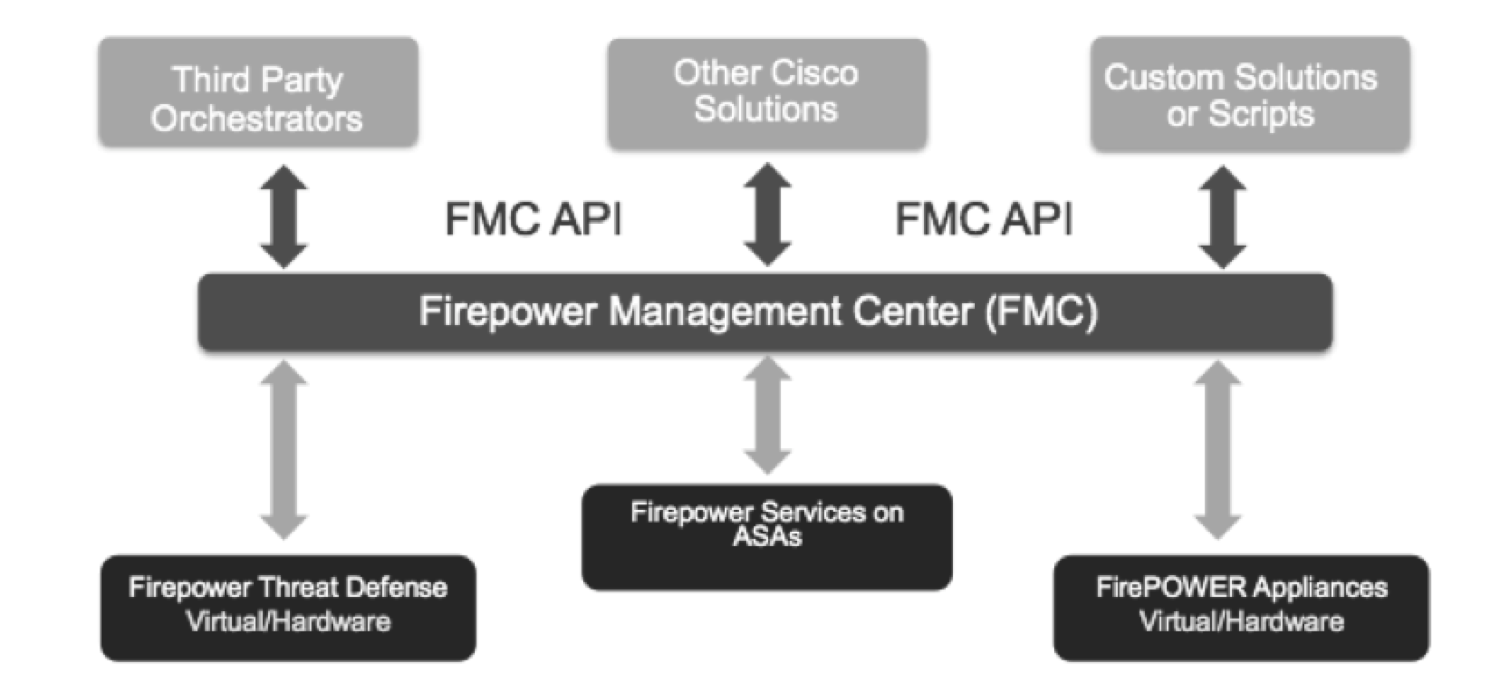
The FMC APIs were introduced in recent Firepower 6.1 release. As shown in the picture below, FMC APIs allow you to program all the types of devices that FMC can manage.


Before we get into how to use APIs, let me quickly summarize what is available in the first release. FMC 6.1 APIs allow you to address most common Firepower programmability use cases where you want to be able to

  1. Register/de-register Firepower and Firepower Threat Defense devices
  2. Program & deploy standardized Access Control Objects & Rules on Firepower and Firepower Threat Defense devices
  3. Monitor Firepower and Firepower Threat Defense Device health & interface statuses

These FMC APIs are prepackaged with FMC software and you don’t need any license to enable them. All you have to do is go to your FMC settings and enable the APIs. Once you enable these APIs, any FMC user can be provided with access with a click of a button. These FMC APIs are completely secure and they use Token Based Authentication mechanism for API users.

The easiest way to figure out specific operations available on any version is by using “FMC API Explorer.” You can launch the API explorer by using the URL

https://fmc_url/api/api-explorer/

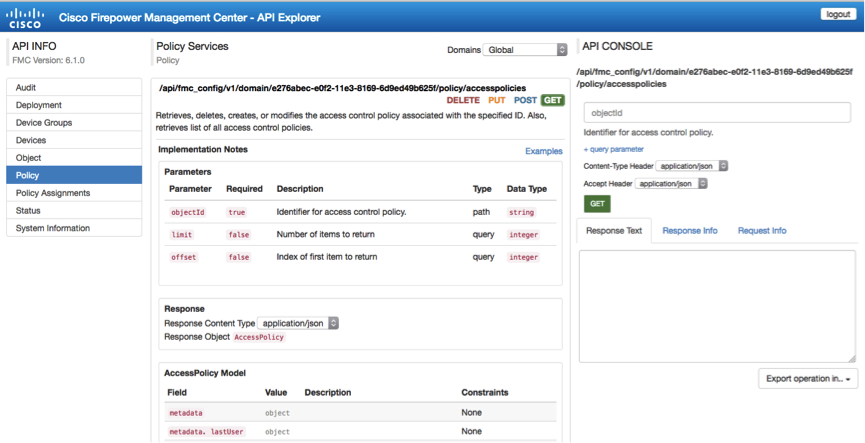
Insert your FMC’s domain name or an IP address in <fmc_url> and you will see API Explorer like the one below

As you can see in the picture, Firepower API Explorer not only provides you information about possible API operations but also gives you code, which you can use. To generate the code all you have to do is click on the left hand side functions, select the REST operation, and use the code from right hand side panel by clicking on “Export operation in…” pull-down menu.

In order to execute any of these operations using REST clients, you will need to use “X-auth-access-token” required for authentication of the API requests. You can obtain the token using “generate token” request with “authorization” parameters i.e. username and password. Once you have “X-auth-access-token” you can use that in the API requests.

Now you can use the code available in FMC API Explorer to program Firepower devices using custom scripts, third party policy orchestrating solutions or even other Cisco solutions. By the way, have a look at the short FMC 6.1 API video tutorial to understand how you can do all of this.

If you need more details on how to get started don’t forget to check out our Firepower REST API Quick Start Guide

And, one more thing…

Along with these FMC APIs, we have also made the ACI devices packages for Firepower and Firepower Threat Defense available. So if you are Cisco APIC customer, who wants to dynamically instantiate virtual Firepower and Firepower Threat Defense devices, and program them through FMC APIs you will be able to do that. Please check out Using Firepower device package in ACI to learn more on that front.

Authors

Jayant Thakre

Manager, Product Management

Security Business Group

Avatar

Have you heard of Cisco DEVNET? 

DevNetZoneWe are the single resource for everything ‘developer’ at Cisco, and we are here to help you learn, code, inspire and connect.


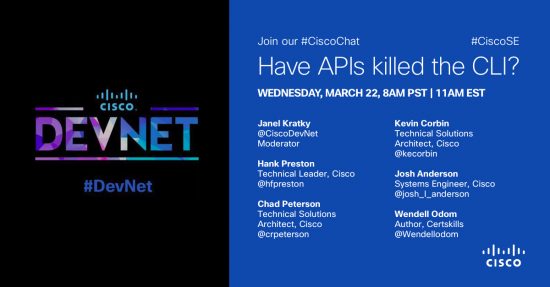
One of our favorite partnerships is with the Systems Engineering organization, #CiscoSE.  Together, we are hosting a #CiscoChat to answer this question: “Have APIs killed the CLI?”

What’a an API? What’s a CLI? What’s a developer?

Bring all your questions to Twitter on March 22.

DevNetZoneTeam

Prior to the chat, make sure to claim your #DEVNET account!

Register:
developer.cisco.com

Let us know you registered by sending us a tweet @CiscoDevNet


Is this a Systems Engineer or a Developer?  

Actually, Hank is both.

Hank Preston DevNet Evangelist
Hank Preston III, DevNet Evangelist

“If you want my CLI, you’ll have to pry it from my cold dead hands!”
Maybe an extreme example, but that seems to be the fear of many network engineers.

But is the CLI really at risk of going away? Or, can new network APIs and the CLI happily co-exist?

In this #CiscoChat, “Have APIs Killed the CLI” we’ll consider this question, and have an honest discussion about the future of the beloved CLI, what new APIs offer the network engineer, and how to pick the right tool for the job.


What’s it like working at DEVNET? 

I love being the developer’s advocate and sharing code “things” I think are cool, DEVNET allows me to do that and so much more! Here’s an example.


John McDonough, DevNet Evangelist


Get to know our extended Team, including John McDonough, Hank Preston, Janel Kratky, Chad Peterson, Kevin Corbin, Josh Anderson, Genna Cargill, Greg Hamilton and #CiscoChampion Wendell Odom!


CiscoDevNet-CiscoChat-Info


Authors

Silvia Karina Spiva

No Longer at Cisco

Avatar

The hyper coverage market is exploding;  ESG’s latest research confirmed the popularity of HCI: 85% of respondents reported that they currently use or plan to use HCI solutions in the coming months.

A broad range of capabilities has driven the organization in that direction:

Improved service and support, scalability, agile VM provisioning, predictable costs, simplified management, fast deployment, better TCO, fewer interoperability problems, and ease of acquisition.

Is it too good to be true? In many cases, it is, especially when software vendors are using generic X86 servers.

I like to call it: software that runs Vs. Systems that fly.


so what are the three things to look for when considering HCI:

The next generation of HCI is not relying only on simplicity and automation. IT teams must start to think about running mission-critical workloads on HCI. Here are three important points to consider:

  1. Density – you want to do a lot more with your HCI platform, run more application and VM.
  1. High performance with low latency: As customers migrate more workloads to HCI, the importance of a strong, consistent performance increases.
  1. Predictable IOPS delivery – Transitioning to All-Flash configuration can help reduce latency in any solution, but you may still have performance variability. You must see stable and predictable performance across all virtual machines, not to hurt your ability to deploy applications.

With 1100 customers in less than a year, we are accelerating adoption of business-critical applications on hyper-convergence infrastructure. Hyper-Flex 2.0 introduces new Cisco innovations in compute, storage and networking to further expand hyper-convergence within your environment.


What customers are using Hyperflex for:


Customers are looking to enjoy high-performing, cutting-edge graphical features, and a better customer experience. More and more graphic elements are embedded inside mainstream applications.  Working together with Nvidia allow customers to meet these requirements.


Other growth demands are delivering on the promise of a virtualized digital workspace. Hyper-Flex, combined with Citrix XenDesktop/XenApp or VMware Horizon, securely delivers anytime, anywhere access to any application on any device, including desktops, smartphones, and tablets.


In 1980, The late Freddie Mercury was ahead of his time, when he sang: “Flash a-ah Savior of the Universe.”


37 years later with Hyper – Flex 2.0 release, customers can now choose to go All Flash nodes and 3rd Generation 40 Gbps UCS fabric networking.


We are dropping hyper-convergence into top-gear and putting in the smarts for a consistent and maximized performance in each gear – getting blazing fast performance for both business-as-usual and business-critical applications.


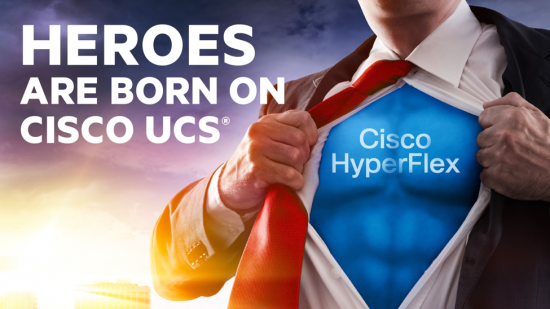
It is time for you to get into a Cisco Hyper-Flex state of mind. See how Hyperflex can help you reach your organization’s business goals. Heroes have one thing in common: They run their infrastructure on UCS.


The adoption of HCI is now a matter of all verticals using a variety of use cases and increasing demand in a desire to migrate more and more application to HCI platform. Learn more how to leverage Hyperflex:


Please do register for our webinar on Cisco/Citrix VDI solution

Visit HX web page

Visit our blog site for more reading


Authors

Alon Sela

Marketing Manager

Enterprise Solutions & Data Center for South Europe