Avatar

https://www.youtube.com/watch?v=8OamlaH8eNE

The big news in March for cloud was the AWS S3 outage that brought down some large pieces of the Internet with it. While the world didn’t end, it definetly caused issues and illustrated the need for a cloud strategy that accounts for vendor failure. But managing multiple clouds, accounts, and capabilities–that sounds too complex, doesn’t it?

Traditionally, you had only a couple of choices on how to manage hybrid cloud or multi-cloud service delivery, usually causing you to use multiple sets of orchestration and management tools that are technology or cloud specific. The better approach,though, is to choose a cloud management platform like Cisco CloudCenter to manage your hybrid estate. If you choose a “One Platform” approach, you get more value by using your CMP to manage as many workload types and technologies as possible.

That brings us to the Cisco CloudCenter 4.8 release, which will release at the end of April.

This release showcases some great work, building upon previous release themes. Before this release, admins had the ability to view existing VMs via the inventory report, but weren’t able to do anything with them. Additionally, we had a list of “Day 2” operations, but no way to extend that list in a meaningful way.

4.8 presents the second of our three-phase plan around brownfield and operations by offering new features that broaden the scope of workloads that can be managed by CloudCenter, and extend what users can do via self-service. These changes deliver on the promise of “Any Cloud, One Platform”, and offer an elegant solution for reigning in shadow IT while improving both user self-service capabilities and central IT control. New features include:

  • Brownfield Import VMs Import and manage previously deployed workloads along with new CloudCenter deployed workloads, in both data center and cloud.
  • VM or Application View Flip between VM view and application view, for those that prefer to manage workloads at the VM level.
  • Action Library Define and execute self-service post deployment management actions further enable self-service within guardrails and that reduce the need for IT help tickets.
  • New Cloud Type – Alibaba Cloud support, across all regions.
  • Native Language Support – Chinese, Japanese, and French.
  • Service Provider License Agreement (SPLA) – Offer to fit with the “fee for service” service providers.
  • Cisco Ecosystem Benefits – The combination of VM import and action library offers improved interaction with Cisco Tetration, UCS Director, and AppDynamics.

Watch the CloudCenter 4.8 video to learn more.

Below find details of these new features:

  • Brownfield Import VMs – Users can now import and manage previously deployed workloads alongside new CloudCenter deployments. When admins connect CloudCenter to a cloud or datacenter, they can discover and import pre-existing virtual machines and assign those discovered VMs to the appropriate owner, enabling further action and cost reporting.

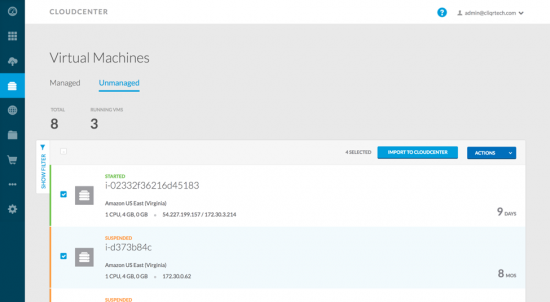
This feature increases the ROI on your decision to use a one platform approach to hybrid IT management. It allows both IT and users to work together to clean up after shadow IT. Application owners can still access and manage their workloads but can now also use a wide range self-service post deployment actions that previously needed separate tools, direct cloud access, or IT ticket requests.

  • VM or application view – Users can toggle between application list or VM view, and now manage at the VM level through CloudCenter. Admins are able to see all imported VMs including unassigned or already assigned to a specific user. Users will get simplified management of managed applications and VMs all from a single interface. This feature offers fine-grained view of virtual infrastructure for users that prefer to manage at the VM level.
  • Action Library CloudCenter’s full lifecycle management includes definable post deployment operations via an extensible library of actions. Users can apply these actions to either imported VMs or previously deployed applications, without logging an IT ticket, and without having to learn yet another tool. Actions are contextually aware so that they only display to the end user if they are appropriate for that cloud and state, simplifying IT management and making application owners more efficient without having to know cloud specific tools and API calls.

Users can scale up by adding or removing CPU, memory, and disk volumes. Or they can perform other tasks like back-up a database or install an agent. Or even vMotion or “lift and shift” via linked tools—all without the hassle of an IT help request. And users don’t need deep knowledge of cloud specific APIs or multiple environment specific management tools.

Admins easily define or modify actions in a central library. Post deployment actions can include common management tasks that leverage scripts, commands, environment specific API calls, or even API calls to other tools. Role based access control and context-driven policy rules guide who can use various types of actions in different deployment environments.  So, Admins can provide automation guardrails by controlling access and context on who, how, when, and where actions can be used.

  • New Cloud Type – CloudCenter has added support for Alibaba Cloud. Now users can deploy applications to 13 regions including China, Japan, Singapore, Australia, as well as Germany and three in the United States. Alibaba cloud is making inroads as a low-cost development environment. Cloud price wars are far from over. Which gives you more reason to maintain portability and leave your cloud options open.
  • Native Language support – CloudCenter has expanded local language support with language packs for Chinese, Japanese, and French. Language is automatically selected based on the user’s browser language. And language is applied to all features and walk thrus.
  • Service Provider License Agreement CloudCenter now has a service provider licensing option that is a better fit for “fee for service” environments. This option is limited to Cisco qualified service providers.
  • Cisco Ecosystem Benefits CloudCenter can now easily extend the value of other Cisco solutions. The combination of Brownfield import and action library delivers additional value to other IT operations tools. CloudCenter can now import VMs and deploy Tetration sensors and AppDynamics agents in both data center and cloud environments. Users can easily initiate Cisco UCS Director workflows to execute common infrastructure management tasks.

Watch the CloudCenter overview video.  To request a demo, contact your sales team.

Authors

Zack Kielich

Director

Solutions

Avatar

This blog is the first in a series of posts featuring perspectives from Cisco women in security. Next month’s blog will feature Chief Privacy Officer, Michelle Dennedy.

When I started my information security career at NASA’s Ames Research Center in 1988, there were very few women in the field. In fact, I’d attend conferences in which I was literally the only female participant.

Back then, I launched and managed the information security program for the Numerical Aerodynamic Simulation (NAS) Facility at Ames. I was greatly encouraged by the support I received at NASA Ames. Still, the lack of gender diversity within my chosen field was a double-edged sword. There would be days when I was motivated to get other women involved and then there were days when I was troubled by the lack of females interested.

Then it happened. In 2011, I was chairing a security architecture summit for the SANS Institute. During a break, I headed to the ladies room and – to my surprise and delight – a line of women attendees was there! This was a first – we acknowledged each other, and celebrated the moment with a “We’ve arrived!” sense of accomplishment. To this day, when I attend any technical event I look around the room and count the number of women – we are growing, but not fast enough.

While females hold one-half of professional occupations in the U.S. and one-quarter of computing-related jobs, they account for just 11 percent of the information security workforce, according to the Women’s Society of Cyberjutsu (WSC), a non-profit that helps and empowers women in cybersecurity. With more than 1 million global cybersecurity jobs unfilled, we can’t afford to let this opportunity slip away. We must do what it takes to make sure that women are well-represented as organizations fill these vacancies. Here’s how this can happen:

Reaching out. When I started my career, women in this field generally didn’t help each other. There was a competitive element in play, and it kept us from combining our knowledge and strengths to advance as professionals. But this mindset is changing. Recently, for example, I co-founded the Cisco Women in Cybersecurity Community, to ignite a passion for women who are new to the vocation. In our first year, we grew the community to more than 200 members. We need to keep up with efforts like these – especially in convincing millennial women to follow our path. We have to reach these women at a younger age, when they are in middle and high school to let them know what great opportunities exist in the field.

Building mentorship/sponsorship programs. At Cisco, our mentorship programs “fan the flames” by encouraging and guiding women. The impact of a positive mentorship experience can last for decades: In 1991, I began a mentoring relationship with Alan Paller, president and founder of SANS. He helped me grow and learn, and even allowed me to offer directional input for SANS in the early years.

Cisco’s sponsorship programs take the mentoring concept to a higher level by designating an executive to map out a professional development/advancement path for a future leader – and then help her make it happen. Organizations need to fully dedicate their efforts to mentorships and sponsorships, particularly those focused upon women in cybersecurity.

Networking and taking advantage of existing resources. If you work remotely or in an area in which your colleagues are all male, you may feel a bit isolated. But this doesn’t have to be the case. Resources exist outside of WSC, including:

When I talk to female cybersecurity professionals at industry conferences and gatherings, I often tell them to “Be bold!” Don’t be afraid to send that initial email to a company leader, go to a networking event or volunteer to be a speaker at a local school or college. The process of achieving the mission at hand – tackling the gender imbalance while elevating our leadership roles in cybersecurity – begins with us.

The most important advice I can offer women in the cybersecurity industry is, “Don’t give up!”


Michele Guel will be joined by fellow Cisco employees at the Women in Cybersecurity Conference (WiCys) taking place in Tucson, AZ, March 31-April 1. She is hosting a workshop titled, “Are your favorite mobile apps leaking your personal data?” The workshop will explore how common, widely used mobile apps collect and retain personally identifiable information and what can be done to uphold data privacy.

Additionally, Michelle Dennedy, Cisco’s V.P. & Chief Privacy Officer is keynoting WiCyS, sharing her personal career journey and the unique opportunities that exist for women in the cybersecurity industry.

Michele D. Guel is a Distinguished Engineer and Chief Security Architect with Cisco’s Security & Trust Organization. She is the recent winner of a 2016 Women of Vision ABIE Award from the Anita Borg Institute.

Authors

Michele D. Guel

Distinguished Engineer & Data Security and Privacy Strategist

Office of the CTO, Security Business Group

Avatar

Cisco Chat trendingWhat’s an API (Application Program Interface)?


What’s a CLI (Command Line Interface)?
Are APIs really poised to take over CLIs?

On Wednesday, March 22, @CiscoDevNet hosted a lively #CiscoChat to discuss these questions. Developers and engineers from all over the world joined the chat to talk about the advantages and disadvantages of APIs and CLIs, data models and how they relate to APIs, and what people entering developer and systems engineer careers need to be aware of.

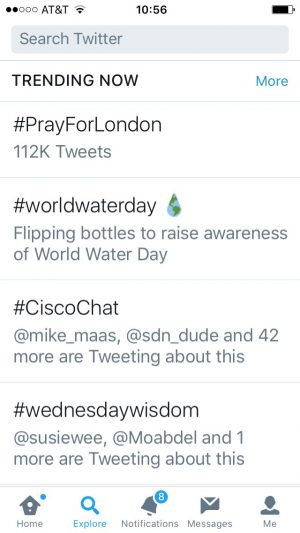
There was so much great engagement that by the end of the chat, #CiscoChat was a trending hashtag on Twitter (for specific regions), and the conversation still continues! Follow along with the highlights below, and catch the full recap on Storify here: storify.com/CiscoChat/ciscochat-have-apis-killed-the-cli


Question: What makes an API better than a CLI?

Cisco Chat Hank Preston API CLI


Cisco Chat CLI API


Cisco Chat Wendell Odom


Cisco Chat Cisco SE Manager


Cisco Chat Cisco SE


Cisco Chat dCloud and DevNet


Question: In a world of APIs, what skills should network engineers be learning?

Cisco Chat Systems Engineers Developer


Cisco Chat DevNet Developer


Cisco Chat conversation


Cisco Developer Looking for more great content around this topic? Check out VP of World-Wide Systems Engineering, Mike Koon’s, blog “Embrace Innovation where Applications meet Infrastructure” and follow him on Twitter for more insights, @KoonsCisco.

Don’t miss your opportunity to be part of the inaugural #DevNetCreate!
Find all the details @DevNetCreate and on blog.devnetcreate.io

Join us for the next DevNet #CiscoSE chat on the week of May 7th.

Thanks to all of you who participated in the chat! We look forward to seeing you next time.

Authors

Silvia Karina Spiva

No Longer at Cisco

Avatar

Recently I had the chance to see how smart technology, applied to vexing social problems, can help provide solutions and build a better world. Working with the American Bar Association’s Center for Innovation (ABA), we’re deeply engaged in an effort to create a better path for those who believe they’ve been victimized by a hate crime to find out whether a crime has been committed, what rights they have, and where to get help.

One of the reasons that after 20 years at Cisco I’m still excited to jump out of bed and start work every day is because we have a community and culture that is inclusive and protects and defends those who elsewhere in society may be marginalized or victimized. We’ve always emphasized the importance of celebrating difference and zero tolerance toward those who would undermine that culture. Those aspirations, while largely fulfilled in my company, are often more challenging in the society at large. Some subcultures even encourage words and actions that are designed to intimidate and spread fear, so that others are denied to chance to live in peace and freedom in our society.

For historical reasons, our legal community has built up a set of rules and practices that make it too hard for ordinary folks to vindicate their legal rights. Organizations as diverse as the FBI and UC Berkeley have done a great job at providing online information resources to help hate crimes victims learn what to do. The information tends to be specialized, however,or not directly actionable.

The ABA has seen that victims are frequently discouraged from taking action because of the multiple steps required. People are used to using clean, highly designed apps in their daily lives and the Center for Innovation’s working group sought to develop a clearly organized and user-friendly website application to determine if a hate crime had been committed, what resources are available and what next steps a victim could take with law enforcement and within the judicial system.

The ABA’s “design sprint” convened lawyers, scholars, designers, and coders for a daylong working session at Suffolk University in Boston, whose Dean, Andrew Perlman, leads the ABA Center for Innovation. The challenge was to develop a website application that gives those who think they have been victims of hate crimes the information and resources they need.

Cisco was a sponsor of the event and I was proud be there and witness first-hand the incredible challenges we can tackle by working together. At Cisco we’ve always believed in the power of the networking technology we invent and build to break down barriers to information. We strive to deploy that technology to empower the disempowered to build bridges.

We applaud the foresight of the ABA for establishing its Center for Innovation and tackling tough issues like this one.

Authors

Mark Chandler

Retired | Executive Vice President

Chief Legal and Compliance Officer

Avatar

Have you heard of Tim Crawford? If you’re an IT leader and you haven’t, you’re in for a treat today. Tim is an advisor to CIOs and enterprise organizations across a number of industries including financial services, healthcare, tech firms, and major airlines. He’s an internationally renowned thought leader in the areas of IT transformation, Cloud Computing, Data Analytics, and Internet of Things (IoT). Which is to say, he is wise. So wise that CIOs (or at least their companies) pay him handsomely for advice on how they can do their jobs more effectively.

And today you will get to hear some of that very valuable wisdom for free on Episode 02 of Cloud Unfiltered.

During this week’s interview with host Niki Acosta, Tim talks about:

  • The difference between Traditional and Transformational CIOs
  • Using culture to differentiate your company when dollars aren’t enough
  • What does and doesn’t concern him about ISP data sharing
  • What the “gooey center” is and why you’ve got to find it
  • How to figure out whether you should be targeting the CIO with your product pitch
  • The desperate need for most companies to update their cultures and processes

See the video podcast on our YouTube page, listen to the audio version on SoundCloud, or read the transcript if you prefer. And if you like what you hear, we invite you to subscribe to these respective channels so you don’t miss any of the exciting podcasts we have scheduled over the next several months. Enjoy!

Authors

Ali Amagasu

Marketing Communications Manager

Avatar


This post was guest-written by Dipak Basu, CEO of the Anudip Foundation, a social entrepreneur who has spent over 30 years employing technology in humanitarian missions worldwide.

Anudip Foundation is a nonprofit company working for the economic empowerment of at-risk youth. We believe the key to human progress and sustainability is skill development and financial stability.

Anudip operates in India, where half the country’s population of 1.25 billion people is under 25 years of age, and 68 percent of its population depends on agriculture. Unfortunately, cultivable land is limited in supply and can no longer support this population. As a result, high unemployment prevails, especially affecting educated rural youth, of whom 100 million are jobless or underemployed.

Meanwhile, according to NASSCOM, the information technology industry in India has created direct employment for 2.2 million people and indirect employment of 8 million people. By 2020, the figures are expected to rise to 10 million and 20 million respectively. Anudip is dedicated to capitalizing on this opportunity. We do so by enabling rural and semi-urban youth to develop skills for secure employment in the IT and internet services sector.

Since its inception in 2007, Anudip has trained over 60,000 youth at more than 150 training centers across India. This, combined with our relationships with 300+ employers, has resulted in a 75 percent job placement rate. Anudip’s beneficiary base includes high-need and marginalized communities such as ethnic and religious minorities, tribal populations, political refugees, and people with disabilities.

One of those beneficiaries is Kunal Bhattacharya. Kunal works at Wishnet in Kolkata, India as a Technical Support Officer. He earns INR₹8000 (US$120) per month and says his income has resulted in financial stability for him and his family. “Earlier, my family income was approximately 900 rupee (US$14) per month,” Kunal says. “At that time, my father, a small businessman, was the sole earning member. He had to work extremely hard, but made sure that I completed my schooling.”


Kunal wanted to help his father by contributing to the family income and was determined to get a job. Through friends, he learned about Anudip Foundation and its Digital Academy program, which provides technical training and job placement.

“The prospect of receiving high-level technical training as well as securing a stable job drew me toward the program,” Kunal says. “I worked hard during the training process, learned as much as I could and did well. I persevered during the placement process and this helped me prepare thoroughly for my job interviews. My hard work along with the continued support I received from Anudip staff was crucial in enabling me to secure my present position.”

Digital Jobs Transform Families and Communities

More than 45,000 students like Kunal have been placed in new economy jobs, helping to increase financial stability for their families. An average three-fold increase in family income on account of our intervention allows access to basic facilities such as health, nutrition, education, water, sanitation, housing, and energy. This empowerment improves the purchasing power of a family, its standard of living, and brings change in its social standing within the community.

Our work also has an indirect but noteworthy impact in the socio-economic development of the community. A growing percentage (now 45%) of women are taking part in our training programs to start up a business or work in jobs. They now have a voice in their own lives, leading to avoidance of early marriage and marriage for convenience, and can send their children and siblings to better schools.

India has the world’s largest population of people with disabilities, but no facilities for them. A large number of people with disabilities who have gone through our Specially-Abled Vocational Education (SAVE) program for digital employment credit Anudip with giving them “confidence” or “courage” to break out of a vicious cycle of intolerance and poverty and enter the workforce as respected citizens.

Growing with Minimal Spending

Anudip has embarked on a three-year strategic initiative, supported by Cisco, called Digital Inclusion of Young Aspirants, or DIYA, meaning “lamp” in Sanskrit. This effort is projected to increase our training capacity 8 times, to 100,000 students per year by 2020, with no more than 3 times growth in operational expenses. The DIYA initiative includes full digitization of curriculum with customized content, interactive multimedia and games, thus making it compelling for remote and rural students in a blended learning environment.

To support DIYA, we are developing a new student lifecycle management system with extensive analytics for improvement of services for a much larger student base. There will be enriched branding to attract more aspirants, as well as employers from India’s burgeoning e-commerce, logistics, retail, and mobile payments sectors so that the enhanced capacity is efficiently utilized.

Financially, the 8x/3x combination will significantly improve company sustainability so the need for institutional grants in 2020-21 will remain at today’s levels. A DIYA pilot is underway at 12 Anudip training centers.

If successful, DIYA can be a disruptive and breakthrough model for economic empowerment in the developing world.

Cisco and Anudip

Cisco has provided seed funding to support the DIYA program, which has resulted in the first versions of our digitized curricula, its supporting platform, and the training (now underway) of 300 students in 12 rural and semi-urban centers.

Cisco has also sponsored research for our 3D for Development (3D4D) program, which offers 3D printed prosthetics for poor amputees, as well as training in 3D modeling and business mentorship for rural entrepreneurs to create locally customized 3D-printed products. We believe 3D4D is the first initiative of its kind globally.

Cisco’s early sponsorship of 3D4D enabled us to trial designs of our prosthetic arms on patients and receive their feedback, which in turn allowed us to evolve the design for better usability. Cisco’s support moved the DIYA program from development to pilot stage to test the ability of rural youth to self-learn – a critical factor for growing our capacity and improving our sustainability. In 2017-18, learnings from the pilot will be incorporated in a full-scale rollout of DIYA.

Finally, Anudip Foundation is proud to participate in the Cisco Networking Academy program by offering courses that prepare people for Cisco CCNA and other certifications for over a year. Since we also have Person VUE testing centers, Anudip and non-Anudip students can appear for Cisco, Microsoft, Oracle, and other certifications at our premises.

Our support of Anudip is one example of how Cisco is harnessing the power of the digital revolution to accelerate global problem solving, enabling people and societies to thrive in the digital economy. Our goal is to positively impact 1 billion people by 2025.

Subscribe to the Cisco CSR blog for more stories about global problem solvers like Anudip!

Authors

Austin Belisle

No Longer with Cisco

Avatar

Small customer-care teams often have limited budgets and minimal IT support. Existing customer care solutions are typically too expensive and complex for their needs. Lacking IT’s attention and support, smaller teams often create their own “shadow” solutions by buying online.

But many digital care and chat solutions don’t measure up. If they don’t retain customer context, every interaction starts from scratch. And without integrated callback support, it’s even more difficult to provide a seamless customer journey.

Not only can buying direct online lead to disjointed customer experiences, but security compromises, too.

A Solution
Every day, more businesses are using Cisco Spark to create, share, and get work done together: anywhere, securely, and in the cloud. And today we’re announcing an exciting new offering that extends the value and capabilities of Cisco Spark for customer care.

Cisco Spark care is a digital customer care solution for help desks and small teams of up to about 20 users. Groups like these can use Cisco Spark care to support external or internal customers via web chat and callback.

Cost Effective, Simple, Secure
Cisco Spark care offers a cost-effective customer care solution that’s simple for users to implement. Your agents can view the context of the customer’s previous interactions, which lets them provide faster, more-focused service. And it’s all secure in the cloud, allowing you to easily adjust capacity and quickly take advantage of new capabilities.

Here are just a few of the key features and benefits of Cisco Spark care:

  • Chat: Let customers interact with your care teams via a chat area on your website. Cisco Spark care helps you generate the code needed to chat-enable your website, including customer satisfaction scoring.
  • Callback: Give your website visitors the ability to request a voice callback. And make it simple for agents to respond with a simple click of a button.
  • Desktop: Your care team gets a clean, simple workspace optimized for customer care, including views of incoming contacts, current contacts, and contact history.
  • Reports: View individual and team performance for your care team, including customer satisfaction scores and handling metrics.

It’s not a big production to enable Cisco Spark care within your existing Cisco Spark environment. You administer the capabilities in the same way as other Cisco Spark services. And once other necessary services are set up, it typically takes only about 15 minutes to configure Cisco Spark care.

Get more details about Cisco Spark care or view a demo.


Authors

Chris Botting

No Longer with Cisco

Avatar

In today’s episode, I cover a few of the day’s panel discussions and provide an overview of the latest Cisco product announcements.

There’s nothing like waking up with the alligators in Orlando. Actually, from the look of the little guys here at the Gaylord Palms, I was far more alert than they were as I wandered to my first sessions this morning. And that was without coffee.

Panel Discussions

I appreciate how Enterprise Connect manages panels. The analysts put a lot of energy into the session planning and moderation. Discussions are organized and panelists are prepared. There’s little chance of a hockey brawl breaking out on the podium. It’s just not that kind of conference. I caught three good sessions this morning.

The Essentials of Team Collaboration: Moderator Dave Michels started out by exploring the true meaning of team collaboration: “If team is two or more people working toward a goal and collaboration is two or more people working toward a goal, does that mean team collaboration is four or more people working toward a goal?” The math works for me.Javed Kahn, VP in the Cloud Collaboration Technology Group, talked about Cisco Spark, explaining “to create a seamless end-to-end experience, you have to create from the ground up vs. trying to adapt existing technologies and applications.” An audience member asked whether user experience causes problems for IT. Not all vendors consider IT teams as another user group. Cisco does.

Is Cloud Changing the Contact Center? Led by Sheila McGee-Smith, there was a natural focus on cloud vs. on-premises approaches. Not everyone agreed (surprise). Chris Botting, GM of the Cisco Customer Care group, brought the conversation around not to vendor opinions, but business needs. “You need to think about what you’re trying to accomplish with your business when you decide whether it’s cloud, public cloud, or on-prem.” He emphasized creating connected experiences that are contextual and continuous. Most important, he stressed that it’s not about the deployment model – it’s about providing the best customer care experience.

What Role (If Any) Should Cloud Communications Play in Your Enterprise? Conference co-chair Eric Krapf assembled a hefty panel of seven UC execs. (Apparently, the dress code specified blue-gray blazers.) My favorite quote, directly addressing the session title, came from Jens Meggers: “The cloud is just a really great tool – not to use the cloud would just be stupid.” He was careful to clarify that cloud is not the only answer. For example, “if you have a beautiful 100gig network, you want to use it for video.”

The more you hear from Jens, the more you get his focus on the experience. “Our goal is to make technology invisible,” Jens explained. “You don’t have to worry about how it works.” And not just for end users, but for IT. Digital transformation is real and happening in the workplace, and Jens feels that helping IT address it should be a vendor’s task. Cisco is focusing on great experiences for IT administrators, making tech secure in cloud, and ensuring it’s simple to manage. His example: The IT experience should be easy, just as “when you listen to music, you don’t worry about the type of MP compression.”

Did Someone Say New Products?

It wouldn’t be Enterprise Connect if we didn’t have new products to announce. Today’s announcements focus on further innovations to the Cisco Spark platform and providing more advanced capabilities for even better end-to-end experiences — for the user, IT, and the enterprise. If you want the whole enchilada, read the full press release. Here I’ll try to distill things:

Smarter Meeting RoomsCisco Spark Room Kit
Designed to work with Cisco Spark, the new Cisco Spark Room Kit Series helps bring Cisco Spark meeting experiences to small, medium, and large conference rooms. Two new products attach to standard HD screens to convert them into powerful video conferencing systems. Both are designed to connect natively with Cisco Spark but can also register on-premises. Check out Snorre Kjesbu’s “Making Every Meeting Room Smarter” for a closer look.

Enhanced Cisco Spark Content Security Options
We designed Cisco Spark with security and information protection as a priority, with end-to-end encryption for data in transit, at rest, and in use. Encryption and decryption are handled using dynamic keys from a Cisco Spark Key Management Server (KMS). This server creates, stores, authorizes, and provides access to the encryption keys that Cisco Spark applications use to encrypt and decrypt content locally. If you need additional information-protection options and controls, such as in regulated industries with specific security requirements, you can now have the ability to own and manage your encryption keys by installing Cisco Spark Key Management Server on-premises. This option will be available in early June.

Meetings from Any Device
All Cisco Spark spaces will have a persistent SIP URI, allowing people to join from any standards-based SIP hardware or software client, such as third-party softphones, Cisco video conferencing products, and even other video conferencing endpoints. We’ve also extended this capability to Cisco Spark Hybrid Media Services. You can place a Hybrid Media Node onto your network to provide local media processing for on-prem attendees of Cisco Spark meetings. This gives them the video quality they’d expect from an on-prem solution and saves on bandwidth costs. Another benefit: Transition to or try Cisco Spark meetings with your existing infrastructure, endpoints, and conferencing solutions.

New Customer Care Capabilities
Help desks and small teams can now provide customer care to both external and internal customers, using web chat and callback via Cisco Spark care. Designed for companies using or considering Cisco Spark, this option can help you give your customers faster, more focused service. With it, you have history and context from a customer’s previous interactions, a user workspace for agents, and integrated reporting with customer feedback. Cisco Spark care is an optional license on the Cisco Spark platform.
On Tap for Tuesday
Jens Meggers delivers the Cisco keynote at 10:00a ET. If you’re not here, watch live on Cisco.com or catch the replay.
Keep watching @CiscoCollab on Twitter for conference highlights.

More Tuesday Things

  • 7:00a ET: If you don’t consider “fun run” an oxymoron, meet kindred spirits at the hotel entrance area for a 5K – that’s distance, not the 5K video quality of the Cisco Spark Kit.
  • 11:30a – 6:00p ET: Visit us in booth #1806 to check out the latest products and get fingerprints on a Cisco Spark Board
  • All day and beyond: If @CiscoCollab highlights aren’t enough, follow me at @ciscokima for a lot of live tweeting and maybe a bit of humor – or valiant attempts. 

P.S. A few panelists could use a quick refresher in Slideware 101. Hint: If you have a slide with a higher word count than this blog post, you may be in trouble.

Authors

Kim Austin

No Longer with Cisco

Avatar

Catena is a multi-terabit service chaining, security, load-balancing, analytics and L4-L7 applications integration solution. Eg, Catena can perform these operations at 40 Tbps.

Have you ever found yourself entangled in deploying multiple applications, L4-L7 services, network devices, VMs and Containers? Add multiple departments/tenants sharing those resources, and you have a nightmare! We have solved these and many more use-cases with our latest innovation, Catena.

The solution works with all L4-L7 virtual and physical devices, such as, Firewalls, IPS, IDS, WAAS, DDoS protection, load-balancers, SSL offload engines, network monitoring, etc.

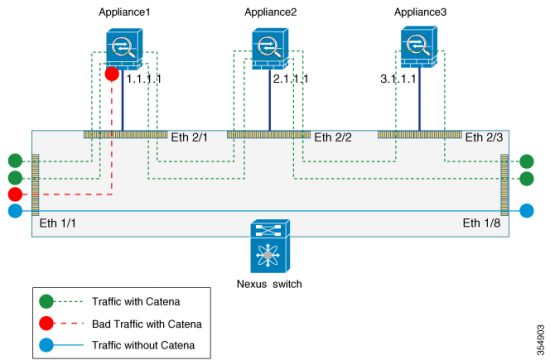
With our patent pending algorithms, Catena allows user to create multiple chains with multiple elements in each chain. User can configure security policies to configure which traffic goes through which chain. An element, could be a cluster of devices, in which case Catena load-balances to the cluster. Catena performs health monitoring and failure handling of devices. Catena performs sophisticated analytics.

The solution is natively embedded into the switch/router, i.e., the user doesn’t have to buy any service module or external hardware.

Currently, Cisco Nexus series of switches natively has Catena. Eg, Nexus 7000, 7700 (already shipped),  9000 (Q2, CY 2017) series of switches.

Here are some key points:

  • There is no solution today which can do all of these: security, service chaining, load-balancing, analytics, L4-L7 integration, orchestration.
  • Significant performance improvement: Today’s solutions only solve a small part of the problem, and even then they work at most at 400Gbps. Catena can scale to 40 Tbps.
  • Scale improvement: Catena can create a large number of chains, with multiple elements (eg VNFs) in each chain.
  • CAPEX savings: Today, partial solution costs around $20K for 100Gbps solution, Catena works at 40 Tbps for a fraction of that price.
  • OPEX savings: Today, the user has to do VLAN stitching or create default gateways, which is very hard to deploy and hard to add/remove devices.
  • With today’s solution, either all the traffic is in a chain or not in a chain. Catena allows securely partitioning the traffic through multiple chains.
  • Today’s solution, does not allow user to create multiple chains using the same network elements. Catena allows that.
  • High availability improvement.

Catena allows the user to create, orchestrate and scale an elastic network. It could be a data center, service provider or enterprise network.

A number of customers are deploying Catena.

Here are some of the links:

Catena configuration guide 

Catena command reference guide

NetworkWorld lists Catena as Product of the Week.

For more information and slide deck, please email nxos-catena@cisco.com


Authors

Samar Sharma

Intelligent Traffic Director for Nexus 9k/7k/6k/5k