Avatar

“58% of business leaders are investing in either new digital products, services and digital channels to reach new customers in new ways.” – Boston Retail Partners

Most of us know that change in any aspect of our lives can be daunting and takes time. However, we also know that change is not only constant, but necessary, especially when everything around us is transforming due to advancements in technology. Rather than waiting to make necessary transitions because the market is moving (with or without you) to meet the demands of modern consumers, it is time to find new ways to assess your current business model and take advantage of the endless opportunities that rise from digital transformation.

According to Cisco’s recent research, $506 billion digital value at stake exists globally in the retail industry, yet retailers have only realized 15 percent of its potential. Today’s digital consumers are using mobile technology in their everyday lives, from watching their favorite shows, to sending payments, to checking their home security system or bank accounts on their laptops or tablets. In today’s digital age, we don’t need to be in a specific location to find information we need or get things done. This is the beauty of living in the digital age: Everything is at our finger tips.

When it comes to the retail space, digital consumers are also using multiple channels to shop for their latest gadgets, groceries, or apparel. Not only that, they use their mobile devices to do research about items they are interested in purchasing before coming to your store, whether they are looking up reviews, price information, in-store inventory, they have the ability to do this anytime, anywhere.

According to a report from InReality, 75 percent of store shoppers use their mobile devices while shopping at stores, and 25 percent make a purchase on their mobile device while in-store. In fact, an increasingly common model is that shoppers buy online, but do so at a store with a local presence that allows them to make exchanges or manage returns. This means that retailers have the opportunity to engage with shoppers in new ways by capturing and using real-time data about their customers. Knowing who is walking in your store helps deliver a more personalized customer experience. With customers demanding digital experiences, digitizing your business becomes no longer an option, it’s a survival imperative.

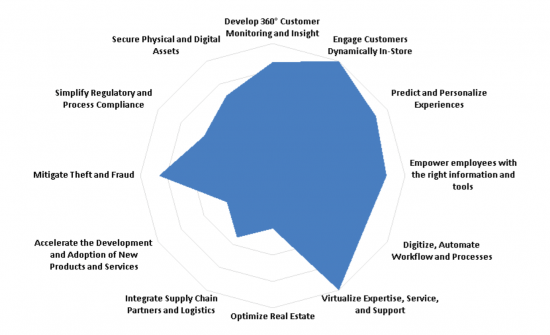
But how do you get started? Cisco helps you to identify how to get started and where you are on your digital journey with a Digital Transformation Readiness Assessment. This powerful tool analyzes your current state of preparedness and provides deeper insight into each of the four key industry imperatives and each of twelve digital capabilities:

Retail imperative #1: Deliver a differentiated customer experience through:

  • 360° customer monitoring and insight
  • Engaging customers dynamically in-store
  • Predicting and personalizing experiences

Retail imperative #2: Improve associate productivity by:

  • Empowering employees with the right information and tools
  • Digitizing and automating workflow and processes
  • Virtualizing expertise, service, and support

Retail imperative #3: Optimize business operations by:

  • Optimizing real estate
  • Integrating supply chain partners and logistics
  • Accelerating the development and adoption of new products & services

Retail imperative #4: Secure operations and manage risk by:

  • Mitigating theft and fraud
  • Simplifying regulatory & process compliance
  • Securing physical and digital assets

Becoming a digital business is not easy. You need a unified strategy across all aspects of your company and channels in order to be successful. Take the Digital Transformation Readiness Assessment today, and find out where you are on your journey to becoming a digital business.


Authors

Brian McDonald

Global Retail & Hospitality Industries Marketing Lead

Private Sector Industry Marketing

Avatar

Today we have a Team of Guest Bloggers that are here to provide some insights into the working environment. Peter Scott and JT Ripton wrote this piece for us. We hope you enjoy the article.

Steps to the Ideal Working Environment

When it comes to employee engagement, there are many factors at play. But one of the most critical is a positive working environment, one that makes employees feel good about coming to work and motivates them through long days and difficult projects.

Unfortunately, companies cannot simply order a positive working environment like they would printer ink. It’s a complex and home-grown concept, and getting it right means putting together hundreds of elements to build a work environment that makes workers feel happy and secure.

The Elements of a Positive Work Environment

While details will vary, the important features of a work environment include relationships between coworkers, relationships between employees and managers, organizational culture, physical office space, easy communications and opportunities for personal development. A positive environment brings enormous benefits: employee retention and the valuable intellectual capital that comes with it, good customer relationships, increased profits and the pick of the brightest new talent.

While there is no one single model for an ideal work environment, there are common factors at its foundation.

Open communications. When secrets are kept behind closed doors, suspicions grow, rumors circulate and employee resentment builds. Managers should have an open-door policy with employees, and consider skipping the anxiety-causing once-a-year performance review in favor of more regular and constructive coaching sessions. Feedback will always be more effective when it’s received in a timely way.

Digital collaboration tools such as messaging can also help encourage regular communications and updates. Companies should be unified and open about the organization’s philosophy and mission, and outline them regularly.

Soften the “top-down” hierarchy. Employees who feel that their opinions are valued and heard will be more engaged, more productive and more passionate. When companies are structured like a dictatorship in which orders come down but suggestions and ideas never go up, employees will feel like cogs in a great, dispassionate machine.

A work-life balance. Employees who are expected to sprint every day will burn out quickly. Everyone needs downtime to recharge, so ensure that your organization is flexible with personal time off. Provide workers with the ability to work from home occasionally, and consider offering alternatives to the traditional 9:00 to 5:00 workday for people who do their best work early in the morning or later in the day.

Development opportunities. When workers understand that their own success and advancement is closely tied to the success of their employer, they will be more engaged with their work. Provide all employees with personal development goals and mentoring – and consider letting them determine some of their own goals — and be transparent about opportunities for advancement. Workers who don’t grow themselves can’t help a company grow when the opportunity arises. Be sure to emphasize both hard skills such as new software solutions, and soft skills such as leadership, teamwork and collaboration.

Encourage teamwork. While healthy competition can be a good thing, unchecked competition can quickly rise to toxic levels. Encourage collaboration by implementing team-bonding activities that allow groups of workers to focus on the positive sides of each member and eliminate the negative ones. To avoid the “group think” that can creep in when teamwork is too strong, however, build a “devil’s advocate” process into each team project by asking groups to list the cons as well as the pros.

Build a diverse workforce. While managers often joke that they’d like to clone their best workers, this wouldn’t necessarily be a good thing. If all employees were the same, creativity and perspective would suffer. Research by Harvard Business Review found that companies that seek out two-dimensional diversity – not only demographics such as race, age and gender but also diversity of skills and experience — are 45 percent likelier to report growth in market share and 70 percent likelier to report that the firm captured a new market.

Praise and recognition. While all organizations should provide regular coaching with managers, it’s important to call out good behavior across the entire organization. Recognizing employee contributions is one of the most effective low-cost ways of building a better work environment. A Gallup study found that only one in three workers strongly agrees that they receive sufficient recognition.

Implement a “wall of fame” in which you recognize a specific employee once a month, or plan occasional in-office social events during which you recognize stand-out workers. Consider offering non-cash rewards such as restaurant gift certificates, company merchandise or perks such first choice of a popular day off. When a good job is appropriately rewarded and recognized, employees will feel valued for their efforts and go the extra mile when the next opportunity arises.

Promote good health. Healthy workers are happy workers, and overly sedentary jobs take a toll on employees. Work-life balance Web site Café Quill recommends that employers find ways to help workers get moving more in the office. Employees should take frequent walks, use the stairs instead of the elevator, and park at the back of the lot. Standing desks are helpful, as are exercise balls. There are also exercises that can be done at the desk, from leg lifts to arm stretches, that will help promote physical wellness.

Happy, engaged employees are worth their weight in gold to any organization. When workers feel their employer has their back, they’re far more likely to invest emotionally in the company to help it succeed.

BIO: Peter Scott is a journalist and editor who has been covering business, technology and lifestyle trends for more than 20 years. You can contact him at PeterEditorial@gmail.com. And JT Ripton is a freelance business and technology writer out of Tampa. He loves to write to inform, educate and provoke minds. Follow him on twitter @JTRipton

Thank you JT and Peter!

From our Team to yours, have a great week. Make sure to keep tabs on us as we always are working on things!

Marc and the Cisco Business Team

Authors

Marc Nagao

Product Manager

Small Business RV Series Routers

Avatar


Splunk is one of our key Cisco UCS ISV Partners in the area of data and analytics for the Data Center.  Big Data as we all know throws off tons of structured and unstructured data and the ability to discover its meaning and therefore value requires good analytics capabilities. This is where Splunk comes into play with Cisco UCS.

Our C Series and S Series Cisco UCS offerings when combined with our Cisco UCS Big Data and Analytics Integrated Infrastructure CVDs deliver awesome data platforms for Splunk – we’re fast; we scale; we’re easy to manage; we save you Op Ex and Cap Ex budget; and we improve your Data Scientist’s productivity.  Splunk, as a recognized and multiple winner in the IT Operations Analytics (ITOA) segment according to Gartner, provides the analytics engine. Together we’re a pretty awesome team.

Continue reading “Cisco UCS Spelunking. Exploring Cisco’s Splunk Community and Other News Bits”

Authors

Rex Backman

Senior Marketing Manager, Big Data Solutions

Data Center and Cloud

Avatar

Most people don’t give much thought to what happens when you connect to your bank’s website or log in to your email account. For most people, securely connecting to a website seems as simple as checking to make sure the little padlock in the address bar is present. However, in the background there are many different steps that are taken to ensure you are safely and securely connecting to the websites that claim they are who they are. This process includes certificate validation, or making sure that the servers that users are connecting to present “identification” showing they are legitimate. This helps to protect users from fraudulent servers that might otherwise steal sensitive information.

Due to the sensitive nature of this process, software vulnerabilities that adversely impact the security of certificate validation could have major consequences. Unfortunately, digital systems are complex and bugs are an inevitable reality in software development. Identifying vulnerabilities and responsibly disclosing them improves the security of the internet by eliminating potential attack vectors. Talos is committed to improving the overall security of the internet and today we are disclosing TALOS-2017-0296 (CVE-2017-2485), a remote code execution vulnerability in the X.509 certificate validation functionality of Apple macOS and iOS. This vulnerability has been responsibly disclosed to Apple and software updates have been released that address this issue for both macOS and iOS.

Read more »

Authors

Talos Group

Talos Security Intelligence & Research Group

Avatar

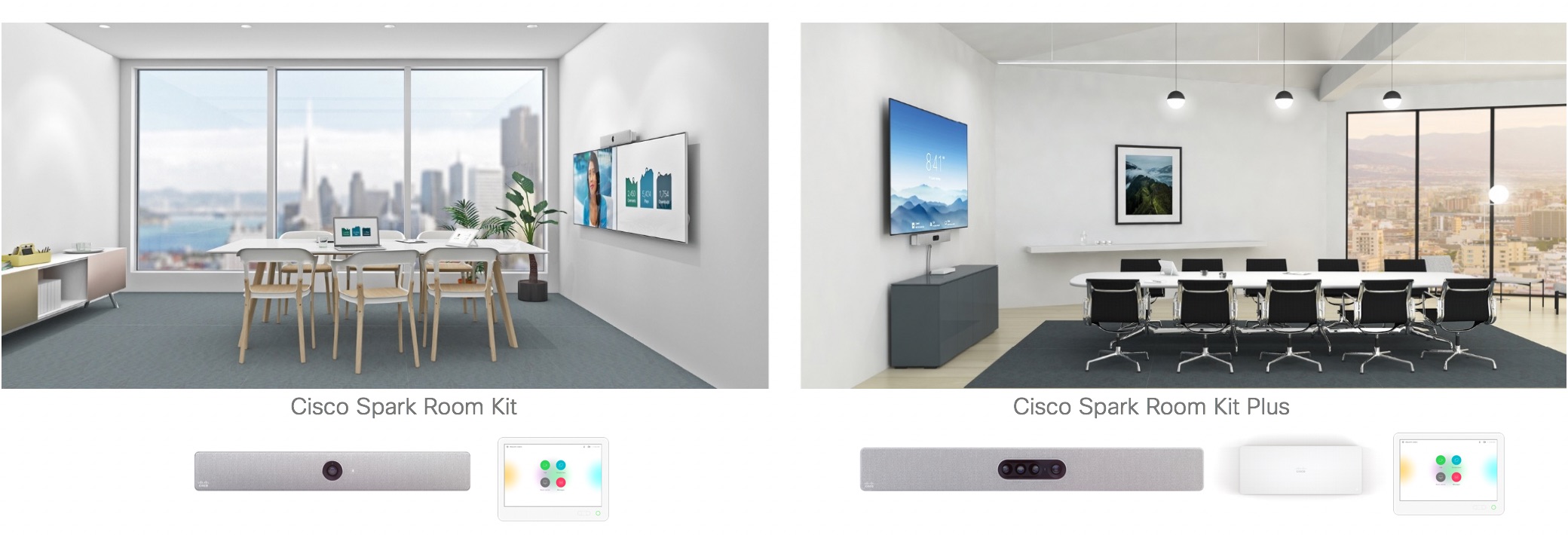
The magic that started with Cisco Spark Board continues. The Cisco Spark Room Kit and Cisco Spark Room Kit Plus are the newest additions to the Cisco Spark portfolio, which aims to revolutionize the meeting room.

We’ve packed innovations into each of the Room Kit options. All you need to do is to add a video display or two. The kits use automation and intelligence to remove the frustration and delays you’ve experienced with many meeting room technologies.

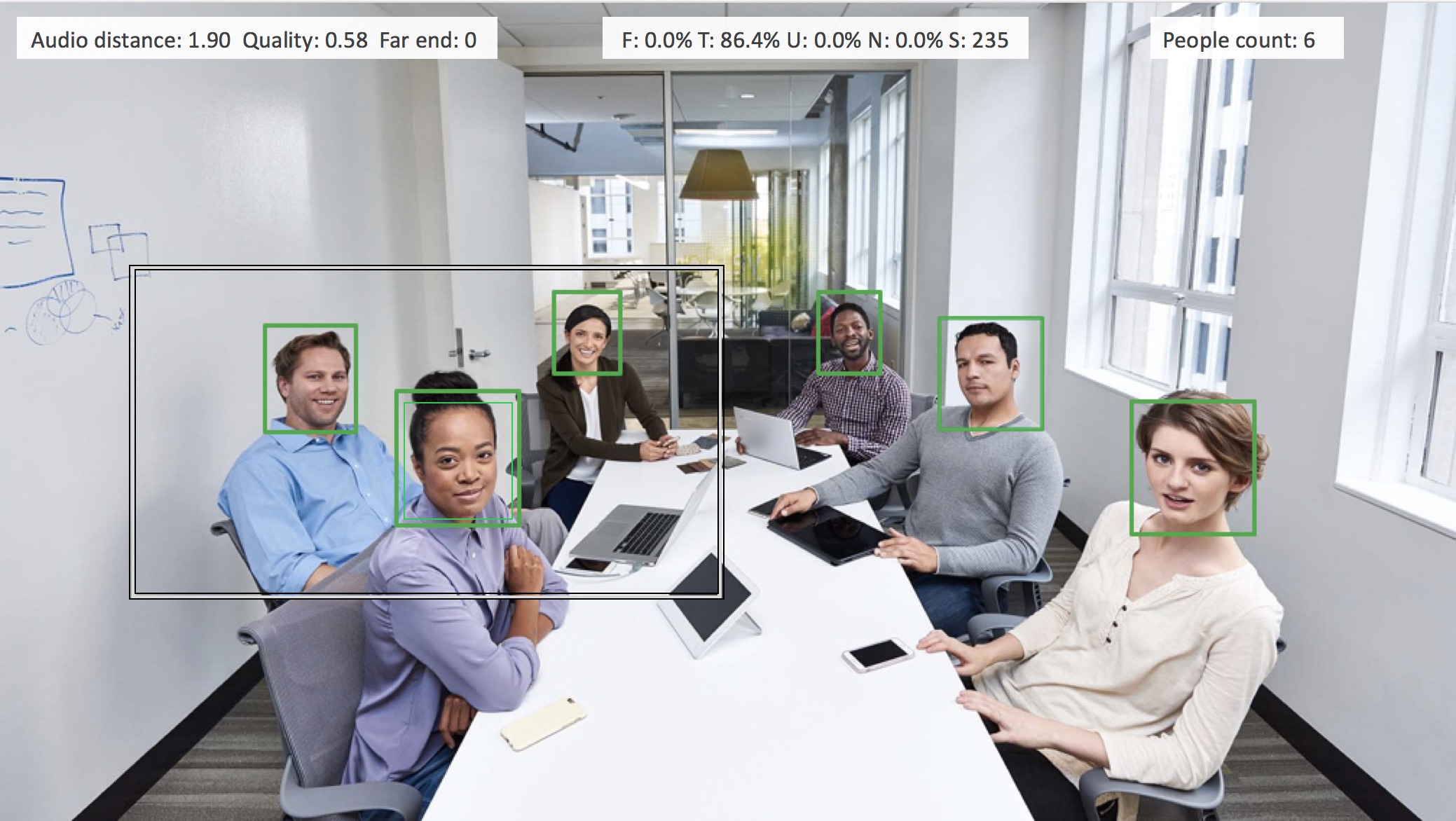
Both Room Kit and Room Kit Plus are available for on-premises deployment with a set of next-generation features, such as counting the people in the room. When rolled out with Cisco Spark, the kits deliver a full host of next-level experiences enabled by the cloud. Buy now for an on-prem or hybrid environment and be assured you’ll have the additional benefits of Cisco Spark when they are ready.

Smarter Meeting Rooms
Connecting people is about more than seeing each other; it’s about getting more done – quickly. With Cisco Spark Room Kits, meetings can start on time and flow uninterrupted.

  • Smart start-up with auto wake-up and automatic pairing with a personal device
  • Smart presenting with wireless 4k sharing
  • Smart platform with APIs for third-party developers
  • Smart integration for simpler interaction and connection to third-party devices

This is the Future
I’m particularly excited about three innovations that show where artificial intelligence can take collaboration.

  • Intelligent framing: We’re pushing the boundaries with a smart and effortless experience. It’s like having a TV camera operator in the room. We have had speaker tracking in our high-end systems – and now Cisco Spark Room Kits have it, too. The feature automatically detects who in the room is speaking and selects the best camera framing for that person. “Best overview intelligence” detects all people in the room and selects the best group framing when no one is speaking. If a large room has only two people, the camera intelligently frames those people.
  • Analytics in diagnostic mode: Artificial intelligence can be pragmatically applied for resource planning. The Room Kits have a high-performing face-detection module that tracks where people are and the angle they’re facing. The system pinpoints the speaker through audio triangulation using the six embedded microphones. The system also counts the number of people in the room. You can send all this data to a management system for customized applications.
  • Voice and face recognition: This is still in beta, but you’ll soon be able to place calls via voice commands and the system will recognize attendee faces and label them with their names. These pre-production capabilities present groundbreaking opportunities for both automated calling and content delivery based on a meeting’s participants.

Cisco Spark + Cloud = Advantages
The Cisco Spark Room Kits in our office are registered to the cloud, which means I can take my meeting with me — moving it from my mobile phone to the meeting room. When I walk into any room that has a registered Room Kit, it recognizes and greets me with a message on the screen. Registering to Cisco Spark enables a seamless workflow before, during, and after the meeting. That’s because the Room Kit is an extension of the online Cisco Spark space. People in the room can also initiate a call or share a file from a Cisco Spark space on a personal device.

The advantages also extend to IT. The Room Kits provide end-to-end encryption and are easily provisioned and managed with alerts and metrics. The kits join the large portfolio of Cisco Spark-ready endpoints, including the cloud-optimized Cisco Spark Board 70 and 55.

Raising the Bar on Quality and Choice
And by the way, the Room Kit options both have great audio and video. The built-in microphones capture voice and perform speaker tracking. We’ve optimized the speakers for voice, lip sync, and echo cancellation. And, for the most advanced camera capabilities, we feature a 5K UltraHD camera.

You can deploy Cisco Spark Room Kit in a small-to-medium-sized room, and Cisco Spark Room Kit Plus in a large room. Both options support one or two displays. I think you’ll want dual displays when you see how beautiful the white board looks when dialing into a Cisco Spark Board. Imagine the experience: You see the white-board content in stunning 4k resolution on one screen, connect with people in 4k on the other, and interact with the white board on your laptop or tablet.

The Room Kits work with your current display, or use an LG display to optimize the experience. This LG optimization is an initiative with vendors to ensure that you get the highest quality experience beyond our own technology.

We’ve unpacked quite a lot here. The most important take away is that the Cisco Spark Room Kit and Room Kit Plus deliver high-quality, next-gen meeting experiences to every room.

Learn more about Cisco Spark Kit and Cisco Spark Kit Plus.


Authors

Snorre Kjesbu

Senior Vice President/General Manager of Webex Devices

Meeting Room Systems

Avatar

We live in a mobile-oriented era. Between our work lives and our lives as consumers, we are connected to the internet constantly. For businesses ranging from large enterprise all the way down to the SMB level, this means more devices, more applications, and higher bandwidth demands. As companies seek to support their users in this era of mobility, they are looking for cutting-edge wireless networks that are easy to manage and deploy, don’t take up a lot of space, and won’t break the bank.

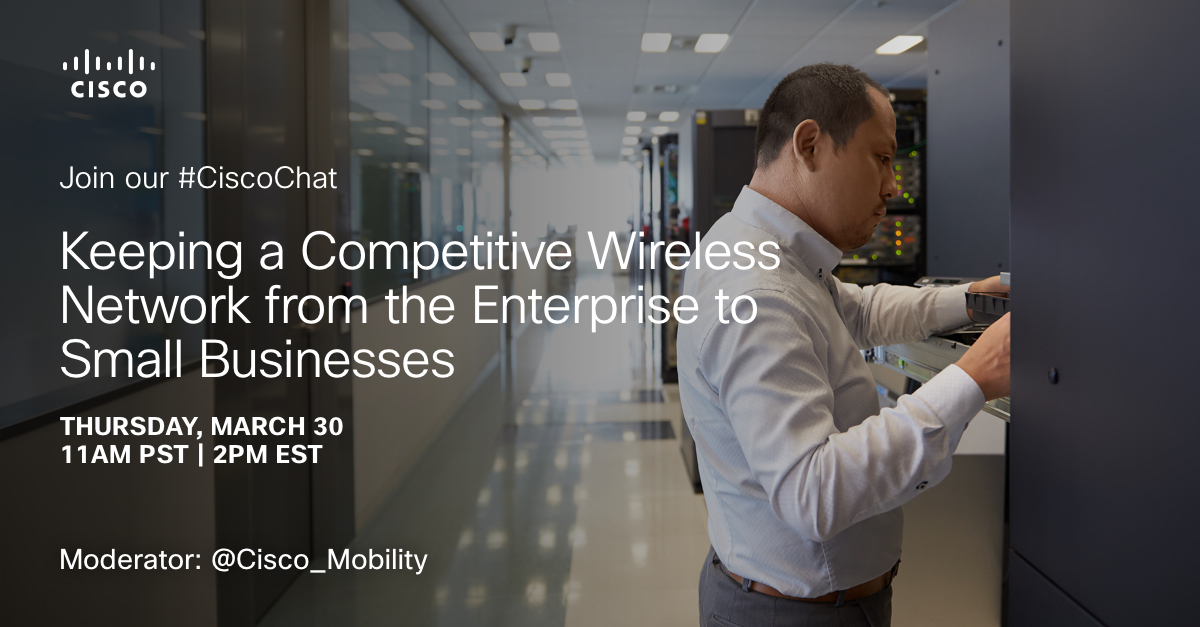
In our upcoming #CiscoChat on March 30, we’ll discuss the wireless networking challenges small and medium-sized businesses are facing today. How should SMBs adapt to address these challenges? What are the use cases for SMBs who’ve found wireless networking success? During the chat, we’ll be joined by @ConnectionIT. Join us at 11am PT (2pm ET) on March 30 to share what you know, ask questions, and be a part of the conversation.


To participate in the chat:

  • Make sure you’re logged into your Twitter account.
  • Search for the #CiscoChat hashtag and click on the Live tab.
  • The chat will be moderated the Cisco Mobility channel (@Cisco_Mobility) on Twitter. Be sure to follow the account to participate. They will begin welcoming guests at 11am PT (2pm ET) and posting questions for discussion.
  • For @ replies to specific participants in the discussion, please use a “.” at the beginning of the tweet, so that your question or comment will appear in your public twitter feed.
  • If you need multiple tweets to answer a question, please preface each tweet with “1A, 2A,” etc., to make it easier for others to follow along with the conversation.
  • Be sure to use the #CiscoChat hashtag at the end of each tweet, so that others can find your contributions to the discussion.

Bring your own questions to the discussion as well! See you there!


Authors

Byron Magrane

Product Manager, Marketing

Avatar

How to take your Incident Response plan to the next level

Practice does everything’ Periander (Often misquoted as ‘Practice makes perfect’)

You’ve gone through the work of creating an incident response (IR) plan, created some runbooks to deal with likely, known threats, and you’re feeling a lot better about the ability of your organization’s ability to detect a cyber incident in your network. But how do you know it works? How can you be sure the teams and individuals named in the plan know their roles and responsibilities, who to report to, or even where the IR documents are stored?

Think about when you learned to drive. First you had to study the rules of the road, and take a test to prove you understood them. Even with this knowledge, getting behind the wheel of a car on your own and driving would have been foolhardy. Actually, driving the car takes practice, usually with an instructor or parent to guide you during the process, and until you receive your license.

So, similar to how driving without the proper training can have drastic consequences, trying out your IR plan for the first time during an active incident can increase time to containment and remediation. Lack of knowledge regarding chain of command, roles and responsibilities, service levels, compliance and legal obligations, and communication plans can cause chaos during the response activities, and result in greater damage to systems or data, or larger financial or reputational repercussions.

How best to put rubber to the road then, and test your IR plan? The most common way is to hold a tabletop exercise (TTX).  This activity involves planning a session where a scenario is presented to the IR team as a paper exercise around a meeting room table; although the “paper” is generally a PowerPoint slide deck. Does anyone use actual paper anymore?  The make-up of your IR team will vary based on your organization, but generally will include representatives from the IR or Security Operations team, one or more members of each operational technology teams (Server, Network, Desktop, Database, Applications), and possibly some representatives from HR, Legal, Corporate Communications and Corporate Security.

A facilitator should be present to moderate the session, introduce the scenario, and add some complications or details as the session progresses.  The facilitator will also lead the discussion and guide the team as they work through the possible incident from identification to remediation according to the IR plan. The session is closed with a “Lessons Learned” activity where participants are asked to discuss how well the steps of the IR plan performed during the run-through, and where the plan needs to be improved or modified to ensure a more successful outcome on the next trial or an actual incident. In addition, the attendees are asked to evaluate, without blame or judgement, how the team performed, and suggest where additional training or practice are required.

A paper TTX can be planned for a variety of audiences as well; from the C-level focusing on higher-level policies, decision-making and compliance topics, to business units targeting business continuity processes in the face of an outage, and of course, technical teams to practice specific runbooks or stages of IR.  Exercises can target specific compliance topics including PCI or HITRUST-related incidents, or familiarize an organization with common threats such as ransomware or DDOS attacks.

Once your organization is comfortable with the IR plan by completing one or more TTX, the way to up the ante a little is to move away from just paper, and introduce a level of simulated attack to your exercise. This can be as simple as deploying a simulated phishing email or social engineering calls targeting a specific group of users or randomly at the entire organization, or involve a full-scale attack on your network by a trusted “red” team while your “blue” team defends.

A red team is made up of trusted internal or third-party attackers who engage in a live attack on your network; usually based on pre-agreed targets or methodology. A blue team is made up of internal and possibly trusted third-party network defenders, incident responders, forensic and malware analysts who actively defend your network against intruders, both real and simulated.

This type of exercise not only tests your IR plan, but also the ability of your organization to actually detect and respond to real security events, determine if chains of those events constitute ongoing malicious activity, and work to contain and eradicate the active threats.

Lastly, the simulated attack can be elevated in complexity again by conducting a blind exercise. In this type, the attack is still performed by a trusted red team, but knowledge of the attack is limited to very few personnel in your organization. This allows the reaction or non-reaction to the red team’s actions to be a true test of your IR team’s ability to detect and respond.  While this can be very effective in identifying opportunities for improvement in your organization’s IR plan and general security posture, it can also be demoralizing if the attack is very successful. Therefore, it is highly recommended that this type of exercise only be attempted against a more sophisticated blue team that has gone through a number of paper TTX, smaller “known” simulated attack exercises, and perhaps even a few penetration tests. This allows the gaps identified in previous Lessons Learned sessions to have been remediated and the team to have learned over time.

Like any other policy or procedure in your document library, an IR plan is a living document and requires constant upgrades and modifications based on the changes in your environment over time, and the growth and maturity level of your security program. Practicing and training your plan on a regular basis using paper and simulated exercises is the best way to ensure it remains effective.

The old saying goes, “Practice makes perfect”. While it is doubtful that responding to a cyber incident in your organization will ever go perfectly, don’t let the first time you test your IR plan to be the day you need it to succeed the most.

The Cisco Security Incident Response Services team are not only available to help and guide your organization during an incident response, but also to proactively assist with planning and conducting a tabletop or simulated exercise.

Authors

Shelly Giesbrecht

Senior Incident Responder

Security Incident Response Services

Avatar

There is no need to reinvent the wheel. We’ve listened to customers who have used E-rate funding to create rich learning environments, and we’d like to share some of their best practices with you:

You’ve got to have the bandwidth

Antonio Romayer, Director of Technology at El Centro Elementary School District in California, knows the importance of providing sufficient bandwidth in a modern learning environment. “I was adamant about not putting the cart before the horse,” he said. “We had some devices already…. But for the most part, our wireless infrastructure wasn’t as stable or as scalable as it needed to be.”

The district was able to leverage E-rate funding to increase their network capacity to support digital instruction for all students, and now has some of the highest performing schools in their county.

Assess needs, prioritize, then build a plan

“What are you looking to accomplish with your system? Are you looking to stream video in every classroom or support a full 1:1 initiative with digital curriculum? Decide what you want to do first, then build your plan around that,” says Scott Miller, Director of Technology and Information Systems at Wayne Highlands School District.

The district’s goals included moving to a flipped classroom model and creating a 1:1, collaborative learning environment. Shortly after the E-rate program was modernized, they were able to leverage E-rate Category Two funding for a new, comprehensive wireless environment, which is also much simpler to manage. Now the district’s IT team is able to focus more time on new learning applications and less on fixing network issues.

Find the money

A funding strategy may be the most important part of a successful digital learning plan and implementation. E-rate will only fund certain technologies, plus as a discount program, it requires schools to put in matching funds for projects. See our recent blog on other funding sources to consider. Additionally, Cisco offers a range of programs that can help increase schools’ return on technology investment. In many cases, these special offers align with E-rate—though schools do not need to use E-rate funds to benefit from these programs.

Get familiar with E-rate

USAC recently shared their Top Ten Filing Window Tips and they have two E-rate program overview webinars coming up on April 5th and 6th for new applicants or anyone who needs a refresher on the program.

Be on the lookout for more blog posts in the coming weeks that highlight some of the great things our Cisco customers have been able to do with their E-rate funding.

Authors

Stacey Arthur

Public Funding Advisor

U.S. Public Funding Office

Avatar

Who’s excited to see the winners of the second annual #WeAreCisco #LoveWhereYouWork employee photo contest?

(Me! ✋ Me! ✋ Me! ✋ )

There were 1300 entries. We know. We counted. (Many times.) There were 1100 entries from Twitter and Instagram, and several hundred entered in the Cisco Jive community.

Entries came from all over the world – from Shanghai to Sydney, from Bangalore to Bedfont Lakes in the UK, from South Africa to San Jose, CA. And they were AMAZING. ASTOUNDING. Wow, Cisconians know how to show off what makes working here great.

If we included every single photo, this blog post would scroll for days, so we’ll just highlight a few of the entries, and direct you to see the full list of winners!

And if you want to see how awesome ALL of the entries were, and understand how incredibly difficult it was to choose, you can see all of the entries here and here.

Power of Teams Category

LoveWhereYouWork entry

Photography Skills Category

LoveWhereYouWork entry

Best Scenery or Backdrop

LoveWhereYouWork

Best Executive Representation

LoveWhereYouWork Entry

Best In Show

LoveWhereYouWork Entry

Who’s image is this? And who won in the other categories? You’ll have to see the full list of winners to find out!

Water BottleFirst place prizes are an exclusive WeAreCisco t-shirt and water bottle, and runners up get a gift card to the Cisco Store to get some awesome Cisco gear. Last year’s prizes were so coveted that this year, thanks to a partnership with the Cisco Store, you can go find a version for your very own, check it out!


Do you want to love where YOU work? Go to the Careers site for Cisco to get started!


Authors

Carmen Shirkey Collins

Social Media Manager

Talent Brand and Enablement Team, HR