Avatar

I always admired creative minds who have the insight to change the game based on data, intuition and strong conviction.  This is almost expected in technology and entertainment fields.  But not in manufacturing.  However, there is no shortage of data coming from machines in a modern factory.  But being able to analyze and act on the massive data streams from hundreds of factory-floor machines is the big challenge. The right data at the right time will drive big efficiencies and open up new capabilities in manufacturing.  It will speed up new product introduction, help with real-time optimization, increase worker productivity, and give customers the ability to track a product from start to finish across the supply chain. This new model for manufacturing is called the digital factory, made possible by quickly transforming data into insights and act upon them.
In recent months, I have met many of our manufacturing customers, including Campofrio Food Group, to discuss how they view the manufacturing plant of the future.  The key message I heard is that manufacturing customers are most concerned about security risks, system complexity, and legacy systems that lack automation and intelligence necessary to achieving their smart manufacturing objectives.

Today at Hannover Messe, we are announcing Cisco Connected Factory for Industrie 4.0 to address these key obstacles.

We focus on three core values:

  • Simplicity: New tools like Industrial Network Director make managing your plant floor network easy for operations.
  • Security: Cisco’s comprehensive security solutions help you secure your IP and protect production integrity.
  • Intelligence: We get your plant data to the right people at the right time, and we provide the tools to manage your network effectively. The more you know, the faster you can act.

Three new solutions enhance the Connected Factory portfolio, powered by our Digital Network Architecture (DNA):

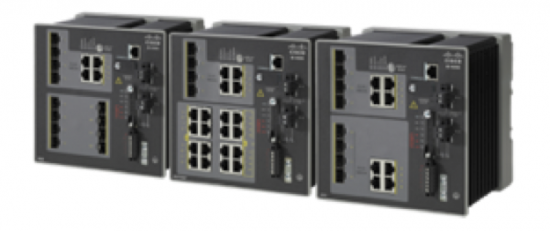
1.  Time Sensitive Networking on the IE4000 Switch family: We support a new standard on our switches to better protect your data and make sure your mission-critical applications are running smoothly on a single, unified Industrial Ethernet network. We are reinventing Industrial Ethernet for the factory floor, built to be compatible with the new applications of tomorrow.

2. Cisco Connected Asset Manager for IoT Intelligence: This is not just another data visualization platform – it can mine data from a variety of sources and bring them together in the plant across legacy systems. Reporting is simple – just drag and drop data in a user-friendly interface designed for business users, not programmers.


https://youtu.be/iOOGanHzejQ


3. Cisco Industrial Network Director: Gives factories full visibility of their plant network, allowing easier set-up and less downtime. It offers true plug-and-play functionality and is made with operators in mind, not just IT. Once you install your managed switch, you’ll enjoy the benefit of built-in security, settings, and functionality. No manual programming required.

https://youtu.be/ytAKMxkXSNA


I believe that we are just scratching the surface on the possibilities around gathering new insights from production data, and helping manufacturers on their Industrie 4.0 journey.  These newly available insights, combined with automation and security open up great new opportunities to innovate in manufacturing.

This is the time of the creative minds who can re-imagine manufacturing to take advantage of the new solutions to get ahead.


To start your Industrie 4.0 journey, check out our Digital Manufacturing website or our Industrie 4.0 e-Book.

Authors

Inbar Lasser-Raab

No Longer with Cisco

Avatar

Over the last several years, manufacturers have tapped industrial Ethernet to connect machines, sensors, and a broad range of devices on the factory floor. Customers have taken advantage of a rapidly evolving IoT ecosystem to transform that data into action and to integrate with applications to gain operational and business insights.

Such an approach has generated dramatic business outcomes including:

  • Improved business efficiency as measured by improvements in Overall Equipment Effectiveness
  • Business growth as measured by new product introduction velocity
  • Increased productivity as measured by asset utilization and workforce effectiveness

Yet despite the business results, some industrial processes requiring deterministic response remained isolated, addressed with proprietary technology and vendor specific products. By design, traditional Ethernet is designed for best effort data delivery. Important enhancements are required to bring the benefits of IoT and open standard Ethernet networking to time sensitive industrial processes.

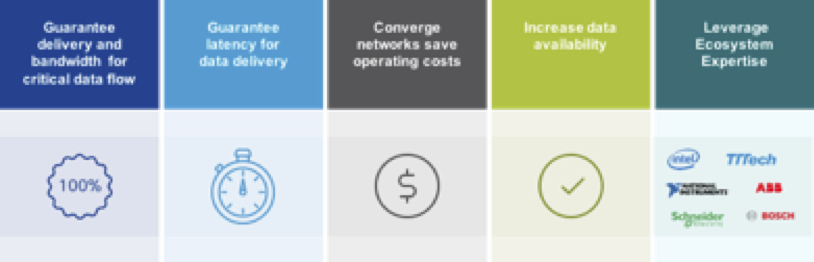
That’s why companies such as Cisco, Bosch, Intel, National Instruments, and Schneider are driving a set of IEEE standards for Time Sensitive Networking (TSN). TSN enables a single, Ethernet network that works across vendors and drives IT and OT convergence through common management practices. This open standards based approach offers real-time control and synchronization of high performance, latency-sensitive processes over a single, standard Ethernet network.

What this means to industry is that one of the last islands of proprietary, costly technology, can be transitioned to standard Ethernet connectivity and integrated to unleash the full potential of IoT.

Customers benefit by:

  • More efficient management across industrial process bringing together OT & IT with common practices
  • Integration of high performance process via guaranteed delivery and minimal jitter over standard Ethernet
  • Rapid, flexible deployment with choice across a diverse vendor ecosystem

Cisco is playing a central role in shaping the standard and working with industry groups such as the Industrial Internet Consortium to test interoperability across the ecosystem. Within the Cisco IoT Connectivity portfolio, TSN will be first deployed within the industry leading Industrial Ethernet 4000 family. The IE4000 is designed for Industrial and ruggedized deployments.  The Industrial Ethernet 4000 switch series supports up to 20 ports of Gigabit Ethernet with POE, as well as Fiber interfaces. The IE 4000 series hardware is currently TSN capable. With the latest IOS s/w release (version 15.2(5)E2) customers will be able to take full advantage of TSN.

The net result for customers is the opportunity to accelerate business with IoT. The latent value of data resident in time-sensitive processes may now be unlocked and turned into operational action as well as business insight.

Visit www.cisco.com/go/tsn to learn more.


For more details on our latest manufacturing solutions and their debut at Hannover Messe, view our blogs here and here.


Authors

John Reno

Marketing Manager

Avatar

The digital age has ushered in a new and exciting time for the media industry. It’s great for consumers who now have their pick of affordable, high-quality content from any device, anywhere, at any time. It’s great for media organizations that have embraced digitization and can respond rapidly to give consumers truly amazing experiences. Unfortunately, it’s also “great” for cyber criminals, who are constantly attacking infrastructure to steal and distribute video content and personal customer information.

As a media company, you need an approach to security that allows you to protect your business and your customers while taking advantage of all the benefits that IP transformation offers.

Transforming with confidence

Cloud and IP technologies are unlocking extraordinary capabilities for your media organization to excel from creation through consumption. Transitioning from SDI to IP is allowing you to transform your production environment to meet the expectations of today’s evolving video consumers for live broadcasts, live streams on social media, and mixed reality experiences on demand. Satisfying the requirements for today’s production organizations, cloud and IP technology are enabling greater agility, lower cost, and the flexibility you need to deliver premium 4K/UHD content.

However, as you make the shift to IP, you need to rethink how you are protecting your premium content and production environment due to the increasing vulnerability to attacks.

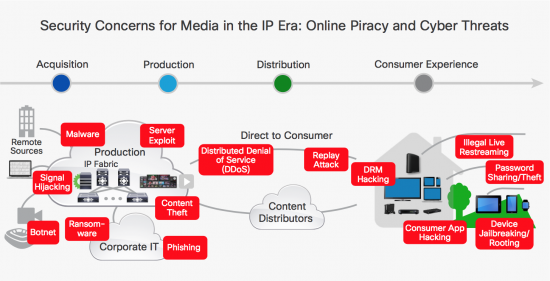
Cybersecurity attacks, an explosion of uncontrolled consumer devices, and illegal online video consumption lead to increased risks for media providers as they transition to IP. While you work tirelessly to create captivating experiences to keep and attract subscribers, cyber criminals work tirelessly to infiltrate your infrastructure in order to access valuable content, data, and systems. Hackers and pirates continuously evolve their methods to avoid detection and can steal content in a matter of hours. Yet because the industry average to detect attacks is 100 – 200 days, you may not know a breach has occurred until they’re long gone and the damage is done.

Cisco Security for Media

Traditionally, to protect the media data center and corporate IT environments from sophisticated attacks, media organizations have turned to a patchwork of disparate security technologies from several different vendors. This fragmented approach leads to security gaps that you are unable to control and see. Hackers and pirates are exploiting these vulnerabilities to directly impact your business and your customers.

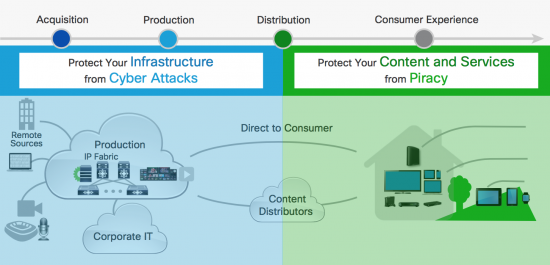
To protect your business and valuable content, you need a truly holistic approach to security. Adopted by over 100 content and media providers worldwide, Cisco’s comprehensive security solution secures the infrastructure and protects content services from growing threats.

Protecting against cyber attacks

Our multi-layered cyber security solution is simple, open, and automated. Based on an architecture that integrates best-of-breed technologies that work in concert, you get the visibility and control you need for robust infrastructure protection across media production and IT environments. Backed by Talos, the largest threat telemetry network and research team in the world, you can be sure you have the latest in threat intelligence. Our unique solution extends visibility into the network, successfully lowering the time to detect and respond to an attack that is unmatched. In fact, we’ve decreased the time to detect to as low as six hours.

Fighting piracy

So that you can truly embrace cloud and IP technologies, Cisco provides protection for your video content and services. We provide an adaptive security approach to detect forms of piracy affecting your business, including  a unique solution that uses automated tools and methods to identify, verify, and eliminate online streaming piracy in real time.


What does all of this mean? You now can have comprehensive security across your entire media production and delivery chain – from content acquisition, to production, distribution and consumption. Only Cisco delivers effective security that is simple, open, and automated so media organizations can confidently embrace all of the opportunities IP transformation offers.

Let us show you how we can help secure your digital transformation journey. Join us at the Cisco booth #SU8502CM in South Upper, Connected Media at NAB 2017.

Look forward to seeing you there. Please make sure to check out our Service Provider Security page as well.

Authors

Marc E. Aldrich

Senior Vice President

GSP Americas

Avatar

For media organizations, your time is now! The shift from SDI to IP is enabling you to be more agile, operate at a lower cost, and gain the flexibility to deliver premium 4K/UHD content to subscribers on virtually any device at anytime, anywhere. From the time content is acquired, put through production, and finally distributed, your environment is moving at lightning speed. Connected networks allow your teams to instantly collaborate to meet both work deadlines and the evolving demands of today’s audience. With the popularity of OTT delivery, IP video is unlocking tremendous capabilities to deliver your premium content to a massive, rising number of screens, in various form factors and in locations that were once thought impossible. Projections point to 8 billion connected devices by 2020 with video driving 82% of global IP traffic.

Taking advantage of all that cloud and IP technologies can offer is where you need to focus so you can monetize video consumption and strengthen customer relationships. But the reality is, as media organizations drive forward with digitization, their data center and corporate IT environments are increasingly vulnerable to sophisticated attacks.

Over the past few years, we have become familiar with breaches that directly impacted major media organizations like Sony, TV5Monde, and Yahoo. In the case of TV5Monde, their organization was taken offline for approximately 24 hours while hackers took control of 11 live broadcast channels and displayed malicious content. Security incidents within Yahoo’s environment led to Verizon devaluing their purchase of the media company by $350 million. When combined with the cost of clean-up following the breach, the financial impact is quite substantial. Clearly, it’s time for media organizations to rethink their approach to security.

Multi-vendor security solutions have left gaps and blind spots in your network. With 28% of media companies reporting that they have suffered cyber attacks, hackers are exploiting these vulnerabilities. These traditional security deployments are costly and complex to maintain.

But imagine working with one trusted partner who understands the complexity of your environment and the targeted attacks that aim to do harm. Imagine security that seamlessly spans your entire media production and corporate IT environment, securing your network from creation and acquisition, through to production, distribution, and consumption.

Used by more than 100 media and content providers around the globe, Cisco provides a multi-layered security solution that works to protect your infrastructure, video content, and customer information. Our integrated best-of-breed architectural approach is simple, open, and automated, closing gaps in your network and providing greater visibility so you can see and respond to attacks quickly.

Security from media creation to consumption:

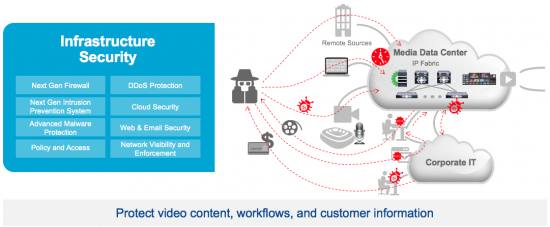
Cisco’s portfolio of integrated cyber security solutions include Next-Generation Firewalls (NGFW), Next-Generation IPS (NGIPS), Distributed Denial of Service (DDoS) Mitigation, Advanced Malware Protection (AMP), Policy and Access Control, Network Visibility and Enforcement, Cloud Security, Web Security, and Email Security. Working together, these solutions stop more threats and reduce your time to detect and remediate when an attack does happen. For example:

  • Strengthen your network perimeter and tightly control access to your media production data centers and corporate IT, preventing unauthorized users from compromising your video content and customer data. With Cisco Firepower Next-Generation Firewalls (NGFW) you can see and control all video production and corporate traffic and enforce granular segmentation and access rights to digital assets across users, systems, and networks.


  • If an attacker tries to compromise your business, you can prevent service disruption and keep your infrastructure secure. With our integrated Cisco Firepower Next-Generation Intrusion Prevention System (NGIPS), distributed denial-of-service (DDoS) mitigation, cloud security delivered by Cisco Umbrella, and Cisco web and email security solutions, you can continuously protect against spam, malware, DDoS, and other advanced attacks.


  • Because breaches do occur, network behavioral analysis by Cisco® Stealthwatch, along with Cisco Advanced Malware Protection (AMP) and Cisco Threat Grid sandboxing solutions (on premises or in the cloud), continuously scan traffic and files to find new malware or targeted attacks. Compromises that would have gone undetected for weeks or months are quickly identified. With Cisco Identity Services Engine (ISE) working together with Cisco Firepower and/or Stealthwatch solutions, should malware become active, we track where the malware has been, what systems have been affected, and isolate the threat so you can remediate and get back online quickly.

Be the leader you want to be in the era of digital media, while safeguarding your business, content, and customers.

Visit us at the Cisco booth #SU8502CM in South Upper, Connected Media at NAB 2017 and let us show you how security solutions can enable the needs of your business.

Please make sure to check out our Service Provider Security page as well.

Authors

Sam Rastogi

Senior Product & Solutions Marketing Manager

Avatar

Are we there yet? If you have ever been on a road trip with kids, you know this question well.  The anticipation of reaching our destination never really disappears. I was recently asked by an astute observer of Cisco’s digital transformation, “When will Cisco achieve its goal of becoming a digital company?”

His question was reasonable given that we are in the process of transforming literally everything we do at Cisco. This includes changing our operating model (how we are organized and work), and reinventing our business model (how we deliver ongoing value to our customers). His question also reflected our natural human desire to finally arrive at the finish line.

I thought the best answer to his query was to paint a picture of our future through a series of questions.

What happens when the local supermarket you’ve been shopping at for years (maybe decades) goes out of business and is replaced by a regional Amazon distribution center that stocks goods based only on analysis of the surrounding areas buying and consumption patterns?

How do we prepare for the reality of autonomous vehicles disrupting not only the automobile industry and adjacent areas such as insurance, parts, parking, and repair, but also real estate, law enforcement, hospitality, and the legal profession?

Which industries will autonomous cars disrupt? All of them.

Source: Global Center for Digital Business Transformation (DBT Center), a Cisco and IMD initiative, 2017

Audi’s vice president of brand strategy and digital business, Sven Schuwirth, recently predicted that car interiors will eventually morph between driving and sleeping modes. This will dramatically reduce the need for roadside hotel rooms and domestic flights. And, what happens to corner gas stations when the majority of electric vehicles “themselves” determine the most convenient places to recharge. I guarantee it won’t be at corner gas stations, which were designed for driver convenience.

Additionally, about 90 percent of car accidents are caused by human error. In a world of fewer accidents, what will hospital emergency rooms look like? How will the insurance industry adapt? How will personal injury lawyers make up the 35 percent of revenue that currently comes from civil trials?

I’m sure you know where I’m headed—digital transformation has no end. It is ongoing. The new mantra is continuous innovation and reinvention. When we get close to the “end,” the finish line will move—again and again. Importantly, this doesn’t mean we won’t progress. On the contrary, progression will occur faster than ever, we just won’t reach a point where we can say, “Done.”

This is why the digital age is so much more powerful and challenging than previous transformational phases such as the shift from mainframes to PCs, LANs/WANs to the Internet, informational web to e-commerce, etc.

The business demands being placed on Cisco by the ever-evolving needs of our customers as they transform to new digital business models are immense. We must always evolve our operating and business models, and continue to deliver automated, secure, self-learning networks that create the underpinnings of digital business agility that our customers require to thrive in the digital world. Further, our own innovation must push the envelope, yet have daily applicability for others to evolve.

We accept that our finish line will always be just out of reach, but we wouldn’t have it any other way, because this time is different—incremental change is not relevant in the digital age.

So, the next time you’re asked, “Are we there yet?” how will you respond?

Authors

Kevin Bandy

No Longer with Cisco

Avatar

Brace for a thriving, lets-go vibe at this week’s National Association of Broadcasters show in Las Vegas, as the leaders in television, media and entertainment solidify their respective entries into the cloud-based, Internet Protocol-heavy, viewer-focused scene.

Why is someone from Cisco making that observation? Because over the last year, we’ve worked really, really hard to build industrial trust in our Media Blueprint. That means working across the broadcast and media ecosystem, from associations, to systems integrators, hardware suppliers, and solution providers, or as we call them independent software vendor (ISV).

I’m glad to report that the work is paying off  — very nicely, and thanks to many of you. I’ll get to that. First, though, I want to make sure we’re all aligned on what it means to our collective broadcast, media and content-side customers.

It’s not a perfect analogy, but think about your car. When you bought it, you didn’t really care who built the windshield, or the transmission, or any of the many constituent parts that combine to make an automobile. You bought it for the brand, or the features, or the curb appeal.

In a sense, our Media Blueprint represents “the parts” that are helping the media marketplace make that mission-critical shift to IP and video cloud. After all, IP is where we “Cisco” live, and where we’ve always lived, since the very beginning of “the Internet.” Building video clouds is also something we know, very well, because we’ve built and supported lots of them (understatement!) over the years. (In the broadcast/media industry, most key players are first-timers, when it comes to moving to IP and cloud. We are not — and that’s in large part why we’re here.)

We don’t want to “build the car,” so to speak. We want to provide the parts, the experience, and, ultimately, the confidence that so many in this established and venerable ecosystem really need — maybe because they hail from the “traditional world” of broadcast video, and need the IP/cloud bits; maybe because they’re used to relying on channel partners.

Speaking of channels — which I’m defining here as “who we transact business through,” not “give me the clicker please” — please forgive me if I sound like I’m boasting. Truth is truth, and our channels are huge and wide. Fun fact: We transact nearly 95% of our business through roughly 70,000 channel partners. In addition to our traditional channel we also have a rich solution perfect for our industry ecosystem to create those cars I spoke of as part of our Solution Partner Program which counts over 1,500 participants today. Channels don’t make for an entire ecosystem, obviously, but they’re one of the assets we bring to the table — in a way few others can.

Again – the point here isn’t to brag. Far from it! We came here last year with a new plan, a Media Blueprint. We swung for the fences to socialize it with partners throughout the media ecosystem. I mean, we are working on so many integrations and customer deployments and commercial relationships — it’s almost a blur. Like who? Like Grass Valley, Presidio, EVS, Lawo, Imagine, Evertz, WWT, Intel … and that’s a partial list.

Because of those (fabulous!) partners, we know one thing for sure, when it comes to what our collective customers want, at this year’s NAB and beyond: They want their broadcast operations to continue along, unchanged; no swapping out consoles or workflows. They’re attaching to us and our esteemed partners because they’re confident that we’ve moved forward, as a group, to support the transition to IP and cloud in a way that’s interoperable and proven.

Here’s a proof point, with more to come: Vivendi Subsidiary CANAL+ announced here that they are working with us to transform their new “Content Factory” to an IP foundation and accelerate live production from their studios. It’s an all-IP infrastructure transformation, in partnership with Grass Valley (production systems) and Videlio (systems integration) for the SDI-to-IP migration. (Love it!)

Further proof: Last month, at our San Jose facilities, we hosted an interoperability event (proclaimed a success by its participants!) involving third party systems, and our Cisco IP Fabric for Media. It was all about enabling our partners (and to-be partners) to work with the open, standards-based API for our Data Center Network Manager — in essence, our SDN controller.

Attendees included networking companies, broadcast vendors, and end-point vendors from across the industry. The group tested 24 test cases with three switch vendors, two broadcast controllers, three end-point vendors, and a registration/discovery service. It was useful, helpful, and actionable — my favorites.

What does all of this mean to you, as you’re walking the NAB Show floor this week? Plain and simple: It’s time to stop answering “I don’t know,” when asked what supplier strategy you’re considering for The Big Shift to IP. First of all, there’s no longer a need to tie up to one provider. You asked us (all!) to be less monolithic, and we listened. Secondly, the partners you seek are those deeply experienced in IP, and have a proven track record in working with your existing technology suppliers. I’ll let you connect the dots from there….come by and see us! We are in SU8502CM.

Authors

Bryan Bedford

Director of Consumer Industries & Business Solutions

US Commercial Sales

Avatar

By 2030, 500 billion devices and objects will be connected to the Internet. At the same time, as part of our work to positively impact 1 billion people by 2025, Cisco seeks to inspire and empower a generation of global problem solvers. People who will not only thrive but also drive an inclusive digital economy in our increasingly interconnected world.

Digitization—connecting people and things to improve processes and decision-making—is fundamentally changing the way we live, work, and solve problems. Through digitization, organizations can accelerate and magnify their impact through greater efficiency, visibility, and responsiveness.

We understand that solutions to societal and environmental problems around the globe require big ideas, and we firmly believe—and have seen, time and time again—that entrepreneurial students can be an excellent source for these solutions.

This is why we are proud to collaborate with the Rice Alliance and award one of the largest non-dilutive prizes (e.g., funding that does not require the sale of shares of stock) in the Rice Business Plan Competition (RBPC) for the second consecutive year.

At the RBPC in 2016, Cisco selected Neopenda, a social enterprise start-up founded by two young women from Columbia University, for a cash award to help develop a low-cost, low-power, wearable sensor that improves the care of newborns in resource-constrained hospitals. The product continuously monitors newborns’ key vital signs and alerts attending health care professionals when a baby is in distress. Since being recognized by Cisco, Neopenda has received more than half a million dollars in further funding from other investors to make their first field deployment in Uganda a reality.

This year, Cisco awarded its Innovation Challenge Prize at the RBPC to Luso Labs LLC, a team we believe exemplifies a mission-driven mentality. Founded by Columbia University biomedical engineers, Luso Labs’ mission is to leverage digital technologies to make cervical cancer screening more accurate and accessible to women worldwide, especially those in low-resource settings.

The solution utilizes a custom camera system to detect precancerous lesions in a manner that integrates easily into existing clinical practices to minimize obstacles to adoption. Images are captured and sent to a secure server for analysis. The team’s lesion detection algorithm creates a colormap that is layered onto the initial image for easy interpretation by healthcare professionals.

Katherine E. Reuther, Ph.D., Director of MS Studies and Lecturer in Biomedical Engineering at Columbia, advises Luso Labs in bio-design principles. According to Reuther, “Cisco’s awards to early stage solutions like Neopenda and Luso Labs are critical to enabling new ideas – to cross the chasm, prove the concept, and ultimately scale.”

The 100 fastest-growing social enterprises have a five-year average of 350 percent growth while new and young companies have been the largest net job creators in the U.S. since the 1970s. Just as businesses need to invest in developing new products and services to open new markets, it is imperative in our increasingly digital economy that we uncover innovation and provide early stage investment to this new generation of students and entrepreneurs pioneering “digital native” solutions. With technology at the core of their work, these innovators can accelerate how we solve pressing problems in our communities and around the world, enabling us to achieve new levels of “possible.”

Inspired by our work with the RBPC, we’re expanding our awards to social enterprises through wider global challenges. How can your new technology solution or service help benefit the economy, society, or environment?


Tell us by applying to our Cisco Global Problem Solver Challenge with $300,000 in prizes for students and recent grads. We all have a role to play to change the world. We look forward to hearing your ideas.


Authors

Cristina McGlew Castro

Strategist, CSR Strategy & Global Problem Solving 1B

Cisco Corporate Affairs

Avatar

Earlier this month, Talos responsibly disclosed a set of vulnerabilities in Moxa ICS wireless access points. While most of the vulnerabilities were addressed in the previous set of advisories, Talos has continued to work with Moxa to ensure all remaining vulnerabilities that Talos identified are patched. Today in coordination with Moxa, Talos is disclosing the TALOS-2016-0231, a hard-coded credential vulnerability that could allow an attacker to gain complete control of the device. Moxa has released a software update to address TALOS-2016-0231 and other bugs.

Read more »

Authors

Talos Group

Talos Security Intelligence & Research Group

Avatar

This post was authored by Nick Biasini

Throughout the majority of 2016, Locky was the dominant ransomware in the threat landscape.  It was an early pioneer when it came to using scripting formats Windows hosts would natively handle, like .js, .wsf, and .hta. These scripting formats acted as a vehicle to deliver the payload via email campaigns.  However, late in 2016 Locky distribution declined dramatically largely due to the slowdown of Necurs that occurred at the same time.  

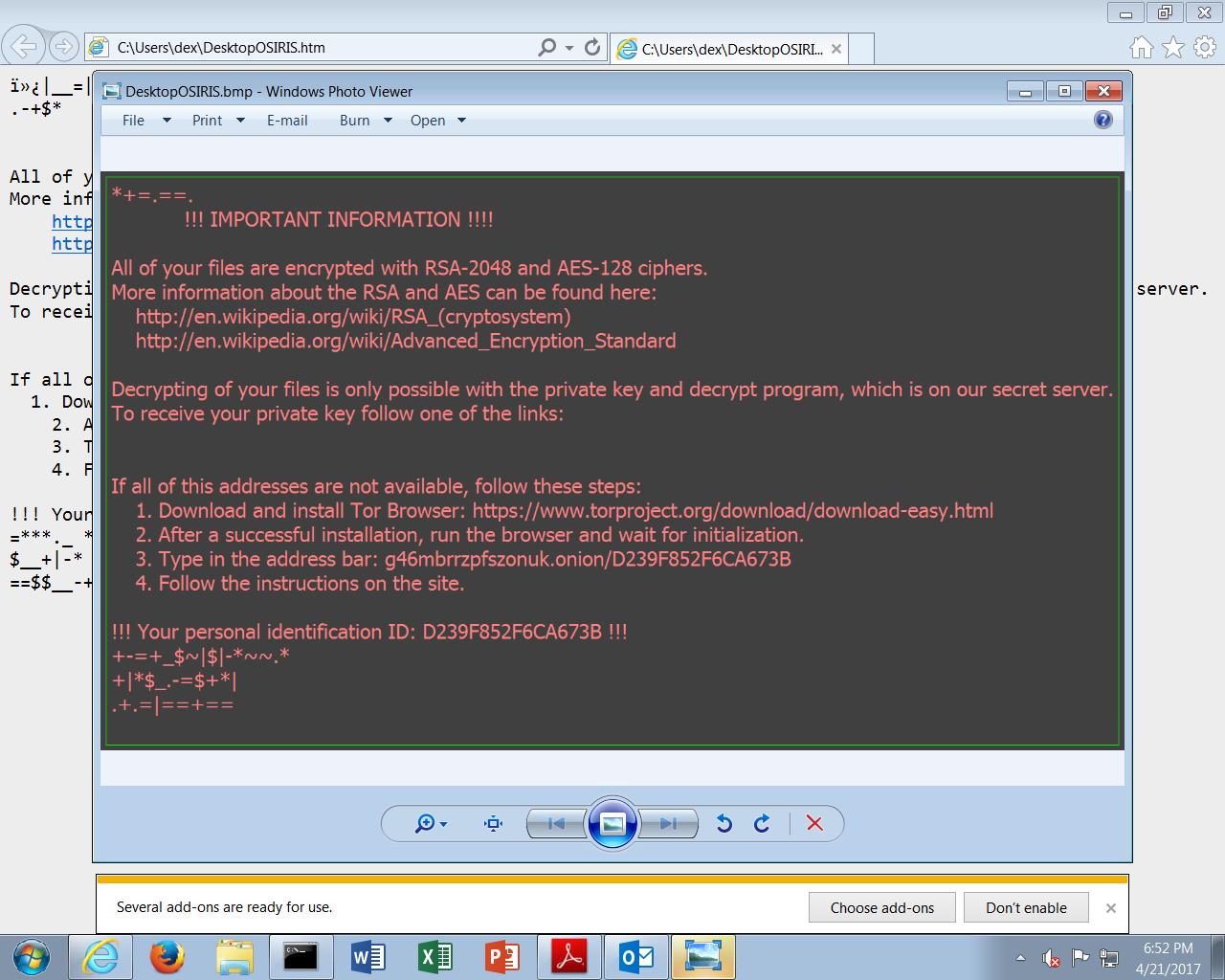
On April 21st, Talos observed the first large scale Locky campaign in months from Necurs.  This campaign leveraged techniques associated with a recent Dridex campaign and is currently being distributed in very high volumes. Talos has seen in excess of 35K emails in the last several hours associated with this newest wave of Locky. This large wave of distribution has been attributed to the Necurs botnet which, until recently, had been focused on more traditional spam such as pump-and-dump spam, Russian dating spam, and work-from-home spam.

Read More >>

Authors

Talos Group

Talos Security Intelligence & Research Group