Avatar

Maybe this has happened to you, in a large or small scale: You captured some cool A/V from an event. (Small scale, maybe it’s your niece’s high school graduation; large scale, maybe it’s a segment for a movie.) It’s time now to edit it. You have lots of ideas, and editing tools. You’ve been burned before by not saving changes as you go along, and you know the importance of saving a separate incidence of each major technique you apply.

Things are going so great! Until your local machine starts warning you — almost out of space. So you shift your work to some form of public cloud, just to keep your local buffers clear and processors working at full muster. At some point, and especially if you’re doing industrial-grade editing, you’re probably going to outgrow your public cloud, too. Two things will happen: Either it’ll get too expensive, or the latency and performance, specific to video, won’t be agile enough for the media workflows you’re trying to establish.

This is where the beauty of object-based storage comes in — scalable, networked storage, designed for heavy manipulation.

Media companies are already looking at object-based storage as a way to manage the growth of their content creations, with greater flexibility and cost performance. Why, because consumers consistently show an insatiable appetite for content, and producers are struggling with the rising costs of CDN storage and distribution for their ever-growing content libraries.

Analytic proof: Both IDC and Gartner Group expect that more than 80% of all storage will be both unstructured and stored in cloud data centers; our Global Cloud Index similarly indicates that 64% of cloud data center traffic will consist of video and storage, by 2020.

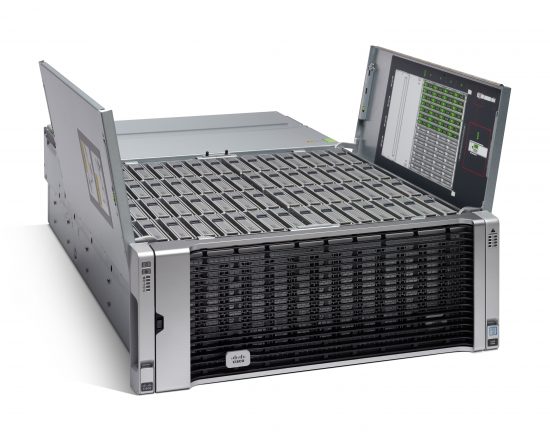
Our solution, which we’re advancing at NAB this year, is housed within our UCS line of servers, used in 85% of Fortune 500 companies, and which have broken over 100 world records for sheer performance. In particular, I’m talking about our new Cisco UCS S-Series, where the “S” stands for “storage-optimized.” Unlike traditional, file-based storage systems — which, don’t get me wrong, are great for storing structured data, in files, with specific info like location, file-type, size and data — object-based storage is infinitely more scalable for the growth of unstructured data.

That means using metadata to define the attributes of the object being stored — which can be changed and indexed, on the fly. It means container-based storage, independent of application and file type, and far more effective for videos and images. It’s web-native, with operations and access handled via REST-based APIs.

Data sheet-wise, the S3260 storage server is optimized data intensive workloads — in that it’s stuffed with up to 600 Terabytes of raw data storage capacity, in a compact 4RU form factor, with policy-based management, seamless resource provisioning, and a killer TCO, compared to traditional, 2RU storage units. By that I mean 34% lower capex, 80% lower ongoing management (scale to petabytes in minutes!), 70% less cabling, 60% less space, and 59% lower power consumption.
But wait — there’s more! The S-Series Storage Servers are just better for media storage because digital video use cases are deeply compute-intensive. That means it’s important to unlock the value of data, and use it in real-time — as a sort of data fabric, covering compute and storage.

And, in keeping with the collaborative nature of all beneficial progress, it’s not just us singing this tune. We’re grateful to be partnered with software defined storage partners like IBM Cloud Object Storage, Red Hat Ceph, Scality and SwiftStack, on specific broadcast and IT use cases — like moving film archives to active storage, which consequently makes it easier to manage and move large volumes. And offering remote production workflows (think stadiums, outside broadcast events) and distributed disaster recovery.

(Speaking of SwiftStack — check out Joe Arnold, founder and chief product officer, who will be delivering the Cisco Daily Keynote on Wednesday (April 26) at 11am. It’s titled “New Choices for Media Storage,” and happens at the Connected Media IP Theater. We are thrilled to sponsor such a fine thing!)

Last not least: our storage for media offering is available “as a service.” We’ve expanded our financing models, covering traditional purchase models, as well as leasing and — this part is new — a subscription service for utility based pricing that starts at a low $15/TB/month. It’s secure (data privacy-controlled), efficient (pay as you go), and flexible (on your schedule/terms), and less costly than competitive alternatives without the compromises, like, oh, say, AWS.

That’s the high level overview for how Cisco Unified Computing is the right system for keeping up with data growth in the broadcast/media sector — with the right storage solution partners, and a solid set of financing options. Let’s talk! We’re in booth SU8502CM.

Authors

Roger Sherwood

Sales Manager

Media & Entertainment

Avatar

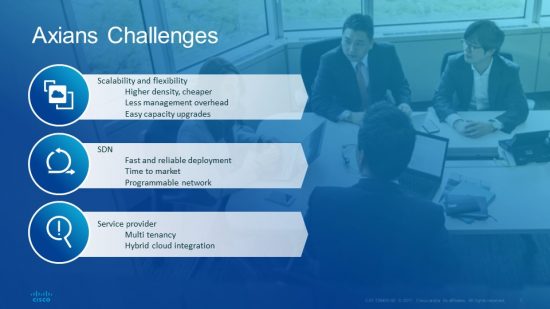
Introduction: In this blog, I am covering a customer success story featuring the Cisco ACI and Fortinet joint solution. Axians AB is a leading Swedish IT sourcing company, with multiple offices in the Nordics and employees across the globe. Axians offers hybrid IT services from datacenters and the public cloud to a diverse set of customers spanning private, government and service providers.

Axians’ Requirements: With a rapidly growing customer base, Axians had a pressing need for a scalable and flexible infrastructure, one that would provide high utilization rates, simplified management and reduced costs. In particular for networking, Axians required an SDN architecture with programmability, accelerated application security delivery and time-to-market advantages. Further, Axians’ Service Provider business needed support for multi-tenancy and hybrid-cloud integration.

Axians Infrastructure

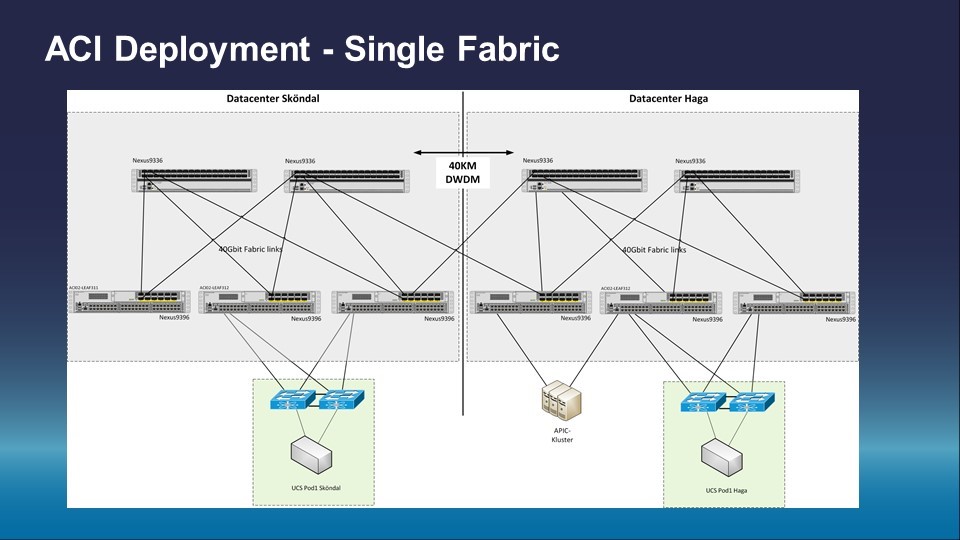
Axians uses a single ACI fabric that stretches across 40 kilometers, spanning two datacenters in Skondal and Haga. Customers are virtually separated and placed as Tenants in the solution. UCS B-series is the server platform running vSphere 6.0 with Cisco AVS integration to VMware, with support for local switching mode. Integration with the Axians internal platform, as well as integration with documentation systems and the legacy network are other characteristics of the environment.

Current ACI Deployment: The Axians deployment environment is a scalable, flexible one with two spines and three leafs in each datacenter (Skondal and Haga), forming a single ACI fabric, with the APIC management cluster at the Haga location. Fortinet’s FortiGate enterprise firewall is deployed in the Axians production environment for L3 (Routed) traffic flows among EPGs.

Each customer in this design is set up as an independent tenant with distinct security functions using Fortinet’s Virtual Domain (VDOM). Depending on the maturity of a customer, the setup can be implemented using an application-centric or a traditional EPG to vLAN mapping. FortiGate adds stateful inspection with advanced functions and better visibility beyond stateless ACLs.

To provide effective security, the security and data elements across the deployment must be well-integrated and able to share intelligence. FortiGate is part of the Fortinet Security Fabric which provides broad, powerful and automated security capabilities that span the entire attack surface. Looking ahead, the possible integration of Cisco ACI with FortiGate and the Fortinet Security Fabric can deliver the following benefits to Axians:

  • Consistency and transparency across physical and virtual application workloads
  • Single-pane-of-glass management enablement with full visibility on security policy enforcement
  • Predefined security policies deployed rapidly through the complete application deployment lifecycle
  • Scale on-demand with automation
  • Broad, powerful and automated security via the Fortinet Security Fabric and ACI.

The integration of Cisco ACI and Fortinet can deliver accelerated software-defined security, enabling transparent security services insertion anywhere in the network through single-pane-of-glass management. The Fortinet Security Fabric’s integrated, collaborative and adaptive architecture can deliver security without compromise to address our security needs. The joint solution provides enhanced visibility and security, lower TCO and increased efficiency in service provisioning and network security segmentation,” said Erik Sohlman, Sr Manager Infrastructure, at Axians.

Buoyed by 2 years of production success with ACI, Axians is moving forward with advanced integration plans in their ACI environment. East-West traffic has become predominant, and security has become very critical. Perimeter security alone does not suffice anymore. Axians is looking to further enhance their networking and security services to further automate and secure their datacenter infrastructure. With an ever-increasing customer base and demands for application agility, Axians is embarking on orchestration as a key initiative. And they are looking to Cisco ACI and Fortinet as a key foundation to meet these enterprise-wide objectives.


Related Links:

www.cisco.com/go/aci

www.cisco.com/go/dcecosystem

www.fortinet.com

https://fortinet.com/products/virtualized-security-products/fortigate-connectors.html


Authors

Ravi Balakrishnan

Senior Product Marketing Manager

Datacenter Solutions

Avatar

Discovered by Aleksandar Nikolic of Cisco Talos

Overview

Talos is disclosing TALOS-2017-0310 / CVE-2017-2813, an arbitrary code execution vulnerability in the JP2 plugin for IrfanView image viewer. IrfanView is a widely used, Windows based, image viewing and editing application.

This particular vulnerability is in the jpeg2000 plugin (JP2) for IrfanView resulting in an integer overflow which leads to a wrong memory allocation and eventual arbitrary code execution. This vulnerability is specifically related to the way in which the plugin leverages the reference tile width value in a buffer size allocation. There are insufficient checks being done which can result in a small buffer being allocated for a large tile. This results in a controlled out of bounds write vulnerability. This out of bounds write bug can be further leveraged to achieve code execution in the application. This vulnerability can be triggered by either viewing an image in the application or by using the thumb nailing feature of IrfanView.

Read More >>

Authors

Talos Group

Talos Security Intelligence & Research Group

Avatar

This article also appears on Sustainable Brands.

Authors:

  • Paul Dickinson, Executive Chair, CDP
  • Heidi Rhodes, Workforce Experience Specialist, Digital Transformation Group, Cisco
  • Darrel Stickler, Global Environment Lead, Corporate Affairs, Cisco

Since the introduction of Cisco Telepresence in October 2006, Cisco has studied how the use of our technology impacts corporate travel. The early days were exciting; Cisco set our first travel reduction goal in 2006! Reducing travel via collaboration technologies had benefits for our business (cost reduction, productivity improvement), employees (work-life balance) and the planet (greenhouse gas (GHG) emission reductions).

Execution, however, invariably focused on travel reduction. The recurring savings from less travel recouped the upfront investment for telepresence systems, so less travel was the metric that mattered. However, harnessing the full benefits of this technology is complicated and requires looking beyond travel reduction.

Cisco and CDP (formerly the Carbon Disclosure Project) have partnered to explore how to implement a virtual collaboration platform that maximizes this broad range of benefits. CDP will be expanding their use of collaboration technologies, using substantially more Cisco Telepresence in addition to their longtime use of Cisco WebEx.

The goal of this project is to make integrated use of Cisco Telepresence and WebEx a mainstream form of collaboration throughout CDP and beyond—and the act of remote collaboration routine for all CDP employees.

“CDP has spent over fifteen years connecting the world’s largest organizations to the very important theme of climate change. To achieve our goals over the next fifteen years we will need to network worldwide like no organization has ever done before. Cisco video communications makes that possible.” – Paul Dickinson, Executive Chair, CDP

CDP presents an excellent test bed for understanding best practices in optimizing collaboration technologies, as the organization is relatively small yet geographically dispersed, supports thousands of external interfaces, serves a single business mission, is comprised of a relatively young workforce, and has an inherent focus on environmental sustainability.

The journey is just beginning for CDP. On a weekly basis, their connected external partner network grows and collaboration improves, with the added benefit of a reduction in costly and unnecessary international travel, happier and more productive employees, and fewer GHG emissions that are at the core of CDP’s mission.

Has high-definition video solved your sustainability, productivity and travel reduction challenge? What can Cisco share about our own journey to harness virtual collaboration technology to benefit business, people, and the planet?

Strategically approaching the use of collaboration technologies such as instant messaging, video conferencing, screen and document sharing, can offer multiple benefits for businesses, employees and the planet.

Who owns adoption?

Problem: Your company now has the gear. Congratulations on your purchase! However, who owns the adoption and use by your employees? Corporate Travel provides a seamless employee experience at the lowest cost. IT supports high-quality video and audio. Corporate Real Estate and Facilities ensure your company has the right mix of meeting spaces for the employees housed. Sales and Services are responsible for revenue and customer satisfaction and are likely the heaviest travelers. Sustainability represents an important perspective but isn’t a business owner. Reducing travel just doesn’t have a natural owner.

How you can respond: Focus on collaboration and the employee experience. Functional business leaders should jointly discuss the required policy, culture, and technology infrastructure needed for a faster and more vibrant company that leverages digital solutions to compete and win in the global marketplace.

What about my budget?

Problem: Because IT invests in the gear, and Facilities funds the required building space, travel reduction often becomes a proxy for budget battles. Sustainability is a care-about in common, but probably not enough to rally a consensus.

How you can respond: Frame the conversation around scaling teams, becoming faster and more agile, and serving the customer better. Working virtually with a customer over modern collaboration tools, instead of in face-to-face meetings, means quicker decisions, better relationships through increased opportunities to connect, and more value when you do meet face-to-face. By better utilizing collaboration technologies, budgets can be optimized to maximize the total benefit from travel reduction, faster decision-making, improved productivity, more successful employee recruitment and retention, and increased sustainability.

Is meeting in person necessary?

Problem: High-quality video and audio for a good virtual meeting is a given. However, what if the high-quality video meeting was never required in the first place? Travel for non-revenue-generating meetings presents the biggest opportunity.

Teams of knowledge workers are usually outcome-based, meaning they have to work together to meet a goal in a set timeframe. Agile teams are the pinnacle of modern business. Fast workflow relies on continuous team collaboration and the ability to connect on each iteration of a project.

If your business relies on a global team of employees and external partners, travel is not only an unwanted cost, but also means that team members are “on hold” while traveling. Instead of dozens of solution iterations and refinement, your potentially winning idea might fail, because collaboration could only move at the speed of an airplane.

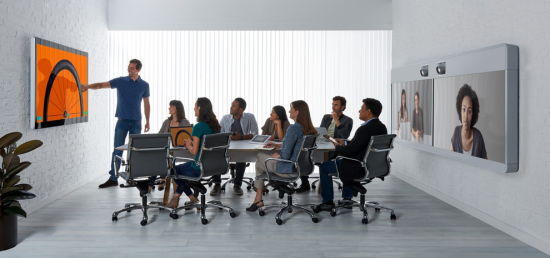
Cisco Spark Board enables presenters to share, draw and converse with meeting attendees in-person and virtually

How you can respond: Map your workflows. Look for “moments that matter” that lead to a decision to travel vs collaborate virtually. Use that insight and understanding to create the right infrastructure for your teams. One size doesn’t fit all and applying a mix of collaboration products that fit your business or team will result in the most effective outcome. For example:

  • Initial Cisco Telepresence units were based in remediated rooms and supported meetings of 6-18 people over three side-by-side screens, replicating the experience of sitting around a large conference table.
  • Regular-room-based units were introduced next to reduce installed cost while increasing video penetration throughout the organization. Spatially aware, dual cameras were added to track and zoom in on individual speakers, improving the interaction between different locations.
  • Desktop video like the DX80 were added for individual use in home offices and in breakout spaces at work. Software solutions such as Jabber, Spark and WebEx desktop conferencing can be used anywhere—in the office, at the customer, on the road, or at home.
  • Cisco Spark Board was recently introduced, because drawing, sharing, seeing and conversing are natural behaviors in all effective collaboration.

Providing flexible and simple collaboration experiences enables employees to embed collaboration into their work processes. For field or remote workers not tied to an office, it’s easy to be virtually anywhere.

CDP and Cisco are together developing a simple process—reaching out to partners around the world through Cisco collaboration. With the installation of Cisco Telepresence of all shapes and sizes and Cisco WebEx, CDP has already achieved a significant reduction in travel costs—and GHG emissions—and improved relationships with CDP’s global network of governments, companies, and partners.

“We wanted to make a product that is easy to use and does everything you need…That product doesn’t exist, and it hasn’t existed until today.” – Rowan Trollope, Senior Vice President and General Manager, Cisco Systems (January 2017)

Replacing business air travel with remote collaboration requires more than just installing technology. Companies must adapt business processes, management practices, and culture to take full advantage of virtual collaboration technologies. By doing this, boosting your business and saving the planet is something everyone can do today.

Authors

Darrel Stickler

Sustainable Business Practices

Corporate Affairs

Avatar

If you compare any video streamer to a reasonably new PC, then you will find that the PC spec is far superior to that of the streamer. But when it comes to actually viewing premium content – I mean 4K/UHD stuff – then streamers are clearly winning over the mighty PCs, including those used as game consoles and home media centers.

The reason for this is the open architecture of the PC, which until recently made it difficult to meet the high standards of protection required by content owners. A high level blueprint for these requirements is described in the MovieLabs Specification for Enhanced Content Protection. Requirements call for providing an isolated, secured environment for processing video, to ensure that only authorized applications have access to it.

But Intel and Cisco are working to change all that.

At this week’s NAB Show, in Las Vegas, Cisco will demonstrate its collaborative work with Intel to secure UHD content for playback on PC platforms. Since its 7th Generation Processors, Intel is offering Software Guard Extensions (“Intel SGX”), a trusted execution environment technology that allows application developers to protect code and data running in SGX from disclosure or modification. Cisco integrated the digital rights management (DRM) components of its content protection system into SGX to enable secure processing of viewing entitlements, descrambling the content and securely handing it off to the Protected Audio/Video Pathway (PAVP) for rendering. As a result, PCs are now able to implement the enhanced content protection required for UHD content.

By utilizing SGX, Cisco retains full ownership and control of the content protection solution, to ensure its ongoing integrity, compatibility with industry standards and performance going forward. The Cisco solution also works across all Web browsers to allow video service subscribers to view the content they want on the browser of their choice.

Tech stuff aside, this is a big deal for content owners, video service providers and consumers. Content owners can now distribute their content to PC-based platforms, knowing that it will be protected to the highest standards. Video service providers will be able to extend their service reach to PC platforms, and to all popular browsers on the PC (for those that rely on browsers for video playback). It’ll also be a big deal for consumers, who will finally be able to watch UHD content on their PCs and laptops.

Please consider this an open invitation to come over to the Las Vegas Convention Center and see our demo. We’re in booth #SU8502 CM.

Authors

Amit Wohl

Video Security Product Manager

Service Provider

Avatar

A few weeks back media outlets were buzzing with articles quoting or referring to Amazon CEO Jeff Bezos’ letter to shareholders. Exhibit 99.1 in Amazon’s SEC filings. Everyone loved how Bezos described Day 1 vs. Day 2 for his 20-year-old baby—Amazon.

“Jeff, what does Day 2 look like?”

“Day 2 is stasis. Followed by irrelevance. Followed by excruciating, painful decline. Followed by death. And that is why it is always Day 1.”

And when asked the question about how to fend off Day 2 symptoms while retaining the vitality of Day 1, he did a fantastic job articulating crucial elements of success and failure. This post is not about summarizing or repeating that great piece of corporate advice. It’s about going back in time to find references to the same timeless wisdom. Wisdom the human race has seemingly ignored for millennia.

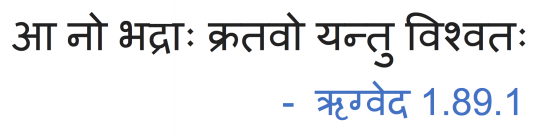
One of the biggest causes of Day 2 irrelevance stems from invincibility syndrome. One of the most ancient epics from India, The Mahabharata, outlines this symptom in a dialog between King Yudhisthira and the Yaksha. The question from Yaksha was quite simple: “What’s the greatest wonder?” The King’s swift reply posted in Sanskrit language below translates to “Every single day countless individuals die, yet the remaining ones think they are going to live forever. There is no greater wonder than this.”

If we replace individuals with companies in the above statement, the explanation still makes sense. Even after seeing many companies go bankrupt every day, most companies are still delusional about their eternal presence and continuous growth. How ironic! No wonder Jeff Bezos presented a warning light against going into the hallucination of Day 2. Complacency kills!

Another great piece of advice found in Bezos’ letter is to embrace external trends–especially around artificial intelligence, bots, drones, etc.

“The outside world can push you into Day 2 if you won’t or can’t embrace powerful trends quickly. If you fight them, you’re probably fighting the future. Embrace them and you have a tailwind.”

Keeping tabs on trends and external disruptions is very pragmatic advice. In fact, one of the oldest books in the world, The Rigveda, quotes the exact same principle: “Let noble thoughts come to us from all the directions.” And once again, in our quest of becoming the most selfish species on earth, we’ve forgotten to think outside of our own box. Win-win and co-innovation are approaches gaining popularity only recently.

Another interesting attribute Bezos mentions is “disagree and commit.” Think for the greater good. If you’re a boss and most of your team agrees on a certain decision, you should give in and commit support–possibly against your personal wishes. This, too, is anything but new. The Vidur Neeti, a book embedded inside the epic of The Mahabharata, describes these qualities quite well. Always think from a big-picture perspective!

In short, the ancient wisdom, which had all of these golden nuggets of corporate and human behavior, is still relevant in modern times. We just have to start practicing these shared values in our respective circles of influence to create a better future. Or at least, stay away from the deadly Day 2 spiral of stasis, irrelevance, decline, and death.

So, what’s keeping us from applying these principles as we innovate? This is a question we must all ask ourselves—and then shift our behavior to embrace the future.


Authors

Biren Gandhi

Head of Drone Business & Distinguished Strategist

Corporate Strategy Office

Avatar

I love coffee. I think it not only helps me to open my eyes in the morning, but it also helps connect people in extraordinary ways. Perhaps my love of coffee comes from my roots as I lived near Italy, or maybe it is because my grandmother used to prepare coffee for me since I was little – whatever the case, I just love it – and I have taken my love of coffee and it’s powerful connections into my life here at Cisco.

I think that coffee always tastes better when you’re in good company.

We work hard at Cisco – it’s true, but from time to time we need to stretch our legs, relax our eyes, and rehydrate or grab a cup of coffee. There is something so magical about heading to the coffee machine, preparing your cup, and taking it to a quiet room to call a colleague and catch up.  Not familiar with this feeling?  I hope by the end of this post you consider it!

Perhaps you feel this is “nothing special” – that it is just a cup of coffee, just a routine part of your day.  But what if I told you that my colleague was in the United States – that he jumped into our virtual coffee call from his local coffee shop – and that we make it a point to do this regularly?

Since I am a part of a global (virtual) organization – GVE at Cisco, beside the interaction from my local office colleagues, I have done my best to also spread my connections with peers in different countries all around the globe. Thanks to Cisco collaboration tools, it’s not hard for us all to keep in touch, provide help, and collaborate no matter where you may be located.

From quick chats on Jabber to meetings and trainings on Cisco WebEx, and deep collaboration on team projects in Cisco Spark – we are constantly connected. It is one of the many things I love about working at Cisco, and I encourage you to use these tools to reach out and make new friends within the company. J

So what should you do if your Virtual Coffee colleague is on the other side of the ocean? Here are a few tips I would recommend:

1. Schedule the “Virtual Coffee” Meeting in Advance – this helps avoid awkward situations like being redirected to the VoiceMail or interrupting your friend during a customer meeting – not to mention ensures that the time works for both of your time zones.  Scheduling in advance means you both have this time on your calendars available, which makes your virtual coffee meeting something to look forward to.

2. Decide on how are you going to make a video call. This will help alleviate any confusion. You can create a WebEx meeting, call through Jabber or use a video bridge number in case more people are invited. What I personally prefer is a direct call to the person through a video-endpoint. In the quiet room in my office we have an EX90 which gives me one touch accessibility and an immersive, full HD experience! With that setup I can enjoy my coffee, be completely hands-free (body language is also very important), and focus on the conversation regardless of where the person is!

  • Keep in mind that Cisco employees can work from various locations (home office, cafeteria, park, or another Cisco office) so this will play a key role in adding to your conversation as well as well how they may answer the call (on another video-endpoint, Jabber, Spark, tablet, smartphone, etc.) – there really are so many options at Cisco!

3. Make a few notes on what you might want to discuss. Nothing too formal, but perhaps there is something you do not want to forget to mention – maybe it is a big project you’re working on, a question you need help with, or a fun personal update.  Just write down a little note and keep it next to you as a reminder. J

With these simple tips, I hope to show you how you can also participate in coffee meetings around the globe at Cisco.  We offer so much flexibility on how and where you can have a “virtual coffee” and what is most important is that Cisco provides us the possibility to stay in touch with our peers from everywhere, with the possibility to share some work-related topics, discuss projects, study, practice a presentation, or to talk how we spent our last holiday with family.

Perhaps it is just coffee for you, part of your daily routine. But, maybe now you can also see how a small cup of coffee has a global reach when you add a little virtual meeting to it.

Want to join us? You can! Apply now.


Authors

Mitja Rakar

Account Systems Engineer

Sales Systems Engineers Italy

Avatar

Allow me to get straight to the point: You’re reading this because you’re either at or interested in the goings-on of what we used to call “the broadcast industry,” and is now broadened to “content,” “media,” “video,” and so on.

It is an industry that dates back 70+ years, depending on when you start the clock.

And, it’s an industry clearly in transition. (Again.) “Clearly,” because we’ve seen the same transition happen, at least twice (in media): First to the music industry, then to what we used to call the cable industry. It started with “going digital.” Now, it’s about “going IP.”

The (Non-Linear) Phases of IP Transition

For broadcasters and media providers, “going IP” is a matter of phasing, and the phases aren’t necessarily sequential. One phase: The shift from SDI (Serial Digital Interface) to IP (Internet Protocol.)

Another phase: To terrestrial, IP/CDN-based distribution, from satellite delivery.

Through it all: Professional-grade, and dare I say, “broadcast-quality” product. After all, broadcast-quality has long been a gold standard, when it comes to good looking “reliable” video/audio.

Let’s start with the transition from SDI to IP. This is happening, by the way, because in the new world — the IP world — it’s no longer about frames of video. It’s about packets, and how best to assemble lots of IP packets into a video frame, as it’s done with SMPTE 2022-6.

Perhaps not surprisingly, we at Cisco know an awful lot about packets. Packets are life! Which brings me to the sturdy pile of updates we’ve made to our Virtual DCM.

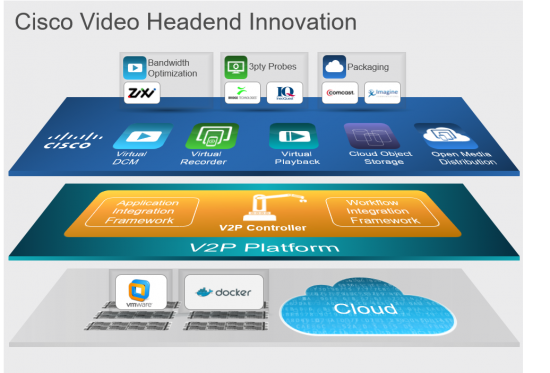
For starters, the Virtual DCM update began with a desire for a single-server/ “one box” approach. As a result, it’s a software-based machine that accepts SDI as well as IP inputs, then outputs multiple “flavors” of packet-based media. Output flavors include 10-bit HEVC encoding, to support High Dynamic Range (HDR) at 60 frames-per-second (HDR10, Hybrid Log-Gamma, Technicolor and Dolby formats). Or, you can transcode that same SDI input as a MPEG-2, AVC, and/or “stat-muxable” format. In other words, output both linear Transport Stream (TS) and OTT from the same platform.

The point of the expansion was to extend the software-based functionality of the (x86-based) Virtual DCM to optimize bandwidth — because 4K/UHD is huge, relative even to “just” HD. We also expanded what was already a rigorous attention to overall video quality (more on that in a bit.)

Which reminds me: Big thanks and a high-five to HorizonSat, a leading satellite provider covering the Middle East, Asia, Africa, and Europe, which announced (here at NAB!) how they are augmenting their existing DCM platform with the Virtual DCM. It’s a great way for them to implement HEVC Statmux in software and use less bandwidth to distribute more media, faster, for both direct-to-home (DTH) and over-the-top (OTT) streaming video delivery. Bravo!

Satellite to IP Distribution

The shift by large broadcasters and content owners to move as many of their programs/channels away from satellite has started a new IP migration approach.  Today broadcasters are actively looking for cost-effective approaches to move regional content and or long tail content off satellite.

Why? Because IP CDN delivery offers advantages in agility and cost savings unavailable with satellite. And CDN delivery for live content offers broadcasters and content owners options beyond costly direct fiber and proprietary direct connect over the Internet.

New is the ability to utilize Adaptive Bit Rate (ABR) technology to gain the advantages of ubiquitous IP with the cost-effectiveness of ABR. Also new is the addition of intelligence to make the shift to consolidate on IP/ABR distribution.

That intelligence comes from another batch of improvements we built into our Virtual DCM and the D9800 Network Transport Receiver for ABR video distribution:

  1. You can anticipate a 40% improvement in bandwidth consumption with the Virtual DCM. This matters especially as HDR/4K content continues to augment “regular” HD material.
  2. You can consolidate on ABR delivery in the core for all services (linear, on-demand, OTT, TS), and from that single source of content you can convert back to legacy MPEG-TS at the edge to feed existing end-points; or go direct to consumer/OTT (how about that).
  3. Video quality, using ABR techniques, is a big part of it.

What’s that, you say? We can cut bandwidth usage by 40%, while improving video quality?

You did indeed read that correctly. Part of our streaming strategy is to leverage intelligence and machine learning, end-to-end (as in from client to cloud, including encode and network elements).

Our new Smart Rate Control technology works by improving the output of the encoder, while optimizing bandwidth for ABR delivery. In other words, the encoder can deliver variable, bit-rate-base outputs, adjusted to the quality of the content — and can set optimal limits to optimize bandwidth, without impacting perceived video quality.  Bottom line: It improves the OTT experience, for sure.

And, lastly — we wouldn’t be Cisco if we didn’t talk about cloud. Everything I wrote about here, all of it, is cloud-based. The Cisco D9800, as part of our Virtualized Video Processing portfolio, enables broadcasters and content providers to move content to the cloud while enjoying a simple and manageable IP-based connection to affiliate clouds/headends. Plus, that conversion from ABR to TS? It’s deployable as part of our distributed micro-services approach to extending processing functionality intelligently to where it makes sense in the network: both in the D9800 or on a server. Not to mention that the microservices of our Virtual DCM platform are implementing Docker-based containers, reaping those associated benefits and efficiency gains.

Cloud Native Software Architecture

This is pretty long, for a blog, I’m told, but HEY, I wanted to put it down all in one place. So I did. Please do come by to check it all out. We are in SU8502CM and will happily talk your ear off!

Authors

Yoav Schreiber

Marketing Manager

Service Provider Video Marketing

Avatar

Technology and mobile devices are everywhere on today’s college and university campuses. Students are using digital tools both in and out of the classroom, and have come to expect a fast wireless connection wherever they are. To keep up with their connected students and the digital demands of a 21st century education, higher education institutions are constantly expanding their technology offerings.

But in addition to increasing the benefits of digital connectivity across campus, these changes can also increase the opportunity for cybersecurity breaches. Because of this, I wanted to talk a little more about what schools can do to mitigate their cybersecurity risk.

One thing institutions can do is invest in new tools and solutions that increase the campus’ cybersecurity protection. However, something that most IT teams don’t think of is not adding more, but looking at what they already have. When universities add new features and new equipment, the old ones don’t just disappear. And with all of the other IT issues that pop up on large, interconnected campuses, as long as things are working properly, why bother?

AQ43747

The problem is that old, outdated network equipment might still work fine, but it’s actually increasing your school’s security risk. These legacy systems were not designed to withstand today’s cyber threats, and most fail to meet current cybersecurity requirements. And if you can’t trust your infrastructure, everything else that’s built off of it is at risk as well.

So instead of adding more and more cybersecurity solutions to your system, you might want to consider focusing on what you already have. By updating your network infrastructure, you can be assured that it is capable of protecting you against modern cybersecurity threats. When you ensure each piece of equipment is trustworthy and deliberately added, you’ll be able to create a trusted end-to-end infrastructure for your campus. This infrastructure will allow you to offer the latest and greatest technologies to your students and staff while still mitigating your cybersecurity risk – a win-win situation.

Learn more about Cisco’s security solutions for education here, or follow along on social media:

Authors

Stephen Orr

Distinguished Systems Engineer

US Public Sector