Avatar

This afternoon the International Trade Commission ruled that Arista switches infringe two additional Cisco patents, covering addressable memory and control plane policing, which are core technologies in network switching. By confirming Administrative Law Judge McNamara’s Initial Determination, the Commission brings the total confirmed Arista patent violations to five. Today’s ruling in the “945 Investigation” concludes Commission review of the two cases brought by Cisco in December 2014.

The Commission’s decision is the latest of several findings that Arista has intentionally and unlawfully copied Cisco’s proprietary technology.  As the Commission put it in its less-redacted version of the‘944 ruling, which was made public only two weeks ago, “Arista’s behavior evinces a corporate culture of copying,” and finding that at best, Arista was “willfully blind” to Cisco’s intellectual property. It is this culture of copying that Cisco has aimed at in its legal action.

Today’s ITC ruling also included a recommended remedy, which consists of an import ban and a cease and desist order, and that Arista pay a 5% bond on covered products sold or imported during the presidential review period described below. These affect all Arista switches. The burden is on Arista to demonstrate that any changes it makes to its products will be sufficient to avoid further infringement.

The Commission’s ruling in particular found:

  • violation of U.S. Patent 6,377,577 (“Access Control List Processing In Hardware”)
  • violation of U.S. Patent 7,224,668 (“Control Plane Security and Traffic Flow Management”)

Both of these patents cover core Cisco networking technology. The ‘577 patent, a named inventor of which is Arista chairman and founder, Andy Bechtolsheim, who presumably was aware of his own invention when designing Arista products, is a fundamental Cisco invention that improves processing in network devices. The ‘668 patent covers a core Cisco invention for improving network device security and helps, among other things, prevent denial of service attacks. Like our other patents that Arista was found to infringe, these inventions were developed by Cisco employees and remain critical to the cutting-edge products that we sell.

We thank Judge McNamara and the ITC for their diligence and review of the evidence that led to this decision. Soon, we expect the full rationale and background for the findings in the ‘945 case to be published, and hope that Arista does not again attempt to shroud non-technical findings about its unlawful conduct from the public.

Now begins the 60-day presidential review period for this case, which expires on July 4, 2017. At that time, barring a very unlikely intervention from the U.S. Trade Representative on behalf of the President, the new ITC orders will go into effect – banning the import, sale and distribution of Arista products in the U.S.

Finally, we note that Arista has requested review of a number of Cisco’s patents (including the ‘577 and ‘668 patents) by the U.S. Patent and Trademark Office (USPTO). The USPTO has conducted that review after preliminarily finding that some of the claims of those patents may be invalid. The ITC refused to allow Arista to invalidate the TCAM patent since Bechtolsheim had sworn to the validity of his invention. We expect decisions in early June. The USPTO has rejected Arista’s request to review all claims Arista was found to infringe in the ‘944 Investigation.

A Cisco action to enforce the exclusion order issued in the ‘944 investigation due to Arista infringement of Cisco’s ‘537 patent, covering “SysDb”, is pending before the Commission, with a decision on that action also due in June. Arista is allowed to import its products in the meantime as the result of a Customs and Border Protection ruling which found that Arista’s engineering changes avoid the ‘537 patent; CBP will be bound by the ITC’s final decision in September.

Cisco’s goal remains to force Arista to cease the intentional and pervasive infringement that comes from its “culture of copying.”

Authors

Mark Chandler

Retired | Executive Vice President

Chief Legal and Compliance Officer

Avatar

Written by Gitesh Shah, Technical Marketing Engineer Cable Access Business Unit
We have discussed the benefits of a Distributed Access Architecture (DAA) with Fiber-Deep topology using R-PHY standard in a previous blog (DAA for Cable Access, separating myths from reality). Today I wanted to talk about deploying that architecture, specifically how to design a flexible, resilient, extensible and easy to manage network to interconnect the CCAP-Core and R-PHY Node Devices (RPDs) in the field. Also called the Converged Interconnect Network (CIN).

Cable operators already have previous experiences with the CIN with M-CMTS implementation. In these deployments, external E-QAMs were deployed to allow for downstream convergence in the hub/headend. The M-CMTS CIN would be composed of a few top of rack (ToR) Layer-2 switches to provide connectivity between the M-CMTS and the co-located E-QAM(s). In comparison, a fiber-deep R-PHY environment CCAP core needs end-to-end Ethernet connectivity with RPDs in the field. This poses additional challenges, I will highlight some of them:

  • Multiple and de-centralized cores: The R-PHY spec defines Primary and Auxiliary CCAP Cores as devices that use MHAv2 to interconnect to an RPD. Each RPD will likely need to connect to many cores, either centrally located on a single CCAP device or spanning multiple devices. Providing this connectivity poses a fundamental networking question, should bridging or routing be used?
  • Bandwidth Planning: The R-PHY CIN requires a nonblocking network architecture. Hence the aggregation points within the CIN, where potential bottlenecks reside, have to be provisioned with maximum bandwidth usage in mind. At the point in the CIN where CCAP core devices are aggregated the requirement is to provision for the CCAP core capacity. For example, the cBR-8 Digital Physical Interface Card (DPIC) with 4+4 10G connectivity should be provisioned with 40G per LC. However, on the RPD interconnect switches the aggregation links should be designed with the total number of service groups served and the maximum per service group bandwidth per switch.
  • Full-Mesh or Point-to-Point: A full mesh design ensures physical connectivity to and from all CCAP-Core devices and their respective ports to all RPDs. If such flexibility isn’t required or desired, partial mesh or point-to-point scenarios provide a mechanism to achieve desired connectivity. However, the operational complexities of future migration of cores and re-mapping of RPDs increase significantly with a partial-mesh or point-to-point design.
  • 1588/PTP Requirements: R-PHY architecture requires CCAP-Cores and RPDs to connect to a common 1588 clock. The CIN network needs to provide, symmetric and predictable latency while minimizing the overall end-to-end latency.
  • Redundancy: The CIN can incorporate fiber redundancy, RPD + CCAP core link redundancy and switch redundancy, any combination aforementioned options are in addition to CCAP core High Availability features that protects against software and hardware failures on those devices.  The benefits of each additional layer of redundancy need to be weighed against the complexity and costs.

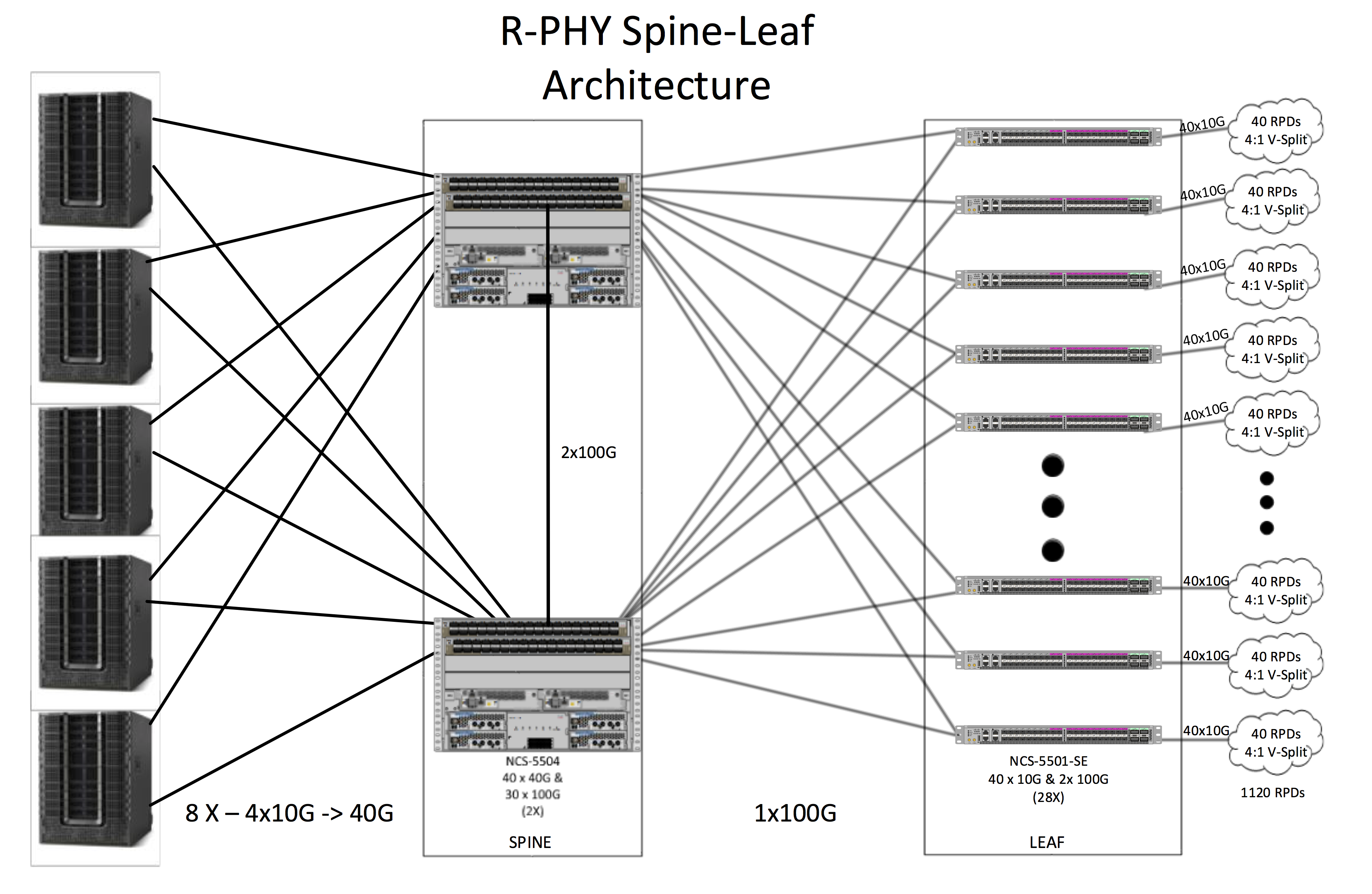
To summarize, we need to design an L2/L3/L2+L3 CIN with a non-blocking architecture, low and predictable latency, and with some level of mesh and redundant connectivity. We can look to modern data-center designs where these precise requirements are met using Clos network-based spine-and-leaf architecture.

The particular use-case for the spine-leaf architecture for the R-PHY CIN is to optimize east-west traffic. Since the CCAP cores predominately communicate with RPDs and vice-versa, both of these elements are part of a common spine-leaf construct. There will be a minimal amount of control plane and management traffic that will be north-south bound, but the amount will be trivial in nature in most deployments. This unique characteristic provides a way to optimize spine-leaf topology to be suited for the R-PHY CIN. Example Topology:


A well-designed CIN will pave the way for seamless deployments of RPDs in the production at scale. Additionally, it will reduce operational complexities associated with operating the R-PHY eco-system along with paving the way for future growth and migration to virtualization technologies.

Authors

Daniel Etman

Product Marketing Director

Cisco's Cable Access Business

Avatar

When you’re sick, wouldn’t it be great if you could talk to a healthcare provider on video, so they could check your vitals and chat about your symptoms? Without having to drive to a clinic? That’s a reality for Mercy Virtual’s customers, thanks to our partner World Wide Technology (WWT).

WWT says…

Our customer Mercy Virtual wanted to reach more patients wherever they were… usually at home. To bring them care that could keep them healthy, independent, and out of the hospital. Mercy asked us if we could build the technology to make it happen.

Many of these patients are elderly, so the virtual care had to be easy to use. Patients shouldn’t see anything except a seamless way to get what they need. But to give them that experience, the technology needed to be cutting edge.

We had to approach each technical challenge with the user experience in mind. So, if normally there would be 15 steps to go from point A to B to help that patient get their care, we tried to reduce that to maybe 6. As a Cisco partner, we already knew that Cisco products could integrate with other technologies. So, step by step, together with Cisco, we built out Mercy Virtual’s Engagement@Home program. Patients get an Engagement@Home kit to connect their data with the Mercy Virtual network.

Within less than five minutes, we’re able to look at their vitals, assess that, and have them on video face-to-face with one of our providers here, when most of them live 60 miles away from the nearest hospital.

Shelby Zytko, Navigator, Mercy Virtual

This gives caregivers a much greater sense of how patients are doing. Within a year of its introduction, Mercy Virtual saw:

  • 50% reduction in preventable readmissions for Engagement@Home patients
  • 35% fewer days in the hospital
  • 60% fewer septic shock deaths in patients treated remotely

There’s never been a better time to make the world a healthier place.

Thanks, WWT!

The story doesn’t end there…

Check out how Cisco helped WWT deliver virtual care with a human touch here.

Meet other Cisco partners helping customers around the world.

Authors

Julie Colwell

Marketing Manager

Global Partner Marketing

Avatar

These vulnerabilities were discovered by Marcin ‘Icewall’ Noga of Talos.

Today, Talos is disclosing several vulnerabilities that have been identified in the AntennaHouse DMC library which is used in various products for web-based document searching and rendering. These vulnerabilities manifest as a failure to correctly parse Microsoft Office documents and could be exploited to achieve arbitrary code execution. These vulnerabilities are being disclosed in coordination with AntennaHouse.

Vulnerability Details

Multiple heap corruption vulnerabilities exist within AntennaHouse DMC HTMLFilter that could be exploited to achieve arbitrary code execution on the targeted machine. These vulnerabilities manifest due to improper handling of Microsoft Office documents, such as Word and PowerPoint files. An adversary that passes a specifically crafted document to the converter could exploit one of these vulnerabilities. Note that the method that an adversary could compromise a vulnerable machine varies as this library is known to be incorporated into other third-party products.

Read more »

Authors

Talos Group

Talos Security Intelligence & Research Group

Avatar

Why 5G will need to be funded by the IoT

The continued explosion of smart mobile devices for connected users with increasing appetite for high-definition video, is fuelling a surge in mobile data traffic worldwide. Service providers coping with such growth need to find new ways to monetise their network investments and develop new business models with OTT providers, Enterprise and Industrial services. As we approach the 5th Generation (5G) of Mobile Networks from 2020, the opportunity for Service Providers to monteize their network investments on the next wave of global digitalisation with the Internet of Things (IoT) could not be greater.

According to Cisco’s latest Mobile Visual Networking Index (VNI) report, the volume of mobile data traffic will expand by another seven times over the next four years, reaching nearly 12 billion mobile devices and connections and generating 49 exabytes of mobile traffic by 2021.

By then, we will also see the industry transitioning to the 5th Generation (5G) of Mobile Networks.

With a more diverse range of Radio Access technologies, potentially ranging from those capable of 1 Gbps and ultra-low latency of 1 millisecond (ms), to those designed for mass deployment and multi-year battery life, 5G will complement, or even supplement, broadband connectivity and change the end user experience.

The average traffic per 5G connection, for instance, will be 5x relative to 4G connections.

A whole new digital infrastructure will be created to support high and ultra-high definition video and rich media telecommunications. This will increase the use of cloud applications and storage as well as promote the next stage of the web – the tactile Internet.

A tactile Internet, characterized by low latency, high availability, high bandwidth capacity and security, is necessary for virtual reality and emerging applications such as autonomous cars and remote tele-surgery.

While 4G has been driven by device proliferation and dynamic information access, Cisco’s VNI report reveals that 5G will mostly be driven by IoT, with resources allocated based largely on “awareness of content, user, and location.”

The rapid growth in smarter end-user devices and M2M connections is also a clear indicator that IoT adoption is on the rise.

By 2019, IoT connections will surpass smartphones, tablets and PCs combined, and by 2021, account for 638 million modules compared to 381 million for all other devices.

5G’s the next step in digitization

5G facilitates new services, each with unique needs, delivered by integrating a range of different types of connectivity into unified service delivery networks, and offering the unique characteristics the services require.

Combined with a virtual and cloud infrastructure, intelligent edge services and a distributed computing model, IoT users will be able to derive insights from the data generated by billions of devices.

These new insights will enable many industries to find new ways to leverage technology, ranging from connected cars, home and office security and automation, smart metering and utilities, maintenance, building automation, automotive, healthcare and consumer electronics. Consumers, businesses, and governments will be able to connect to and control everything around them.

Businesses can use real-time information monitoring to deploy new video-based security systems, while hospitals and healthcare professionals can remotely monitor the progress of their patients.

What’s key about 5G is that it isn’t about faster speeds or a new technology for service providers to upgrade their network. It’s the next step on their digitalization journey.

For IoT to thrive, the mobile industry must come together to ensure the next generation of networks can support a wide range of services and devices and seamlessly interoperate with one another.

They must find ways to monetize the higher usage of mobile data traffic while developing profitable business cases to support capital infrastructure expenditures.

The scale of 5G’s deployment over time is likely to see IoT go mainstream and take off in a big way.

5G networks, combined with IoT, can transform the world.

Research Sources:

Authors

Dirk Wolter

Head of Mobile Networks

Asia Pacific Region

Avatar

What happens when writer’s block hits and you struggle for days on finding the perfect words to tell Toby’s story?  Well, eventually, you just hand over the computer to your 3 year old Boston Terrier…and let him tell the story himself. 😉 So, everyone, heeeere’s Toby!

Hi, fellow Cisconians! You might wonder what a Boston Terrier’s favorite thing in the whole wide world is, and why it’s allowed him the unique opportunity to write a blog post for Life at Cisco – for me, it’s an easy answer! I love going to work at Cisco with my mom!  She’s been working there for 16 years now, and while she used to work remotely most of the time – recently, Cisco allowed pups to visit the office on certain days during a pilot program and so mom thought it’d be fun if we went in together so I could help her (and our other co-workers) tackle the day in front of us. I love being her Cisco sidekick!

When I’m at the office, there’s a lot of hard work involved – someone has got to do the innovating and collaborating (luckily I just get to help with this from the sidelines!) But I also love to make some new friends, and the Cisco offices are always jam packed with smiling faces and lots of love. Danita gave me a stuffed pound puppy with a squeaker in it. Mike the Security Guy comes by every time I’m there and scratches my ears real good.  Mildrenea sits by my mommy and is so nice, she lets me kiss her all the time.  The Cisco Family is definitely one I’m proud to be a part of!

I feel so important when I get to go to work with my momma.  She spends a lot of time on the phone talking to her customers and solving their problems, while I listen and take naps.  I have a blanket, toys, snacks and water right there in a safe place under momma’s desk – really everything a good little Cisco pup needs!

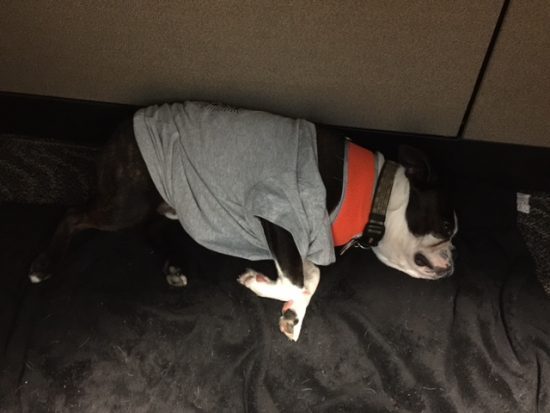
When she is on WebEx calls with her team, mommy puts us both on camera so everyone can see me and they all get really happy that I’m there!  One of her team friends even sent me a Cisco t-shirt that I wear sometimes when I get chilly in the office. Not too many pups can say that they’ve been pampered in such awesome ways!

This is a far cry from where I was at almost two years ago when my momma rescued me from the Boston Terrier Rescue of East Tennessee – they had saved me from a puppy mill when I was just a year old.  That first year of my life was pretty tough, I stayed in a crate and didn’t know how to play or interact with other doggies. But those days are long gone now that I have new pawrents that really love me, and Cisco enables my mom to not only focus on her work in changing the world, but taking me along for the journey.

Why do I love where my mom works? It’s easy! Cisco considers this little Boston Terrier part of the family. Join us!


Authors

Julie Wasmus

Partner Operations Manager

CPS - Public Sector – Supporting Federal Partners

Avatar

Welcome to the third and final blog of the Extending Care series. In past posts, we’ve shared key determinants in telehealth adoption, as well as the world of opportunity with EHR-integrated video. Now, we’re excited to release our new remote care solution – Cisco Extended Care.

Cisco Extended Care is more than just telehealth.

This solution leverages simple API frameworks and Dynamic Link capabilities to integrate with your existing EHR system. It receives scheduled appointment data from the EHR or other portal application’s telehealth workflow, and then uses that to launch the virtual video experience. See Cisco Extended Care in action in this demo:

https://youtu.be/HkCmByhVu34

A native virtual waiting room functionality provides a more authentic and welcoming experience for remote engagements. The provider can serve specific imagery and messaging to users while they wait for all participants to join the telehealth session, or enable triage workflows throughout the patient encounter.

Combined with the ability to redirect video to supported Cisco endpoints, as well as third party telehealth carts, providers can use the EHR client application running in a virtual desktop environment. This seamless experience allows a high quality video encounter through a dedicated video endpoint. Not only are consultations more natural, but this also ensures deployment is scalable in a virtual desktop environment, resulting in higher adoption rates.

The value of Cisco Extended Care is clear:

  • Easy and cost-effective deployment model by redirecting video to Cisco endpoints from EHR client thin-client environments.
  • Improve clinician efficiency and productivity by unifying EHR and video telehealth workflows to a single, cohesive familiar interface and process.
  • Close gaps and improve quality of care with proactive discharge follow-ups, intuitive portal access and reduced care continuum complexity.
  • Leverage your investment and reduce support costs by building upon your Cisco security, unified communication and video investments
  • Flexible and scalable integrations with Extended Care allowing you to not just integrate the system with the EHR’s client or web portal but also portals and clients from any number of third party vendors or those developed in-house.

Learn more about Cisco Extended care by contacting your Cisco sales representative or visiting cs.co/extendedcare.

Authors

Jason Mortensen

Global Healthcare Solutions Portfolio Manager

Digital Transformation Group

Avatar

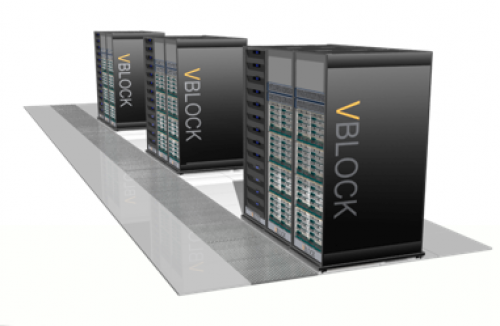
Next week the Cisco team is again excited to be attending Dell EMC World in Las Vegas. Cisco and Dell EMC continue to deliver tremendous value to customers through Vblock/VxBlock converged infrastructure systems. These systems combine the compute power of Cisco’s UCS servers, Cisco Nexus networking technology, with Dell EMC storage. The combination of Cisco and Dell EMC allows customers to adopt best-of-breed technology within a Vblock system that is easy to deploy and operate.

MARKET LEADERSHIP

According to the Q4 2016 IDC Converged Systems Tracker, Vblock/VxBlock is the leader in the integrated systems and reference architecture segment with 41% market share. We
continue to extend the value of Vblock/VxBlock with Vscale fabrics to easily scale out modern data centers and share resources across multiple Vblock systems.

SEGMENT LEADERSHIP
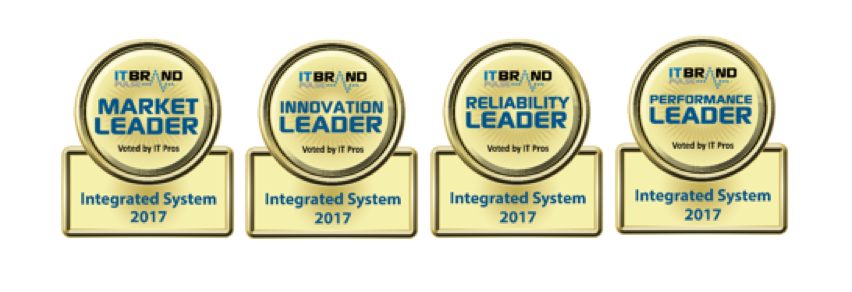
Cisco UCS based integrated systems continue to dominate that segment with greater than 70% market share. And, for the second year in a row, Cisco was named the Integrated Systems leader by IT Brand Pulse for market leadership, innovation, reliability, and performance.

Cisco UCS is a revolutionary system enabling:

  • IT to quickly respond to changing business conditions
  • Simplified and increased operational velocity by leveraging automation and ensuring consistent policy and security through policy-based configuration


Continue reading “Dell EMC World 2017: Vblock/VxBlock Built on Cisco UCS is The Leader in Converged Systems”

Authors

Tim Stack

Product Marketing Manager

Data Center and Compute

Avatar

Today, Cisco is announcing its intent to acquire the Advanced Analytics team and associated advanced analytics intellectual property developed by Saggezza, a privately-held technology services company.

As applications are moving to the cloud and billions of things are connecting to the network, our customers need a way to see and manage these increasingly complex networks. Cisco believes that analytics will play a critical role in building the next-generation of simplified, dynamic, automated networks. Network analytics form a critical piece of Cisco’s goal to provide comprehensive, end-to-end analytics solutions that span the entire technology ecosystem—including network, cloud, data center, security, applications, and business processes.

The Advanced Analytics team is a select group of platform analytics experts within Saggezza with unique capabilities in cloud and secure platform development. This team has been responsible for developing innovative technology that powers Saggezza’s internal analytics platform, which enables customers to rapidly acquire and analyze data, creating complex rules and new data visualization applications. With today’s announcement, we will acquire a cohesive and high-performing team of analytics experts to bolster our ongoing innovation in this space.  Similar to our just-announced intent to acquire Viptela, the infusion of Saggezza’s talent and technology will help accelerate development efforts related to Cisco’s Digital Network Architecture (DNA), our transformational architecture to more effectively automate network operations.

The Advanced Analytics team from Saggezza will join the Cisco Enterprise Networking Engineering Group, led by Senior Vice President Ravi Chandrasekaran. The acquisition is expected to close in the fourth quarter of Cisco’s fiscal year 2017.

Authors

Rob Salvagno

Vice President

Corporate Development and Cisco Investments