
Avatar

This post was written by guest blogger Carsten Johnson, CSR Consultant, Cisco Corporate Affairs & Cisco Berlin Girls Power Tech Site Lead

On April 27, my Cisco Berlin colleagues and I had the pleasure of celebrating International #GirlsInICTDay as a part of Cisco’s Girls Power Tech (GPT) initiative.

International Girls in ICT Day aims to create a global environment that empowers and encourages young women to consider careers in the growing ICT field, enabling girls and technology companies to celebrate and explore the benefits of greater female participation in the ICT sector.

Cisco Berlin was one of several Cisco sites that hosted an event on Girls in ICT Day to help kick-off the Girls Power Tech program. I could not be more proud to be a site leader this year.

It’s one of the many reasons I love working for a company like Cisco, which allows us to take the time to step back and focus on programs where we can give back, teach and mentor others, and make an impact in our broader communities. We all have unique talents, and it’s important we share those with others, and help them uncover their own along the learning journey!

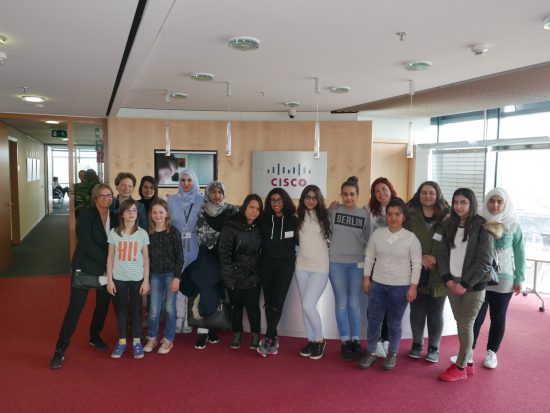
Our #GirlsInICT Day in Berlin was a very special and unique experience. We hosted a group of 22 girls—mainly middle school aged students—through Girls Power Tech. We were also thrilled to host three welcome classes (boys and girls) through collaboration with the Wolfgang-Borchert School; participants came from countries including Syria, Iraq, Serbia, Afghanistan and Romania and Turkey.

Our new partner in the Cisco Networking Academy for Refugees project, the REDI School for Digital Integration, provided two volunteers to cover the variety of languages spoken in the welcome classes. This amazing non-profit serves as a digital school for tech-interested newcomers applying for asylum in Germany; providing students with valuable digital skills to help create new opportunities.

Cisco Berlin’s work with the Wolfgang-Borchert-School has been an important partnership for the past 10 years and a cornerstone of Cisco’s NetAcad program. Through their welcome classes, children from refugee or migrant families spend the first 12 months assimilating to their new home in Germany and spend significant time learning the local language, as well as developing basic technical skills to help them succeed.

I was energized by the diverse range of Cisco Berlin employees who participated in Girls Power Tech and came ready to help make our #GirlsinICT Day a success. Our volunteers featured a panel of international interns and colleagues from several different regions leading several hands-on activities throughout the day and mentoring the students 1:1 in various activities.


We began our day by introducing the students to our global Girls Power Tech materials as well as a video conferencing exercise through Telepresence. We did some fun group reflection on the brand-new Girls Power Tech kick-off video, to enable the students to have the full global experience of being a part of an international Cisco community.

Our multi-lingual volunteers translated materials in German, Farsi, Arabic, Kurdish, Romanian and English so that all students could learn and easily participate. We then kicked off tours through the Cisco Berlin office, where visitors witnessed the power of Cisco’s digital innovations first-hand. Groups split up into teams among their common languages with a simple goal: to learn as much as possible through their own eyes!

Part of the tour also included a visit to one of our on-site demo labs. Splitting the students up into four groups, each had the opportunity to interact and converse with a Cisco systems engineer and better understand the machines that bring the Internet of Things to life.
During our workshops, we took the students through two hands-on activities. The first was a short robotics class, where students built a robot with just two small sensors. The second taught participants the basics of coding by asking them to build a model car. Using a vehicle that ran in only one direction, the girls had to identify how to turn the direction of the car.

Our curriculum allowed us to create a unique experience for our students, where we used the traditional Girls Power Tech approach and introduced our students from the Wolfgang-Borchert-School to new types of learning activities.

As a site leader for Girls Power Tech Berlin, I was personally inspired to see how digitization and technology impact everyone; and the importance of continuing to make sure that digital skills are a priority for all people.

In today’s world, we need to keep investing in these programs and resources for girls and all people, as we seek to close the global IT skills gap. Throughout the day, the message was clear to me: diversity and inclusion is an important part of who we are at Cisco.

We’re taking it seriously. I am grateful for the experience of being a site lead, and I strongly encourage anyone who is not currently involved in Girls Power Tech to get started and make a difference in STEM education! Together, we can accomplish great things.


Girls Power Tech, a Cisco Mentoring Initiative, is being celebrated by nearly one hundred Cisco offices in over fifty countries now through the end of May. This program will introduce over 5,000 young ladies to the world of possibilities a career in technology can offer. 

Click here to learn more about Girls Power Tech and Cisco’s commitment to STEM Education and be sure to follow all the excitement on social media by using the #GirlsPowerTech hashtag.

Authors

Austin Belisle

No Longer with Cisco

Avatar

Disclaimer: This is not a real job at Cisco, but you can use the link below to send in a resume. As much as we think we often use the Force in our daily jobs, and would really, really like some light sabers for real.

The Corporate Functions Recruiting Team (thanks Nan and team!) would like to show off their Star Wars geekiness, and thus, we present to you a job opening from a not-so-long time ago, in a galaxy that’s pretty close, actually. Cisco is looking for a…

JEDI KNIGHT

What You’ll Do

The old Republic is gone, the Empire is defeated, but the New Republic still faces tremendous challenges. You can be part of the next generation to bring synergy and innovation to a proven market leader in justice. Will you be the one to take up your light saber to defend the Light Side of the Force against the Sith, the New Order, renegade Ewoks, and all other Dark Side challengers? With your knowledge of the Force, you will provide sound advice to the younglings and potential new recruits to the Jedi Order.

Who You’ll Work With

You can join such industry leaders as Yoda and Mace Windu to capture the latest market transition of Force of Things (FoT).


Read on to find out the minimum requirements for the role, and even apply. Do you have what it takes to work for the Cisco Order?

http://cs.co/Applywiththeforce


Authors

Carmen Shirkey Collins

Social Media Manager

Talent Brand and Enablement Team, HR

Avatar

Market disruptions don’t occur every day or even in all industries. However, when they occur, for the most part, they end up vastly improving the experience or product that consumers benefit from. Nothing exemplifies this transformation more than the ride sharing market. Several large upstarts have shaken the core tenets of the transportation industry and indirectly led to reforms.

How did this disruption happen so quickly? For something as simple as ride sharing to get from point A to point B, the use of technology and big data analytics seems almost a non-sequitur but if we peel off the top few layers, we’ll find that there was a fundamental change in how the problem was approached and then solved – using big data and broader set of analytics. The use of data collection, processing and analysis was not important for consumer (rider) or service provider (driver) but it allowed for a seamless and efficient transaction between the driver and rider.

Not All Platforms Are Created Equal
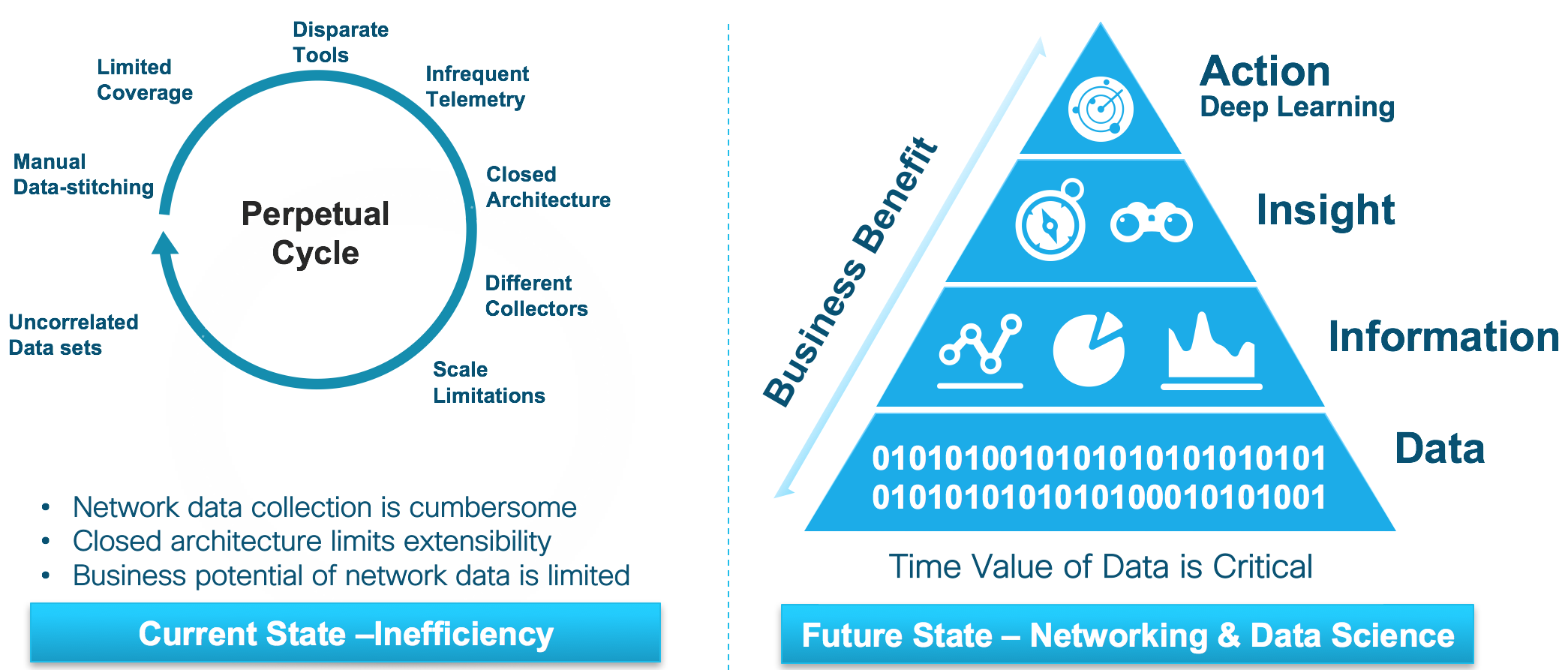
Underneath the hood of the ride sharing experience is a rich and complex data platform that handles a number of functions – route optimization, geo-location analysis, rider and driver context, payment estimates, billing information, ratings and feedback, and distributed intelligence on demand and supply. The “dirty layer” of data is critical but not exposed to users – this is key to its success. Can we apply these techniques to our business? Networking seems a far cry from ride sharing but many of the facets are common. If the same approach was used with network telemetry data, perhaps the inefficiencies seen in the current approach could be removed? The graph below on the left shows the current state of how data collection and analysis done. On the right is the desired state of converting network telemetry into insights and meaningful actions.

How would this platform for collecting, processing and analyzing network data be architected? What are the key functions that it needs to have in order to solve the traditional networking problems but also enable business insights? An ideal reference architecture should have the following approach:

  • Improves network efficiencies
    • By using distributed data processing that can create deductions and insights
    • Source from streaming telemetry, machine learned data and insights from network and transit traffic
    • Efficiently and securely transport data and insights to a repository
  • Eliminates analytical constraints
    • Integrating network engineering and data sciences onto a single processing stream
    • Providing contextual interpretation with network data graphs through outside sources
    • Make the processing and analysis scalable and extensible
  • Addresses developer friction
    • Allow access to data and insights without having to learn networking
    • Create an open ecosystem with standards-based APIs, query language and Devnet
    • Offer flexible deployment with built-in multi-cloud and on-premise support with multi-tenancy

If these tenets can be followed and designed into the architecture, the network telemetry data could be transformational and deliver the new level of experience in a space that is normally perceived as stodgy and complex.

Authors

Roopak Patel

Product Management Leadership

Enterprise Networking

Avatar

This post authored Sean Baird and Nick Biasini

Attackers are always looking for creative ways to send large amount of spam to victims. A short-lived, but widespread Google Drive themed phishing campaign has affected a large number of users across a variety of verticals. This campaign would be bcc’d to a target while being sent to hhhhhhhhhhhhhhhh@mailinator[.]com, to make this email appear legitimate the sender would be someone who had the target in their address book.

Mailinator is a “free, public, email system where you can use any inbox you want,” often used for throwaway accounts. In this instance, the Mailinator inbox in question could have been used by the spammer to monitor whether or not the email was successfully sent. The use of Mailinator, however, is not what made this campaign unique.

Read More >>

Authors

Talos Group

Talos Security Intelligence & Research Group

Avatar

When was the last time you filled an ice cube tray? It’s probably been awhile hasn’t it? When you want a cold beverage, you open up your freezer or click a button and boom, instant ice cubes.

Why should your wireless network be any different? With Cisco Flexible Radio Assignment (FRA), found in the Cisco Aironet 2800 and 3800 Series Access Points, your wireless network automatically adds capacity by changing the access point from 2.4/5GHz radios to dual 5GHz radios. It also monitors the network for security threats and RF interference that may affect performance.

But unlike the refrigerator analogy, Cisco is the only company that offers FRA. This means that Cisco has the only products where the access point automatically selects whether the radio should be 2.4GHz or 5GHz. Other companies offer dual 5GHz APs, but the customer has to manually assigned the radio band. FRA makes the dual 5GHz easy to deploy.

When you have a great feature like FRA, it worries the competition. HPE Aruba has been quoted as saying customers, “aren’t ready for 5Ghz networks” and suggesting that Cisco is claiming that 2.4Ghz radios aren’t needed any more. This isn’t true at all.

My colleague Wes Purvis explains, “The whole point of FRA is to remove excessive 2.4GHz coverage, which causes co-channel inference and is a detriment to the network. Many customers already realize they have excessive 2.4GHz coverage causing harm on their networks, so they go through and manually disable a percentage of the 2.4GHz radios.”

In other words, a dual 5GHz network provides a customer with more spectrum than the 2.4GHz.

Secondly, our competition claims that having an access point that has two 5GHz radios won’t work because it’s never been done right before. Technically, they do have a sliver of a point there. Before the Aruba acquisition, HP had a dual 5GHz capable access point with external antennas. The implementation never really took off. The idea of two 5GHz radios in one access point has been tried here and there, but hasn’t worked particularly well until the Cisco Aironet 2800 and 3800 Access Points were released last year.

But why does the two 5GHz radios in the Aironet 2800 and 3800 work? A number of reasons. One, Cisco separated the antennas.  Two, Cisco ensured that there is 100MHz of channel separation between the two radios. Three, in the internal antenna access points, Cisco engineers came up with a micro/macro cell concept where one radio operates at lower transmit power than its twin.

In this illustration, the micro cell provides High Density Service for a small coverage area while the macro cell simultaneously covers larger areas such as hallways and lobbies.

With the external antenna access point, a macro/macro concept was used where both radios operate at a higher transmit power.

In this illustration, with macro/macro deployment, Cisco provides more coverage with fewer access points. How does it compare against the competition? In the illustration below, more access points are needed for coverage in the HPE is deployment.

This is further highlighted in a test performed by Purvis (that you can view here) he set up two networks; one run by a Cisco Aironet 2800 access point and one run by two HPE Aruba access points. The reason for the dual Aruba devices was to create an apples-to-apples comparison of two 5GHz networks comparing the 2800 to a traditional access point. Since HPE doesn’t have an access point with two 5GHz radios, Purvis had to set it up this way.

The result was that the mobile device (an iPhone 7) connected to the Cisco access point received much more bandwidth than the device (also an iPhone 7) connected to the HPE access point. The Cisco bandwidth was also much more consistent as the two Aruba APs were interfering and stealing bandwidth away from one another. The device connected to the Cisco APs saw 550Mbps while the Aruba-connected devices saw only 355Mbps—not to mention you won’t have to turn off a radio on your new AP.

And that’s what the crux of the test shows: with the Cisco Aironet 2800 Series Access Point, you can plug it into your network and get a feature like Flexible Radio Assignment up and running. It’s really that simple. With the competition, you’re increasing your price and you’re spending hours designing your network to make sure that the access points are playing well with one another.

Still not convinced? Check out the independently run results from the Miercom report that shows these Cisco products crushing the competition.

So while the Cisco Aironet 2800 and 3800 Series Access Points may not be able to chill that glass of lemonade after a long day at work, it’s also a very cool product.

Learn more about the Cisco Aironet 2800 here and the Cisco Aironet 3800 here.

Authors

Byron Magrane

Product Manager, Marketing

Avatar

Talos has discovered an unknown Remote Administration Tool that we believe has been in use for over 3 years. During this time it has managed to avoid scrutiny by the security community. The current version of the malware allows the operator to steal files, keystrokes, perform screenshots, and execute arbitrary code on the infected host. Talos has named this malware KONNI.

Read More >>

Authors

Talos Group

Talos Security Intelligence & Research Group

Avatar

It is generally accepted that revenues for mobile service providers are trending flat to down. A recent ARPU report from Informa provides this picture in detail by country. Some mobile service providers have acquired content services as a way to boost this trend, but they admit that this too will eventually trend to flat again. What is needed is a new business model that goes beyond connectivity and bandwidth. There are a number of studies on digital transformation and 5G in particular that note the services for enterprise are strong growth opportunities between now the 2025 (and beyond). There is an in-depth 2016 report from the European Commission with a catchy title of “Identification and quantification of key socio-economic data to support strategic planning for the introduction of 5G in Europe” that projects a large growth in enterprise business for mobile service providers 5G network services between now and the 2025.

Figure-1: Operator revenue growth opportunity

For brevity, the report focused on only a few key business areas, but one can clearly see from the charts above that enterprise services makes up a very small amount of revenue for mobile service providers, but that it is projected to grow substantially in eight years’ time.

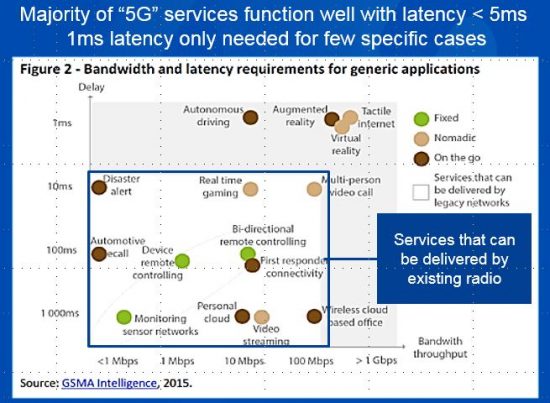
Another interesting study is a 2015 report by the GSMA on 5G opportunity. They discuss the technical requirements for 5G to deliver new services. You’re like familiar with many of these, like ultra-high reliability, ultra-low latency, etc. One thing that jumped out to me is a chart they used (see below) of a basket of “5G” services. They show that approximately 85% of these “5G” services can actually be delivered over existing radio technology if only the right 5G-ready network foundation was in place. This is really good news, because we all know that the most expensive parts of the mobile network is (a) spectrum and (b) radio. The rest of the network is a much smaller piece of overall expense. If you can actually deliver on a majority of 5G services without the expense of new radio (and hence gaining great value from your existing radio investment) that’s great news. Now you can be far more pragmatic with you planning.

Figure-2: 2015 GSMA Report on 5G Services

So, back to discussing the right network foundation. By “right network foundation”, we are talking about advanced automation and virtualized functionality. This includes network slicing over a distributed architecture that includes edge computing and the ability to place what resources are needed, where needed, and when needed. This is about the right time to pause and explain what 5G is from a Cisco point of view. Quite simply, the Cisco Open Network Architecture (ONA) forms an enablement platform for innovative services and applications. It is our unifying network fabric that simplifies this through advanced end-to-end automation.
So by now you are likely thinking, “OK Dan , that sounds nice and all, but how does a mobile service provider get from where they are today to this lovely Unified Enablement Platform and enterprise services nirvana? And how is this economically feasible?” I’m so glad that you asked. Cisco also takes a very pragmatic view of digital transformation and 5G. We believe it is advantageous to squeeze as much business potential out of any network investment as possible.

At Mobile World Congress 2017 in Barcelona, Cisco unveiled our 3-Phase Plan to your 5G success. The three phases are:

  1. Assess and build foundation
  2. Launch new 5G services
  3. Advance to 5G standards (once ratified)

Phase-1: Assess and Build
Cisco Services will work with the mobile service provider and create a complete 5G network assessment. This includes a present state model (of network and business) and a future state model (where you want to be and what they looks like). Once agreed upon, we transform the network into a 5G ready Unified Enablement Platform. This platform will leverage industry leading distributed virtualized network and service functions.

Phase-2: Deploy new 5G service (over existing radio)
Your network is now agile and operations simplified with advanced end-to-end automation and orchestration. You choose the service you wish to introduce, the orchestration creates the network slice and assembles the required building blocks to deliver the specific requirements and meet SLAs.

Phase-3: Advance to standard based 5G
Once 5G standards are actually ratified and standard-based technology is delivered, you already have the rest of your network in place and the rest can be added in a less disruptive manner. Additionally since you already have been delivering a majority of 5G services, you can have a more pragmatic approach to what and where you really need to add the 5G radios.

There are many benefits of the 3-Phase Plan beyond the most obvious – that you can sell 5G services well before 5G is ratified. The 5G ready Unified Enablement Platform is highly efficient and you can expect significant cost savings:

  • Up to 52% TCO savings for IP Transport network using Cisco CloudScale programmable technologies and segment routing
  • Up to 53% TCO by implementing the virtualized and distributed packet core (Ultra Services Platform)
  • Over 70% operational efficiencies through our advanced automation and orchestration
  • And you gain millisecond granularity through our telemetry and analytics

Cisco understands that transforming your business and network to take advantage of the digital transformation and 5G is difficult. But we have the expertise and leadership in IP infrastructure, Platforms and Automation. We are development leaders in our industry and we can help you deliver new 5G services today. And very importantly is that Cisco is uniquely positioned to help connected the service provider with enterprise customers and vertical opportunities. Like you we take a pragmatic view of this 5G transformation and can help the mobile service provider gain the most out of the digital transformation and 5G.
You can learn more about our 5G ready Unified Enablement Platform.

Authors

Dan Kurschner

Marketing Manager, Product/Systems

Avatar

The number and type of things connecting and communicating through the Internet increases every day. Business growth and success favors those who fully embrace IT innovation and create improved digital experiences for customers.


Look at the retail industry, where they are driving consumers’ toward the Omni-channel shopping experience. Retail understands that people use social media, online reviews and comparison shopping sites before they buy. And given their access to online or mobile store apps and traditional brick-and-mortar locations, retail stores need to ensure they connect with those users at every point, in a way that’s fast, reliable, and secure.

Ubiquitous connectivity and on-demand services are only going to grow. That means that retails will be competing in these environments and will require modern networking capabilities and distributed compute fabric that can provide the flexibility, availability and security to accompany those demands.


These new requirements are changing also the application landscape.


Applications are increasingly housed in the data center and in cloud platforms, and the Internet edge is moving to the branch and user devices.


There are certainly benefits to consolidating apps and services like this and delivering them over the WAN or the Internet. Such centralization gives you consistent security policy enforcement and can bring about IT equipment and staff efficiencies.


Such market trends put IT on the edge. Some will say on the edge of an evolution… and some will say on the edge of a cliff.


Want to meet one of our consultant for an intensive discussion? Click here

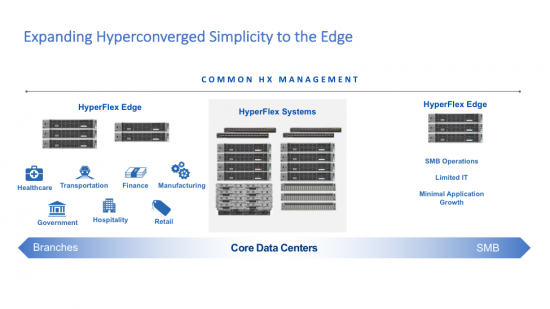
How can SMB and ROBO (remote office, branch office) in retails and other verticals best compete with those challenges? In a previous post, I described HCI & the benefits of Cisco Hyper converge  solutions, and I am thrilled to share Cisco’s new bundle: Hyper Flex EDGE:

A hyper converged solution which is tailor-made for the small business & ROBO.

A solution that take into consideration with existing networking, virtualization licenses and above all a solution that answers the Increased Compute & Storage Demands at the Edge.  Ready to deal with IT challenges and the willingness to deal with the increase demands on the edge.

Integrate into Your Existing Infrastructure, Intelligent Automation flexible deployment tailored to your specific needs and Simplified Operations with HCI and CI Working Together.

it’s a simple, elegant and price sensitive offering


with this recent addition to the Cisco Hyper converge family  a customer can choose the right solution to his business needs, scale as like,  while having the right economy model.

What are you waiting for? Start today:

For more information on Hyper Flex:

 TechWise TV Live: More Apps. More Simplicity. The New HyperFlex

Learn about  HX latest and greatest


Authors

Alon Sela

Marketing Manager

Enterprise Solutions & Data Center for South Europe

Avatar

There is no dispute that Cisco offers an unmatched portfolio of networking solutions that gives our customers the unique ability to simplify their IT infrastructure and optimize it for the many diverse on-prem and cloud-native applications they are deploying today. The Nexus 9000 is a foundational element of that portfolio that has been installed in almost 11,000 customer environments worldwide.

What helps truly set the Nexus 9000 apart in a very crowded data center switching industry is its Cloud Scale ASIC technology. We believe the advanced intelligence gives Cisco customers a two-year innovation advantage in terms of application performance, pervasive visibility, and security. Today, Cisco is expanding on the tremendous momentum we’ve had with the Cisco Nexus 9000 and Cloud Scale technology with more flexible ways to deploy them in their data centers.

Specifically, Cisco is expanding the Nexus 9000 fixed-configuration options with the introduction of two new Nexus 9300-FX fixed switches:

Continue reading “Scale Your Data Center with the Nexus 9000 and Cloud Scale Technology”

Authors

Tony Antony

Marketing

Solutions