Avatar

It’s all about customer experience in the digital world and that experience depends on the performance of your applications and their supporting infrastructure.  At a time when applications and technologies continue to increase in volume and density, how can you be sure your applications are running at their best?

IT teams are faced with a set of complex trade offs. Where to place application workloads:  on premise, public or hybrid?  How and when to scale them? What is the right quantity of infrastructure to assure effective operation?  Cloud, micro services and internet of things only increase the number of trade offs your teams need to make.  Data centers have become so complex, teams can’t assure application performance. Here’s why.
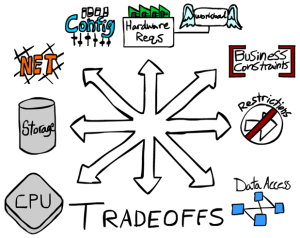
As a rule, IT assures performance  by over provisioning resources then relying on predefined alarms, alerts and metrics as early warning systems.  This model was designed to isolate issues on individual components; but performance issues are rarely isolated at the individual component level. There is an intricate connection between your applications and their infrastructure. Traditional monitoring solutions were not designed to look for these connections — let alone monitor them.

Your data center needs a solution that maps these inter dependencies.  A solution that can automatically make the trade offs between performance, cost efficiency and operational requirements.  You need a data center that is self-managing.

You need Cisco Workload Optimization Manager.  This solution works to create a dynamic equilibrium between workload demand and infrastructure supply.  It abstracts your data center into a virtual market of buyers and sellers and then applies market-based algorithms of supply, demand and price to optimize your environment.  Continuously monitoring the exchange of compute, network and storage against application demand allows your data center to automatically adjust to the ebb and flow of business.

Cisco Workload Optimization Manager installs within 20 minutes.  Within one (1) hour it delivers actionable advice for basic components (compute, network, and storage). Over the next 72 hours, it learns your data center’s patterns using 16 different metrics; then delivers recommended actions that assure balance between performance and cost efficiency. Some examples of these actions could be:

  • Right sizing a virtual machine
  • Moving a virtual machine from a host with high consumption to a host with less use
  • Provision a new blade or suspend it
  • Add ports to port channels or remove them

Like to know more?  Come to CiscoLive Vegas and make plans to attend one of these sessions:

Cisco Solutions Theater:      Wednesday, June 28th   12:30 – 12:45

Data Center & Cloud Education Zone:   Tuesday, June 27th 2:20 – 2:30 and Wednesday, June 28th 11:20 – 11:30

Solution Overview:  PSODCN-1145  Wednesday, June 28th   8 am – 9 am    Mandalay Bay, Level 2

To effectively compete in today’s business environment, your applications need to be running at their best.  Today’s data centers are too complex to guess.  It’s time to let software manage software.  Get to know Cisco Workload Optimization Manager today and then contact your Cisco sales representative.

Authors

Joann Starke

No Longer with Cisco

Avatar

This is exciting.

It has been just over a year since my first blog in which I stated, “To win in today’s market where disruptive startups and agile competitors are advancing on all sides, digitizing the enterprise to infuse greater agility and innovation is critical. This means transforming your operating model, which includes reimagining products and services and business models…” And in almost every blog since, I have touted the necessity of transforming your business and operating models to become a digital company.

By helping our customers reimagine both how they work (operating models) and the value they deliver to customers (business models), the completely refreshed Cisco Enterprise Agreement enables them farther along their digital transformation journeys and accelerates the pace of future progress. Here’s why.

A key barrier to digital transformation is complexity. In fact, the average amount of overspending due to complex software licensing is 25%*.  The evolution and alignment of Cisco’s operating model with its portfolio allows customers the flexibility to consume our innovation in a far more integrated way.

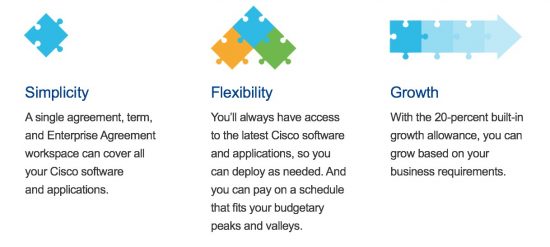
With the new EA, we have turned complexity into simplicity, a key enabler of digital business transformation. Now customers have a simplified buying model, a real-time consumption model view of licenses, and a blanket enterprise-wide contract. These capabilities allow customers to centralize license management, predict budgets, and have a strategic, multiyear relationship with Cisco.

The Cisco EA Improves Simplicity, Flexibility, and Growth—Three Keys to Digital Business Transformation

A guiding principle of Cisco’s own digital transformation is to provide more value through new business models and continuous innovation. Importantly, the new EA delivers the same abilities to our customers. They now have access to the latest improvements in Cisco software and applications across our networking, collaboration, and security portfolios. With this foundation, they can more quickly create and launch new business models that to win against disruptive competitors.

Next, the new EA encourages business success by giving customers a 20% growth allowance, eliminating retroactive charges, and providing a credit for existing solutions so customers always know the value of their Cisco investment is protected. In short, there is no longer a penalty for growth, a top business priority for any company fighting every day to thrive in a world of digital disruption.

The enemies of digital transformation are complexity, rigidity, and stagnation. The new Cisco EA removes these barriers and replaces them with simplicity, flexibility, and growth. This will enable our customers to transform their business faster, more successfully, and more securely than ever before.

* IDC Software Licensing and Pricing Predictions, 2016

Authors

Kevin Bandy

No Longer with Cisco

Avatar

We are at an inflection point where we are moving to a world where everything is connected to everything else. That’s what the Internet of Things (IoT) means. The IoT links objects to the internet creating the always-on economy by enabling data and insights never available before. By definition, the always-on economy requires real-time analytics. With analytics capabilities becoming the primary competitive differentiator, enterprises must now have the ability to analyze terabytes and petabytes of data, both in real-time as the data is being generated, and for business intelligence making use of past data. Increasingly, there is a need to join historical data with streaming data in real-time; something that has proven to be quite challenging as the size of the datasets have grown.

Analytics solutions have been a key part of our solution engineering portfolio from the very beginning when we introduced Cisco UCS back in 2009. This is true for both traditional relational-based systems, and emerging big data analytics (often described using the thee V’s: volume, variety and velocity; and sometimes with the three I’s as well: investments, innovations and improvization‎s).

Today I am happy to announce yet another addition to our growing portfolio of analytics solutions: Cisco UCS with MemSQL for real-time data warehousing applications.

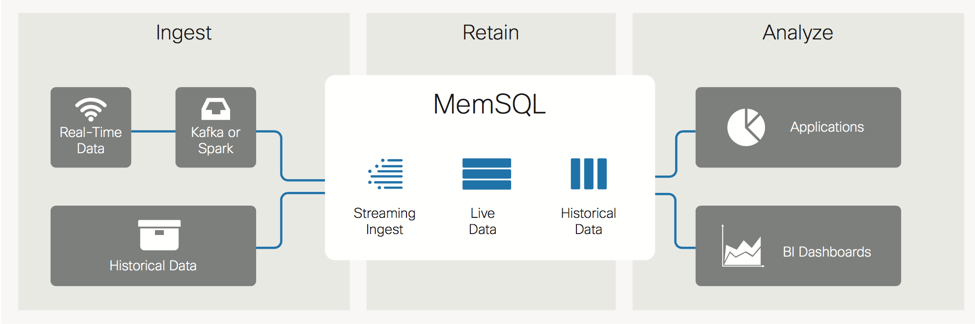
MemSQL is a distributed, in-memory, relational database management system with full SQL compliance. It can ingest and transform millions of data events per day while simultaneously analyzing billions of rows of data using standard SQL as shown in the figure below.

Some of the key capabilities of MemSQL include:

  • Fast data ingestion: Collect data using common message brokers such as Apache Kafka while maintaining durable, consistent delivery with exactly-once semantics
  • Fast analytics: Query terabytes of data with advanced data compression using disk-optimized tables with high compression and vectorized queries for fast analytics
  • Real-time analytics: Use memory-optimized tables to analyze real-time events
  • Geospatial support: Store, query and index geographic data types, including polygons and points, to support area, distance and location analytics in real time
  • JSON optimized: Store and query JSON data as a column type to efficiently store and analyze multi-attribute objects
  • Fully distributed joins: Scale out fully distributed joins across any table and column for simple, efficient query access.

Cisco UCS Integrated Infrastructure for Big Data and Analytics is an ideal platform for MemSQL deployments – capable of processing high volumes of real-time or archived data, both structured and unstructured.

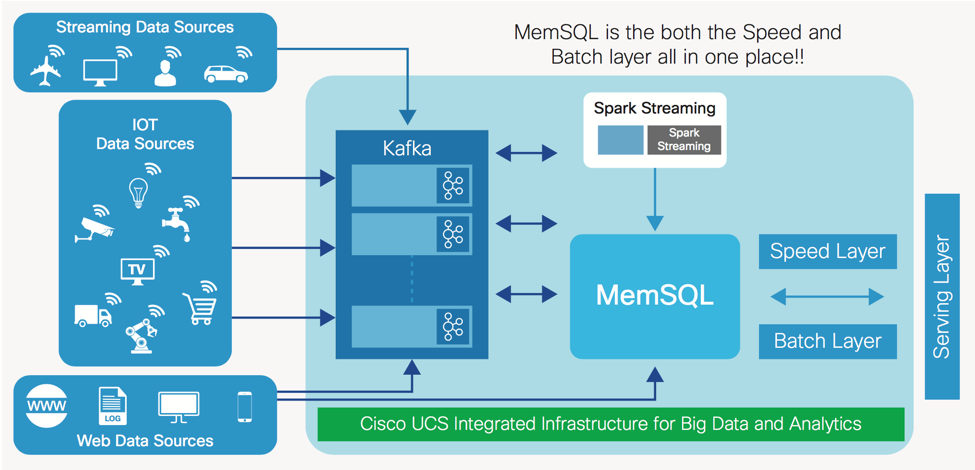
As shown in the figure below, our joint solution provides a scalable, real-time data warehouse platform for high-performance applications that require fast, accurate, secure and always available data, with linear scalability to millions of events per second while analyzing petabytes of data for insights.

The Cisco UCS Integrated Infrastructure for Big Data and Analytics with MemSQL provides a simplified, intelligent infrastructure and a real-time data warehouse with the scalability to meet growing business demands:

  • Combines innovations from Cisco UCS such as programmable infrastructure with real-time analytics capabilities of MemSQL
  • Designed and optimized for real-time analytics, internet of things, personalization and recommendations, risk management, monitoring and detection, and customer 360
  • Pre-tested, pre-validated and documented by Cisco and MemSQL engineers to ensure dependable deployments that can scale from small to very large as workload demands
  • Substantial business value for enterprise BDA deployments through scalability, performance, time to market, and cost effectiveness (Source: IDC).

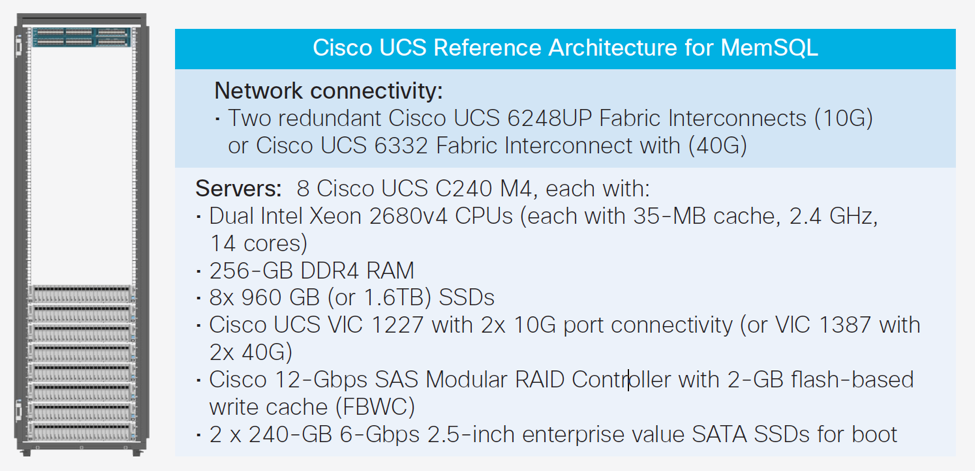
The joint reference architecture is shown in the figure below. The architecture can scale as the workload demands, including expansion to thousands of servers through the use of Cisco Nexus 9000 Series switches.

For more information:

White Paper: Real-Time Data Warehouse with MemSQL on Cisco UCS

Cisco Big Data Portal 

Cisco Validated Designs


Authors

Raghunath Nambiar

No Longer with Cisco

Avatar

He may or may not have hacked his mom’s cable box when he was a kid, he definitely worked for the Navy as a cryptologist, and he has since worked for NASA, the TSA, and Silent Circle. So Branson Matheson has a lot to say about information security and the desire for online privacy that most businesses and humans are currently so very interested in.

Did I mention that he now works for Cisco?

He does, and we’re really, really glad he’s on our team. Oddly however, his current job description is not security-centric at all. He’s a Cloud Systems Technical Lead, which is why we were eager to have him on our show.

We still asked him security questions (because how could we not?), but he also spoke with us about:

  • The different sides of the net neutrality argument, and who the winners and losers will be if the laws are changed
  • Which orchestration software is good for cattle and which is better for pets
  • Whether or not we’re really automating ourselves out of jobs
  • Successfully facilitating culture change within companies

See the video podcast on our YouTube page, listen to the audio version on iTunes, or check out our archives for past episodes. And if you like what you hear, we invite you to subscribe to our channel so you don’t miss any of the other exciting podcasts we have scheduled over the next several months. Thank you!

Authors

Ali Amagasu

Marketing Communications Manager

Avatar

The high performance, ruggedized design and multiple transport options of Cisco’s IoT gateways have delivered high value business outcomes ranging from increased operating efficiency with remote asset management to new customer experiences from Wi-Fi services onboard public transportation.

Yet, several mission critical applications remained unserved by current IoT offerings in the market. Customers in areas such as public safety, mass transit and transaction monitoring demanded WAN connectivity across simultaneous LTE networks. The Cisco IR 829 dual LTE gateway now delivers secure connectivity across multiple carriers with the simple management necessary to deploy and operate cost-effectively at scale as well as the edge application execution to transform IoT data into business insight and action.

Early adopters of the product include organizations such as the City of Olathe using the multipath LTE connectivity coupled with key features such as location aware GPS services for mobile communications with police vehicles and first responders.

The flexible communications options resident within the IR 829 dual LTE’s small, ruggedized form factor unlock new value for energy companies as well. For example, Great River Energy uses the IoT gateway across remote substation with the cellular network acting as alternative backhaul to their operations center working in conjunction with their primary WAN. The built-in Wi-Fi services provide secure connectivity for field services technicians at the substation to further streamline maintenance processes.


Mass transit authorities will benefit from redundant connectivity and options to provide services from multiple carriers.  The improved quality of service and configurable routing policies offer value for both passenger Wi-Fi services as well as service assurance for delivery of telematics data. Location aware services driven with GPS information from the IR 829 open the way for new services such as real-time arrival information and integration with digital display signs.

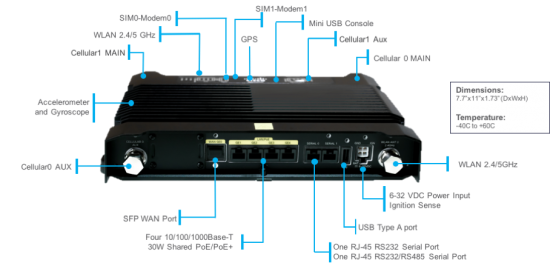
These IoT applications and many others benefit from the compact form factor, integrated 9-32 VDC power input, and dual multimode 3G and 4G LTE wireless WAN and IEEE 802.11a/b/g/n WLAN connections. The Cisco IR 829 dual LTE is designed for hostile environments including shock, vibration, dust, humidity, and water, as well as a wide temperature while delivering enterprise-grade wireline-like services such as quality of service (QoS), advanced VPN and edge application execution via Cisco IOx. The Cisco IR 829 further offers the flexibility to integrate with the Cisco LoRaWAN gateway for IoT use cases requiring integration of battery-powered sensors.

If you want to see how police cars get real-time data, stop by the cloud managed dual LTE IR 829 booth in the Cisco Live IoT & Industry District to watch a live emergency vehicle in action. I will also be presenting customer use cases featuring mission critical IoT applications in the IoT and Industries solution theater on Wednesday, 6/28 at 5:45 pm. See you in Las Vegas!

To learn more, visit www.cisco.com/go/ir829.

Authors

John Reno

Marketing Manager

Avatar

Many organizations today fail in adequately acquiring the necessary visibility across their network to perform efficient and effective Incident Response tasks, one of which is Intelligence-Driven Incident Response; defined as driving intelligence mechanisms to dig deeper into detecting, containing, and eradicating the latest cyber threats. Occasionally, adversaries may leave evidence on compromised devices which may be helpful for identifying Techniques, Tactics, and Procedures (TTPs) of value for attribution of an attack to a particular group, association, or individual; which allows responders to identify additional affected systems and pursue further leads. Such critical components to threat intelligence include Indicators of Compromise (IOCs), but are not limited to: file names, file paths, hash values, IP Addresses, Uniform Resource Identifiers (URIs), and common tools used by known individuals or groups.

Organizations often struggle in achieving this next-level of proactiveness without the precise logs required to investigate thoroughly. Many organizations simply can’t ingest every single log type from each technology used within the organization, furthermore are typically limited to the number of Events Per Second (EPS) into a central log aggregator or Security Information and Event Management (SIEM) product, whether it’s a bandwidth constraint, limitation of the product or even a license issue. While some enterprises may be fortunate enough not to have such technological limitations, others may simply not have the man power or expertise necessary to provide efficient and effective monitoring and detection. Whether this is a resource deficiency or absence of skill, some organizations tend to ingest as many logs as they can, and then leverage use of these logs when an incident arises in an attempt to conduct a thorough investigation and response.

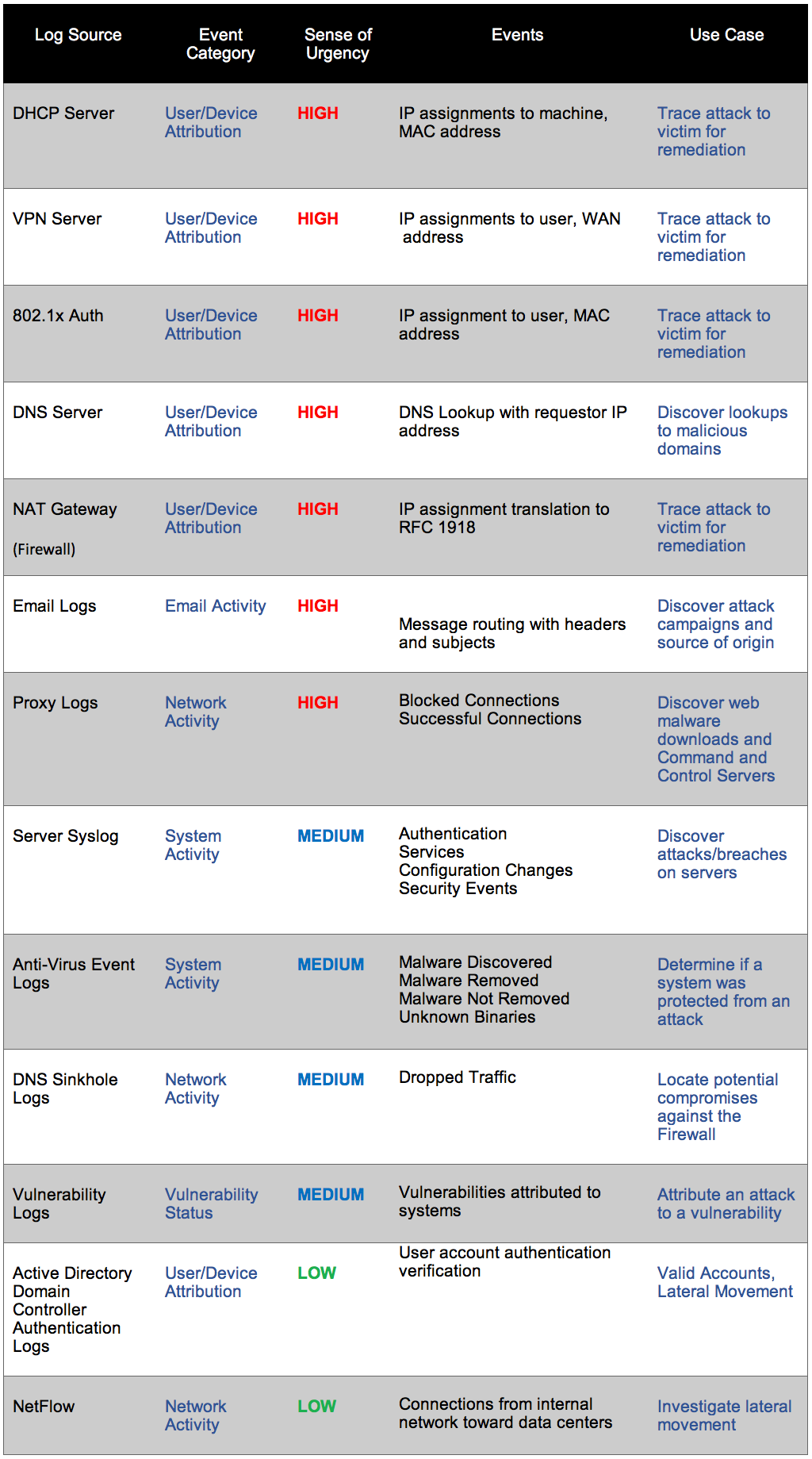
This is not the approach that should be taken and is why we here at Cisco, assist organizations in building effective, world-class Security Operations Centers (SOCs) that will help prioritize log sources based on the Use Case, Event, and Sense of Urgency desired to detect and prevent an attack as it happens, and impulse to more of an Intelligence-driven Incident Response competency, shown in the figure below. For instance, logs should not be ingested without first building a use case scenario for the business to determine if the use case can be successfully achieved. This is similar to building a business case for a particular investment in technology and answers the question of ‘What’s your end-goal’? All use cases have one end-goal which is attribution to the detection of a threat, a fundamental necessity to the response of an incident. However, a use case can’t be built without the technology logging the appropriate necessities, and vice-versa, attribution can’t be achieved without a successful use case.

A use case should also identify the key stakeholders, timeliness and lifetime, and the investment required (both from a time and monetary perspective) of the use case, for such to be fully operational, effective, and efficient within an environment. Regardless of where the limitation lies upon, addressing the constraint initially; will allow the organization to build a successful use case, incorporate the necessary logs, prioritize based on the industry relevancy that a threat (use case) may have based on previously discovered high impacted/high risk incidents.

By integrating such proactive measures, organizations can take an initiative to stay one step ahead before falling victim to a serious cyber security incident. Is your organization prioritizing the necessary log sources?


See how Cisco Security Advisory Services can help your organization here.

Authors

Aaron Varrone

Threat Management IC

Cisco Security Advisory Services

Avatar

As Cisco continues to transition our portfolio towards a software centric, subscription-based model, we are constantly looking for ways to help our customers simplify their software management and get the most out of their investments. To do that, we announced the Cisco Enterprise Agreement (Cisco EA), the next stage in the evolution of our former ELA 2.0. This new single enterprise agreement for our entire software portfolio provides our customers with a better, more simplified way to take advantage of our best-in-class technology portfolio, and it unleashes the power of our partner network.

As companies leverage technology to drive business growth, they are increasingly challenged by the complexities of managing their software. A growing, unmanageable number of contracts (hundreds to thousands) for a variety of licenses from multiple vendors is indirectly leading to a 25 percent budget overspend by our customers.[1] This complexity can also prevent visibility into software usage so companies are unsure if they are getting sufficient return on their investments. These problems often culminate in increased compliance risks for companies.  More specifically 70 percent faced retroactive charges from software vendors in the last 12 months.[2]

The Cisco EA provides our customers with a single co-terminated three- or five-year contract with enterprise-wide coverage across Cisco’s Infrastructure, Collaboration, and Security portfolios. In addition, the new Enterprise Agreement workspace portal provides the customer with self-service license fulfillment and a real-time consumption view. Customers select the suites their business needs today with the flexibility to add additional capabilities at any time. Their growth is easy to manage with 20 percent growth allowance and the industry’s first “Annual True-Forward” that allows unfettered growth with no retroactive charge.

What really excites me about this new Cisco EA is how it empowers our partner network to evolve towards more software oriented practices as well. You, our partners, have the unique opportunity to form strategic relationships with your customers to drive business outcomes and help guide them towards realizing the full value of the Cisco technology portfolio. With a simplified customer value proposition and lower minimum purchase requirements, not only will you be able to reach entirely new customers, but you will also have an interesting offer for a larger portion of your current customers. Additionally, the EA provides significant opportunities to build a Lifecycle Management practice and expand partner services. Leveraging Cisco EA’s unique Growth Allowance and True Forward features will also allow you to work with customers in developing a reliable strategic road map for growth with no unexpected retroactive charges.

The new Cisco EA plays a major role in Cisco’s move towards a software centric model. It provides our customers with ongoing value with a simple and flexible method for managing an end-to-end technology base that no other company can match. I can’t wait to see how our software practices grow together as we expand our customer base and generate more revenue through the Cisco Enterprise Agreement!

For more information, visit our Partner Launch Hub and be sure to check out Mark Hill’s blog on the Cisco Enterprise Agreement.


[1] Amy Konary, IDC, https://www.linkedin.com/pulse/idc-software-licensing-pricing-predictions-2016-top-10-amy-konary

[2] Zeus, Kerravala, ZK Research

Authors

Jason W. Gallo

Vice President

Global Partner Value Acceleration

Avatar

Note: The leadership team of Cisco’s Connected Asian Affinity Network (CAAN) would like to thank its executive sponsors and supporters for supporting this international give back the initiative. This program would not have been possible without them.

At Cisco, we cultivate change agents. We empower global problem solvers. We strive to positively impact 1 billion people by 2025. We encourage employees to seek out volunteering opportunities, to use their professional and personal skills to better the lives of others, and to improve the health of their communities, both locally and globally.

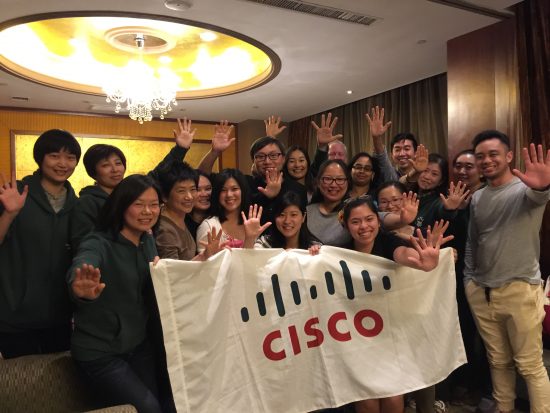
Recently, Cisco’s Connected Asian Affinity Network (CAAN), an employee resource organization (ERO) that focuses on cultivating more Asian leaders, sent several of its members to Shanghai to perform pro bono work for HandsOn Shanghai (HOS). The skills-based service trip was the first of its kind; the first global give back program within Cisco which offered employees the opportunity to volunteer their time and expertise on an international level.

Some of CAAN’s 2017 Global Give Back volunteers on the streets of Shanghai.

Selected members of CAAN collaborated with HOS’s staff between April 10-14 on four distinct projects. These projects included: enhancements of current mobile and web applications, the creation of marketing videos, acceleration of annual fundraising efforts, and development of HOS’s social media marketing and engagement strategies. Volunteers from California, North Carolina, Anhui, and Shanghai worked closely with their respective teams to complete their deliverables before returning to their ‘day’ jobs.

HOS currently organizes 120 regular volunteering events each month and offers more than 2,500 volunteer opportunities. They work directly with 75 community partners to provide services to socially vulnerable groups. They also create custom volunteering opportunities for multi-national companies to meet annual corporate social responsibility goals.

“We selected HandsOn Shanghai for our inaugural Global Give Back Program because we felt this NGO would create the greatest impact given their pre-existing relationships with local charities and multinational corporations like Cisco,” said Faith Lin, Community Relations Manager for Cisco. “HandsOn Shanghai fosters a culture of volunteerism; through individual action, volunteers create a collective impact to change the world.”

CAAN and HOS celebrate a productive week together.

As CAAN looks ahead to its next global give back location, its leaders hope other EROs will follow suit and offer similar pro bono trips for its members. CAAN’s inaugural global give back program proved that it’s possible to affect change in a short amount of time. But first, you must want to be the change.

Check out our video to see what we were able to accomplish through our HandsOn Shanghai partnership:

Authors

Austin Belisle

No Longer with Cisco

Avatar

124 hard-working Cisco employees. A modern skyscraper with fantastic city views. The best coffee you’ll find anywhere, hands down. Where can you find this office?

Welcome to Cisco Bogota, our main office in Colombia. I’m Lucero, I’m a Partner Advisor based in Costa Rica and a frequent visitor of Cisco Colombia, and I’ll be your blog tour guide today.

First, a bit about Bogota:

Bogota is located in the eastern territory of the Cordillera de los Andes, which means the city’s altitude is more than 2600 meters above sea level (over 8,600 feet, for those of you who are imperial system users.)

Even though the altitude isn’t as high as some other cities, if you live in a city with no altitude you will probably notice the difference. You’ll adjust over time, and you won’t get sick, but you might find yourself getting tired more quickly going up the stairs, and just feel like some things take more energy. The good side is that when you go back to a lower altitude, you’ll feel fit and have more energy!

Where to find Cisco:

Cisco Bogota offices occupy the 14th and 15th floor in the skyscraper I mentioned. Floor 14 is full of meeting rooms that are used to gather with clients and partners, and this is likely where you’ll enter as a visitor or if you have an interview. Our lobby ambassador is quite helpful and friendly.

Floor 15 is for Cisco employees only, and features lots of desk spaces and smaller meeting rooms for team gatherings.

Colombia views
The view from the 14th floor.

Prepare to be amazed:

If there is anything that I loved since I first stepped into the office, it was the city view. The building gives you a 360 view of Bogota city. The east side will give you a view of Usaquen and the mountains, but my personal favorite is the west side, it will give you a view of the entire city and amazing sunsets are a plus.

Colombia sunset
Sunset view from the 15th floor.

What should you wear?

The weather in Colombia is always fresh, with an average temperature of 10 degrees Celsius. It gets a little cold early in the mornings so if you are visiting remember to bring a coat.  Colombia is still a formal city when talking about business, so if you have important meetings dress accordingly, otherwise business casual is the norm on floor 15.

Let’s talk coffee:

Coffee lovers get ready to fuel innovation with one of the best coffees in the world. Yes, you heard me right. Colombia is known for having some of the best coffee anywhere. So take advantage of the onsite coffee machines, ask someone in the office to help you make one OR just walk five steps outside of the building and you will get to Juan Valdez. If you are not a coffee fan, you can always order a hot chocolate. But when in Colombia, you have to at least say you’ve tried from-the-source Colombian coffee!

Colombian Coffee
Colombian coffee with a side of view. Yes please!

Fueled with coffee, ready to innovate, but now you’re hungry!

There isn’t an onsite café in the office, but honestly, you don’t need it. Just in front of the building, you can find a mall full of restaurants and one block away is Usaquen, a place known for having some of the best restaurants in town. So why stay in the office for lunch when you can walk ten steps, try some delicious Colombian food and enjoy a great colonial view?

Where to stay when you visit:

There are hotels for every need in Bogota. There are three really close to the office. The W is right in the building next to the Cisco Office. There is also a Novotel just a few steps away. My personal favorite is the Hampton by Hilton, which is a newly constructed hotel just three blocks away that has a great view of Usaquen’s church (If you chose this hotel ask for a fifth floor room or above, you will get the best view.)

Spend extra time in the city:

There are countless things to do here. You can take art tours, food tours, coffee tours, and hiking tours; there is even a graffiti tour. There are also many museums, like the famous Gold Museum or the Botero Museum. However, what you cannot miss is Monserrate.

If you have short time I would recommend waking up early and heading to Monserrate. The first funicular leaves at 6:30 a.m. and it takes 5 minutes for it to reach the top where you can enjoy a full view of Bogota city. Early in the morning, you have the whole place to yourself (and maybe a couple of joggers).  It takes about half an hour to get to Monserrate from the Cisco Office so going early morning means you can easily be back at the office before 9am.

Monserrate morning view
The view from Monserrate at 7 a.m.


By night, do not forget to visit Andres Carne de Res. It is the craziest restaurant you will visit, you will have good food, and a great time, I promise. The most famous one is just outside the city but there is also one in the Zona T where you can have just as much fun.


Don’t you want to work at Cisco Colombia, or any of the other sites around the globe?  Here’s where you can find all open opportunities.

Visit some of the other Cisco sites with more Cisco site guides here!


Authors

Lucero Fernández

Partner Advisor

Latam Partner Organization