Avatar

This year’s theme at Cisco Live in Las Vegas (June 25-29) is all around empowering IT – the superheroes who keep our networks humming while leading us through amazing technology transformation. The Technical Services team has been hard at work preparing a showcase of our industry-leading super powers for keeping your infrastructure running at peak performance. Don’t miss these five opportunities to learn about the latest tools, technology and best practices from Cisco Technical Services.

1) Attend the Cisco Services Innovation Showcase

Join Denise Cox, VP of Cisco Technical Services, for an inside look at how companies are embracing the current IT evolution. Learn how technology roadmaps, analytics and TAC innovations can help you resolve issues before they affect your network. Can’t make it to Vegas? Catch the live stream of the session.

2) Stock your tool belt with these Technical Services sessions

The pressure is on for IT to accelerate ROI and business outcomes with software, cloud, automated networks and more. Check out these sessions throughout the week and learn how technical services can help you stay ahead of the curve while defending the network and simplifying complexity.

Monday

  • 12:00 PM: Lunch & Learn – Software Support Services: Accelerate ROI of Cisco Software
  • 3:30 PM: Automation and Analytics Driven Services – schedule here

Tuesday

  • 12:00 PM: Lunch & Learn – Upgrading Your Network? Premium Support for Next Generation IT

Wednesday

  • 12:30 PM: Maximize the Business Value of your Network with Premium Services – schedule here
  • 3:30 PM: Services to Help you Move to the New Network with Confidence – schedule here

Thursday

  • 11:15 AM: Cisco Technical Services: The Edge You Need when You’re IT – schedule here

3) Visit the Services Booth for informative demos, fun and prizes

This is the place to get hands on with ground-breaking tools that will help you automate product support functions, manage your Cisco inventory, and let you connect devices to the Cisco TAC for proactive support. Our experts will also be onsite to talk about innovations to software, multivendor, and network-level support that will help you adopt new IT solutions.

And in case you need another reason to visit us in the booth, we are debuting our Services Experience Room filled withsix different games, including Cisco Solution Support Kingpin. Yes, that’s right, it’s a bowling game where you’ll be knocking out those digital network issues. If you play five games or more, you can enter to win a daily drawing for a GoPro.

Drop in on us at the Cisco Services booth located in the World of Solutions, opening Monday to Thursday at 10:00 AM.

4) Talk to a TAC engineer…and more

Interact with the best and brightest members of our Technical Services and Learning@Cisco teams. Check out a technical seminar or drop in on a self-paced lab. Visit the Technical Solutions Clinic to consult with TAC engineers on your toughest challenges and discover new solutions. No appointment necessary – just come on by.

5) Engage with us on social media

Especially for those of you who won’t be able to join us in person, you can follow the conversation and see the highlights on Facebook, Twitter, and LinkedIn:

You don’t have to be super human to navigate your next IT transformation – Cisco Technical Services has you covered! We look forward to welcoming you in Las Vegas.

P.S. Have you taken the IT Superhero Quiz yet? I’m Major Shift. Which one are you? Let me know in the comments below.

Thank you,

Joe Pinto


Authors

Joe Pinto

Senior Vice President

Cisco Technical Services Group (CTSG)

Avatar

Last weekend, I had the opportunity to deliver a keynote speech at the Global Software Architecture Conference, in Santa Clara, California, about digital disruption and the future of technology innovation. Today, I’ll share the key takeaways, including the complete presentation (click below).

Although Gartner’s definition of Digital Business has been around for quite some time, people find it very difficult to realize the amazing transformation happening around us. From the days of the first general purpose computer ENIAC that carried out 5000 operations/second at the cost of $5.5 million in 1946 to today’s musical greeting cards that are 1.1 million times less expensive and 800 times faster, the technology industry has come a long way in today’s IoT-centric world.

Digital business is the creation of new business designs by blurring the digital and physical worlds.

With new business and consumption models of “on-demand,” and “as-a-service” becoming more prominent, the pace of disruption is accelerating with democratized innovation. Governments in some countries are launching special programs to leverage the global innovation ecosystem. Cisco’s global innovation centers are a proof point of this corporate mindset shift.

One of the biggest concerns about digital disruption is the loss of conventional jobs. Both Bill Gates and Mark Zuckerberg have expressed their perspectives on how AI and robotics are matching human cognitive skills and capabilities as a result of technology developments in recent times.

Bill Gates has proposed even a robot tax for companies deploying robots that take away human jobs. Irrespective of the legal and ethical implications of replacing humans with robots in a myriad of fields, the real transformation is about how human potential will be perceived and used in the future.

A seismic shift is happening in human employment. It’s changing skills from hand-based (blue collar) to head-based (white collar) to heart-based (no collar at all?).

According to some viewpoints, only certain skillsets are safe in an increasingly AI-centric world. These skillsets relate to communication, compassion, empathy, creativity, and other heart-centric emotional intelligence aspects of human beings.

Winning this digital disruption game requires a 4-I approach: Innovation, Investment, Internalization, and Introspection. Using innovation as a discipline to invest precious time in internalizing the thought process is the recipe for success. Innovative practices should become a natural habit similar to brushing one’s teeth. It just happens.

Continuous introspection helps us stay focused and calibrated on the path of mindful innovation. At the end of the day, success is measured in how many seeds we’re planting today—and not the yield we’re harvesting.

Do we really want machines to outsmart the human race?


Authors

Biren Gandhi

Head of Drone Business & Distinguished Strategist

Corporate Strategy Office

Avatar

A while back, I blogged on a survey that market research firm Ovum ran to help us with market research in NFV and SDN professional services.  While it wasn’t our principal objective in this survey to measure competitive position, we did receive some very interesting competitive perceptions from the service provider respondents.   In this survey, conducted in 2015, Ovum found that both Service Provider and Enterprise respondents rated Cisco as top #1 for Professional Services for SDN and NFV.

In early June (2017), we in Cisco Services received more good news!  Market research firm IHS released their “SDN and NFV Vendor Leadership Global Service Provider 2017 Survey“, and I’m delighted to say that Cisco was reported as the #1 leader for Services and Support in both the SDN and NFV categories.  (Note that Cisco tied at #1 with one other telco vendor in SDN, and was the sole #1 in NFV Services and Support, where that other vendor was joint 4th).

The IHS SDN & NFV Vendor Leadership Service Provider Survey resulted in a detailed report that provides service provider ratings of software-defined networks (SDNs) and network function virtualization (NFV) vendors. The study assessed how service providers rate SDN/NFV vendors in 9 categories, including : product roadmap, security, management software, product reliability, price-to-performance ratio, service/support and other categories.

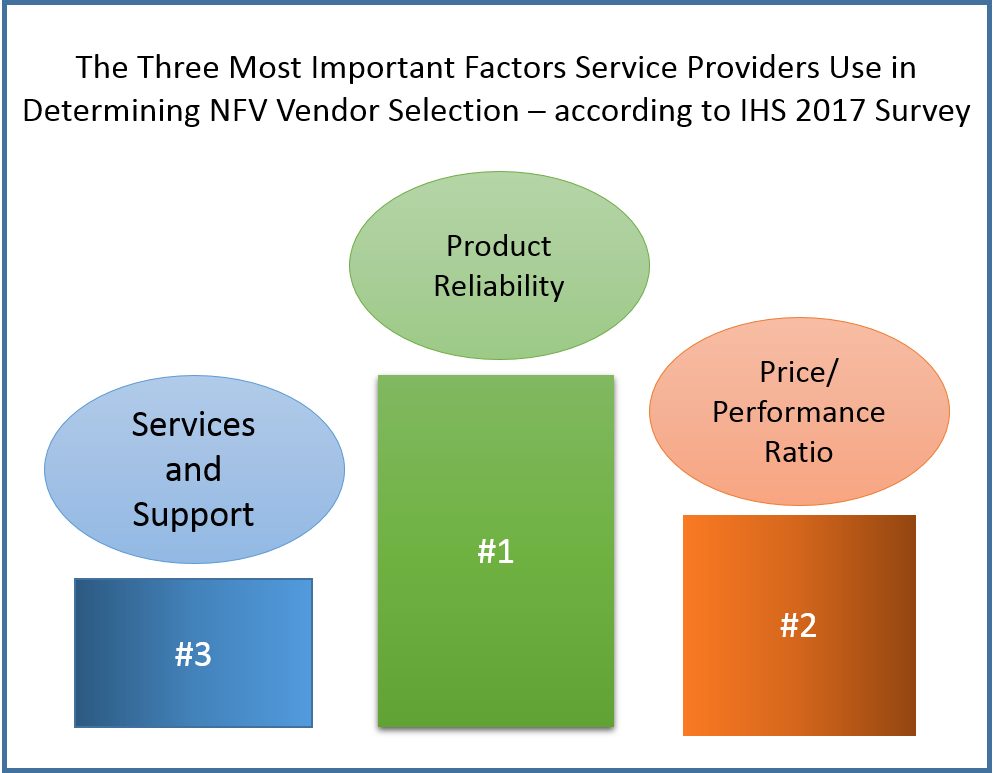
I was particularly interested in vendor selection criteria: how important were professional and support services to communications service providers deciding on a NFV partner? After all, I’d argue that many in technology view the innovation, product roadmap and performance statistics as being most important.  The customers in the IHS survey reported differently, indeed services and support was rated #3 most important factor that CSPs use to select NFV vendors, after Price/Performance ratio at #2 and Product Reliability at #1, as illustrated below.  Note again that IHS measured 9 factors – so it’s not just these 3 factors that matter, although they were judged most important in helping CPSs choose their NFV vendor.

In conclusion, if you are evaluating NFV solutions for your future service provider roadmap, make sure to evaluate the professional services and technical services offers and capabilities of your potential vendors.  Don’t assume that all vendors are created equal. The IHS report shows that your competitors certainly will be doing precisely this!

I’d like to thank IHS for firstly producing such an insightful report and secondly for granting me permission to replicate the above conclusions from their report.  Details on how to obtain the report are available here, at SDN and NFV Vendor Leadership Global Service Provider 2017 Survey on the IHS web site.

Authors

Stephen Speirs

No Longer at Cisco

Avatar

On July 16, 1997 my life changed. Arriving six weeks early, and changing our entire focus in life, Alice Elizabeth entered the world and my wife, Iris, and I were overjoyed. For the next 16 years this was to be the only time she was ever early for anything. 😉

One thing I never suspected on that Wednesday morning in 1997 as I held my daughter for the first time – thinking how small and vulnerable she felt while I looked down on her – was that 19 years later she would be driving us to work. Those car rides are always filled with laughter as we share stories of her exploits and those of her Cisco colleagues.

Yes, you read that right. Both Alice and I work for Cisco, and we truly love where we work!

I have worked at Cisco in sales for 14 years, eight of those years as a high touch end user account manager and five were as a partner account manager. Alice has now been at Cisco for eight months on our degree apprenticeship program working towards a B.S. in Digital and Technology Solutions. As we’re a Cisco family, of course, we added a CCNA for her to pass this year to help keep her on her toes.

So how did this fortuitous turn of events come about? Alice, like 95% of young people in my experience, had no assured vision of what she wanted to do post university. She had applied for university and had secured a place for 2017 to study business management and that was written in stone.

However, our HR team is quite excellent in promoting the wider benefits of being an employee at Cisco, and this is something I will be forever grateful for. Thanks to HR and the work of my colleagues, Alice had the benefit of “growing up” Cisco.

Our technology is hidden from most people’s day to day world. They don’t realize all the incredible things we’re working on like Jimmy Kimmel’s Wall of America or that we’re the tech behind being able to order your Starbucks through your mobile. So, to many, Cisco is a “hidden company”.

This was not so for Alice!

Alice was able to come to Cisco when she was 12 for our “Bring Your Kids to Work Day” – she did the same again the following year. When she was 15 she spent a week with my colleagues in the UK Service Provider team. And when Alice was 18, she attended a week long work experience event organised by the wonderful Kathryn Baddeley and her team. And these events opened up the world of Cisco to Alice.

When I first broached the subject of Cisco apprenticeships with Alice, I could see that her heart was set on attending university with her friends and the fact that she had received an offer from her University of choice had, in her mind, secured her next three years. However, after talking it through, Alice agreed to apply for the apprenticeship by way of a good learning exercise and life experience (plus I suspect to keep her Dad – someone who got into the industry by way of an apprenticeship in 1981 – happy!). Her reluctance was driven by the perception of the apprenticeship being technically focussed, but this is not the case at all!

Subsequent to her interview, Alice expressed her new view that Cisco was the future for her! After a number of nervous and tense weeks awaiting word of Alice’s status, we finally received good news – Alice had been accepted!

So how have the first eight months been for us both? For Alice she said joining Cisco was a bit like getting on a running machine when it’s already going. I think this is more a reflection of going from 15 hours a week at college to a full time role. I see her studying in the evenings and also on the weekends as she absorbs all this new information.  She certainly recognises that she has the opportunity of a lifetime working for a company such as Cisco and the opportunity to work from anywhere in the world.

For me, I couldn’t be “more proud” to quote the Cisco vernacular. I am proud of Alice and proud to be a part of a company that truly invests in a young, dynamic, and diverse workforce.

The question I get asked most by people when I extol the virtues of the Cisco apprenticeship program is, “Did Alice obtain her apprenticeship because you work at Cisco?”

It’s an obvious question to ask and I always respond by saying that, in a way, she did – because I took advantage of the opportunities that Cisco offers to all our staff to expose our children to IT when young and I was, of course, the one who told her about the programme.

Outside of that, and in terms of everything else, however, that was up to Alice and her performance on the day. Cisco is strictly performance driven in the admissions process. So, of course, Alice achieved this apprenticeship on her own accord as well.

As to the future, I tend to avoid being anywhere near Alice at work. I want to give her space to learn and grow all on her own. After all who wants to see their Dad at work no matter how much you love them? I am just happy that we get to share in these moments together, of sharing laughs while riding in the car to work, and truly loving where we work!

It is so important to me that other Cisco employees know what valuable benefits we have, and I have even emailed my customer’s staff to ensure that they are aware that their children also have access to such a great opportunity! I believe that true equality is about equal access to opportunity – and I believe we are a part of ensuring that happens.


Are you interested in the apprenticeship program? You can find more information here!


Authors

Martin Hardy

Partner Account Manager

UK Partner Organisation

Avatar

Network plugs

Software Defined Networking (SDN), and the dizzying number of different ways IT organizations define it, continues to be a moving target.

However, whatever the definition of SDN is this month, it is clear from talking to customers and seeing how the large web and cloud providers are transforming their operations, that all IT organizations will eventually bring automation and programmability into their IT operations. To be honest, if they don’t, they will eventually get left behind.

What is also clear is that like any new technology or method of operations — in this case automating network operations — each customer will be at varying levels of programmability skills, understanding of new tools, and breaking away from command-line interface (CLI) operations in general. For these reasons and others, I like the approach Cisco is taking around SDN, programmability, and automation.

Offer Options

As the SDN hype has begun to settle, Cisco offers options, recognizing that each IT organization is at a different stage of developing in-house expertise. Moreover, no two network environments are the same; it is almost certain that more than 90 percent of the IT organizations looking to leverage automation have a current install base they need to support as well. This is where the offering of SDN options applies.

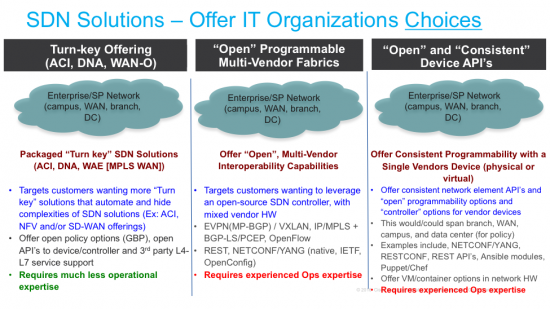
I have been referring to this as the “three-pillar” approach to offering customers options as they begin to embrace and begin to insert automation and programmability into their IT network organization, including heterogeneous multi-vendor environments.

What are these three options?

Prescriptive Turn-Key Solutions – This offering is for those customers with a limited amount of automation and programmability skill sets within the operations teams. The solutions Cisco offers in this category hide a large amount of complexity from the customer, offering a prescriptive solution that typically automates on-boarding of new network elements (plug-and-play), pre-built graphical user interface (GUI) applications, and automation of the fabric configuration which could take days/weeks using CLI. These solutions clearly target simplification and automation in a shrink-wrapped type of solution. Examples of these solutions from Cisco include:

Open Programmable Cisco hardware/Virtual Network Functions (VNF) – This capability targets those customers desiring Cisco hardware/VNF, but that also prefer open-source controllers (Ex: Open DayLight) and/or a rich set of “open” automation tool sets driven from in-house developed applications not requiring a controller. This type of customer has typically already embraced a DevOps model and “do it yourself” mentality within their IT operations team, is moving towards a model driven capability for configuring or abstracting telemetry from the device, and is leveraging native and open source tools for automation, and even programming their own applications. Examples of open source tools and data models offered by Cisco and gaining traction in the network automation space include:

Support for Heterogeneous Hardware/VNF Environments – This option targets those customers that have either embraced a multi-vendor hardware/VNF environment, or must operate in a heterogeneous environment for other reasons. From an automation and programmability perspective, this approach is much like option two above: It also uses open source tools like YDK or Ansible, open standard communications protocols such as NETCONF, and a combination of native and open YANG data models. But here we also add a common open standard transport data plane and control plane at the network layers, capable of supporting multi-vendor networks.

Multiprotocol Label Switching (MPLS) with multi-protocol BGP (MP-BGP) is a good example of multi-vendor solution that has existed for many years in service provider and large federal networks, with an open standard interior gateway protocol as well. As this approach moves into the data center and campus networks, open standard solutions such as E-VPN/VXLAN, Segment Routing with PCE, and others are gaining traction. The key point here is, in addition to open standard automation and programmability offerings needed to support a multi-vendor environment, the need for an open standards transport must also be considered.

While offering options to customer and accommodating solutions to match their network operations skill set is a needed approach, there are key trade-offs for each of these solution offerings that must be considered within a federal agency. The prescriptive option is ideal for those organizations that don’t have deep skill sets to build their own automation environment, or the solution explicitly targets offerings an agency can leverage immediately. However, for vendors to accomplish this level of simplicity and innovation, the solution may require pre-standard offerings and specific capabilities tied to the network OS and hardware.

infographic
Options at a glance

On the flip side, “open” solutions clearly offer more capabilities for heterogeneous environments, but they demand an advanced skill set and even DevOps experience within the network operations team. They also can bring challenges dealing with multiple vendor network operating systems, hardware and inconsistencies of supported features. In addition, typically in multi-vendor networks the designer must design the offerings and capabilities towards the lowest common denominator of support across all of the vendors, and that common level is almost always far less feature-capable and innovative than solutions from a single vendor. This is not to say the open solutions are a bad thing, these are just factors we have learned through experience that need to be considered in the overall evaluation.

Offering choices to customers as they move down the SDN/automation/programmability path is, in my opinion, no longer an option, but a necessity. The key point is aligning those options offered by single or multiple vendors, to the needs of the Federal IT organization.

Lastly, if you are new to automation, don’t try to do everything at once. Focus on automating operational processes you perform in your network operations on a daily basis. You will quickly see the power of network automation.

Authors

Craig Hill

Distinguished Systems Engineer

U.S. Public Sector, CTO Office

Avatar

Take A Few Tips From Gartner…

Analyst reports are a valuable tool I often use to help me better gauge the market and plan out my team’s strategy and goals. I relish taking a deep dive into industry intelligence and insights to help shape my approach to enterprise networking – and at times challenge my thinking. One recent analyst report really grabbed my attention, which is why I think it might pique your interest too.

Unlike some other reports I have read recently, Gartner’s 2017 Strategic Roadmap for Networking really opens up our horizons to explore what the future of the network holds for us all — and more importantly where IT leaders need focused efforts. And somewhat surprisingly, perhaps (as Gartner and Cisco haven’t always seen eye-to-eye on everything), I believe this report aligns closely with Cisco’s technology vision, strategy, and roadmap.

If Gartner, the leading IT analyst firm, and Cisco, the leading networking vendor, hold complementary visions about the future of networking, perhaps we’re both on to something. I thought it would be important to share a glimpse into exactly what those visions hold.

The future-state network
In my own conversations with CIOs and IT leaders, there is a common recognition that they have to change their networks to keep up with their organizations’ fast moving digital business goals. I think Gartner states it perfectly:

The future-state network is an aspirational view of how enterprise network architectures should evolve to meet emerging business requirements and be more closely aligned with critical business objectives.”1

What that means is that we have to move away from today’s networks – that at best can be manually configured in silos — to ones that are automated, driven by intent of the business. These networks must continually adapt, protect, and learn so they can constantly support application service levels, security policies, and operational processes.

I believe the reasons for this necessary move to a more intelligent network — that responds instinctively to the needs of the business — are well understood by now. In fact, Gartner captures the urgency very elegantly as follows:

1. Business Transformation: “By YE20, CIOs anticipate that 78% of business processes will be affected by digital business opportunities and threats.”1 Without a network that can quickly adapt to new business needs, these digital business efforts will stall.

2. IoT: “Gartner predicts there will be 63 million new devices attaching to enterprise networks per second in 2020.”1 These efforts will fail, too, without a network that can scale to support the complexity and security risks of IoT.

3. Cloud: “The agility and elasticity associated with cloud computing are essential ingredients of digital business.”1 So, the new network needs to ensure secure and reliable access to cloud-based applications and services.

4. Mobility: “The number of digital devices connected to an enterprise network is increasing, due to bring-your-own device policies and the IoT.” 1 And likewise, without a network strategy to support mobile devices, the efficiency and experience benefits of mobility won’t be attainable.

So that covers the “what” and the “why”…but what about the “how?”

From an architecture perspective, Gartner talks about:

“ The network must become simpler, more agile, and more automated.”1 and “We will see a continued trend to leverage software-based, virtualized network solutions.”1 and also “Automate service delivery as much as possible in all parts of the network.”1

And I would enthusiastically agree. But I think we also need to be very clear on three other major capabilities the new era of networking needs to offer. The first is Security. In fact, in another report, Gartner relates to security as follows:


Shift your security mindset from “incident response” to “continuous response,” wherein systems are assumed to be compromised and require continuous monitoring and remediation.”2

Again, I would wholeheartedly agree. However, I would add that it is only an intelligent network that has the visibility and reach to deliver on this powerful and necessary capability.

The second is Analytics: The future network needs to offer more than connectivity to the business. It needs to provide insight based on all the contextual data it can provide to both IT and the business.

And the third is Assurance. The network needs to have the visibility through context and intelligence driven by intent to understand what service levels all aspects of the organization need –  and to deliver all those services securely and reliably. No questions asked!!

If like many of your peers, you’re trying to determine the best way to create your organization’s own network journey, you can’t go wrong with reading Gartner’s 2017 Strategic Roadmap for Networking.

As a next stop – I urge you to check out Cisco’s latest networking innovations here, as well as Cisco’s Digital Network Readiness Model and the DNA Readiness Advisor here to help you get started on planning your own roadmaps.

And be sure to let me know about your journey to a digital-ready network on Twitter @prashanthshenoy


[1] Gartner, Danilo Ciscato, Mark Fabbi, Lisa Pierce: 2017 Strategic Roadmap for Networking, February 2017, G00324263

[2] Gartner, Neil MacDonald, Peter Firstbrook: Designing an Adaptive Security Architecture for Protection from Advanced Attacks, January 2016, G00259490


Authors

Prashanth Shenoy

Vice President of Marketing

Enterprise Networking and Mobility

Avatar

Perspectives from Career and Technical Education (CTE) Leaders from the Asia Pacific 

Economic growth is driven by the capacity of economies to continually renew themselves, by drawing together the right skills, talent and technology at the right time. Governments and companies need to be proactive in evaluating where future sources of economic advantage will come from in a global economy with greater flows of capital, people and information.

Where retraining and up-skilling form a necessary part of the transition to high-value sectors – which is the case in most developed economies – Career and Technical Education (CTE) is vital to economic competitiveness. Across Asia, developing CTE capacity and capability is a major priority for the digital economy transition.

While innovation, entrepreneurship and skills are becoming the currency of the global economy, individuals remain at the centre of this broader change. If we continue to equip the disadvantaged and disenfranchised with the skills that allow them to contribute productively to the economy of the future, both the individual and the broader community benefit. CTE forms a major part of this equation; we know that many of the vital skills for future jobs will be taught in CTE Institutes.

These changes are occurring against a backdrop of rising student expectations (particularly in relation to digital technology) and flat or declining government funding. Training institutions are realizing that innovation and digitization are two of the most powerful levers to effect change and improve outcomes. There has never been a more urgent need for digitization that drives efficiencies through better infrastructure utilization, better learning outcomes and more effective collaboration with industry.

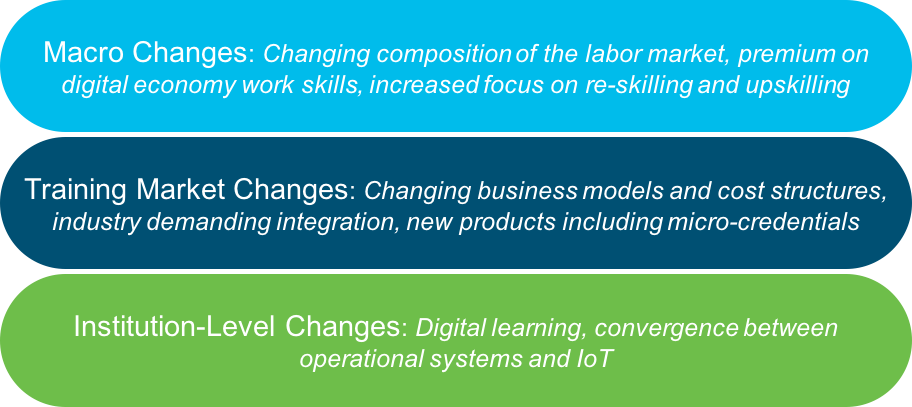
Career and Technical Education is changing in fundamental ways – from macro changes to the labor market and work skills, to training market and institution-level changes.

Opportunities

CTE is a major economic and community asset. As such it needs to be accessible to industry, entrepreneurs, not for-profits, students and community organizations. Institutes must be digitally-enabled, if not digital leaders, to create new opportunities for the communities they operate in. This is particularly true in rural and regional areas where the TAFE / Polytechnic can underpin the economic and social fabric of an entire region. A thriving CTE institute plays critical economic and community roles beyond their core function of delivering training.

As an example, industry and the local community benefit from access to high speed connectivity (including Wi-Fi) which is increasingly important for start ups and entrepreneurs who are being lured on campus to bring the next generation of industry closer to students.

Challenges

There are a range of challenges for training institutions to overcome in capturing opportunities from digital.

The future of publicly-funded training institutions is largely in the hands of their leaders. While these institutions are heavily regulated and have accountabilities to taxpayers, they have significant levers available at the institution level. These include the discretion to make decisions about where to invest (i.e. bricks and mortar vs digital), how to teach (technical vs horizontal skills), how to organize themselves and how to engage with industry. While the decision is not necessarily binary, institutions will need to act and invest digitally if they are to thrive.

Next Steps

During a recent CTE Summit, institutes present recognized that their own transformation needs to occur on a range of fronts. Four major imperatives were discussed to pivot successfully to the digital economy – new models of teaching, experimentation and innovation, industry engagement and upgrading the underlying digital fabric.

To ensure that each institute could meet those imperatives in a way that was scalable and secure, three things were determined as mission critical:

Icons Representing Priorities

Want to learn more about the current state of CTE and the findings of the recent Career and Technical Education Summit? Click the button below to read the full report.

Authors

Reg Johnson

General Manager, Education

Cisco Australia and New Zealand

Avatar

What makes space so amazing? Every time human kind takes a deeper look, we find something that we didn’t know was there before. The same concept applies to analytics. Gathering deeper insight into any data set through automation allows you to make better and quicker decisions, expose gaps, and identify areas for cost reduction or investment.

However, before you buy the next seat on Virgin Galactic, let’s explore how you can maximize and quantify value from your investments in analytics. The first step is a detailed understanding of your organization’s business plan. For example, if your analytics strategy is focused on your infrastructure, you should ask: “How does my infrastructure provide value to the top priorities in my organization’s business plan?”

Based on these insights, the next step is to identify and establish key performance indicators (KPIs) to measure results and action items for continuous improvement. Your results will depend on the ability to track KPIs, determine the amount of data available, and identify and/or correlate trends across multiple data sources.

On this journey to the outer space of analytics, Cisco Advanced Services has built the experience and framework to help enterprises and services providers navigate and maximize the value from their data.

The value of analytics comes in multiple shapes. In addition to using an analytics approach to drive insights, another meaningful and often unrecognized side effect is internal efficiency. Tasks that used to be done manually in days can now be automated with information instantly available. This benefit reinforces fishing for value in a digital world across the entire lifecycle of IT services.

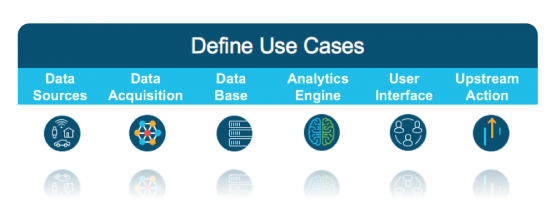
Many organizations see the analytics engine as the biggest hurdle of implementing the analytics strategy. And, initially, it will be. However, once selected, there are multiple components that require unique skills and efforts beyond simply coding the use case. To gain a better understanding and the ability to identify and engage the right types of resources, Cisco Advanced Services created an analytics reference model.

During the implementation of our analytics model, we looked at many different alternatives. We picked a solution where the learning curve to code the use cases into the analytics engine was the shortest.

What happened? We were presented with a pleasant surprise! Our consultants embraced the opportunity to get trained on analytics. They started to use the platform and explored new use cases based on their interactions with customers. Typically, we would have had a team of 10 developers. Now, we have over 1,000 consultants who are all enabled to build and contribute in a true crowdsourcing model.

Data acquisition is the most important area to have a dedicated team. Data availability through easy-to-consume APIs is the key for a model like this to work—effectively and efficiently.

With six months invested in the program, we have data from 2.7 million infrastructure devices (routers and switches) in customer networks around the world. These are correlated with a number of our internal data sources, like reactive cases, ‘Mean Time Between Failure’ calculations, and our software defects tracker.

Key takeaways for you to consider:

  1. Build value from analytics (number of sources, ability to correlate, number of use cases, etc)
  2. Drive external insights AND internal efficiency
  3. Establish an analytics reference model to determine the analytics engine
  4. Create an engine that addresses your organization’s objectives and needs—today and future
  5. Shoot for the moon

Want to hear more? Join us at Cisco Live in Las Vegas from June 25th to 29th and attend my Critical Insights: Industry-leading Analytics Platform session to learn more about Cisco Advanced Services’ latest analytics platform. Don’t forget to check out Matt Lewis and Joel Prothro explain how to prepare network operations for the digital future. See you there!

Authors

Ulf Vinneras

Director Optimization Services

Advanced Services

Avatar

I continue to bet on Cloud Computing (I am not referring to the horse that won the Preakness Stakes ahead of ‘Classic Empire’) but as I place that bet … my assumption … is that the various major industry players will continue to work together in a meaningful way toward the progressive standardization of cloud technologies.

Not too long ago (well … it feels that way at least ..), I was at the Red Hat Summit event in Boston and I was reflecting on the complex network of alliances, partnerships and relationships that have shaped the evolution of the IT landscape for decades. Customer demand has often driven unlikely alliances among rivals that had to cooperate to meet the needs of their customers.

Cloud is no exception. As cloud native applications continue to proliferate, a common fabric is required to ensure interoperability across multicloud environments. With the introduction of containers, tangible progress has been made in this direction. For example, the Open Container Initiative intends to create ‘open industry standards around container formats and runtime’. More notably, organizations like the Cloud Native Computing Foundation  want to “create and drive the adoption of a new computing paradigm that is optimized for modern distributed systems environments capable of scaling to tens of thousands of self-healing multi-tenant nodes.” And OpenStack has been promoting ‘wide adoption of an open-source, open-standards cloud’ for quite some time.

However, most of you would agree that we are still far from what can be characterized as truly open, standards-based and interoperable multicloud environments. It will take time, but for cloud to continue to sustain its growth trajectory, this level of cooperation is an important requirement in my mind. This is also why we continue to be actively involved in many of these initiatives along with our partners.

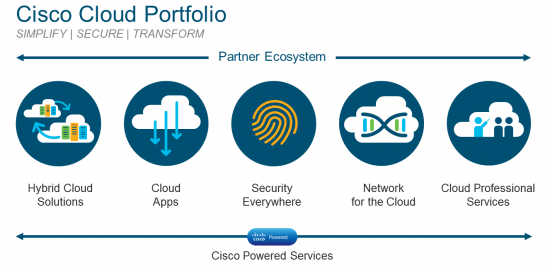
And this is also why one of the key tenets of our cloud strategy and portfolio relies on our partner ecosystem.

There are at least a couple of facets associated with our partner ecosystem:

  • A set of technology partnerships to help drive standards, innovation and ultimately value for the entire industry. Think of our collaboration with INTEL, Docker, Red Hat, NetApp, Microsoft, SAP and countless other vendors equally important to our customers’ success
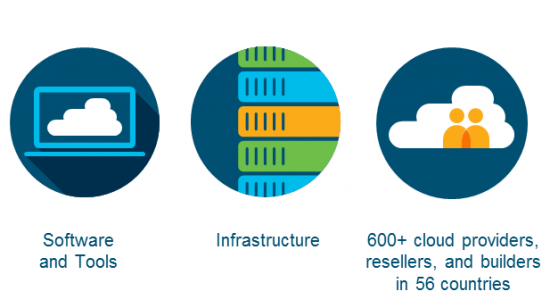
  • A broader, potentially more distributed and complex network of collaborators who can help us deliver complete solutions to our customers across the globe. Think of our partners holding the Master Cloud Builder qualification, or our partners part of the Cloud and Managed Services Program able to offer hundreds of Cisco-Powered cloud services today.

While I was giving presentations at the Red Hat Summit in the Cisco and INTEL booths -reviewing some of our Cisco Cloud and OpenStack related offerings – and even before then while co-hosting a webcast with INTEL representatives about our Cisco Business Cloud Advisor framework, I have been able to experience (once again) the critical importance that our partner ecosystem continues to have to help our customers retain control and choice.

And a distributed, rich and vibrant partner ecosystem is extremely important and not only from a pure technological point of view. For example, we know that one of the major barriers that IT leaders face as they try to improve the business impact of cloud adoption in their organizations is tied to skills. In fact, there is a major talent gap that separates those organizations that have been able to maximize their cloud benefits from those still attempting to do that. Most of the emerging technologies – be that containers, microservices architectures – and even OpenStack continue to be characterized by a significant shortage of expertise. Ironically, that ‘vendor lock-in’ avoidance that prompted organizations to embrace many of these technologies reincarnates into another form of ‘lock-in.’ Entire IT organizations can become overly dependent on the skillsets that only a handful of their employees possess. What happens when they leave? And more importantly to what extent do you want to invest in these technologies and the human capital required to make them fully operational in your environments?

Ultimately, you may want the option to ‘partner’ with other vendors who can help you manage your risk and help you make more efficient use of your capital. And this is exactly why Cisco and its vast partner ecosystem represent a formidable asset that can extend your IT value chain. Our partners can help you complement your existing skillsets, guide your multicloud journey and ultimately allow you to determine on a case by case basis if you want to rely on your internal capabilities or find alternative ways to meet your needs. As you routinely evaluate your vendors, please add this element to your selection process.

Reference materials

Authors

Enrico Fuiano

Senior Solutions Marketing Manager

Cisco Cloud Marketing Team