Avatar

Partners crave speed. Customers want business outcomes. Distributors respond to both in a big way.

Understanding what partners and customers need to succeed is THE driving factor in my job.  When partners and customers succeed, Cisco and our distributors succeed. The key to ensuring this is simple – evolve before the industry does. My team is dedicated to investing in better ways to capture market transitions before they happen.

The technology industry is built on fast paced innovation. Such speed often creates a volatile paradigm shift for business models and companies. The role of Distribution is pivotal. We must find the balance of transformation and execution. This means that we are taking the calculated risks and testing new business models to give our distributors the greatest opportunity to be successful.

How is Cisco playing a differentiator role today? By creating greater leverage and scale to drive a dynamic value exchange for our partners, our distributors and ultimately our customers. This is centered on a driving a combination of traditional capabilities with services and more focused high touch enablement exercises than ever before.

As the channel evolves, the distributor role is crucial. We are committed to our Recruit, Enable, and Grow (REG) model, as we see immense value in staying committed to our core strengths, while innovating WITH our distributors to capitalize on new markets and technologies that are accelerating our top priorities in FY17 – Security, Software and refreshing the install base.

We are investing in these three key areas because they represent big opportunities for our distributors. This commitment is predicated around our goal to crack the code – unlocking the Power of Distribution.


Security

As we move into FY17, Security is undoubtedly one of the most significant investment areas across Cisco. Last week, Global Partner Organization VP Wendy Bahr wrote a blog that highlighted the great recognition we’ve received in the security space and the need to continue driving down this great path moving forward.

As our partners work to make Security the #1 practice in the industry, they will need support. The type of support I’m alluding to comes from our distributors and their ability to provide security resources.

From the ability to deliver network assessments to creating a fully integrated security network design, the evolution of security is moving fast. Couple this with the capability to conduct risk assessments and translate the findings into actionable recommendations and you have industry advantage. This as the proliferation of mobile devices grows exponentially, and the complexity of protecting such a wide array of devices becomes unmanageable without an integrated, end-to-end security strategy.

It is a fundamental priority to ensure that businesses are secure and protected against threats. Our customers demand the most innovative products to enable them to speed up time to market while ensuring that they’ve taken every step to protect their assets with a strong security strategy. Our distributors and partners make this possible with equally innovative programs like Security POVs and pre-sales security design support.


Software

 The name of the game in software is Opportunity. A few months ago, I read a great piece by Jason Gallo, Cisco Global Director of Enterprise Networking and Software. He covered maximizing profitability, a differentiated customer experience and the massive opportunity around digitization. For channel partners and distributors alike, software businesses will thrive as Cisco embarks on executing the largest enablement campaigns we have ever run around software with Cisco ONE.

Our distributors have extensive experience selling software and in turn, are amplifying this through education and new capabilities so ensure their partners have the right conversations with their customers. This leads to business outcomes, with an end goal for our distributors to engage several thousand partners, helping them get up to speed on the software opportunity with Cisco.

How are we doing so far? The results are staggering – Cisco ONE penetration through Distribution in the first quarter is up over 30% compared to last year. Let’s keep the momentum going.


Refreshed Install Base

A few months ago, we came out with a sales campaign focused on refreshing our core. The campaign was targeted at helping our customers transformation to digital by building an infrastructure that is geared towards today’s need for faster innovation, reducing cost and complexity and lowering security risks.

Since then, we have seen strong momentum across our customers in the different regions with strong proof points: our Meraki cloud managed IT business is growing 50% year over year and new product innovations are coming out on a regular basis. We have over 11,000 customers buying Cisco ONE software, which provides ongoing software innovations in a simple software consumption model.

The value of digitizing the business is more important than ever as more and more companies see technology as not just an enabler but also a differentiator. I encourage you to work with our teams to make this a priority for you in FY17.

Stay tuned for more updates to support this acceleration over the next few months.

Want to learn more about partnering with Cisco? Click Here.

Questions or Comments? Feel free to connect with me on Twitter.

Authors

Julie Hens

Vice President

Global Distribution Sales

Avatar
Icon_1_Data_StorytellersData Storytellers: Each month we’ll be highlighting experts and advocates to share their data stories, knowledge, and insights into the future of data and analytics. Subscribe to the RSS feed to get the latest updates.
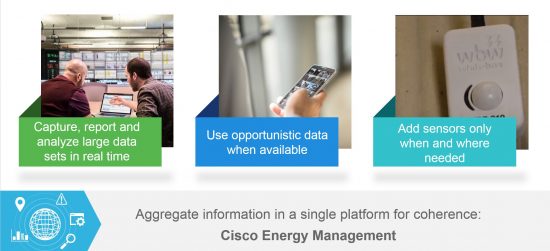
The emergence of smart cities holds great promise for the economy and the citizens, but it also presents certain challenges. Smart and sustainable cities are data driven and rely on IoT to connect the unconnected. But only capturing data from things is not the key challenge. The question is what to do with all that data. Aggregating the information in a way where it can be analyzed and used for improvements is essential. At the same time, political pressure mandates a green agenda and a more sustainable way of operating large cities.

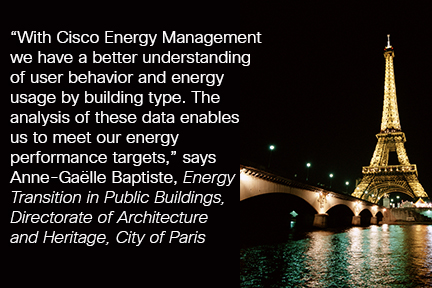
On its way to a smart, sustainable city, Paris adopted an ambitious Energy Climate Plan: a commitment to reduce greenhouse gas emissions and energy consumption by 30 percent before 2020. Together with Cisco, Paris launched a pilot experiment using Cisco Energy Management to develop a replicable energy optimization plan. By properly instrumenting various buildings and places in the city, Cisco Energy Management helps to benchmark buildings, direct investments where they need to be and measure improvements thanks to sensor networks called the Internet of Things (IoT).

Emmanuel Tychon Image 2


A common mistake I see in many IoT projects is to start with deploying hundreds or thousands of sensors without even knowing what problems should be solved with the accumulated information. So instead, we started this project establishing a series of use cases that are based on real issues that had been brought up by occupants of those places.

For example, there is a dance training room with very specific issues related to how it was built. Temperatures are uneven and depending on the type of activity and external conditions, it can lead to uncomfortable situations for dancers. By measuring real-time temperature, presence and luminosity from both inside and outside the building, we can correlate the data to identify patterns all in the same system. Now it is possible to anticipate when conditions will become uncomfortable and raise an alert in advance, leading to proactive, corrective actions.

After the use cases were defined we installed hundred sensors that were specifically custom-made for this project, and that measure temperature, humidity, brightness, luminosity, noise level and human presence in different buildings. Cisco Energy Management delivers precise and regular data that enables the City of Paris to monitor the “real life” of the studied buildings – what’s happening inside depending on different parameters – to improve the buildings efficiency.

City of Paris Blog quote

Watch the video:

https://youtu.be/DOGmhOrI8WA

Authors

Emmanuel Tychon

Solutions Architect

Advanced Services

Avatar

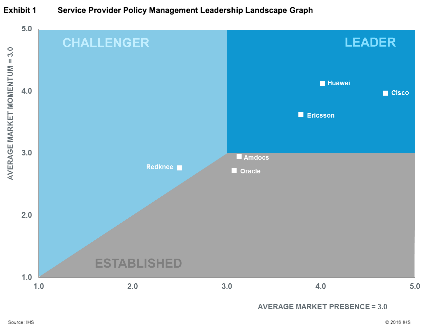
Cisco is proud to announce that IHS has recognized Cisco as a Leader for the second year in a row in the July 22, 2016 Policy Management Vendor Scorecard. With the recognition, IHS continues to validate Cisco’s leadership position and momentum in the Policy market place.  The analyst scored each of the vendors, listing Cisco as a clear #1 in market presence and close #2 in market momentum.  Here is the landscape graph from the report:

graph 1

The report further states,  “Cisco’s solid scores in market presence and market momentum place it in the leader category and reflect the strength of the company as a whole. Cisco leads the pack on market share momentum, gained at the expense of several former partners, as Cisco began bidding its own policy assets as opposed to other vendors’ as part of larger deals. The company also received a high score in financials, technology innovation, reliability, and service and support (the latter two are important criteria for operators, given the key role that policy management plays in their ability to manage and monetize their networks).”

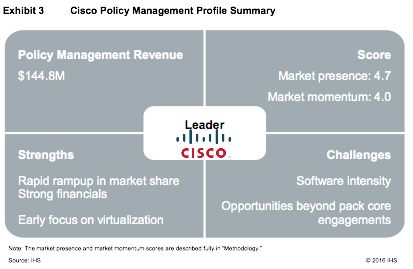
Although “Software Intensity” was listed as a challenge, that opinion was tempered by the author noting that this analysis was “attributable to the nature of Cisco’s customer base—larger Tier 1 operators typically require more integration services work than their smaller counterparts—rather than a reflection on the relative maturity of the solution.”

graph 2Finally, we continue to develop and innovate in our newest version of Cisco Policy Suite, version 10.0 which has just been released.  Release 10 brings additional HTTP REST and API-driven NFV functionality including dynamic modification of configuration parameters and the dynamic scale-out of both Policy Server and Session Manager virtual machines. We have also added more flexibility in how policies are evaluated and triggered, efficiencies around multiple session handling and further enriched our VoLTE call handling.  I encourage you to check it out; the latest software is now available for download on cisco.com.

Learn more about Cisco Policy Suite at cisco.com/go/mobilepolicy.

Authors

Maywun Wong

Manager, Market Management

Avatar

This year at Cisco Live Las Vegas, attendees had the pleasure of hearing Jason Silva, the host of National Geographic’s “Brain Games” and YouTube Channel “Shots of Awe” speak. If you are not familiar, Silva compiles short videos which he calls “philosophical shots of espresso”, that weave together disparate yet oddly connected ideas like enlightenment, neuroscience, biomechanics, transcendence and the Internet.

As an early-in-career employee at Cisco, Jason’s perspective was inspiring for me. I really connected with his premise of an achievable future that is accessible for all. I joined Cisco fresh out of college, almost a year ago, wide-eyed at the possibilities of shaping the future. It was around the same time our own CEO, took the helm. We entered hungry with the potential, and for me, the ambition to help shape the next generation of technology.

While Silva’s philosophies are existential in nature, Cisco’s applications to them are very much real. In the keynote he talked about the role of Cisco and our partners, in playing a leading role in designing adjacent possible futures. He challenged us to think of Cisco as a captain of ‘Spaceship Earth’.

I’ve seen Cisco channel that passion into brilliance in my first year, but I believe there’s more to come. In this blog, I will share some of Jason’s philosophical shots that resonated with me in my contributing in Cisco’s quest to captain that future.


We Are All Future Blind

Consider two questions when we think of the future: What is and What if. Throughout our development into adults, millennials are asked to brainstorm, to problem solve, to create models of reality to help solve existing issues. Simply put, we use our current reality as our guide to make simulations of the one we live as accurate as possible.

Jason said:


“the more we overlay digital information on top of the physical world.. the more cognitive activity there is occurring in the interface between self and world until self and world become one”


The world beyond information technology is still quite new to us. Consider the fact it has taken us over a generation to have developed to now, a world that is shrunken in reach but not in size. Technology has allowed the rate of change to significantly increase and will do so exponentially. Our tools (including language, science, math, etcetera) were used to design the next round of tools (better phones, cars, even supercomputers with cognitive ability).

We as millennials are the first generation to be born in an era, where transformative change happens at the speed of Moore’s Law, roughly one year. We’ve had to adapt our minds to tap into the information ‘over-flow’.

Although we are the first generation be born into the digital age, our minds have been engineered to think with a linear lens by those before us. From generation to generation, year to year, it’s intuitively assuming that our current rate of change will continue for future periods. Rather, it’s a cognitive bias that tells us to see the future as the recent past.

You see examples of this everyday: subconsciously navigating a city landscape, picking up the kids from soccer practice from when they’re just starting to when they’re about join college, or the passing on of mother’s kitchen secrets. For us millennials, it’s the every day commute, blaming ageism for college nostalgia, see a Pokémon, catch a Pokémon.

We are human. We are genuinely concerned about the future because we will spend the rest of our lives there. But our linear view is blindfolding us from how the world really operates. Rather it’s exponential. It’s taking a grain of salt and imagining a beach. Or in Jason’s example, trying to visualize your next thirty steps on the same scale to realize you’ve taken a billion and circumnavigated the world twenty six times. It’s unfathomable.

As a millennial, the notion that the world today can radically change tomorrow is what drives me, that a sustainable future is yet to be discovered, that we still haven’t defined what it means to be human 50 years from now. It will cause paradigm after paradigm shift and it’s already doing that. What will that mean for Cisco and her customers? How can we apply Moore’s Law to not just 30 steps, but rather 50 plus years? For Cisco and its employees to help make a monumental societal steps forward, we can’t just think linearly, but must train ourselves to recognize those shifts.


To Be Human is to Be Trans-Human

We are at a point in society where our connection to technology is at its strongest and our possibilities endless. In the video he shared, he quotes Edward O. Wilson to say “..We have decommissioned natural selection, and must look within ourselves to decide what we will become”.

Over the course of history, we have continuously revolutionized society, technology, and what it means to be human. We have built complex tools, transformed cities, and increased every comprehensible aspect of our day-to-day to its maximum efficiency, in an effort to make our lives simpler. In doing so, these tools inherently built us. We’re able explore and understand the depths of the cosmos, communicate with others around the world in less than a second, and have the ability to dissect an atom down to its protons and neutrons.


Our technology is getting smaller, subtler, and more symbiotic – more elegantly and seamlessly absorbed into life’s fabric


But what’s next? How do we transcend this plane and achieve something greater?

Cisco’s mission has and will continue to be to connect the unconnected, create sustainable environments with the help of technology, and develop an augmented space to trade, share, and store infinite amounts of data. But there’s more. As a millennial, connectivity isn’t just the barrier to entry, it’s the enabler. Realizing that we can imagine exponential future landscapes, the very rules that governed and shaped our society today are up for grabs.


When I consider the work I’ve produced in my time with Cisco, it’s quite similar, it’s foundational growth towards my future, towards my better self. Technology will help boost my physical, intellectual, and psychological capabilities beyond what I was naturally capable of without it. Considering that same idea at the scale of Cisco, the possibilities are endless. What it means to be human is changing and Cisco is in a position to re-write it.


The New Definition of a Billion

Besides the “basic” millennial mantra that experiences and adventures make up our dichotomy, we are also largely driven by wealth. Wealth in relationships, experiences, but more often than not, in the tangible greenback that sometimes doesn’t yield as much as its value.

The new definition of a billion is far more promising: positively affect the lives of a billion people. During his keynote, Silva references the movie Interstellar when he says, “Empathy rarely extends beyond our line of sight”. To feel how someone else feels, to understand them, to extend that emotional connection.

In part, I believe Cisco is well on its way to positively affect the lives of more than just a billion. Some of our technology already has the capacity to be empathetic: Jabber to communicate, Webex to relate, and our hardware to provide the power for those two to come to life. The resources exist. The tools exist. The passion to transform exists.

Cisco has developed new constructional tools that have helped in mapping the universal node, the cognitive membrane for the world to share one voice. Our technology has allowed our people, our customers to revolutionize how they connect with others, extending their line of sight. With that power, it has become our responsibility to start mapping the uncharted world of technology for humanity to follow. How we control the narrative is something I hope to be apart of. 


We Are An Evolutionary Force

Looking back at my first year at Cisco, I cannot help but feel that there’s more to accomplish, more to look forward to, more to be excited for. I’ve had moments of challenges and some of brilliance; I suspect Cisco has had a similar journey. We both have the potential, as well as the capacity to proverbially “drop the mic”.

The adjacent possibilities hover on the present state of things, and I want to be a part of Cisco when we take our learnings, our innovations beyond the edge. Millennials do not believe in conforming to any preset set by past generations and neither should Cisco. Neither should you.

We Are An Evolutionary Force. We’ll create our own contextual templates, and with Cisco’s help, become future captains of spaceship earth.


Authors

Sachin Khalsa

Marketing Specialist

Cloud Solutions

Avatar

The final countdown to the 2016 Olympic Games is on – the Opening Ceremonies are a week away, and people around the world are working tirelessly to ensure that everything runs smoothly and efficiently.

Cisco is an official supporter of the Olympic and Paralympic Games, and we are dedicated to leaving a lasting impact in Brazil that goes far beyond the four weeks of competition. Through numerous social and urban innovation projects, we are working to transform Rio into a smarter and more connected city, both now and in the future.

A large part of that endeavor comes from our biggest asset as a company – our employees. In February, as part of our Corporate Social Responsibility (CSR) efforts, we kicked off a new initiative to involve global employees in the Olympic legacy work the company is doing in Brazil.

The CSR Volunteer Program virtually connects employee volunteers around the world with students and instructors of the Cisco Networking Academy and Community Centers in Rio for 30-minute sessions on various topics. So far, we have facilitated 18 sessions with 20 employee volunteers from four countries and more than 600 students.

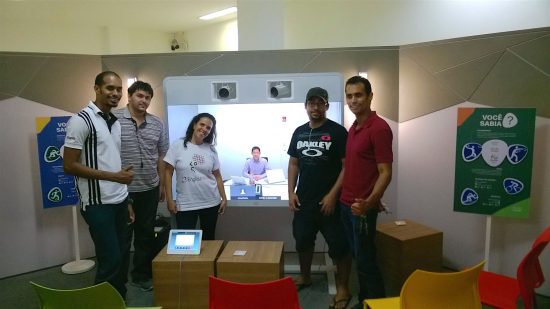
Students and instructors in Rio connect virtually with Cisco employees from around the world
Students and instructors in Rio connect virtually with Cisco employees from around the world. The sessions help the students and instructors practice their English, learn more about Cisco, and connect the world to the 2016 Olympic Games.

Through the power of Cisco collaboration technology, the CSR Volunteer Program aims to help Networking Academy students and instructors learn from the Cisco employees while practicing their English skills, building relationships, and having fun. And we’ve seen so far that the benefits go both ways – the Cisco employees have enjoyed the experiences as much as the students, as it gives employees around the world an opportunity to be a part of Cisco’s Olympic sponsorship platform (employees only).

During sessions focused on technical topics, Cisco employees who either hold or are working toward a CCNA certification connect with Networking Academy instructors and students in Rio who are working toward the certification. The employees share their own experiences, provide tips and advice, and answer questions. One of the first volunteers was Alan Groom – a 19-year-old Cisco intern in London.

“For me personally the fact that we are all studying toward the CCNA certification meant that we would be able to share our experiences and methods of study to one another,” Alan says. “It’s just one of the amazing characteristics of working for an international company, and working together as one to achieve the same end goal.”

The response from the students in Rio has been equally as positive.

“This is such a great opportunity for our students,” said one Networking Academy instructor who took part in the session with Alan. “They never get to talk to global Cisco employees. They are going to get really excited about it.”

Visit Cisco Corporate Social Responsibility online and on Twitter to learn more about the Cisco Networking Academy. And if you’re an employee, find out how you can participate in the CSR Volunteer Program! 

*Key people behind this effort include Gilberto Cabral, Deborah Chamovitz and Alex Rosen.

Authors

Austin Belisle

No Longer with Cisco

Avatar

Camberwell Girls Grammar School is a showcase for what’s possible when students meet the best teachers and exceptional technologies.

Recently, BBC Future ran a feature on Camberwell Girls Grammar School and their digital approach to learning by creating global citizens equipped with the skills for a 21st-century future.

Screen Shot 2016-07-20 at 11.35.41 AM

Camberwell implemented Cisco networking, Wi-Fi, switching and routing on their campus to support tools for teaching and learning, for communication and collaboration. By using Cisco WebEx, administration can more efficiently manage their communications, interviewing potential candidates online, saving time and money.

For students, global video conferencing brings the whole world to the campus. Using Cisco TelePresence, students are able to connect with lecturers and experts virtually. These virtual lecturers have included scientists based at Antarctic research stations, archaeologists on a dig in Turkey, and chemists who can conduct experiments virtually that were too dangerous to conduct on campus.

Screen Shot 2016-07-20 at 11.35.05 AM

According to Camberwell Girls’ Head of Digital Learning, Kim Perkins, “The possibilities that this collaboration and communication technology have opened up, the excitement that it generates amongst the students, and the uptake by the staff have been the most impressive changes.”

Watch this video to learn more about Camberwell’s use of Cisco technology, and read the full case study here.

https://www.youtube.com/watch?v=NGdkpq3lhOk

Authors

Reg Johnson

General Manager, Education

Cisco Australia and New Zealand

Avatar

5G is closer than you might realize.

It seems like a not a week goes by where you read about another development, test, or government agency helping to pave the way to this next generation of mobility. (Don’t get me wrong – I love this stuff.)  So how can all this be happening before we even have our first 5G standards written?  Well, we do have a set of use cases provided by the Mobile Network Operators (MNO) – both directly and via the NGNM 5G organization (white paper from 2015 – https://www.ngmn.org/5g-white-paper.html).

5g 1These use cases are there to guide the development for 5G to support the desired business outcomes from implementing this next generation technology (and standards).  This includes enabling vast new opportunities in the Internet of Things and growing video as well as providing greater agility and efficiency for the MNO and for the customer (individual and business).
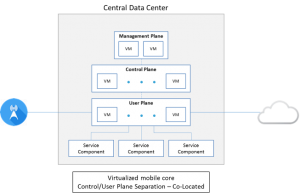
Some of these use cases require open, extensible, and secured virtualized platforms. But 5G is more than just virtualizing some purpose-built product.  The 5G use cases call for re-imagining the MNO network.  Moving from the Central Office to a distributed architecture of data centers – “The cloud” if will.

For this blog, I am going to focus on the reimagining of the mobile core. And discuss how you can implement a 5G capable mobile core today and by doing so you can improve agility and your top and bottom line.

The 5G capabilities leveraged are:

  • Radio Agnostic (any RAT)
  • Virtualization (NFV)
  • Software Defined Networking (SDN)
  • Control User Plane Separation (CUPS)
  • Distributed Architecture
  • Network Slicing
  • Ultra-high reliability
  • Ultra-high scale (that means scaling low and high – both)
  • Ultra-low latency (real-world latency must consider the round trip of the service)
  • Efficiency (we need to deliver services at lower costs per session)

A really good independent study.

The goal is to evolve your mobile core architecture that can deliver savings/revenue and agility. To make my points I will refer to a recently published report on a study by the research and analyst firm, IDC.  You can download the report at http://www.cisco.com/c/m/en_us/offers/sp04/ultra-services-platform/index.html#

The report looks at potential benefits by migrating from purpose-built to virtualized mobile core. I know, you’ve read a few of these – but this one is different.  This independent study included IDC speaking with several MNO around the world.  They also considered whether there are tangible benefits of continuing the evolution to a distributed architecture (not simply going virtual).

In this study, IDC took an approach to ensure a real world scenario. Understanding that in all likelihood a MNO would evolve this change to virtualization and distribution.  They modeled their studies as a multi-step approach (purpose-built to virtualized, and then virtualized to distributed).

What they found is worth the time to read the report. When the whole concept of SDN and NFV came out it was heralded as a great way to cut costs.  Then as some began to “dabble” in virtualization there were concerns about the actual savings.  Today, most in the industry understand that if done well, virtualization’s biggest benefit is the agility it enables.  Still, the cost savings are there (both Capex and Opex).  There is also the benefit of getting new services to market faster.

Why virtualize?

5g 2IDC’s study concluded that by virtualizing all mobile core functions the MNO would achieve far improved functional utilization of up to 87%.  This alone resulted in improved cost efficiencies of up to 25%.  They also found that while there are good cost savings from these efficiencies, the saving quickly flatten out.
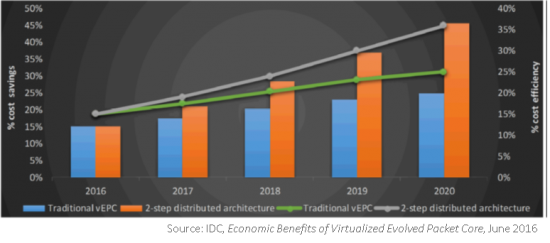
So, can we do better? I am so glad that you asked (you really are a great audience).  In fact, you can do better – much better.  You do better when you go to a distributed architecture.

5g 3

Why distributed architecture?

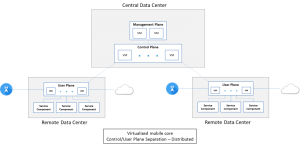
This study showed that by leveraging the 5G use cases of control/user plane separation and distributed architectures, mobile operators can further increase cost savings over those who deploy virtualized in a more traditional centralized architecture. The distributed architecture increase opportunities to increase cost savings by placing resources closer to the end users.

5g 4As result, the operator can reduce backhaul and internet interconnect costs, and avoid network resource idle time. Additional efficiencies are found through automation and network slicing.

Network slicing creates a logical, customized network for specific use cases, services and customers. Implementing network slicing in a distributed virtualized architecture provides for greater granularity and efficiencies.  This results in a better service for the customer and reduced costs for the provider.

The IDC study shows that factors such as the extent of network virtualization and control/user plane separation–driven architectures can result in potential opex cost savings in the range of 20– 40% over a five-year period. The study these cost saving continue to increase annually over the 5 year model, unlike the centralized architecture that flattened out.

In short, a distributed architecture is more efficient because it places only those resources that you need, where you need, when you need them.

What about Agility?

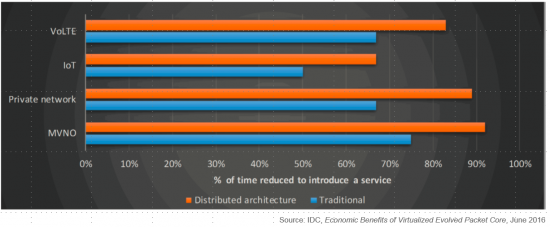
The IDC study showed notable improvement in service agility driven by an orchestration and network slicing in a distributed architecture. They found a promising 67% reduction in TTM to launch new services such as MVNO, private mobile network, IoT use cases, and VoLTE.

5g 5

Why now?

Well, as noted earlier, 5G is closer than you might think. You really need to consider 5G capabilities in products and solutions you implement today.  But more than that, why not enjoy the benefits today?  If you can implement a distributed mobile core that can scale as big or as small as you need.  If you can spin-up those services and functions that use and your customers’ needs when and where you need them – why not now?

5g 6

Authors

Dan Kurschner

Marketing Manager, Product/Systems

Avatar

Think about it: you’re checking in for that international flight across an ocean, connecting through a busy hub somewhere.

Your suitcase is weighed and given a tag. This tag contains some basic information:

  • Where it needs to go.
  • When it needs to be there.
  • Who it belongs to.

As you leave the check-in area, make your way through airport security, and finally to the gate, your suitcase has already started its own complex journey down a maze of conveyor belts, security scans, luggage carts and baggage handlers – not at just one, but in this scenario, at three airports.

It’s no wonder there’s a potential for lost luggage. Yet thankfully more often than not most passengers are reunited with their luggage at their destination.

The positive outcome  – in this case, your checked belongings arrive with you – depends on how the data on the luggage tag is processed by the airport’s intricate systems. Each scan of that tag along it’s journey through the system results in a decision on what needs to happen to it next. The workflow of the systems required to get that suitcase from point A to B to C is mind-boggling.

I find that fascinating.

Using checked luggage as an example, it’s hard imagine how just three bits of data can result in such a positive customer experience and desired outcome. We tend to take it for granted. The keys to success are the processes and supporting infrastructure that create that experience and outcome. And the four imperatives of successful big data implementations are: data preparation, data analytics, data management, and the supporting infrastructure.

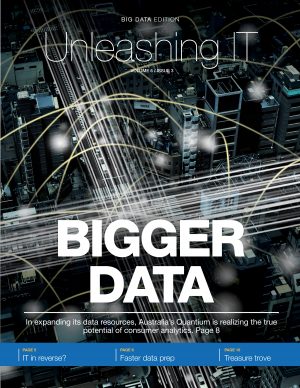
The Bigger Data edition of Unleashing IT goes into the latter: how your organization can achieve desired outcomes with the right data preparation, data analytics, and data management tools in place, supported by a solid and well integrated infrastructure.

Unleashing IT - Bigger Data Edition


Subscribe or login to download your copy now.


Let’s face it, whether you’re just starting your journey or returning from one, you haven’t truly arrived until you and your suitcase pass through customs together..


Authors

Adrian den Hartog

Senior Marketing Manager

Field Marketing US Commercial

Avatar

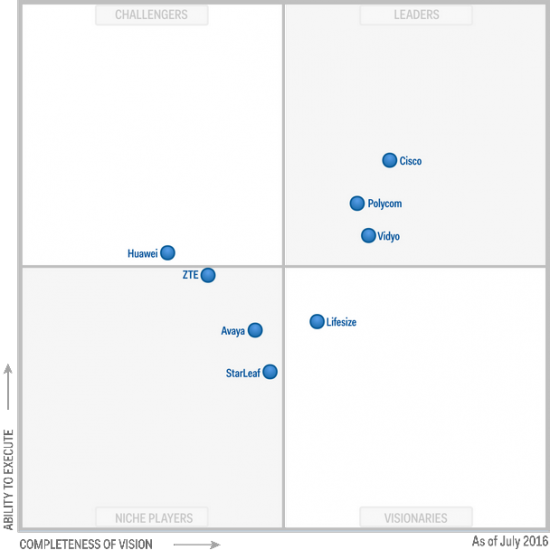
We’re delighted to share that Cisco has been named a Leader in the Gartner Magic Quadrant for Group Video Systems for the second year in a row.

This is a dynamic time for video and collaboration. Many organizations are evaluating more pervasive deployments and expanding the use cases for video.

Among important factors in evaluating the ability of video systems to meet enterprise needs, Gartner includes:

  • Clearly demonstrated market traction with large enterprise or public sector customers
  • Product range, including the ability to span from large dedicated video rooms to personal and mobile endpoints
  • Product quality, especially in dedicated room systems and modular room systems
  • Innovation in endpoint design, cloud-based infrastructure and user experience

MQ_GroupVideoSystems

As Cisco SVP and GM Rowan Trollope recently shared in the Collaboration Innovation Talk at Cisco Live, we continue to focus on delivering quality experiences that are simple, open and delight users. And this focus on simplified experiences resonates. We’re seeing strong adoption for video across the board – in conference rooms, huddle spaces, desktops and mobile devices – and even expanded use cases.

But we’re not stopping there. Enabling pervasive video means delivering flexibility and options so you can easily extend video to more users. To that end, we’ve accelerated availability for cloud-connected video systems across the portfolio, including

We’re focused on making video easy-to-use and part of every collaboration interaction – today. Our software-based approach provides added flexibility. This lets you add value to workflows from the cloud or extend your on-premises deployments. And we continue to integrate Acano infrastructure solutions to further scale and simplify video collaboration with anyone.

Congratulations and thanks to the engineering teams, partners, and customers who continue to help us to evolve our video collaboration solutions.

We believe it’s a great time for pervasive video. Let us know your thoughts in the comments below.

Learn more about our leadership placement in other Gartner Magic Quadrant reports for Collaboration: Contact Center, Unified Communications, and Unified Communications for Midsize Organizations (North America).


This graphic was published by Gartner, Inc. as part of a larger research document and should be evaluated in the context of the entire document. The Gartner document is available upon request from Cisco. Gartner does not endorse any vendor, product or service depicted in its research publications, and does not advise technology users to select only those vendors with the highest ratings or other designation. Gartner research publications consist of the opinions of Gartner’s research organization and should not be construed as statements of fact. Gartner disclaims all warranties, expressed or implied, with respect to this research, including any warranties of merchantability or fitness for a particular purpose. 

Authors

Angie Mistretta

Chief Marketing Officer, AppDynamics

AppDynamics