Avatar

In February, Tim Banting of the Business Technology and Software group at Current Analysis, produced a report analyzing the growth and changes around SoCoMo Platforms. I’ve summarized the focus and themes of that report below.

When you hear the acronym SoCoMo for the first time, what comes to mind? I pictured a little hipster coffee shop located in Southern California. In actuality, it stands for social, collaborative, and mobile platforms. The past two decades have experienced radical change in the collaboration and communication market, which occurred in two distinct stages of transformation.

  • The first wave resulted in significant cost cutting, brought on by simplifying and consolidation IT infrastructure.
  • We are currently in the second wave, where SoCoMo reigns supreme.

SoCoMo platforms provide the software to integrate current business systems with new capabilities, all via a single cloud service. It has already become apparent that vendors who choose to not invest in SoCoMo platforms risk being marginalized. On the other hand, companies that integrate their current unified communications (UC) offerings and new SoCoMo platforms will generate further value.

Market Trends & Business Drivers
As we trek through the formative stages of the second wave, platforms are becoming a core for team productivity and collaboration. There is a rising need for platforms to be flexible enough to meet current business needs, and innovative enough to address future needs. This second wave has also proven to be more impactful. How? It’s not limited to the organization alone but has the potential to stretch across the entire digital supply chain.

SoCoMo platforms have gained a lot of traction through employees investigating and using the technology on their own. This bottom-up approach has proven effective in large organizations. But to truly be ingrained within an organization, managers and IT leaders must also come on board.

From Past to Present
Fifteen years ago, Cisco Architecture for Voice, Video and Integrated Data (AVVID) was a revolution. Scalable, flexible, and reliable, the majority of communications vendors at the time used it. But as the industry moved forward, new avenues have emerged, like virtualization. This let vendors sell different software options “as-a-service,” further simplifying the process for customers. The overarching theme of the first wave of productivity seemed to be all about simplifying and consolidating.

As technology continues to mature, new challenges develop. For instance, “Shadow IT” can expose your company to potential security threats through unsanctioned apps. Employees bring in these apps because they are searching for new ways of working and collaborating. Aware of the risks, IT professionals have made strides to include the rest of the organization in buying decisions.

Adoption
Technology is only useful when people use it. SoMoCo vendors have developed Enterprise Graph analytics to map out a user’s connections through a collaboration journey. Vendors have also adopted gamification technology to increase employee engagement: Employees  can earn points and badges for completing tasks. Many gain a sense of pride by showing off their accomplishments.

Another critical challenge can be the organization itself. People fully expect technology to change, but the organization needs to evolve as well. Innovation must not only occur at the technological level; it must be encouraged at the organizational level as well.

Recommendations
Banting offers some perspective on the current SoCoMo platforms available, one of them obviously being Cisco. He notes that Cisco Spark has a lot to offer in the areas of integration capability and support that its competitors don’t. He also advises that Spark can be improved by integrating with Cisco’s recent acquisition, Acano.

Not only does Banting offer his sage advice to the software companies, he also extends it to current enterprises. He calls for existing Cisco clients to take full advantage of the free technology available to them, and to be on the lookout for the many innovations Cisco will ultimately release.

To dig deeper into the report, read the full report here.

Authors

Maggie Harper

College intern

Collaboration Business Unit

Avatar

Would you trust your money to a bank if it had no vaults and no guards? Of course you do. You do it every day. With the digitization of banking and other financial services, customers cannot see all the defenses being used to protect their assets. There are no alarms nor armored cars, it is all 0’s and 1’s.

As we just released our Midyear Cybersecurity Report, I, along with every other banking customer am concerned about identify theft and loss of access to my accounts. Security breaches and data leaks make headlines every day. Continue reading “Go Digital Securely … and Fast”

Authors

Leni Selvaggio

Global Senior Manager

Financial Services Industry

Avatar

Cisco dCloud is moderating the #CustomerExperience #CiscoChat on August 22nd – so we spent some time thinking about the Customer Experience and our role in it.

With the advent of social media marketing, the line between “customer-facing” and “non-customer-facing” becomes increasingly blurred. Visiting a client’s office isn’t the only way to interact anymore – and that’s a great thing. It empowers employees and gives each of us a chance to think about our little circle of control over the customer experience. It keeps the customer top-of-mind and helps us to infuse every action with a client-first mentality, which raises the quality of our product and the level of our participation in the process.

Continue reading “Accountability for the Digital Customer Experience”

Authors

Anne Robotti

Senior Technical Writer

eXperience Services - dCloud

Avatar

Let’s take a break from presidential politics for just a moment to consider an election that is happening much sooner, and will probably be much more fun for everyone involved.

The OpenStack Foundation received over 1,500 submissions for speaking sessions at the upcoming Barcelona Summit, and they need your help in deciding which ones to choose (well, they probably don’t need your help in a traditional sense, but it’s a big part of their open source culture to include members in setting the agenda). So as is their custom, they’ve set up a voting site. You can find it here: https://www.openstack.org/summit/barcelona-2016/vote-for-speakers/.

Have you voted yet?

If not, I encourage you to scoot on over and take a look at the incredible array of topics and speakers at the site. And don’t be freaked out by the 1,500 thing. Nobody expects you to read all those abstracts. Just hit the drop-down menu on the left-hand side of the main voting page, and choose the track that appeals to you. That will narrow it down to several dozen abstracts–still a lot, especially if you’re interested in multiple tracks–but a lot more manageable than 1,500. Then pick what you like.

Piece of cake. No debates. No angry tweets. No fighting with family members over the Sunday afternoon BBQ. Just an opportunity to shape the agenda at one of the most worthwhile, informative conferences you’ll attend all year.

Want to know which topics Cisco speakers have submitted? I’ll tell you, but it comes with a caveat: No ballot box stuffing! The Foundation is trying really hard to prevent big companies (and little ones with a lot of hustle) from swaying the results with voting campaigns that have very little to do with genuine topic interest and a lot to do with just wanting to get their own employees up on stage. To that end, the Foundation no longer provides direct links to each talk. So if you see something from the list below that truly interests you and that you’d like to see on the final Summit agenda, you actually have to search for it on the voting site by name in order to select it. A little less convenient, yes, but probably smart on their part. It’ll weed out most of the recreational voters pretty quickly.

Happy voting. I hope to see you at the Summit!

Architectural Decisions

Wizard – Generalized Execution Service in Cloud Computing, Debojyoti Dutta, Komei Shimamura

Big Data

Build a Self-healing OpenStack Cluster using Cognitive, Marc Solanas Tarre, Xinyuan Huang, Johnu George

Multitenant TensorFlow on OpenStack, Marc Solanas Tarre, Xinyuan Huang, Johnu George

Case Studies

Case Study: Cisco Intercloud, Yuming Ma, Shyam Bollu, Alex Sorokunov (NetApp/SolidFire)

Cisco Intercloud Migration from Ceph to Swift While in Production, Johnny Wang, Martin Lanner (SwiftStack)

Sungard Availability Services: Building a Multihypervisor Cloud with Automated Network, Mike Cohen, Jason Plank

Swift Deployment Automation in Cisco Intercloud, Johnny Wang

Why We Chose OpenStack as our Hybrid Cloud Management Platform, Mike Cohen, Madhura Maskasky (Platform9), Blake Parker (AVG)

Cloud App Development

Crafting Your App with OpenStack Orchestration, Hart Hoover

Deploying Apps on OpenStack: Things We Found While Playing Around, Hart Hoover, Anne Gentle

Let’s Learn Go!, Christopher MacGown

Cloud Models and Economics

Are You Scared of Isolation? Think About Alliance, Arvind Tiwari, Ken Owens

Bite Off More Than You Can Chew, Then Chew It: OpenStack Consumption Models, Jon Kelly, Walter Bentley, Tyler Britten

Community Building

Making Meetup Magic: Growing the OpenStack Community Through Local Events, Gary Kevorkian, Kenneth Hui (Rackspace), Tassoula Kokkoris (IBM/Blue Box), Lisa-Marie Namphy (HPE)

Containers

A Journey to Use Kuryr in Private Cloud, Liping Mao, Ian Zhang

Dev and Ops – Separate Islands No More!, Karam Sivia, Amit Sharma

Monitoring Engine for Linked Containers and Application Stack, CB Anantha Padmanabhan, Rahul Upadhyaya, Meenakshi Sundaram Lakshmanan

OpenStack is an Application! Deploy and Manage Your Stack with Kolla-Kubernetes, Ken Wronkiewicz, Ryan Hallisey, Michael Jastzebski

Setting Up Your First Microservice Application on Shipped with OpenStack, Nick Hayward

WAN Optimization Using Docker Containers, CB Anantha Padmanabhan, Rahul Upadhyaya, Meenakshi Sundaram Lakshmanan

Cultural and Organizational Change

How OpenStack Changed an Engineer’s Life, Hector Morales, Faustino Aranda

Inside the Developer Persona: What are They Thinking?, Ali Amagasu, TBD

Developer Tools

¿Por qué no los dos? Container and VM Images with Packer, Hart Hoover, Jason Smith

Getting Started

OpenStack Techtorial by Cisco, Hector Morales, Faustino Aranda

Hands-on Workshops

Getting Started with OpenStack, Charles Eckel

How to Write a Network Function and Deploy in your OpenStack Cloud in less than 30 minutes!, Sumit Naiksatam, Hemanth Ravi (One Convergence), Dinko Mitic (Sungard)

How To and Best Practices

Cisco: Testing Strategies for OpenStack-based Production Cloud Platforms, Manisha Yeshwanth, Mohan Natarajan, Saravanan Kuppuswamy

DevOps on Cisco Metapod OpenStack Cloud, Srinivas Tadepalli, Prateek Tripathi, Chris Riviere

Kraken CI Platform – How to Strain Your Code and Sleep Well at Night, Alex Altman

OpenStack and Infrastructure High Availability for a Production Deployment, Rama Nishtala

Put Applications/NFV Performance Optimization Intelligence Into Your Cloud, Ian Zhang, Liping Mao

QoS QoS Baby, Anne McCormick, Robert Starmer, Alka Sathnur

Two Years of Running a SaaS on OpenStack, Marc Solanas Tarre, Xinyuan Huang, Johnu George

How To Contribute

The Path to Becoming an AUC (Active User Contributor), Maish Saidel-Keesing, Shamail Tahir (IBM Cloud)

HPC/Research

Driving Science in the Hybrid Cloud with Ansible, Steven Carter, Jason Grimm, John Lothian

HPC on OpenStack – Real-World Deployments and Use Cases, Steven Carter, Jason Grimm, John Lothian

Hybrid HPC on OpenStack – Virtualization, Bare Metal, Containers, and Microservices, Steven Carter, Jason Grimm, John Lothian

IT Strategy

Cloud Strategies for Greater Business Impact, Enrico Fuiano

Future of IT – How DevOps and Microservices will Disrupt Enterprise IT, Balaji Sivasubramanian

Networking

Container Networking Strategies in OpenStack, Naveen Joy, Rohit Agarwalla

Deploying IPv6 in OpenStack Environments, Shannon McFarland

Network Policy Enforcement Based on Cloud Identifiers, Sebastian Jeuk, Gonzalo Salgueiro

Networking-vpp: A Simple Open Source Networking Driver for Neutron, Jerome Tollet, Ian Wells, Vincent Jardin (6WIND)

OpenStack in Reference Implementation for Next Generation Network Services, Charles Eckel

Practical Neutron: A Hands-On Lab, Vallard Benincosa, Chris Riviere

Resolving the SR-IOV Connundrum for NFV, Mandeep Dhami, Mike Cohen, Amit Bose

Sharing Your Driveway With Neighbours The OpenStack Way, Ian Wells, Adrian Hoban (Intel)

Troubleshooting Network Issues in Docker Networking Environments, Sebastian Jeuk, Rohit Agarwalla

Operations War Stories

War Story: How We Built a Scalable and Reliable Neutron Driver, Ivar Lazzaro, Robert Kukura, Amit Bose

BrokenStack: OpenStack Failure Stories, Jon Kelly

RabbitMQ at Scale, Lessons Learned, Matthew Popow, Wei Tie, Weiguo Sun

Ops Tools

Adiuvo Bot – Smart DevOps Using Bots for Effective Triaging and Operations, Yathiraj Udupi, Rahul Ramakrishna

Cisco Litmus: Test the pH of Your Cloud!, Dave Spano, Kieran Spear, Russel Sim (Aptira)

Debugging OpenStack Networking Reloaded, Amit Saha, Ramaraja Ramachandran

dotStar – A Tenant-Centric Tool for OpenStack Ops Monitoring and Analytics, Jim Huang, Omer Ansari

Effective Distributed Monitoring and Load Balancing Using Consul, Rahul Ramakrishna, Yathiraj Udupi

Maat – Adaptive System Configuration and Recovery with Predicates, Noel Burton-Krahn

Massive Data Plane and Storage Scale at Your Fingertips with KloudBuster, Yichen Wang, Alec Hothan

OpenStack Discovery and Assurance, Koren Lev

Orchestrate Once, Deploy Everywhere, Ken Wronkiewicz, David Wang

Products and Services

Cisco Cloud Center Architecture with OpenStack, Hector Morales, Faustino Aranda

Identity as a Service for Cisco Cloud, Klaas Wierenga, Krishna Athur, George Chogovadze

Policy Driven Red Hat OpenStack Platform with Cisco ACI, Muhammad Afzal, Iftikhar Rathore

Security

Leverage Ironic to Secure Bare Metal Service, Rajesh Kharya, Vishwanath Jakka

Telecom and NFV Strategies

Building a Highly Scalable Fast Forwarding Application Stack Using OpenStack, Wojciech Dec, Frank Brockners

Gluon – Accelerating Development of New Networking Services for OpenStack, Ian Wells, Tobais Ford (AT&T), Jeff Collins (Ericsson), Marco Rodrigues

Authors

Ali Amagasu

Marketing Communications Manager

Avatar

#CiscoChampion Radio is a podcast series by Cisco Champions as technologists. Today we’re discussing Cisco Spark Service.

Cisco Champion 2016Get the Podcast

  • Listen to this episode
  • Download this episode (right-click on the episode’s download button)
  • View this episode in iTunes

Cisco Guest
Louis Pratt (@orangeballdome), Technical Marketing, Cisco Spark Service

Cisco Champion Hosts
Ed Walsh (@veddiew), Director, Technology Vision
Alex Bisset (@abisset1), Director, UC Sales Engineering

Moderator
Kim Austin (@ciscokima)

Continue reading “#CiscoChampion Radio, S3|Ep. 21: Cisco Spark Service”

Avatar

Security news continues to make waves in the healthcare industry, and it seems as though we hear about it on a daily basis. Lately more and more of security news relates specifically to cybersecurity, which makes sense given the massive digital transformation taking place across multiple industries such as healthcare, education, and government. As these industries continue to harness the true power of technology transformation, they are also becoming more prone to growing threats such as ransomware.

HCSecurityBlogCover

The healthcare industry is seeing a large number of security breaches whereby patient privacy and data security are being compromised. The industry is of the utmost interest for attackers, as a single patient record fetches 8-10 times more on a black market than a traditional credit card information record.

This situation is compounded as the healthcare industry continues on its digital journey of improving access and quality of patient care by investing in areas such as EHR (electronic health records) and sophisticated imaging modalities, but not investing enough in security, which will affect patient healthcare and well-being if their medical records are stolen.

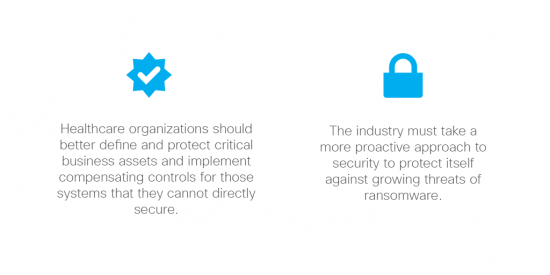
The latest Cisco Security in Healthcare – Bolstering Connectivity and Protecting Patients white paper outlines what the healthcare industry must do in order to mitigate the growing threat of cybersecurity:

HealthcareSecurityBlog

Major Findings

In this paper, Cisco experts analyze IT security capabilities in the healthcare industry, using data from the Cisco Security Capabilities Benchmark Study. We found that:

-Healthcare security professionals appear to be losing confidence about the strength of their security defenses.

HealthcareSecurityBlog#2

-Budget constraints were the most likely barrier to adopting advanced security processes and technology. However, in 2015, healthcare organizations showed a greater use of outsourcing than they did in 2014. This increase may help them strengthen security defenses at affordable costs.

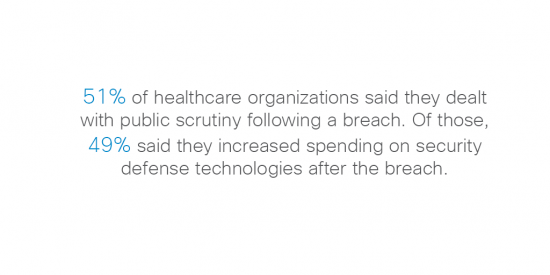
-Breaches may influence security improvements.

Graphics

-In 2015, more healthcare organizations had an executive in charge of security. There was also an increase in the number of executives that have metrics in place to assess security. These numbers suggest that organizations in this industry are taking more active measures to address threats.

To learn about Cisco’s comprehensive advanced threat protection portfolio of products and solutions, read our latest white paper and visit www.cisco.com/go/security.

Authors

Tapan Mehta

No Longer with Cisco

Avatar

The term “insider threat” is thrown around a great deal in the security world without much clarity. It’s a great marketing buzzword, but what exactly is an “insider threat” security program and how does it affect the Department of Defense? To start with, the National Counterintelligence and Security Center defines an inside threat as occurring when a person with authorized access to U.S. Government resources – including personnel, facilities, information, networks, and systems – uses that access to harm the security of the United States. Over the past century, insider threats have become more and more common, and have been responsible for some of the most damaging attacks on our country’s networks.

To counteract insider threats, the U.S. Government has taken steps to help safeguard agency networks from these inside attacks. On October 7, 2011, the president put into effect Executive Order (EO) 13587 – Structural Reform to Improve the Security of Classified Networks and the Responsible Sharing and Safeguarding of Classified Information. EO 13587 stressed the importance of managing the people who have access to classified information and included strategies to keep an eye on what these people are doing with said classified information, be it physical or electronic.

EO 13587 also created the National Insider Threat Task Force (NITTF), an interagency task force responsible for preventing, deterring and detecting inside attacks on classified information. The NITTF also assists government agencies, including the DOD, in developing their own insider threat detection and prevention program.

The NITTF established baseline requirements to aid government entities on how they should be handling classified information, which can be broken down into three basic parts:

  1. Human Intelligence (HUMINT)
  2. Training
  3. Monitoring

The first part of the equation is human intelligence (HUMINT). The central focus of this is to make sure that only authorized individuals have access to classified information. Part of this is ensuring that people with access to classified information are not compromised or vulnerable to becoming compromised due to issues in their personal lives or outside factors.

The second part of the mandate is straightforward training. People who handle classified documents should be properly trained in what to do and not to do with classified information. This training teaches personnel security guidelines for viewing, transporting or sharing classified information. Clearly outlining the rules and regulations for classified information is very important to protecting against insider threat incidents.

The last part of the equation is the monitoring of user activity on U.S. Government networks. This refers to audit data collection strategies for insider threat detection, leveraging hardware and/or software with triggers deployed on classified networks to detect, monitor, and analyze anomalous user behavior for indicators of misuse.

By putting these three parts of the equation together, the DOD and other government agencies can help better protect their networks against insider threats. This is especially important for the DOD because of the nature of the data on its networks. If any of its classified military information was compromised, it could result in a serious breach in our national security. And in such a large organization with so many employees, it is imperative that the DOD have a strong insider threat program to keep its data – and our country – safe.

Authors

Michael Reed

Security Engineering Manager

Cisco StealthWatch - Federal

Avatar

Don’t stop believin’

That’s the lyrics of my husband’s favorite song. And it is on a sign hanging on our bedroom wall. Whether you love or hate Journey, it’s corny, but true. This is a great message for us … with all the upheaval in the SP industry, we need to keep believing. Whether you are the CEO, the engineer, business analyst, sales leader, or marketing manager like me, you feel the changes coming. How will my company transform, how do I personally transform?

You can do it – there are many ways to get there in life and in business. For SPs, it is possible to transform by making good choices in partners, technology and org structure that makes sense. Some may want to go it alone, others, like Telstra find a partner.

Be inspired, see how Telstra did it

I was inspired by this video from Guy Lupo, a self-described disrupter, talk about the future he sees for Telstra. It is interesting to hear how he leveraged Cisco’s technology to create a secure Cloud VPN service for medium-sized businesses… best part is they can leverage business internet to upsell services like security. Smart, right? These smaller companies struggle with the high cost of a secure WAN and need an alternative. Typically, SPs couldn’t even consider reaching these businesses – it was just not possible to make money. Now with automation, virtualization, cloud and advancements in networking, just about anything you can dream up is possible.

Watch the Video

https://www.youtube.com/watch?v=8MjZ4GpVaRM

If you’re still not convinced, consider this number – $350 Billion* — the market opportunity over the next few years for those who offer cloud network services. SPs – you are perfectly primed to grab your share. The harsh reality is customers will work with you or switch to someone else if you cannot deliver new, economical cloud services.

Take the first step…

Guy is convinced believing in new technology is the key.

“To continue our growth we need to focus on automating our networks, cloud and service creation to create virtual products that can run anywhere,” said Lupo when interviewed at Cisco Live recently.

Lupo’s group is transforming Telstra’s enterprise and small business services and network automation through a worldwide partnership with Cisco.

“We partner with Cisco because we can co-create together. We saw the opportunity to get into a relationship where we design together, create together and go to market together, leveraging each other’s capabilities and strengths,” added Lupo.

Technology keeps shifting – that won’t change. People like Guy Lupo won’t stop innovating, they won’t stop believing, and they won’t stop moving all of us forward.

To learn more about our service provider solutions, visit us at cisco.com/go/serviceprovider.

*(Early estimates from the Cisco MOI Study, 2016, to be released next month. The study includes ITaaS, IaaS, SaaS, PaaS and includes 2016-2020.)

Authors

Melissa Zelyez

Marketing Manager

Virtual Managed Services

Avatar

I focused on the innovation imperative in Part 1 and how digitization is driving a new pace of change.  Established organizations need to embed innovation as a core competency and they need to do it quickly.  But how do you get started?

Fostering an Innovation Culture

Before embarking on building a culture of innovation within an organization or re-energizing an existing program, it’s worth paying attention to a few simple but tough questions to lay the foundations for success.

What is the leadership appetite for innovation? It’s critically important that the senior leadership within any organization buys in to the need for innovation and its importance. But not just at a superficial level. It must be done in a way that avoids a mismatch between what the leadership says about innovation and what it actually does about innovation. It’s about championing it in a visible way–getting involved and demonstrating commitment. Without this in place, any innovation program is unlikely to get far off the ground. Innovation culture has to be led top down within an organization.

What is the definition of innovation? It’s important to have a good handle on this so that everyone understands what it means and what’s expected to pull in the same direction. It helps to define the aiming points for innovation and how they align to organizational strategy. Given that innovation also spans a wide spectrum, it’s useful over time to adopt a balanced innovation portfolio that provides a structure for managing current performance while maximizing opportunities for growth.

What does success look like? Knowing what needs to be achieved and what success looks like for everyone involved is important. That invariably involves laying out some Key Performance Indicators (KPI’s) and measuring performance along the way. Identifying this will help frame the innovation strategy and how it will be measured. In turn, this helps shape behavior.

Building an Innovation Capability

The notion that innovation is often about game-changing ideas that emanate out of chaos from a small number of isolated geniuses is misguided. In established organizations, innovation benefits from structure and some order to ensure it doesn’t become a meaningless distraction. Consider using a practical framework like the one used at Cisco to help leadership teams with the job of innovation. It’s based on an approach that melds together leadership and strategy, people and culture, and process and tools.

Innovation Tools and Best Practices

There are plenty of tools and best practices out there to support the many roles and people involved in enabling the end-to-end innovation process. Some of these will be the subject of future blog posts but in summary they include ways, for example, to capture insights, generate ideas, manage incubation, train and develop, increase collaboration, reward and recognize people, use different processes and methodologies, manage communication, and facilitate change.

Innovation is Key to Survival

Remembering that there’s no single way for established organizations to innovate, many ecosystems will also find room for formal R&D, mergers and acquisitions (M&A), co-creation with customers, open source development, or teams dedicated to working with the start-up community. All are important and collectively contribute to all-round innovation capability.

Underpinning everything and to make all approaches possible is the need to build a long term, everyday, everywhere culture of innovation that drives results. It’s the foundation, and the ability of organizations to do this with agility will be key to their survival in this fast-moving era of digitization.

There are those that will inevitably join the ranks of Blockbuster and Kodak but then there are those that will set the agenda and lead from the front. It is these organizations that will successfully manage the job of innovating to survive in the new digital economy.

Will you disrupt or be disrupted? There can only really be one option.

Authors

Matt Asman

Innovation Manager

Services Innovation Excellence Center (SIEC)